It’s Monday, What Are You Reading? #SOL10 11/31

imwayr2b2015Elisabeth Ellington over at The Dirigible Plum introduced me to “It’s Monday, What Are You Reading” or #IMWAYR. The idea is that people share the children’s and young adult books that they are reading right now and include a short review or reaction. I followed it for a while but eventually had to stop for my own mental health. Seriously, these people read SO MUCH that I started to feel a little badly about myself; I could not keep up at all – which is crazy because I read more than anyone else I know in my day-to-day life. If I read more than Elisabeth’s post every week, my “to read” list and my hold list at the library get a *little* out of control. (Ok, truth: even if I read only Elisabeth every week my hold list gets a little out of control. Also, it may be true that I max out my monthly acquisitions recommendations to my public library every month. I was a little embarrassed by this until a librarian friend told me how much she loved it. Whew.) And finally, I teach high school and, many of the books sounded amazing but were not ideas I could pass on. (That said, I’ve kept my dyslexic 8-year-old knee deep in graphic novels because of the recommendations, and I’m convinced that this is the support he needs as he moves into more word-based chapter books.)

All of that to say, I love the idea of #IMWAYR, though I rarely participate. Last year I even incorporated it into a grade 9 class I inherited part way through the semester. Every Monday we started class by talking about what we were reading. This discussion became almost mini book-talks and morphed into some writing. Eventually one student participated in a CBC (Canadian equivalent of NPR) book contest, defending I’ll Give You the Sun as a book that all students should read. (That, by the way, was all about her. I’ll acknowledge providing the initial platform, but she found the contest, prepared, entered and did the whole thing by herself.) Clearly, #IMWAYR has some legs!

And today I cannot resist: I just have to tell someone about the book we just finished reading out loud in our house and some of the other amazing books in my life right now. Guess what, dear reader? You win! You’re the one!

First, The Great Brain Does It Again by John D. Fitzgerald

7b18e07df0-6b59-40f6-9243-6813cf4848cf7dimg400

If you don’t know The Great Brain, you are in for a good time. I like to think of him as kin to Tom Sawyer with a money-loving heart and an observant little brother. This book is number 7 in the series (originally the last book, but one more was published posthumously from the author’s notes). You can read the books in any order and each chapter stands more or less alone.

The stories are narrated by JD, the Great Brain’s little brother, and they all take place in a small town in Utah at the end of the 19th century. JD’s older brother, Tom D (or TD), is constantly plotting ways to get rich, mostly by swindling kids out of their money and then convincing them that what he did was acceptable. What I love the most is that while we are laughing at yet another swindle (JD will acknowledge that he has literally never won a bet with Tom even as he shakes his hand on one more sure thing), the books don’t shy away from complex issues like poverty, religion (the family is Catholic in a majority-Mormon area – but no insults here, just acknowledgements), Indigenous peoples (respected!), and even depression (in an earlier book) . This particular book includes lots of belly laughs along with a chapter that brought tears to both my eyes and my 10-year-old’s. We talked about family expectations, chores, who has responsibility for their actions, why Indigenous people were placed on reservations… You get the picture.

We’ve been reading the books out of order (because I couldn’t find them all), so we’ve got two or three left, and we can’t wait to get to the rest of them. Also, we are clearly going to love Tom Sawyer when we get there.

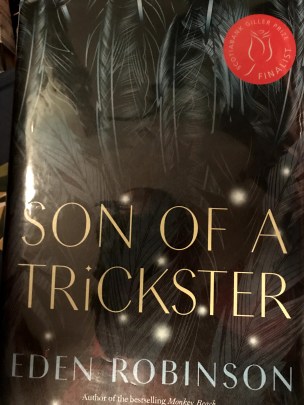
I also just finished Son of a Trickster by Eden Robinson
img_8229

There is much to love about this coming of age novel. First, the language is gorgeous. But my favourite thing is the narration by Jared, the protagonist. He is gentle and thoughtful and narrates his life without self-pity. His voice is so strong that it took me a while to see him as others must: a druggie, alkie, Indigenous kid who is going nowhere. He does not see himself that way – who does? – and his actions make complete sense when we are inside his head. In fact, what I love about this book is that as I read, I believed that Jared’s responses were the only real response available to the world around him. This is first person narration at its best.

I have two reservations about this book, and neither is enough to prevent me from highly recommending it. First, the trickster stuff really picks up right at the end. This is the first book of a trilogy, but I would have like more trickster earlier from a plot perspective. Second, I’d have to think about various reactions if I were to teach this book. Though the violence, drugs and alcohol are all filtered through Jared’s narration, there’s not really any repudiation of these things. So, in terms of *teaching* the novel, I’d want to be thoughtful. In terms of reading it, I’d say “have at it!”

And finally, a mini plug for Ben Clanton’s books Rot, The Cutest in the World and It Came in the Mail.
rot-the-cutest-in-the-world-9781481467629_lg and  81rqrq7hy1l

We found these because my kids wanted more Narwhal books. We’ve finished the Narwhal books (to date) but we found Ben Clanton. Both of my boys – ages 8 & 10 – giggled their way through these and the older declared that It Came In the Mail was “a really good book” even though he’s supposedly done with picture books.

Currently reading:
Read aloud: Fish in a Tree by Lynda Mullaly Hunt
YA: Some Kind of Courage by Dan Gemeinhart
PD: Book Love by Penny Kittle
Just for me: Searching for Stars on an Island in Maine by Alan Lightman

3d17d-screen2bshot2b2014-12-152bat2b7-37-262bpm

Describe Joy #SOL19 10/31

img_8273-1

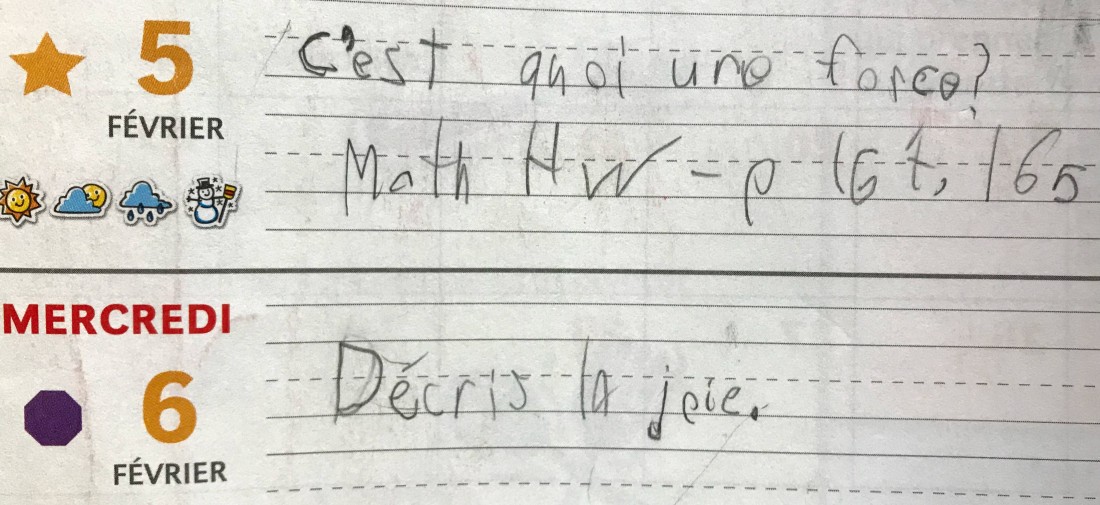
He copied the phrase
into his agenda
Wednesday, February 6
“Décris la joie.”
Describe joy.
After Math.
Before Reading.

Décris la joie.
Describe how wonder is suddenly more necessary than air
when I check on him before I sleep.
The silk of his hair
The satin of his skin
The even slip of his breath.

Décris la joie.
Describe the way my heart seizes and jumps
when they bound in after playing outside.
The whirl of the air
The whoosh of their hugs
The carefree wildness of their laughter.

I ask
Have you done your homework?
Yes, he says,
It was easy.

Reflection on my process:
I originally jotted this exchange down when the assignment came home. I kept coming back to it, and tried to write it as a humorous piece because it made me laugh out loud when it happened. It sort of worked as a funny bit, but there wasn’t much to it.

I hesitated to turn it into a poem, but decided to take the plunge because Slice of Life writing is, in part, about learning to become better writers. If I can’t try new things in this supportive community, when will I try them? Also, it’s the weekend, so I had some time to work on this if I wanted.

The first and last stanzas came easily because they are what literally happened. I nearly published the poem like that, but I know I tend to cut my poems off at the knees by not offering enough development. The middle two stanzas then, were my attempt to show how hard it is for me to describe joy. I made some of the lines longer because I wanted them to reflect the complex nature of the task. I let the sensory details be shorter because, in the end, they seemed to me to be the essence of the feeling.

In the end, I don’t love it, but I like it. I’m still a nervous poet, but I like how this combines the humour of the initial situation with the complexity of the thought behind it. I’m not sure I love the middle two stanzas, but I’m glad I pushed myself to add them. And hey, maybe I’ll try another poem or two this month. We shall see.


3d17d-screen2bshot2b2014-12-152bat2b7-37-262bpm

It’s just a scratch #SOL19 9/31

Today, Humble Swede over at FiveHundredaDay wrote about a dramatic situation that ended with having to call an ambulance. Suddenly, I knew I wanted to write about one of the times I’ve placed that call.

My sister and I were living in a tiny studio apartment in Portland, OR. I was in graduate school and she was working nights as a social worker in a group home for girls. We had bought a second-hand bunk bed, pushed up against one wall and draped a dark blanket all around to make a sort of sleeping cave. Most of the time, we both slept in the bottom bunk – me at night and her in the daytime. Along with that, we used the room’s built in dresser and a tiny patio cafe table with three chairs that my friends’ grandmother had loaned us for our table. Our kitchen was mostly dinged up pots and pans that we’d found when we bought the bunk bed. We were young.

We saw each other most afternoons when I got home just before she went out. In the precious moments that we were home at the same time, my sister talked almost non-stop. Apparently even a very quiet introvert needs to talk to people sometimes, and her night job provided little interaction with others. In fact, I had threatened to hide a tape recorder and record her talking so that the rest of the world would hear how much she talked when given the space. She was not amused.

So, it wasn’t as unusual as you might expect for my sister to walk into the bathroom while I was taking a shower and start talking to me. I struggled to hear her quiet voice through the stream of water, and had only just made out the words when she fainted.

“I think I cut myself quite badly.”

The water was still running when I called 911. Water puddled and dripped on the white tile floor of the bathroom where I had glimpsed the blood leaking out between her fingers. Water soaked a trail into the old gold carpet from the bathroom door over to the cafe table where the phone perched precariously on some books. Water pooled around my feet as my naked body shivered and I said to the operator, “It’s my sister. She’s cut herself. She’s bleeding and she’s fainted and I don’t know what to do.”

The ambulance arrived in minutes. I don’t remember when I put on clothes – just sweatpants, really, just enough to be decent – but I was on the floor with my sister, holding her while she squeezed her wrist and hand and we held our breath. The EMTs took over, and I called her work to say she wouldn’t be in. I heard them in the bathroom, telling her that she had to release her hand, she had to let go so they could see. They were gentle, but she was trembling, crying.

When she finally released her hold on her wrist, lifting one finger after another, holding her breath to see what damage had been wrought, everyone let out a huge sigh. The knife she was using to cut brownies – the dinged-up, second-hand, dull old knife – had cut her, scratched her, really, a scratch so negligible that an EMT smiled, wiped the blood off and put a band-aid on her wrist.

Then the EMTs left, assuring us that we should always call 911 when we think there’s an emergency, and though we were both embarrassed and relieved, that night we slept in the bunk bed together.

3d17d-screen2bshot2b2014-12-152bat2b7-37-262bpm

An hour of one’s own #SOL19 8/19

An astute observer might notice that my posts do not go up at the same time every day. In fact, some days I get something written and posted first thing in the morning, and other days, like today, my posts go up much later. Every now and then – though not yet this month – I don’t post until after 10pm.

I’m a teacher, so the rhythm of my days is relatively predictable. I mean, sure, there’s the occasional before or after school meeting and whatnot, but mostly I live by the mindless monotony of minute hands and bells. Given this predictability, I feel like I should be able to write and post pretty much at the same time every day. But I can’t.

In 1929 Virginia Woolf published her (long) essay A Room of One’s Own in which she argues that in order to write, women need money and space, both literally and figuratively. 90 years later, I have much of what she argued is required for women to be able to create. Sometimes when I read her words, I feel encouraged by how much things have changed. Sometimes I want to cry at how much things are the same. I would guess that I more or less have the money and the room that Woolf was looking for. What I don’t have is an hour.

I understand why I don’t have this hour. I know the statistics on how much time women spend on housework, and how we spend as much time with our children now as in some other decade but we work more, and how we get paid differently, and how and how and how…. I know that we are helicopter parents and that we use our cellphones too much while we do or don’t sufficiently supervise the children at play. I have learned that what we do is necessary/ damaging/ laudable/ laughable. I know that I should manage my time better, discipline my children differently, organize my family efficiently. And I know that if I could just do all of those things, I could get the extra hour of sleep and I would have an hour to exercise and I would have an hour to write. I understand that this is, undoubtedly, my fault. And if it is not my fault, I understand that it is the fault of women or, at the very least, the fault of society. I have been so well socialized that I even feel badly about writing this.

But one way or another, I don’t have an hour. Not at work, where my job involves constantly responding to the desires and needs of others and not at home where my job… wait, same thing. And it’s fine, really, usually, mostly. And, you know, I love my students and I love my husband and I love my children and I swear I am a nice person and I’m only just barely complaining because who wants to listen to a whiner, but I’ve written this post a few sentences at a time in my head over the course of several days, occasionally jotting a phrase or two down and sometimes managing to get some sentences into the computer and, as it turns out, that’s not really the best way to write.

Sometimes I imagine what I could do with an hour to write every day. A magical hour that doesn’t mean I sleep less or that dinner doesn’t get made. A magical hour where the kids aren’t looking for me and I haven’t simply shifted work on to my supportive partner. A magical hour where I can gather my thoughts, put them down, and elaborate.

Next week is March Break. Maybe I can make it happen.

3d17d-screen2bshot2b2014-12-152bat2b7-37-262bpm

I might have a problem #SOL19 7/31

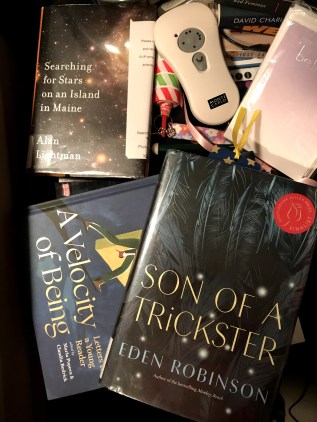
This is on my bedside table

img_8229

I just finished Son of a Trickster last night, and I really enjoyed the way that that Indigenous narrator’s voice makes sense of his actions, which from the outside definitely look like those of a druggie kid failing out of school, and reveals the motives behind the appearance. It’s the first of a trilogy, and it felt like it – much of the real action doesn’t come until right at the end and it feels a little unfinished.

That book is sitting on top of these two. A Velocity of Being was a gift, and it is perfect in

img_8230many ways: it’s beautiful and has amazing illustrations, it has a nice heft to it and is a bit oversized without being as unwieldy as a coffee table book, and it comprises letters from all sorts of amazing writers. I am nibbling away at it steadily. Near that is Searching for Stars on an Island in Maine. I was about halfway through this lyrical, thoughtful contemplation of the intersection between science and religion, our desire for permanence and our experience of change, when I had to return it to the library because someone else had it on hold (sigh). Now I have it back, but I feel like I need a bit of a slower pace in order to really appreciate Lightman’s prose. I have it until the 15th and March break starts tomorrow afternoon, so I should be good.
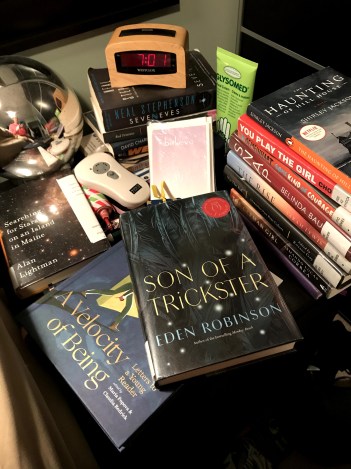

The thing is, that those three are sitting next to theseimg_8231


which looks like this up close
img_8232img_8233

So now you see the problem. I’ve kind of written off the ones in the right hand picture because they are holding up my alarm clock – so I’ve decided that they are more furniture than actual choice at the moment. And I’ve read almost all of the book on dyslexia; I just like to have it nearby in case I start freaking out about my child and many of my students having dyslexia, which I do on occasion. Four of the ones on top of that have been borrowed and I really need to give them back (sorry Tara, Debbie & Anthony) but I also really want to read them first. Anyway, they’re furniture now, so they have to wait.

Five of those in the left hand picture are library books. The EA who works in my classroom says that I am not allowed to check out any more books until I work my way through these. This makes perfect sense (which is one of the many reasons she is amazing), but my library hold list is pretty long, and I didn’t dare tell her that another one has already arrived at my local branch. Plus, they all look so good. And they come recommended. And they are so different! How am I supposed to choose which one to read next? Sometimes I nibble at a few and make a choice, other times I just pick up the one that looks right and dive in. Right now, I’m a little overwhelmed. I might have a problem.

The overwhelm is why my nightstand rarely gets this full. Usually the guilt overcomes me and I have to clear the decks. I get to feeling bad for the books sitting there forlornly, begging to be read, and I have to start returning them, whispering promises that someone else will come for them, someone will open them, turn their pages, love them. Sometimes I put them right back on my hold list, promising that I will take them back when the time is right.  But today this is my nightstand – any suggestions for which book I should start with tonight?

3d17d-screen2bshot2b2014-12-152bat2b7-37-262bpm


Another reason why winter needs to end #SOL19 6/31

Tonight, my son’s friend stayed for dinner because we were having homemade pizza. Afterwards, the boys played on their devices for longer than I meant to allow. As I shooed him out the door – homework! bedtime! – I filled his arms with his iPad, the book he wanted to borrow, and a dozen fresh eggs for his mother. I asked if he had gloves. No. I reminded him to be careful. Ok. Could he manage all these things? Yes. Say hello to your parents. Goodbye!

He left.

A few minutes later, my phone buzzed. His father:

img_8225

img_8226

I’m blaming the enticing snow banks, not the 10-year-old. After all, winter will end before the kids grow up.

3d17d-screen2bshot2b2014-12-152bat2b7-37-262bpm


Gratitude at work #SOL19 5/31

Today’s post was inspired by Tammy over at Tammy’s Reading/Writing Life. Her gratitude list felt like just the right way to start a day. 

What I am grateful for at work

I am grateful that my English department colleagues are some of the smartest and most well-read people I have ever worked with and that they offer students a wide range of ways to approach texts.

I am grateful for raucous, hilarious lunchtime conversations about everything from Hamlet to hell-raising.

I am grateful that we have a kitchen in the English office, and I’m grateful to the custodian for giving us a cast-off round table a few years ago so that everyone can sit around talking at lunch and to a department that welcomes all comers – especially supply teachers (Canadian for “substitute teachers) and those new to the school.

I’m grateful for the freedom to teach my class in ways that are supported by research but which are new to me. I’m grateful that my administration and my department trust me enough to let me try new ways to encourage growth in our students.

I am grateful that our librarian is incredibly enthusiastic about books and reading, that she shares the library with me all the time, lets my class have first dibs on new arrivals, will work with my struggles one-on-one and generally supports my crazy literacy ideas

I’m grateful for a principal who loves to talk pedagogy, who believes that relationships are what make education, and who always – even when he drives me crazy – starts with the question, “will it help the students learn?”.

I’m grateful for vice principals who demonstrate respect for the students they encounter – and who are effective and supportive.

I’m grateful for a partner teacher in Spec Ed (Canadian for Special Education) who is committed, dynamic and visionary.

I’m grateful that the EAs (educational assistants) are some of the best I’ve ever worked with: smart, funny, and deeply focused on our students.

Good heavens, I am realizing that I’m grateful to work with so many amazing people -and I can’t possibly enumerate them all here (but I’ll start): our head custodian who provides laughter and counsel, our office staff who are ridiculously competent and have the best Halloween costumes, our Guidance Dept who are tirelessly supportive of students, our IT support who is constantly on the go & saving our bacon, my colleagues who share complaints & compliments freely. I feel like I could write whole posts about person after person.

I’m grateful for the dynamism that is generated by the Arts programs. Our school is full of kids dancing down the hallway, singing in the stairwells, painting on the walls (sanctioned!). I’m grateful for the student performances that inspire: music, dance, words and images permeate our every day. And I”m grateful to the teachers for providing the structure and the time to make that happen.

I’m grateful that our school actively works to make spaces for all sorts of students – physically disabled, talented in the arts, behavior challenged, gay, trans, LD, newcomers to Canada, kids from down the street. We take our commitment to welcoming all very seriously.

I’m realizing as I write that what it comes down to is that I am grateful for a team of people who believe deeply in the potential of all of our students and who hold each other up as we strive to offer our students the best that we can.

3d17d-screen2bshot2b2014-12-152bat2b7-37-262bpm

Sing! #SOL19 4/31

Where did this start? Do I blame the very enthusiastic gym teacher who came in and jokingly shamed the English Department into participating in Buskerfest? “It’s for a good cause,” he said. “Your department didn’t do anything last year.” But what should the English teachers do? Declaim poetry? Offer our services to write love letters? We are a bookish crowd, not well suited to busking.

Maybe I should lay the blame more firmly at the feet of my 75-year-old colleague, who has never met a crazy idea he didn’t want to try, and his partner-in-crime, a former drama teacher with a penchant for performance? Either way, when the Phys Ed teacher told us that the French department was singing French folk songs in the lobby, one of those two said that we would do karaoke. WE.

I had never actually done karaoke, though I’ve watched in awe as others sing with great enthusiasm in front of complete strangers. And, while I have been known to dance to the songs that play over the PA system before classes begin, I had certainly never done karaoke in front of my students and colleagues.

But here I stood, next to a jerry-rigged home karaoke machine in the middle of the main foyer, belting out “I Will Survive” in front of the principal, my laughing colleagues and an alarming number of students. I’ll admit, I was having fun, but I was also mortified.

Maybe my obvious combination of enthusiasm and embarrassment was just what the crowd needed: soon, one of my former students stood and joined me and my colleagues – a little vocal support or just wanting to be part of the fun? I’ll never know. As we finished, two more students, both new to our school and struggling to fit in, were at the mic, and the student who had joined me, joined them. Next, a quiet grade 9 student offered up an Ariana Grande song (“It’s the clean version, Miss,” she whispered, just before she took the mic and sang to the crowd). More and more people came – another teacher, some dance students – and my personal favourite: one of our students with a physical disability sang Shawn Mendes’s “It’s In My Blood” from his wheelchair as an EA held the mic. His delivery of the lines “Sometimes I feel like giving up/ But I just can’t/ It isn’t in my blood” sent shivers down my spine.

img_8198
Shawn Mendes had better look out!

In the end, the English Department karaoke busking raised $123.65 during that lunch – but what it really did, somehow, was give everyone a place to sing. It’s the first time I’ve ever really understood karaoke, and I’m already thinking about a song for next year.


3d17d-screen2bshot2b2014-12-152bat2b7-37-262bpm

Country girl? #SOL19 3/31

This summer my sister and I stayed at my dad and stepmom’s lake house for a week while they went camping with our children. It was delightful. I have been a city girl for a long time now, so I relished my time in the “country.”

Since the grandparents had all the kids, my sister and I generously did a few chores during our week off. We watered the plants, tidied the house, fed the cat, did all the laundry we could find, even went through old canned goods and got rid of the ones that were seriously expired.

But no one had said anything about the chickens. And clearly living creatures needed to be looked after. So… how much do you feed chickens? How often? We didn’t want to bother our stepmother, the main chicken keeper, and we really didn’t want them to come home early with all the kids, so the internet was our friend. At no point did we pause to realize that our extremely competent stepmother probably did not leave her beloved chickens to starve while she was gone.

img_6122
Chickens are fun to watch.

Once we’d finished our basic research about chicken feeding, I let myself into the coop, confident that I could handle this chore. As I entered, I noticed that the top of the wire mesh roof was covered in rotting leaves, and I decided to clear the leaves as an extra bonus to my super-daughter work. I started poking and pushing at the decaying debris and, of course, it rained down all over my head, into my eyes, onto my shoulders, and right down into my bra because, of course, I was wearing sundress. As I stood there, covered in itchy, smelly leaf rot, the thought “I am not stupid. Why did I do this?” ran through my head.

I probably should have just left the coop then, but I was worried about those chickens, so I brushed off what leaf pieces I could and continued with my mission. It turned out that the chickens had a feeder, so I assumed they had enough food, but what about water? I looked around the coop – my stepmother is no slouch: these chickens have multiple rooms – and eventually found a small water bottle. It honestly looked like something I’d put on a hamster cage, not nearly big enough for four chickens, but I filled it anyway. Still, I continued to worry: there was no way that was enough water. I noticed the chickens milling around a white bucket precariously perched on some cement blocks. A water bucket! When I looked in to check the water level, I noticed lots of green mold growing inside, so… I decided to continue my super-daughter act and clean it. I was still wearing my cute sundress.

How hard can it be to clean a water bucket for chickens? I looked up at the mess of hoses attached to the garage spigot. There were at least five along with some sort of crazy thing that you move around to make water flow out of one hose or another according to your needs. But, they were just hoses, how hard could it be? About five minutes later, after some curses and some water spraying in unexpected directions, I finally managed to get water into the bucket. The mold did not come off. I made the hose spray harder. The water rebounded out of the bucket and all over me, but the mold held on.

At this point my city thinking clicked in, and I went inside, got a kitchen sponge to clean the bucket, noticed the dish soap, and grabbed that, too. And, voila!, my city solution worked: the bucket was clean. Hooray! I stood back to look proudly at my handiwork and had a terrible thought: Are chickens sensitive to dish soap? I had no idea. I did a very thorough rinse of the bucket.

This process took at least 15 minutes, and the chickens glared accusingly from their coop the entire time. They knew that I had no idea what I was doing. I had taken their water and was clearly incompetent. They clustered around the door, watching, waiting, judging.

Triumphantly returning the chickens’ glares, I returned to the cage and placed the now-clean, thoroughly rinsed, and completely refilled water bucket on the uneven cement blocks. And it leaked. A lot. Water went everywhere. The chickens were visibly delighted, clucking and pecking at the wet ground, at the stream of water, at my toes. I repositioned the bucket. No dice. I fiddled with the spouty-bit that was supposed to let the water out only when they pecked at it. More water flowed, and the coop turned into a muddy mess.

Finally, soaked, rotten leaf debris still in my hair and bra, sweat running down my back and cleavage, and flip-flops covered in mud from the mess I’d made in the coop, I gave up. My stepmother was returning tomorrow. I would just have to ask how to take care of chickens.

P.S. She had left the coop completely prepared for her absence, and I had broken the water bucket beyond repair. She made a new one and I haven’t been in that coop since.

3d17d-screen2bshot2b2014-12-152bat2b7-37-262bpm

Phone home

“Da-an’s in trouble!” A young girl’s voice echoed through the phone on my end; I could only imagine how it echoed through the house on the other end. There was a brief rustle as someone else picked up the receiver, and I overheard a muffled curse.

“Hello?” His mother’s voice was wary.

I launched into my spiel. I was so nervous that I talked without pausing until I finished with “…so that’s why I called.”

Silence. Then she muttered, “Well, thanks.” I hung up.

I was doing my student teaching. In our Classroom Management class – a label, by the way, which I dismissed as euphemistic. “Just call it ‘discipline,’” I groused. – one suggestion was the “positive phone call home.” I can’t remember if the professor suggested calling about the hard kids or if I dreamed that up, but that’s what I decided to do: I decided to find something good about the toughest kids in the class and call home. I had no idea what I was getting myself into.

Dan was in my French class and he had approximately zero interest in learning French. In fact, given that we were in a poor neighborhood in Portland, OR, I would guess that most of the students were in that class because Spanish didn’t fit in their timetables and the teacher was relatively new. Dan was a big, athletic kid who came to class most days sweating and heaving from his lunchtime basketball games. He could not sit still, talked constantly and was mostly a royal pain in the tuchus. On any given day, Dan could easily send the whole class sideways.

I was ridiculously young and enthusiastic, so I had made a few changes since I took over – thank you, Classroom Management class – and Dan was responding well. We’d redirected his unending comments into French and he was leading the class in actually speaking French. So, I called home.

After his mom hung up, I was stunned. That had not gone as I had planned. Chagrined, I turfed my plans to call a few more kids and reflected that not all good theories work well in practice. Boy, was I wrong.

The next day, Dan came bounding into class and gave me a big sweaty hug. “I GOT ICE CREAM!” As it turned out, no one had EVER called home to say something good about Dan. His mom had called his Dad, a trucker, on the road and had taken him and his siblings out for ice cream. He was one of my best students and a class leader right up until my student teaching ended.

And I was hooked. Since that day the “positive phone call home” has been one of my secret weapons. I use it all the time. Knowing that I want to call home and say something nice about each of my students means that I watch them differently. I actively and regularly look for what they do well. When I see it, I call. I can always find something good. Always.

Parents are regularly stunned by this call. Even parents of the best students rarely get positive feedback outside of report cards. Almost never do they get a call to tell them something kind, proactive or thoughtful that their child has done. I am regularly greeted by stunned silence, though by now I have learned to slow down while I speak. One father cried because his son – who, to be fair, was *really* struggling with all things related to school – had never heard a teacher say something nice about his child. One mother whooped and laughed, “You made my day! Heck, you’ve made my week! This is the best.” Most just say thank you.

And the kids? Well, like Dan, a few mention the call. Monday comes (because I love calling home on Fridays and making the whole weekend start well) and a quiet voice will say, “I can’t believe you called my mom. That was great.” But many – often the least engaged – never say a thing. Still, they keep coming back to class. They keep learning. And someone somewhere in their life knows that I am trying to really see their child.

We all want to be seen.

When should you call home to say something nice? Here are a few suggestions…
Call in the first few weeks.
Call when you’re upset with your class. You will remember what they do well.
Call when you see something good happen. Call that day: at lunch, right before you head out the door to go home, whenever. The calls are rarely long.
Call on a Friday. Or a Monday. Or whenever. It does not matter: just call. It might just change YOUR life.

3d17d-screen2bshot2b2014-12-152bat2b7-37-262bpm