It’s kind of a funny story

Commenting on student work, 2024 edition
Me, to a student who obviously used AI: please use your own words.
Student: what says this isn’t in my own words??
Me: I expect students to write in the doc I provide. I am automatically worried when I see a large chunk of work pasted in.
Student: I wrote it on paper before I pasted it onto the computer. If I find the paper will that help??

Um… that’s not how paper works.

That’s how I shared the story with friends. It’s all true, and dear Heaven, but this generation of kids…

But it’s also not the end.

Today, the last day of school, the student came to class. They finished up some work and, at the end of class, hung back at my request. We both wanted to see if all their missing work had been submitted, and I wanted to talk about that pasted-from-paper document. The student had resubmitted it, this time with a photograph of a handwritten document – the paper they supposedly wrote before they (magically) pasted it into the doc.

It was already hot – today’s high was 32C/ 90F and felt like 43C/ 109F – and the end of school was on everyone’s mind. I know I had to muster up all the calm I could find; I assume the student had to do the same. I opened the assignment. I showed the student how I could see the copy/ paste. I showed them the AI detector and the 100% AI result. I acknowledged that I could see the handwritten document, but shared my concern that the assignment didn’t fit the instructions. Then, as patiently as I could, I said, “I can see that you’re upset. Tell me what happened. I’m listening.”

Then I listened.

And it turned out that I was wrong. They walked me through their work and showed me their thinking. They hadn’t used AI to generate the text, but they had typed it up in Grammarly (because when you’re learning English a good grammar program goes a long way) so some of the words were not quite theirs. And they had followed the instructions, sort of, they just hadn’t organized properly to separate parts. And they were shocked that I could see the copy/ paste and a little hurt that I thought they might have “cheated.”

So we talked about cheating and about getting behind in our work and the shortcuts we sometimes take. We talked about the pressure of finishing all that late work and about talking to teachers rather than hiding. Then I thanked him for talking to me and shooed him off to catch up with his friends. The whole thing probably took three minutes, maybe two.

It’s not as good a story as the one where a student says “I wrote it on paper before I pasted it onto the computer” and the teacher thinks, “Um… that’s not how paper works”  but the real part of teaching, I think, is the part after the funny part – the part where we listen – and I wanted to write that, too.

Writing beside him

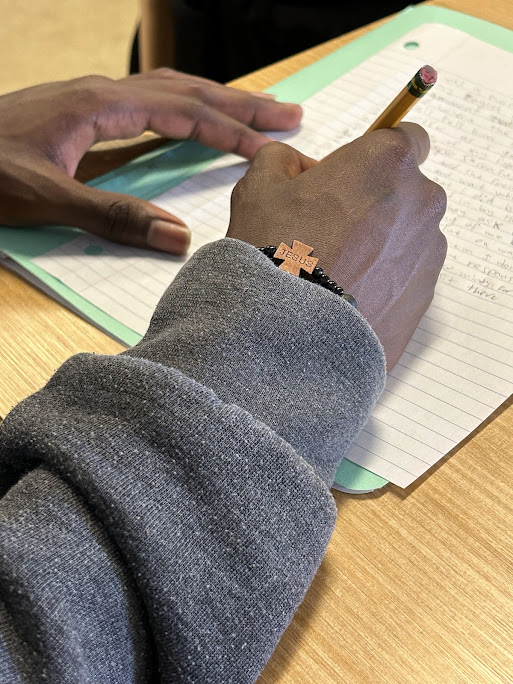
I’m helping a former student write a personal essay for his Grade 11 English class. We’ve talked it through, and planned a little; his next step is to write it. Reading and writing aren’t his forte – he’d much rather be on a playing field than in any classroom – but this story is important to him, and he wants to get it down on paper. So here we are, sitting in the upstairs lobby – currently one of the coolest places in our very hot school – and he’s writing.

This kid has my heart, as many of them do. Last year, he didn’t do particularly well in our first semester English class, so he agreed to change his timetable in order to be part of a reading class with me during the second. That alone took some courage: not everyone who needed the support was willing to accept it. Once there, he mostly tried, even when the work was repetitive or “not that interesting,” even when he took extra long body breaks or got frustrated by the “simple” books he was reading.

Knowing that history, I’m intrigued by his choice to sit with me in such a public place this afternoon. With only two weeks left in the school year, students are out of classes nearly as much as they are in, and many of them wander aimlessly through the halls. Several have stopped to greet us; pretty much all of them give us at least a passing look as we sit here at a student table and work. There’s no hiding that we’re writing together, no hiding that I’m helping.

Nevertheless, he’s nearly filled a page with his small, neat handwriting – a feat which would have been unfathomable last year – and his focus hasn’t wavered, though he has had to stop a few times to flex his tired hand. Meanwhile, I sit here typing my own story, this story, marveling at this moment of quiet togetherness amidst myriad other students. We are here, the two of us, writing; we are here, the two of us, writers. 

This sense of camaraderie has me thinking about what we mean when we say that teachers need to “get to know their students.” How well do I know him? I didn’t spend a lot of time last year asking him about his family, though I did call home when I needed to. I have no idea if he has pets, and am not clear about how many siblings he has. In fact, I don’t know many things about him, but I know enough that I can tell him, honestly, that I believe in him. I never told him he was a strong reader or writer; I did tell him that I thought he could be. I never told him this path would be easy – heck, I was clear that parts would be hard – but I did tell him that I thought it was worth it. Other teachers and coaches told him the same thing, complimenting him when he improved, noticing when he was reading, harrying him back to class when he was in the hallways. When he faltered, he had a team of people to remind him of his long-term goals.

Today, he has a story to tell, and he has found me. He says he needs help, but I think he just needs someone who believes in him to write beside him. What a privilege! I can do that any time.

Again

The assignment was due March 5. Today is April 2. So far, only six students have received grades. Why? Because only six have fulfilled *all* the requirements, and I’m refusing to mark assignments that aren’t complete.

Before you get worried, I don’t think I’m overly demanding. The basic assignment is to write a 100-word memoir. A complete assignment has a title and a story that is exactly 100 words. Students must use a spelling/grammar-check (I’ve recommended LanguageTool, but some use Grammarly)  so that no underlined problems remain, and they must label three “craft moves” – or good things in their writing. For the last part, a poster in the classroom lists things we’ve studied and they’ve seen multiple examples.

Some students have only been through one round, but most are on their third or fourth attempt. In years past, I’ve marked what came in, no matter how incomplete. But this semester, something changed. I decided that every single student was capable of following all four steps:

  1. Title
  2. 100 words
  3. Spell check
  4. Label

What is different? I wish I knew. The closest I can come to explaining is that I am taking my role as a “warm demander” increasingly seriously. To the very tips of my toes, I believe that every student in my class is capable of completing the assignment. Even more, I believe that they are capable of completing it well. So I keep returning the assignments with plenty of feedback (“I really appreciate how you’ve opened this fun memoir. Next you need to give it a title and run it through LanguageTool.”) and insisting they do it again. This weekend, one student turned in the identical assignment three times. Last night I caved and wrote in all caps, “USE THE FEEDBACK.” Today, they finally asked for the explanation they required to finish their work. 

I’m not sure that I’m making the right choice, and I need to be clear that I am consistently upbeat and encouraging as I hand back the assignments (again and again with no mark), but I figure if they learn nothing else this semester besides “follow all the steps” that’s probably a reasonable life skill. 

Now, off to write, again, “True compliment about the writing. Next, you need to give your good work a title and run it through LanguageTool.” I’m betting I can get 24 completed assignments by the end of next week because I’m pretty sure I’m more stubborn than they are – at least about getting this right.

The Truth About Stories #SOL24 31/31

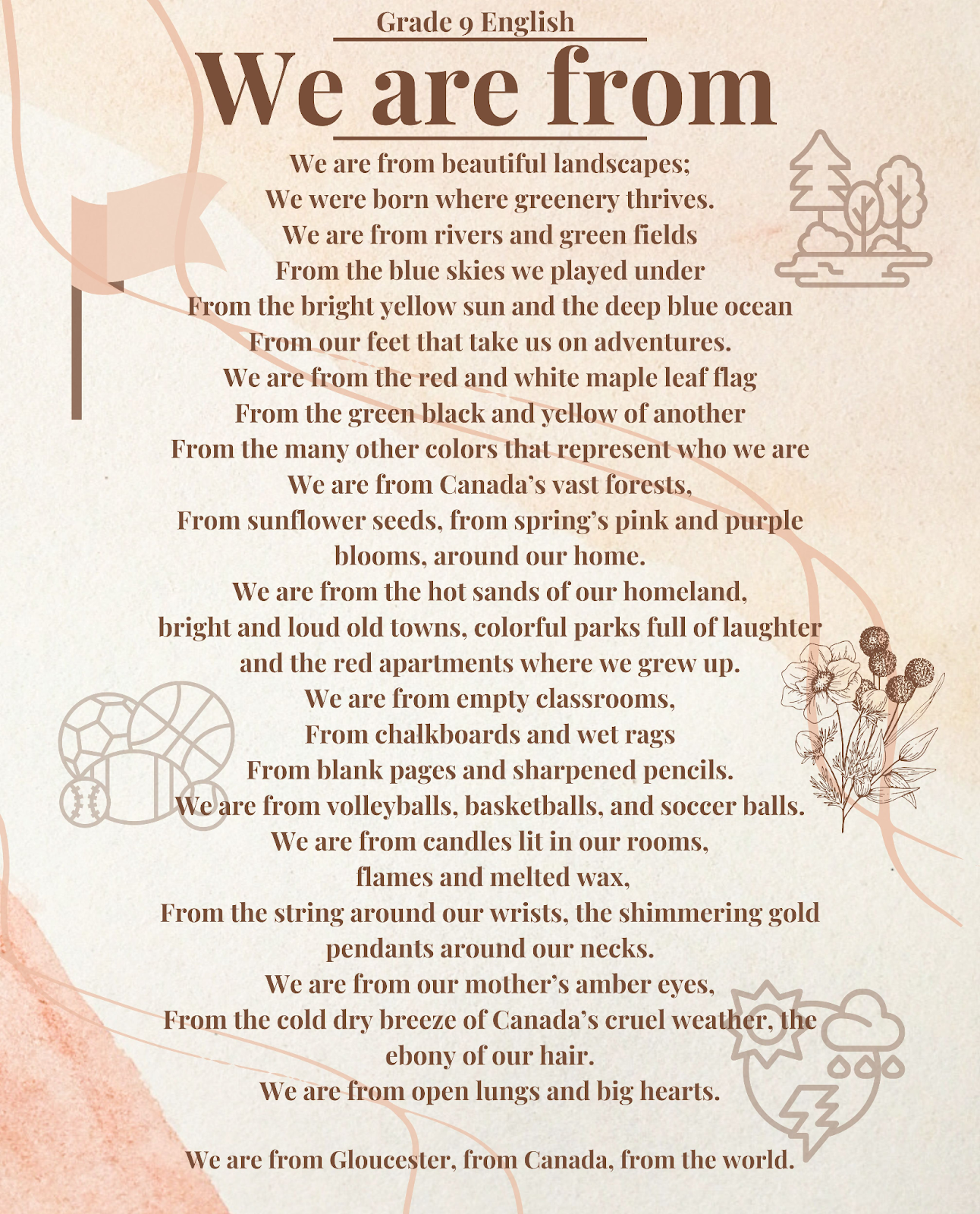
In grade 9, we’ve moved from our first unit – Stories of Us – into our second – Stories of Others. We’ve written Where I’m From using not only George Ella Lyon’s wonderful poem but also interpretations by Melanie Poonai, a young writer from England, and Danika Smith, an Indigenous author from British Columbia, as models. We’ve worked as a class and in small groups to create Where We’re From poems that help us understand our class as a whole. Students turned these into posters or short videos – and the school board’s print shop has delivered gorgeous prints that now decorate our room. We’ve written our own 100-word memoirs, too. Now, it’s time to look outside our classroom walls.

It’s also March, which means that I am in the middle of writing and publishing stories every day. I tell the students about this, and they are interested, impressed, curious, bored, and not listening. Some of them want to know where I get the stories from. I laugh and say, “from you.”

For a few days, we listen to StoryCorps interviews and look at Instagram posts from Humans of New York. We practice active listening and asking follow-up questions. Then, I put this quote up in the right-hand corner of the blackboard as one of our daily quotes:

The truth about stories is that that’s all we are. 
-Thomas King

After reading time, I draw their attention to King’s words. I ask what they think he means. It takes a minute, but when they arrive at an understanding, a few of them marvel. “It’s really true, isn’t it? Our stories are really important,” says one. “It’s like what we think about what happens is as important as what happens,” says another. I just nod.

I think about the quote all the time. I think about how I am made of the stories I’ve heard, the stories I tell myself. I think of how the way I tell the story affects who I am and how the stories themselves change over time. I think about the value of regularly capturing tiny moments, recognizing the story I’m telling myself as I live it. These stories are everything. As Jess writes, “There is gold in every piece of your story.”

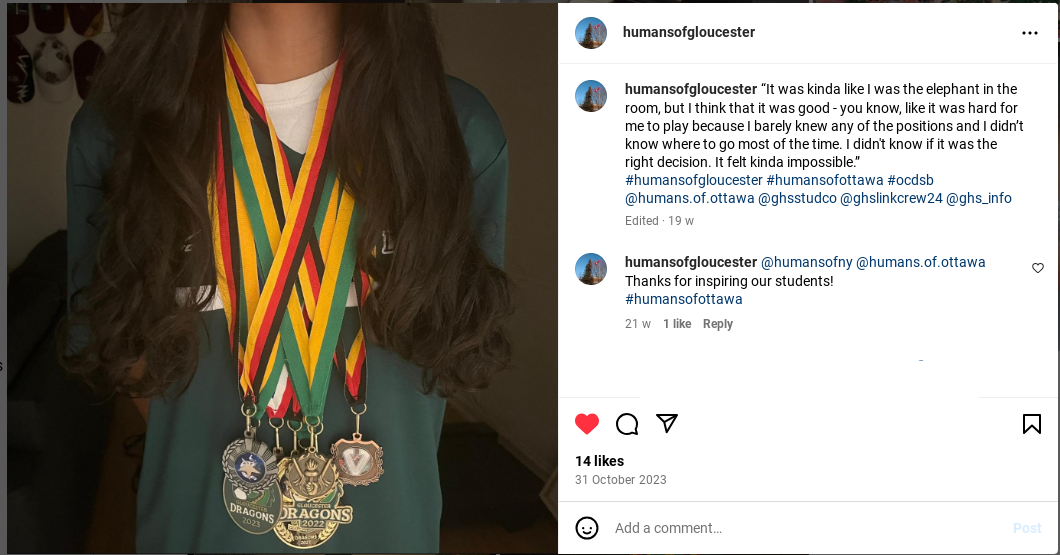
Now, the students are out in the world (mostly in the hallways, to be honest), interviewing other people: family or friends, students or staff. They have to choose a tiny powerful moment from their interview – a story – and pair it with a photo. I post these on our Instagram account, and we marvel at the moments that shape our community. The students must think about what part of their interviewee’s story they chose to tell and what parts they left out. How will that change people’s perceptions? What story are they telling? These students learn to lean in to other people’s stories and consider them deeply.

This year, this part of the unit is closing as March comes to an end. Today marks the end of seven years of this challenge for me. I know that, tired as I am, I will miss this – the writing, the reading, the commenting – tomorrow and in the days to come. And I know it’s because of the stories people share, and the stories I choose to share, too. What a privilege it is to be part of so many stories! What a boon to be allowed so many views of the world!

If Thomas King is right, and I think he is, then I am so much better, so much more because of the stories others have shared this month and in all the months and years past. I am better, too, because of the time you’ve taken to read my stories. Thank you. 

Locked Out #SOL24 28/31

As I walked up the sidewalk towards the house, my heart dropped. Two large boxes waited just in front of our door. I glanced inside: the lights were off. I dropped my things on the front porch and, although I was fairly sure I already knew what I would find, dug through all the pockets of my purse: nothing. Just in case, I checked my backpack. Not there either. Finally, I walked back to the driveway, opened the passenger door and checked in the glove compartment. Still nothing. I could hear the dog pawing at the door, but there was nothing I could do about it: I was locked out. 

The thing is, that after years of relative stability, lately Mr. 13 has been losing things. Notably, his house key. Because he is often the first one home in the afternoon, I loaned him my key. Then he found his key and gave mine back – but then he lost his again. Then things got complicated. Somehow or another, I realized earlier this week that I no longer had either my key or my back-up key. At the time, I thought, “I should really take care of this now,” but of course I didn’t. And here I was now, keyless.

I left my things on the porch and walked over to Mike’s because he has a spare key. He wasn’t home.

So I walked back to our front porch and texted Mr. 15. “Are you near home? I’m locked out.” Since Mr. 15 pretty much always has his notifications silenced, so I didn’t get my hopes up. I told myself that we were lucky it was such a beautiful day; just a week ago, I would have been freezing while I waited. I tried to be happy that my children were off with their friends rather than inside online.

After a few minutes with no response, I texted Andre to see if maybe – maybe – he was finishing up work early before the long weekend. Nothing.

Finally, I sat down on the front steps and texted my friend. (Yes, a fair number of people have extra keys. Our house is pretty friendly.) We were heading to the gym soon anyway, so I figured maybe she could come a bit early.

She replied immediately and agreed to come by in a few minutes. The dog was pretty unhappy about me sitting on the porch without him, but there was nothing I could do. I checked my email and waited until she arrived, tossed me the keys, and went to park. I gathered my things, moved the boxes to the side of the front door, and put the key in the lock. 

Wait. The door wasn’t locked. That was odd. I pushed the door open to discover that BOTH OF MY CHILDREN WERE HOME. Both of them. One was on the computer; the other was in the kitchen *on the phone I had just texted*. 

“Did you not see me?” I asked. “Did you not notice the dog at the door?”

They looked at me, perplexed. No and no.

“Did you not notice that I texted? Did you not hear the delivery guy who left the boxes?”

Nope. Not at all.

Mr. 15 said, “I mean, why didn’t you just open the door?”

I looked at the large boxes, the excited dog, the dark house and my two clueless children. “Well,” I said, “I thought I was locked out.”

Sisyphean Laundry Basket #SOL24 24/31

All day, I’ve been meaning to write. 
All day, I’ve been meaning to prep for the week. 
All day, I’ve been meaning to mark.

But I couldn’t. Because, you see, I need to fold laundry. A LOT of laundry. Maybe five loads? Maybe more? I was going to post a picture, but I can’t – it’s too embarrassing. 

I promised myself I would do it before I sat down at the computer. 
I did not promise myself I would fold laundry before I went grocery shopping. Done. 
I did not promise myself I would fold laundry before I walked the dog. Done. 
I did not promise myself I would fold laundry before cooking, cleaning the kitchen, cleaning the bathroom. Done, done and done.

It’s not like I haven’t been productive. I have, more or less. But now it’s almost bedtime, and the laundry is there, staring at me. I’ve had to create a giant pile so that I could reuse some of the baskets for – you guessed it – more laundry.

I usually don’t mind folding laundry – just turn on a TV show and off I go, but today, the knowledge that the minute I am done, the very second I put the laundry away, there will be more… I just couldn’t do it.

There is a reason Sisyphus wasn’t a woman. If he had been, rolling that boulder endlessly up the hill would have just been another thing on his to-do list every day.

Runaway #SOL24 20/31

He rarely comes to class, but when he does, we do what we can to make sure he has at least a little success. He’s in grade 9 and is currently illiterate in three languages. Research says that students with strong reading skills in their home languages often also have strong reading skills in their second language (see Short & Fitzsimmons, 2007 or this shorter article by Fred Genesee), but he doesn’t have strong reading skills anywhere. We can’t turn back time, but we’re doing what we can to move forward.

He’s lucky because this class has a push-in support teacher. She’s technically there for other students, but no rule says that she can only help them, so we’re using what wiggle room we have to create as much space for him as possible. When we were writing 100-word memoirs, she just happened to be sitting near him and just happened to be able to scribe for him. As I circulated, their heads were close together in front of the computer, counting words. When he realized he had written a story of exactly 100 words, he was so proud that he asked her to read it to him again. He beamed. Then he skipped for three days.

Then next time he made it to class during reading time, I sat with him and quietly talked through The Invention of Hugo Cabret, which he likes because it’s thick and he says it makes him look smart, while Ms H kept an eye on the other readers. Even the pictures were hard for him to understand, but he liked talking about them. Then he refused to do anything else.

Sometimes, he comes to class (late) and then asks to get water or go to the bathroom. I put him off as long as I can, but I am not the arbiter of his bodily functions; when he says, “Miss, I really have to go,” I let him. Sometimes he comes right back, but sometimes he runs. Two days ago, he swore he would only be gone for two minutes, then he took the hall pass and disappeared. I found him in the lobby later that day, skipping a different class. While we walked to where he was supposed to be, he told me that he had thrown up that morning, so he couldn’t return to my class. Given that he was practically bouncing up and down with energy as we edged towards his class, I reminded him that usually someone who throws up goes home, but he said he called home and his mother said no. Ahem. I found him in the hallways again that period and once the next period. He told me he just can’t stay in class.

Yesterday, Ms H had a breakthrough. She saw him (in the hallway, of course) and made some sort of deal/ bet with him – and then he actually showed up to English class a mere 10 minutes late (thus missing most of reading time). Meanwhile, she had hatched a plan. She took him to a quiet room – but not the resource room; he refuses to go there – and she started a phonics assessment with him. She praised him for what he could do and talked about ways we could help. She told him she could start with what he can do instead of expecting him to be able to do impossible things. He was eager.

Ms H was excited that we’d found a way to start giving him some real support. That afternoon we talked through her plan. But this morning, he saw her in the hall during first period, turned around and went the other way. Then, he saw her at the beginning of our class. This time he ran away. Ran.

We stayed after class together, Ms H and I, trying to figure out how to help him accept our offers of support. We reminded ourselves that years of failing in school, years of hiding his weaknesses, mean that he probably thinks he’s beyond redemption. He may be afraid that he’ll just fail again and disappoint us in the process. We walked into the hallway partway through lunch, and there he was, right by our English classroom. Gotcha! Gently, we reminded him of his (broken) promise. I told him that it hurt Ms H’s feelings when he didn’t come. She told him that she had been really excited to see him today. He shifted his weight back and forth, back and forth. When we finished – maybe a 30 second “chat” – he said, “OK” and then… he ran.

Sweet runaway boy, how I hope you’ll let us try to help you read. Reading will make a bigger difference than you can imagine. It’s worth sticking around for.

Throwing in the towel #SOL24 16/31

I give up. It’s not that I haven’t written anything today. Oh no, it’s much worse than that: it’s that I haven’t *finished* anything today. When I realized I was struggling to write, I looked through my photos, thinking that a photo essay might be just right. I even got as far as creating a March collage. Then I decided I didn’t like it. Harrumph.

I considered writing about my pets because I love posts with pets, but this morning Hera stood on my chest and purred until I woke up, and the dog was kind of a jerk at the dog park this afternoon, so no posts for them.

I looked back at ideas I’ve collected from other bloggers this month and got deeply involved in a prompt from Steph at Steph Scrap Quilts, but it’s definitely not done enough to share. Or, more true, I like it too much to share it too early.

I tried to shake off my writing blahs by doing non-writing things that sometimes help me write: I took a walk, baked (banana bread – delicious), talked to my sisters for a long time, worked out, read other blog posts… Still, nothing.

And here I am. It’s almost 8pm, and this is what I’ve got. I’m giving myself credit for writing something when nothing would have been easier, and I will publish my imperfect writing.

Now that I think about it, I’m going to dedicate this to my students. After all, I started blogging as practice so that I could be a better writing teacher. I think it’s worked. If nothing else, I know what it means to stare down a blank document, knowing I have a deadline, knowing that others will read my work, knowing that another day, another hour might make it better. And then, I publish anyway. This is what I wish for you all: the strength to do your work, even when you aren’t inspired, and the courage to turn it in, even when it’s imperfect. This is me, practicing what I teach.

N-less #SOL24 11/31

For a few days last week, my keyboard’s n stuck as I tried to reply to others’ posts. I was frustrated. My discomfort made me ask myself if I could write a whole post without it because I like to test myself. I will admit, it is very difficult. Years ago, I worked at a small DC school where, at a PD day, the facilitator asked us to write for a short time without “e”. For me, that was easy. I immediately chose to write about a topic without “e”: swim stuff, e.g. swim practices, with their laps, or swim meets with their races. I wrote quite a lot, which frustrated the speaker because she had hoped to illustrate how hard it is to write without a simple letter. If I had appreciated her motive, I would have stayed quiet. Such is youth, I suppose. Hmm… maybe I will ask my pupils to try this exercise.

As I write today, I realize how much has shifted. At that PD, we all wrote with paper. Today, however, I write with a computer; I have a tab with access to a thesaurus; my spellcheck tries to correct misspelled words to add the letter I avoid. As I cease this exercise, I will use Ctrl-f to check if I used what I promised to dodge. Truly, spellcheck is how I was able to reply to posts last week. It took a lot of time, so I replied to very few posts, which made me sad. If I missed you, I am sorry! I swear that I read, but to reply was quite difficult.

As I write, I also realize that without this letter I avoid, I must be upbeat. Without it, I have become aware that the adverse is hard to write. The words for bad possibilities or outcomes all use the letter. Hmm… this is a fresh thought for me. I pause to marvel at this simple idea. Whoa. Lots of ideas/objects use this letter, too, because of suffixes. Lastly, I have realized that I must write exclusively for this time or the past. The future requires this letter. So… I am forced to write about the positive, past or immediate with few words for big ideas. It’s complicated. As I wrap up, I try to visualize this n-less world. Impossible. I am over this self-imposed exercise: I would like all the letters back, please! 

Par, pars, parsh, parch #SOL24 6/31

“Hey Mom! Can you come help with my English writing?”

I’m supposed to be doing my own writing – this writing, to be precise – and I’m still knee-deep in grade 9 projects, but he knows I won’t say no. Mr. 13 is an excellent writer – effective vocabulary, interesting sentence structures, good grasp of punctuation – and he is dyslexic. Years of Orton-Gillingham-based tutoring means that he reads well and knows how to make good use of extensions like Grammarly or Language Tool, but when push comes to shove, he still benefits from a once over by someone who’s not dyslexic. Also, he knows I like to read what he writes.

He’s reading his sentences aloud under his breath as I plunk down next to him. “Um… I need a word for like ‘kind of was related to the point but not 100%.'” My eyes widen as I try to figure out what on Earth he’s talking about. “Oh!” he snaps his fingers, “got it: partially!”

He types parsley.

He keeps going, then circles back to fix it. Parshly. Spellcheck suggests harshly as a replacement, so he changes it to parchly – and the new suggestion is archly. “Um, Mom?”

“Partially means ‘in part’ so it starts with the root part,” I say.

“Part isn’t really a root,” he interrupts. Then, “sorry.” He would know. He knows Latin and Greek origins of words; he understands spelling rules in ways I have never had to.

I laugh, “Just start with part.” He does. I break the word down orally so he can hear all the syllables, then I spell. “Now i a l…” I pause because he is looking at me like I have two heads. Finally, I reach over and type the word.

He stares for a long second, then shakes his head in wonder. “There is no way that word looks like /parshully/. I would never have guessed that.”

And he wouldn’t have. Which is why I was so angry last night when I found one of his old math tests where the teacher has circled his attempt at the word “isosceles” and written “Really???” with multiple question marks. He brushed it off – “I mean, she did tell us we had to be able to spell all the terms” – but she doesn’t see how hard he works to spell these words.

But now he’s moved on and is enthusiastically excoriating someone’s weak debate argument. He doesn’t need me again until the end, when I do a check for capital letters and other words that spellcheck didn’t get. This time, he’s mostly good. I ruffle his hair and head back to finish my own work.

I wish all teachers could understand his truth – the kind that looks good on the surface but is working awfully hard to stay afloat. “Isosceles,” I mutter, and his exasperated voice trails behind me, reminding me to let it go. “Mom!”