Locked Out #SOL24 28/31

As I walked up the sidewalk towards the house, my heart dropped. Two large boxes waited just in front of our door. I glanced inside: the lights were off. I dropped my things on the front porch and, although I was fairly sure I already knew what I would find, dug through all the pockets of my purse: nothing. Just in case, I checked my backpack. Not there either. Finally, I walked back to the driveway, opened the passenger door and checked in the glove compartment. Still nothing. I could hear the dog pawing at the door, but there was nothing I could do about it: I was locked out. 

The thing is, that after years of relative stability, lately Mr. 13 has been losing things. Notably, his house key. Because he is often the first one home in the afternoon, I loaned him my key. Then he found his key and gave mine back – but then he lost his again. Then things got complicated. Somehow or another, I realized earlier this week that I no longer had either my key or my back-up key. At the time, I thought, “I should really take care of this now,” but of course I didn’t. And here I was now, keyless.

I left my things on the porch and walked over to Mike’s because he has a spare key. He wasn’t home.

So I walked back to our front porch and texted Mr. 15. “Are you near home? I’m locked out.” Since Mr. 15 pretty much always has his notifications silenced, so I didn’t get my hopes up. I told myself that we were lucky it was such a beautiful day; just a week ago, I would have been freezing while I waited. I tried to be happy that my children were off with their friends rather than inside online.

After a few minutes with no response, I texted Andre to see if maybe – maybe – he was finishing up work early before the long weekend. Nothing.

Finally, I sat down on the front steps and texted my friend. (Yes, a fair number of people have extra keys. Our house is pretty friendly.) We were heading to the gym soon anyway, so I figured maybe she could come a bit early.

She replied immediately and agreed to come by in a few minutes. The dog was pretty unhappy about me sitting on the porch without him, but there was nothing I could do. I checked my email and waited until she arrived, tossed me the keys, and went to park. I gathered my things, moved the boxes to the side of the front door, and put the key in the lock. 

Wait. The door wasn’t locked. That was odd. I pushed the door open to discover that BOTH OF MY CHILDREN WERE HOME. Both of them. One was on the computer; the other was in the kitchen *on the phone I had just texted*. 

“Did you not see me?” I asked. “Did you not notice the dog at the door?”

They looked at me, perplexed. No and no.

“Did you not notice that I texted? Did you not hear the delivery guy who left the boxes?”

Nope. Not at all.

Mr. 15 said, “I mean, why didn’t you just open the door?”

I looked at the large boxes, the excited dog, the dark house and my two clueless children. “Well,” I said, “I thought I was locked out.”

Sisyphean Laundry Basket #SOL24 24/31

All day, I’ve been meaning to write. 
All day, I’ve been meaning to prep for the week. 
All day, I’ve been meaning to mark.

But I couldn’t. Because, you see, I need to fold laundry. A LOT of laundry. Maybe five loads? Maybe more? I was going to post a picture, but I can’t – it’s too embarrassing. 

I promised myself I would do it before I sat down at the computer. 
I did not promise myself I would fold laundry before I went grocery shopping. Done. 
I did not promise myself I would fold laundry before I walked the dog. Done. 
I did not promise myself I would fold laundry before cooking, cleaning the kitchen, cleaning the bathroom. Done, done and done.

It’s not like I haven’t been productive. I have, more or less. But now it’s almost bedtime, and the laundry is there, staring at me. I’ve had to create a giant pile so that I could reuse some of the baskets for – you guessed it – more laundry.

I usually don’t mind folding laundry – just turn on a TV show and off I go, but today, the knowledge that the minute I am done, the very second I put the laundry away, there will be more… I just couldn’t do it.

There is a reason Sisyphus wasn’t a woman. If he had been, rolling that boulder endlessly up the hill would have just been another thing on his to-do list every day.

Runaway #SOL24 20/31

He rarely comes to class, but when he does, we do what we can to make sure he has at least a little success. He’s in grade 9 and is currently illiterate in three languages. Research says that students with strong reading skills in their home languages often also have strong reading skills in their second language (see Short & Fitzsimmons, 2007 or this shorter article by Fred Genesee), but he doesn’t have strong reading skills anywhere. We can’t turn back time, but we’re doing what we can to move forward.

He’s lucky because this class has a push-in support teacher. She’s technically there for other students, but no rule says that she can only help them, so we’re using what wiggle room we have to create as much space for him as possible. When we were writing 100-word memoirs, she just happened to be sitting near him and just happened to be able to scribe for him. As I circulated, their heads were close together in front of the computer, counting words. When he realized he had written a story of exactly 100 words, he was so proud that he asked her to read it to him again. He beamed. Then he skipped for three days.

Then next time he made it to class during reading time, I sat with him and quietly talked through The Invention of Hugo Cabret, which he likes because it’s thick and he says it makes him look smart, while Ms H kept an eye on the other readers. Even the pictures were hard for him to understand, but he liked talking about them. Then he refused to do anything else.

Sometimes, he comes to class (late) and then asks to get water or go to the bathroom. I put him off as long as I can, but I am not the arbiter of his bodily functions; when he says, “Miss, I really have to go,” I let him. Sometimes he comes right back, but sometimes he runs. Two days ago, he swore he would only be gone for two minutes, then he took the hall pass and disappeared. I found him in the lobby later that day, skipping a different class. While we walked to where he was supposed to be, he told me that he had thrown up that morning, so he couldn’t return to my class. Given that he was practically bouncing up and down with energy as we edged towards his class, I reminded him that usually someone who throws up goes home, but he said he called home and his mother said no. Ahem. I found him in the hallways again that period and once the next period. He told me he just can’t stay in class.

Yesterday, Ms H had a breakthrough. She saw him (in the hallway, of course) and made some sort of deal/ bet with him – and then he actually showed up to English class a mere 10 minutes late (thus missing most of reading time). Meanwhile, she had hatched a plan. She took him to a quiet room – but not the resource room; he refuses to go there – and she started a phonics assessment with him. She praised him for what he could do and talked about ways we could help. She told him she could start with what he can do instead of expecting him to be able to do impossible things. He was eager.

Ms H was excited that we’d found a way to start giving him some real support. That afternoon we talked through her plan. But this morning, he saw her in the hall during first period, turned around and went the other way. Then, he saw her at the beginning of our class. This time he ran away. Ran.

We stayed after class together, Ms H and I, trying to figure out how to help him accept our offers of support. We reminded ourselves that years of failing in school, years of hiding his weaknesses, mean that he probably thinks he’s beyond redemption. He may be afraid that he’ll just fail again and disappoint us in the process. We walked into the hallway partway through lunch, and there he was, right by our English classroom. Gotcha! Gently, we reminded him of his (broken) promise. I told him that it hurt Ms H’s feelings when he didn’t come. She told him that she had been really excited to see him today. He shifted his weight back and forth, back and forth. When we finished – maybe a 30 second “chat” – he said, “OK” and then… he ran.

Sweet runaway boy, how I hope you’ll let us try to help you read. Reading will make a bigger difference than you can imagine. It’s worth sticking around for.

Throwing in the towel #SOL24 16/31

I give up. It’s not that I haven’t written anything today. Oh no, it’s much worse than that: it’s that I haven’t *finished* anything today. When I realized I was struggling to write, I looked through my photos, thinking that a photo essay might be just right. I even got as far as creating a March collage. Then I decided I didn’t like it. Harrumph.

I considered writing about my pets because I love posts with pets, but this morning Hera stood on my chest and purred until I woke up, and the dog was kind of a jerk at the dog park this afternoon, so no posts for them.

I looked back at ideas I’ve collected from other bloggers this month and got deeply involved in a prompt from Steph at Steph Scrap Quilts, but it’s definitely not done enough to share. Or, more true, I like it too much to share it too early.

I tried to shake off my writing blahs by doing non-writing things that sometimes help me write: I took a walk, baked (banana bread – delicious), talked to my sisters for a long time, worked out, read other blog posts… Still, nothing.

And here I am. It’s almost 8pm, and this is what I’ve got. I’m giving myself credit for writing something when nothing would have been easier, and I will publish my imperfect writing.

Now that I think about it, I’m going to dedicate this to my students. After all, I started blogging as practice so that I could be a better writing teacher. I think it’s worked. If nothing else, I know what it means to stare down a blank document, knowing I have a deadline, knowing that others will read my work, knowing that another day, another hour might make it better. And then, I publish anyway. This is what I wish for you all: the strength to do your work, even when you aren’t inspired, and the courage to turn it in, even when it’s imperfect. This is me, practicing what I teach.

N-less #SOL24 11/31

For a few days last week, my keyboard’s n stuck as I tried to reply to others’ posts. I was frustrated. My discomfort made me ask myself if I could write a whole post without it because I like to test myself. I will admit, it is very difficult. Years ago, I worked at a small DC school where, at a PD day, the facilitator asked us to write for a short time without “e”. For me, that was easy. I immediately chose to write about a topic without “e”: swim stuff, e.g. swim practices, with their laps, or swim meets with their races. I wrote quite a lot, which frustrated the speaker because she had hoped to illustrate how hard it is to write without a simple letter. If I had appreciated her motive, I would have stayed quiet. Such is youth, I suppose. Hmm… maybe I will ask my pupils to try this exercise.

As I write today, I realize how much has shifted. At that PD, we all wrote with paper. Today, however, I write with a computer; I have a tab with access to a thesaurus; my spellcheck tries to correct misspelled words to add the letter I avoid. As I cease this exercise, I will use Ctrl-f to check if I used what I promised to dodge. Truly, spellcheck is how I was able to reply to posts last week. It took a lot of time, so I replied to very few posts, which made me sad. If I missed you, I am sorry! I swear that I read, but to reply was quite difficult.

As I write, I also realize that without this letter I avoid, I must be upbeat. Without it, I have become aware that the adverse is hard to write. The words for bad possibilities or outcomes all use the letter. Hmm… this is a fresh thought for me. I pause to marvel at this simple idea. Whoa. Lots of ideas/objects use this letter, too, because of suffixes. Lastly, I have realized that I must write exclusively for this time or the past. The future requires this letter. So… I am forced to write about the positive, past or immediate with few words for big ideas. It’s complicated. As I wrap up, I try to visualize this n-less world. Impossible. I am over this self-imposed exercise: I would like all the letters back, please! 

Par, pars, parsh, parch #SOL24 6/31

“Hey Mom! Can you come help with my English writing?”

I’m supposed to be doing my own writing – this writing, to be precise – and I’m still knee-deep in grade 9 projects, but he knows I won’t say no. Mr. 13 is an excellent writer – effective vocabulary, interesting sentence structures, good grasp of punctuation – and he is dyslexic. Years of Orton-Gillingham-based tutoring means that he reads well and knows how to make good use of extensions like Grammarly or Language Tool, but when push comes to shove, he still benefits from a once over by someone who’s not dyslexic. Also, he knows I like to read what he writes.

He’s reading his sentences aloud under his breath as I plunk down next to him. “Um… I need a word for like ‘kind of was related to the point but not 100%.'” My eyes widen as I try to figure out what on Earth he’s talking about. “Oh!” he snaps his fingers, “got it: partially!”

He types parsley.

He keeps going, then circles back to fix it. Parshly. Spellcheck suggests harshly as a replacement, so he changes it to parchly – and the new suggestion is archly. “Um, Mom?”

Partially means ‘in part’ so it starts with the root part,” I say.

Part isn’t really a root,” he interrupts. Then, “sorry.” He would know. He knows Latin and Greek origins of words; he understands spelling rules in ways I have never had to.

I laugh, “Just start with part.” He does. I break the word down orally so he can hear all the syllables, then I spell. “Now i a l…” I pause because he is looking at me like I have two heads. Finally, I reach over and type the word.

He stares for a long second, then shakes his head in wonder. “There is no way that word looks like /parshully/. I would never have guessed that.”

And he wouldn’t have. Which is why I was so angry last night when I found one of his old math tests where the teacher has circled his attempt at the word “isosceles” and written “Really???” with multiple question marks. He brushed it off – “I mean, she did tell us we had to be able to spell all the terms” – but she doesn’t see how hard he works to spell these words.

But now he’s moved on and is enthusiastically excoriating someone’s weak debate argument. He doesn’t need me again until the end, when I do a check for capital letters and other words that spellcheck didn’t get. This time, he’s mostly good. I ruffle his hair and head back to finish my own work.

I wish all teachers could understand his truth – the kind that looks good on the surface but is working awfully hard to stay afloat. “Isosceles,” I mutter, and his exasperated voice trails behind me, reminding me to let it go. “Mom!”

Second day jitters #SOL24 2/31

At first, this post may look like a poem – and it is! A pantoum, no less! – but it actually a tribute to mentors & the writing process.

On Day Two
How have I forgotten these early days
When doubt – or lack of sleep – drowns
any conviction that I have made
the right choice,

When doubt – or lack of sleep – drowns
the constant rhythm of the deep heart’s core,
which knows the right choice must be
the leap I have already taken?

The constant rhythm of my deep heart’s core
fears nothing:
The leap I have already taken,
the worry that I will share my imperfection,

fears, – nothing
you, too, have not felt before.
The desire to share imperfection,
and be seen –

you, too, have felt it before,
that conviction that we are made
to be seen.
But, oh, I had forgotten these early days.

How I started
(Mentor #1: Alice Nine, who blogged here when I first started, used to write something and then share her process. I found it endlessly fascinating. Today, I’ll share mine.)

I went to bed last night with my head full of ideas for blogging – and I woke up this morning with nothing. Nothing. “Why,” I asked myself, “did I even sign up this year?” (Note: I literally never considered NOT signing up, so this question is ridiculous.) I proceeded to spend a fairly impressive amount of time beating myself up: I overcommit, I take on new things but don’t let anything go, I compare myself to others, I should have chosen a theme for the month (Mentors #2 & #3: Sherri Spelic and E Griffin, both of whom have lovely themes for the month). You get the picture.

Of course, I quickly realized that I have been in this space before – the space where I doubt basically everything. It happens every March during this challenge (and usually right at the beginning, go figure). My mind leaped quickly to the truth that this is also how I felt when I had newborns: some combination of overwhelming excitement, fear and doubt. This leap, I am certain, came from reading a new-to-me blog yesterday, Ana Paton’s lovely post about overwhelm and holding her newborn daughter & poetry.

In my head I heard, “How have I forgotten these early days?” I scribbled that down & then free-wrote for a few minutes. It was poem-ish, probably because of that single line. Plus, mentor #4, my friend Earl Brogan once told me that if I was having trouble saying something, I should try poetry. (I think I harumphed, but he has been proven right.)

Getting unstuck
When I ran out of steam, I paused and wrote about what I was trying to write. I make my students do this meta-writing all the time, and I love it. I wrote, “Revision: This is a poem of fears and questions. Is the final answer yes? Or I am enough? Or one step at a time? Hmm… Or is the final answer a question?” The idea of questions and answers led me to try the duplex form that poet Jericho Brown invented because the theme seemed ideal for a conversation. I played with that for a while until I suddenly wrote, “Nope – not a duplex – because the second voice is insipid.”

Well.

One of the sites I’d used to remind myself of the duplex form had also discussed pantoum. I love pantoums but find them complicated to write. Still, my early draft had a lot of repetition, so I copied out the form.

Stealing a line
From there, I spent a fair amount of time tinkering with lines. A pantoum is not a weekday poem – at least not for me. At one point, I nearly threw in the towel, but then I remembered a line from (Mentor #5) WB Yeats’ poem “The Lake Isle of Innisfree” – the deep heart’s core. Once I would have eschewed that line as not mine, but I another trick I share with my students is to “steal a line.” So I did.

Having some courage
And here I am! I have a pantoum! And I’m publishing it! And for that, I need to thank other mentors like (mentors #6 – a bazillion) Margaret Simon, Glenda Funk and Fran Haley who regularly & generously share their poetry – plus the Monthy Open Write that Sarah Donovan hosts over at Ethical ELA.

As it turns out, I write in a community who does, I think, “see” me. And for that, I thank Stacy Shubitz, Melanie Meehan and everyone at TwoWritingTeachers.
Now, with day 2 under my belt, I move forward into day 3.

If you could talk to your younger self

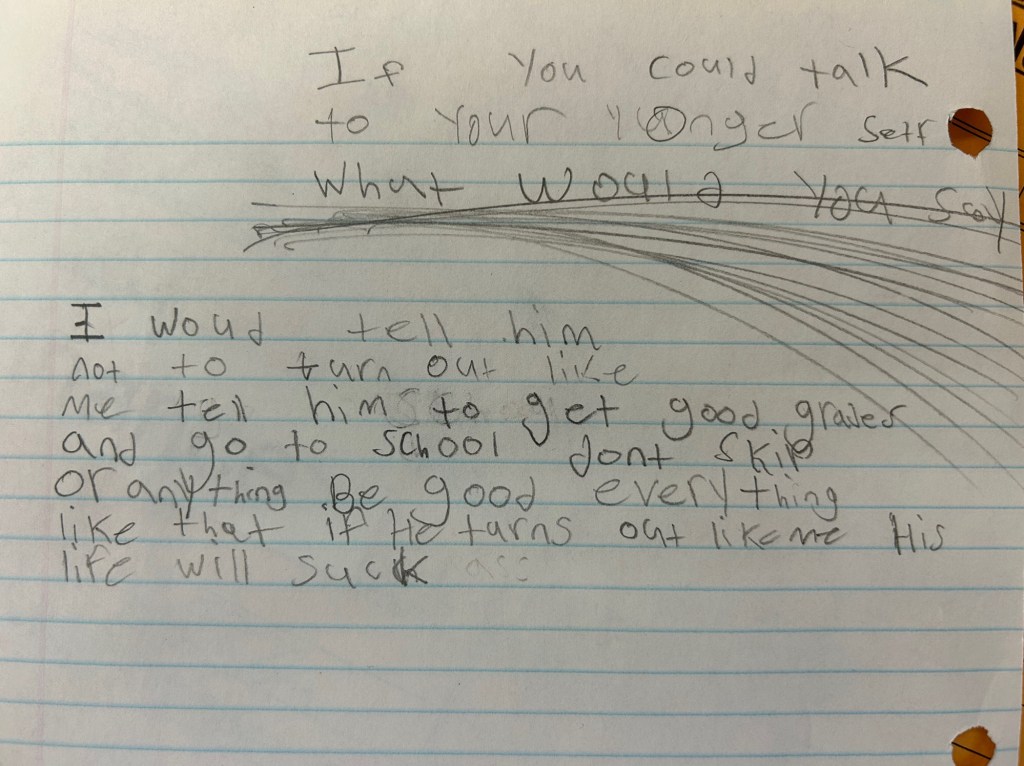
I was tidying the copying area in our office when a sheet of lined paper, adrift amidst the abandoned photocopies, caught my eye. A quick glance told me this was not my writing prompt, not my student. Still, I couldn’t help but read the words – and my heart broke open. Oh, how I wish I could tell this anonymous student about the poetry he has created, tell him that he is so much better than he knows.

If you could talk to your younger self what would you say

I would tell him
not to turn out like
me tell him to get good grades
and go to school dont skip
or anything Be good everything
like that if He turns out like me His
life will suck

My response (quickwrite)
If I could talk to the student whose paper was left behind

I would tell him
not to give up on
himself, tell him to hold on
and keep doing what he can. Be kind, everything
that I wish he could hear. If he knew the power of his
words, he would be stunned.

Wordless

Sometimes my youngest has trouble with words. Whatever mysterious worlds hold him together – his own internal sun, moon and Earth – line up, and emotion rises in him like a spring tide, flooding him and robbing his ability to speak. If I catch him early enough, he can still tell me what’s happening, though it’s hard. If we don’t notice the rising waters until it’s too late, his voice is gone. While he sits, nearly mute, fist pounding the space beside him, tears in his eyes, I struggle to guess at the words that elude him. Sometimes, I can find the words for him, and he collapses in relief; others, though, we’re not so lucky and all that that’s left is the language of the body. When I can, I hold him until the waters recede.

This is what happened on New Year’s Eve. I was the only adult left awake with the kids, who were waiting up for whatever magic they think happens at midnight – or at least for fireworks. I knew he had planned to walk out to the dock with the rest of us, but as the hour approached, he no longer wanted to come. When I asked him what was going on, his words were drowned out and his eyes filled with tears. I was reluctant to leave my youngest crying alone on the couch as the new year rolled in, but the others were waiting and time was short. Luckily, my partner was still awake, reading. He knows these moments, and came down to snuggle with our child while I went with the others into the dark. By the time we returned, my son was fast asleep.

These moments are frustrating, heartbreaking and, most of all, perplexing for me. I live in a world of words, trusting them to be my messengers to others, certain that I can coax them into shapes that will communicate meaning to those around me. I rely on words to tame the very emotions that, I think, overwhelm my child.

And yet. And yet.

These past months, words have often eluded me. I haven’t written here regularly. In fact, I haven’t written anywhere regularly. I’ve spent far too long staring at other people’s stories in an attempt to avoid my own. I’ve had no desire – much less ability – to put words to what I’m feeling. Instead, I’ve allowed myself to float on my own wordless tides. It’s unsettling.

Now, as 2024 begins, many people I love and admire – writers, readers and lovers of words – have chosen “one little word” for the year. I’ve tried to choose one, too, but the words have been as hard to hold as water. No word stays. As if to prove a point, I have spent some time now writing, erasing, then staring at the screen. The words slip through my fingers. What should I say? What should I not say? How do I feel? I don’t know. I want to commit to writing weekly this year. I want to say that I am grateful to know in advance some of the challenges that this year will bring. But those things aren’t true. 2024 may be the year I wrestle (again) with what a friend told me long ago: “Words put space between thought and meaning.”

I think about my sometimes wordless child, approaching the new year exhausted and curled up with his father. Perhaps this year it will be enough to hold on to those I love and ride the tides as we can, with or without the words to describe the experience. Surely, that is enough. 

Because of you #SOL23 31/31

When I woke up this morning, my left eye was swollen shut. A stye, I think, though no amount of hot compresses have brought it to a point, so who knows, really. At least it’s settled down enough that I can see. I had already taken today off sick; I wasn’t quite sick yesterday, but I was far from my best, and I knew my run-down body needed a break. Turns out, I have slept much of the day because I am, in fact, sick.

When I haven’t been napping, I’ve mostly been deep in a giant bean bag accompanied by a book, the puzzle section of The New York Times, and cats. We haven’t done much, and I’m ok with that.

While I’ve rested, I’ve wondered what I should write for the final day of this Slice of Life Challenge. I’ve wondered this every year that I’ve participated. After a month, I’m used to the practice of noticing and holding on to moments, of seeing how what is happening today brings up memories of what happened years ago. I love the way that writing daily makes me pay attention to the world around me (special thank you to Stacey for dreaming this up years ago to help get through March and to the Two Writing Teachers team for supporting this). I’ll miss this, even though doing it every day is hard.

I teach narrative writing at some point every semester, and I often tell my students that the universal lives in the specific. We connect best with friends and strangers when we share our very specific feelings or experiences – everyone has lived moments of joy or fatigue, grief or giddiness. This challenge is about sharing those moments, creating a community through that connection, through those stories.

I started this month with some trepidation: school systems are in a state of flux right now, and teaching is harder than I’ve ever known it to be. We need to have some hard conversations about things that don’t really fit into the “Slice of Life” model. I wasn’t sure I could write honestly for a month without talking about those hard things, but I did it. Mostly.

When I look back over my posts, I can see some of my concerns lurking behind and beneath my words, but that’s ok, I think, because reading and writing for a month with teachers from around the world means that I can also see the ways in which we hold each other up and, more importantly, how we share the dreams we have for schools and the world we’re striving to create. I can see how many teachers (and coaches and retired teachers and people in the world of education) are dedicated to our children and how, even though many of us are really, really tired, we don’t just cling to hope, we create it.

And so I leave March better than I entered it, better able to find the kernels of joy, better able to rest when I need to and fight for what is precious, better able to teach and, truly, to be taught. If you’re reading this, that’s probably because of you.

See you on Tuesdays.