Last day

Read more slices like this every Tuesday at Two Writing Teachers

I decided to wait until the end of the school day to write this week’s slice because it’s the last day of classes and I wanted to write about the last day. I am kind of terrible at last days – Do we prep for exams? Do we play? Do we reminisce? – and I guess I hoped that if I paid attention I would find the perfect slice and suddenly I would be good at last days. It was all going to come clear as I wrote: this is what I do, and this is what we learn, and it looks simple, but it’s really amazing because, as it turns, out I have this “last day of school” thing down.

Instead I’m sitting in an Adirondack chair on my back porch. I’m barefoot, wearing my favourite blue sundress and, while the late afternoon sun still shines on the rhubarb and the mint in my garden, I am luxuriating in the shade. Birds are calling to one another and it’s that perfect temperature when you can’t quite decide if you should call it warm or cool. Sometimes a gentle breeze blows and sometimes one of the cats comes to rub against my legs. My children are playing together and I can hear them laughing.

It was a good day. I brought Timbits* and freezies for a bit of a celebration, and the students and I mostly laughed and talked. There was some drama in the hallways and such – last days can be stressful – but it mostly stayed out of my classrooms. It’s not the kind of day we will remember, I don’t think.

I was a little worried about that when I sat down to write, but now, with the breeze and the sun and the quiet and the cats, I’ve decided that it’s probably ok to let some things slip away without without a fancy farewell. Exams loom, then the flustery excitement of graduation, and then summer. Today was more of a pause than an end. That’s probably enough – and it’s going to have to be.


*For all the non-Canadians: Timbits are donut holes from Tim Hortons. Freezies are, apparently, called “Freeze pops” in the US – they’re just popsicles.

img_5153

The Right Book at the Right Time

On Friday, we unboxed the books. Brand new, hardcover books.

“These are for us?” asked one boy, incredulous.
“Yes!” I laughed, “but you have to give them back.” He made a funny face and shook his head a little, dismissive of my excitement. Why would he keep a book?

“Can I use the stamp?”
“Can I choose the number for mine?”
“Yes!” I said yes over and over. Yes, these are for you. Yes, they are new. Yes, you can stamp them. Yes, you take them home.

“This book sure has won a lot of awards,” marveled a boy near the front.
“How’d you even get these, Miss?” asked another student, turning his brand new book over in his hands.
I laughed again, “I begged, borrowed and stole!”
His face got serious. “You didn’t steal, Miss. Don’t say that.”
I took it back. I should know better than to joke about stealing.

IMG_4832.jpgOn Friday, we started reading Jason Reynolds’ novel in verse, Long Way Down. I had offered the class several options for reading – book clubs, individual choice, whole class – and they told me flat out that they would never read a book on their own. “No point in that,” muttered M.
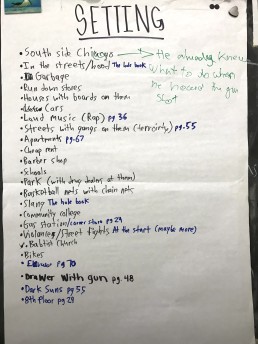
We’ve been reading all semester, but always short pieces. In general, my students are a little wary of my ways, but they were willing to try poetry with me last month, so I knew we were making progress. Still, they were nervous about reading a book, like maybe I’d gone a bridge too far – a whole book. Some of them are enthusiastic readers, but many of them haven’t read a book for years. When I told them that I would NOT read the entire book out loud, one boy looked down at his desk, shook his head and made a loud “tsk” sound. “That is NOT gonna work.”

And then came Jason Reynolds. Actually, first came the discussion about a shooting death in the neighbourhood. I was shocked to learn that gun violence is a part of so many of my students’ lives, then I was surprised by my own shock. (That’s a reflection for another post altogether.) Then I got upset because I realized how little support these students were receiving for their reality (also a reflection for another time). I had a long talk with the (amazing) EA who works in my classroom who insisted, “That book you’ve been telling me about is the right book for this class.” And she issued a challenge: “If anyone can get them that book, it’s you.”

So I begged. I told the principal I would buy half with my own money. I talked about the awards, the subject matter, the poetry. I told him about our progress, the growth, the learning. I found other pots of money. Finally, I said, “I have to teach these kids this book right now. I just have to.” Hats off to my principal and our Student Success teacher: they bought the books.

IMG_4834.jpg
That’s their handwriting – and page numbers!

On Thursday I gave the students photocopies of the first few pages. “AW! It’s more poetry,” groaned one kid. But they tried it. We used the same technique we used with Nikki Giovanni’s kidnap poem a few weeks ago: students wrote back to the text right on the paper. They asked questions, made comments and generally had their say. When we shared, they had made lots of inferences and had plenty of evidence to back them up.

Friday was the new books. After everyone had one, I explained that they could take a few minutes just to read. No set goal, no required number of pages, no plan – just read to see what’s there. My goal was 15 minutes. Boy did I underestimate them.

IMG_4830.jpg

They would not stop reading. T looked up after ten minutes and said, “Can we read as far as we want?” I nodded, he gulped some air and dove back into the book. S turned around and said, “Did you get to the part where he took the gun yet?” H nodded and kept reading. Silence. No phones. No sleeping. Eventually, one student lost focus, and I decided to stop them before the magic spell broke: “Hey, let’s take a break and see what we’ve discovered so far.”

They took a break, talked about the book, started to do the activity… and then I noticed that one, two, three kids had snuck back to their books. Then another. I asked if they wanted to just go back to their seats and read. “YES!” So we did.

As class came to an end, I found two kids surreptitiously trying to slide the book into their backpack. “You’re allowed to take it home if you want,” I said.
“For real?!”

One book went right into the backpack, but T hesitated. Finally, he put it back, “I want to make it last a little longer, Miss.”

I have a feeling that, for some of them, this will last for a long time.


Sink Holes and Lava Flows

Screen Shot 2018-03-18 at 7.58.50 AM
 

Join me on Tuesdays at https://twowritingteachers.org where you can read other slices of life – or even contribute your own.


On Mondays, if I remember, I ask my class how their weekend was, though sometimes by last period the weekend seems far away. I don’t have any research on this, but somehow it seems like talking about their weekend honors their life outside of school and says that what they experience matters. Also, sometimes I glean interesting tidbits about them, and pretty much always I can get a sense of the class energy from the way the discussion flows. So I ask.

Today, before I even finished the question, one girl was shaking her head and making a face. It was not a good weekend. She wants to move. Uh-oh.  I looked at her hard – I know of several reasons why she might want to move, so I wanted to tread carefully, but I also knew that if she spoke up, she might make connections in the classroom, and she might find support, so I took the plunge: “Anything you can share?”

There was a shooting just four doors down from her house; she had heard the shots. She didn’t feel safe. “It was a homicide!” called in a boy across the room. Then he added, almost casually, “I live around the corner. A guy got killed.”  I was shocked, but my students were not. Most of them live in the neighborhood, and they had lots to share. They talked about gun violence in their lives: they have heard it, seen it, been affected by it. I wanted to ask questions, find out if they were scared, know what they have seen, but I also didn’t want to push them or puncture the fragile veneer of safety they had created. One boy said he was not afraid because he wasn’t home when the shooting occurred. One girl said most of the shootings are on the 8th floor of her building, and she doesn’t live on that floor. As they talked, I realized that I didn’t know what to do.

I struggled to figure out my next steps, but my students didn’t hesitate. “Miss, did you hear about the sink hole in New Zealand? It’s GIANT!” “Yeah, and the volcano in Hawaii – you can see the lava!” I shook my head – I hadn’t followed any news this weekend, so I knew nothing. They were really proud that they knew things I didn’t. And just like that, we were talking about the changing world. We searched for articles, collected interesting words (“gigantic cavernous void”), talked about potential found poetry, watched videos. I complimented them for being so aware of the world – they weren’t doing this when the semester started. Most students participated in our discussion; everyone looked at the sinkhole video over and over. We couldn’t believe that it just opened up overnight, that the farmer just happened upon it. We couldn’t imagine having lava flow down our street. We decided that if we were in Hawaii we would NOT be dumb enough to go near the flowing lava to try to take pictures (though I’m pretty sure some of the boys were lying). And then we moved on to the rest of the lesson.

Now it’s evening, and I can’t shake off the shots that my students buried in that sink hole, that they burned beneath the lava flow. In case I had forgotten, my students reminded me today that they lead real lives that can sometimes make school seem beside the point. As we talked in class, we tried to imagine what it would be like to walk somewhere we knew well and happen upon a giant sinkhole in ground that had seemed solid just the day before.  I think that actually happened to me today. Their world is not mine. I am shocked, overwhelmed, embarrassed again and again that I can think that I know who they are. I love them, but I know nothing.

I Lost My Talk – FNMI PD

IMG_4760.jpg
From a slideshow by Justin Holness of Tr1be Academy

Today I attended a PD day focused on FNMI learning. For those who don’t know, FNMI stands for First Nations Metis Inuit and is the acronym we are currently using to talk about peoples who are indigenous to Canada.

“In 2009, the Truth and Reconciliation Commission of Canada began a multi-year process to listen to Survivors, communities and others affected by the Residential School system. The resulting collection of statements, documents and other materials now forms the heart of the National Centre for Truth and Reconciliation.” (from The National Centre for Truth and Reconciliation) In 2015, the Truth and Reconciliation Report included 94 “calls to action” urging all levels of government to work together to change policies and programs in Canada in order to repair the damage done by residential schools and help our country move forward with reconciliation. One of the main calls to action is to change education to include FNMI history and culture in all parts of the curriculum. This means educating teachers as well as children.

Today, teachers heard from elders and youth and everyone in between. We listened to talks, singing, drumming. We ate food with a traditional flavour. We experienced cultural activities from sports to drumming to beading. We even sang. We tried to be open; we were open. Tomorrow, and for many tomorrows, we must continue to educate ourselves so that we can share these vibrant cultures with our students. To that end, I’m including two poems here. The first, I Lost My Talk, is well-known in Canada, but I’m not sure non-Canadian readers will have read it. The second is my own creation, a found poem from the words I heard in our PD sessions today. To all those who shared their knowledge with me today, thank you. Migwech.

I Lost My Talk

I lost my talk
The talk you took away.
When I was a little girl
At Shubenacadie school.

You snatched it away:
I speak like you
I think like you
I create like you
The scrambled ballad, about my word.

Two ways I talk
Both ways I say,
Your way is more powerful.

So gently I offer my hand and ask,
Let me find my talk
So I can teach you about me.


FNMI PD Found poem 4/27/2018

I Reflection
How did you get here?
A brief centering of self where
your knowledge comes from where
you look to know that
knowledge is real.
Connect the words
to your embedded
knowledge.

II Meaning Making
Life requires sacrifice.
Everyone has value
regardless of physical attributes.
The land tells us what is real.
Expand your ways of knowing, being and doing
Evolving while you learn.

III Acting
No idea is too
small
to make a difference;
No idea is too
big
not to get started.
Bring unity to the community.
Acknowledge, Learn, Celebrate
Indigenize.

Poetry Friday is being hosted by Irene at Live Your Poem


Blooming

IMG_4739.jpg
Ready or not: time to bloom

When I woke up this morning, my job description included teaching Special Education and Grade 10 Applied English. We’re six or so weeks from the end of the semester, so I assumed I would continue apace through June. Not so. By the time school started this morning, I had become a Literary Arts (aka Writing) teacher. (And also, of course, because teaching is a little crazy, I’m still a Special Education and Grade 10 Applied English teacher.) I teach at an Arts Magnet school, and one of our teachers can’t finish out the school year with this class. I have been asked to step in.

Am I ready? I’ll admit that I’m nervous and also pretty darn excited. To think: I started this blog a mere two months ago. Two months ago I challenged myself to actually start the writing I’ve dreamed of doing; two months ago I started sharing my thoughts in public; and today here you are, reading this. And here I am, getting ready to teach writing. Is two months (plus umpteen years) enough time to call myself a writer? It’s going to have to be.

Here’s what I know: Yesterday, the crocuses in my yard bloomed. They’re sneaky ones, those crocuses. We’re on the shady side of the street, so things take their time coming out. One day, the yard is completely brown and dead-looking; the next, purple and white blooms appear, fully-formed, seemingly out of nowhere. I know that they did not spring from nothing: they’ve been pushing up through the warming earth, making their way skyward long before I am able to see. They’ve put up tiny green tips under the leaves, sheltered from the cold, testing the air. And when it’s finally time to blossom, they have no reason to hide. The blooms are exuberant, wholehearted, and suddenly it is Spring.

Here’s what I think: I’m a shady side of the street sort of writer, coming along in my own time, tentatively testing the air. Am I ready? Not sure I have the choice. Once Spring arrives, it’s time to bloom.

slice-of-life_individual
Just about every Tuesday I blog for the Slice of Life challenge over at Two Writing Teachers. You can read more posts on that blog.

And we’re writing!

IMG_1077I am excited to take part in Poetry Friday, where writers share their love of all things poetry. Tabatha hosts the Poetry Friday Roundup today at  The Opposite of Indifference.  She is celebrating the release of Imperfect, an anthology of poetry about mistakes for middle schoolers. Drop by and see what poetry morsels are offered this week.

In my last post I wrote about some poetry lessons that had started well but ended flat. I was worried that the learners I work with might not be willing to stick with me if I didn’t get it together. Several people shared ideas about things that might work to help keep my students engaged; one that really resonated with me was that I don’t need to separate assessment from the play we’re doing. I could go on – and I probably will at some point – but I honestly think part of our success today is because I said, “Hey, you have all these great ideas in your writer’s notebooks & it’s Friday, so let’s just play.”

I showed them some cool thing – sijos and kimos; nonets and golden shovels – things they’d never dreamed of. They loved it! They wrote for at least 30 minutes – and when I said it was Poetry Friday and I could share some on my blog… FIVE asked to be featured. Then, we ended the class by starting a group “I am from” poem. They’ve asked to finish it on Monday. My students never cease to surprise me.

Golden Shovel poem by J (Party in the USA)
So Emily and I said, “Yeah
the song is old, but it’s
a fun song to sing, a
good jam to dance and party
to, especially when you are in
the basement alone, or in the
room and partying in the USA.”

Golden Shovel poem by T (based on his own I Am From poem)
When I was young
The very best food was my mom’s chili
Then going to my uncle’s to play hockey
Those were the best days


Lost Home Nonet by S
A place that felt like home is gone now
Here in Ottawa is uneasy
It feels like something is wrong
Where is my freedom now?
Will I find it soon?
Sweet potatoes
With sweet peas?
Teddy Bear?
Home.

The beginning of our “We are from” poem
We are from long cold winters
Icy roads, I almost got hit by a car,
Snowball fights that last all day.
We are from snowflakes that fall with the maple leaves,
Skating on the Rideau Canal for beaver tails,
Skiing and snowboarding down the hills.
Skating on rinks, hitting the puck, cheering our teams.
Yet we live for the months of summer
Expired Ferry Express tickets,
The days we spend outside, the nights we spend with our families.
(More to come – the bell rang!)


And then… poetry lessons go awry

After a bit of a slow start in Grade 10 English, the poetry unit has been going gangbusters. All my plans were working! Students were engaged! They were having fun! They were playing with language, finding words, generating metaphors! I was a great teacher! And then…

Yesterday started well. We used Jabberwocky to think about how sounds create images. We listened, added images, read on our own, listened to a different interpretation, argued for our favourite, tried to “translate” it, read out loud, did readers’ theatre. The classroom was abuzz. And then… I decided to “let” the class listen to Poe’s The Raven. I had a good version with a creepy voice, the words scrolling past, the whole thing. Except that I overestimated my students’ attention span. Even with the lights out & the scene set, they got bored. Quickly. I should have pulled the plug, but I hesitated and the class ended on a decidedly dull note. Note to self: The Raven is too hard and too long for this group to listen to without a better introduction.

Today I wanted to get back to our poetry buzz. I prepped The Bells as an attempt to rehabilitate Poe after yesterday. I found multiple videos, including songs and recitations with images, that illustrated various tones. The plan was to listen, notice, discuss, then look at other poems where sound takes centre stage. I was completely ready, and then… as the students walked in, one of the social leaders said, quite loudly, “Please tell me we aren’t doing poetry again today.” Another one of my touchstone students showed up late and dragging. The Bells was not going to work. I needed something quick & engaging.

So instead of The Bells we worked with Gwendolyn Brooks’ We Real Cool. Students listened to two versions and were able to hear how enjambment can create rhythm, sound and meaning. They heard Brooks read and said it sounded like jazz. They noticed the alliteration, the “hidden” rhymes, the images and more. Great, but the dang class is 75 minutes long. We needed more and my original plans were out the window. So I read them Gertrude Stein’s Susie Asado.

Now, you might think that Stein is an unusual choice for a motley crew of Grade 10 reluctant readers, but hearing a poem where the sounds count more than the words usually completely fascinates students. This group was no different. We talked about flamenco dancing. (I wasn’t quick enough to find a video; I was teaching on the fly at this point.) We talked about the sounds words make. We talked about why Stein might write like this. It was great, and then…I moved too fast. I asked them to choose a person and try to write a few lines about them using the sounds of words rather than the meaning.

Here’s what I did not do:
1. provide more than one mentor text
2. help students sufficiently analyze the mentor text I did provide
3. offer written instructions to supplement my oral instructions
4. brainstorm ways that onomatopoeia is different from what Stein is doing
5. break the task down into chunks that they could approach
6. provide anywhere near enough structure

I could kick myself. My darling students tried – they really did – but I had set them up for failure. Only a few got anywhere near something they liked. Most were completely  overwhelmed, so they got off topic, used the bathroom (my rule of thumb: once the third student asks for a bathroom break, that lesson is done), put their head on the desk… GAH! It’s a good assignment, I swear it is, but I forgot to take into account what these learners need.

And then… I sent prayers of thanks up that I was prepped a little ahead. I pulled out a handout about Juxtaposition from Karen Benke’s book Rip the Page(Thank goodness for Elisabeth Ellington and Catherine Flynn writing about this recently.) At last: a written assignment, concrete, with clear directions. Something they could do with some success.  I guided them through it, and then… class ended before we could share.

I was feeling like a bit of a failure, but truthfully, I think we’re ok. I’ve stolen from tomorrow’s assignment, and the exercise wasn’t quite as good without the lead-up I’d planned to use, but it was good enough. In writing about these two days, I’ve realized that I haven’t ruined everything – yet – but I am still nervous about tomorrow. If things go awry again, the unit may be done for: my students preconceptions about poetry (and English) are pretty tightly held; they will happily revert to their ingrained habit of hating it. And I want them to try writing poems on their own. They’ve seen loads of mentor texts now, written lots of bits and bobs; it’s time. But generating language is hard, and now I’m nervous.

Anyone out there in the blogosphere have suggestions?

Miss, this poem is trying to kill us!

My Grade 10 students are, generally, a suspicious lot when it comes to English class. If they’re having fun, they pretty much want to know when the other shoe is going to drop. As I mentioned in my last post, this stream of English is called “Applied”; I try to take that descriptor seriously. How will we use this? What do we get out of this? Why bother? These are guiding questions in the classroom.

And we had the *best* poetry class today. A while ago I found an article by Prof Toby Emert on The Poetry Foundation website. In it, he talks about “exploratory methods for interacting with poems” and details a workshop he designed to “help students respond to poetry in ways that encourage them to love the poems and to enhance the skill set they need to engage in deep readings of texts.”

Well, I happen to know a few students whose skill set for deep reading is, ahem, not well developed. And I have been reading about why poetry can be a good entry for reluctant readers, so I was committed to trying this out.

Background: We’ve already spent five periods on poetry, mostly just playing around. We’ve read mentor texts and tried out blackout poems, list poems, book spine poetry; we’ve rotated through stations of haiku, cinquain, skinny and concrete poetry; we’ve listened to spoken word poetry, and we’ve even collected words. We’re ready to go deeper.

Ok, ok, ok… but you want to know what we did today. Well, we did what Prof Emert suggested – and it worked.

I photocopied Introduction to Poetry by Billy Collins, Poetry by Pablo Neruda and Ars Poetica by Archibald MacLeish onto the biggest paper I could find. I think any three poems on a similar topic but with varying tones would do the trick here, but Emert suggested these, so I followed.

These poems are *way* beyond what my students would normally access. Not only is the vocabulary hard (palpable, palpitating, casement, etc.) but their length and metaphoric thinking was more than we had approached as a class. That was important. I wanted them to be in over their heads a little, to react to the poem at a level beyond literal comprehension. I wanted them to do what Emert suggests: be willing to climb inside a poem and sit awhile.

I posted each poem on the chalkboard, spaced well apart. Next to each poem I wrote two sentence stems. I told the students that we don’t always understand a poem right away – and that’s ok. (I was rewarded with a dramatic eye roll.) I told them that sometimes poems just sit with us, we just feel them. Sometimes we hate them and walk away; sometimes we’re intrigued; sometimes they grow on us. I reassured them that, while they might not *get* a poem, they could still react to it. (I admit it: I talked about Gertrude Stein.)

The students, in groups of three, read the poems then used sticky notes to complete the sentence stems in response to the poem.

If I were sitting next to this poem, waiting for the bus, it would say…

If I went on a date with this poem, we would…

If this poem could fly, it would…

In this poem’s pockets are…

If this poem were a burrito, it would…

This poem is hiding…

The students started slowly. They kept looking to me for permission. I kept insisting that they should write what came to mind. “Poems aren’t burritos…” one muttered. “Why would I date a poem? That doesn’t even make sense,” grumbled another.

I tried to overhear beginning responses and encourage them.
“If it were a burrito, it would… be cheesy?” ventured one boy.
“YES!” said the extremely enthusiastic teacher behind him (ok, ok, that was me). “Write that down!” He looked doubtful, but he did it.

Once they got the hang of it, they moved quickly. The sentence stems were so outrageous that the kids felt free to be silly. Each group spent 3-5 minutes with each poem (more time earlier on, but then they got going).

“Did you understand these poems?”
NO! Not really… a little… maybe… no… they were defiant, sheepish.
“Remember that you don’t HAVE to understand it. And anyway, I think you *did* get them.”

I asked which poem was the funny one, the most beautiful, the most serious. They absolutely knew. I told them that they had identified tone. They were impressed. We read their responses out loud and, lo and behold, they (mostly) matched the poems’ varying tones. (I’ve included some of their responses at the end in case you want to see.)

Next, I distributed a copy of Nikki Giovanni’s kidnap poem to each group. I asked them to “have a little conversation” with the poem by asking a question of each line. Again, we had a slow start here, but this time, they decided to humour my odd request, especially once I encouraged them to start with any line they wanted; within a few minutes, each group was writing questions after every line.

Soon, giggles and guffaws filled the room. I heard one student say, “Ask her what lyre means” and another reply, “no, no ask the poem.” Everywhere, heads bent over Giovanni’s work. Pencils and pens marked up the lines. Shh! Don’t tell anyone that these kids were annotating a complex poem, line by line. Any group that finished took their notebooks to collect words and phrases from the posted poems.

The final magic happened when everyone was finished with the questions. Each group chose two people (future reference: I might do this whole exercise in pairs) to read the poem out loud like a dialogue: line of poetry/question. This valued their voices as equal partners to the author’s voice and moved us gently in the direction of reading poems aloud. Their questions, their reactions became part of the poem itself.

The first group read & everyone listened. Their honest and sometimes aggressive or bewildered questions were funny. Everyone laughed and applauded at the end. Groups volunteered to read next. Each dialogue was better than the last. Another teacher walked into the room, talking, and my students shushed him. The bell rang just after we finished.

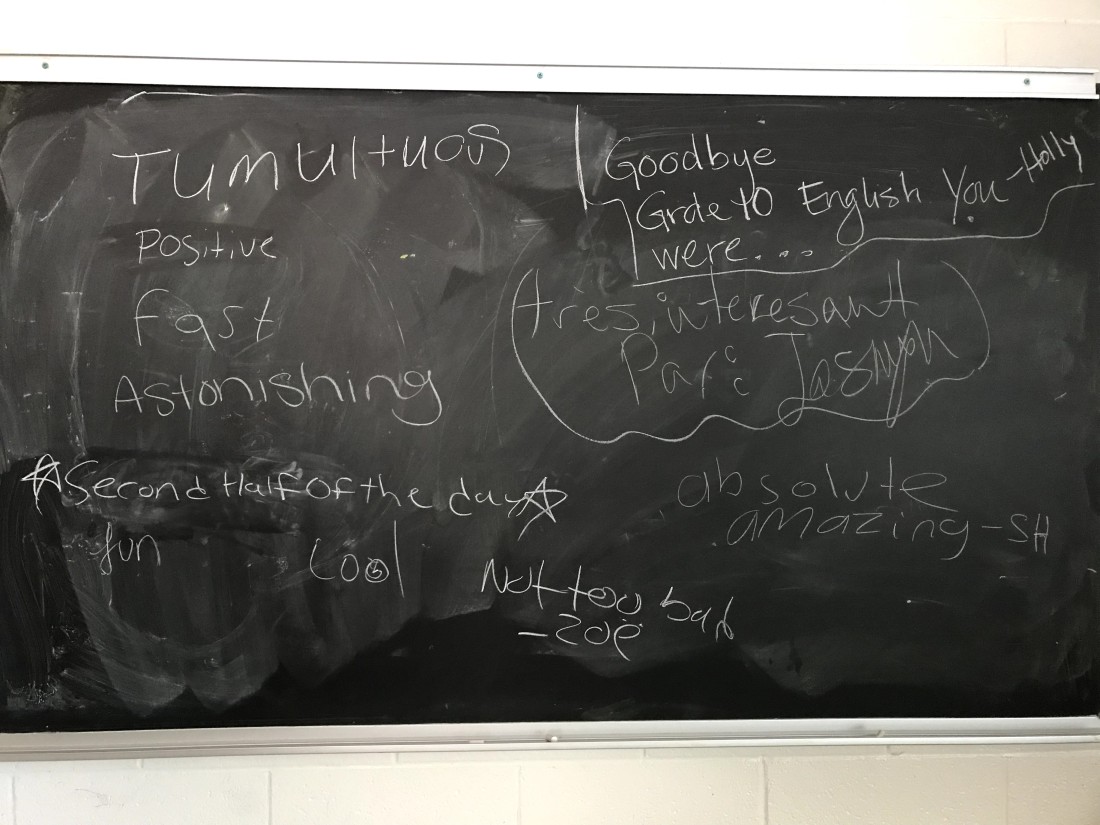
Today’s exit question was “summarize today’s class in one word.” Their responses?
fun, hilarious, funny, fast, creative, effervescent(!), energetic, good.

I am not exaggerating when I say that not one of them used a negative or even a neutral word to describe their study of four complex poems. It was magic.

IMG_4682.jpg


************

Here are some of the responses to the sentence stems I used. (I’ve put some of the less effective responses are in parentheses because I want to be clear that this exercise was imperfect. In class I read all the responses but highlighted responses that seemed sensitive to tone. I wanted the students to feel success as a group.)

Billy Collins =>
If I were sitting next to this poem, waiting for the bus, it would say…s’up dude, what’s popping?; hey, wanna fight?; Boo! (bye, Felicia; Where are you going?; seal)

If I went on a date with this poem, we would… go on a game show and find a new date, make an excuse to leave, be scared go skydiving and then go swimming (go to the cinema, kiss, stop talking)

Neruda =>
In this poem’s pockets are… figures of speech, la poesie, (empty, key lime pie, memes, a Rolex)

If this poem could fly, it would… fly with broken wings, glide beautifully, be a dove (go to Ikea, fall)

MacLeish =>
If this poem were a burrito, it would…be a stuffed burrito; be too cheesy; not last long; have too much hot sauce; have guacamole

This poem is hiding… a message, sadness, its soulmate, the truth, in a Disneyland ride (seals; something; words)

We did it ourselves

Um, you all, guess what happened? Two of my students “didn’t have anything to do” last night so they went to a bookstore and created book spine poetry. Then they took pictures of the poems and brought them to class.

THIS IS AMAZING! I wish I could do a little dance right here in my blog. This is true application as implied in the moniker “Applied” for this stream of English.

Zoe and Marta said I could share, so here are their poems:


Standardized test answer

Today our Grade 10 students wrote the standardized literacy test they must pass in order to graduate from high school. I supervised the extended time room and silently cheered them on as they worked. I cannot encourage or help them, but I can smile, wink and even pray. I also peeked at some of the questions. I cannot share the prompts here, but I can share two of my own answers…

Short answer response (6 lines provided):

I can swiftly and easily respond to inane prompts. I can generate a story for any question no matter how banal, pull semi-believable facts willy-nilly from the air, and find the perfect example for even the most general of queries, all while employing the Oxford comma. I can write complete sentences, including participial phrases cleverly separated from a main clause with commas for extra points. I can vary sentence length. I can repress my desperate longing to throw in an effective sentence fragment for style; I can restrain myself because, above all,  I possess the skill of passing standardized tests.
(exactly 6 lines in Google Docs)

Opinion response – maximum two handwritten pages.
I’ve done a sneaky poetic response because
a) it’s Poetry month and
b) I don’t actually want to write a one page response to the question and
c) one of my students worked tirelessly on this one, and my heart broke a little for her.

Standardized Test Opinion Response – a Golden Shovel Poem

She flexes her tired hand then gets back to work, suddenly knowing that no matter what she does
Today in the library, tonight she will do the homework
Assigned by the teacher who looked her in the eyes and said, “You can improve,
You will improve” then gave her harder work because she is learning.