Standardized test answer

Today our Grade 10 students wrote the standardized literacy test they must pass in order to graduate from high school. I supervised the extended time room and silently cheered them on as they worked. I cannot encourage or help them, but I can smile, wink and even pray. I also peeked at some of the questions. I cannot share the prompts here, but I can share two of my own answers…

Short answer response (6 lines provided):

I can swiftly and easily respond to inane prompts. I can generate a story for any question no matter how banal, pull semi-believable facts willy-nilly from the air, and find the perfect example for even the most general of queries, all while employing the Oxford comma. I can write complete sentences, including participial phrases cleverly separated from a main clause with commas for extra points. I can vary sentence length. I can repress my desperate longing to throw in an effective sentence fragment for style; I can restrain myself because, above all,  I possess the skill of passing standardized tests.
(exactly 6 lines in Google Docs)

Opinion response – maximum two handwritten pages.
I’ve done a sneaky poetic response because
a) it’s Poetry month and
b) I don’t actually want to write a one page response to the question and
c) one of my students worked tirelessly on this one, and my heart broke a little for her.

Standardized Test Opinion Response – a Golden Shovel Poem

She flexes her tired hand then gets back to work, suddenly knowing that no matter what she does
Today in the library, tonight she will do the homework
Assigned by the teacher who looked her in the eyes and said, “You can improve,
You will improve” then gave her harder work because she is learning.

Endurance

Today, my students and I created book spine poetry in the library. They are not regular perusers of the stacks, but almost all of them joined in the fun. Here is my contribution to our poetry playfulness:IMG_4632.jpg

The Impossible Journey
Endurance
Endurance
Endurance
Return to Paradise

As a side note, book spine poetry was at least as popular as blackout poetry was the other day. (We had a middle day – list poetry – that I thought was less successful, though two of the the kids assured me that “that was pretty cool, too.”) Today students roamed the stacks, fingers traipsing along the edges of books. They crouched low, leaned in, turned their heads sideways to read, then pulled out books and showed them to other students. They laughed and shared and talked about books. Both students and teachers from other classes came to see what was happening. It felt joyful and fun. They even created some poems in French! I’m so grateful to all the teachers out there in the blogosphere who have guided me down new paths this month. Here, take a peek at some of the excitement:


Today, for the first time, I’m joining Poetry Friday. Head over to The Poem Farm for this week’s round-up of Poetry Friday posts. Thanks, Amy, for hosting our gathering!


Finding poetry

IMG_4610.jpg

It’s April, so my Grade 10 class is busy doing poetry. Many of these students are not enthusiastic about reading or writing in any form – yet. I have one semester to plant seeds that will, hopefully, sprout into a literate life for each of them over time, and if well watered. It’s an exhilarating challenge.

Many of these students are not yet poetry lovers. In fact, when I told them that it was Poetry Month, exaggerated groans erupted around the room. One boy mimed death by choking. I’ve suggested he take a drama class, but…

So why do I choose to do poetry with students who are not yet lovers of words? Jason Reynolds articulates it perfectly in this interview. The gist of what he says (if you don’t have 3:00 to listen right now) is that poetry is perfect for reluctant readers: it doesn’t overwhelm them with words; it has spacing, line breaks, and stanzas that break things down; and there is lots of white space. (It’s a great piece – not an interview exactly – but a mini-talk with a poem at the end.)

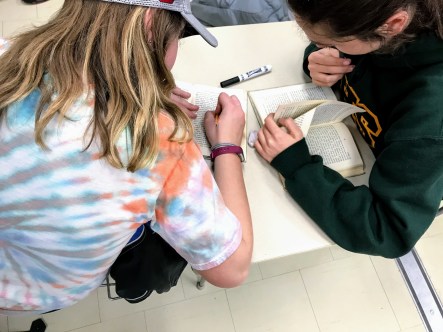
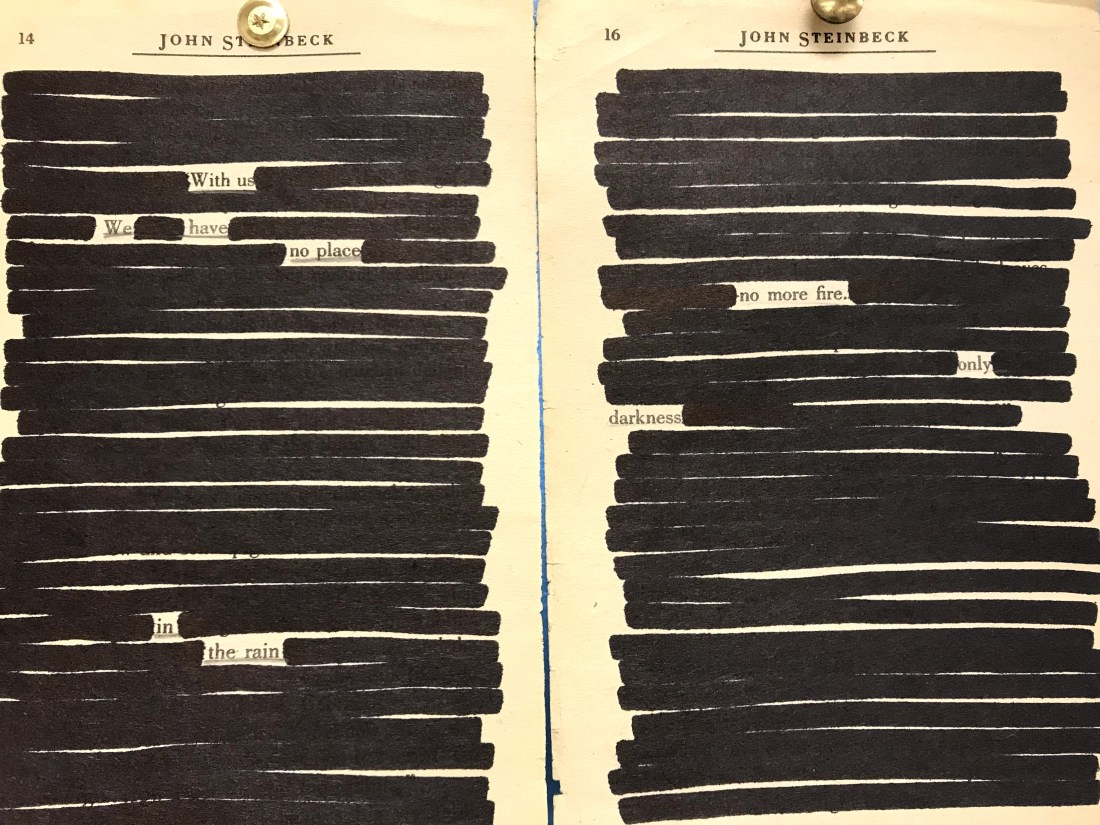
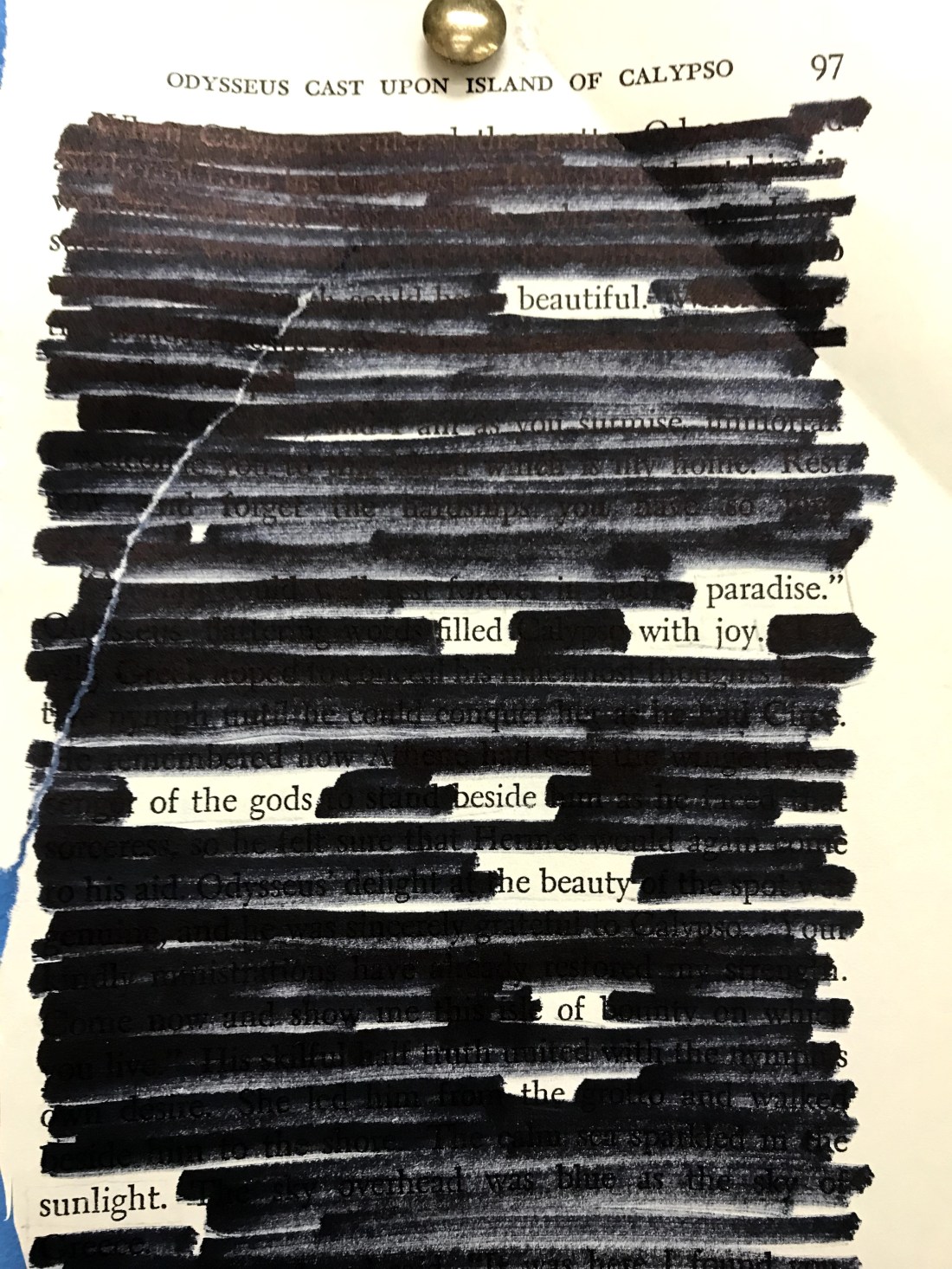
Our class started with a list poem (inspired by Richard Brautigan via Elisabeth Ellington) in part because a visiting poet had already introduced this form earlier in the semester. We had fun with it – I may have to share more on this later – but I knew I had only a few fairweather converts. Today, however, we hit pay dirt: the blackout poem.

IMG_4614.jpg

First, I showed the students some mentor texts – mostly Austin Kleon but also some random ones with images. (I cannot lie – I did a Google search for blackout poetry and showed the images. I like showing the students things that they can easily access without loads of specialized knowledge. Don’t know who Austin Kleon is? No problem.) They were intrigued but not hooked.

So I linked to The New York Times. We use their “What’s Going On In This Picture?” feature every Monday, so the kids are familiar with the paper. Today, we used an older post called Searching for Poetry in Prose. This pairs some NYTimes articles on the left side of the screen with a blacked-out version on the right. When you click on a word in the article, it gets un-blacked-out (that cannot be the way to say that) on the right. You get to choose up to 15 words and you can save your poem. We played with a few together, and more kids perked up.

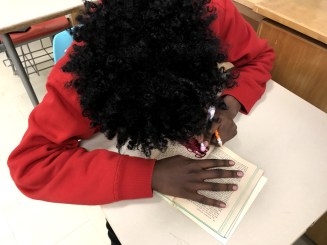
Then – this is where things got good – I gave them actual books from our book room. You know, the ones where the spines have split and pages are falling out but someone re-shelved them anyway? Yup – I gave them those. And markers. Lots of markers. I suggested that they use pencils to outline the words they were choosing… some listened, some didn’t. If they couldn’t stomach the books, they used the website. Some were a little slow to start, but after a few minutes, the room was abuzz. They called friends over to share or used their hands to hide what they were doing. Words whipped around the room: “You are never gonna believe what’s in this one!” What does this word even mean?” “Look it up!” “Wait, no, I know that word!” (Someone learned the word “fornicating” – I nearly choked with laughter. It was a well-shared discovery.)

Eventually, a head popped up, “Are we allowed to do more than one?” Yes, yes you are. “Oh! I ripped it! Do you have tape?” Yes, I do. “Can I put mine up on the board?” Yes, you can. “Can I take this book home?” Oh, yes. Yes. You can take the book home.

I think blackout poetry won the day.

IMG_4620.jpg
by Simbi


IMG_4618.jpg
by Marta


Eye of the storm

Every Tuesday, the writing community of Two Writing Teachers hosts Slice of Life. All are welcome to participate by linking up posts or commenting on other participants. 

It’s quiet in my house. Our Easter guests have gone; my children are off with a friend, pretending that sunshine = Spring even though the thermometer says otherwise; my partner is at work, getting ready for a busy week. Even the cats are sleeping. Me? I’m sitting at the kitchen table, wandering through students’ notebooks, trying to get a handle on what they already know and where they need to go next.

It’s a patient little quiet here. I love the whirlwind of holidays and visitors – the cooking, the stories, the laughter – so I always feel a little bereft when my extended family leaves. The house has already settled back into its regular creaks and groans with only the discovery of an occasional missed Easter egg or some leftover confetti to remind me of what was reality mere hours ago. I’ve done a lot of laundry; most of the week’s food is prepared; much of what needs doing is done. I should tidy some more, but it can wait. Right now, I am still.

Tomorrow we will all be back to work and school. Texts are already flying about who will carpool where and when. There’s a Spec Ed meeting tomorrow morning before school and a Department Heads’ meeting to attend tomorrow night, then Parent-Teacher conferences loom on Thursday. When I think about the week ahead, I know I need to make decisions about mentor texts, book talks, poems to share, feedback, and more. I can feel the weight wanting to settle on my shoulders, but I’m not quite ready for it. Not yet.

I don’t know where this calm has come from. I know I am in the eye of the storm, but right now my kitchen is warm and my work feels useful. Right now, the quiet envelopes me and I am breathing in its unexpected serenity.

May I remember this when the storm returns.

Update: Everyone returned; chaos ensued. I spilled both water and flour on myself, one after the other. The older child had to write a speech; the younger did not. For inexplicable reasons, I decided that I really needed to pot some spider plant babies. And we had four loads of laundry to fold before bed. We are back in the storm. I’m trying to hold on to the calm.

How to write an ending

Ok. I have to do this. It is the final post and it must be written. Let me tell you, I’ve been overthinking this one. So I followed a tried-and-true strategy: I procrastinated. I’ve been an evening writer all month, but I decided that this would be a morning post. I mentally made notes on several fascinating ways to write this, but I conveniently rejected or forgot them all. And now here I sit, facing a blank page, and it’s the last day of SOLC18.

Should I say thank you? How on earth could I say thank you in a way that reveals what this month has meant to me? Do you know that I literally found this challenge randomly on Day 3? I don’t even remember how I found it. I have started to believe that something in the universe knew what I needed and placed it in front of my face. And why did I sign up? Naivete? I had no idea what this would entail. I remember thinking, “Well, I keep saying I want to start a reflective blog, how hard can this be?” I didn’t know that I would end up spending 2 hours a day on this challenge, that I would fall in love with commenting, that I would get to know other bloggers, that my heart would burst open with stories and thoughts and observations.

Should I tell you about my happiness? How can I explain what it feels like to read each comment? To read others’ stories? Do you know that my whole world has expanded? Even my 9-year-old has noticed my new demeanor. I feel supported, encouraged, surrounded by a group of like-minded colleagues who will help me grow and improve in my writing and my teaching practice. I have a whole list of books to read. My library hold list is a mile long & I’ve already discovered amazing books.

Should I write about my sadness? How I have realized that I desperately need to connect with like-minded colleagues in my own space & cultivate those relationships more than I have? I will miss the daily affirmations of this community but I can resign myself to weekly, I think. Do you know that I am embarrassed about how many books on teaching I haven’t read? I am so behind. Seriously. And here I thought I was pretty on top of things. So… I have resolved to start a PLN here rather than continuing to wait for it to magically develop. I can do that. And I can read – oh yes, I can read. And write.

Should I talk about how my writing has changed? How at the beginning I carefully curated what I wrote, mining old journals and notebooks for well-crafted moments? And how I was not going to share my personal life – only professional. As if they were not intertwined! Nevertheless, I was stern with myself. And then, I let go a little. And you kept reading and commenting. Even when I shared a *poem* which is terrifying to me. You all, you said nice things about my poetry. And then yesterday I wrote what was happening *in front of me*. THAT IS CRAZY. And still you commented. I am amazed.

Should I talk about my excitement for the future? This challenge has opened up new vistas for me. I know that I am changing, becoming, moving along a new path as a teacher and person as a result of this month. I don’t know exactly where I’m going, but I’m going to coddiwomple along with glee.

But no, it is a Slice of Life challenge. So for my last slice of this life-changing month, I will share this moment: I woke up with my son’s small warm body snuggled next to mine, his eyes staring intently at my face, his breath warming my nose. He does not sleep in our bed, but he often wakes me like this. How does he manage to sneak in there? “Are you awake?” he whispered, “I want to play Starbound without cheating.” Downstairs, he sat on my lap, reading the words on the screen – words that were meaningless to him the last time he played this game six months ago – leaning against me, stroking my face as I got him set up. He is 7 and 17 all at once, this child of mine. When the game finally loaded, I said, “Ok, you play, I’m going to write” and he responded, “Oh good, that makes you happy.”

And it does. It really really does.

Thank you. See you on Tuesdays.

slice-of-life_individual


Slice of Life Day 31, March 2018

Thanks to Two Writing Teachers for this wonderful month of inspiration.

Late Night History

It’s late and the long weekend has begun. My mother and my aunt have arrived. The kids are asleep, my mother too. Me? I’m exhausted  – sleep has eluded me several nights this week – but up late trying to write my slice for tomorrow. I am overwhelmed at the thought of this month ending, overwhelmed by the supportive community here, overwhelmed by what I’ve learned and what I’ve experienced. I have changed, and I had planned to write about it. But I’m sitting in at the kitchen listening to my husband and my aunt, deep in animated conversation. Honestly… how can I write or reflect when they are talking history?

For my husband and my aunt, history is alive and fully present. They are teary while talking about Uncle Pete (my great uncle) finding a baby during WW2 and carrying it with him through France until he found a family to care for it weeks. My aunt has a picture of the baby on her phone, but no one knows what happened after Pete gave the baby back. As Pete was dying, he wondered about that baby.

UPDATE: Here’s the picture of “Pete’s baby”
Pete's baby.jpg

And now my aunt is telling another story… and there are more tears – for a soldier who died at 19, for his buddy who lived and married his friend’s widow, for his revelation 50 years later that he had been living his buddy’s life for him and, after all that, he was afraid if his wife died first she would meet his buddy in Heaven and he would lose her forever. He died minutes before she did. These men, their stories, they are real and important right now in this kitchen.

And now they are laughing through the tears – for Uncle Pete who probably would have been diagnosed with PTSD and swore to God on a battlefield that if he ever got home he would never leave Rte 27 again. How he RSVP’d for a wedding by writing on the back of the invitation “Sorry, can’t leave Rte 27 yet.” How he really thought that Eleanor Roosevelt and Churchill were having an affair. And about the seemingly endless keg of beer in his basement…

And now they are on to Band of Brothers. And Saving Private Ryan. And Frederick Forsyth’s “The Shepherd.” Movies and stories and books that have embodied the stories that move them to tears. Their passion, the way they build on one another, their fully focused presence in this kitchen, far from any battle – it’s absorbing.

And here I sit, listening, writing, and marveling at their passion, at how stories bring these men into our kitchen, at how important the stories are. Tomorrow, I’ll mourn the end of this Slice of Life Challenge. Tonight, I’m listening to two of my favourite people discuss their passion like it is alive. What could be better?

slice-of-life_individual


Slice of Life Day 30, March 2018

Thanks to Two Writing Teachers for this wonderful month of inspiration.


Reading & Writing & ‘Rithmetic

As I type, my darling children are using an app called Reflex Math. They are also whining. A lot. Reflex Math is designed to help them learn math facts through the 10s. First addition & subtraction, then multiplication & division. It looks like fun to me: instead of just practicing facts with flashcards, they choose games to play, earn points for playing, and “buy” things from the online store. They can check their progress to see which facts they’ve mastered and they only need to play about 10 minutes a day to progress well. So… choice? Check. Rewards? Check. Autonomy? Check.

They hate it.

Me? I’m conflicted. I hated hated hated learning my facts when I was in elementary school. I failed one timed test after another and eventually decided that I was no good at math. I was wrong, but it took me years to realize this. I do not want my kids to have the same experience. Luckily, the current curriculum in our province includes lots of deep understanding. The kids know how addition and multiplication work. They can explain, re-group, skip count – the whole nine yards. I’m really pleased about that, and I know that this is better, harder, and more important work than the memorization I did when I was young.

On the other hand, their current teachers have not emphasized actually *knowing* these facts – you know, just being able to say 6×4=24 without hesitating. And it seems to me that when push comes to shove, you need to know the answer. I used to believe that, with practice, they would just sort of pick up the facts over time. I no longer believe this: as a Special Education teacher, I do educational testing for our high school students, and I regularly see students – some of whom are taking courses as complex as Calculus – struggling to do the testing because it must be done without a calculator. It’s not just that the work is harder to complete without the technology; they often have little number sense. They quite literally cannot add and subtract. They are hamstrung in their complex thinking because they don’t know the basics. I don’t want this for my kids. So they’re memorizing – in a fun, non-judgmental way, I swear.

And yet… today, I had a conversation with my English department that was more complicated than I had anticipated. At its heart, I think the discussion was about how best we can help the students understand the complexities of literature. Is it more important to develop readers first or is our priority to teach analysis (as if this needs to be a dichotomy – sigh)? Can we trust the students to get what they need out of books that they choose? How much direction must we provide in order for them to develop complex thinking about and understanding of the written word? We found ourselves in different places along a continuum of thinking. I was very firmly in the “trust the kids; they’ll learn it (with good guidance)” camp.

On reflection, I see this discussion as the inverse mirror of my math facts concern. I’m asking my own children to memorize their math facts completely devoid of context. Apparently I think this is important. But, if pressed, I would argue something quite different about reading. I believe that my students need to *read* before they can really dig into the depths of literature. And to get them to read, I need to talk about books, provide books, value reading of all kinds, and offer lots of choice for their reading. Then, as we read, we will begin to talk figurative language and etc. (This is an oversimplification of the process, but you get the picture. Elisabeth Ellington’s post hits at some of what I mean – and she kindly sent me on to a post by Donalyn Miller which says more of what I’m talking about but much more eloquently. ) Some of my colleagues think differently: given that the students don’t read much, we must directly teach various literary devices, methods of development, etc. The paucity of the students’ reading experience means that memorization is required. Only then will they be able to understand literature. I bet they make their kids memorize math facts, too.

Hmm… the kids have long since finished their math game, but here I sit, writing, deleting, pondering, writing again. I have to stop, but I have a lot more to say about this. For now, here’s my take away: It’s easy for me to feel strongly about how to teach reading and writing – trust the kids, let them read; it’s easy enough for me to think that the old school way is, frankly, less effective. But I don’t seem to believe that about math facts, now do I? So, first, where’s the mismatch? And, second, I’d better not be too quick to judge.

slice-of-life_individual


Slice of Life Day 29, March 2018

Thanks to Two Writing Teachers for this wonderful month of inspiration.


My personal IEP

Image result for iep memeIEP FOR AMANDA POTTS
Age: not as relevant as it used to be. Let’s just say that she no longer tells people she is anything “and a half”; also, she is old enough to have forgotten her age on more than one occasion
Address: Really? This is a blog. I don’t think so.

Assessments:
Educational Assessment: 18 years of formal schooling, mostly tests at the beginning, but strong performance on tests led to the increased use of essays and presentations
Assessor: teachers, professors
Notes: achieved well, though she sometimes demonstrated signs of stress during peak testing periods; possibly overly conscious of teachers’ and professors’ opinions and not focused enough on her own learning; well, maybe not in grad school. In grad school she kind of figured it out.
Diagnosis: Clever Enough, but kind of a Slow Learner

Social Assessment: observational and anecdotal
Assessor: family, friends, husband; recently her children have provided keen and unrelenting observation – although they are clearly biased, they are also painfully honest
Notes: appears friendly and outgoing but needs quiet time to recover her full energy; often over-commits and then struggles with time management; subject to bouts of righteous anger when things aren’t working the way she thinks they should
Diagnosis: Executive Processing Disorder brought on by adult responsibilities; possible movement towards introversion, but this may have been influenced by Susan Cain’s book Quiet; sometimes prone to Expecting Too Much of Self and Others

Exceptionality: yes
She’s exceptional according to her mother *and* her mother-in-law, so that has to count for something. Label: “Generally Pleasant”
Her children have recently told her she is grumpy but acknowledge that this may not be a permanent diagnosis. Label: “Occasionally Grumpy”
Her students have not yet shared their label this semester, but previous students admit they appreciate her more as they age. Label: “Fine wine”

Strengths: avid reader, bakes well, willing to have friends over even when her house is a mess, can change lesson plans in the middle of class if necessary, really likes most people, generally enthusiastic, pretty creative

Needs: reminders to look on the bright side, lots of sleep, more exercise, snuggles with her children, laughter encouraged by her husband’s cockamamie ideas

Accommodations:
Instructional: turn off the background music so she can hear what you’re saying, for Pete’s sake; make sure she has eaten recently before imparting new or potentially emotional information; repeat information, especially if she is doing other things – like cooking, talking on the phone, packing lunches, talking to another student/child or reading – while you try to talk to her; allow for texting of friends when she is feeling snarky and needs to vent

Environmental: benefits from fresh air and sunshine; may become bad-tempered after extended winters or exposure to excessive complaining; needs at least one hour per week for yoga; is calmed by hot baths

Assessment: performs best when given a non-negotiable deadline. She may insist that she can complete the project without the deadline, but she is fooling herself. Ignore signs of stress and leave her alone until the task is complete. Produces best blogs when involved in a supportive writing community.

GOALS:

  1. Make sure she continues blogging after the end of March – it makes her happy. Aim for a minimum of one blog/week. Timeline: begin in one week, continue weekly or more often, indefinitely.
  2. Now that spring is nearly here, add at least two or three walks per week in order to maximize life satisfaction. Timeline: as soon as all this dang snow melts.
  3. Create a reading challenge (a la Elisabeth Ellington) and read loads of books of all kinds. Timeline: at least once per year, repeat regularly forever.
  4. Learn Patience. This appears to be her life challenge. See diagnosis of “slow learner” and “occasionally grumpy” above. Timeline: every single day until she dies.

Special thanks to Romeolitcoach whose slice about her dog Bella yesterday inspired me to write my own IEP.

slice-of-life_individual


Slice of Life Day 28, March 2018

Thanks to Two Writing Teachers for this wonderful month of inspiration.

It takes all kinds

Every morning my older son, T, leaves the house at about 7:40 and walks half a block to pick up his friend R. Together, they walk another half block to pick up their friend F, and then the three of them walk together to school. These three have grown up together: they were born within 10 weeks of each other; they attended the same daycares, the same preschools, and now the same elementary school; they have sleepovers together, go to camps together and read books together. They are each the oldest in their family, and when they were babies their mothers (me, my friends) spent hours and hours together trying to make sense of our new world. They could not have more in common.

So this morning, when my guy had trouble getting out the door, I texted my friends to let them know he was running late. You see, the elementary school has this thing where the 4th graders have to give a short speech to the whole school – in French. The project was announced last week, and my son is really struggling with it. There have been a lot of tears (but he swears he is NOT afraid), and since they don’t give the speeches until April 17, I expect there will be more tears. As a parent, I don’t know quite how to help except to love him, offer what support I can, and remind him that he has done hard things before and he can do this one, too. And then I send him to school.

I’ve been assuming that his buddies are equally nervous about this BIG SPEECH. So today, I sent a text as he ran out the door, late. The responses from my friends – immediate, of course – made me laugh out loud with their clarity. Please meet our three children, friends since birth, practically the same age, who live within 100 metres of each other:

Capture.PNG


It takes all kinds, my friends. It takes all kinds.


slice-of-life_individual


Slice of Life, Day 27, March 2018

Thanks to Two Writing Teachers for this wonderful month of inspiration.

Parkour Pedagogy

Today was parents’ day at the gym where my boys are taking a parkour class. This is hands-down their favourite hour of the week, and today I saw why: their instructor could teach a master class in pedagogy if he weren’t so busy running up walls. Here are some of his teaching moves:

IMG_4533.jpg

Establish a clear routine – the kids knew exactly where to go and what to do as class started. The coach pointed out what was different about today (“there are a lot of parents in the space”) and made suggestions about how to handle this (“so make sure you don’t accidentally kick anyone”).

Demonstrate – right away, he demonstrated something cool and new. The new vault was related to one they had already practiced, but it was a bit harder. And he gave an advance organizer (more on this later this week, probably) by telling them the plan for the session: “We’re going to practice all the vaults we’ve already learned and add some new ones. Then we’ll learn a new way to get up a wall.” He also set a purpose: “if you’re being attacked by, like, three bad guys and you need to get away, these moves will come in handy.” I scoffed, but the kids didn’t.

Connect new skills to prior knowledge – the instructor really shone here. First, he related the new skill to a previously mastered skill (a new vault was the next version of an easier vault). Next, he visually demonstrated the whole vault. Then he broke it down, showing the motion step by step and pointing out what was different from the previous skill. Finally, he used a metaphor that the kids related to – a fantastic way to connect new knowledge to old – pausing at important points in the vault demonstration and saying, “so, you don’t want to look like some girl on a piano in an old time movie (pause, pose – giggles); you want to look like Spiderman in a movie poster (pause, pose – oohs and aahs).” I heard one or two kids breathe the word “Spiderman” as they tried to remember where their foot was supposed to go.

Interleaving (Practicing an old skill and a new skill in connection – I could be accused of being a bit liberal with this definition her, but I’m ok with that.) The kids learned several new moves today (some of them nearly gave me a heart attack). In every case, they practiced the new move in combination with one at which they already had some competence. This meant that every attempt offered them a decent chance of some success and some failure.

Lots of practice – they ran around and around the circuit, practicing over and over. They actually ran until they were panting, something that is rare for my kids. There was time to jump and then time to watch others. And the coach had planned so that while he supported a new skill one-on-one (shimmying up between two walls), the kids independently practiced a skill they had already started but not mastered (running up a wall and heaving themselves to the top – Heaven help us all).

Which leads me to the next two things…

Failure is part of the practice – the coach openly talked about failure. He didn’t expect anyone to be immediately successful or succesful every time. He didn’t harp on this, it was just part of what was going to happen. He anticipated it (this will probably happen to you), planned for it (when it does, you should keep moving forward in the circuit; you’ll try it again the next time), and made it clear that any failure was not the last step of the activity. The learning would come. The kids fell over and over. They made mistake after mistake. In the whole hour, only one child got upset, and both the coach and the other kids reminded him that it was no big deal if he didn’t get the move this week.

Peer support – the coach moved around unhurriedly. After all, there was going to be enough practice time that he could observe each child. And the kids were busy helping each other. They gave plenty of high fives and compliments and showed a willingness to demonstrate or help a peer when asked. This meant that the coach wasn’t pressured to be everywhere at once and learning was happening all the time.

Consequences – At first I thought maybe parkour is just so dang cool that the coach doesn’t have to fight for their attention, but that wasn’t true. After all, he has a bunch of 7-10 year olds out there, and they have busy minds and bodies. And he really needs them to pay attention. (His motto is “Don’t Die”; parkour is not for the faint of heart.) So the consequence of not listening or not following the rules (four pushups) is non-judgmental and non-negotiable – AND it builds strength to do the desired activity.

Consolidation – after the skill-building portion, the coach set up a new circuit and allowed the kids to decide how to approach it. They independently chose which skills to practice – some kids ran the circuit trying to perfect the same moves over and over; others tried different versions every time.

Inspire – Finally, the coach showed them what the next step looks like, and sent them off convinced that practice would get them there. (My 7-year-old now wants to jump off of our roof, but that’s a different story altogether…)

Obviously the kids are signed up for this class again. And me? I’ll be at parents’ day, taking notes!

IMG_4550.jpg

This kid has been seriously inspired to practice – in every doorway he can find. Also, he wants you to see his cool parkour moves.

slice-of-life_individual

Slice of Life, Day 26, March 2018

Thanks to Two Writing Teachers for this wonderful month of inspiration.