
A photo essay of Hera (left) and Tippy (right). They would like you to know that they are not blood-related.
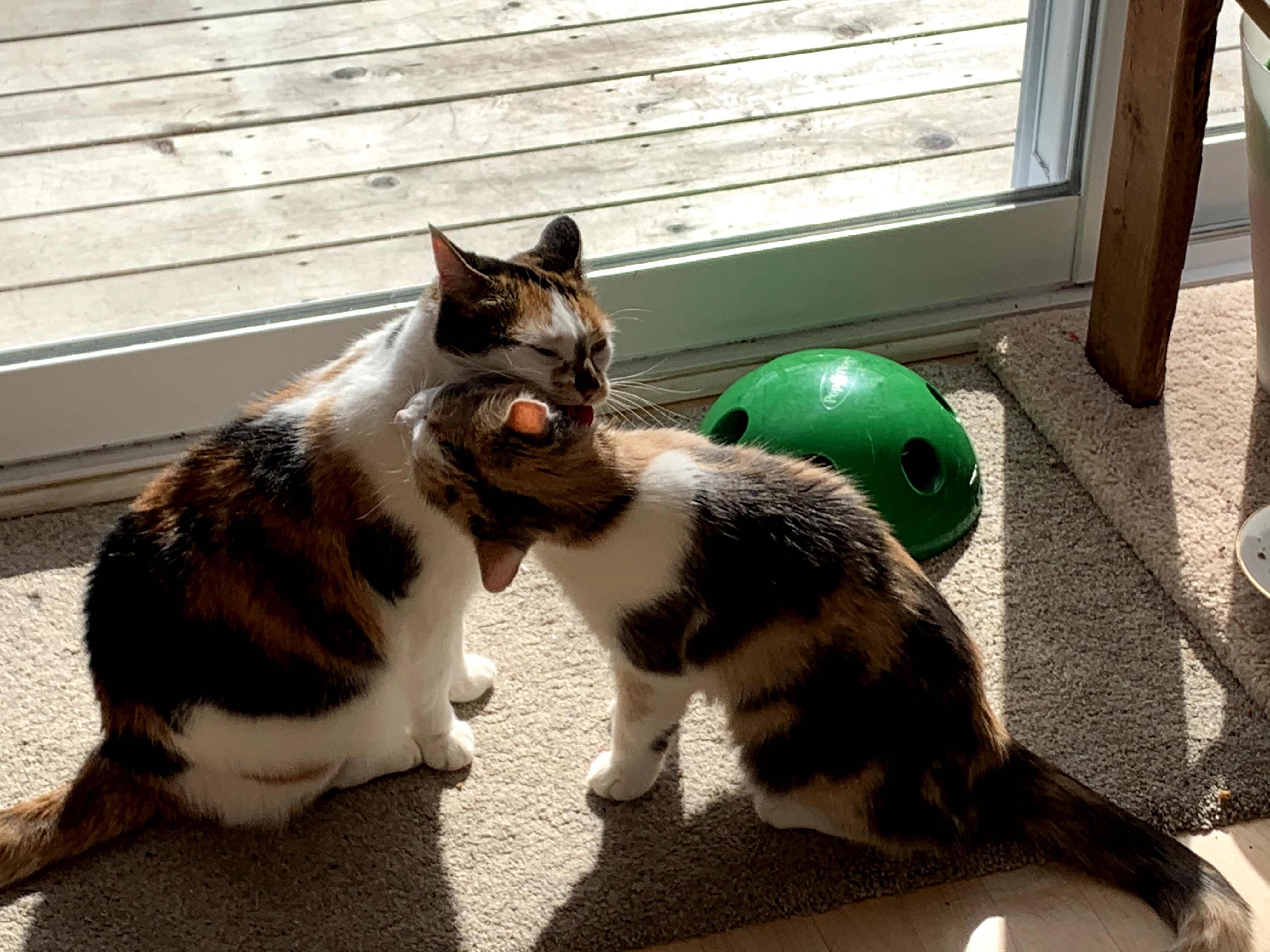


A photo essay of Hera (left) and Tippy (right). They would like you to know that they are not blood-related.
It’s 3:34 and I have forgotten something. I know I have forgotten it because I remember that I was going to be late to my weekly online teacher knitting group (we are lots of fun – for real). I’m pretty sure that the thing I’ve forgotten must start around 6 or 6:30. It’s not the gender reveal party for my brother & sister-in-law’s baby: that was Sunday & I remembered it. It’s not the doctor’s appointment I forgot on Friday and re-scheduled for Wednesday. Dang it – tomorrow’s Wednesday – I’d nearly forgotten. Thomas’s hair cut was on Friday and mine is scheduled for Saturday coming up. The next book club isn’t until April. Marks were due last week and Parent-Teacher interviews aren’t until Thursday night…
No idea.
I have an agenda and I use it. I used to even think I used it well, but that was before the pandemic. With all the craziness of Covid, I’ve started writing *everything* in pencil, but still: it’s usually mostly there. My bigger problem is that the days insist on running together right now. I regularly spend three or even four days convinced that it’s Wednesday. Usually I’m right at least once.
And now it’s after 4pm. I’ve updated my CV, answered some emails, talked on the phone… I still don’t know what I’ve forgotten, but whatever it is, I’m getting closer to having missed it. Soon, I’ll be past the feeling of dread and segue right into a feeling of regret about whatever it is. Oh sure, there’s a chance that someone will call me between now and whenever the thing I’ve forgotten is supposed to happen. Maybe they’ll remind me before I miss it. But probably not. Pretty much everyone I know isn’t quite sure if today is Wednesday. Or Thursday. Or Monday. Or maybe Tuesday? Who knows? One way or another, someone will be at whatever event I’m about to miss. I hope they take good notes.
Update: 5:02 and I’ve remembered what I forgot but I have, indeed, already missed it and, as predicted, have moved directly into regret. SIGH. The good news is that I have plenty more opportunities to forget meetings in the coming weeks, and maybe next time I’ll remember what I forgot before I miss it.
A few days ago, Terje wrote a slice about her name. And then Elisabeth followed suit. And in her book Being the Change, Sarah K. Ahmed suggests having students write the story of their name as an identity activity. AND I’ve been working with my own students on how our identity affects our interpretation of information. So how could I resist? It’s time for a name story.
My name is Amanda. When I was little, it was an unusual name. In fact, I have a fill-in-the-blank journal from 4th grade where I wrote that my name was “old fashioned.” During the middle school name-sticker phase, I had no name stickers. A nurse named Amanda who worked with my father once bought me stickers because she, too, was excited to see our name in a store. (Amanda tchochkes abound these days; the generation behind me has no idea how we older Amandas suffered.)
I liked Amanda – though everyone called me Mandy and I like that, too. It was just unusual enough to be mine, but it was still easy to say. And it was certainly better than another choice that lurked in my baby book: Jemima. I used to imagine a whole different life for Jemima-me. I assure you that she wasn’t not doing nearly as well in life as I was. In college, Amanda was written on the door of my freshman dorm & Amanda I became. These days, I go by both.
But that’s not the story.
During my junior year abroad, my friends and I traveled over Spring Break. We left France and headed to Salzburg, Vienna, Prague and Budapest. We were four young women: a tall redhead, a willowy brunette, a blue-eyed blonde and a curly-haired brunette. I’ve seen the pictures; we caught the eye. We can (and will) tell story after story from that trip. For example, in Prague,we followed our guidebook’s dubious suggestion and “found” a room offered by someone who met the train at the quai. We ended up staying in an apartment owned by a fast-talking British (?) guy who decided to go ahead and stay the night with us. (I know, I know. It’s a miracle any child of the 70s or 80s survived.)
We settled in, drank some cheap Russian champagne, and then happily agreed to go dancing with our new friend. Once we arrived at the club, he quickly found friends for each of us to chat with, while he stayed with the willowy brunette. I had a boyfriend in France, thus making me harder to match, but he managed: I soon found myself deep in conversation with an incredibly handsome Swedish man named Torin. He was in Prague to collect art. He spoke French, English and heaven only knows what else. Our conversation ranged from books to art to travel. Soon, he asked me to dance, and there I was, at a club in Prague, dancing with a gorgeous Swedish intellectual who leaned over to me and said, “Amanda. Such a name. Do you know what it means?”
I did. I do. But I still let him tell me.
“Amanda, worthy of love.”
I mean, who derives the Latin root of a name as a pick up line? I was very nearly swept off my feet. But not quite. As he leaned in to kiss me – of course he would, after that little gem – I turned my head. “I still have a boyfriend.” He smiled ruefully, “and your constancy makes it harder to let you go.” (I’m not even kidding – he talked like that.) We danced and talked all evening. We did not exchange information and this was long before the internet. One night was one night.
My French boyfriend, wonderful though he was, did not collect art or speak multiple languages. He had no idea what my name meant in Latin. He was, nevertheless, my first love. We stayed together for a while, and then we broke up. I’ve never been back to Prague, and no one else has ever tried to pick me up with such an urbane pick up line. Sometimes, I still think about Torin and Prague and that carefree trip. After all, while I’m now a middle-aged wife (Honey), mother (Mama or Mom), and teacher (Miss), I remain Amanda, worthy of love.
My son and I are sitting at the kitchen island, working together. His 7th grade teachers are very big on projects and presentations, so he spends a lot of time creating slideshows – exactly what he’s doing right now. As it turns out, hybrid teaching also requires quite a few slideshows, so I’m doing the same thing.
He loves it when we work together, laptops side by side. Mid-afternoon on Sunday, and he’s still shirtless, wrapped in a blanket. Right now he’s looking up information about Selma and the March to Montgomery for a presentation on John Legend and Common’s song “Glory”. He’s already confused and unhappy, and he has not yet gotten to the worst of it: he’s just about to learn about Bloody Sunday, 56 years ago today. And… here it is.
“Um, Mom, there’s something I don’t understand,” he begins.
Me neither, my love
“Didn’t the law say they could vote?”
“Yes. Yes, it did.”
“So why did people elect a racist governor? Didn’t they know he was bad?”
The pandemic means that I have had the privilege of watching my son’s racial awakening this year, and also the burden. Since my children were small, we’ve read books with protagonists who do not look like them – who are not white boys – and my son’s friends own many identities. Still. There’s knowing and then there’s knowing, and right now he’s starting to grapple with whiteness.
“Why were white people so mean? Why couldn’t they just understand that everyone is a person?”
I badly want to tell him that there were good white people. I want to reassure him, to make him feel better. I want him to learn about James Reeb in the same moments that he is learning about John Lewis, but that’s not the truth. “Not all white people” isn’t what he needs to know.
So we talk about the violent history of whiteness. Briefly, he says, “but not in Canada” and I explain that Canada, too, has systemic racism. This talk is not easy. He does not want this to be true. But it is true, and he needs to know. Eventually, he goes back to his presentation. “What is Ferguson?”
I explain. He feels like Ferguson is long in the past; after all, seven years is over half his lifetime. Isn’t it better now? I remind him of George Floyd’s murder. “Right,” he says, “right.”
This child, this white boy of mine, will need to be part of the solution as our society changes. He needs to know about history – and not just what shows up in his textbooks.
Later, he’s working on a different slideshow, this time about Canadian politician Lincoln Alexander. He asks me to check his work, and I see that he’s written that Alexander “had to work very hard to excel, even harder the I would have to work because of the color of my skin.”
Yes, my love. Exactly. The struggle is with the colour of our skin, not with his.
The first time I understood someone else’s grief was the second time I fell in love with a poem. The day after our beloved Calculus teacher, Doc, died of cancer, the principal announced her passing over the PA.
Doc loved teaching and, I think now, loved us. After her diagnosis, she had taken a summer trip and then decided to keep teaching for as long as she could. We would be her last class – not something we understood at all.
Sometimes, when we were struggling with a concept or deep into a problem, she’d order pizza to be delivered to the school’s back door & sneak it up to the classroom. We’d stay in and do math through lunch. No one ever complained.
Once, when my home life was falling apart, she asked me to come to her house and babysit her granddaughter. I still remember the long quiet afternoon away from home, swaying with the baby as Norah Jones sang “Don’t Know Why.”
After the principal’s dry announcement, Mrs Jackson – 9th grade Algebra – came on. In a voice that quavered at first, she began: “Do not go gentle into that good night”
With each line, each verse her voice grew stronger, until the end: “Do not go gentle into that good night./ Rage, rage against the dying of the light.”
Was there silence then? It was high school; experience tells me that most of the students went right back to talking. But that’s not what I remember: I remember silence. I remember Dylan Thomas’s words reverberating through homeroom, through the hallways, through the school. I remember knowing that I would cry when I got home.
I had no idea that a poem could stop the world like that. I had no idea that grief could echo in empty spaces. I know now.
Now I know.
One way or another, I thought we should get out of the kitchen.
Earlier that day, the construction crew had excavated in order to waterproof our kitchen foundation. But instead of a true foundation, all they’d found was a cinder block wall just casually supporting our kitchen, approximately 14 inches back from the edge of the walls. It was as if, at some point in the past, a couple of guys decided to dig out a basement, and while they were at it one of them looked around and said, “Hey, whaddya think about throwing a few cinder blocks up here? Just in case, ya know?” And the other guy said, “Think we should dig on over to the actual edge of the entire house above us?” And the first one said, “Nah, what’s a foot or two? It’ll still hold things up for now.”
Which meant that now, in 2018, when the foundation crew stopped for the day, we were left with a trench and a flimsy wall rather than the soil that used to help support the kitchen. We also had a small mountain of dug-out dirt towering over the trench. Not ideal, but before they drove off, the guys assured me it was “solid enough” until we figured out what to do.
The tornado threw us for a loop. We don’t have tornados here: this is a government town, and things like that are just a little too dramatic for our tastes – and Ottawa isn’t exactly Tornado Alley. In fact, we were so surprised when the radios and cell phones started blaring about a tornado watch that we kind of ignored it. It just didn’t make any sense. One of my friends hopped in the car with her child to come over to visit. Even if there was going to be a tornado, she said, which seemed ridiculous, it wasn’t due for another 30 minutes. As my friend walked in, she commented that the wind and rain had really picked up.
She was right about “really picked up” given that it had been a lovely day right up until the tornado came. We sat down in the kitchen, our usual gathering place, and poured a “nice to see you” drink. Andre walked in a few minutes later – he’d biked home from work – and he, too, commented on the wind and the rain. “It was so pretty earlier,” he mused as we handed him a drink.
Did I mention that our kitchen was no longer supported?
Mere moments later, through occasional wind-blown gaps in the rain that was now sluicing down our kitchen window, I could make out cascades of water gushing down the pile of mud and directly into the ditch next to our definitely-not-to-code kitchen foundation. “You’ve got to see this!” I gestured my guests over to the window.
We looked out, gasping, and at that moment, as the wind howled around us, we realized that we were watching torrents of water flow into the trench below us next to the sort-of-supportive cinder block wall. Standing next to the window meant we were standing over the trench – which meant we were standing over thin air. The lights flickered. One way or another, I thought, we should get out of the kitchen.
As we settled into the (well-supported) playroom, the lights went out. The kids were horrified and delighted. We rounded up the flashlights and the candles. Within minutes, the winds died down and the rain stopped. From what we could see, the trench had quite a bit of water in it, but there wasn’t much in the basement. Nevertheless, once the tornado had passed, we decided we were better off at a friend’s house for a while. In the end, we were lucky: our house held up, probably because the tornado – which turned out to be several tornadoes – didn’t directly hit our part of town. Our power was out for a while, and school was cancelled the next day, but the foundation crew had been right: that old cinder block wall was, indeed, solid enough. Somewhere in the early 1900s whoever dug out our basement must have known what they were doing after all – thank goodness.
I woke up with a tiny bit of a sore throat and a foggy sort of headache. I hadn’t slept particularly well (possibly because I literally dreamed up a really great assessment for next week – it’s going to be excellent!), so I was sure that everything would be better after a cup of tea and a shower.
Downstairs, I turned on the kettle and fed the cats. While I waited for the water to boil, I closed my eyes and put my head on the cool kitchen counter. I was tired. Once the water was hot, I tried to bustle around the kitchen, getting the morning set up, but my bustle was more of a shuffle. Time for that tea.
By the time the rest of the family was in the kitchen, I knew the truth: “I have a tiny sore throat and I’m a little tired.” Meaningful glances ricocheted around the table. The messages were clear if cacophonous You need to get a test – you’re not allowed go to work if you have even one symptom – she’s not going work – hey, that means we can’t go to school – oh no, we can’t go to school – oh no, now they are ALL going to be home while I try to work. Only my partner spoke, “You need to schedule a test.” Which means we would all need to stay home. This was not how I had envisioned my day. I groaned, but I knew he was right.
While I made an appointment – plenty were available – the ten year old slithered out of the kitchen and slyly installed himself in front of the computer, volume turned down. “I’m checking my Google classroom,” he said when I found him, “but there’s nothing for me to do.” A pathetic attempt to justify Minecraft at 9am; I found several unfinished assignments to keep him busy. The twelve year old, already dressed and ready to go, texted his walking buddy to say he was staying home, opened his laptop, and pulled up a project. “I’ll go ahead and finish that slide show I’ve been working on.” My partner checked on everyone then went to work in what was the guest bedroom but is now his office.
And me? Well, I got a covid test with no waiting – and realized that I haven’t been tested since early November, which means I haven’t felt sick at all since then, so I’m trying to feel lucky. If I can’t muster up “lucky” I can at least fall back on “fine.” I’m giving it a 99% chance that the test comes back negative, hopefully in time to send both kids to school tomorrow, but this is what it means to be part of keeping the community safe. (Update: negative & the kids are off to school.)
355 days. It’s been 355 days of watching for symptoms, of staying distant, of reminding each other of what it means to work together. I’m tired – and it’s not just from a poor night’s sleep. I really hope that my next visit will be for the vaccine. Until then, I’m hoping for lots of early bedtimes and lessons that plan themselves when I’m not trying to sleep.
.
When all else fails, there’s the crossword. In the world of the crossword, everything fits: every letter has its place; every word interlocks. The grid is clear even when the clues are not, the perfect combination of word thinking and pattern thinking. Even if I can’t solve a crossword, I’m comforted by its self-contained certainty.
I do the New York Times crossword. Weekdays, the puzzles are published at 10pm. I should be going to bed by ten, but lately I’ve found myself up, puzzling. What body part name comes from the Latin for “little mouse”? No idea, but – wait – I can almost capture it. I think I knew this once. It will come once I get one of the letters. When will I get the vaccine? I cannot know this; I will not think about it. Metaphor from Homer’s Odyssey, “wine dark ___”? I know that one. I keep going.
Sometimes the puzzles feel like old friends: clues I half recognize, names I dredge up from the past, facts I can place without batting an eye. Sometimes they delight me with their cleverness. Sometimes I am disgusted by their cleverness
Tonight, I told myself that I would be upstairs by 10, but when the time came my mind was jumpy. Monkey mind, I’ve heard it called, and these days I’ve got it. I need to settle my monkey down; racing thoughts will do me no favours as I try to fall asleep. If I just turn on the computer… there, laid out in orderly black and white squares, the reassurance that the world is, ultimately, knowable, that if I can make the right connections, I can complete something. Anything.
I do the crossword, even though I know that in the morning, I will regret having finished it tonight. Ah, well, the morning will have to provide its own reassurances. Sudoku has a lovely grid, too.
Just yesterday I was talking with a friend about the evils of sugar. Just yesterday I agreed with her that the only rational choice is to limit sugar or even to avoid it altogether. I talked about the month a few years ago when I went sugar-free; I remembered that I felt really good by the end, though it was hard in the middle. We commiserated about our children’s sugar habits. Really, we said, when it comes down to it, we should be setting a better example.
So it’s just as well that no one is in the kitchen right now as the gooey insides of a warm butter tart drip down my fingers and into my mouth. My eyes shift to the right: no kids. I scrape my teeth across the cupcake liner to get the last caramelized bits from the edges then quickly crumple the evidence and throw it in the compost. No one needs to know about this.
I’m home today, playing hooky with my older child. Well, I say we’re “playing hooky” but the truth is that I’m not calling it hooky, I’m calling it rest because we both needed a break. Pandemic school is tough, and we’re practicing being kind to ourselves when we need it, so when he asked if we could extend the weekend by a day, I said yes. This morning while he slept in and read in bed, I took a walk, went to the library, and sent a few emails. When my almost-teenager, still wrapped in a blanket, wandered into the kitchen around 11 and asked if we could bake something, I delighted in the opportunity to say yes.
We thumbed through a cookbook, and he chose butter tarts. Before I moved to Canada, I had never heard of these, but the idea is simple: they are tiny pecan pies, usually minus the pecans. Traditionally they are made with a flaky pastry crust, but we opted for a simpler pâte brisée. Easy peasy. Then the filling: a cup of brown sugar, 1/3 cup of melted butter and one egg. That’s it – I mean, you can make it more complicated and some people add raisins or pecans or (shudder) chocolate chips, but we went for the classic. We whisked the ingredients together and spooned them into our crust-lined mini-muffin tins. Mere minutes later, we had butter tarts.

They needed some time to cool and set, so my 12-year-old co-chef went upstairs to play video games while he waited. And I can hardly be blamed if some of the filling had oozed out of its shell, onto my fingers and into my mouth. I sigh, and realize that I won’t be giving up sugar until the sweet days of baking with my boy have passed.
I woke up early to write today but it is no longer early: it is almost time to go. Rather than write first thing, as I had promised myself, I turned on the oven to make my son’s breakfast, turned on the kettle to make myself tea. I fed the cats and checked my email. I read some other slices – to get inspiration, I told myself – and commented. I played a word game in the NYTimes. I dithered.
I love writing but I often struggle to start – and what writer doesn’t? Ideas fill my head at all the moments when I’m not able to write them down. I shape the phrases, find the insights, promise to remember, to catch them…. and then I don’t. Now I’ve committed myself to the 2021 Slice of Life challenge, to writing every day, at a time when I already barely have time to breathe. I sit here, staring at my screen, thinking what have I done?
But I know what I have done: I have committed to try. I have committed to sharing (my OLW for the month is, in fact, publish). I have committed to bringing my imperfect self to the page as often as I can. Truth be told, I am often afraid to show the world my imperfect self – even if the world is just a few readers of this blog. And yet, I will do it.
Last week my students handed in their first major assignment, a personal essay. Because of the structure of the pandemic school year, they wrote their essays and handed them in after seeing me in person, at most, five times. They trusted me with their stories; I really gave them no choice since it was an assignment. Some of the essays are unfinished (Can you help? is written at the top of one, This story is important but it’s hard for me to write about & I don’t know how to end.) but they are written, attempted, shared. This amazes me year after year.
I, of course, have much more practice at writing than my students do. I’ve practiced the tricks to getting something out of my head onto the page and into the world nearly every week for a few years now. This challenge helps me remember the fun and the fear that comes with writing: the community, the chaos, the commitment that is writing. This is why I signed up. This is why I’m here.
For this month I will trust you, reader, with my stories and my imperfect self. Together, we will see what happens. Welcome. Welcome again.
Riding to find the strange and sublime
teacher and learner
Learn about our adventures in RV camping!
A community of readers
A Social Justice Newsletter for Educators
Education and Design: Thinking, Doing, Being
Pretending to be a functioning adult is exhausting
Reflections and ramblings about life as an educator, writer, reader, knitter, and over-thinker. Trying to do the writing only I can do.
"Our lives are connected by a thousand invisible threads..."
Reflecting. Discovering. Learning.
Make them believe.
Sharing Ideas, Strategies and Tools
There's a lot to unpack here.
Lines on Living & Learning
Seeking Ways to Grow Proficient, Motivated, Lifelong Readers & Writers
chris j cluff
Blog
Doing what you like is freedom; liking what you do is happiness.
This is where I write.
 Persistence and Pedagogy