And so it goes..

While searching through my idea files, I found a journal entry from my second week of teaching in France twelve years ago. I’ve tweaked it, but it’s just too funny not to share. So today’s slice is a memory:

Week Two begins and all is well in the world of the Lycée. After the topsy turvy beginning of the French school year, today felt like time to get down to business.

My première class (11th graders) started at 8am (poor things – teenage body clocks just aren’t set for that time!) by writing their (required) summer reading essay. I brought an electric kettle, tea, and coffee to help their brains get moving – and N brought in a few store croissants. I’m not convinced any of them could make heads or tails of One Hundred Years of Solitude by reading it on their own over the summer, and I’m sad that I had to assign this essay before we discussed it. I told them to think of it as practice for when you really don’t know what you’re doing: you come up with something and make damn sure the writing is good because you know the content isn’t. At least I made them laugh before they began. Still, who wants to start the year handing the teacher an essay that doesn’t really represent their ability? Ah well. They wrote for the entire 90 minutes – not one finished early.

All French students have a “trousse”. The technical translation of this is “pencil case”, but the truth is much more complex. A trousse holds the keys to success in the French school system.
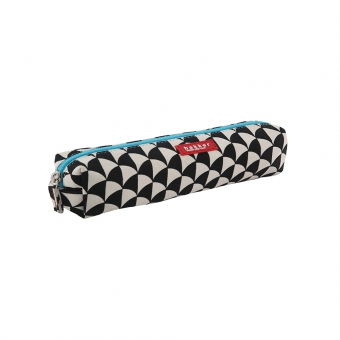
Trousse Canvas Matahari - Noir
Une trousse

Much like Mary Poppins’ magic carpet bag, the trousse might contain anything: I have seen students reach into their trousse and come up with pencils, ball point pens,  ink pens, colored pencils, markers, ink-pen erasers with blue write-over tips,  rulers, scissors, small staplers, paperclips, ponytail holders, small dictionaries, cell phones, TVs,  entire living room sets, deeds to houses, and occasionally originals of the constitutions of various small countries. Every writing task involves a variety of colors and steps: even note-taking requires straight edges to underline headings, colors to show what point goes with what and careful ordering of the points the teacher makes. Me? I make regular use of mind-maps and often end class with a chalkboard full of arrows and circles. So far I’ve resisted the temptation to see how my very organized students are possibly using straight-edges and magic eraser to make sense of my crazy notes, but I’ve already started dreaming up days of mild torture: using multiple colors of chalk haphazardly, starting phrases and then crossing them out, beginning an organized chart then erasing it – or adding to it – in the middle. Someday I’m going to steal all their straight edges and see what happens. I imagine the entire classroom will devolve into chaos.

My 5ème class – the 7th graders – has no problem talking, though I suppose some would argue about how much thought goes into it. They continue to amuse me and I suspect will do so all year. We are preparing for Beowulf – the big beginning comes tomorrow when we actually start reading! Today was all about Anglo-Saxon riddles. Last week this group got very involved in writing out their own epic quests (L’s heroic test was being forced go to the planet of the nerds and dress like a nerd for a week; someone else’s superhuman gift was smelling chocolate 2 miles away), so you can imagine that riddle solving and riddle-writing was a big hit. M was so proud of his short riddle that he forgot to pause at the end and told us the answer the minute he finished reading it.  J told two riddles in a row about spiders (after using Spiderman as his example of an epic hero on Friday), but then fooled us all by telling a third riddle… about a pencil. Today they also saw Old English for the first time, and I was definitely worn out because it took me a full three minutes to get them to stop discussing whether it looked more like Swedish, German or Icelandic. Icelandic?
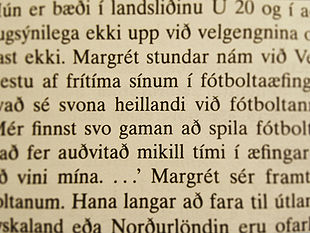
Icelandic

When have they ever seen Icelandic? Sheesh. I can’t wait to get these kids dressed as ancient warriors or to have them re-enact the scene where Beowulf tears Grendel’s arm off. I’m convinced we’re going to get in trouble somehow or another; it’s really only a matter of time with these guys. Sometimes they can’t even quite stay in their seats as we talk. It’s going to be a great year.

Thank heavens for my one hour lunch break. I’m not sure I could have managed two more classes without some food! As it was, when I got to the 4ème class, the 8th graders definitely had a little more control of the room than I did. Perhaps it was because I told them that Petrarch wrote hundreds of sonnets to a woman he only ever saw once in church and never really met; or maybe it was because one of the students figured out early on that they had to write a sonnet for homework. Slowly, the class began to revolve around two themes, neither of which were exactly my point for the day: “but I don’t understand why he didn’t just talk to her” and “wait, it has to rhyme AND be in that rhythm thing we wrote last night?” Um , yeah, that iambic pentameter thing.

Petrarch, engraving
Good thing I didn’t show them this picture of Petrarch (https://www.britannica.com/biography/Petrarch)

So I found myself repeating, again and again, variants of “he couldn’t talk to her and, yes, all sonnets are written in iambic pentameter.”
“But I don’t know that many rhyming words.”
“Does it have to make sense?
“Was she married?”
“If she was married, dummy, she just could’ve gotten a divorce.”
“Not back then.”
“How would you know?”
“What if it doesn’t rhyme?  Will that count off?”
“Oh no – Shakespeare wrote a different kind?”
“Which kind do we have to do?”
“But Shakespeare met the women he wrote about.”
“Do they have to be about girls?”
“I would never have written that many poems about somebody I didn’t even talk to.”

And on we went. Needless to say, we did not have time to try to put together cut up sonnets, nor did we get to Romeo and Juliet’s first scene together when they actually speak two sonnets in a row. By the end of the class, I felt a little bit like the Wicked Witch of the West as she melts and cackles, “Oh, my plans, all my beautiful plans!” Heck, when class came to an end, I felt lucky that anyone actually knew the word sonnet; if they figure out that it’s somehow related to Romeo and Juliet, I think I will be ahead of the game.

And thus I have started my second week. In 5ème L is already one of my sweeties and he knows it. I still don’t know the names of half my 4ème or Seconde classes. Somehow I have to get my 5ème through Beowulf, my 4ème through Romeo and Juliet and my Première through Crime and Punishment; and my Secondes will grimly plod through Huckleberry Finn unless I can get them to engage. And in all of this, I’m supposed to settle in to France, get my paperwork completed and keep my sanity. I’m sure that can all happen – I’m just not sure it can all happen to me. But, as Kurt Vonnegut said, and as precisely none of my Secondes understood (perhaps because half of their essays relied heavily on internet sources), “so it goes”.

And so it does go.


Imitation is the sincerest form of flattery

11454297503_e27946e4ff_h
I have been thinking a lot about Wallace Stevens for the past few days. As one does. His poem “The Disillusionment of Ten O’Clock” has been on my mind. Today, I think I’ll write an imitation. Or a parody. Or, well, a poem like his.

First, here’s his poem:

The Disillusionment of Ten O’Clock

The houses are haunted
By white night-gowns.
None are green,
Or purple with green rings,
Or green with yellow rings,
Or yellow with blue rings.
None of them are strange,
With socks of lace
And beaded ceintures.
People are not going
To dream of baboons and periwinkles.
Only, here and there, an old sailor,
Drunk and asleep in his boots,
Catches Tigers
In red weather.


Now mine:

The Disillusionment of the Day Before Spring Break

The classrooms are haunted

By lecturing teachers.
None are laughing,
Or talking with laughing students,
Or laughing with crying students,
Or crying with writing students.
None of them are strange,
With hats of feathers
And rainbow waistcoats.
Teachers are not going
To speak of Uranus and bubbles.
Only, here and there, an old writer,
Daring and aware that the principal is gone,
Teaches Writers
In red weather.

Taking a page from Alice Nine, I want to think for a minute about what I did here, especially because I sometimes ask my students to play with poem imitation.

I knew I wanted to write about school on Friday right before the break. I had been struck by how empty the hallways were in our normally busy school. Many of our students and teachers are on various March Break trips, and it was snowing, so we had some serious attrition as the day went on. By 3:30, our lively school was a ghost town. Nevertheless, when I thought about how to write this as a slice of life, I came up blank: yup, the school was quiet the day before a long break. Nothing to see here, move along. It was so mundane as to be unremarkable – yet it seemed remarkable to me.

Wallace Stevens really has been on my mind for a few weeks, so the idea that the school was just a ghost of all its possibility easily brought this poem to mind. (Note to self: you can’t be inspired by what you haven’t read.) Also, the teachers have been preparing a silly surprise for our principal (who has a good sense of humour and who went on one of the school trips), so I was thinking about our really goofy sides. (I can’t post the pictures in case someone from my school stumbles across this & somehow the principal sees – suffice it to say that we’ve been having fun.)

Stevens sees what happens when we let the mundane take over all the wild possibilities. What are the wild possibilities in the classroom? At first, I had the teachers “droning” and the list of things the teachers weren’t doing was more realistic, but then I took a second look and noticed that “white nightgowns” are unremarkable and, more importantly, non-judgmental… that is, until you read the rest of the poem. Teachers lecturing probably won’t catch anyone’s attention in an early line – it’s what we assume high school teachers do – but the wilder possibilities in the next three lines should change that.

In the next three lines Stevens has a careful pattern – pulling a colour from one line into the next – and all these colours exist very firmly in the realm of possibility. It took me several tries to find a way to make my phrases do the same thing. In fact, only at the last minute did I realize that I could replace the “rings” in his poem with “students” in mine. That opened things up for me.

I love the lines about the “socks of lace” and the “beaded ceintures” because “socks of lace” pulls my attention when “lace socks” might not. And I imagine that Stevens originally wrote “beaded belts” (nice alliteration, Wallace!) and then revised it to something more unusual and evocative. (“Damn the alliteration, I’ll use ‘ceintures!’ That’ll get ’em!”) I actually started my line writing “Fascinators of feathers” then realized that “socks” are mundane and switched to “hats.” I couldn’t quite find an equivalent for “ceintures” but I decided “waistcoat” was near enough and I like the assonance that came from rainbow.

Uranus and bubbles just came to me. Probably because another blogger I read recently (can’t remember which one – sorry!) wrote about talking with her nephew and Uranus came up.

Finally, who might replace the old drunk sailor? Who in our school was dreaming big dreams on Friday afternoon? Well, a writing teacher, obviously. Someone who has journeyed and knows about possibilities. (Yes, yes, I’m biased.) And a reference to our absent principal, who allows us to play, followed by the red weather line because a) I didn’t know what else to write and b) I like a nod to the original when I write imitations.

I’m not sure I knew how much went into this until I wrote it down. Well, no wonder it’s hard for my students. WHEW!

The harm I’ve done; the lesson I’ve learned

I knew that Martin had cheated.

I was teaching EFL in Bulgaria – my first year of teaching – and most of my students were spellbound by my American-ness. After seven months, I was beginning to think that I had mastered the art of teaching or, better yet, that I was simply a natural teacher.

What was so hard after all? Discipline was a breeze: most of my students wanted to be in my classroom. Motivation was a snap: everything I assigned fascinated them just because it was from me. Of course, a few students refused to believe in my American magic, but I had fallen under my own spell and thought of these few as difficult, recalcitrant, even bad.

In fact, cheating was one of the only problems I had encountered in my short time in the classroom. Today I know that I had no idea how to teach writing. I didn’t model, scaffold or even help with revision. As a result, for their first assignment nearly all of my students had turned in essays copied from some famous work or another.

I really believed that these children of a failed Communist state valued accuracy and impressiveness over creative thought. I had no idea that I had played a role in the outcome, so it was hard to tell who was more befuddled by the Fs I gave back on that first assignment – me at what I perceived as my students’ betrayal, or them at my unrealistic expectations.

A few months’ experience had made me a slightly better teacher. I had learned to articulate my expectations more clearly and my ever-attentive students had worked to meet me well more than halfway. It didn’t hurt that the students generally liked me and, mostly, wanted to please me. I rarely received plagiarized papers anymore. Until Martin’s.

He was unconcerned as he swaggered up to my desk after class. He gave his friends suggestive looks as if I were going to proposition him or ask him on a date. I shooed them out of the room, and he planted himself in front of me with an impressive “I don’t care about anything you do” stance: shoulders slumped, hands jammed in his pockets, chin jutted sideways. He assumed an air of infinite boredom. I realize now that he must have been waiting for praise on his essay.

The essay was about his grandfather and his wartime exploits. It was nearly perfect and absolutely fascinating, so I assumed that it was someone else’s grandfather’s exploits. I hadn’t even bothered to finish reading it. After all, Martin’s work in English had been far from perfect to date – when he did it, that was. Frustratingly, I thought that he and I had recently made a connection, and I was angry that he had copied this essay now that we were on the verge of understanding one another. It didn’t matter: he was one of the “bad” kids who didn’t hang on my every word.

Martin was clearly smart, and he had no natural respect for me. He didn’t care if I was from the US or Mars, and I found his apparent lack of motivation more frustrating than anything else I had encountered. I had no idea how to encourage him. Sometimes I felt that his attitude, his unwillingness to do his work, was calling my bluff: I was just masquerading as a teacher. His lack of respect for me fed my growing fear that maybe this teaching thing wasn’t as easy as I had imagined.

I accused him of cheating. Martin was silent for a long moment before he ripped his essay out of my hands.  He raged back to his seat.  He grabbed his bag and shouted his way to the door. Through the noise and garbled grammar, I discovered that Martin had spent hours on the essay. His grandfather was, perhaps, the most important person in his life. He had taught Martin everything. Martin had wanted me to know his grandfather and had worked and worked to show him to me.

I cried after he left. Nothing I could say or do made any difference (and in my youthful chagrin I changed his grade to an A, as if that were the important thing). Martin had long known what I had just realized: I didn’t see him as a whole person but rather as just another kid in my English class, just another one of the bad boys, just another, but not unique. My accusation confirmed his opinion. If I had read the whole thing, if I had listened to the note of honesty that rang through the essay, if I had paused for even a moment, I might have seen Martin, the real Martin, who had tentatively entrusted me with a bit of himself in that essay.  But I hadn’t.

In my whole career, I may never want to go back and fix something as badly as I want to go back and fix that day. But since that awful confrontation, I have tried, in Martin’s honor, to remember every day that I teach whole people, people with lives outside of my classroom and outside of the school. I teach people with problems at home, secrets to keep, and dreams they desperately need to share. I teach people who have amazing grandfathers. Martin may never know that I know this, but I always will. It has shaped my career. It has changed my life.

And I really really hope that it has not shaped his.

What we are creating

Today, a young woman I have never met before came into the Special Education room and asked, “Is there anyone here who could help me with an essay?” In Spec Ed I pretty much always get to answer those questions with a resounding “YES”. It’s fantastic.

She and I sat side by side looking at the essay she had written and the comments her teacher had made. The essay was already strong, and the teacher had ideas for how to make it stronger: try discussing your theme in more depth in the introduction; try making your topic sentences more specific to what you are proving; try breaking down long quotes and discussing the importance of particular words or images. The suggestions were clear and came with thoughtful direction.

The teacher had not provided a grade on the essay, and the young woman was quite nervous. We spent time deeply focused on the comments, what they implied about the essay in its current form, what they envisioned for a future form. We looked back and forth between the essay and the comments, talking, pointing, questioning. Eventually, I left her to her writing and moved on to work with other students.

At some point while I was talking to another student, she finished up and left. She didn’t say goodbye; she didn’t need to. She was deep into her own learning and confident in her own process. I was delighted, and I kept smiling a secret little smile as I continued through the morning.

This was the story I told about my day when I got home, and then the story I wanted to write about today, which made me curious: What was it about this interaction that was buoying me up? I have edited literally thousands of essays with students. I have helped thousands of students. As great as this interaction was, it has happened before and it will happen again. (Though I freely admit that I love it every time.)

I thought about the moment when she understood how to re-shape her topic sentences. How she suddenly said, “Oh! So stop trying to be general and really dig in to what I’m going to be saying in the paragraph. It’s almost like leaving off my old first sentence.” Was that it? It should be, but no…

What old first sentence did I need to leave off to see what was really going on? How could I re-view my experience of this? I decided to do what I tell my students: just start writing and see where you end up. It’s only a first draft.

And sure enough, as I wrote, I got it. That young woman who stopped into Spec Ed for help: she doesn’t have an IEP. In fact, she doesn’t have an IEP, she’s in a Grade 12 University level English class, and by all accounts (I asked her teacher), she’s an excellent student. But she came to Spec Ed for help. This is fantastic. Our Special Education room is becoming the room we’ve envisioned: everyone who wants to learn is welcome. Spec Ed is a space for learning strategies, for valuing how we learn and that we learn. You don’t need an IEP to look honestly at your strengths and your needs and figure out how to mesh those two things. You don’t need a learning disability to realize that you need help. And if you *do* have a learning disability, you should have a place that values learning for all. That’s why helping another student with another essay made my day. We’ve created a real learning space right in the middle of the school.

And now, I take a leap. This isn’t my first draft (I’ve been revising as I go), but it’s not a polished piece, either. This is my first blog and today I will publish a piece that is definitely still in progress. Since I decided to participate in the month-long Slice Of Life challenge, I’m going to have more of these, and I’m not used to it. Still, if I value learning and I value writing, then I value the process as much as the product. I say this *all the time*; today, thanks to this challenge, I start to live it. Here goes publishing a draft…


Carrot-ing on

Image result for carrots

I’m just going to leave this here at the top: I promise that we have tried everything. But…

I just found these carrots on the table near my son’s lunch bag.

Two lonely carrots.

This morning, they were half of a quartet, nestled into a shiny silver container, part of a brilliantly healthy lunch I provided for my darling child.

Who doesn’t eat vegetables. Or fruit. Or most meats. Or, honestly, many foods that aren’t beige. Except yogurt. He eats vanilla yogurt. And hamburgers. Plain hamburgers.

There was one amazing day in his 7 years on this planet when he wavered ever-so-slightly in his anti-vegetable convictions and said he would eat carrots.

To be precise, he said he would eat baby carrots, the “new” ones that look “wet.”

And he did: he ate carrots! For a week – or maybe two – the memory is a little hazy now, blurred by my euphoria, faded by time…

Because of course he stopped. And, being who he is, he now refuses to eat the carrots. Nevertheless, I continue to put carrots in his lunch, undeterred by their daily return, now a little dry and sad looking, languishing in the bottom of the container in the bottom of his bag. Every day, I add the carrots, three if they are “big”; four if they are “small.” (These are baby carrots; they are, by definition, not big. This fact is of no interest to my child.)

He does not eat them at school. Ever. He has not eaten carrots for lunch this entire school year. When he comes home, I open his lunch box and, ever hopeful, peer inside each container. Maybe today he ate an apple. Possibly he consumed some grapes. Finally, wearily, I check the carrots. They are always there.

I pick up the open container and go in search of the boy. I point out that he has not eaten his carrots. He agrees that this is the case. I tell him he must eat his carrots. Mostly, he consents to eat two.

I eat the other two.

Later, after he is asleep, I begin again. I open the fridge and remove four small, wet baby carrots. I nestle them into the shiny container. I tuck the container into his lunch bag. I send them to school, glaringly obvious in a sea of beige food.

Maybe today he will eat them.

PS – The 7-year-old in question has approved this post, though he wants you to know that I have exaggerated a little. His 9-year-old brother also approves this post, doesn’t believe there’s much exaggeration, and would like you to know that he eats everything.

On Becoming a Teacher

I was in fourth grade. We were in the dining room for a fancier than normal dinner. I’m pretty sure that the neighbors were over. Someone was asking all the children what they wanted to be. My sister, who was in kindergarten, wanted to be a garbageman. Everyone laughed. I wanted to be a teacher. My father was curt, “Don’t be silly. You’re too smart to be a teacher.” No one disagreed. The chair pushed hard against my back. I stared through the door into the kitchen beyond. I didn’t want to cry. And the conversation moved on.

I was in college, considering a career in the foreign service. My school didn’t even offer an Education major. I studied Economics and International Politics, Political Science and Philosophy. I went to a fancy dinner party. I was wearing a long dress, holding a cocktail in a dark-paneled room. I laughed as I told an acquaintance that I wasn’t a grown-up yet because I still hadn’t quite gotten over that standard childhood dream of being a teacher. She looked perplexed. My voice rose as my statement became a question, “You know, how everyone wants to be a teacher when they’re young?” She said, “No one I know wanted to be a teacher.” And the conversation moved on.

I was in the hallway of my boyfriend’s apartment in France. I curled the phone cord around my finger and told my father that I still wanted to teach, that I had always wanted to teach. I told him that teachers should be society’s best. He agreed. I tried not to cry. And the conversation moved on.

I took a class that allowed me to teach in a local elementary school. I took a job that allowed me to teach my colleagues. I moved overseas so I could “see if I like teaching.” I did. I applied to grad school. I taught and I taught and I taught.

I sat in the principal’s office, interviewing for a job I couldn’t hope to get. I was only sort of qualified. It was after hiring season. I only had the interview because of a friend of a friend. The office was paneled in dark wood and the hard chair pressed into my back as we talked. As the conversation moved on, I confessed that I was more of an English teacher than a Math teacher. She was curt, “Nonsense. You are very clearly a teacher of students.” And I was.

And I am.

Late to class

pexels-photo-280264.jpeg
I was late to class today. I was so late that the Vice Principal unlocked my classroom door then called up to the English office and asked if I was coming. Yikes!

I rushed downstairs, embarrassed and flustered, and my class greeted me with giddy laughter.

“Miss!” they hooted, “you are LATE!”
“You gonna have to stay after!”
“We gonna write your parents!”
“We’re gonna write an email to you and bcc your parents!”

That last one made me burst out laughing. We just learned about cc and bcc on Friday. My students’ eyes had widened when they realized what bcc meant, how it worked. One boy declared, “Well, that’s just evil,” and I had laughed out loud, but I struggled to find even one example of bcc that my students thought was acceptable use (aka “not evil”).

“I have a perfectly good excuse,” I batted my eyes and looked chastened. “You don’t need to tell my parents,” I paused, “or the principal.”

“I’m gonna email your parents and BCC the principal!” called one perpetually late student. Everyone fell into gales of laughter.

Once we settled into our lesson, my students busily writing about today’s picture prompt, I had a moment to reflect. How do I treat late students? I try to be aware, to remember that sometimes life gets busy for these kids, that English class isn’t always their top priority. Today I got confused. It happens. Lots of things happen.

I know that I am respectful of the almost-never-late student. That’s easy. And I can handle the occasionally late student, but how do I treat my perpetually late students? They mostly come in BIG, swaggering and waving their way into the classroom, disrupting class and (though I hate to admit it) making me angry. I have tried to teach them how to come in small, we’ve even practiced, but change is a struggle. They arrive loud and swaggering anyway, prepared for whatever I throw at them: reminders that they will have to stay after class, public scolding, comments about emailing their parents again. I try to be mindful, I do. In general we do more laughing than shouting in our classroom, but still…

Today I’m wondering what it feels like to be a student rushing to English class, late again, knowing that I will be waiting. Maybe tomorrow I will ask them. Maybe I will remember that my students always have reasons for their behaviour, even when I don’t understand or condone the reasons. Maybe tomorrow I will be just a little more patient.

I think it’s a good thing I was late today. Even if the VP did have to call. And for the record, I do have a good excuse.


8am and a funeral awaits

It’s 8am. I should be on my way to work. Instead, I am sitting here, uncomfortable in my black dress and sheer nylons. At least I’m still wearing my slippers, but I can see a sliver of black heels lurking around the corner in the front hallway. I’ve blown my hair dry and put on my make-up. I’ve already taken my final sip of tea. It’s time to go, but I don’t want to leave.

When I walk out of this cozy house, away from the comfortable chair and the mercifully impersonal computer screen, I’m not heading to the school. My students won’t greet me with comments on my haircut (so much shorter!) or my fancy clothes (why are you so dressed up?). I’m going to a funeral.

This one is hard. I suppose all funerals all. I don’t even know the deceased, but I do know his daughter. His funny, loud, thoughtful, expressive, loving, wonderful daughter. She is not my student; she is my colleague. She is great in the classroom. She has some sort of crazy ability to see into the very heart of her students – especially the ones who have made themselves almost invisible to others – and she challenges them all to rise and rise to the very top of their abilities. Students don’t all love her, but those who do love her fiercely, unconditionally. And before she went on leave, she was mad at me.

There’s not much I can do about her anger. The cause is so transient as to be irrelevant. I know that the anger will pass, that I am only a convenient target for frustrations that were so widely scattered that she could barely keep them all in sight. But she was really mad. And I was trying to be patient.

I am not always patient.

And now her father has died. This wonderful woman is in pain. I do not want to add to her pain. I want her to know that, even though she is mad at me and even though I am not always patient, I will continue to support her and even to love her.

I hope that the heels and the sheer tights and the black dress and the new haircut speak loudly of love because I’m not sure that I will have the words.

The Slice of Life Challenge (Day 3; my day 1)

So. Welcome to me.

I have decided to participate in the Slice of Life Story Challenge, and I honestly have no idea what I’m doing. I have to send a permalink to someone, somewhere and… I’m not sure. But I’m doing this anyway because I have wanted to start a teaching blog, and I have wanted to write daily, and I have wanted to participate in a virtual community of educators, and so far I have done none of these things.

I am like my students in this way: I have so many excuses about why I can’t write.
And I am also like my students in this way: I can be impulsively enthusiastic about something that I may or may not be able to finish.

When one of my students is ready to leap into the unknown, I often ask them to think about the possible consequences of their choice: what good might come of this? what are the downsides? what might happen if you fail? what will happen if you don’t try? what will you learn?

Well, there’s not much downside here. I figure out how to create a permalink and where to send this permalink and then… I try. I try something new. I try something I have wanted to do. And I might fail – but I might not. And either way I’ll learn something.

So. Welcome to me.

Slice of life today:
Drive. Drop. Pick up. Shop.
Stir. Mix. Spread. Whisk.
Roast. Steep. Bake. Simmer.
Read. Dress. Kiss. Love.
Talk. Think. Create. Write.
Then sleep. Sweet sleep.