
My Grade 10 students are, generally, a suspicious lot when it comes to English class. If they’re having fun, they pretty much want to know when the other shoe is going to drop. As I mentioned in my last post, this stream of English is called “Applied”; I try to take that descriptor seriously. How will we use this? What do we get out of this? Why bother? These are guiding questions in the classroom.
And we had the *best* poetry class today. A while ago I found an article by Prof Toby Emert on The Poetry Foundation website. In it, he talks about “exploratory methods for interacting with poems” and details a workshop he designed to “help students respond to poetry in ways that encourage them to love the poems and to enhance the skill set they need to engage in deep readings of texts.”
Well, I happen to know a few students whose skill set for deep reading is, ahem, not well developed. And I have been reading about why poetry can be a good entry for reluctant readers, so I was committed to trying this out.
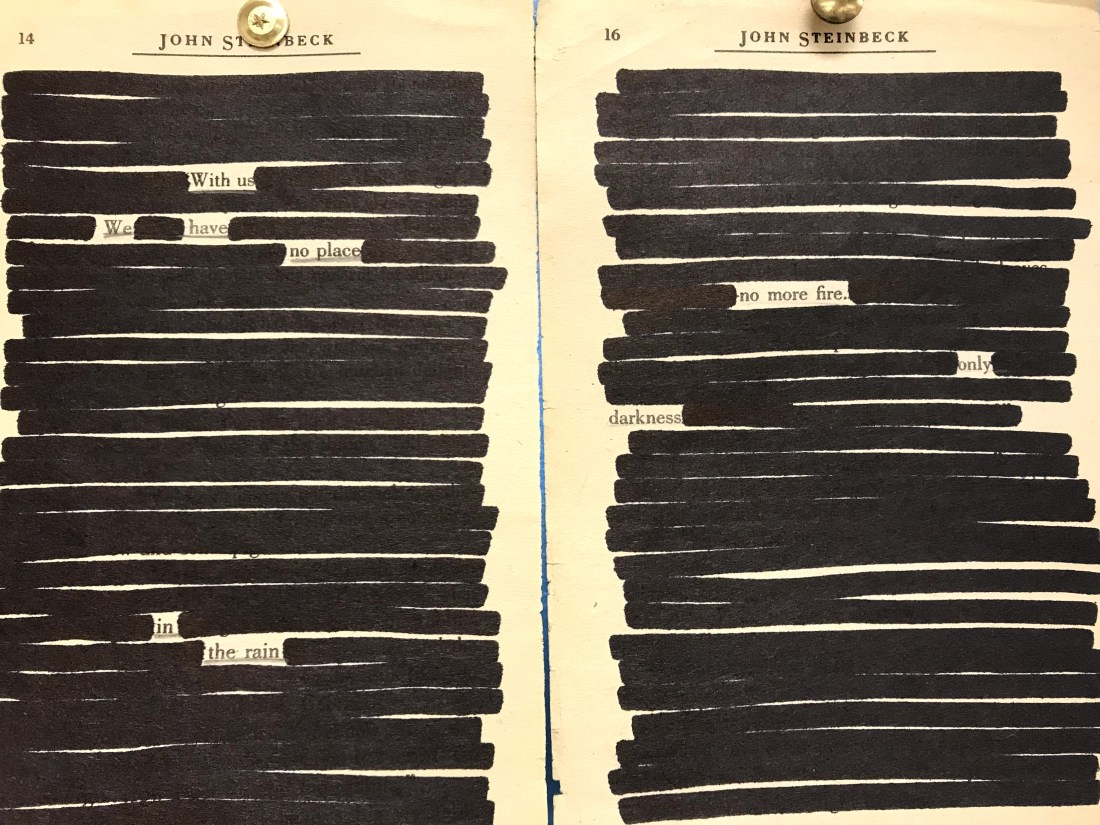
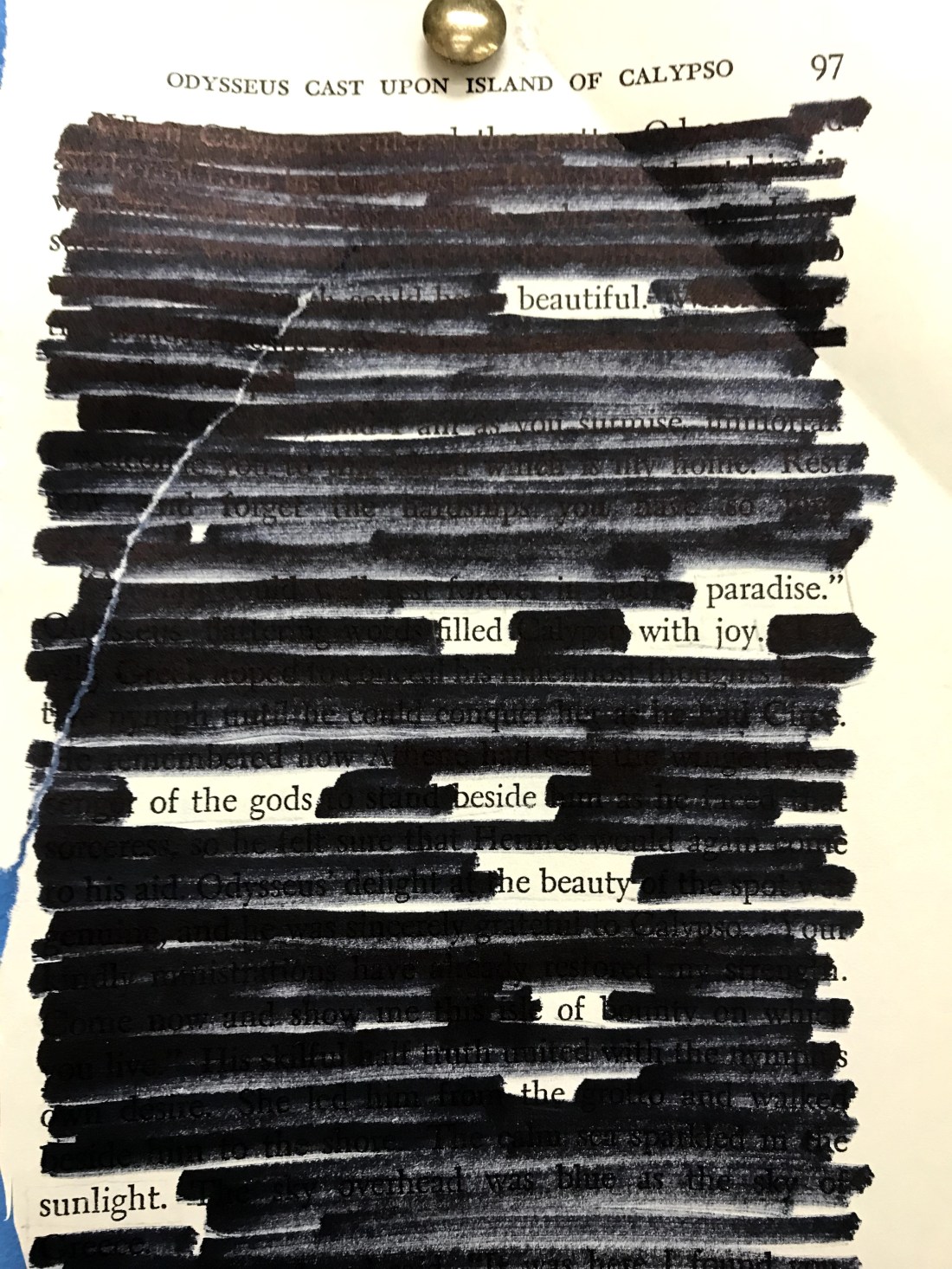
Background: We’ve already spent five periods on poetry, mostly just playing around. We’ve read mentor texts and tried out blackout poems, list poems, book spine poetry; we’ve rotated through stations of haiku, cinquain, skinny and concrete poetry; we’ve listened to spoken word poetry, and we’ve even collected words. We’re ready to go deeper.
Ok, ok, ok… but you want to know what we did today. Well, we did what Prof Emert suggested – and it worked.
I photocopied Introduction to Poetry by Billy Collins, Poetry by Pablo Neruda and Ars Poetica by Archibald MacLeish onto the biggest paper I could find. I think any three poems on a similar topic but with varying tones would do the trick here, but Emert suggested these, so I followed.
These poems are *way* beyond what my students would normally access. Not only is the vocabulary hard (palpable, palpitating, casement, etc.) but their length and metaphoric thinking was more than we had approached as a class. That was important. I wanted them to be in over their heads a little, to react to the poem at a level beyond literal comprehension. I wanted them to do what Emert suggests: be willing to climb inside a poem and sit awhile.
I posted each poem on the chalkboard, spaced well apart. Next to each poem I wrote two sentence stems. I told the students that we don’t always understand a poem right away – and that’s ok. (I was rewarded with a dramatic eye roll.) I told them that sometimes poems just sit with us, we just feel them. Sometimes we hate them and walk away; sometimes we’re intrigued; sometimes they grow on us. I reassured them that, while they might not *get* a poem, they could still react to it. (I admit it: I talked about Gertrude Stein.)
The students, in groups of three, read the poems then used sticky notes to complete the sentence stems in response to the poem.
If I were sitting next to this poem, waiting for the bus, it would say…
If I went on a date with this poem, we would…
If this poem could fly, it would…
In this poem’s pockets are…
If this poem were a burrito, it would…
This poem is hiding…
The students started slowly. They kept looking to me for permission. I kept insisting that they should write what came to mind. “Poems aren’t burritos…” one muttered. “Why would I date a poem? That doesn’t even make sense,” grumbled another.
I tried to overhear beginning responses and encourage them.
“If it were a burrito, it would… be cheesy?” ventured one boy.
“YES!” said the extremely enthusiastic teacher behind him (ok, ok, that was me). “Write that down!” He looked doubtful, but he did it.
Once they got the hang of it, they moved quickly. The sentence stems were so outrageous that the kids felt free to be silly. Each group spent 3-5 minutes with each poem (more time earlier on, but then they got going).
“Did you understand these poems?”
NO! Not really… a little… maybe… no… they were defiant, sheepish.
“Remember that you don’t HAVE to understand it. And anyway, I think you *did* get them.”
I asked which poem was the funny one, the most beautiful, the most serious. They absolutely knew. I told them that they had identified tone. They were impressed. We read their responses out loud and, lo and behold, they (mostly) matched the poems’ varying tones. (I’ve included some of their responses at the end in case you want to see.)
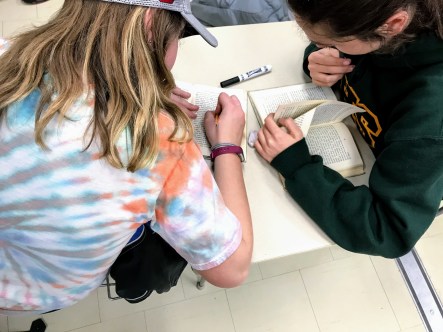
Next, I distributed a copy of Nikki Giovanni’s kidnap poem to each group. I asked them to “have a little conversation” with the poem by asking a question of each line. Again, we had a slow start here, but this time, they decided to humour my odd request, especially once I encouraged them to start with any line they wanted; within a few minutes, each group was writing questions after every line.
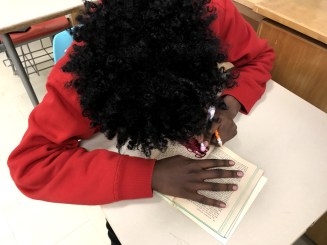
Soon, giggles and guffaws filled the room. I heard one student say, “Ask her what lyre means” and another reply, “no, no ask the poem.” Everywhere, heads bent over Giovanni’s work. Pencils and pens marked up the lines. Shh! Don’t tell anyone that these kids were annotating a complex poem, line by line. Any group that finished took their notebooks to collect words and phrases from the posted poems.
The final magic happened when everyone was finished with the questions. Each group chose two people (future reference: I might do this whole exercise in pairs) to read the poem out loud like a dialogue: line of poetry/question. This valued their voices as equal partners to the author’s voice and moved us gently in the direction of reading poems aloud. Their questions, their reactions became part of the poem itself.
The first group read & everyone listened. Their honest and sometimes aggressive or bewildered questions were funny. Everyone laughed and applauded at the end. Groups volunteered to read next. Each dialogue was better than the last. Another teacher walked into the room, talking, and my students shushed him. The bell rang just after we finished.
Today’s exit question was “summarize today’s class in one word.” Their responses?
fun, hilarious, funny, fast, creative, effervescent(!), energetic, good.
I am not exaggerating when I say that not one of them used a negative or even a neutral word to describe their study of four complex poems. It was magic.

************
Here are some of the responses to the sentence stems I used. (I’ve put some of the less effective responses are in parentheses because I want to be clear that this exercise was imperfect. In class I read all the responses but highlighted responses that seemed sensitive to tone. I wanted the students to feel success as a group.)
Billy Collins =>
If I were sitting next to this poem, waiting for the bus, it would say…s’up dude, what’s popping?; hey, wanna fight?; Boo! (bye, Felicia; Where are you going?; seal)
If I went on a date with this poem, we would… go on a game show and find a new date, make an excuse to leave, be scared go skydiving and then go swimming (go to the cinema, kiss, stop talking)
Neruda =>
In this poem’s pockets are… figures of speech, la poesie, (empty, key lime pie, memes, a Rolex)
If this poem could fly, it would… fly with broken wings, glide beautifully, be a dove (go to Ikea, fall)
MacLeish =>
If this poem were a burrito, it would…be a stuffed burrito; be too cheesy; not last long; have too much hot sauce; have guacamole
This poem is hiding… a message, sadness, its soulmate, the truth, in a Disneyland ride (seals; something; words)