The student (prose poem)

April is Poetry Month, so I’ve been occasionally stopping over at EthicalELA to participate in Verse love and write some poetry. The people who write there are incredibly supportive, which encourages me to keep playing even though writing poetry intimidates me. Today’s prompt suggested writing a prose poem (a poem that looks like a paragraph but reads, somehow, like poetry), something which has fascinated me for a few years now – ever since I discovered Nicole Stellon O’Donnell’s book of poems You Are No Longer In Trouble – specifically, the poem “Marriage,” which makes me giggle. Here, see what I mean:

Marriage

The rash of weddings at recess continued until Mrs. Provencher had to give a talk. You are third graders. You cannot be married. Parents had called to express their concerns. The margarine tubs full of violets in your desk were bouquets and the flower girls had carried them, stems pressed into foil pilfered from the kitchen drawer. She can say what she wants, but you were married to Doug M. all those years ago, bound by asphalt promises over the screech of the swings’ metal chains.

Margaret Simon suggested that we use Marci Calabretta Cancio-Bello’s prose poem, The Houseguest as a model and personify an emotion, so I gave it a go. Here’s what I wrote.

The student

Curiosity pops into your classroom before the first bell. You are writing the date on the blackboard – neatly, in the upper right-hand corner, in cursive. You finish, then place the chalk in its tray. Next, you connect the cord to your computer then cast about for the remote control. Curiosity discovers it over near the bookshelves and brings it to you. You continue your morning routine, aware that Curiosity is watching: straighten the student desks; sift through the papers. You want to settle in, but Curiosity has found the magnetic poetry in the back corner and is busy creating crude verses – and cackling. You hesitate, trapped in the fun house mirror as you pretend not to watch Curiosity who is pretending not to watch you. Should you interrupt the word play? Stop the game? Once, you would have sidled up next to Curiosity and, snickering, added an “s” to “as”. Once, you would have scrawled the verse on the walls in permanent marker. Once, you would have grabbed Curiosity’s wrist and run out of the classroom before the bell, after you had both arrived early. Today, you quietly allow Curiosity to continue writing poetry.

Impressions Underwater #SOLC25 13/31

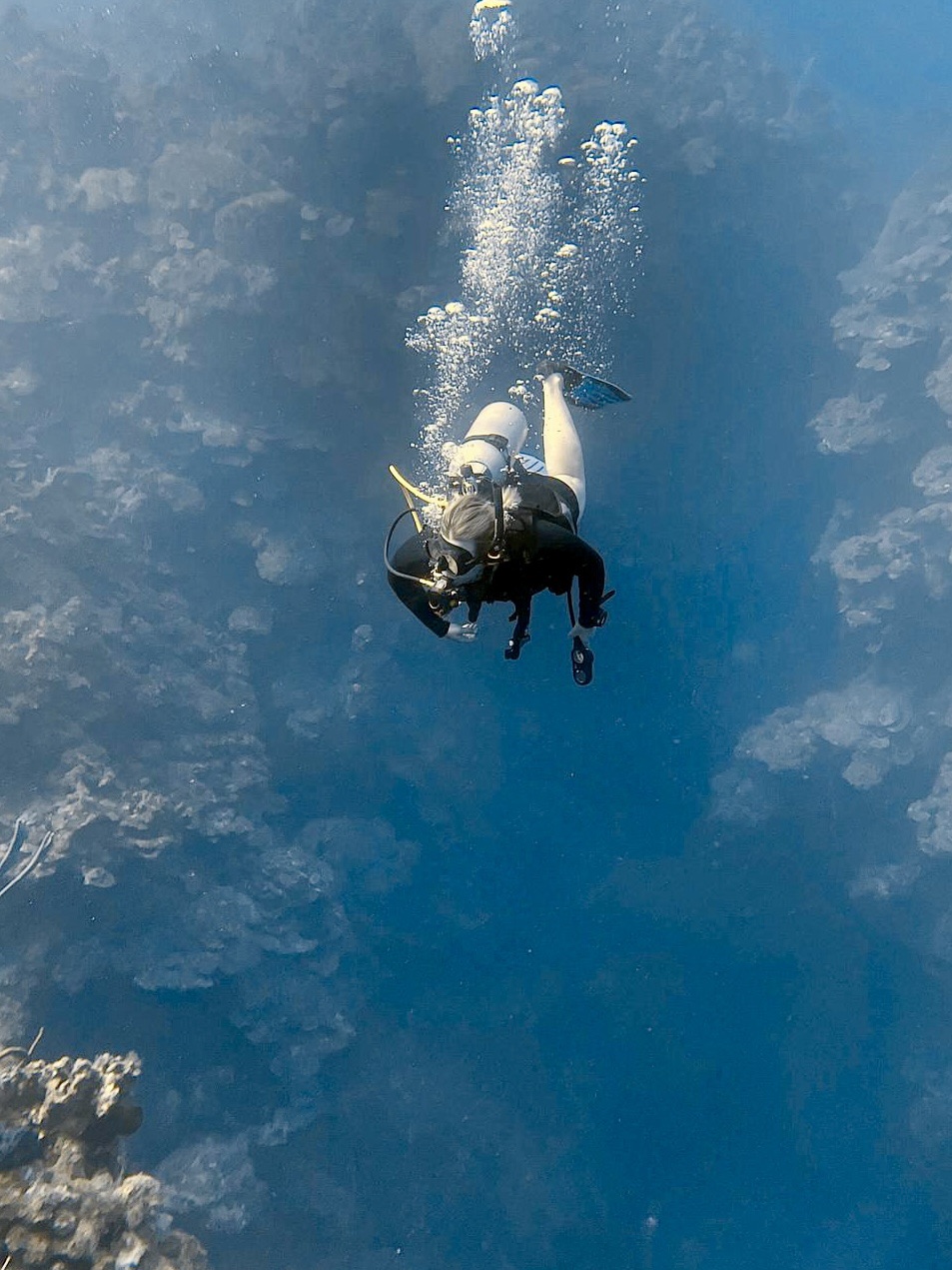
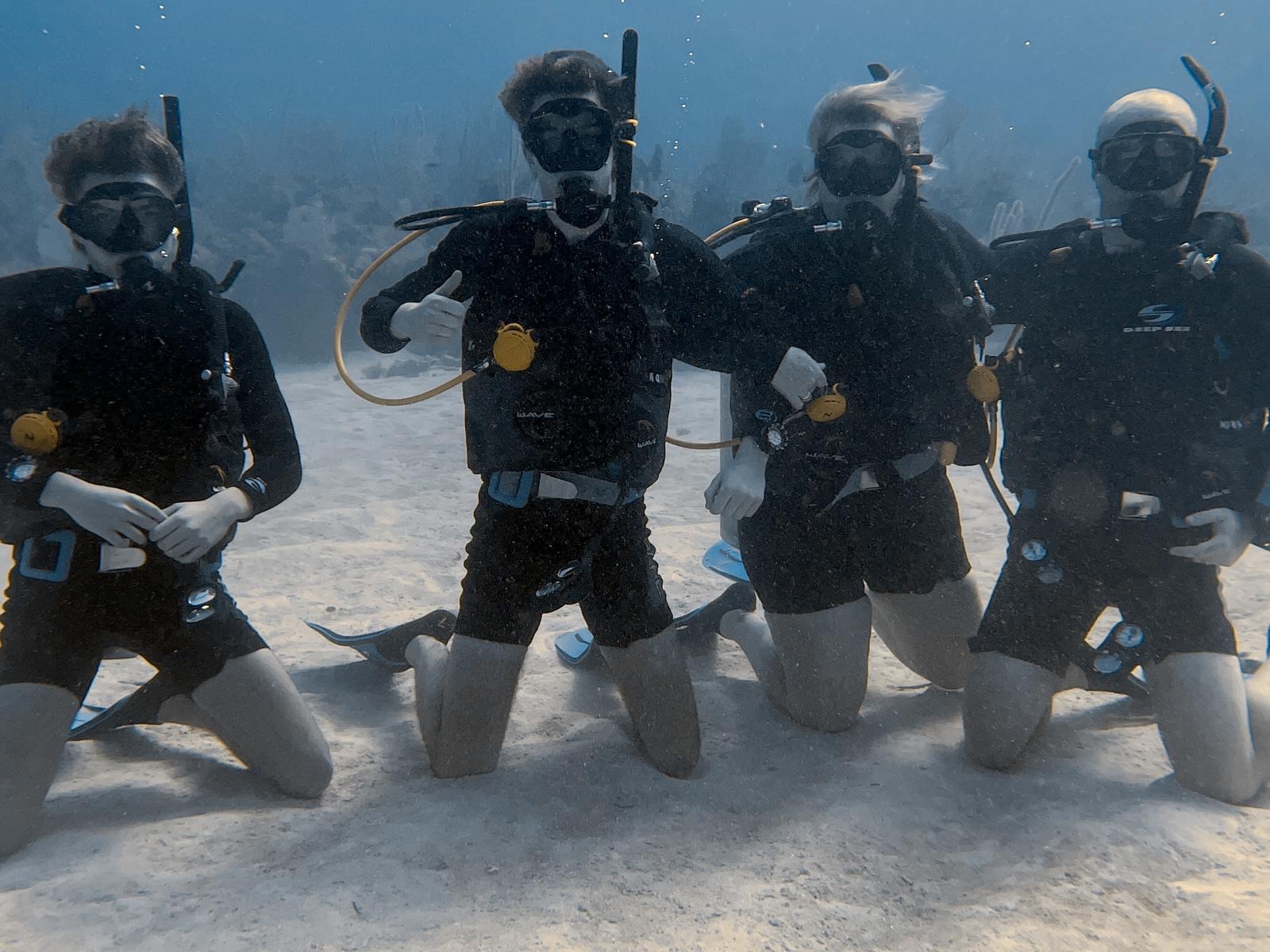
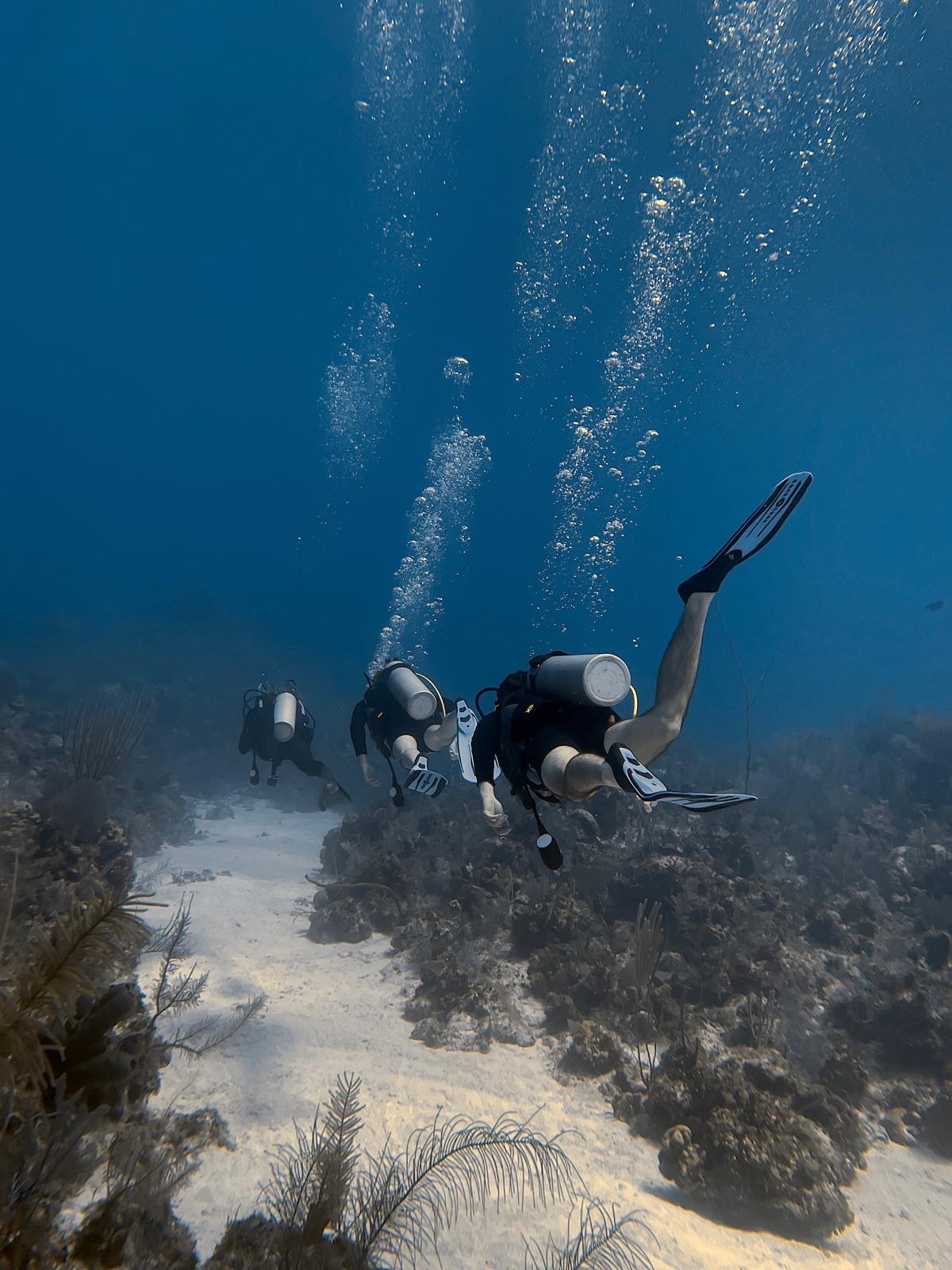
We finished our scuba course today: we now have four certified divers in our family. We loved the diving, but after three days in and out of the water, learning, we were so tired that we all – including the teens! – took a nap. 

The sun is slowly setting as I sit on the porch and try to find words for what it was like to experience this part of the planet we live on. Even after the nap, I’m so tired that words just keep swirling around. Our instructor told us that it’s the effects of pressure changes on the body, and he knows more than I do. Either way, I can barely think, so for today I will let words swirl and aim for watercolour impressionism:

Under the blue
Kneel on the white sand and
pass the tiny crab from hand to waiting hand;
watch the clear blue shrimp wave their antennae, safely tucked in 
the tentacles of the curly anemone that peeks out from under a shell.
Breathe.
Silver bubbles rise.
Touch the anchor of the wreck –
No rust, but maybe luck, rubs off.
Ascend no faster than your silver bubbles.
Breathe.
Equalize.
Fly from coral mountain peak to coral mountain peak.
Although the deep blue beckons below,
Don’t descend.
Know your limits;
Share your air;
Practice breathing
as the gray sharks swim by and one turns, curious.
Who are you to be in her world?
Hover over a sting ray as she feeds,
disturbing the white sand on which you have knelt
elsewhere
under the deep blue ocean.
Breathe.
Rise with your silver bubbles.

Happily Ever After

I’m on my prep, heading back to the classroom and slowly catching up to the two girls wandering down the hallway ahead of me, deep in conversation. For what must be the millionth time this December alone, I am trying to decide if it’s worth telling students that they really should be in class: my brain is on autopilot. Then I hear one of them say, “it’s happILY ever after.”

“HappILY?” her friend repeats, shaking her head quizzically.

“Yes.” She re-emphasizes the ily and the girls slow even more.

“But why?”

“I don’t know. But it is so.”

“Why not ‘happy forever’?”

“Yes, in Spanish it is ‘happy forever’ but here is it ‘happILY ever after.’”

They have nearly stopped. The questioner continues to shake her head, repeating “happILY” under her breath a few times. And now I have caught up to them.

“I can explain the ‘-ily,’” I say. Two faces turn towards me with such obvious pleasure that I nearly laugh. I explain that happily is an adverb and that it tells how they lived. I liken it to lentamente in Spanish. They nod gravely.

Then, I add, “but I don’t know why it’s ‘ever after.’”

Their interest bubbles over. “Si! In Spanish we say feliz para siempre – happy forever. So easy. Forever.”

Now we are in front of my classroom door. Inside, my student teacher is waiting. And really, the girls should be in class. So I shoo them off, saying, “I’ll look it up! Come back if you want to!” and off they go, hopefully to class, hopefully happILY.

Two poems #SOL24 18/31

Two poems for today. First, a book spine poem created from the books I just checked out of the library based on recommendations from other bloggers so far this month. Sensing a theme? (I also got Thornhedge, but it didn’t fit the poem.) I love all the recommendations and ideas I get during March. Will I finish these all before they’re due? I doubt it, but I’m not sure if that’s really the point.


Second, a poem for my recently restless nights.

The middle-aged woman’s sleeping prayer
Now I lay me down to sleep,
I pray that I won’t wake to pee.
If I should feel a sudden heat,
I pray that I won’t drench the sheets
And if I’m up throughout the night,
I pray my kids’ve turned out the lights.

Tomorrow I’m going to get my sh*# together and write earlier in the day.

Second day jitters #SOL24 2/31

At first, this post may look like a poem – and it is! A pantoum, no less! – but it actually a tribute to mentors & the writing process.

On Day Two
How have I forgotten these early days
When doubt – or lack of sleep – drowns
any conviction that I have made
the right choice,

When doubt – or lack of sleep – drowns
the constant rhythm of the deep heart’s core,
which knows the right choice must be
the leap I have already taken?

The constant rhythm of my deep heart’s core
fears nothing:
The leap I have already taken,
the worry that I will share my imperfection,

fears, – nothing
you, too, have not felt before.
The desire to share imperfection,
and be seen –

you, too, have felt it before,
that conviction that we are made
to be seen.
But, oh, I had forgotten these early days.

How I started
(Mentor #1: Alice Nine, who blogged here when I first started, used to write something and then share her process. I found it endlessly fascinating. Today, I’ll share mine.)

I went to bed last night with my head full of ideas for blogging – and I woke up this morning with nothing. Nothing. “Why,” I asked myself, “did I even sign up this year?” (Note: I literally never considered NOT signing up, so this question is ridiculous.) I proceeded to spend a fairly impressive amount of time beating myself up: I overcommit, I take on new things but don’t let anything go, I compare myself to others, I should have chosen a theme for the month (Mentors #2 & #3: Sherri Spelic and E Griffin, both of whom have lovely themes for the month). You get the picture.

Of course, I quickly realized that I have been in this space before – the space where I doubt basically everything. It happens every March during this challenge (and usually right at the beginning, go figure). My mind leaped quickly to the truth that this is also how I felt when I had newborns: some combination of overwhelming excitement, fear and doubt. This leap, I am certain, came from reading a new-to-me blog yesterday, Ana Paton’s lovely post about overwhelm and holding her newborn daughter & poetry.

In my head I heard, “How have I forgotten these early days?” I scribbled that down & then free-wrote for a few minutes. It was poem-ish, probably because of that single line. Plus, mentor #4, my friend Earl Brogan once told me that if I was having trouble saying something, I should try poetry. (I think I harumphed, but he has been proven right.)

Getting unstuck
When I ran out of steam, I paused and wrote about what I was trying to write. I make my students do this meta-writing all the time, and I love it. I wrote, “Revision: This is a poem of fears and questions. Is the final answer yes? Or I am enough? Or one step at a time? Hmm… Or is the final answer a question?” The idea of questions and answers led me to try the duplex form that poet Jericho Brown invented because the theme seemed ideal for a conversation. I played with that for a while until I suddenly wrote, “Nope – not a duplex – because the second voice is insipid.”

Well.

One of the sites I’d used to remind myself of the duplex form had also discussed pantoum. I love pantoums but find them complicated to write. Still, my early draft had a lot of repetition, so I copied out the form.

Stealing a line
From there, I spent a fair amount of time tinkering with lines. A pantoum is not a weekday poem – at least not for me. At one point, I nearly threw in the towel, but then I remembered a line from (Mentor #5) WB Yeats’ poem “The Lake Isle of Innisfree” – the deep heart’s core. Once I would have eschewed that line as not mine, but I another trick I share with my students is to “steal a line.” So I did.

Having some courage
And here I am! I have a pantoum! And I’m publishing it! And for that, I need to thank other mentors like (mentors #6 – a bazillion) Margaret Simon, Glenda Funk and Fran Haley who regularly & generously share their poetry – plus the Monthy Open Write that Sarah Donovan hosts over at Ethical ELA.

As it turns out, I write in a community who does, I think, “see” me. And for that, I thank Stacy Shubitz, Melanie Meehan and everyone at TwoWritingTeachers.
Now, with day 2 under my belt, I move forward into day 3.

If you could talk to your younger self

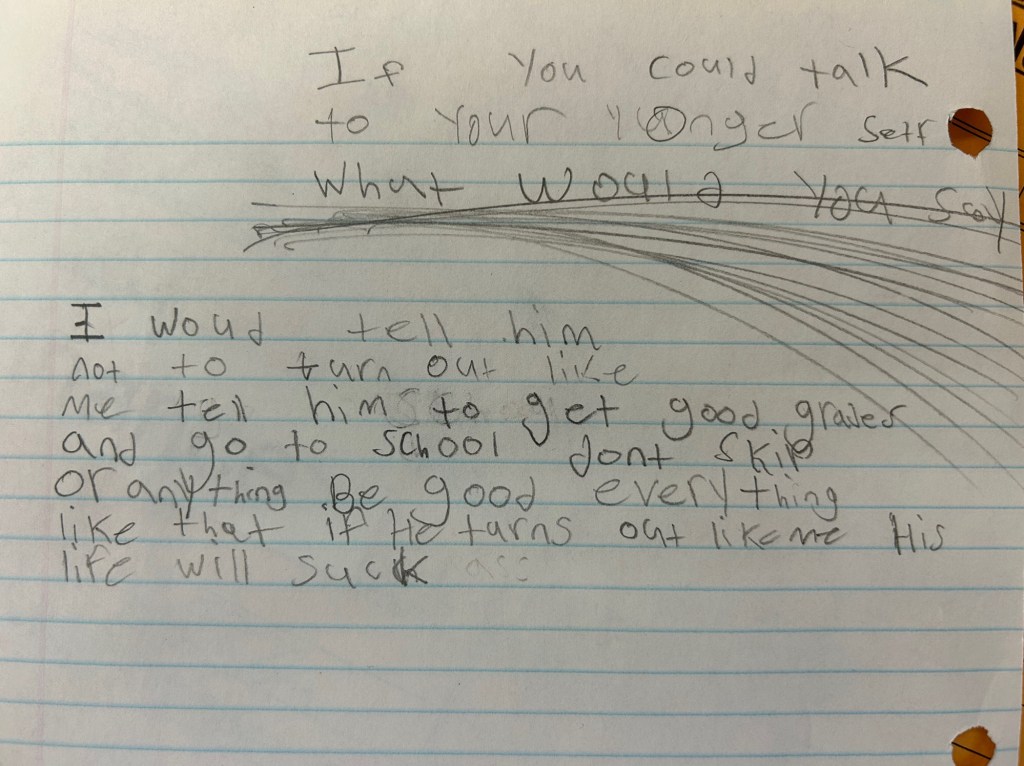
I was tidying the copying area in our office when a sheet of lined paper, adrift amidst the abandoned photocopies, caught my eye. A quick glance told me this was not my writing prompt, not my student. Still, I couldn’t help but read the words – and my heart broke open. Oh, how I wish I could tell this anonymous student about the poetry he has created, tell him that he is so much better than he knows.

If you could talk to your younger self what would you say

I would tell him
not to turn out like
me tell him to get good grades
and go to school dont skip
or anything Be good everything
like that if He turns out like me His
life will suck

My response (quickwrite)
If I could talk to the student whose paper was left behind

I would tell him
not to give up on
himself, tell him to hold on
and keep doing what he can. Be kind, everything
that I wish he could hear. If he knew the power of his
words, he would be stunned.

Open Tab Poetry #SOL23 10/31

Sherri’s slice today inspired me right away; in it, she lists the titles of her open tabs. “Well,” I thought, “that is truly a slice of life.” I knew I wanted to try the same thing – not least because it would be easy, right? Ha. Writing is pretty much never exactly “easy”: first, I got all judge-y about the number of tabs I have open. (It’s a lot.) Then I got even more judge-y about the quality of my open tabs. And then I got judge-y about my judgy-ness. Harumph.

I stared at my list and wished I could change it. Moments before despair set in, I realized that, of course, I could change it – because that’s what writers do, they change words, and I’m a writer.

So I present to you the equivalent of book spine poetry except now it’s “open tabs poetry.” And because I just made up the genre, I decided that when you write it, you can use parts of the tab titles & just cross out the other bits. Also, I decided that I would use tabs as titles for each poem, too. Now I present to you three of the world’s first-ever “open tab” poems:

My Honest Poem

A Trick of the Light
Poetry Couture
Microjoys
if this is therapy, then i am all in

The Reading Performance – Understanding Fluency through Oral Interpretation

32 Million U.S. Adults are “Functionally Illiterate”
21 Lives Lost Invitation to Submit
No Time to Waste
What If Schools Truly Partnered With Families Living in Poverty?
Designing Trauma-Sensitive Classroom Management Strategies
I want to change the world, one proficiency sequence at a time

5 Exercises to Keep an Aging Body Strong and Fit

Art – Jarret Lerner
March Madness Poetry Bracket
Thinking About How Visual Images Support Writing
Reading Visual Texts with “The Call”
Memoir Writing 101 handout

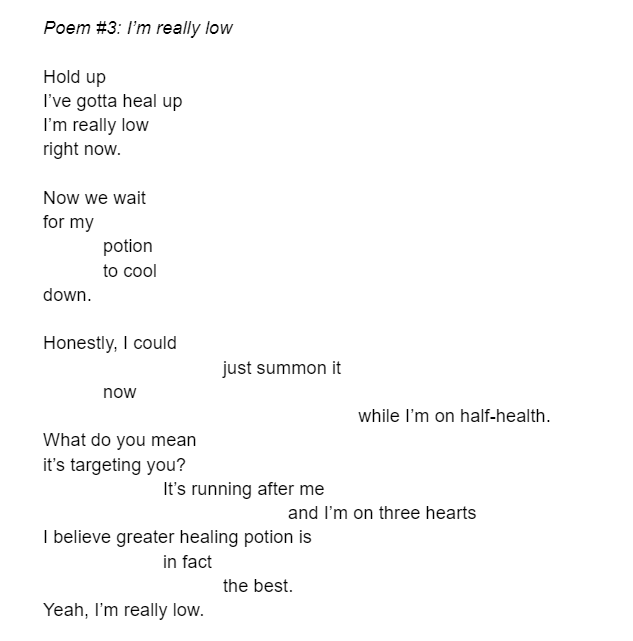
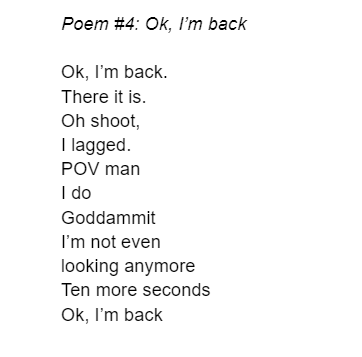
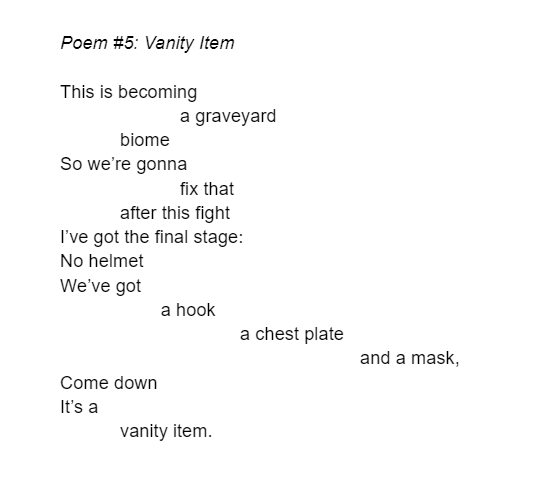
Video Game Poetry #SOL23 4/31

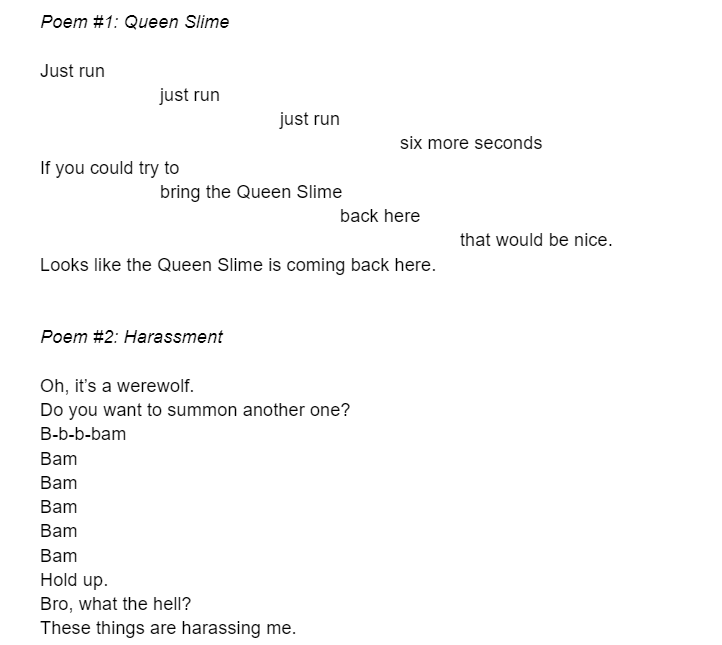
I have spent much of the morning in the same room as Mr 12, who is deep in a video game with a bunch of his friends. At first I was annoyed – it’s hard to write with someone talking loudly right by me – then inspiration struck: somewhere on Twitter, people are turning their bedmate’s sleep talking into Insta-style poetry. Here, very lightly edited, is the poetry of 12-year-old gamers. (Apologies for the curse-words. I promise he mostly curses in video-game play.)

Ribbit

Over lunch, when I mention that I have opted Mr. 13 out of the new online learning requirement for high school, my mother in law asks casually if I think online learning is the way of the future. I do not.

Listen, I know that e-learning works for some people. And I know that it can be done very well. And I know that there are times and places when it is the right option. I’m not anti e-learning. (Well, ok, I’m a little bit anti e-learning, but I can live with it. I’ve done all of my credentialing/ post-graduate school classes online, and there are definitely advantages.) I am, however, against an e-learning requirement in high school – especially when I believe it is a nakedly political attempt to increase class sizes and destabilize public education rather than increase student learning or wellbeing. And I absolutely do not believe that e-learning can or should replace in person learning.

In the kitchen, I start to explain the reasons that mandatory e-learning doesn’t make sense to me. I reach for evidence; my brain goes into fact mode. Even now, as I write, I have paused to find articles to link to, statistics to back up my beliefs. I have searched the internet for other voices to back up my own (there are plenty). But I decide not to include them. For the past two weeks in Grade 12, we’ve been working with analysis and reviews, reading mentor texts and noticing how writers choose and use evidence, so I realize that I am defaulting to logos even though I firmly believe that the most convincing arguments must first appeal to pathos.

Let me tell you a story.

Last week, on the way to school, I was listening to poet Ada Limón’s podcast “The Slowdown“. Each day, she shares a little bit of her thinking and reads one poem. The show is usually about five minutes long, and I love it. In fact, I love it so much that I was listening to back episodes as I drove in, and I stumbled across an April episode where Limón read Alex Lemon’s poem “Credo”. Its energy blew me away, and I knew immediately that I would use it in class.

So there I was, less than an hour later, reading this poem to some sleepy 12th graders. We noticed its exuberance (ok, that was my word), then grabbed our notebooks (ok, because I made them), and wrote “I can be…” at the top of the page (the repeated line in the poem). I set a timer for three minutes and we let ourselves go, completing the line in any way we wanted to. I wrote on the board so they could see me working. An observer in our class also wrote – if you’re in the room, you’re in the class. When the chime sounded, we paused to take a breath. I could feel the changed energy in the room.

“Let’s each share a line,” I said. We’ve done this before – we do this regularly – so even though reading our writing out loud can be tough, most of the students were up for it. Sometimes people only share a word; sometimes they share far more. That day, most people had picked up on the freedom in Lemon’s poem – some were still writing! – and the sharing began quickly. We heard from most of the class, including our visitor, but of course, there are always those who are reluctant; in those moments I try to encourage, maybe even push a little, but not to over-pressure. This day, the extra push allowed M to share a line that they prefaced with, “this is a little weird.” Their line began, “I can be a frog…” Afterwards, they added, “I mean, poems aren’t really about frogs” and they blushed a little.

My response was immediate, “Of course poems can be about frogs! I can think of one right now,” and I launched into Emily Dickinson’s “I’m Nobody! Who are you?” I had only gotten out the first two words when another student chimed in and recited the rest with me. This student is neurodiverse and participates in class in their own rhythm; in saying the poem with me, they astonished their classmates.

Then class moved on. And that would have been it. Except that the next day I opened class with 32 translations of Basho’s Frog haiku. By the time we got to, oh, the 15th or so, people were smiling. We spoke very briefly about how translations can help us see a poem in a new way – and how well they do or don’t communicate the original. Then class moved on. But our original classroom frog poet was absent that day, so the next day I arrived with Hilaire Belloc’s “The Frog.” We giggled about calling a frog “Slimy skin” even as we learned the word “epithet”. Unfortunately, the student poet who kicked this off was at a track meet. “Don’t worry,” I assured the students, “I have plenty of frog poems. I’ll just keep going until they’re back in class.” Their best friend laughed and students around the room shook their heads at what is, essentially, the teacher version of a dad joke. Then class moved on.

(Fear not, there are a LOT of frog poems. I can keep this up for a while.)

I have finished telling my mother in law this whole story – from the podcast to the writing to the ongoing frog poems. She is not a fan of e-learning (in fact, she’s a firm believer in energy and creativity and more), so she has been an easy sell. And even though I have decided not to link to any of the statistics or evidence out there – and there’s a lot – I know that the online classroom can’t replicate this, the gentle push to share a bit of yourself, the wonderful astonishment of a quiet student suddenly reciting a poem they know by heart, the moment of mild discomfort that leads to a world we didn’t know existed, the serendipity that allows one moment to become a string of moments that creates a community of learners, a community of people who experience the beauty and humour and affirmation that leads to learning that lasts a lifetime.

So, no, I don’t think that online learning is the way of the future. Unless we can find a way to include a lot of frog poems.