Throwing in the towel #SOL24 16/31

I give up. It’s not that I haven’t written anything today. Oh no, it’s much worse than that: it’s that I haven’t *finished* anything today. When I realized I was struggling to write, I looked through my photos, thinking that a photo essay might be just right. I even got as far as creating a March collage. Then I decided I didn’t like it. Harrumph.

I considered writing about my pets because I love posts with pets, but this morning Hera stood on my chest and purred until I woke up, and the dog was kind of a jerk at the dog park this afternoon, so no posts for them.

I looked back at ideas I’ve collected from other bloggers this month and got deeply involved in a prompt from Steph at Steph Scrap Quilts, but it’s definitely not done enough to share. Or, more true, I like it too much to share it too early.

I tried to shake off my writing blahs by doing non-writing things that sometimes help me write: I took a walk, baked (banana bread – delicious), talked to my sisters for a long time, worked out, read other blog posts… Still, nothing.

And here I am. It’s almost 8pm, and this is what I’ve got. I’m giving myself credit for writing something when nothing would have been easier, and I will publish my imperfect writing.

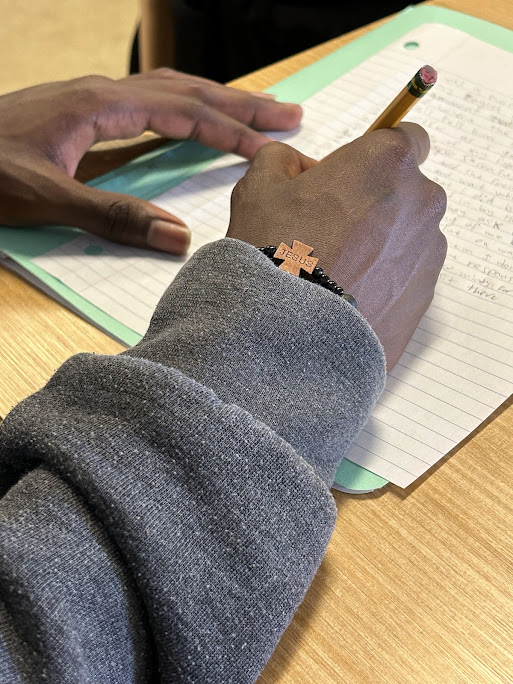
Now that I think about it, I’m going to dedicate this to my students. After all, I started blogging as practice so that I could be a better writing teacher. I think it’s worked. If nothing else, I know what it means to stare down a blank document, knowing I have a deadline, knowing that others will read my work, knowing that another day, another hour might make it better. And then, I publish anyway. This is what I wish for you all: the strength to do your work, even when you aren’t inspired, and the courage to turn it in, even when it’s imperfect. This is me, practicing what I teach.

Hammer/Nail #SOL24 15/31

Mr. 13 is remarkably willing to go to appointments, provided we abide by one simple rule: the appointment must be scheduled during the school day. He’ll do almost anything to miss school. Unfortunately for him, his parents work, and he has a *lot* of upcoming appointments, so when the dentist observed that one of his canine teeth still has not fallen out and that X-rays showed a potentially impacted tooth, I scheduled the orthodontist for this morning, the last day of March Break. He was not impressed.

Nevertheless, he got up with only a bit of groaning and walked with me to the orthodontist. After we filled in all the paperwork, we were put into a consulting room where his x-rays were up. Right away, I could see the problem: one tooth looked stuck. But Mr. 13 is a curious sort, and he was looking at far more than one tooth. After a minute he said, “I think these are old.” The technician pointed out that they were dated Tuesday; they were recent. Mr. 13 nodded politely, and she went to get the orthodontist.

As soon as she was gone, he said, “Mom, those are definitely old.” He showed me the teeth he’d lost that were still present on the x-ray along with the teeth that hadn’t fully grown in but were, quite obviously, in his mouth. When the orthodontist and tech returned, I pointed out the problems. “Let me take a look,” said the orthodontist, but all he had to do was glance at Mr. 13’s mouth to know that we were right.

“Hmph. We need a new x-ray.”

“He just had one on Tuesday,” I said.

As it turned out, he had not had an x-ray on Tuesday. I was confused. Why were we here? No one was sure. The technician took Mr. 13 for the x-ray, then everyone reassembled in the tiny room. The new x-ray was displayed and the “impacted” tooth was, in fact, not impacted at all.

“Maybe he could just, you know, try to wiggle it for a little while?” I asked. I know my child; he is not a tooth-wiggler. He would prefer to keep everything as it is, thank you very much.

But no. We were already at the orthodontist’s, and he suggested sending Mr. 13 to an oral surgeon. Mr. 13 asked if the appointment would be during the school day. I rolled my eyes. Next, the orthodontist explained that he would need braces on the upper teeth to “close the gaps” and on the bottom to “correct the overbite”. All of this, of course, after this tooth came out and the new one grew in. 

The orthodontist left, and the technician continued the explanation: braces will take two years, followed by a retainer for two years, then a small wire behind the teeth to hold them in place, and a retainer for the rest of his life. She sent us to billing for the estimate. 

Billing booked us for an appointment in December (during the school day) to check on the position of the erstwhile tooth, then showed us the price of braces and all the ways we could pay for them. I tried not to let my jaw drop too far open. When she was finished, we paid for our visit, took the estimate and headed home.

As we walked down the front steps, Mr. 13 said, “Um, Mom. I don’t think my teeth are too far apart. And no dentist has ever mentioned that I have an overbite before. Do you think I need braces?”

“Have you ever heard the saying ‘if all you have is a hammer, everything looks like a nail’?”

He had not. I explained. He nodded sagely, “Yeah, this guy definitely only has a hammer.” We continued walking until we arrived at the diner we love, my bribe to get him to the orthodontist this morning. As we sat down, he confirmed, “So, I’m probably not getting braces, right?”

Nope, kiddo, probably not. Hammer/ nail.

Grief at 6 weeks #SOL24 14/31

“You can’t write your way out of this,” says my therapist, and I know she’s right, but that doesn’t mean I have to like it. Anyway, the words won’t come out properly, so it’s not like I have a choice.

She says she’s not crying as much as she expected. Apparently her therapist told her, “You’re going to have to actually feel your feelings.”

We repeat the phrase to each other and laugh at ourselves because we aren’t crying until we are crying – and then we start laughing again because we’re crying about not crying and does this count as feeling your feelings?

At the gym, the coach shows us the workout: lifting again, the weights carrying some of our grief. But today all of her muscles hurt and she didn’t sleep well and she’s just so angry that she finally has time to take care of herself only her body won’t cooperate. I know what she means, but it’s not my child who died, not my body that aches so deeply. We do what we can and cry again. 

“I’m so tired of crying,” she says, and I agree, “yeah, six weeks is way too long to mourn a child” and “what are you thinking anyway?” because apparently right now all we can do is cry, then laugh, then cry again.

With that, the coach erases the whiteboard, grabs her phone and orders us all something from Starbucks. We change our shoes and head out for a walk, which doesn’t fix everything – or anything – but at least we are outside, together, sipping hot drinks in the sun. 

Cheesy #SOL24 13/31

Tonight’s dinner will be raclette. The potatoes are already boiled, the cheese is laid out, and the raclette grill is warming. Soon, the whole family will be melting the cheese then pouring its oozy deliciousness over the potatoes. Everyone is excited.

As I prep, I’ve been thinking of the first time I ever had raclette – which was also the first time I’d ever heard of it –  in France during my junior year abroad. My (French, obviously) boyfriend and I had been together long enough that I was finally starting to meet his friends. That day, we drove into the countryside for dinner with a group of people I’d never met before. After aperitifs, we sat down at a table with this odd contraption on it. Small potatoes were piled in bowls interspersed between the guests. Long trays were layered with thick slices of cheese and various cured meats. Here and there were small bowls with cornichons. Everyone was talking and laughing and I had no idea what was going on.

Pause here. Prior to arriving in France that September, I had eaten cheddar cheese, Swiss cheese mozzarella cheese (on pizza) and Velveeta. Surely I had seen brie before, but I’m not sure I had tasted it. I had definitely heard of blue cheese, but all I knew was that it stunk. Similarly, I had never drunk more than a sip of wine and certainly had never had an aperitif. Also, I didn’t exactly speak French. I mean, I had *studied* French, and I did very well on grammar tests. I could even write a reasonable paragraph. I could not, however, actually talk to people. 

So, when I moved in with a family that spoke only French and who cooked only French and Alsatian food, I had had to either figure things out or, I suppose, go home. Then I met Jean-Luc, whose English was also limited, and promptly fell head over heels for him. That turned everything up a notch. 

Now it was maybe January, and I had gotten used to only understanding some of the conversation and not always knowing exactly what I was eating, but tonight I really wanted to make a good impression on Jean-Luc’s friends. I wanted to be part of the gang. But what does one do when seated in front of something like this (see below) and given a tool called a pelle – which I knew darn well meant “shovel”- and a wooden paddle?

At first, no one noticed my unease and, I had become expert at copying those around me. Soon enough, however, Jean-Luc realized that I was a neophyte and started helping me pile various meats on the grill and melting cheese underneath. Raclette, I discovered, was essentially an excuse to eat all the cheesy potatoes you could. It’s not especially refined and lends itself to laughing and chatting as you wait for something to melt or cook – or accidentally take your neighbour’s pelle. We had a fantastic evening. I was hooked. 

My American friends in Strasbourg also discovered this dish, and by June we were all more than happy to go with Erin to a raclette restaurant for her birthday (even though raclette is, at its heart, a meal often served in the winter). There, we saw “real” raclette: a heater brought up to a giant wheel of cheese while a server scrapes the melting cheese onto a plateful of potatoes. 

After I left France, I doubted I would find many places willing to serve melted cheese as a large part of a meal. I was going home to a land of cheddar, Swiss and mozzarella. I knew there was always fondue, but somehow that seemed almost as unlikely as raclette. And, sure enough, none of my friends at home had ever heard of raclette. It became just a delicious memory…

Until I got engaged to a Canadian. We were looking at things to put on our registry (“just in case”) when I noticed the raclette machine. My fiancé was taken aback by my extreme enthusiasm for something which he thought was, well, kind of normal. I tried to explain – France, cheese, years ago – but he just shrugged and said, “well, let’s put it on the list.” So we did. And we got one.

Pretty much every winter we find raclette cheese at the grocery store and drag the raclette machine out of the basement. We boil the potatoes and find the meats; we cut some veggies and, often, gather friends. Then we put the cheese in the shovels and thrust them under the heat. While it bubbles away, we grill the meats and veggies on the warm stone. We scrape it all onto potatoes and eat until we’re bursting. 

I love it every single time. And now, dinner’s ready!

At the dentist #SOL24 12/31

While I was out with a friend this morning, the boys’ dentist called and asked if we could come in 20 minutes early to help with a scheduling hiccup. By the time I got the message, I knew we would have to hoof it to be there at the new time, but I called back and said yes, anyway. Unfortunately, when I told the kids, Mr. 15 said “yes” with his mouth but not with his brain, and hopped into the shower at the last minute. We managed to make it, but I dropped the boys at the door so that they could go in while I parked.

When I got in, Mr. 13 was already in with the hygienist. I love that my kids are independent enough to handle moments like this on their own. Just a few minutes later, Mr. 15 was called; he loped into the back, trailing after a different hygienist. I settled back to enjoy a little quiet time.

As I played a game on my phone, another mother came in with her two boys who rushed ahead of her to the receptionist’s desk. “Hello,” she chirped at them, “Who have we here?”

A small voice said, “Johnny Bear” and everyone chuckled. I looked up to catch the younger boy, maybe 6, holding his stuffie over his head so that the bear could “see” the receptionist. His mother ruffled his hair, grinned at the women behind the desk, and gave their names. The trio moved into the waiting room and the younger boy snuggled up next to his mother.

Oh, I miss those days, I thought. 

Just then, the older boy – maybe 8 – made a snide comment under his breath. His mother heard, and snapped at him. He slumped in his seat, pouting. The water cooler bubbled and suddenly Mr. 6 really wanted a paper cone of water. Then his brother did, too. Mom heaved a sigh and asked, “Do you really want the water, or do you just want it because you heard the bubbles?” Mr. 6 assured her that he really wanted the water. Mr. 8 grumbled. 

Mom stood up and got some water for the six-year-old. More mumbly-grumble from the eight-year-old. “What?” she asked.

“I said I want to do it myself. I want water AND I want to do it myself.”

Mom looked from the younger boy, holding the fragile cone of water, to the older boy, arms folded stubbornly across his small chest. “Ok,” she said, “Can you wait for me to come watch?”

He jumped up from his seat, ran to the cooler, pulled off a paper cone cup and waited for his mom. She watched carefully until she said, “and that’s enough!” 

Delighted with himself, he sat back down to taste his independence. Mom turned back to her youngest, who had not, in fact, spilled any water. Just as she sat again, the hygienist came out and called one of their names. She heaved a deep sigh, gathered first one child, then the next. She took the now-empty paper cones and threw them out as they all trooped into the back together, Mr. 6 clutching Johnny Bear in one arm. 

Nope, I thought, I don’t think I miss those days that much after all.

N-less #SOL24 11/31

For a few days last week, my keyboard’s n stuck as I tried to reply to others’ posts. I was frustrated. My discomfort made me ask myself if I could write a whole post without it because I like to test myself. I will admit, it is very difficult. Years ago, I worked at a small DC school where, at a PD day, the facilitator asked us to write for a short time without “e”. For me, that was easy. I immediately chose to write about a topic without “e”: swim stuff, e.g. swim practices, with their laps, or swim meets with their races. I wrote quite a lot, which frustrated the speaker because she had hoped to illustrate how hard it is to write without a simple letter. If I had appreciated her motive, I would have stayed quiet. Such is youth, I suppose. Hmm… maybe I will ask my pupils to try this exercise.

As I write today, I realize how much has shifted. At that PD, we all wrote with paper. Today, however, I write with a computer; I have a tab with access to a thesaurus; my spellcheck tries to correct misspelled words to add the letter I avoid. As I cease this exercise, I will use Ctrl-f to check if I used what I promised to dodge. Truly, spellcheck is how I was able to reply to posts last week. It took a lot of time, so I replied to very few posts, which made me sad. If I missed you, I am sorry! I swear that I read, but to reply was quite difficult.

As I write, I also realize that without this letter I avoid, I must be upbeat. Without it, I have become aware that the adverse is hard to write. The words for bad possibilities or outcomes all use the letter. Hmm… this is a fresh thought for me. I pause to marvel at this simple idea. Whoa. Lots of ideas/objects use this letter, too, because of suffixes. Lastly, I have realized that I must write exclusively for this time or the past. The future requires this letter. So… I am forced to write about the positive, past or immediate with few words for big ideas. It’s complicated. As I wrap up, I try to visualize this n-less world. Impossible. I am over this self-imposed exercise: I would like all the letters back, please! 

Bangs #SOL24 10/31

On Friday, my best friend from high school texted me a picture of my high school yearbook senior photo.

Look at those bangs! They started about ⅓ of the way back on my head. Every morning, I carefully curled them, brushed them to the side, and then hairsprayed them until they were stuck together in one giant flap of “feathered” hair. And, though you can’t tell here, that blue sweater has sparkles in it. Sparkles! Oh, the 80s.

That picture was still on my mind on Saturday when I went for a hair cut. Chuckling, I pulled out my phone and showed my stylist. I couldn’t quite tell if he was horrified or impressed. He chatted on about 80s and 90s clothes and hairstyles, while I stifled a laugh: He wasn’t around for those eras, so what does he know?

The picture must have stayed on his mind, too, because after my colour was done, as he was starting the cut, he said, “You keep saying you want something different. How about bangs?” 

It was my turn to look horrified. “No, no,” he reassured me, “not like in the picture. You know, something more modern.” I still looked doubtful. “I wouldn’t recommend it if I didn’t think it would look good.”

So I said yes, and now I have bangs again for the first time, I think, since that high school photo. Way back then, in English class, Libby had once declared, “everyone looks better with bangs.” (At least I think it was Libby. It could have been Anne. At any rate, one of the stylish girls.) I haven’t thought of that comment in a long time, but she might have been right. If nothing else, I like the new look: it hides some of my wrinkles.

Better things #SOL24 9/31

I have better things to do. I could be writing or reading other people’s blogs and commenting. I could be tidying the house before guests come, or just tidying in general. I could be folding the laundry put in the wash first thing this morning or running some errands. I could be working out or doing yoga.

To be fair, I’ve already been out for a walk and gone to the hairdresser. I’ve had my tea and played with the dog. But now? Yeah, I have better things to do.

I could be looking at the work my students turned in yesterday or planning ahead for the next unit. I could be catching up on emails or finding the numbers of all the places I need to call for various appointments for various people. 

Still, I’ve already cleared out the fridge and reheated leftovers for lunch. I’ve already started and abandoned a list of the things that I will, in fact, have to do sometime soon. Because I definitely have better things to do, like calling my sisters or reading a book, taking a nap or knitting. At this point, even watching a movie would probably be better. 

So many things are out there, just waiting to be done. But it’s the first day of March Break and outside it’s rainy and gray. I’m on the couch, wrapped in a soft blanket, and the dog is sleeping at my feet. So instead of doing any of the many things I could be doing, I’m allowing myself a luxury I rarely have time for: playing mindlessly on my phone. 

Do I have better things to do? Nah, not really.

Учителката #SOL24 8/31

We had only been talking for a few minutes when her phone rang. She glanced at the screen and said, “I have to take this. It’s my father. I’m so sorry.” With an apologetic look, she answered. I looked down at my notebook to give her what little privacy the conference room afforded.

“Говоря с учителката на И”

I looked up, startled. I had perfectly understood that sentence. She said it again, adding “да, да но…” Yup, my student’s mother was definitely speaking Bulgarian.

She hung up and started to apologize again – after all, she’s the one who had asked for this parent-teacher conference – but I interrupted and said, “Are you Bulgarian?” She looked at me quizzically, so I added, “I speak a little Bulgarian; I could understand what you said.”

Soon, the parent-teacher conference had taken a decidedly friendly turn. We talked about Bulgaria, which city she was from, where I had lived, and more. She told me a funny story about getting married in Canada: Bulgarians nod their head up and down to say “no” and side to side for “yes.” As she stood in front of the judge, answering questions so she could marry her fiancé, she kept saying “yes” but, in her enthusiasm, moving her head “no” – to the point where the judge decided he couldn’t accept her verbal answers. They had to call in an interpreter to verify her responses. “I tried to explain,” she laughed, “but I could tell the judge was worried.” In turn, I told her about trying to gauge students’ understanding during a lesson and finding myself completely bewildered by the sea of heads shaking all different directions.

“But… when did you live there?” she wanted to know.

I had to calculate. “Um… 1995? Nearly thirty years ago!” 

“And you still remember the language?!” Her astonishment was clear.

“Oh no!” I laughed. “You just said about half of what I remember. The first half of what you said was more or less what I memorized so that I could leave phone messages for people. And the second part was about teachers.”

I spent a year teaching in Bulgaria. I loved it – the teaching, the country, the people, the language. As I started to make friends, I also started needing to call people. The problem was, no one lived alone in Bulgaria, so I always needed to ask to speak with the one person I knew – who was almost always the only English speaker in the home. I quickly learned to say, “May I speak with…?” (Мога ли да говоря с) Then, I waited. If there was silence followed by a familiar voice, I’d found my friend. If instead there was a long string of what was gibberish to my years, I took a deep breath and said, “Кажи му, че Аманда се обади”… “Tell him that Amanda called.” And then I hung up. Because that was all I could say. I was pretty much terrified every time I made a phone call all year, which means that those two phrases are tattooed in my brain. 

I can also still remember bits of what I used to call the “train conversation.” That’s the conversation you have when you take the train from your town to the next one if you’re a blond foreigner in a sea of dark-haired Bulgarians. It’s pretty much always the same: Where are you from? What are you doing here? How long have you been here? How long are you staying? Do you like our country?” The whole train conversation lasts just under 10 minutes, and I must have had the conversation dozens of times in several languages. 

All of this came together this week when the parent was speaking because what she said was, “Dad, I’m speaking with I’s teacher.” And I can 100% remember all of those words – apparently even 30 years after I last needed them.

The rest of the conference went swimmingly. Shared language can do that. I’m confident that we can work as a team to support her child for the rest of the semester. And I get to spend a few days reminiscing about a year of amazing experiences – and trying to call up a few more words.

(Written for “Multi-Lingual Friday”)

Knock-on Effects #SOL24 7/31

Today, I got an *AMAZING* message from a former student. She is graduating from university and is “almost an RN now.” I am aglow with happiness for her – and for us: she’s going to be a wonderful nurse. I am proud to say that a tiny part of her story relates to my post from yesterday. 

You see… back when Mr. 13 was Mr. 6, he was driving his teacher up a wall. They butted heads regularly (in a first-grade sort of way – the kind where it turns out that six-year-olds need to follow rules sometimes), most often in reading group. There, Mr. 6 would some days read fluently, then other days act silly, “reading” words that were not on the page. We were baffled. The story goes that one night, angry with my insistence that he try to sound out words, he “read” his entire book without looking at the pages *even once*. But he couldn’t read individual words.

Because his teacher was both kind and deeply experienced, she had already flagged his reading as potentially problematic. Because I knew that dyslexia ran in my family, I already knew to pay attention to my children’s reading. Because my colleague’s wife was a child psychologist who did lots of educational testing, she advised testing Mr. 6 asap, rather than following the school system’s recommendation to“wait and see.” Because we have good health insurance, we could pay for private educational testing. And because of all that, we discovered that Mr. 6 had dyslexia when he was, well, 6.

The chips continued to fall in our favour. First, even though I am a high school English teacher, I was already learning about how people learn to read, so I knew that people with dyslexia benefit from early intervention. Then, when the principal said it was “too bad” that Mr. 6 was going into Grade 2 because the school’s reading intervention program started in Grade 3, we were wealthy enough to pay for tutoring. Then, I began researching dyslexia and found Dr. Sally Shaywitz’s book, Overcoming Dyslexia which recommended specific research-based tutoring programs. In a final bit of good fortune, a local tutoring company specialized in exactly this. 

Y’all, that is a lot of good luck. Learning to read should NOT be a matter of luck.

Now, let me tell you about my student. She had struggled to learn to read when she was little, but she was an incredibly hard worker, so she managed to stay on top of things. She was seriously smart, so she was able to figure things out, even though reading remained, well, not easy. By the time I met her, she was in 10th grade, and she was working her butt off. She was also doing extremely well in school. 

Still, as we got to know each other over a few years, she confided in me that she wasn’t “as smart” as her friends because she took “three times as long” to do her homework and made “stupid mistakes” if she wasn’t focused. I believed her, but I didn’t know what to make of this… until about ¾ of the way through Shaywitz’s book. There, I read a description of a high school student with dyslexia. Right away, I thought of her. Pages later, Shaywitz listed some common signs of dyslexia – and suddenly I had concrete questions I could ask someone. 

I explained to this young person that I had an idea about her learning. Then I read her the description in Shaywitz’s book. Recognition dawned: “That’s exactly me!” I am not an educational psychologist, so I can’t diagnose anything, but at least we had an idea of what might be happening. All we needed was some testing – which our school system couldn’t provide because, first, our limited resources go to students who “are not able to access the curriculum” and this student was on the Honour Roll and, second, those same resources are meant for students in our system, and she was nearing graduation. We fought on. One thing led to another, and things stayed plenty dang complicated, but in the end she was able to get accommodations when she went to university. Things weren’t easy, but they were, at least, easier.

Looking back, it all feels awfully precarious. What if my child’s teacher hadn’t noticed his uneven reading? What if we hadn’t known to get him tested? What if I hadn’t been reading about dyslexia? What if?

I think about all the people who will benefit from having this brilliant, determined, caring young person as their nurse. I know this is supposed to be a slice of life – and I really want you to know how much I admire the student I’m writing about – but I have to end with what I already said: learning to read well should not be a matter of luck. As a profession, we are trying to make changes so that more students learn to read well. I hope our systems don’t give up when our first attempts aren’t perfect. I hope our system doesn’t write off students who are already in high school. I hope we have success story after success story to tell in years to come. And I really hope you’re lucky enough to have this person as your nurse. That would, indeed, be lucky.