Need a hug?

Two days before Winter Break, I asked a student to switch seats to mitigate disruptive behaviour. Instead, angry, they ran out of the room and left the school. The next day ice and snow closed schools, so we didn’t see each other again until January.

This gave me plenty of time to reflect. In my twenty-some-odd years of teaching, I’ve only rarely experienced something like this. I know enough to know that it’s not usually about the teacher, but I also know enough to know that there are always things I could have done differently and better. Without beating myself up, I thought long and hard about what had happened.

The first day back, the student was in class. I let everyone go a minute early, knowing that this student rarely left quickly. As they packed, I sat next to them and quietly apologized for my role in their distress. They ducked their head and looked away, “No. it was me. I’m really sorry.” We talked briefly, me explaining that I could have noticed their distress, them explaining that there was a lot going on. 

After that moment, they came to class a little more often and showed up during exam days for extra help so they could pass English. Every interaction felt a tiny bit more relaxed.

Then the semester ended, and the student was no longer in my class. Last week, I popped over to the public library (right next door to the school – so convenient), and saw this student, this child, standing, clearly forlorn, a large bag dangling from one hand. When I greeted them, I noticed their red eyes. I asked about the bag – they didn’t say much. I asked if they were ok.

“People are mean,” they whispered, and tears welled in their eyes. I said yes, sometimes they really are. I asked if I could help. No. I asked if teachers or students were being mean. Students. Silence. The tears spilled over. 

I leaned in and touched their shoulder gently. “I wish I could give you a hug,” I said.

“You can,” they replied, and looked up.

I’ll stop there. 

These days, teachers cannot hug students. Just this week, the Ontario College of Teachers’ newsletter included “hugging” as one of the several reasons a teacher’s license was suspended. Even touching the child’s arm was possibly a bridge too far. We do not hug students.

On the other hand, the child was crying. They had been bullied and spent much of the class in the office as a result. They did not see school as a safe space, but they were starting see me as safe. 

So, what do you think? Should I have given them a hug? What would you have done? What would you want for your child? Does your answer change if I am NOT a middle-aged white woman? Does it change based on the child’s gender? Or are teachers – acting in loco parentis – allowed to treat all children in our care with, well, care? Can we comfort them when they ask for comfort? 

I know my answer. What’s yours?

Thanks to twowritingteachers.org for hosting this space for teacher-writers.

And then, a miracle occurred

Only years after we started did anyone outside of schools begin to wonder. After all, teachers had been doing so much with so little for so long that people had forgotten that we, too, were subject to the basic laws of physics. Let’s be honest: most people had forgotten the basic laws of physics, so it was easy to forget the rest.

No one questioned how our classrooms were set up, the computers charged, the rooms tidied. No one wondered how teachers were able to give exams, grade all the final projects, communicate with parents, write report cards and start an entirely new semester with an entirely new set of classes and students all in the same week.

When politicians or parents or the public added another thing to teachers’ plates, they never wondered how it would get done. “This isn’t much,” they thought – if they thought about it at all. Soon we were able to give epipens, handle both epileptic and non-epileptic seizures, monitor blood sugar, stop bleeding, re-start hearts and more. We could identify and support students with any and every learning need because we seemed to have endless time to read the latest research and put it into place in the classroom.

Every English teacher read hundreds of books per year so they could always recommend the latest ones. Science teachers set up perfect labs, day after day, week after week, month after month. History teachers never lacked for primary sources. Art rooms were constantly clean. Teachers called home for every absence, every missed test, every concern. We all returned student work the day after it was submitted.

No one really noticed. “After all,” they thought, “that’s what teachers *should* do.” The less generous grumbled, “It’s about time they did their jobs” while the more charitable thought, “teachers seem much more relaxed than when I was in school.”

When the first scientist suggested that maybe something unusual was happening, teachers basically ignored it. “Oh,” we laughed, “don’t be silly. Teaching is easy. We have plenty of time.” When the second voice joined the first, a few of us started to worry. Luckily, it was a long time before our secret stash of time turners were revealed and we had to confess just how many hours all of this actually took…

*****

Sorry. Just kidding. Today we had about three hours to tie up loose ends from last semester, tidy our rooms – or change rooms or even schools – and prepare for all new classes. But fear not, we have three whole days of teaching full time before our report cards are due. Totally normal.

Many thanks to Two Writing Teachers for hosting the Slice of Life every Tuesday.

What I didn’t expect

What I didn’t expect
at the complicated end of a complicated semester
was that he – who talked through the quiet and through the loud and through the movie and through the reading and through the writing and through it all – 
would declare “Done!”
then stand up and walk, ungainly, to the next table.

I didn’t expect him 
to land his tall body, still heavy with childhood,
in the small plastic chair
next to a slender child
who had embodied invisibility since September.

I didn’t expect him to say,
“You can give me feedback” 
unselfconsciously shoving his words in front of his silent peer.

What I didn’t expect  
was that the second boy
who had spent the semester shrouded in his hoodie, 
his face wrapped in the winding sheet of his wispy brown hair,
the boy who had only used his voice to say “no”
that boy
would use the excuse of a keyboard and “nothing else to do”
to lean towards the awkward offer
and accept.

(I was so stunned that I took a picture of the two of them, hard at work. I don’t have permission to share – I didn’t even ask – but I invite you to imagine it.)

Book Love

Out of the corner of my eye, I could see the student teacher looking around the classroom in astonishment. 9:30 on a Tuesday morning in mid-November and every one of the students in Grade 9 English was reading a book. Every single one. L had finally caved last week when I plunked a shiny copy of Neil Gaiman’s The Sandman: Preludes & Nocturnes in front of him and walked away as though I didn’t care even the tiniest bit if he opened it. (Reader, I did care. I cared a lot. And I walked away anyway.) Now, for fifteen minutes, the regular rhythm of ocean waves filled the room (thank you YouTube) and we all read.

He commented on it later; I knew he would. A room full of 14-year-olds reading books is, after all, truly an unusual sight, and it was this young teacher’s first day with us. “How did you do that?” he wondered. I almost laughed. Those fifteen minutes are the result of a career’s worth of practice, a lifetime of reading and a lot of support from other people.

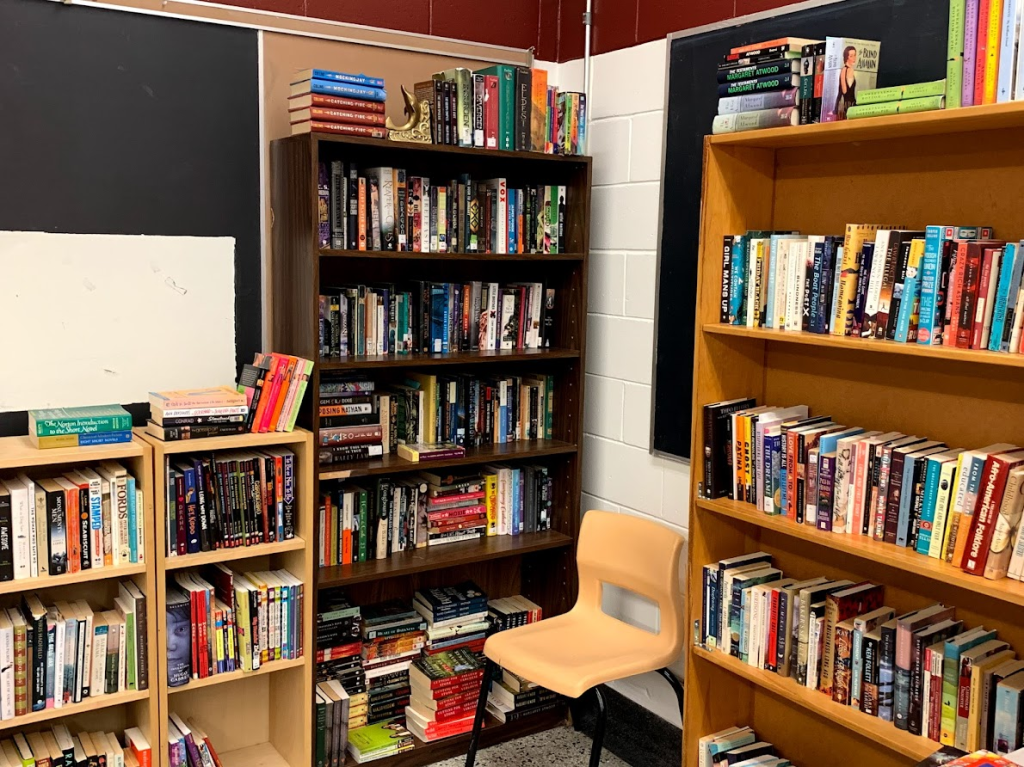
My classroom is full of books. A wonky combination of scavenged bookshelves line the back wall, full of novels and nonfiction, poetry and graphic novels, all shelved according to the eclectic organization that more or less mirrors students’ reading tastes. Books have been tossed into class bins, waiting to be picked up the next day. Books lean against the blackboard, begging to be chosen next. They teeter in uneven stacks on flat surfaces around the room, waiting to be reshelved. They linger in desks where they were stashed just in case the reader could sneak in a few extra words before class ended. 

Some students enter this room and feel at home; others are less excited. By 9th grade, some people have already abandoned reading. Every year I ask, “When was the last time you read a book cover to cover?” Every year, I hear stories of reading lives gone dormant, reading lives that have never had a chance to grow.

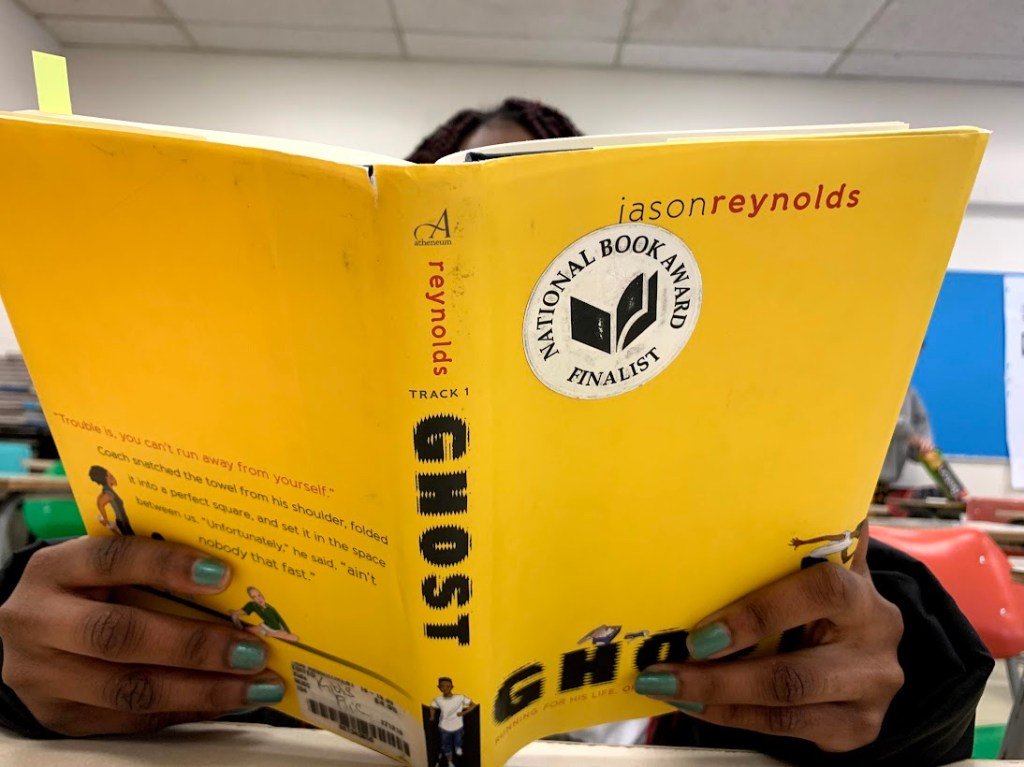
“It’s ok,” I say, “it’s ok. There’s something here for everyone” and I offer books from childhood, books they used to love, books someone once read aloud or books they’ve seen as movies or books full of pictures. I tell them about stories that have made me cry or laugh out loud. I ‘fess up to my serious crush on Jason Reynolds and admit that I have read past my bedtime and that I still can’t read horror novels – then I show them the collection of horror novels that I won’t ever read.

I tell students that I am a scavenger. I frequent little free libraries and I know which public libraries sell books cheap. At garage sales I explain why I need to buy all the books for much less than they are asking. I convince friends to pass along the books their teens are done with. Once, a former student cleaned out her room and brought me all the books she thought other students might like. I even ask on Facebook (because I’m old).

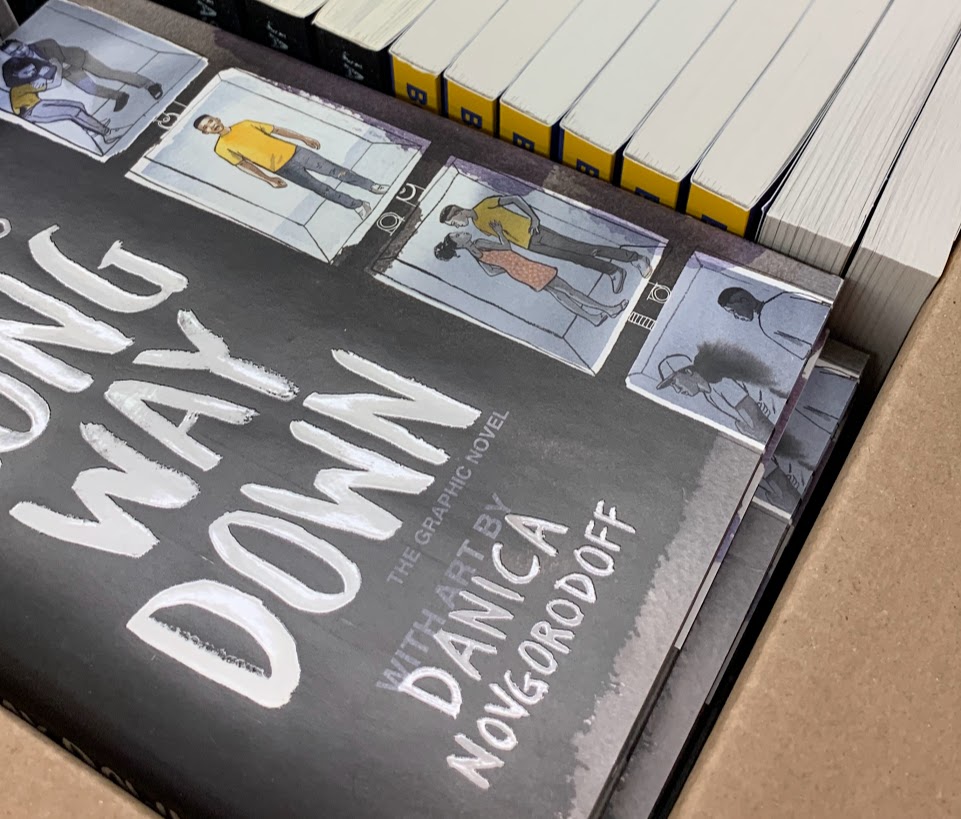
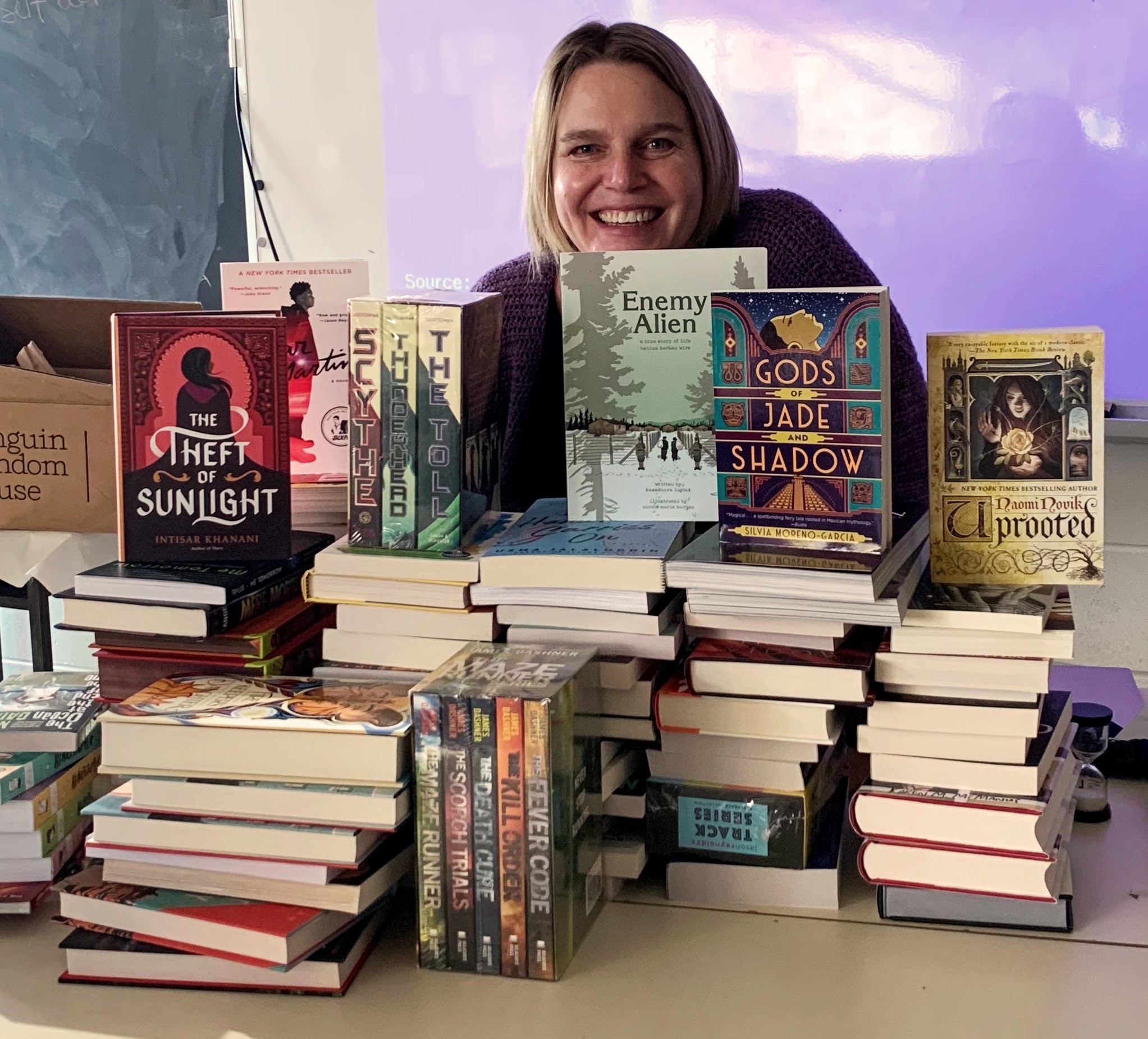
And this year? This year I won a grant from The Book Love Foundation. I applied last Spring, knowing that it was a long shot – so many teachers apply; so few can be funded. When I found out that I had won the grant, I cried, and then I got to work making my list. The books arrived last week – boxes and boxes of them. Books by Indigenous authors and Black authors and Muslim authors and LGBTQ authors; books with characters who wear hijabs or who face monsters or who had a child while they were in school or who found success beyond their dreams. Books about sports and books about travel and books about memories and books about the future. Books you’ve definitely heard of and books I haven’t read yet. (That might have been the students’ favourite part. “Wait. You haven’t read this one? Are you kidding? I’m going to read it before you!”) So. Many. Books. Good books.

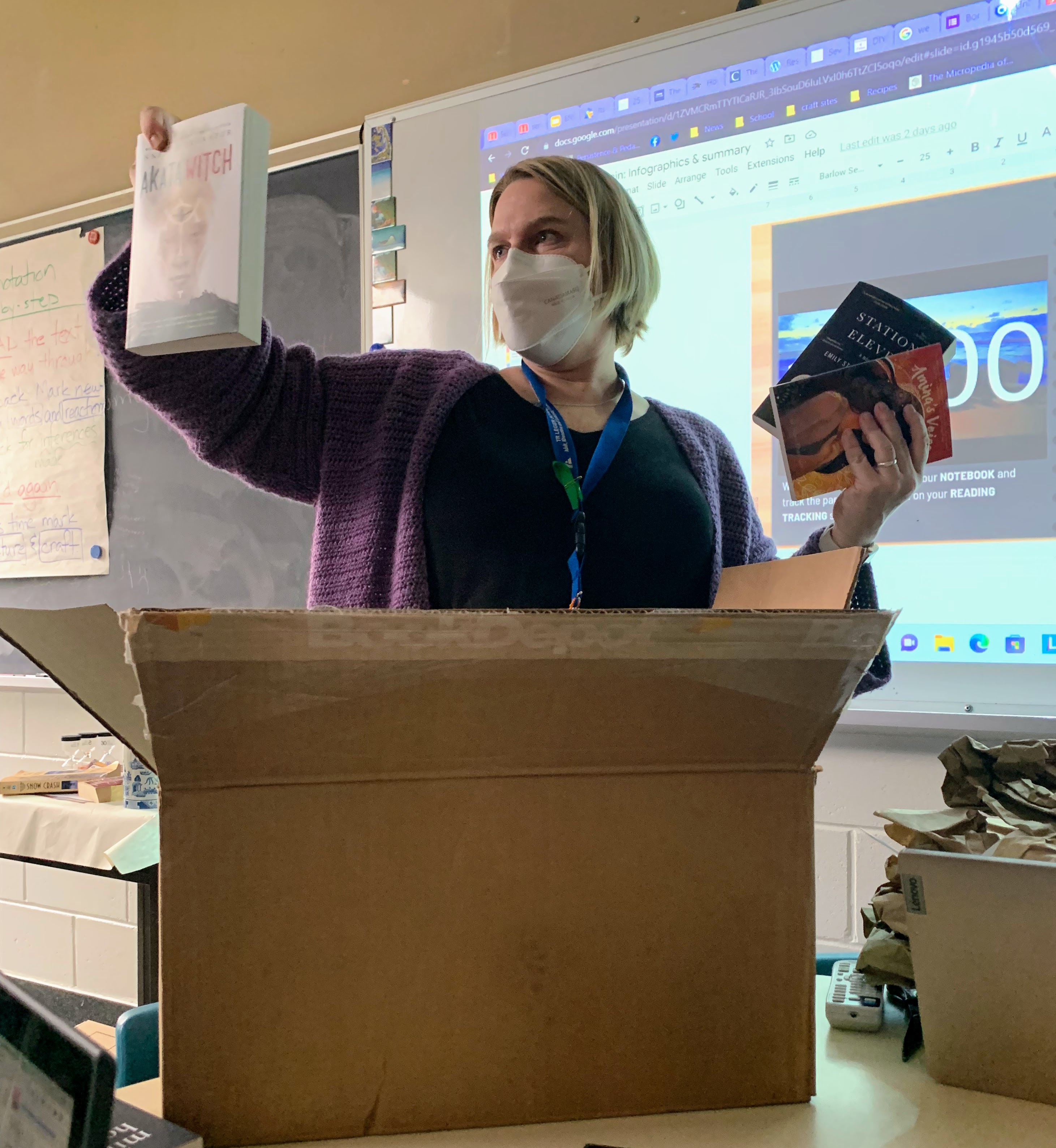
We unboxed the books together, and already the Rupi Kaur is tucked next to someone’s bed; two of the Maze Runner series are out; Alice Oseman is circulating; Girl in Pieces has a waiting list; Kwame Alexander went to basketball practice, and Tupac’s poetry may have lured in the one last reading holdout – the lone student who hasn’t really read anything yet. These books honour the students in the classroom. Thanks (at least in part) to the Book Love Foundation, the students know that they are valued and valuable.

As for that student teacher, I don’t think I’ll have to convince him that choice reading is magic. Oh, I’ll I need to let him know that in September we could barely read as a class for five minutes, but he’s seen what happens when people know that they can read what they want, for real. And once I shelve these new books, maybe I can help him start his own classroom library, too.

(FYI – these grants are made possible by donors. If you want to help support classroom libraries, please consider donating here.)

October Multiple Choice for English Teachers

  1. How many books have you read since school started six weeks ago?
    • Easily a book a week since all of the students in all of my classes read independently and silently for at least ten minutes per day. 
    • Do you mean the books I read to model reading behaviours for my students or the books I read at home? Or maybe the professional books I read?
    • Does it count if I don’t remember them?
    • [quiet weeping] I keep starting the second chapter but someone keeps farting loudly… in every class.
  2. When you model writing in front of your students, they…
    • watch with interest, asking questions and noticing how I am shaping my work.
    • glance up from their own writing occasionally if they are stuck and need some inspiration.
    • keep talking
    • Wait – I’m supposed to write in front of them? I’m not sure I should turn my back to the class.
  3. How many phones have you confiscated so far?
    • We have incorporated phones seamlessly into our daily routine so that students recognize them as useful learning tools.
    • My students and I co-created classroom rules; as a result, they respect the rules and only use phones at pre-determined times.
    • 14. Yesterday. During first period.
    • [quiet weeping] I’ve started loaning my phone to students when theirs run out of battery.
  4. How many assignments have you graded?
    • We have a routine where students choose their best work every Friday. They polish it and hand it in so that I can provide feedback over the weekend. We don’t need grades because each student has individual goals that they set for themselves and they are monitoring their progress. So far, everyone has an A.
    • Six weeks of school; six assignments. I strive for a 24-hour turnaround.
    • One. The next one is due at the end of the week.
    • One. Mostly. [quiet weeping] Ok, I’m lying. Some students have turned in *something* and I swear I’ve looked at it.
  5. What is the current state of the magnetic poetry on your chalkboard?
    • We have a multi-class collaborative poem that is currently up to four stanzas of rhyming iambic tetrameter. 
    • Students are using each other’s creations as springboards for their own writing.
    • Someone separated the words “pretty flowers” from the rest of the bunch.
    • Even though I removed all of the potentially vulgar words from the set, one student – who has yet to turn in any actual work – has managed to write “I want to tongue your mother” and other vague obscenities every day.
  6. Which unit are you studying?
    • We have eschewed “units” as a colonial construct; instead, each student has determined their own course of study, including stretch goals.
    • We are right on schedule: we’ve completely wrapped up the second of four units, leaving time in the semester for a final project.
    • So… that first unit is taking longer than I thought.
    • I think this semester might be one long unit.
  7. How effective are your anchor charts?
    • My students have worked together to create attractive, informative anchor charts that cover the bulletin boards and indicate that this is *their* classroom.
    • The anchor charts around the classroom both support and reflect student learning.
    • I have some.
    • I’m waiting for the chart paper we ordered in late August to finally come in.
  8. How often do you eat lunch?
    • Daily. With my students. I supervise a club every day. Interactions with students are paramount.
    • Every day. With my colleagues.
    • I mean, I eat…
    • I keep forgetting to pack a lunch. Yesterday I gave a student some money when he took a “bathroom break” and he brought me a McDonald’s hamburger and some fries.
  9. Your sleep patterns can best be described as…
    • An effective routine that allows me to function at my peak
    • 8 hours per night.
    • Erratic
    • I just want to get through a night without school nightmares.
  10. According to your therapist, how many weeks before you go on stress leave?
    • This is simply unthinkable. My students need me.
    • Stress leave? Teaching is my dream job.
    • We think I’ll probably be fine.
    • I’m just trying to survive to November.

Call them by their name – or whatever

Yesterday a new student joined my class. He showed me his timetable to confirm that he belonged in this room, and I asked him his name. He replied with the name written on the paper, then followed up with, “but call me xxx”. So I did.

I know there’s a lot of fuss right now about teachers using the name students ask to be called. (Brief background: in the US, some people are demanding that teachers inform parents when children ask to change names or pronouns; some people are demanding that teachers not do this, in part to protect vulnerable students;  Canada’s laws are different, but the same issue is cropping up.) Just before school started this year, a colleague in my school board posted a thread on Twitter about why we should use students’ preferred names, and spiteful commenters piled on, calling the teacher a “groomer” and worse. I was astonished by their ignorance. Well, maybe not astonished – I’m too old to pretend that I’m not a little cynical about the outrage; but I found it, at a minimum, fatiguing.

Here’s what they don’t know: teachers have long used students’ preferred names. I’ve been calling students what they want to be called pretty much forever, and I have never – not once – phoned a parent to let them know about it. My first memory of this is from years ago when a student asked to be called Kronos. Kronos! My instinct was to say no, mostly because this 8th grader was decidedly neither the king of the Titans nor a god of Time, but before I could say a word, the teacher standing next to me said, “Ok.” So we called the child Kronos. We didn’t phone home or worry about report cards. We just called him Kronos until he asked us to stop.

In that same school I had a student who went by Sarah while her family called her Sally. I’ve had students ask me to call them by their nicknames, middle names or last names (there are a lot of Emmas and Mohammeds out there; sometimes these name changes are a godsend). Before parent-teacher conferences, I often ask students what their parents call them, so that I can communicate effectively. 

For a lot of young people, names are a good place for a bit of experimentation. When we were little, my sister wanted to be called Christy instead of Kim. I have no idea why. I grew up in the South, so I knew plenty of kids whose first names were someone else’s last name – Madison, Perrin, Riley come to mind. When I was in my early teens, I longed for a name that could be mistaken for a boy’s. I blame Little Women for my dreams of being called “Jo” or “Alex” while behaving in unladylike ways. Later, I was awed when Shannon Faulkner took advantage of her gender-neutral name to become the first woman to enroll in the then all-male Citadel. Meanwhile, my aunt and uncle named my cousin Andrew, insisting that he not be called Andy; this worked fine until someone started calling him Drew. These days, he answers to either.

In the classroom, I’ve had students use a gender-neutral version of their own name, use a name frequently associated with the opposite gender, and use a name that, frankly, no parent in their right mind would choose. (I think most of us would try to talk our kid out of “Kronos.”) Sometimes their parents know; sometimes they don’t. It’s never really been an issue.

Look, I’m not naive: I know that people are using the name issue as a proxy for homophobia and transphobia. They say “name” and mean something else altogether. They’ve worked themselves into hysterics over this and decided that when teachers respect a child’s request to be called by a certain name or pronoun, something terrible will happen. In all my years of teaching, calling a child what they want to be called has never – not once – made a child feel less welcome; it’s never interfered with their learning; it’s never made them unhappy. I have 26 years worth of experience suggesting that using a child’s preferred name or pronouns won’t change who they are – but it might make them feel a little more like themselves.

So, when a child asks me to call them a particular name, I say “yes”. Why wouldn’t I?

Presenting

I have been futzing with the same slide show for hours. Hours and hours and hours. I’ve added some icons, resized them, resized them again. I changed fill colours and checked fonts. Oh, and I re-jigged one slide from three columns to four. That took at least 30 minutes and somehow seemed very very important.

I could be doing other things, of course. I could be helping with dinner or practicing on Duolingo. I could be heading to Knit Night or reading a book. I could be relaxing or chatting with my sister. But the slide show keeps calling me.

Tomorrow I will be doing my first-ever presentation at a conference. I am a little nervous. I have been reassuring myself that a teacher being nervous about a presentation is, honestly, silly. After all, I present all the time in the classroom, right? (Ok, well, not so much lately since I’ve tried to make my classroom much more student-driven, but I definitely presented for years.) And I’ve co-hosted an online book club for colleagues – complete with slide shows! – with no problem. And I’ve spoken on podcasts! How different can this be? (Different. It can be different.)

And it’s not like I’m doing this alone. My friend, mentor & colleague, Melanie White, is presenting the session with me. She is, frankly, inspirational: a powerhouse of thinking fueled by an almost unimaginable volume of reading and listening. In fact, I’m pretty sure that *she* is the reason people will attend. After all, *I* would attend her session in a heartbeat. (And yes, Melanie, I see you reading this and shaking your head. Let me have my nervous moment over here.)

Even as I write this, I am starting to laugh at myself a little. Sure, I am nervous – but writing about it down makes me realize that perhaps this is not as big a deal as I think. After all, Sarah Zerwin (of the book Point-less) was the keynote speaker today, and she presented for 2.5 hours. Now *that* would be nerve-wracking. She nailed it: my brain was spinning with ideas and questions right up to the last moments. And she told us that it was her first time presenting for that length of time – and that she over prepped. Sigh… such a teacher move.

Which brings me back to that slide show for tomorrow. I’m pretty sure that I need to just double-check a few more of the slides. And maybe tweak the script a little. I swear I won’t add any more columns, but one more icon might make all the difference…

(Wish us luck! Here’s hoping we share things others find useful.)

Many thanks to twowritingteachers.org for hosting this space for teacher-writers.

If a student asks for poetry…

If a student asks for a poetry book that’s not in the library, you buy it.

I didn’t know this rule existed, but as soon as she asked, I realized it was clearly a rule. After all, how often does a student ask to read a book of poetry? How often is the poetry by a poet I don’t know, a poet the student discovered on her own? How often is that poet a refugee, born in a camp as her parents fled the Khmer Rouge regime? How often is the student who is asking a newcomer herself?

After class, we looked up Lang Leav so at least I would know a little about what we were getting into – but, to be clear, I was always going to buy the book. Leav’s style reminds me of Rupi Kaur, whose books are so popular that they regularly disappear from my classroom, leaving me to buy them again. (It’s ok; another unspoken rule seems to be “If a student needs a book of poetry to become theirs, they should probably have it.”)

In April – National Poetry Month – I usually read a poem out loud every day. We don’t study it or anything fancy like that: we just read it. For a few minutes, the poem simply exists with us; the students simply meet it. I choose all sorts of poems, often with the students in mind but sometimes just because I love them. Usually a few students will start to share poems they love after a week or two. Often someone brings up something that a poem reminds them of. Sometimes, like this year, we find ourselves talking about one poem, which leads to another and – oops! – we’ve read four and are accidentally talking about Robert Browning’s Meeting at Night and Parting at Morning and somehow we’re talking about sexual imagery and I’m blushing and then… well, then class continues. And the next day we read another poem.

On this day, the student wasn’t sure which of Leav’s books was “best”, so we looked at the covers and the previews, and then I bought two. Thanks to the miracle of modern shipping, I will put them in her hands tomorrow. I cannot wait.

Two books of poetry: the lefthand one is red and is entitled "Love"; the right hand one is cream and we can see the word "September" in the title.

Because you know what? If a student is reading poetry and falls in love with a poet – well, I buy it.

(Also, I just realized that Rupi Kaur is missing again. I know I spend too much on books for my classroom, but how can I say no?)

The Dilemma

My test is positive. Again. Unquestionably, undeniably positive. Despite my best efforts to prevent it, I have covid. Today is day 8 since my symptoms began and, while I feel much better – only a cough and runny nose linger – my RAT test insists that I am still highly contagious.

I’ve already missed five days of work, so my self isolation period is officially over. According to both Public Health and my employer (the entity, not individual people), it’s time for me to get back to the classroom. Public Health’s official policy is that people can go back five days from the date their symptoms started if their symptoms have been improving for 24 hours and they don’t have a fever. This is me: fever is gone, symptoms are improving. My employer offers five days of “quarantine” leave, but after that I am using my sick leave. I am an employee, and I am supposed to work. Did I mention that I am still testing positive for a disease that may be more transmissible than measles and which, while it can be mild, can cause unknown amounts of long term damage to vital organs?

Nevertheless, the expectation is that I go to school – masked – even though both the tests and the science say that I am contagious and that the mask will not prevent me from infecting others. And I want to go. I’m so eager to return that this morning I even contacted a physician, just to double-check. Her response was unequivocal, “The RAT means you are still contagious. You shouldn’t go to work. Even in an N95 mask. Your students aren’t in the best masks. Just staying 2m away doesn’t prevent others from getting sick. Covid is airborne. I’m sorry.”

Each day that I stay home, the pressure to go in grows. Each day I’m out, the students lose out on effective instruction. Our school board, like so many others, is struggling to find supply teachers (substitutes). My colleagues are stretched thin, covering classes that are not their own; if we’re lucky and the school finds a supply teacher, that person is unlikely to be able to deliver a lesson; increasingly, we cannot find coverage at all and the students have (another) study hall.

But if I go in, I put real people at risk. Real people. People like you or your loved ones. Even as I type, researchers are trying to figure out the complications of covid, and we know they’re more likely if people aren’t vaccinated. Maybe you think that everyone should just get covid and get it over with. Or maybe you think that covid isn’t really that serious. Ok, sure. But what if I go in, coughing, masked and infect your child or your sibling? I don’t know if the students are vaccinated. I do know that one of my students is just out of the hospital. I do know that some of my students have younger siblings who cannot be vaccinated and others have family members who are at risk of complications if they get covid. I know that my friend’s child attends my school. I know, too, that my colleagues have people in their lives who are at risk. Who am I to decide that they should be exposed to covid?

Then, as my father (who is an infectious disease doctor) points out, I am lucky enough that I don’t *have* to go to work. Perhaps instead of being upset that I am still sick, I should be grateful that I am able to protect others. In that case, I can choose to be particularly cautious to protect others who don’t have the same luxury.

While I try to balance all of this, I must continue to plan my classes, even though I am not there to teach. Tomorrow will be day 7 of students following instruction from a screen. They are trying; they know that I, too, am trying. They really are the best. Still, some of them have thrown in the towel. Attendance is dwindling and fewer and fewer assignments come in. I don’t know what they have actually learned or what they need next to support their learning. I really want to be in the classroom.

And yet: I am so much more than simply an employee, merely human capital. I am a friend, a mother, a teacher, a colleague and so much more; much of my identity is wrapped up in caring for others. If I go to work, even though I am “only” coughing, even if I am wearing a N95 mask, even though Public Health says it’s ok and my employer (again, as an entity, not as individual people – my administration is lovely) would prefer that I return, I am denying the human-ness of all the people around me. I am deciding that my choice, my freedom is more important than they are. I can’t do that.

I love my work and my students. I miss them. I want to be there. Precisely for those reasons, I look at my RAT, look hard at those two red lines, and know that I am about to call in sick for tomorrow. After that, I’ll get to work on another lesson plan.

Please, join us weekly at twowritingteachers.com If you are a teacher, this community can be life changing. Trust me. I know.

Pivot

Educators in Ontario are starting 2021 by pivoting. Again. 2020 saw us pivot from what we quaintly referred to as “school” to “emergency remote learning” from April to the end of June. Then, in my school board, high school teachers started September in “quadmesters” organized into what is possibly the weirdest teaching I can imagine (and one which I still cannot describe succinctly): we teach one course for approximately four hours a day every other week. During that week, half of the class is in person one day and the other half is at home; the next day, they switch. Teaching is hybrid because the at-home cohort requires “some” synchronous connection with the in-class cohort during the day. Once both cohorts are home and have had a lunch break, they are supposed to do asynchronous learning for another hour. I’m pretty sure we used to call that homework, but whatever. The next week, we switch to a different course. Apparently, this is a mere pivot from our previous practice.

Now, as 2021 starts, we are “pivoting” again because Ontario is back in lockdown – or at least partial lockdown. First, we’re teaching fully online for three weeks. Because that doesn’t feel quite challenging enough, we are going to teach two classes a day for 112 minutes each (the two classes which we previously taught on alternating weeks for 225 minutes). The instruction must be synchronous for some amount of time that I can no longer remember, and there will still be an asynchronous component at the end of the day for those whose heads aren’t already spinning.

Also, while no one knows exactly what will happen, we’ll probably pivot back (re-pivot? un-pivot?) for the last week of January when we may or may not return to the original 2020 quadmester plan, except that this would give one course a full week of instruction and the other course none – so I may or may not be seeing the students who may or may not need something to learn. I mean, it’s not a problem because when we get there, we’ll just pivot.

But the current pivot means that all I need to do during winter break is cut my pre-planned two weeks of hybrid daily instruction plans in half, spread them over three weeks and – maybe? – two days, download and practice using a few apps (hello, colleagues who have time to practice with me) so that fully virtual learning can go smoothly, convert any planned in-person instruction to a different delivery mode, and get ready to handle any residual upset the students might be experiencing from the last time this happened – when we told them we were extending March Break & then separated them from all their friends & didn’t allow them back in the school for 5 months.

You know, pivot.

As 2020 ends and people suggest various phrases that define the year – “You’re on mute” is a fave – I vote for “pivot.” Oh, how I have come to loathe that word. To me, it implies an easy twist to a new position. Just turn a little and keep doing what you were doing. No biggie. No need to reconsider your pedagogy to take into consideration the trauma adolescents might be experiencing as the world around them goes haywire. No need to think about how that affects their ability to learn. No need to recognize that in-person, hybrid, and online education are, in many ways, entirely different beasts. No need to examine which educational practices are foundational and which are, perhaps, merely habitual. Just pivot.

So I looked it up. Because I’m a word nerd like that. And, while I regularly tell my students NOT to start essays with definitions (Dear Heaven, but they don’t need another way to avoid saying actual things), I’m going to share two of the definitions I found at dictionary.com.

Pivot
– to modify (a policy, opinion, product, etc.) while retaining some continuity with its previous version
– Basketball. to keep one foot in place while holding the ball and moving the other foot one step in any direction.

Suddenly I am back in high school, playing basketball with my athletic younger sister at the top of our driveway. She is on the Varsity basketball team. I am terrible at basketball, and my inexpert play is not helping her improve her game. Frustrated by my inability to block effectively, she sighs, “Just… set a pick,” and she places me between her and the basket. “Spread your feet, bend your knees a little, and stand still.”

I do, and she dribbles around me again and again, her brown hair flying as she finds different ways to create space for her shots. Sometimes – often – she pivots, confusing the imaginary defense before she spins around me and shoots.

Pivot, huh? Keep one foot in place and move the other foot in any direction. Retain some continuity. It sounds easy when the government or our school board assures people that we will simply pivot to online teaching, but I know better. Pivoting isn’t an effortless turn, a round peg gliding smoothly in a round hole. I think of my sister, relentlessly seeking improvement, earning her starting position one afternoon at a time, bouncing and bouncing, turning and turning, intentionally putting obstacles between herself and the basket. She was working.

Thanks to twowritingteachers.org for hosting this weekly space where teachers can hone their writing skills – and have fun doing it!

Still, even if we had to work at it, we had fun on those afternoons, and we got better – or she did, anyway. I didn’t, but I was mostly just standing still. It wasn’t easy, but, well… I think I need to go try out a couple of new apps. I’ll try to remember to keep one foot in place, but I’m constantly stepping with the other because on Monday, we pivot.