Bangs #SOL24 10/31

On Friday, my best friend from high school texted me a picture of my high school yearbook senior photo.

Look at those bangs! They started about ⅓ of the way back on my head. Every morning, I carefully curled them, brushed them to the side, and then hairsprayed them until they were stuck together in one giant flap of “feathered” hair. And, though you can’t tell here, that blue sweater has sparkles in it. Sparkles! Oh, the 80s.

That picture was still on my mind on Saturday when I went for a hair cut. Chuckling, I pulled out my phone and showed my stylist. I couldn’t quite tell if he was horrified or impressed. He chatted on about 80s and 90s clothes and hairstyles, while I stifled a laugh: He wasn’t around for those eras, so what does he know?

The picture must have stayed on his mind, too, because after my colour was done, as he was starting the cut, he said, “You keep saying you want something different. How about bangs?” 

It was my turn to look horrified. “No, no,” he reassured me, “not like in the picture. You know, something more modern.” I still looked doubtful. “I wouldn’t recommend it if I didn’t think it would look good.”

So I said yes, and now I have bangs again for the first time, I think, since that high school photo. Way back then, in English class, Libby had once declared, “everyone looks better with bangs.” (At least I think it was Libby. It could have been Anne. At any rate, one of the stylish girls.) I haven’t thought of that comment in a long time, but she might have been right. If nothing else, I like the new look: it hides some of my wrinkles.

Better things #SOL24 9/31

I have better things to do. I could be writing or reading other people’s blogs and commenting. I could be tidying the house before guests come, or just tidying in general. I could be folding the laundry put in the wash first thing this morning or running some errands. I could be working out or doing yoga.

To be fair, I’ve already been out for a walk and gone to the hairdresser. I’ve had my tea and played with the dog. But now? Yeah, I have better things to do.

I could be looking at the work my students turned in yesterday or planning ahead for the next unit. I could be catching up on emails or finding the numbers of all the places I need to call for various appointments for various people. 

Still, I’ve already cleared out the fridge and reheated leftovers for lunch. I’ve already started and abandoned a list of the things that I will, in fact, have to do sometime soon. Because I definitely have better things to do, like calling my sisters or reading a book, taking a nap or knitting. At this point, even watching a movie would probably be better. 

So many things are out there, just waiting to be done. But it’s the first day of March Break and outside it’s rainy and gray. I’m on the couch, wrapped in a soft blanket, and the dog is sleeping at my feet. So instead of doing any of the many things I could be doing, I’m allowing myself a luxury I rarely have time for: playing mindlessly on my phone. 

Do I have better things to do? Nah, not really.

Par, pars, parsh, parch #SOL24 6/31

“Hey Mom! Can you come help with my English writing?”

I’m supposed to be doing my own writing – this writing, to be precise – and I’m still knee-deep in grade 9 projects, but he knows I won’t say no. Mr. 13 is an excellent writer – effective vocabulary, interesting sentence structures, good grasp of punctuation – and he is dyslexic. Years of Orton-Gillingham-based tutoring means that he reads well and knows how to make good use of extensions like Grammarly or Language Tool, but when push comes to shove, he still benefits from a once over by someone who’s not dyslexic. Also, he knows I like to read what he writes.

He’s reading his sentences aloud under his breath as I plunk down next to him. “Um… I need a word for like ‘kind of was related to the point but not 100%.'” My eyes widen as I try to figure out what on Earth he’s talking about. “Oh!” he snaps his fingers, “got it: partially!”

He types parsley.

He keeps going, then circles back to fix it. Parshly. Spellcheck suggests harshly as a replacement, so he changes it to parchly – and the new suggestion is archly. “Um, Mom?”

Partially means ‘in part’ so it starts with the root part,” I say.

Part isn’t really a root,” he interrupts. Then, “sorry.” He would know. He knows Latin and Greek origins of words; he understands spelling rules in ways I have never had to.

I laugh, “Just start with part.” He does. I break the word down orally so he can hear all the syllables, then I spell. “Now i a l…” I pause because he is looking at me like I have two heads. Finally, I reach over and type the word.

He stares for a long second, then shakes his head in wonder. “There is no way that word looks like /parshully/. I would never have guessed that.”

And he wouldn’t have. Which is why I was so angry last night when I found one of his old math tests where the teacher has circled his attempt at the word “isosceles” and written “Really???” with multiple question marks. He brushed it off – “I mean, she did tell us we had to be able to spell all the terms” – but she doesn’t see how hard he works to spell these words.

But now he’s moved on and is enthusiastically excoriating someone’s weak debate argument. He doesn’t need me again until the end, when I do a check for capital letters and other words that spellcheck didn’t get. This time, he’s mostly good. I ruffle his hair and head back to finish my own work.

I wish all teachers could understand his truth – the kind that looks good on the surface but is working awfully hard to stay afloat. “Isosceles,” I mutter, and his exasperated voice trails behind me, reminding me to let it go. “Mom!”

How I Learned Canadian History #SOL24 4/31

Kindergarten: I met this fascinating man at a wedding. He told me he was from Ottawa and started to explain where it was. I stopped him, saying, “It’s the capital of Canada; I know where it is.” He was astonished. Later, he married me. These things are not unrelated.

First grade: Immediately after my permanent residency was approved, I was offered a job teaching Canadian Civics in French. I’m American, and my home language is English (though I speak French). I looked through the curriculum and politely declined. I knew nothing except that I didn’t know enough to teach Canadian Civics… yet.

Grade Two: I got a job teaching French in the English public school system, as opposed to the Catholic public schools or the French public schools or the French Catholic public schools. Just navigating the four public systems was an education in Canadian history – where minority language rights for the French and the Catholic system were enshrined in the law. I also learned that Canadians talk about Grade + year rather than the other way around.

Grade 3: I switched to a new position called “Student Success” where I helped students “recover” courses they had previously failed. Many of them failed Civics. Many many many of them. Remember that job I turned down because I didn’t know enough? Now I helped with dozens of failed Civics projects – and at least half a dozen Canadian History classes, too. I began to understand the Parliamentary system and even knew who the Governor General was. Riding? Premier? MP? MPP? I knew it all. Helping with Grade 10 History taught me a lot of battles, too. This would come in handy later.

Grade 4: I watched in fascinated horror during an election where an entire party got virtually wiped out. No one blinked. My spouse insisted that the party would come back in the next election. In Quebec, a young woman who had been running as a place-holder candidate in a riding that was all but guaranteed to go to someone else was suddenly elected and had to return from a trip to Las Vegas. She would turn out to be a strong MP. I realized that I needed to be able to vote in Canada.

Grade 5: I took the Canadian citizenship test. The people I knew told me it would be “super easy” but I took it under the Harper government, and they had a thing about the War of 1812. I knew very little  about the War of 1812, so I studied the citizenship packet assiduously – and spent several hours taking practice tests online. I learned about Louis Riel and Indigenous fishing rights and much much more. The exam itself was multiple choice and while it’s marked as pass/fail, I’m pretty sure I aced that thing. For the record, I’m glad I studied.

Grade 6: My children started school. Elementary school projects were straightforward, but I was impressed by the attention their teachers paid to Indigenous peoples. Together, we learned about Indigenous cultures, granted in a somewhat general way, but it was good. 

Grade 7: I spent several hours – twice! once with each child – helping prepare for a debate arguing the pros and cons of Canadian confederation in 1867. Sadly for my learning-to-time-spent ratio, child 1 was given the “pro” side and, two years later, child 2 was given the “con” side. Child 2 remembered this assignment at dinner last night. It is due today. I can now tell you about the Dorion brothers in Quebec and the Fenian raids and the arguments about how to pay for the intercontinental railroad. Heck, I can tell you how the US Civil War influenced the drive for Confederation and so, so much more.

Grade Eight: I know what’s coming next: a project about Louis Riel and the Red River Resistance. In French. Luckily, this one is due after March Break, so my Canadian History education will not have to take place largely in one week. Also, I’ve already had at least a middle school education in Canadian History, so I’m ready to go!

Nearby #SOL24 3/31

Years ago, a photographer friend of mine, Maggie Knaus, had an exhibition that she entitled “Nearby.” In it, she featured pictures she had taken when her brother-in-law had been nearby. He had passed away, but the images remained, beautiful and poignant. 

I think about that exhibition a lot: the beauty; the sadness; the sense that noticing who is nearby, who is not quite in the picture, is powerful and important. Because of it, I find myself thinking about who is nearby as I go about my day.

Right now, for example, my spouse and his buddies are playing a board game in the next room. The game will last most of the afternoon, their laughter and chatter an accompaniment to my writing and planning. Dice rattle; pieces plunk onto the board. I love the easy camaraderie of these men, the way they gather often, using games to deepen their friendships. They laugh again, and here, mere metres away, I smile.

Mr. 15 is in his third-floor hideaway. The “chill room” was meant to be a shared space, but his bedroom is tiny, so he has spilled into this space, too: computer, books, beanbag – and all the detritus that trails behind teenage boys. When he is home, he is up there. Moments ago, we crossed paths in the kitchen as he cut two thick slabs of fresh bread, slathered them with butter and popped them into the toaster “to melt the butter just enough.” I silently marvelled at his tall and slender form, at his long torso stretching up from pajama bottoms knotted low around his hips. What a miracle, to watch my child become a man. I hug him when I can and keep my comments to a minimum. Now, he is hidden again: only his voice trails down the stairs, a murmured reminder that he is nearby.

Mr. 13 is in the room with me, but a bookcase and a bamboo screen separate us. He is nearly silent now. Only the click of the keyboard and the occasional slide of the chair across the floor let me know he is nearby. Soon enough, he will finish this task and join his friends online. At some point, his excited voice will rise up to fill this room, and I will say, “Seriously! Can you please tone it down?” and he will – for 30 seconds or a minute – until the game and the friends fill his brain again and his voice surges again.

In the kitchen, one cat sleeps in her perch near the sliding glass door. In the basement, the other cat sleeps in the box of giveaway coats that she has adopted as her own. And here on the couch, the dog has curled up next to me as I write. 

In this mundane moment, I pause to recognize just how much love is near me, just how lucky I am.

An unwelcome visitor #SOL24 1/31

I knew for sure that I had an unwelcome visitor on Saturday. I’d heard the quiet knocking every morning for days, but tried to pretend it wasn’t coming: I went to bed early, but soon sleep started to elude me; I woke daily with a tickle in the back of my throat. By Saturday there was no ignoring the visitor: the virus had arrived.

“I think I’m sick,” I croaked at my spouse, as if my voice and the circles under my bleary eyes didn’t make this obvious.

“I think you are,” he replied, and set me on the couch to recuperate.

We’ve had viruses visit before, of course. Mostly we greet them with tea and honey; we entertain them with ridiculous series on Netflix or long cuddles with good books; always, we like to offer them plenty of rest. This satisfies most viruses. After a day or two, they thank us politely and move on, sometimes leaving behind a bit of a mess, but nothing that we can’t handle if we’re cautious.

This virus though, the one that came on Saturday, this one has overstayed its welcome. I tried to coddle it over the weekend, hoping that it would be willing to move on by Monday morning, but no. Instead, the virus – which had initially taken up residence in my throat – decided that it was too confined and expanded into my lungs and my sinuses. There, it stretched out. “Ah… just what I needed: more space.” It took a particular liking to my lungs and hung out there, making it hard for me to breathe.

So, I took the virus to the doctor’s office where we tried to take a picture of it, but it was shy and hid from the x-ray. “Well,” said the doctor, “at least it’s not Pneumonia. She always overstays her welcome – a real hanger-on, that one.” Pneumonia has visited both me and my spouse, so I knew exactly what the doctor meant. She is a terrible guest. “Still,” the doctor continued, “there are some truly ill-mannered viruses going around right now. This one may stay for days.”

I nodded my head, but I didn’t believe her. I know how to deal with a virus, and I don’t get sick very often. I wheezed my way home and curled up on my couch. I played puzzle games with my virus and watched lots of bad TV. We downloaded a mindless game app and played for hours. We drank unending pots of tea with honey. We knit, pet the dog and took naps. Still, the virus stayed. It fiddled with the thermostat, so I tried to help it get comfortable with some ibuprofen. Then, ungrateful, it spent Monday evening painting my throat bright red. “Much better,” it squealed. After that, it yelled at me whenever I swallowed, “You’re ruining the paint job!”

Every afternoon, I checked in with my virus. “Maybe you could leave tomorrow?” I asked. The virus laughed, and watched me write increasingly tearful emails to the vice principal, telling her that I needed to be out yet again. Last night, as I created the fifth day of lesson plans, the virus was not even remotely helpful. In fact, it laughed even harder and said, “I *might* leave tomorrow, but I’m just not sure yet. Maybe you should go in just to see what I do.” I’d gotten wise to it, though. I knew that it just wanted to stay longer, so I called in sick and sent the (now pretty pathetic) lesson plans.

Today is the seventh day of the virus’s visit. I’ve told it that my spouse and I don’t typically welcome guests for more than a week without consulting with one another, so it is reluctantly packing up. The paint job it had so delighted in has largely faded, and it’s moved into a smaller space, mostly in my throat. I’ve offered it more tea and sleep, but I think it’s starting to crave something different, hopefully something it can’t find in this house. By Monday, this unwelcome visitor should be gone, and I should be back to work. Fingers crossed.

A call from the teacher

The phone rang after dinner. I warily checked the caller ID, then perked up when I saw my sister’s name. Ah, exactly what I needed! But just as we settled in to a nice chat, I heard a beep.

Call waiting. I didn’t even know we still had call waiting. We’re already the odd family out because we still have a landline, but I can’t even remember the last time two people tried to call our house at the same time. Odd. (For what it’s worth, our reasoning for the landline is complicated, but the crux of it is that one of the kids still doesn’t have a cell phone AND we want them to be able to answer the phone in a general sort of way – you know, like if their grandparents call.)

Even odder, the tiny screen displayed the school district’s phone number. Someone was calling us from a school at 8:15pm. I asked my sister to hold on, and clicked over. My younger child’s teacher chirped a cheery hello. Quickly, I hung up on my sister (sorry, sis) and devoted my attention to this unusual caller.

I was a little concerned. I mean, when was the last time we had a not-automated call from the school? We got his report card last week and nothing looked terribly amiss. And he was already at home, playing video games & chatting with his friends, safely in one piece. More than that, when I’d asked, “How was your day?” he had pleasantly replied, “boring” as he does virtually every day. Everything seemed fine.

But his teacher was talking. I calmed my racing mind and paid attention. She was just calling to say hello and see how things were going. She was impressed with his math work. She knows about his dyslexia and complimented his writing. We talked about this and that. Finally, I asked if she was calling everyone. Yes, she was. She had decided to call all of her students’ families just to check in after report cards. After all, she said, it’s really too bad that the students who are doing well don’t get this sort of attention. We had a very pleasant conversation, and I hung up in a good mood. Judging from her voice, I bet she felt pretty good, too.

Before I called my sister back, I realized: I have done this. I have called home to say something nice. I have called home to check in. I have been the chipper voice on the other end of the line, the teacher saying that things are going well. But, I have never been the parent who got this call. And you know what? It felt nice. It felt like the sort of thing I might want to do for the families of this semester’s students. In fact, maybe I’ll start again this week.

Wordless

Sometimes my youngest has trouble with words. Whatever mysterious worlds hold him together – his own internal sun, moon and Earth – line up, and emotion rises in him like a spring tide, flooding him and robbing his ability to speak. If I catch him early enough, he can still tell me what’s happening, though it’s hard. If we don’t notice the rising waters until it’s too late, his voice is gone. While he sits, nearly mute, fist pounding the space beside him, tears in his eyes, I struggle to guess at the words that elude him. Sometimes, I can find the words for him, and he collapses in relief; others, though, we’re not so lucky and all that that’s left is the language of the body. When I can, I hold him until the waters recede.

This is what happened on New Year’s Eve. I was the only adult left awake with the kids, who were waiting up for whatever magic they think happens at midnight – or at least for fireworks. I knew he had planned to walk out to the dock with the rest of us, but as the hour approached, he no longer wanted to come. When I asked him what was going on, his words were drowned out and his eyes filled with tears. I was reluctant to leave my youngest crying alone on the couch as the new year rolled in, but the others were waiting and time was short. Luckily, my partner was still awake, reading. He knows these moments, and came down to snuggle with our child while I went with the others into the dark. By the time we returned, my son was fast asleep.

These moments are frustrating, heartbreaking and, most of all, perplexing for me. I live in a world of words, trusting them to be my messengers to others, certain that I can coax them into shapes that will communicate meaning to those around me. I rely on words to tame the very emotions that, I think, overwhelm my child.

And yet. And yet.

These past months, words have often eluded me. I haven’t written here regularly. In fact, I haven’t written anywhere regularly. I’ve spent far too long staring at other people’s stories in an attempt to avoid my own. I’ve had no desire – much less ability – to put words to what I’m feeling. Instead, I’ve allowed myself to float on my own wordless tides. It’s unsettling.

Now, as 2024 begins, many people I love and admire – writers, readers and lovers of words – have chosen “one little word” for the year. I’ve tried to choose one, too, but the words have been as hard to hold as water. No word stays. As if to prove a point, I have spent some time now writing, erasing, then staring at the screen. The words slip through my fingers. What should I say? What should I not say? How do I feel? I don’t know. I want to commit to writing weekly this year. I want to say that I am grateful to know in advance some of the challenges that this year will bring. But those things aren’t true. 2024 may be the year I wrestle (again) with what a friend told me long ago: “Words put space between thought and meaning.”

I think about my sometimes wordless child, approaching the new year exhausted and curled up with his father. Perhaps this year it will be enough to hold on to those I love and ride the tides as we can, with or without the words to describe the experience. Surely, that is enough. 

Puzzling #SOL23 29/31

I came home tired. Scratch that: I woke up tired, even though I woke up before my alarm went off, which I thought was supposed to be a sign that you’re getting enough sleep. I’m here to tell you: that truism is false. Anyway, I was still tired when I came home. There, that statement is more true.

Even though I was tired, I went for a walk because, thanks to Lisa, I have walked at least a mile every day for 1045 days, and a little fatigue is not going to end that streak, thank you very much. While I was walking, it started to rain and, as I got home, the rain turned to snow. I silently railed against the weather. For pity’s sake, it’s the end of March.

I came inside and shook out my jacket. I should have sat down to plan tomorrow’s lessons – the grade 9 class did not even come close to finishing what I had planned for today; the reading class got distracted by – wait for it reading (yes, I did an internal happy dance while I pretended that was totally normal for them to ask to read a news article) – but now I was tired and slightly damp, so instead of working on work, I found myself listening to a podcast and working on the puzzle that has bedeviled me for several weeks.

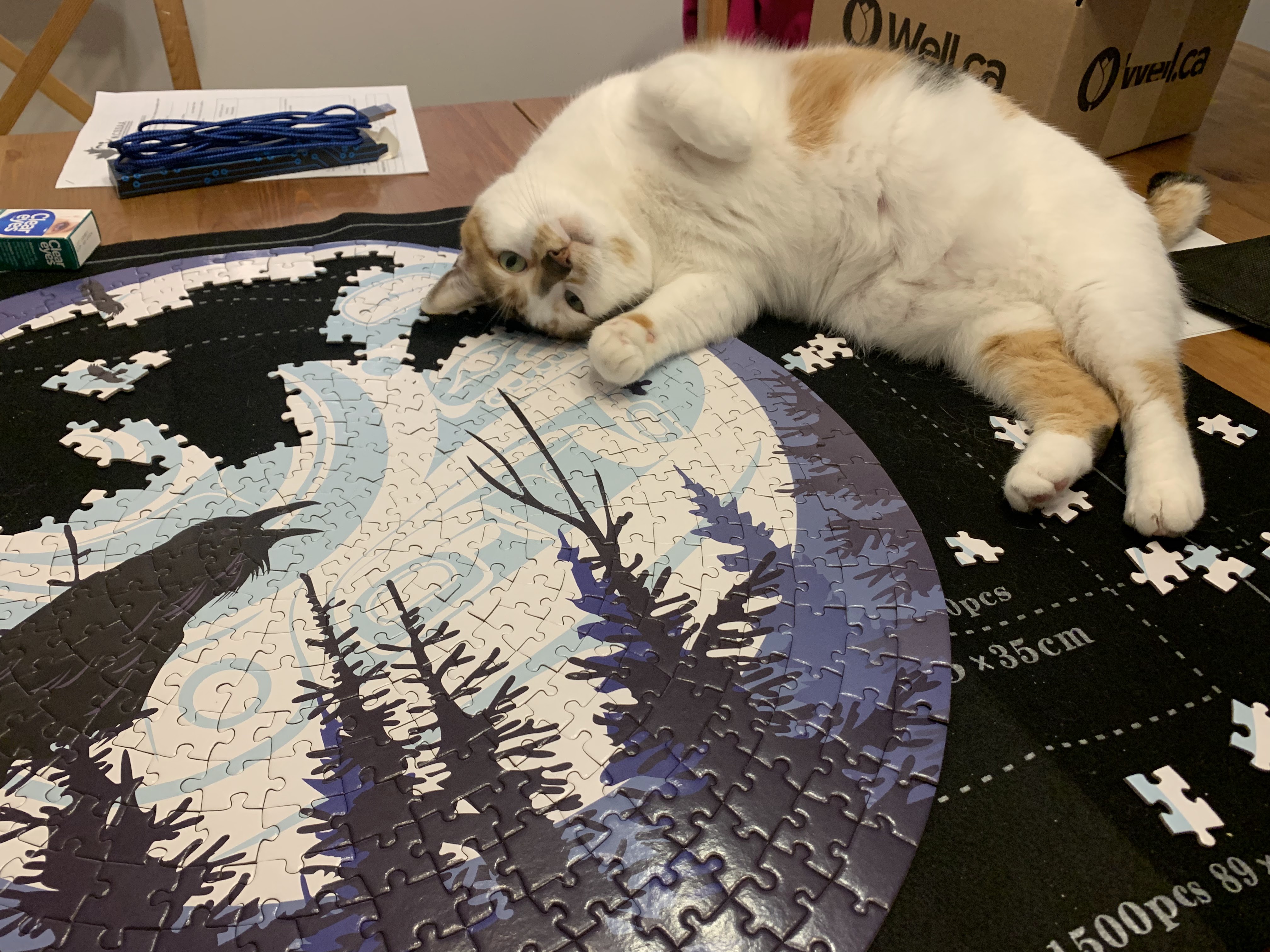
Hera came to “encourage” me by covering up one of the unfinished spaces.

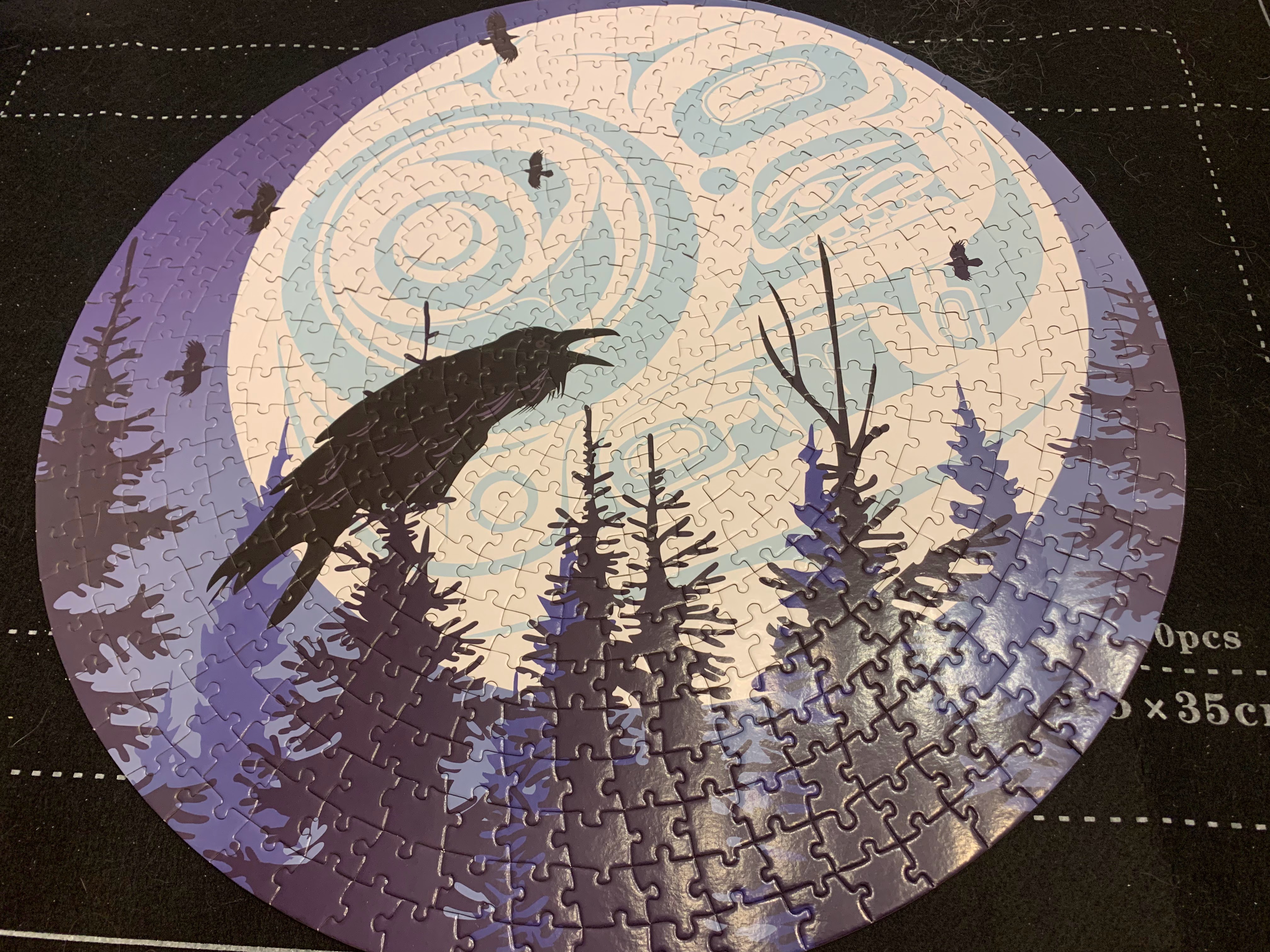
I persisted. The kids came home. Andre came home. Andre left with one of the kids for a father-son dinner out. I kept puzzling. And I finished. Here it is:

Look, I’m still tired, but I finished a puzzle. Seems like a reasonable outcome.

Don’t you…forget about me #SOL23 27/31

Mornings in our house are a tightly choreographed dance of who is doing what where when: Andre is in the kitchen and I am upstairs; Andre is upstairs and I am in the kitchen; Andre is making breakfast and I am waking the kids; the kids are eating breakfast and I am finishing getting dressed. On it goes, each of us weaving around the others, chatting, moving and generally getting ready. By 8:15, everyone is out of the house.

Except for last Thursday. Last Thursday we thought everything was going along smoothly: Andre had run out to the bakery for our breakfast; I had woken the children and then finished getting ready; Mr. 14 was putting his lunch together in the kitchen while Andre dressed upstairs. I left first, and Mr. 14 followed me. Andre was putting on his shoes, about to head out the door, when he noticed a backpack in the corner of the front room.

A backpack? But the kids had already gone to school.

Except that we had forgotten about Mr. 12. He had stayed up LONG after his bedtime finishing a book (Skander and the Unicorn Thief – he highly recommends it and is already desperate for the sequel which has not yet been released) so when I woke him up, he said hello, sat up, then laid back down, turned over and went back to sleep. In the morning chaos (ahem, choreography) no one noticed a missing 12-year-old. Oops.

Andre slipped his shoes off, woke up the kid, made him some lunch, thrust a bun at him for breakfast and got him out of the house so quickly that Mr. 12 wasn’t even late for school and Andre wasn’t late for work.

We have tried to foist this oversight off on the child, telling him firmly that he cannot read until all hours of the night on a school night, but he knows the truth: we totally forgot about him.