

I haven’t written here all summer (wow!), but that doesn’t mean I haven’t been thinking about reading and writing. In fact, quite the opposite is true. During a summer of learning and thinking about how to help students who are not yet reading at their grade level or chronological age, I found myself remembering some of my own stabs at emergent literacy. No, no, not from when I was a child. That’s important, I suppose, but I learned to read in a relatively straightforward way, so my journey doesn’t shed much light on adolescent learners. Instead, I keep thinking about the times I’ve had to learn to read again as an adult.
Anyone who’s learning about reading is going to come across Scarborough’s Reading Rope at some point or another. Here, I’ll show you the image:
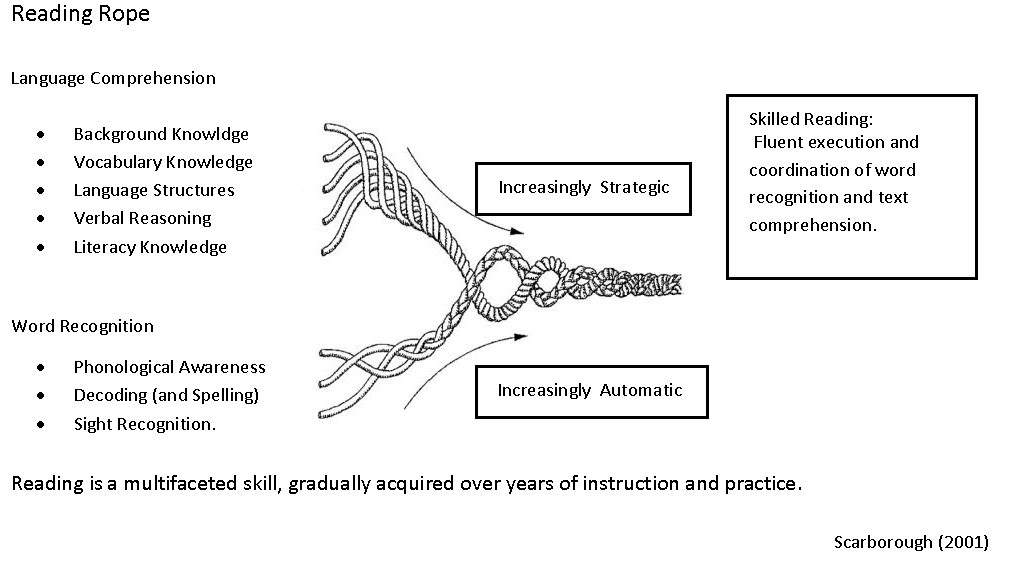
It’s not particularly complicated (in fact, this is called the “simple view of reading”), but it’s a useful way to break down what goes into the complex task of learning to read.
My first attempt at learning to read again was when I moved to Bulgaria in the 1990s (“You’re from the 1900s, Miss!”). There, long before the internet was ubiquitous, I approached an entirely new alphabet and language armed only with a physical book hopefully entitled “Teach Yourself Bulgarian.” It was, shockingly, the only copy at the bookstore when I went in to buy it. Amazon did not yet exist.
On the trip to Sofia, I pored over the Cyrillic alphabet. Some of it overlapped with my familiar Latin alphabet – easy; some of it used familiar shapes for different sounds – harder; some of it was completely new to me – hmmm…. In my airplane seat I made sounds under my breath, testing myself by covering the pronunciation guide with my hand.
Days later, I wandered through downtown Dimitrovgrad (Димитровград) forcing myself to pause and sound out the words on signs. It was disheartening until I got to I discovered ресторант – restaurant! Yes! Minutes later I encountered a store window that said аптекар – ah…p…t…eh..kah…er – aptekar – apothecary – this was the drug store! A glance in the window confirmed my elementary decoding. I was right! I could read Bulgarian! This year overseas was going to be a snap! I could already read! I was exultant.
Friends, decoding is not reading. If only I’d known then what I know now – if only I’d known about the interplay between vocabulary knowledge (I already knew what restaurant meant), background knowledge (which moved me from apothecary to drug store), and decoding, I might not have been so disappointed when I looked at what was clearly a bookstore and read книжарница. It was more than my poor language-loving heart could take. I went back to my apartment for the day.
While I never learned to read or speak Bulgarian fluently, I did learn enough to handle daily life. I could find markets and grocery stores, order a coffee or a simple meal. I could get on the train and have a basic conversation with the people in my compartment. I learned how to tell people that I was a teacher and I found Bulgaria beautiful. My reading, like my speaking, remained halting. Even once I could decode quickly, I often couldn’t understand what I was reading. It was…. hard.
I’ve been thinking about that a lot this summer, about what it was like to live in a country where I had to pause to read the signs, pause to make meaning of what others took for granted. I mostly frequented familiar places. In the markets, I went to the vendors who I knew would be patient with me; in restaurants I ordered what I could understand, rarely veering into the unknown. It was a comfortable way to live, but over time I think I would have felt hemmed in.
In a week, when students are back in school, when I’m meeting young people who are hiding their reading difficulties (even though they will be in Reading class, so it’s not like I won’t know), these experiences will stick with me: both the comfort of sticking with the familiar and the excitement of decoding a new word. After all, by the end of my year in Bulgaria, I could easily read книжарница even if I only went in ones that stocked English language books.


Amanda,
I am amazed over and over by your intelligence and depth of knowledge. You are one of the most impressive educators I’ve had the pleasure to interact with, and i am so sad the TWT proposal for NCTE was declined. 😩 I hope you share this reading struggle w/ students and hope your students, colleagues, and admin know how lucky they are to have you in their school. Like you, I am so worried about the decline in reading and literacy we see and believe it is endangering us all. While in Vietnam in April I met a five year old boy studying Chinese and English. I told my husband “as a country the U.S. is f*cked.” Something has to change.
LikeLiked by 1 person
What lovely compliments! I have to admit that I have a fondness for languages and an absolute fire for learning – so more languages are always interesting to me. Also, someday we will meet in person & it will be glorious!
LikeLiked by 1 person
“While I never learned to read or speak Bulgarian fluently, I did learn enough to handle daily life. I could find markets and grocery stores, order a coffee or a simple meal.”
I am so impressed!
Bulgarian? In the 90’s? Pre-Amazon?
I am also so happy you’re back!!
I second Glenda Funk: you are such an impressive educator. So smart. Or wicked smaht, as we say in Maine.
LikeLiked by 1 person
Oh the idiot things I did in the 90s – like move to a not-first-world country where I couldn’t read the alphabet and didn’t know a soul instead of accepting the (very reasonable) permanent job I had been offered because, well, it wasn’t teaching. But hey, I had a book and a lot of chutzpah… and here I am! 😂
LikeLiked by 1 person
First, I think it is the most powerful thing a teacher can bring to their teaching- the memory of when they have been challenged learning. How great to tell honest stories to your students.
I appreciated your direct, daily examples of restaurant and apothecary to illustrate foundational knowledge we depend on.
I was brought in by your title. I think a lot about language learning, subsequent language learning, and interactions between speaking, reading and writing. I’m currently in Spain, I am a slow Spanish learner, and I am just now starting to g to use reading to improve my grammar and vocabulary. And I am fascinated with my grandchildren’s life, bilingual plus the local Valenciano (taught in their public school) makes three. They study English spelling patterns online. And all this is still using the same alphabet!
Finally, I just read a good YA book I got for my grandson called The Teacher of Nomadland by Daniel Nayeri. It is very much about language.
LikeLike
When we become students to a new language it gives us a better understanding of what our students face when learning something new. I applaud you for this undertaking.
LikeLike