Once an English teacher…

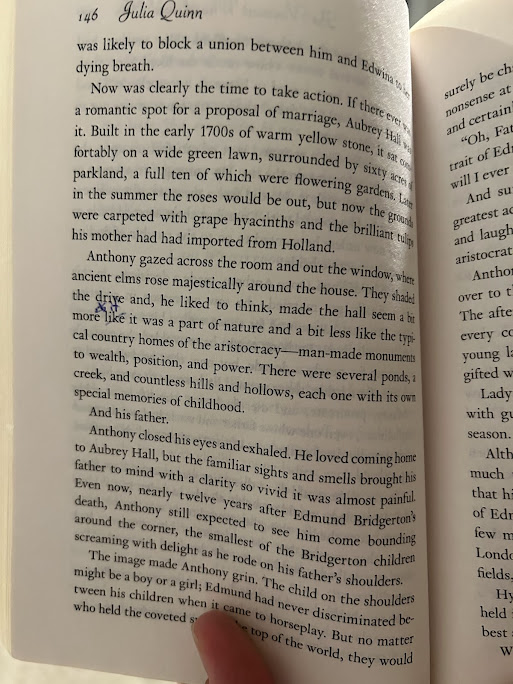
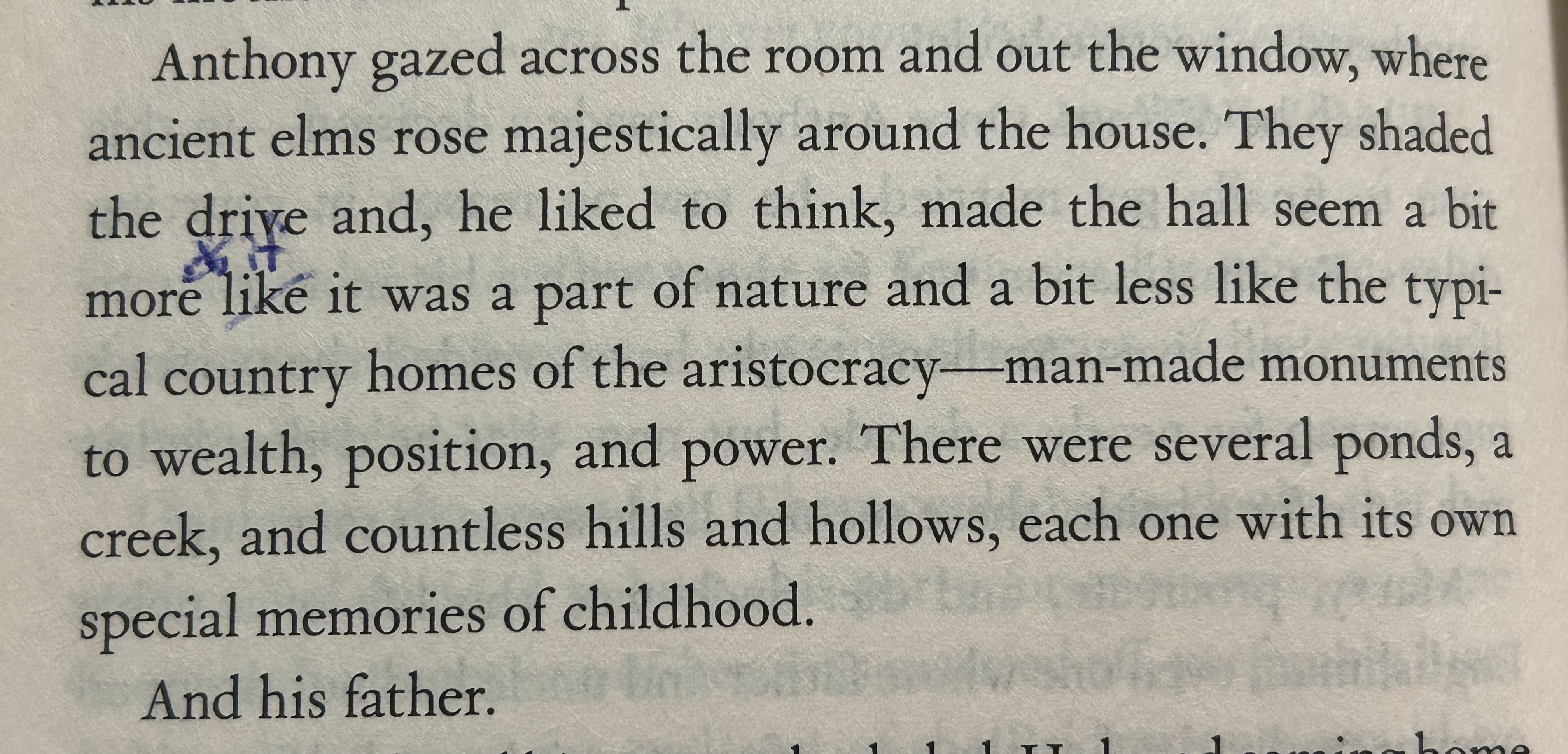
The first hint was on page 194. Blue ink.

I was a little startled. I mean, this is a trashy romance. The main characters murmur and gaze longingly. I was enjoying the story, but I wasn’t exactly on the lookout for grammar errors; in fact, I’d consciously decided to overlook some of them. And yet…

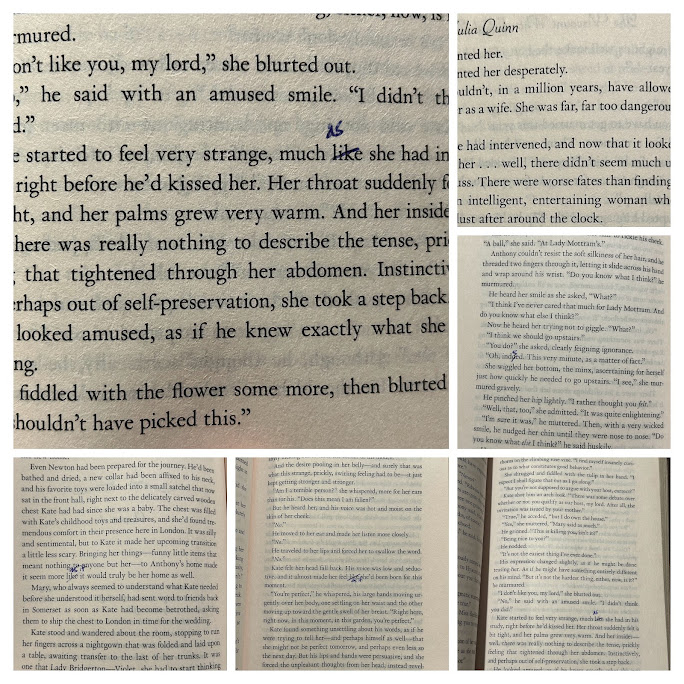
“As if”? I nearly laughed. This is my fellow reader’s quibble? I mentally shrugged, then moved on. Until it happened again. And again. And again. Someone had taken her blue pen to the novel and fixed “like” – and only “like” – a dozen times throughout the novel.

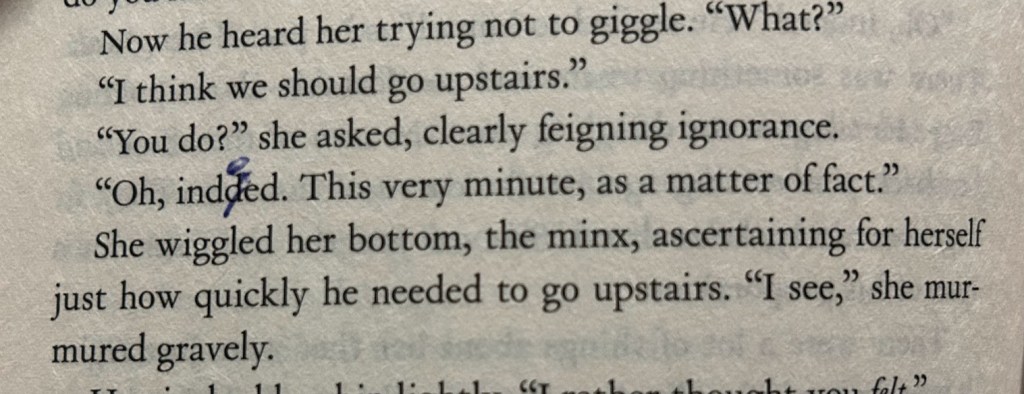
Wait. I lie. Once, she fixed a typo. Indeed.

I imagine her reading along, overlooking the missed subjunctive, ignoring the diction (minx!), letting the anachronisms lie… and then she hits her limit… “like.” She shudders. She thinks of the years she spent in the classroom, teaching students when to use “like” and when to use “as if.” She thinks of endless hours of grading essays, the constant battle against the demise of the English language. Her fingers tingle, and before she knows it, she has a pen – because of course she always has a pen nearby – in her hand, and she has made the correction.

Once she’s started, she cannot stop. The pen is uncapped, the errors egregious – at least in her eyes. Surreptitiously at first, then with greater and greater glee, she fixes the error each time it appears. As the novel climaxes in a crescendo of smouldering looks and husky moans, with one final flourish, she amends the typo in indeed and, triumphant, re-caps her pen. The world is now a little more orderly.

The next day, chastely, she returns the book to the library. Maybe she glances about as she slips the book into the returns slot; maybe she holds her head high, firm in the knowledge that she is right.

One way or another, I got double the pleasure out of book two of Julia Quinn’s Bridgerton series: trashy romance, and proof that English teachers never really leave the classroom.

Just 15 minutes

Once again, I forgot it was Tuesday. This is odd because yesterday I knew that today was Tuesday, and, frankly, today I knew it, too. I had planned to write something last night, but then I didn’t because… I can’t remember, but there was a very good reason. This morning I even set aside some writing time, but then the supplies we ordered came in, so I had to check what we received against what we ordered (vaguely similar) and distribute them to various teachers, then I had to set up a new booking system so that we can get the 95ish Chromebooks distributed fairly to the 30ish teachers who want them for various classes (no, the math doesn’t math there). Anyway, one thing led to another and then it was after work and now it’s 8:45 and I haven’t written my Slice of Life.

Recently, when I’ve found myself in this position, I’ve thrown up my hands and decided to put things off until “next week,” but this week my students have essays due, and I have this nagging sense that if they have to write and publish then I should probably write and publish. So here I am.

Part of the reason I lost track of time (and the day of the week – I even missed my knitting group!) is because I’ve been trying to figure out what to do with about 15 minutes of class time tomorrow. The original plan was for the grade 12 students to share their This I Believe essays in a sort of “desk exhibit” – they were going to walk around and read each other’s essays & leave positive comments on post-it notes. BUT… today’s lesson involved a peer feedback protocol that worked so well that quite a few students have some serious edits to make. Given our lack of Chromebooks combined with student jobs and after-school commitments, tomorrow needs to involve a little time to tidy up their writing in class, so the gallery walk will happen on Thursday. They do not, however, need 75 minutes (the length of our classes) to edit, or even 60 minutes (after 15 minutes of daily reading), or even 45 minutes. I figure we need a maximum of 30 minutes of editing time. This means that I need to create a tiny lesson – just 15 minutes – to bridge us from reading and writing narrative arguments to learning about rhetorical analysis and using that with popular culture.

Here is where being a teacher gets weird: I know what we’ve done, and I know where I want us to go; I also know the information I need to share, and I know the students. This lesson should be simple – just, you know, teach. Instead, I’ve spent at least an hour looking at videos and slide shows, thinking about the right way to present the topic so that students are interested and engaged. I need something that intrigues students and is memorable. This will be the first peek at something that we won’t really start until Monday (because essays, PD day, the weekend…) I want this to hook some specific students. I want them to have something to think about. Come Monday, I want them curious.

So do I read them a picture book by Jacqueline Woodson? Do I show them a video about a soccer team in Thailand – one that turns out to be an ad? Or maybe I show a brief interview with Simon Sinek about the power of stories? What stories matter? Why do we care? Who is telling these stories? To whom? For what purpose? Thomas King says, “The truth about stories is that that’s all we are” – I need a fifteen-minute something to start them down the path to believing that. 

I bet I can find it if I think about it for just a few more minutes…

Why read?

It’s the second week of classes, and we’re all slowly settling in to the familiar rhythms of school. In grade 12 English, we’re already reading our second short mentor text for our narrative argument unit. (This is a new unit for me; I wanted something a little different from the personal essay, and here we are.) Today we read a This I Believe essay called “The Power of Hello” by Howard White. I didn’t know who White was (former basketball player, VP at Nike) until I read this, but I loved his message “that every single person deserves to be acknowledged, however small or simple the greeting” so his was an easy essay to choose as a mentor text for the class.

Before we got to the text, however, I paused to ask the students why they think we are still teaching reading and writing in an age of AI. Reading was the easier sell. If you google “Why is reading important?” – which I do every semester – there are pages and pages of hits. I like to summarize them by saying, “Reading makes us smarter, kinder, richer and a better date.” (The better date is because reading can improve conversational skills – who knew? Well, I mean, besides me and the internet.) Lots of students nodded their heads and sort of looked like they agreed, and for today that was enough. We’ll come back to this when they need to remember why I’m pushing for a high volume of reading.

Writing, on the other hand, seemed less important to many students. While one student straight out said, “writing is thinking” plenty of students looked less than convinced. And I get it – though I disagree. Words work for me; for others, this is less true. When I try to sketch something, I am often significantly less successful at communicating. If I needed to show my thinking through movement, I would, I suspect, often fail. Too often, students have only ever written for a grade. I can’t fix that, but I can try to help them understand that words have power that they can harness with practice. I’ve got a whole semester to make my case.

Because of this brief class discussion, reading and writing were on my mind when I saw a woman with a stroller stopped on the sidewalk ahead of me. I wasn’t actively thinking about Howard White’s essay and the power of saying hello, but his words must have been somewhere in the back of my mind because I very consciously registered the scene: a young woman with a baby strapped to her front and a toddler between her legs, hanging off the stroller. She was stopped awkwardly in the middle of the sidewalk, and the toddler was twisting and turning just enough that I knew she wasn’t watching him. I said hello.

“Hi. Um, there’s something in my eye,” she said. “A bug flew in there. I can’t really see.”

In fact, her eye was watering. The baby wasn’t just in a carrier, they were nursing, and the toddler was close to tipping the stroller over. The mother looked just a tiny bit frantic.

“I could look at your eye…?” My voice trailed off into a question. It’s an oddly intimate offer – here, stranger, let me look at your eyeball – but she took me up on it immediately.

I didn’t see a bug, and now her eye was watering with tears? irritation from the bug? “I can really feel it. Can you look again?”

And there it was! A tiny black spot. I reached toward her face and swiped the critter to the edge of her eyelid; she did the rest. “Oh, thank God. Thank you. Thank you so much for stopping.”

I told her, of course, that it was nothing – because it was. Just one mom helping another on the sidewalk at the end of the day. Just a tiny interaction between two people who happened to cross paths. She won’t remember it by tomorrow morning; she may be so tired that she has already forgotten.

But I wonder… would I have noticed her if we hadn’t read that essay in class? Maybe White’s belief that everyone deserves to be acknowledged primed me to actually see her. Maybe the fact that he wrote his small story and shared it helped one human reach out to help another. Maybe now that I’m writing this, I will remember to do this again. Maybe you will read this and you, too, will help someone. Maybe this will happen even if you forget that you read this. 

This, I believe, is why we write and why we read. I think I’ll share it with my students.

September Looms

I gave myself the summer off, mostly. From blogging, from prepping for classes, from worrying about who can or cannot read and what needs to change or stay the same. I tried to actually relax – or at least not to be actively stressed. I attend zero conferences. I abandoned books I didn’t like. I didn’t plan a big family trip. I hung out with friends and family and quit Twitter. Overall, I think I did ok. 

I still have a week left before school starts, so this morning I rolled out of bed and plopped almost directly into our oversized beanbag to read a little of Jhumpa Lahiri’s Whereabouts. Instead of immersing myself in the story, however, I found myself wondering if I could finish it and return it to the library today, another item checked off the before-school to-do list that’s already filling up. My mind gleefully got into the go-getter groove, and soon I was listing as much as I was reading. Gah! Not what I had wanted.

I tried to shake off the looming lists and plans. I tried to read one more short chapter, but Hera – our cat – was having none of it. She scaled the back of the bean bag and dragged her tongue across my cheek. Skritch. Then she did it again. She clambered onto my chest, batted down the book, and looked me in the eyes. I knew she was right: time for tea and then into school to set up the classroom.

So I got up, neither fully relaxed nor fully tense, and lumbered down the stairs towards September.

It’s kind of a funny story

Commenting on student work, 2024 edition
Me, to a student who obviously used AI: please use your own words.
Student: what says this isn’t in my own words??
Me: I expect students to write in the doc I provide. I am automatically worried when I see a large chunk of work pasted in.
Student: I wrote it on paper before I pasted it onto the computer. If I find the paper will that help??

Um… that’s not how paper works.

That’s how I shared the story with friends. It’s all true, and dear Heaven, but this generation of kids…

But it’s also not the end.

Today, the last day of school, the student came to class. They finished up some work and, at the end of class, hung back at my request. We both wanted to see if all their missing work had been submitted, and I wanted to talk about that pasted-from-paper document. The student had resubmitted it, this time with a photograph of a handwritten document – the paper they supposedly wrote before they (magically) pasted it into the doc.

It was already hot – today’s high was 32C/ 90F and felt like 43C/ 109F – and the end of school was on everyone’s mind. I know I had to muster up all the calm I could find; I assume the student had to do the same. I opened the assignment. I showed the student how I could see the copy/ paste. I showed them the AI detector and the 100% AI result. I acknowledged that I could see the handwritten document, but shared my concern that the assignment didn’t fit the instructions. Then, as patiently as I could, I said, “I can see that you’re upset. Tell me what happened. I’m listening.”

Then I listened.

And it turned out that I was wrong. They walked me through their work and showed me their thinking. They hadn’t used AI to generate the text, but they had typed it up in Grammarly (because when you’re learning English a good grammar program goes a long way) so some of the words were not quite theirs. And they had followed the instructions, sort of, they just hadn’t organized properly to separate parts. And they were shocked that I could see the copy/ paste and a little hurt that I thought they might have “cheated.”

So we talked about cheating and about getting behind in our work and the shortcuts we sometimes take. We talked about the pressure of finishing all that late work and about talking to teachers rather than hiding. Then I thanked him for talking to me and shooed him off to catch up with his friends. The whole thing probably took three minutes, maybe two.

It’s not as good a story as the one where a student says “I wrote it on paper before I pasted it onto the computer” and the teacher thinks, “Um… that’s not how paper works”  but the real part of teaching, I think, is the part after the funny part – the part where we listen – and I wanted to write that, too.

Sort of tutoring

“Miss, are we done with that thing?”

He’s caught me in the hallway between classes. I hesitate, not quite sure what to say. He bulldozes ahead, “You should come get me from class today, like maybe thirty minutes in.”

Ah-ha! He wants to continue our reading comprehension sessions. Or rather, he wants to get out of his science class for twenty minutes.

“I kind of figured you should stay in class and work on your summative project,” I say. 

“Nah,” he scoffs, “I don’t understand any of it. I’m just making stuff up.”

I relent. “Fine. I’ll see what I can do.” 

So, about thirty minutes into his Science class, I pull him out.

The project is pretty cool, if you ask me, which he didn’t. They are supposed to be creating their own habitable planet and an alien race that lives there plus some other stuff, but I don’t get a good look at the project because he’s already asking a question.

“Is there a difference between mass and density?”

I tell him to look it up.

“But if you know, why don’t you just tell me?”

I just give him a look. He asks again, gets sidetracked for a minute, and then circles back to ask one more time. Silently, I take his computer and type in “Is there a difference between mass and density”. I turn the screen back to him so he can see the bazillions of responses.

“There is! I thought so! Why didn’t you just tell me?”

I ask him what the difference is. He tells me it doesn’t matter. I refrain from making a joke about matter.

Now he wants to know why the mass of the planets is listed as x1024 and how do you type up high like that? And also what’s a good temperature? Like, you know, a neutral temperature. And why does he have to use Celsius when he’s sort of used to Fahrenheit and actually he’s not really very good with either so is 16 cold? 

I ask him if he’s talking Fahrenheit or Celsius. “Either,” he says, “I just want to know if it’s cold.”

Every time he asks a question, I help him look it up. Every time a webpage comes up, he groans and says he doesn’t want to read “all that.”

“Miss, I just want to put down easy stuff and be done,” he tells me. “Can’t you just tell me the answers?”

I tell him that if he just wanted the answers, he wouldn’t have asked me for help. He disagrees. So I don’t tell him about distance from the sun, and I make him look up if a planet can have long days and short nights and whether or not it can always be Fall. He argues with me every step of the way, right up until he tells me class is almost over and he needs to go get his stuff. 

“Fine,” I say, trying to keep the frustration out of my voice. “Do you want more help tomorrow?”

Not like you helped him today, says a little voice inside my head. I mean, we fought for many minutes about whether or not he needed to know what axial tilt is. (He does, but he refused to read the information.) Classes end in one week. We are all exhausted and ready to be done.

“Yeah,” he says, “if you have time you can come back. I like it when you help me.”

So tomorrow I will once again sit with him and refuse to either answer his questions or allow him to barge forward without thinking. I will bite my tongue, and he will be frustrated with me, but apparently we’re both good with that. 

One more week.

Writing beside him

I’m helping a former student write a personal essay for his Grade 11 English class. We’ve talked it through, and planned a little; his next step is to write it. Reading and writing aren’t his forte – he’d much rather be on a playing field than in any classroom – but this story is important to him, and he wants to get it down on paper. So here we are, sitting in the upstairs lobby – currently one of the coolest places in our very hot school – and he’s writing.

This kid has my heart, as many of them do. Last year, he didn’t do particularly well in our first semester English class, so he agreed to change his timetable in order to be part of a reading class with me during the second. That alone took some courage: not everyone who needed the support was willing to accept it. Once there, he mostly tried, even when the work was repetitive or “not that interesting,” even when he took extra long body breaks or got frustrated by the “simple” books he was reading.

Knowing that history, I’m intrigued by his choice to sit with me in such a public place this afternoon. With only two weeks left in the school year, students are out of classes nearly as much as they are in, and many of them wander aimlessly through the halls. Several have stopped to greet us; pretty much all of them give us at least a passing look as we sit here at a student table and work. There’s no hiding that we’re writing together, no hiding that I’m helping.

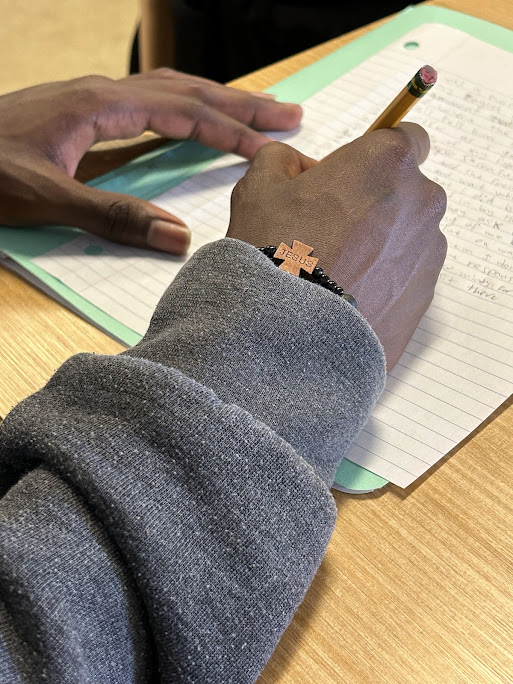
Nevertheless, he’s nearly filled a page with his small, neat handwriting – a feat which would have been unfathomable last year – and his focus hasn’t wavered, though he has had to stop a few times to flex his tired hand. Meanwhile, I sit here typing my own story, this story, marveling at this moment of quiet togetherness amidst myriad other students. We are here, the two of us, writing; we are here, the two of us, writers. 

This sense of camaraderie has me thinking about what we mean when we say that teachers need to “get to know their students.” How well do I know him? I didn’t spend a lot of time last year asking him about his family, though I did call home when I needed to. I have no idea if he has pets, and am not clear about how many siblings he has. In fact, I don’t know many things about him, but I know enough that I can tell him, honestly, that I believe in him. I never told him he was a strong reader or writer; I did tell him that I thought he could be. I never told him this path would be easy – heck, I was clear that parts would be hard – but I did tell him that I thought it was worth it. Other teachers and coaches told him the same thing, complimenting him when he improved, noticing when he was reading, harrying him back to class when he was in the hallways. When he faltered, he had a team of people to remind him of his long-term goals.

Today, he has a story to tell, and he has found me. He says he needs help, but I think he just needs someone who believes in him to write beside him. What a privilege! I can do that any time.

Stolen Kisses

I’m walking towards the library in the middle of my prep period when movement in the stairwell catches my eye. A black t-shirt stretches across a broad back and muscular arms. A black hijab tilts upwards. Two faces come together briefly, then separate.

I keep moving. I don’t want them to know that their moment was observed. I want a world where kids can cherish a stolen kiss, hidden from other eyes, weeks before high school comes to an end.

When I return from the library, the stairwell is empty.

Nine Times

This morning was dreary: gray, rainy, and far too chilly for mid-May. On the drive to work, the spitting drizzle was too sporadic to merit even the slowest setting of the windshield wipers, but too persistent to be ignored. I rotated the on/off knob back and forth, back and forth. In the classroom, only dim light filtered through the high windows, making the space too dark for reading. I was forced to flick on the harsh fluorescent lights. Students groaned. Even inside the building, the air felt heavy. No one wanted to be at school.

Heads nodded towards desks during period 1. Half-lidded eyes flickered open, then closed. Students strove valiantly to pay attention, to fight off the malaise, but it was no use: several slept during work time. After a few half-hearted attempts to keep them on task, I let them rest. 

I had hope for period 2 – grade 9 – but they wandered in, half-dazed. I surveyed them as they read and realized that there was no way they were going to write an in-class essay today – or at least no way they would write a good one. We needed a change of plans. 

Ferris Bueller’s Day Off. None of these ninth graders had ever seen it. Just what the day called for. On it went. 

80s movies can be tough for the students. They start more slowly and rely more heavily on dialogue than their modern counterparts. Worse, I wouldn’t let the students use cell phones – even though we were taking a break – so they were stuck actually watching. And then we got to this scene:

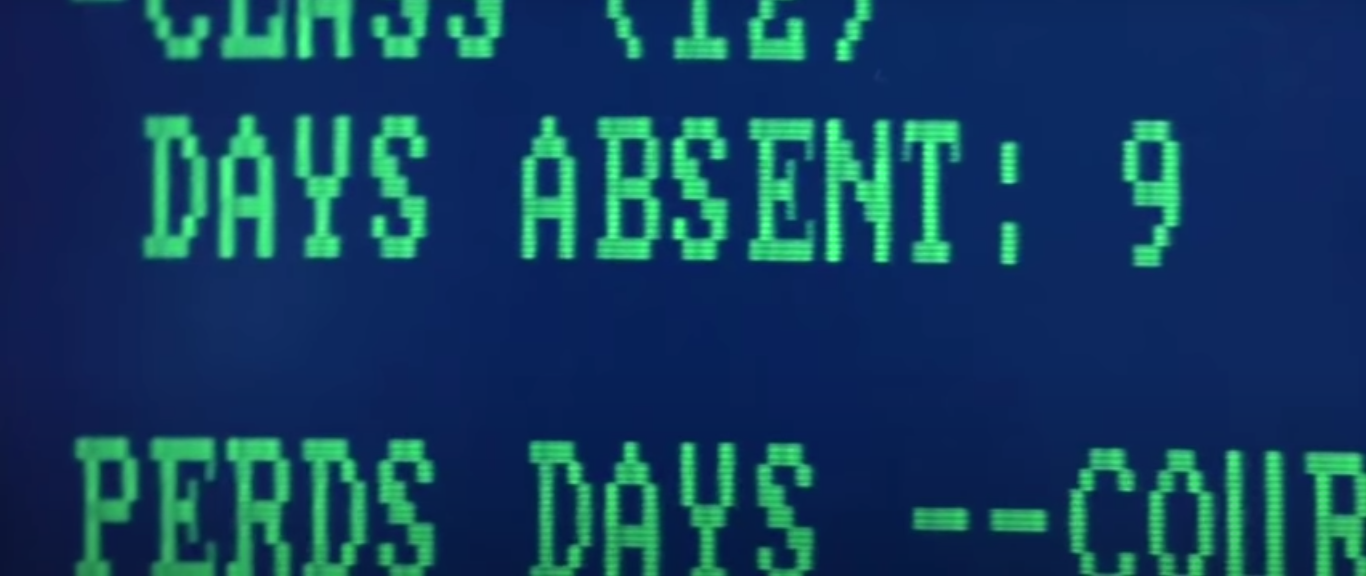
Ferris Bueller’s Day Off – Nine Times

“Why are they so worked up about him missing nine times?” asked a student.

I snorted.

“Well, there was a time when if you missed ten days, you had to repeat the class.”

The students close enough to overhear this discussion looked at me in disbelief. And no wonder: over a fifth of this class has already missed over nine times; another handful have already missed seven or eight. And we still have five weeks to go.

“Like, you failed just because you didn’t come?” 

“Exactly like that,” I said.

And we went back to watching the movie. I’d like to think that the students had a renewed respect for Ferris, but I suspect they were simply shaking their heads at the weird things we used to do in the olden days.

(In case you’re wondering, it’s still a good film.)

Civilly Disobedient

Way back near the beginning of my teaching career, one of my regular classes was grade 11 American Lit. I think I taught it for seven or eight years, and by the end I had developed some pretty good activities. This is one of my favourites – though I could never get away with it now, both because I doubt my students could access the texts and because, well, you’ll see…

First, the background. We read some of Emerson’s “Self-Reliance” and both the Introduction and Chapter One of “Nature”. Students loved lines like “Whoso would be a man must be a nonconformist” and “Trust thyself: every heart vibrates to that iron string” even while they struggled with metaphors  like “Society is a joint-stock company.” One afternoon, their homework was to try to understand Emerson’s insistence that “To go into solitude, a man needs to retire as much from his chamber as from society” by going outside and not reading, writing, or listening to anything. They had cell phones, but at the time they could still go without for a while.

Next, we read Thoreau. We started with a few excerpts from Walden which is an easy follow-on from “Nature.” We read about Thoreau’s cabin in the woods and his beans. Then, the piece de resistance: “Civil Disobedience”. We considered the questions he raises, like, “a government in which the majority rule in all cases cannot be based on justice, even as far as men understand it. Can there not be a government in which majorities do not virtually decide right and wrong, but conscience?” and “Unjust laws exist: shall we be content to obey them, or shall we endeavor to amend them, and obey them until we have succeeded, or shall we transgress them at once?” Class discussions were sometimes (ok, often) raucous.

Then came the day of days. Students arrived in class and were given these instructions:

I believe that you have a reasonably in-depth understanding of Thoreau.  In particular, I feel that you understand how he relates to Emerson and to nature, why he chose to protest against the government, why he feels protest is necessary, and what he believes the consequences of peaceable revolution are for the protester and the government.

If you feel that you have a good understanding of Thoreau, then you may begin today’s assignment now.  Please do something of which Thoreau would approve.  Class will resume at 2:25.

That is all I will tell you.

Stunned, they milled about the room, trying to figure out what to do. Eventually, year after year, they left the class and went in search of a protest. One group took the athletic trophies from the school display case and paraded them around. “WE won these. They belong to US, not the school” they crowed. One group took control of the PA system and read passages urging self-reliance and rebellion to the entire school. Many students headed outside to find a green space and hang out. Some left campus and found food, claiming they were old enough to go off-campus alone. Many many of them did not make it back five minutes before the end of class. Instead, giddy with their tiny taste of rebellion, they tore in as the bell rang, gathered their things and ran to their next class.

As they rushed off, I yelled after them, “Your homework is to write about what you did!” 

“OKAY!” they called back. And that was that.

The next day opened with exhilarated students sharing their escapades and referring to lines in the text that supported their actions. Never had textual analysis been so worthwhile. After everyone had spoken and the energy had dwindled a little, I drew their attention to a passage we had studied before: 

I know this well, that if… one HONEST man, in this State of Massachusetts, ceasing to hold slaves, were actually to withdraw from this copartnership, and be locked up in the county jail therefor, it would be the abolition of slavery in America.

Basically, he says that we end unjust laws by standing against them and being punished for our stance. The end of the injustice comes because others are inspired by our unjust punishment. (Honestly, this seems a little naive to me, but we went with the flow.)

Hmm. So, were the students trying to stand up against injustice? And if so, were they willing to be punished for it? I pointed out that I had not even given them permission to leave the room, much less to traipse about taking things and making statements. So, everyone was going to have lunch detention for the next one to three days depending on the severity of their misconduct.

Horror! Outrage! The students were unwilling to accept this! “Ok,” I shrugged. “I’ll make you a deal.” And then I broke their hearts. “The punishment will only make a difference in the world if you think you are an honest person standing up for what is right. If that’s not you, just stand up and say, ‘I don’t believe in what I did’ and your detention will disappear. After all, there’s no point in the punishment then.”

Some students stood immediately. They’d had fun, but they weren’t really protesting. Slowly, slowly, more would follow. The class joined in the debate with those who hesitated. What was injustice? Was this action protesting a law or a government of some sort? Did they think their punishment would actually bring about change? Almost always, everyone eventually stood and acknowledged that they weren’t willing to accept punishment for their actions for one reason or another. 

Of course, sometimes, someone held out. The most memorable of these was Danny. He had, indeed, left the classroom, but he’d sat outside and taken in the beautiful day. He had a book with him, but he argued that Thoreau had nothing against books, and he wasn’t convinced Emerson was saying *never* to read. He said he absolutely believed that students should have more time to pursue their own interests and if lunch detention was the consequence and it made people consider his stance, so be it.

In the end, I always canceled lunch detention – after all, it was mostly a ruse to get them to think deeply – but Danny was having none of my wishy-washy ways. The next day at lunch, Danny sat in the main office, clearly visible through the glass walls, and read a book. He jailed himself for three days and talked to anyone who asked about why students should be allowed more freedom of choice. 

I’ve been thinking about this lesson a lot recently, what with all the news of protests. From where I sit now, I can see its flaws, but it was effective at the time. If nothing else, we all took a minute to think about what civil disobedience really entails and what we were willing to sacrifice for our beliefs. It was a good lesson.