Ribbit

Over lunch, when I mention that I have opted Mr. 13 out of the new online learning requirement for high school, my mother in law asks casually if I think online learning is the way of the future. I do not.

Listen, I know that e-learning works for some people. And I know that it can be done very well. And I know that there are times and places when it is the right option. I’m not anti e-learning. (Well, ok, I’m a little bit anti e-learning, but I can live with it. I’ve done all of my credentialing/ post-graduate school classes online, and there are definitely advantages.) I am, however, against an e-learning requirement in high school – especially when I believe it is a nakedly political attempt to increase class sizes and destabilize public education rather than increase student learning or wellbeing. And I absolutely do not believe that e-learning can or should replace in person learning.

In the kitchen, I start to explain the reasons that mandatory e-learning doesn’t make sense to me. I reach for evidence; my brain goes into fact mode. Even now, as I write, I have paused to find articles to link to, statistics to back up my beliefs. I have searched the internet for other voices to back up my own (there are plenty). But I decide not to include them. For the past two weeks in Grade 12, we’ve been working with analysis and reviews, reading mentor texts and noticing how writers choose and use evidence, so I realize that I am defaulting to logos even though I firmly believe that the most convincing arguments must first appeal to pathos.

Let me tell you a story.

Last week, on the way to school, I was listening to poet Ada Limón’s podcast “The Slowdown“. Each day, she shares a little bit of her thinking and reads one poem. The show is usually about five minutes long, and I love it. In fact, I love it so much that I was listening to back episodes as I drove in, and I stumbled across an April episode where Limón read Alex Lemon’s poem “Credo”. Its energy blew me away, and I knew immediately that I would use it in class.

So there I was, less than an hour later, reading this poem to some sleepy 12th graders. We noticed its exuberance (ok, that was my word), then grabbed our notebooks (ok, because I made them), and wrote “I can be…” at the top of the page (the repeated line in the poem). I set a timer for three minutes and we let ourselves go, completing the line in any way we wanted to. I wrote on the board so they could see me working. An observer in our class also wrote – if you’re in the room, you’re in the class. When the chime sounded, we paused to take a breath. I could feel the changed energy in the room.

“Let’s each share a line,” I said. We’ve done this before – we do this regularly – so even though reading our writing out loud can be tough, most of the students were up for it. Sometimes people only share a word; sometimes they share far more. That day, most people had picked up on the freedom in Lemon’s poem – some were still writing! – and the sharing began quickly. We heard from most of the class, including our visitor, but of course, there are always those who are reluctant; in those moments I try to encourage, maybe even push a little, but not to over-pressure. This day, the extra push allowed M to share a line that they prefaced with, “this is a little weird.” Their line began, “I can be a frog…” Afterwards, they added, “I mean, poems aren’t really about frogs” and they blushed a little.

My response was immediate, “Of course poems can be about frogs! I can think of one right now,” and I launched into Emily Dickinson’s “I’m Nobody! Who are you?” I had only gotten out the first two words when another student chimed in and recited the rest with me. This student is neurodiverse and participates in class in their own rhythm; in saying the poem with me, they astonished their classmates.

Then class moved on. And that would have been it. Except that the next day I opened class with 32 translations of Basho’s Frog haiku. By the time we got to, oh, the 15th or so, people were smiling. We spoke very briefly about how translations can help us see a poem in a new way – and how well they do or don’t communicate the original. Then class moved on. But our original classroom frog poet was absent that day, so the next day I arrived with Hilaire Belloc’s “The Frog.” We giggled about calling a frog “Slimy skin” even as we learned the word “epithet”. Unfortunately, the student poet who kicked this off was at a track meet. “Don’t worry,” I assured the students, “I have plenty of frog poems. I’ll just keep going until they’re back in class.” Their best friend laughed and students around the room shook their heads at what is, essentially, the teacher version of a dad joke. Then class moved on.

(Fear not, there are a LOT of frog poems. I can keep this up for a while.)

I have finished telling my mother in law this whole story – from the podcast to the writing to the ongoing frog poems. She is not a fan of e-learning (in fact, she’s a firm believer in energy and creativity and more), so she has been an easy sell. And even though I have decided not to link to any of the statistics or evidence out there – and there’s a lot – I know that the online classroom can’t replicate this, the gentle push to share a bit of yourself, the wonderful astonishment of a quiet student suddenly reciting a poem they know by heart, the moment of mild discomfort that leads to a world we didn’t know existed, the serendipity that allows one moment to become a string of moments that creates a community of learners, a community of people who experience the beauty and humour and affirmation that leads to learning that lasts a lifetime.

So, no, I don’t think that online learning is the way of the future. Unless we can find a way to include a lot of frog poems.

It’s not about me #SOL22 30/31

If you read my blog regularly, you might remember that I had a – ahem – challenging class last semester. You might remember because I wrote about that class here and here and here – and that was just the first few weeks. Oh my.

Now, don’t get me wrong: I *liked* the students. They are fun and funny and smart and honest and many other wonderful things, but teaching them all in one classroom for two and half hours (thank you, Covid) was not straightforward. In the end, I did an ok job – not great, but ok.

I thought what I was most worried about was reading and writing skills that had atrophied a little during online learning, but when I reread my blogs, I remember that we were also working on social skills and work habits. It was a lot.

Since then, I’ve talked about this class in two separate PD sessions where teachers and coaches from across schools were planning for “de-streaming.” (Next year, our school board is ending streaming for grade 9 and 10 students in all subjects. This will require a shift in our mindset and our teaching practices.) The first time, a Black educator I didn’t know but who is deeply dedicated to equity, pushed me to redefine what qualifies as success for my students. I bristled; he suggested that for some kids success is “just crossing the school’s threshold.” I’ve done enough work with students damaged by our system to know that he is right, but inside my head I wanted to scream, “That may be enough for you in your position, but once they cross the threshold and they come to class, then success changes – and then *I* have to give them a grade.” I didn’t say that, our breakout room ended, and I let it sit in the back of my mind, where I could come back to worry over it from time to time.

Today, I brought up this class again. I talked about students who refused to read or who did very little work. I was lucky enough to be in a group that allowed me to speak openly. I spoke about the “soft bigotry of low expectations” and my fear of what happens when we allow students to move through the system without the skills they need for success. One colleague – an Indigenous teacher and deep thinker – challenged me to think about grapho-centrism and what that means for our students and our culture. This resonated with me because I was recently on a podcast panel where we discussed multimodal essays and the myriad ways that people can express complex critical thinking.

I sat with my colleague’s ideas for a few minutes, but soon I was worrying aloud – again – about how I can help students become literate, be able to write well. At this moment, another colleague – younger than me and also fiercely dedicated to equity – said, “I notice how much you’re using the word I.”

Whoa. She was right. I was centering myself. Oh, sure, my focus was firmly on my students, but it was also on what *I* could do to help them. When I stepped back, I realized that I have now heard from two colleagues – gently, kindly – that I am, perhaps, too much in the centre of my practice, that I might be playing the role, even unintentionally, of “white saviour” – at least in this instance. (Though they never said those words.”

That’s a tough one for me. As a teacher, I want to help – I mean, it’s kind of my job to help. On the other hand, as a white woman who is constantly working towards anti-racism and equity, I know I need to “hold myself in healthy distrust” (Kike Ojo-Thompson). My colleagues’ questioning and observing has me thinking about the ways in which I can re-centre student voice and goals. I don’t know the answers yet, but I know that if I’m talking about a class, and the most common pronoun I use is “I”, then I need to rebalance my thinking because it’s not about me.

It’s good to have such thoughtful observant colleagues. This is how we get better – together.

Fill the gaps #SOL22 24/31

Curtain rises on a workshop. A person wearing a suit is fiddling with a mannequin that looks like a young teenager. The mannequin is holding an open book in its hands. The manager moves various parts of the mannequin, leans in as if to listen, and shakes their head.

MGR: Hey, Potts! I’ve got another one for you!

POTTS enters stage left. She looks a little harried.

MGR: Oh, good. There you are. I’ve got another one with a glitch. Doesn’t seem to be reading properly. Gonna need you to fill the gaps.

POTTS looks at the mannequin a little sadly.

POTTS: Oh. Ok. Um…. do you know where the gaps are?

MGR: No, but there are definitely gaps.

POTTS: Do we have baseline data?

MGR, scoffing: No.

POTTS, almost timidly: I don’t suppose we can do any testing to see what might be causing the glitch?

MGR laughs loudly.

MGR: You’re a riot – you always ask that. You know we don’t have the money or the personnel for testing. Just fill the gaps. That’s all – nothing to it.

POTTS looks doubtful.

MGR: Oh, and I’m going to need you to fill the gaps and get this model working no later than June. That’s when we report and we’ll need to move this one along. (He pats the mannequin.)

POTTS: June? That’s three months from now. These gaps might have been growing for years. And we don’t know what’s causing them. And most of my training is about improving working models, not…

MGR interrupts: You’ve got a good reputation, Potts. I’m sure you can do it. And guess what? I’ve got a surprise for you.

POTTS eyes the manager warily.

MGR: Look, here’s a tool that’s designed for gap-filling. (MRG hands POTTS an all-purpose tool. She accepts it dubiously.) Just put this one (he pats the mannequin again) near the tool, and the they’ll practically fix themselves. (The MGR pauses and looks at POTTS appraisingly.) Speaking of “them” – this tool is the latest thing – loads of research, so we went ahead and bought a few. The idea is…

MGR trails off because POTTS is shaking her head. Then, MGR barges ahead.

MGR: … so, like I said, it’s the latest thing. It’ll really improve your efficiency, which is good because we’ve found a bunch of these guys who aren’t working quite right. Now the idea is you just use this tool and they’ll fill their own gaps. Should work like a charm – makes it as easy for you to fix ten as one. We’ll bring the others around in a minute.

POTTS: But… I… I just use the tool and the gaps fill? So why am I here? And what if it doesn’t work?

MGR: Oh, it’ll work. You’re here to make sure it works. By June – don’t forget – you need to fill all the gaps by June – but don’t worry, we’ve given you everything you’ll need…

MGR exits as he’s talking, leaving POTTS alone on stage with the mannequin.

Once the MGR is off-stage, POTTS lets her face fall. She approaches the mannequin.

POTTS (hides the tool behind her back): Hi there. It’s nice to meet you. I’d love to get to know you a little. Let’s see who you are before we think about gaps.

The mannequin, who is, of course, a real child, begins to soften and move as though they want to speak with POTTS but as POTTS starts to talk to the child, a line of similar-aged children begins to come on stage. Each one holds a book, like the first child. They form a single file line from the first child to the wings of the stage. POTTS looks at the child, at the children and then at the “miracle” tool she is holding. She starts to cry.

Curtain.

Notes: I hope it is obvious that I in no way think that children are mannequins. And the manager is not based on a particular person. I’m just musing about what it means to try to “close literacy gaps” for a group of students I do not know by using a (research-based) computer program. I find myself swinging between extremely hopeful – what if this works! – and despairing – I’m pretty sure there’s no quick fix for students who struggle with reading as they enter high school, especially when we don’t know what’s causing the problems and I’m not familiar with the program itself. SIGH. I guess I’ll be familiar with it soon enough. Here’s hoping that it works.

Who’s right? #SOL22 22/31

For the past few semesters, influenced by Kittle & Gallagher, most of my English classes have started either with short memoir or flash fiction. One of the minor miracles about doing this type of writing at the beginning of the semester is that students often invest in their stories in ways that elude them if we start with expository or analytical writing. Short pieces allow us to get into the nitty gritty of craft without getting overwhelmed by, as one student said, “all the things.”

These assignments also allow plenty of time for feedback and revision. Students begin to ask for feedback from peers and, in turn, to offer comments beyond, “it’s good” and “I think this is a run-on?” As they tweak their imagery, diction, rhythm and structure, I can offer plenty of feedback via quick conferences, voice notes, and written comments on drafts in progress. In the end, the best part is that these stories emphatically theirs. Most students finish with a well-written narrative that they actually like.

Once I had this assignment as part of my repertoire, I started to focus on improving my feedback because feedback is part of what creates the magic of these assignments. (I wrote about commenting on student work once here. More recently, Melanie and Heidi (and Joel in the comments), have addressed feedback in their posts.) If we just grade for grammar or comment on what is not working, our students will stop writing. Growth happens when we highlight what is working in a piece. So I’ve learned to share my reactions as a reader, explain what I see students doing, and ask a lot of questions.

This semester, one student used identical phrasing at the beginning and the end of a short memoir. I didn’t love it, so in my comments I asked what effect they were hoping to create. I was thinking of this essay on picturing narrative structure, and particularly of the visual about coming full circle, where the author writes, “For… (the) conclusion to feel truly satisfying, however, it must mimic life, which is never completely complete… So the best conclusions open up a bit at the end, suggesting the presence of the future.” I thought the story would be better if it were a little more open.

A visual of coming nearly full circle, then opening up

Then, the most amazing thing happened. In the classroom, the student called me over and told me that they didn’t agree with me. They liked their closed loop. As soon as they finished speaking, they took a deep breath and looked away, astonished, I think, at their own boldness. Are students allowed to tell teachers no?

Disagreeing with teachers isn’t an everyday occurrence in schools. Too often, even when teachers try to demonstrate openness or give effective feedback, students just nod and do what we ask. After all, we have all the power. If we don’t like what they write, they get lower grades. For kids who’ve learned to play the game of school, disagreement about how to do an assignment can be nearly unthinkable. After all, they explain, being right doesn’t get you into university; doing what the teacher tells you to does.

When this student told me she didn’t want to change her work, she was telling me that her story mattered more than the grade. THAT IS INCREDIBLE. So I told her the truth,

“Look, I’m only one reader. I’m not your only audience, and I might not even be your target audience.”

She looked dubious. I told more truth: I admitted that I sometimes don’t like books that have won awards. I told her about reading Jonathan Franzen’s much-admired novel The Corrections and hating it so much that my spouse begged me to stop. (I read to the last word so no one could ever say, “Oh, but the ending was so good” thus making me go back and reread.) It won the National Book Award, so obviously lots of people really liked it; just not me.

I asked who the student imagined enjoying this story. “My friends.”

“So, show it to your friends. Shop it around. Tell them that you like this and that I would change it. Ask what they think and why. Come back and tell me about the effect it has on your audience.”

It took them a few minutes to turn to a peer and share their story, but once they started, they gathered opinions from around the classroom. They made some changes based on what they heard, but they kept that circular structure exactly as written.

I still don’t like it, but they earned an A.

Make Writing #SOL22 13/31

I suspect that I found Angela Stockman through my knitting and reading (and all around awesome) friend Lisa Noble, though I honestly can no longer remember. I’ve lurked around Angela for a while – reading her emails, checking out her free units. Not only is she incredibly generous and thoughtful, her specific thinking and doing around writing intrigues me to no end.

Lately, I’ve been reading her work on using “loose parts” to teach writing. I find it fascinating, but each time I think about using it in the classroom I balk: I’m just not very spatial, I tell myself; I haven’t tried this myself, I worry, how will I explain it?

Angela writes, “Offer writers a variety of loose parts to build their ideas, responses, and drafts with.” In this phrase alone, I see all the reasons that loose parts fit with my writing pedagogy: play, multimedia thinking, draft, response… still, I couldn’t do it. Once I almost brought in a tray of thingamambobs, but then I didn’t.

On Friday, a student asked to conference with me about her personal narrative. She knew what she wanted to say, but she couldn’t figure out how to tell the story. She could articulate that the beginning was too long, “too much exposition”, but how could she tell the story without the background? She was stumped.

As we brainstormed, I found myself wanting to take scissors to her work – to physically move pieces around and see what might work where, but of course the writing was on the computer and somehow we couldn’t quite *play* with it. Play – PLAY! Of course!

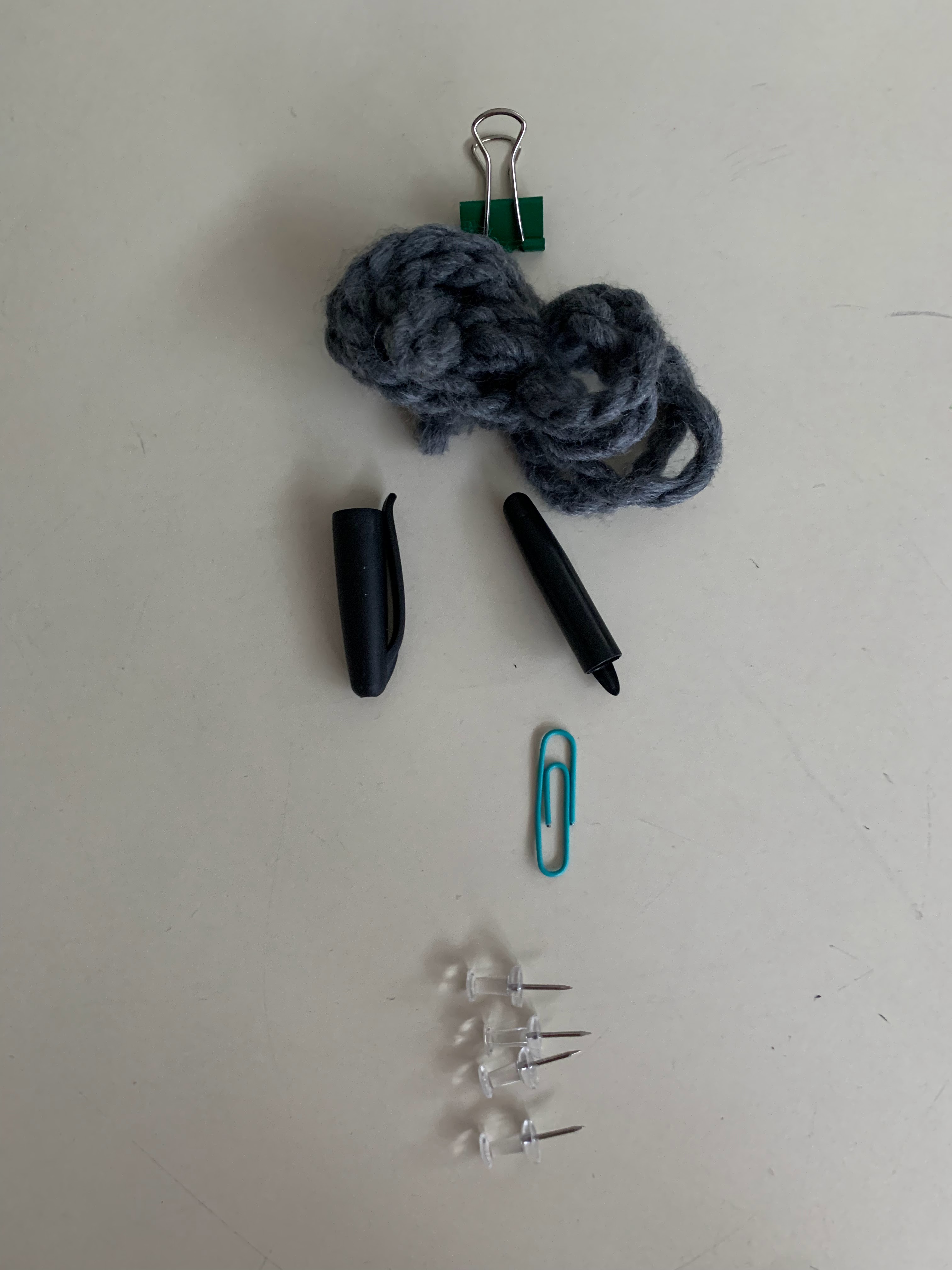
I reached over to my desk and found some loose parts – a few pen caps, some paper clips; some random yarn (I have no idea – don’t ask) and a box of tacks. I plunked them down on the table where we were working. “Ok,” I said, “bear with me. What if these three pen caps were the aunties…”

We named parts, moved them, played around, and she ended up with this structure:

The final essay structure, minus a pen cap.

“This is great!” she said. “I can see exactly how to do it!”

I could, too, so I snapped a photo as the bell rang and thought, loose parts play. Got it.

Next step: figure out how to incorporate this on purpose. I have a feeling I won’t have much trouble with this now.

Many thanks to Angela Stockman, who doesn’t even know me, but who nevertheless just made my teaching better than it was before. Amazing. (And thanks to Lisa, too, for her neverending encouragement.)

Hot tub #SOL22 11/31

“Write about the hot tub,” they say. I’ve done a quick write in front of them, randomly listing childhood memories. Trampoline and Hide-n-Go Seek haven’t piqued their interest in quite the same way as hot tub.

I laugh. “Sadly, there’s not much to say. We had a hot tub in our backyard when I was in high school… nothing really happened there.” I trail off and end up writing about the trampoline after all, shaping the story, modeling various openings, playing with structure.

I don’t tell them that images of the hot tub bubble in the back of my mind. Look: my sisters and I are playing in the warm water, snow on the deck. There: I am 13 and awkward, wearing my bubble gum pink bathing suit, my hair pulled back – the photograph reveals a liminal beauty that I can only now appreciate. Over here: My birthday party, fifteen-year-old girls full of high spirits and loud laughter, though in every photo of the evening our heads are hidden in our arms, as shy away from the very lens we crave. “We’re in our bathing suits!” someone had squealed and the camera was put away.

Was that the night the boys crashed the party? Possibly, but even that phrase implies a wildness we didn’t embody. Maybe I should rewrite it and say, “was that the night that Michael and some friends came over while we were outside and we sort of pretended to scream but mostly chatted?” Or maybe both ways of telling the story are true.

With my sisters in the snow

How disappointed they would be with the truth: “The hot tub story” isn’t really a story, and it isn’t salacious. The hot tub is evenings with family, breath-holding contests with my sisters, a science fair project done with my dad (about the chemicals – the only science fair I ever won. Figures that it was about that hot tub.) I know what my students expected to hear when “hot tub” appeared in my list. Instead it’s moments of connection with my family and friends, moments from a time so distant it seems almost unimaginable now.

On the other hand, the trampoline – now, *that’s* a story.

Fatigue #SOL22 10/31

When she first came to visit, I wasn’t surprised; March Break was coming, and she often arrives around this time. Most days, she showed up in the late afternoon, hung around until bedtime and then left, sated. I reminded myself that there was no point in pretending she wasn’t coming, no point in ignoring her – better to accept her visits and maybe go to bed a little earlier than usual to help send her on her way.

But since the beginning of this week, five days before break, she’s been here every day. Some days, I swear she shows up first thing in the morning and lingers until lights out. I can’t shake her. I’ve tried warm baths and early bedtimes. Still, she’s there the minute I open my eyes, laughing. “You thought I’d leave?” Her shoulders shake as she chuckles, “You know better.”

At work, she’s been messing with my calendar: every day this week I’ve found myself accidentally double-booked for at least one meeting. I’m usually very good with time management, so I’m sure it’s her fault. And she’s making me very grumpy. I’m trying to ignore her, but she’s *always* there, and I have to admit my temper is short. She’s even infiltrated my writing – I’ve been posting later and later even though I’m often a morning writer.

The good news is that March Break starts at the end of the day tomorrow. She may try to accompany me on vacation, but I have a feeling that some serious family time, a lack of commitments and, yes, some morning sleep-ins will let her know that it’s time to leave. After all, I much prefer her more pleasant sister, Energy.

Observation #SOL22 9/31

“They were all on-task the whole time; they were literally all sharing their stories.”
I try not to blush – can one intentionally not blush? – and say, “Well, we’ve been practicing.”

Today, a colleague from my previous school came to observe and collaborate. (Pause for a moment and cheer for her principal – and mine – for deciding this was important.) I like to think of my classroom as open, and I regularly say that anyone is welcome at any time, but the truth is that most teachers spend most of their career playing to an audience comprised entirely of students, and I am no exception. I wasn’t nervous, exactly, but having a colleague in my room definitely heightens my senses.

Right away, I noticed that my instructions for one activity weren’t as clear as I had hoped. I noticed that I move around the room an awful lot, and that I am very comfortable with students moving, too. I noticed that I am (ridiculously) enthusiastic about student writing, and I recognized that this probably makes it easier for students to share. Mostly, however, I noticed that my students were willing participants in even unfamiliar activities, like stations that asked them to tell their narrative aloud, read examples of narrative essays or write first drafts. The last time they did “stations” was probably elementary school, but they humour me.

As a teacher I am so obviously my own worst critic that even my students (I see you, Leah & Nadiya) have commented that I should be easier on myself, but I knew that today’s class went well. After lunch, my colleague and I debriefed, which is when she pointed out that even at the “talk” table, everyone was on task. I explained that we had practiced this: we have shared stories in pairs and small groups; in class today, I referred to research we’ve already discussed, research which suggests that talk supports writing; we have also practiced providing effective feedback for other people’s stories. Because of my self-criticism, I am teaching some of these skills more effectively than I did last semester.

If I keep writing, I will find the flaws in the lesson – I misjudged the length of the final activity and there were those imperfect directions at the beginning – but I know that no lesson will ever be perfect. Today was pretty darn good, something I can recognize mostly because I saw someone seeing me teach. And I’ve realized that I’m pretty proud of me – which is not something I let myself say very often – so I thought maybe I should share that.

Talking with my colleague today was not only a pleasure but also a moment of reflection and growth for both of us. Think of how much teachers could grow if more schools prioritized time for observations and collaboration. Wouldn’t that be something?

Losting #SOL22 8/31

Near the beginning of each semester, my students write 100 word memoirs (thanks, Kittle & Gallagher). These never fail to knock my socks off, and this year that’s even more true. At my new school, many students have clear memories of coming to Canada, and many of them are continuing to learn English. Combined these lead to some great moments. For example, below, Tung wrote about his first time in a Canadian high school. Pay particular attention to the word “lost” – we’ll come back to that.

Walking through Canadian high school for the first time was like walking, lost, in an old tunnel surrounded by unknown creatures. The low-ceilinged crowded hallway was an ant’s nest of students trying to sprint through the narrow corridor. The thick moss-green bulletproof door had only a small glass cut-out, covered with an English-only poster. This prevented my curious eyes from spying on the Canadian students in the classroom. Everything was beyond my imagination. Each step I took, one rhythm faster my heart beat. What was I getting myself into? Would there be a light at the end of this tunnel? 

Tung, Grade 12
What I was seeing/ What was in my mind

He added pictures – including some pictures of his school at home. It’s much, much brighter and airier than our school and I can safely guess that it has never seen snow.

Watching Tung try to capture the feeling of that first day was fascinating. Some descriptions came easily – he knew he wanted a tunnel and he knew the door needed to be moss-green and bulletproof. Those things never wavered. Other things changed – coming in, getting cut out, changing form. To me, the most interesting thing of all was the word “lost”. He really wanted it to be “losting”.

We chatted in the back corner of the room – the place he’s chosen for now – about this word. Somehow lost just wasn’t quite what he was looking for. He had a sense that losting wasn’t a “real” word, but he wanted the word to be active. He wasn’t simply lost, he was wandering, loose, casting about, feeling the sense of not fitting in, not knowing if he belonged. He was losting.

I couldn’t help but think of my own child, then quite small, crying as his grandmother left after another wonderful visit. He threw himself into her arms and said, “It’s your fault, the goneness.” The goneness. Really, it’s the only word for the feeling.

I told Tung he could keep “losting” – that it made sense to me and described what he was feeling – but English isn’t thoroughly his yet; making mistakes and making new words are still too intertwined to tease one away from the other. Still, I expect that the word exists now. I suspect that someday, probably soon, I will see a student wandering in the hallway with a particular look in their eye, and I will know that they are losting. When I do, I’ll try to help – because the goneness can be overwhelming.

Join us – or just come to read – as we blog every day in March at twowritingteachers.com