PD Day Agenda

9:30 sharp (as per the email to staff)- PD Day begins
Teachers wander into the library and mill about, slowly noticing that we have assigned seats. Some people try to switch groups. One entire table switches locations because they have been placed so far to the front and side that they cannot see the screen. 

9:33:30 – Principal address
“Today’s PD will be extremely useful.”

9:35:12 – First speaker.
Topic: substance abuse
Y’all, it is happening: kids are still abusing substances. You know it, I know it, they know it. Sure, the overall stats are pretty good and, yeah, we *could* invest in vape detectors for the bathrooms, but that costs money, so instead someone will tell you about marijuana and cannabis as though it is still the 80s. We will not talk about things like phones, social media, opioids or fentanyl. Stay focused. 

Some time later – Break – supposedly 10 minutes but now 5 because we are already behind

10:47:08 – Teacher-led presentation about [Literacy/ Numeracy]
Note that this session will begin just late enough that the staff who worked like crazy on this presentation will have to cut something important, and every minute extra will shorten our lunch.

10:48:00 – ICEBREAKER
Today we will either be annoying the Humanities teachers and boring the Science/ Math teachers or annoying the Science/ Math teachers and boring the Humanities teachers. Roll the dice. 

10:59:21 – Chipper staff members (confession: I am usually one of them) begin desperately attempting to convince other staff that they should stop saying that they “hate [math/English]” and that they really should not tell their students that [any subject but mine] won’t be useful after high school. 

10:59:42 – If the school is providing lunch, (unlikely but possible) it arrives. It is set it up in the back of the room as staff continues to learn about [math/English] and why we should integrate it into our classroom. The smell of lunch now fills the room as the staff presentation continues.

Special note: today’s lunch is scheduled to begin 30 minutes later than on a normal school day. The smell of food should permeate the room long before teachers can eat.

11:12:37 – The buzz of teacher talk suggests that everyone is on task and excited to use [math/English] in our classes next week. Or maybe it suggests that Mr. X has pulled out pictures of his twins – now 6 months old! – and everyone is cooing over them. Well, everyone except the AP Physics teacher, who is still marking tests, and two basketball coaches who are hunched over a playbook. “Look!” says a harried teacher-presenter, “That playbook is a perfect example of [math/English]!”

11:28:16 – Everyone applauds the teacher-presenters. One of them is visibly sweating; another has just wiped away tears; a third is still looking at pictures of the twins. The principal announces that all 17 afternoon sessions are now “self-directed learning” to honour us as professionals. To prove we have “engaged with the content” teachers are required to complete a “proof of engagement” after each session. This may include Google forms, e-signing a document, taking an online test, a spit shake, swearing on a religious text of your choice, taking a blood oath, offering up your firstborn unless you guess the name of a short bearded visitor, hopping on one foot for exactly 2 minutes and 16 seconds, and other activities to show that we have completed each session.

11:30 Teachers leave for lunch

12:30ish – Some teachers return

Afternoon – 43 voluntary meetings are available for teachers to attend this afternoon. None of them are about any of the 17 required afternoon topics. They are voluntary so we do not have to be there because this is the time scheduled to complete our required self-directed work. If we choose to attend the voluntary meetings, we will have to complete the required work at home. Oh, and the Principal will be at all voluntary meetings and will take attendance. Just in case. 

Partial list of the 17 Mandatory Self-Directed Training Sessions

From the Ministry of Education: The total video time of this training is 7.25 hours, not including the time required to prove you did the work. We have allotted 3 hours for you to complete it. We have disabled your playback speed options on some – but not all – of the videos. If you figure out which videos allow you to change the speed, AND if you skip slides on the boring slideshows and just go straight to the tests, you can probably finish by the end of the school day.

Note: all training will be identical for all staff K-12 at all sites. There will be no differentiation.
7 minutes, 8 seconds: Equitable and Inclusive Schools
14 minutes, 12 seconds: Child Abuse Prevention and Reporting
8 minutes, 47 seconds: Appropriate sign-offs for professional emails
4 minutes, 3 seconds: Cybersecurity, Part 3
21 minutes, 32 seconds: Ladder skills
3 minutes, 54 seconds: Concussion Symptoms
3 minutes, 2 seconds: Only You Can Prevent Forest Fires
18 minutes, 7 seconds: Stop, Drop and Roll
5 minutes, 4 seconds: Shoe Tying – Reverse Chain or Bunny Ears?
1 minute, 44 seconds: Self-care to Prevent Burnout – You Are Responsible for Your Mental Health

Conveniently, no one knows when the teachers go home.

Read aloud

I’ve already handed out the papers – forty words neatly divided into two columns with checkboxes next to each word; forty words we read aloud earlier this week as a group; forty words that should be easily accessible to high school students, although I am well aware that they will not be easy for the students in this room – and the students are calmly looking them over. Calmly, that is, until I say, “So, today’s challenge is to read these words out loud in your small groups.” As the words “out loud” leave my mouth, a hand shoots up.

“Um, I can’t read out loud because I’m dyslexic.”

I pause. In retrospect, I will be able to articulate some of the myriad thoughts that run through my mind before I speak, even though in the moment I respond immediately. Later, I will feel my hesitation, the laughter that wants to bubble up behind my shock, even the bit of the sadness that eventually seeps into my consciousness. Right then, however, I say casually, “Everyone in here is dyslexic. That’s why we’re here.”

Suddenly all eyes are on me. I stumble. “I mean, I guess you’re not all technically dyslexic, but every person in the room – including me, actually – has a reading disability. Literally. All of us. You’re here to get better at reading. If you were already good at it, you wouldn’t be here.”

As I finish speaking, I am briefly worried: am I being mean? But I know I’m not. I’m being honest. And I’m surprised. We’ve been together for almost a month. The class is called “Reading”. We’ve spent weeks working on basic phonics, practicing short vowel sounds, encoding phonemic word chains, and decoding three- and four-letter words. I can’t imagine even a casual observer who wouldn’t understand what we’re doing: Everyone is here to get better at reading.

In the classroom, students look around. I can’t catch all the various emotions, but I start to realize that they were not, in fact, all aware of the truth of the class. I remind them (again, I swear!) that we are here to support each other, that mistakes are normal and part of learning, that this is practice, that this is how we get better. I reassure them that they will not die from reading aloud. I promise that, as far as I know, there is no recorded history of students dying purely from reading – even reading aloud. They start to laugh. Soon enough, everyone is reading out loud, round-robin style, in their circle, and they are, as predicted, helping each other. Mistakes are made. Everyone survives. There are smiles and laughter and we are learning rather than worrying. By the end of class, people are willingly writing on the white board to practice encoding. When someone says, “I can’t really spell” someone else replies, “neither can most of us” and there are plenty of giggles. 

But after the students leave, I can’t shake the feeling that this moment needs my attention. What was happening when the student announced that they could not read out loud? Why were they still self-conscious in a room full of striving readers? At first, I think of how my co-teacher and I have worked to make this class respectful of the learners: students who are still striving to learn to read in high school are typically students who have not been well served by our system; they are not dumb, they simply haven’t received the instruction they need. The reasons behind that are as unique as our students, but it’s still true. We designed this class to honour them and treat them as the intelligent beings they are, so maybe we should take some comfort in the fact that they did not realize that they were all here for reading instruction. Still, as much as I like a good pat on the back, the moment continues to gnaw at me.

Long after school ends, I’m walking the dog when I suddenly realize what I witnessed: despite having a learning community of support and care, our students have been working so hard for so long to hide their reading struggles that they haven’t had time to notice that others are struggling, too. They spend much of their social and cognitive energy protecting their identity and sense of self, and as a result they cannot easily focus on others. I imagine spending my work day trying to cover up something that I see as a major deficit – as if all I did all day long was try to hide a giant stain on my clothing. I imagine being so busy covering that stain in creative ways that I don’t have time to see that others have stains, too. No, worse: I am so concentrated on hiding the stain that I don’t really look at others; I just assume they are wearing much better clothes than I am. I keep one hand on that spot and sometimes miss things going on around me because I’m worried. If I relax and my hand creeps away from the stain, I have to quickly put it back down, maybe glance around and make sure no one else saw it. By the end of the day, I am exhausted and not able to remember everything that happened.

All of this explains why, at the end of September, the students in our Reading class haven’t fully understood that they are in a class where everyone is learning to read better, a class where, ideally, they can relax a little. It may be a while before they believe that everybody else in the room is making mistakes, too. It may be even longer before they trust each other enough to get things wildly wrong, to make outrageous guesses, and to allow themselves to do the hard work of learning to read. I realize, too, that I have more work to do to make this a space of hope and freedom, to let reading class help students be more fully themselves.

I reflect for a while and consider ways to tweak the class for increased student agency and more time for relationship-building. Clearly, I decide, we need more laughter. Clearly, we need more talk. And yes, clearly we need more read alouds. I’m on it.

The Lights are On, but…

As I approach my classroom, I glance down at the crack between the door and the floor. “Wait – is it dark?” It’s Monday of the third week of school. I shouldn’t get my hopes up, and yet I can’t help it. I call out to my colleague, who trails behind me, somewhat less obsessed. “I think it’s dark!”

As I get closer, reality sets in, “Nope. It’s still light.” My shoulders slump and my pace slows. The lights are still on – exactly as they have been 24 hours a day since some time during the week before school started. I sigh, “Guess it’s another day without the projector.” Her laugh is somewhere between commiseration and desperation. We turn into the stairwell – where the lights automatically flicker on – and make our way to our permanently lit office.

Over the summer, most of the lights in our school were replaced. This was a much-needed renovation: most of the old fluorescent fixtures – the kind with the long bulbs and the plastic covers – had long since lost their coverings. Last year, students in one of my classes managed to accidentally shatter one of the bulbs, and the fixtures were, in general, well past the end of their useful life. We welcomed the idea of new lights.

We should have known better. 

We found out on the last day of the school year that we needed to empty our classrooms before the electrical work started. If we didn’t, we were warned, the construction crews would “try” their best to get things back in the right places, but they made no guarantee. Since it was the very last day we were allowed in the building, and since both time and boxes were in extremely short supply, most of us threw our hands up and left. I figured I could come in the week before school started and get things sorted. This did not happen.

In our school board this year, both teachers and students started on the Tuesday after Labour Day. There were no PD days, no time to meet or plan or – crucially – set up our rooms after the summer’s chaos. And chaos it was. Teachers weren’t allowed into our building until the Friday before the long weekend. (Well, that’s not quite fair: on Wednesday we learned that if we had classrooms on the first floor, we could get in on Thursday afternoon.) I went in all day on Friday, but I had to help new teachers (who were not officially employed until Tuesday) find their way around the school – all while trying to figure out why I had a heat lamp of sorts while I was missing most of the student chairs from the classroom. And then there was the question of what had happened to the teacher desks from the English office; they had migrated into the Business office, where they huddled into a corner, hiding. I worked all day, and didn’t come close to being ready. I noticed that we didn’t have light switches – heck, I even laughed about it – but I was so busy that I didn’t quite register what it would mean to have super-bright LED lights on all day every day.

On Labour Day, while others enjoyed a day off, I cajoled Mr. 17 and his friends into the school building to help haul things around. Desks were moved; chairs were located; books were carted from one room to another and, after several hours of sweaty work, the office, the classroom and the book room were functional, if not organized. The teens commented on the brightness of the lights and asked how I would manage without being able to turn them off, but I was mostly focused on making sure that students would have a place to sit on Tuesday.

School started. The lights were on. By the end of the first day, my eyes were tired, but then I was generally tired because it was the first day, so I ignored it. By the end of the second day, my eyes were dry. By the end of the week, I was a little headachy. Imagine: every room has lights on at full brightness ALL THE TIME. There is no respite. I have tried to use the projector to, you know, teach, but the lights are so bright that students can really only see text. No images. No video clips. No nothing. Mostly, I try not to use it because it’s not worth the hassle – or the extra light from the bulb.

The rest of North American schools are trying to figure out how to deal with AI in the classroom. Me? I just want to turn off the lights.

Last week, a few upstairs classrooms got light switches. Today, as we left school, electricians were in our office. They had removed some of the ceiling tiles and were fiddling with wires. I didn’t dare ask – because I didn’t want to jinx it – but I’d swear they might have been installing a light switch. It’s not as good as having a light switch in my actual classroom, but I’ll take dimmed lights in the office if it’s all I can get. Maybe I can go in before school and sit, blissfully, in the dark for a few minutes. Rumour has it that the whole school will have light switches installed “in the next few weeks.” Until then, the lights are on.

There, their, they’re

I’m losing them and there’s no time to think this all the way through. The class is smallish today because it’s Eid al-Fitr. Split-second decision: I go for it.

“Let’s play a game!” I clap my hands together. Faces look up. At least one cell phone gets pushed into a desk.

“A good game?” someone asks.

I shake my head. “Always a teacher game.” They’ve heard me say this so many times, I half expect them to chime in, but they don’t. Wow. We are really disengaged. Before they have time to complain, I start counting them off. “Remember your number. Use your fingers.”

Six groups of three. I tell the students to push their tables towards the back of the room. As the metal legs scrape across the linoleum floors, I write there, their, and they’re on whiteboards – one up front and one on either side of the room. 

I turn around and clap again: “Everyone to the centre of the room!”

I wish I could tell you that they are excited, but mostly they sort of drag themselves suspiciously into what is generally the centre. Hmm… I am going to have to be the one to light this fire.

My brain churns. Clarity is key. On a good day, I’ve pre-planned the activity and thought through the steps, so I can give directions efficiently and effectively. Today, however, I’m winging it. Exams loom, the Chromebooks aren’t available, it’s a Monday…and it’s raining. The students are standing in the centre of the room, looking at me warily.

“Ok! Each group has three people. For every round of this game, one of those three people has to move AND it has to be a different person for each round. You can consult with each other, but every team member has to take a turn being it.”

Oh, now they’re paying attention. “It?” Yup.

I explain that I will read a sentence that uses one of the forms of there/ their/ they’re. The team whose runner touches the board with the correct form first will get a point. Then, we’ll do it again with new runners and a new sentence. I indicate the whiteboards with the various forms. I tell them that I plan to move fast, so they should have the next runner ready to go once the first one is done.

Chaos ensues. We whip through the sentences I had originally planned for us to do as a worksheet, then keep going with another handful. Students are laughing and sweaty. Heck, I am laughing and sweaty. I have to settle a few near-arguments about which form is correct. We pause for everyone to catch their breath, and I change the words on the board to its/ it’s. We play another round. Eventually, class is nearly over. We have just enough time to move the desks back. The winning team gets to choose a gift from the “box of terrible prizes.”

“These really are terrible,” one of them mutters, but it doesn’t matter. We’ve reviewed, and the students are ready for the homophones that I know are on the test. Plus, it was fun.

****

(Pull back the curtain)
“But… how did you think of that?” my younger colleague asks when I tell the story after school. It’s a good question. In the classroom, we often have to think on our feet, and I’ve realized that I have a series of questions that help me make choices:

  • What do the students need to know?
    Tricky homophones
  • Why do they need to know it?
    For the test
    • Why is it on the test?
      Silly or not, using these words correctly is an entrée into a certain level of education/ standing in the world; this is clout.
  • What’s standing in their way?
    Boredom, widely varied levels of knowledge, lack of urgency (they don’t care about this)
  • What options do we have to learn this material?
    Worksheets (boring), computers (someone else booked them), independent work (won’t hit the Goldilocks zone in this class – it will be either too easy or too hard), pair work, group work…
  • How does this group of students learn?
    They like talking and moving, but they don’t 100% trust each other.
    They do well with competition and speed but not too much pressure.
  • What would make this memorable for them?
    Movement, working at the board
  • How can I put all that together?

It doesn’t always work, but this is more or less where my brain goes when I’m planning. What? Why? How? What would make this stick?

And, of course, it never hurts to embrace a little chaos.

Twelve Days

In 12 days, he will be done with high school. Today, however, he is sitting in my classroom during his “spare” period, trying to catch up on what he’s missed. He has his earbuds in, his phone out. He’s using one of my Sharpies to write a thesis on a scrap piece of paper.

He will not catch up.

I’ve known him since his first day of grade 9, and I’ve taught him English three times. Usually, when I say that out loud, I put air quotes around “taught”. When he was in grade 9, I hid the Sharpies and push pins from him so that he wouldn’t casually harass his peers.  In grade 10, I insisted that he read aloud to newcomers (which he loved) and tried to cajole an essay out of him (which he hated). Now he’s in grade 12, and during independent reading time he is (still) reading the book he started in grade 9. He claims he’s close to the end. These days, I can only occasionally convince him to come to class – and even then he doesn’t pay much attention.

Today, after a futile hour of explaining that a thesis statement is supposed to be about more than the plot of a story, and insisting that to create an effective thesis statement a person must actually read the story under consideration, I head to my office to grab lunch before my hall duty. In the stairwell, a colleague comments on my obvious exasperation and reminds me that, because of me, this child will (possibly) read one more story than he would have otherwise. He will, at the very least, write a series of (bad) paragraphs that are loosely related to one another. He will know that someone thinks he can do more.

I try to believe this is enough.

I manage a few bites of sandwich before the bell rings, then grab my apple and head into the halls. In the science wing, someone has pulled the handle of the emergency shower, so the floors are flooded. A VP stands amidst the resultant disaster, directing students away from the shimmering water while custodians run the shop vac. Around the corner, a large group of students talks loudly in the new bathroom; I tease that they must be having a bathroom party, and they laugh as they slowly move away. Nearby, a student sits against the lockers, their head tilted back, their eyes closed, creating a moment of peace in the chaos of the school day. A colleague pauses to ask me a question. Behind us, two girls chase each other, screeching, down the hall. 

Outside, the sun beckons. The lawn is dotted with dandelions and dawdling kids. Students fill the basketball courts and the athletic field. The year is so close to an ending that I can almost feel the hallways holding their breath. “Soon,” they whisper, “soon.”

As I walk, I remember the day my mother dropped me off at university. When it was time for her to go, she cried. “I’ll be fine, Mom,” I said, not sure if I was comforting her or reassuring myself.

“I know,” she sniffed, “it’s just that I have so much more to teach you.”

She was right, of course, though so was I. My student will manage something, and it will be both enough and not nearly enough. I will put away the Sharpies. The year will end. He will graduate. I will have more to teach him.

Immigrant

Last week, my child had to interview an immigrant for a grade 9 Geography assignment. Everyone in his class had to do the same. Pause for a moment and take that in: we live in a place where a teacher can safely assume that every child in a class of 25ish can, with relative ease, find a person in their life who has immigrated to the country. Oh, and we live in a place where that is a good thing.

I no longer take this for granted.

My child chose to interview me because I am an immigrant. Some days I am highly aware of myself as an immigrant; others, it seems like a word that pertains to other people. As an American immigrant to Canada, right now I feel horribly connected to my birth country: people who, like me, have immigrated, only to the US instead of to Canada, are being targeted and deported – sent to rot in foreign jails from which they may never return – for no reason other than being immigrants. Yes, yes, I realize that there are trumped-up reasons for their deportation, but even the Cato Institute (not exactly a bastion of liberal thinking) has determined that many of the men recently deported to an El Salvadorean prison had no criminal record and had never violated immigration law. The immoral actions of the current US government must surely give many immigrants pause.

So, when my child started asking me questions, I was a little tense. He was conducting the interview in Frenglish because I refused to answer exclusively in English for a class that he’s taking in French. Soon, he learned that I had lived in five places (and two countries!) before I was ten; that I have taught in four countries; that people in the US don’t take their shoes off when they enter a home. (“Wait? Really? That’s weird. Why don’t I know about that?” he asked. I said that his American relatives probably just laugh at him behind his back. Hee hee hee.)

He learned about the visa process and what it was like to move to a country where I could not yet hold a job and didn’t really have any friends.

“What did you do?” he asked.
“Learned to knit,” I replied, which is sort of true.
“I never really thought of you not knitting,” he said.
Oh, my sweet child. One is not born knowing how to knit.

After the interview, he drafted his “article”. It was still in Frenglish, though the French was coming along. Tonight, he’s polishing it, so we’ve spent quite a long time making sure the French grammar is right and double-checking accents. “I trust you more than Google Translate and BonPatron,” he tells me.

I point out that I am American. He is literally writing about me being American. I am not a native French speaker and still have a bit of a Southern accent when I speak. He says my French is still “really good,” and I decide to accept the compliment.

He decides he wants pictures to accompany his article. He’s particular – he wants me at specific ages and doing certain things.
“Do you have any in the snow?” he asks.
“Not if I can avoid it,” I tell him, but I live in Ottawa now, so of course I do. I send him what I can.

After a few minutes he says, “Do you have any of you looking normal?” which makes me laugh – I love making silly faces for the camera. Still, for him, and to make immigrants look good, I find some “normal” pictures. 

For you, however, I will share some of the funny ones.

There: faces of an immigrant. Remember this the next time another person gets deported. They might be a lot like me.

I bought you a book

She had grade 9 English with me and, though it’s hard for me to believe, she’s in grade 12 now which means we’ve been smiling at each other and saying hello in the hallways for three years. In seven weeks, she’ll graduate, yet it was only a few days ago that I realized I’d never told her the story.

Oddly, I’ve told a lot of other people the story: how we were both new to the school; how she was quiet but eager; how she finished reading a book then asked me shyly if I had any books about Asia. She didn’t even ask for something set in Bangladesh – her home country – just anywhere in Southeast Asia. Oh, how I wanted to say yes! I scoured my bookshelves – my classroom library suddenly seemed so paltry – but I could only come up with one, and it didn’t really fit: it was really about a girl living in the US who was dealing with issues of sexuality. The 14-year-old in front of me wasn’t ready for that book; she wanted something that reminded her of home.

I was sad to have to tell her that I didn’t have anything, really. We found another good book, and she continued to read, but I couldn’t shake my disappointment. I looked online to find books about Bangladesh. I checked out Samira Surfs from the public library – too young, too refugee-focused. I found books set in Pakistan, books by white authors, books for adults… 

As the school year continued, I had to confront a sad truth: my classroom library was designed for a different student population. At my new school, the books I had didn’t reflect the students in the room. I knew I needed to address the problem, but I also knew I needed money to do it. 

At this point, I applied for a classroom library grant from the Book Love Foundation (founded by Penny Kittle). I asked two senior students to write me a recommendation; they also helped me with my video. And then… I won a grant! Oh, the books I bought – books set in places around the world. Sports books and fantasy books and realistic fiction. Graphic novels and novels in verse and memoirs with main characters from places my students knew and I did not. And yes, a book set in Bangladesh.

By the time the books came in, she was in grade 10 and our paths rarely crossed, so I didn’t think to tell her what she had inspired. Last year, I barely saw her at all. This year, though, our schedules overlap, and I see her often. And this year, I finally realized that I’d never told her about the books. So, last week I told her. She was startled. She didn’t remember asking for a book and she was surprised that I remembered where she was from. She blushed a little and we went on our way.

Then, a few days later, there was a knock at the classroom door. Could she come in? Could she see the books? I showed her what I could find on the shelves, but I had to laugh: so many of the books that I would have offered her if only I’d had them then – Amina’s Voice, Amina’s Song, Amira and Hamza, The Last Mapmaker – weren’t there because they’re being read by current grade 9 students. Still, I showed her Saints and Misfits, and Love from A to Z, and The Patron Saints of Nothing – and listen, it’s not perfect, but oh how she smiled.

Three years later, her request and the Book Love grant have changed everything. 

(If you are interested in information about applying for the grant, feel free to reach out to me – though honestly the link has all the information; if you are interested in donating to the foundation, please don’t hesitate. All kids deserve to see themselves in good books!)

Classic literature #SOLC25 30/31

The text from the young teacher comes in on Saturday. They want to start reading Lord of the Flies or maybe Hatchet with their intermediate ESL class. They’ve looked into purchasing copies, but it’s expensive. Maybe they could just print the pdf of the book, chapter by chapter? How do I buy books for kids?

I am quietly stunned. I sit with this for a few minutes, trying to decide where to begin my response. Finally, I point out that printing the entire book for 20 students is still expensive – we just transfer the expense to the school. Then, I suggest that the school has books – in both the ESL and the English departments. Then I pause.

In my next series of messages, I say that I find LOTF and Hatchet to be at very different levels. I casually note that neither of them has any female characters. (To be fair, in Hatchet Brian at least has a mother; no women exist in LOTF – just British schoolboys as far as the mind can fathom.) I wait again before adding that LOTF makes some “weird” arguments about the importance of British schooling for a civilized society.

I do not say that LOTF has a peculiarly western view of humans as inherently selfish and vaguely awful. I do not say that when a group of school boys were actually marooned on an island, they did not descend into chaos or madness. Instead, they worked together, supporting one another through hardships. I do not say that perhaps students from around the world will not be intrigued by stories in which western boys fight to dominate nature. Instead, I offer to brainstorm some other options and take the teacher on a tour of our tiny book room. They say yes.

Later that day, I read an article in the New York Times about The Great Gatsby turning 100. I love Gatsby and I love teaching it, though I haven’t taught it in a while. I have my reasons – its casual racism, its core critique of the American Dream in an era when that is all too easy – though I would probably teach it again if I could shoehorn it in somewhere. Still, I’m struck when the article reminds me that, upon the novel’s publication, “Reviewers shrugged. Sales were sluggish. The novel and its author slid toward obscurity.” I disagree with the early reviewers, but I find it interesting that the novel was not immediately seen as “classic” or even very good.

LOTF was similarly poorly received at first, and I can reel off a list of other books English teachers love that had rough starts – from Frankenstein and Wuthering Heights to Animal Farm and The Handmaid’s Tale with plenty of others in between. I’d love to point this out to those who wander through English offices saying things like, “there’s a reason they’re classics.” 

In fact, someone said exactly that in our English office not too long ago. My most effective approach to these platitudes is a lot of listening seasoned with a well-timed word or two, so I let the teacher talk. Eventually, they pointed out that part of the reason that it’s hard to find new “classics” is because books need to be “just right” to work in a classroom – not too long, not too spicy, not too hard, not too dull. They need approachable literary devices and characters that are relatable. 

By this metric, Gatsby, LOTF and even To Kill a Mockingbird are classics in no small part because of their length and lack of curse words. They have a plot and characters we can remember, so, assuming we ignore the racism and sexism and similarity in their world views, we can’t really go wrong.

I point out that “not too hard and not too long” means that our list has to keep changing. When I started teaching, The Scarlet Letter was on every high school bookshelf; now, the language makes it extremely challenging, so it is taught much less frequently. When I was in high school, everyone read Dickens. Now, his work is just too long and wordy. What has replaced these “classics”? I toy with the idea that The Outsiders is on the list; in the 70s and early 80s, it was just a good book to read. What about The Handmaid’s Tale? Atwood is Canadian, but we don’t teach her novel too often – too political or too long? I don’t know. Why has Their Eyes Were Watching God not made it into rotation in Canada? I have no idea.

I love to say that when we read everything, we can read anything, but many of our students are not reading everything or even very much at all. As a result, the books schools choose to offer take on outsized importance; each book is expected to do the work of ten: catch student interest, teach something worthwhile, be a paragon of “good” writing, reflect what our society can/ should be and more. Sadly – or maybe happily – no one book can be everything we want because good stories are, by design, problematic. To really use literature as a teaching tool, we need lots of it. 

I don’t know how to make that happen, but I’m pretty sure it doesn’t start by teaching students who are learning English in Canada in 2025 about shipwrecked British schoolboys in the 1940s. I’m going to suggest we start somewhere else.

Being the Parent #SOLC25 25/31

I parked in the tiny parking lot and sat in my car for a few minutes, hoping that the rain would let up. While I waited, I texted a friend to let her know I had arrived; we made plans to meet in a bit. That taken care of, I darted out of the car and towards the well-lit building. A young man – one of Mr. 16’s friends – said hello to me as I made my way up the stairs. There, a couple I’ve known for years were standing near an open door, so I paused to chat for a few minutes – kids, work, life. Luckily, no one was in no rush. 

Eventually, a door down the hallway opened, and an old colleague gestured to me. I made my excuses to my friends and headed over to him. We embraced briefly and then caught up. He shared photos of his son – already two and a half! – and we laughed a bit about my youngest, now 14, and some of his antics in English class. Time flew; soon it was time to go.

This is how parent-teacher interviews go for me now that both of my children are in high school. 

The next interview was across the courtyard, and I ran into several people I knew as I made my way to the classroom. There, a semi-familiar young teacher greeted me and reminded me that we had worked together a few years ago. “I’ve gained weight,” he said ruefully, “Imagine me, thinner.” Again, we used some of our ten minutes to catch up and some to talk about Mr. 14. When time was up, the next parent was a friend, so we all talked for a minute before I left them to their discussion.

Being the parent in these meetings is odd. I’ve taught in this school district for seventeen years now, and I’ve worked in four different high schools. Since I take pleasure in both collaboration and mentoring, and since new teachers often move around a bit before they get a contract, I’ve gotten to know a lot of teachers at a lot of schools. More than that, a few of my former students are now teachers (!!).  These days, much to my children’s dismay, parent-teacher conferences are a semisocial event for me.

The third teacher on my appointment sheet was not able to make interviews – too bad, really, because she was the only person I didn’t already know. After I figured out that she was absent, I made my way back to the front hall of the school to wait for Mr. 16. He was serving as a guide for the evening, and it was still cold and rainy, so I had offered him a ride home. This meant I was free to stand in the lobby and chat with an old friend/colleague and talk about books, the upcoming PD Day, and changes in the school board. Soon, one of Mr. 16’s teachers joined us, and we began an animated discussion of AI and how it’s affecting learning. By the time Mr. 16 was released from his duties, we were gesturing with enough enthusiasm to be completely mortifying.

Eventually, parent-teacher conferences wound down. Before we left, I found the friend/ neighbour/ colleague who I had texted when I arrived, and we all walked out to the car together – of course we were also giving her a ride home. After we dropped off my friend, my child said, “It’s kind of cool that you know so many of my teachers.”

I’m glad he’s ok with it because apparently this is what it means for me to be a parent who teaches.

A good day #SOLC25 19/31

Today was a good teaching day, the kind that makes me keep grinning off and on right through the evening. At first, I was going to write something else, but then I wanted to capture this.

First period:
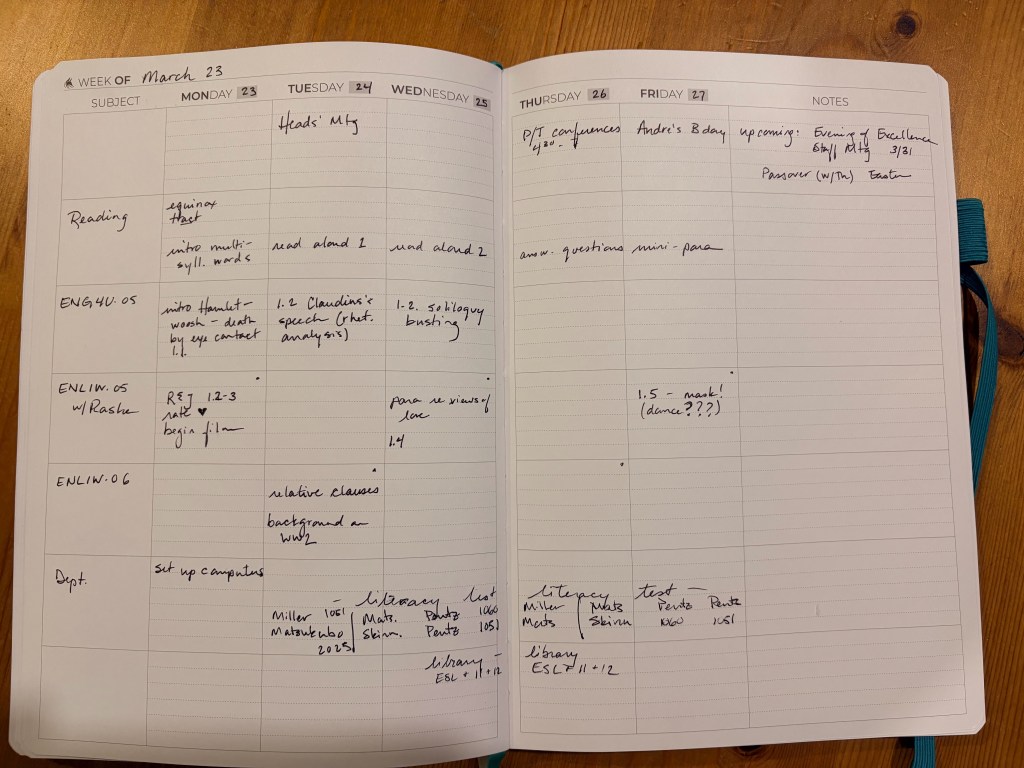
In grade 12, we’ve just started Hamlet. I am always torn about teaching Shakespeare, but I really love teaching this play. And today was amazing. We finished up yesterday’s rhetorical analysis of Claudius’s first speech and students cited lines from the play without being prompted. In my head, I was jumping for joy, but on the outside I played it cool, like, “yeah, my classes always just naturally use lines from Shakespeare to back up their points. Nothing to see here.” My super-cool teacher persona just took notes on the board and nodded her head.

Then we moved on to Hamlet’s first soliloquy. I’d planned a soliloquy buster (which I clearly got from somewhere at some time, but I no longer remember where or when), and even though we’ve only been together for six weeks, and even though it wasn’t quite 10am, and even though it’s Shakespearean language, the students happily moved their desks and sat in a circle and read aloud. Then, the real miracle occurred: no one protested (I mean, I heard a groan or two, but that’s just normal) when I dragged the class into the school lobby to “walk” the soliloquy. I stood on the risers and read the lines loudly while students held their copy of it and walked, turning 180 degrees every time there was a punctuation mark. By the end, we were breathless. When I asked how they thought Hamlet was feeling as he gave this soliloquy, students knew immediately: agitated, frantic, upset.

The energy in the room was high when the bell rang; I could almost *feel* the learning. They were jazzed. 

Second period: Planning. And I actually got things done. I even sent a suggestion to the principal: what if we invite the public library to set up a table during parent-teacher conferences and help people get library cards? (He said yes!)

Third period:
Literacy support. Another teacher actually invited me into their classroom to support students. I used AI to almost instantly convert the assignment (which is a *great* assignment but which has a LOT of words) into a checklist. I photocopied that and handed it out within minutes AND managed to sneakily support two students who really needed support. HOORAY!

Fourth period:
My, ahem, energetic grade 9 class started Long Way Down today. Their reactions to seeing the books piled on desks were decidedly mixed: “Are we going to read that?” can be said in many ways. But Jason Reynold’s novel has a magic that has never failed me – not since the first moment students unboxed brand-new copies of the book a few years ago d, and started to read. Today, Reynolds’ voice filled the room, our hearts beat as we heard that Will’s brother Shawn was shot, and we waited the horrible millisecond while we turned the page and read the words “and killed”. Someone gasped.

The kids let me pause to ask a few questions here and there, but mostly they begged to keep reading, so we read right to the bell. As they piled the books back on the desk (we have to share books with other classes), several of them said, “That’s a really good book, Miss.” I just nodded and said, “I know. I know.”

Then one darling child stayed after and whispered the story of the book she finished over March Break, the one she really wanted to tell me about, even if it might spoil it if I decide to read it. (Reader, I will not; it is “romantasy” – virtually all she reads – and sounds extremely silly, though just right for her.) I nodded and oohed and aahed until she realized her bus was coming and ran out the door.

For just a minute, I sat in the quiet classroom, completely satisfied with a day when learning felt almost tangible, when almost everyone was engaged almost all the time. I don’t always write about these days, but they happen – they really do – and I wanted to capture today. It was wonderful.