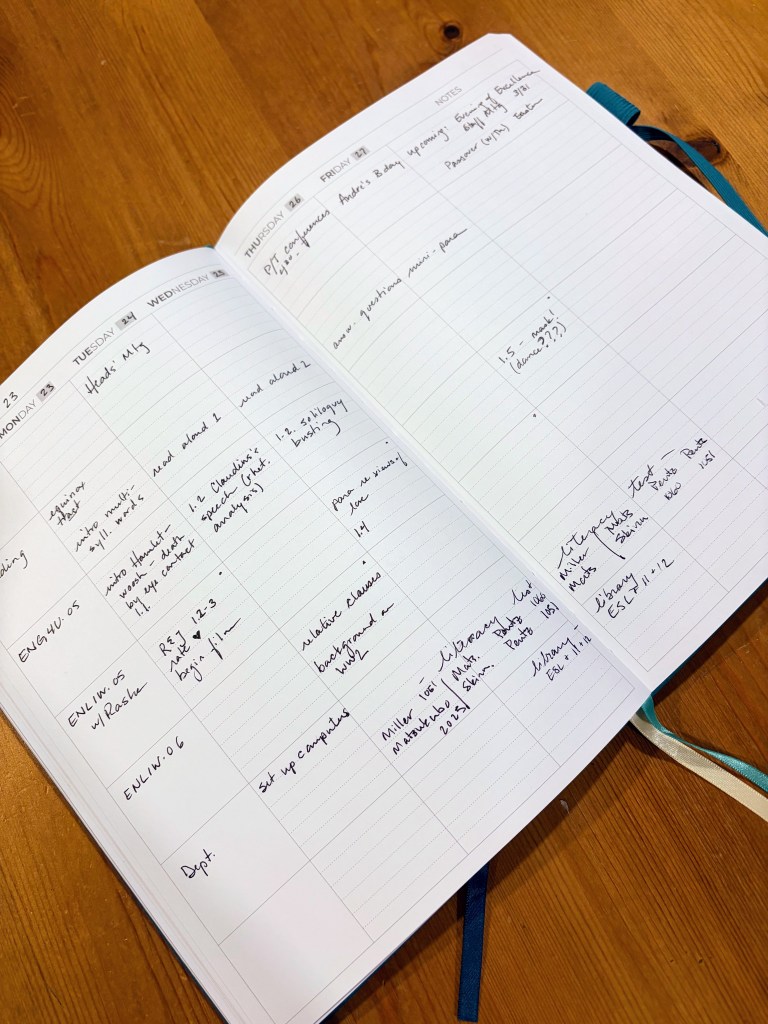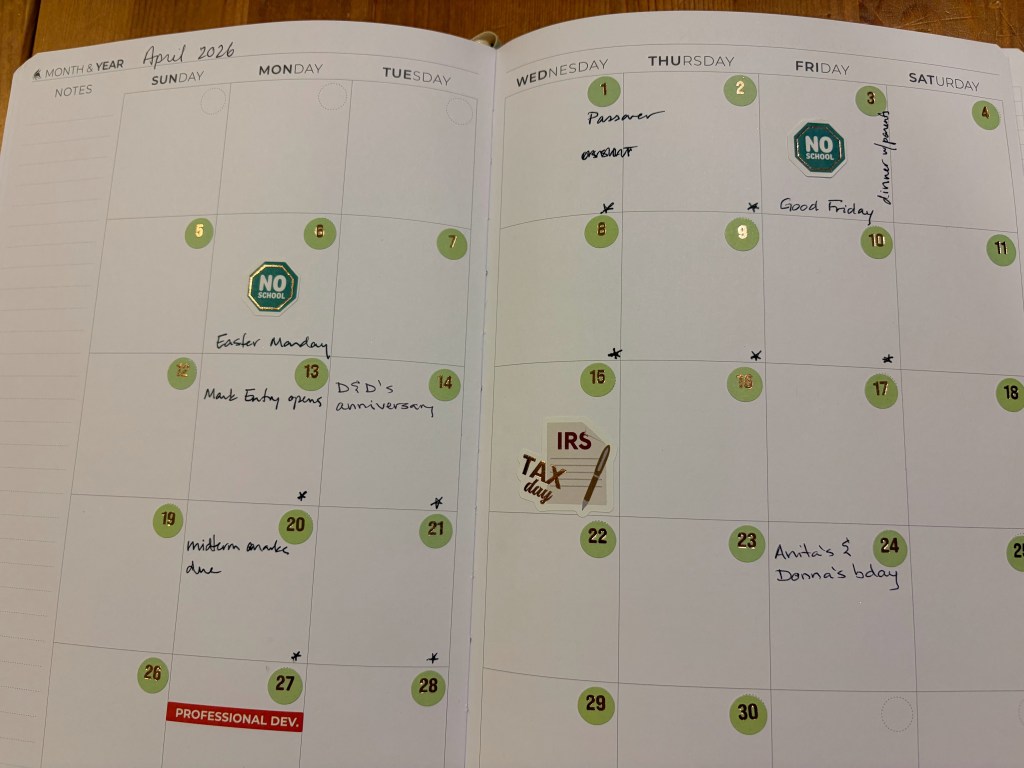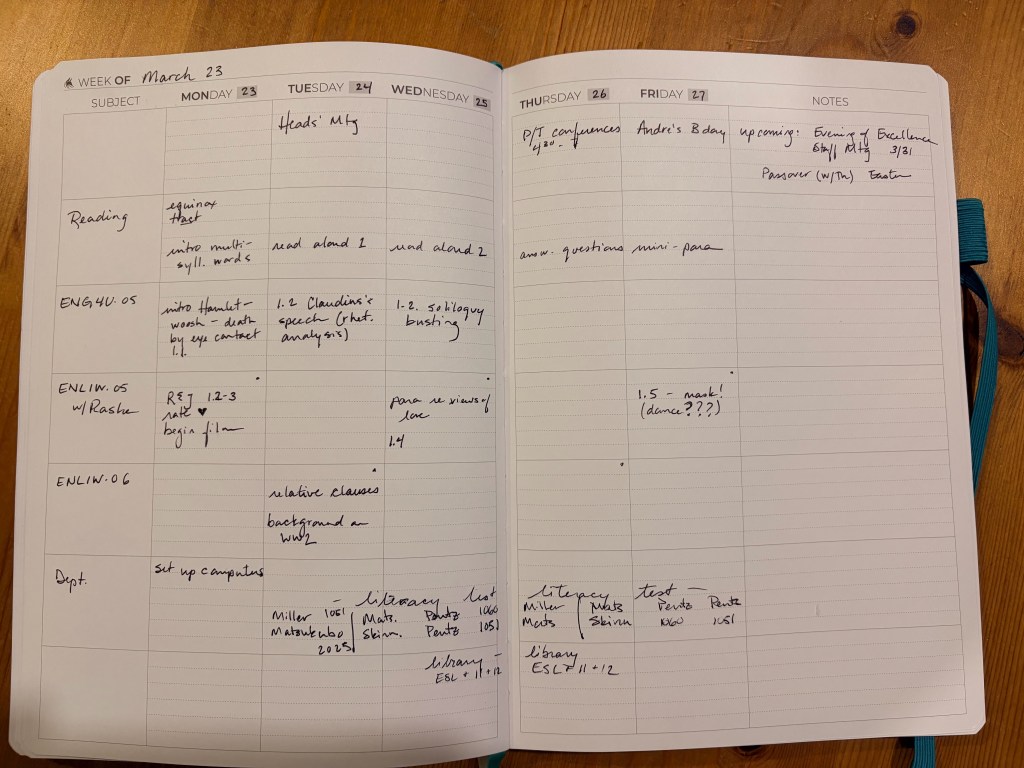
Friday, First Period #SOLC26 14/31

The bell has rung, but attendance is sparse on this last day before our March Break. The students who have made it to class on time occupy two ends of a spectrum: they either have their head down on the desk and appear to be asleep or they have a serious case of the sillies and are taking up a lot of space. This is more or less normal: First Period is Reading class, and not all of the students are entirely enthusiastic about starting their school day learning how to read – whether or not the next week is a holiday.

After the anthem, we go through the usual rigamarole: Phones away, take your earbuds out. No, really, the phone needs to be away. I know that you still have your earbuds in under that hoodie. Wake up. Waking up means sitting up. Seriously, put the phones away… and begin our daily routine:  CNN10 to increase our background knowledge, develop our vocabulary, and support our ability to read. One student remembers he’s supposed to be on a field trip and dashes out of the room. We wake another one up for the third time.

Holidays loom over this group. Some of the students are looking forward to time off; others definitely are not. As a result, we need a balance between routine and understanding today. People are unsettled; we want to set them up for calm as best as we can. Today is not a day where we can expect a lot of reading practice – because learning to read is exhausting. So after the news, we play a few word games then switch to our CNN10 vocabulary Kahoot. Our students can now reliably read and define words like surreal, innovative, feline and replicate and my colleague and I are extremely proud of them. Plus, it’s fun.

As the students log in, one – no seriously, I know you are listening to music – tries for the millionth time to convince us that he doesn’t need to play. Today, with the small class and the extra time, I am able to take a chance. “Hey,” I say, “let’s take a walk.” My colleague nods; she can handle the classroom. He ducks his head, embarrassed, but agrees.

Walking with students is a teacher trick. There’s something about being on the move, side by side, that lets people talk in ways they might not in a classroom. In this case, I lead with one of my favourite questions, “So, tell me about not playing Kahoot. What’s up with that?”

He doesn’t know, of course, except that he doesn’t like it. It’s stupid and it’s too easy and the words are too hard or too weird or too useless. He also requires quite a bit of daily cajoling to watch the news – and the vocabulary comes from there – so, since we’re walking, I ask about that, too. He doesn’t know why he hates it. He doesn’t know why he hates it all. He wanted to be in this class, and he knows we fought to get him in, but now… We walk and talk, talk and walk. 

In one stairwell, four boys are letting the recycle bins they just emptied slide down the stairs with a satisfying (nearly deafening) clatter and bump. I stand still, watching, until they see me, blush and leave. The student I’ve been talking with snickers a little. In a hallway, we encounter a student who we just saw in another hallway. There, he told us he was going to class. That class is not here. I tell him I’ll check his classroom in a few minutes to make sure he’s made it, but for now I’m focused on the child next to me, so I don’t have time to chase a different one.

This child, the one I’m walking with, is deeply uncertain about why he’s unwilling to participate in so many of our reading activities. After 15 minutes of walking, he still can’t quite articulate his concerns, but it’s somewhere between really wanting to learn to read and being horrified that “everyone” knows he’s in a class for people who can’t read. I tell him – not for the first time – that even the parts of the class that aren’t actively reading (like watching the news) will still help him with learning to read. He nods, but I know he’s not convinced. Nevertheless, he agrees that, for today, he will try the Kahoot with the hard vocabulary. 

I drop him back in the classroom, head back to check on the wandering student, and get back to class in time to watch the last – triumphant – round of Kahoot. When the bell goes, the kids tear out of the room, saying over their shoulders, “Have a good break! See you in a week!” and my colleague and I share a quick conversation before the next class comes in. 

Nothing has been solved. Nothing has changed. Still, the walk was a start; next time, in a few weeks maybe, my colleague will walk with him. Step by step, we’ll figure things out together. But now it’s time for a different class.

Countdown #SOLC26 12/31

Earth Date, March 2026
Context: Ramadan, Lent, war in Iran, the week before March Break

Monday, Break -5: Finally succumbing to whatever bug has been decimating attendance, I stay home sick; some students do some of the work I’ve left for them.

Tuesday, B -4: Student walk out (to protest provincial changes to education) starts at lunch and continues into the afternoon; workers in the neighbourhood accidentally cut the power lines; things goes dark; school is dismissed early.

Wednesday, B -3: Major ice storm predicted; buses cancelled; teachers must attend school but students do not; I have a total of two students attend class; in the end, the freezing rain mostly misses us.

Thursday, B -2: Intruder in the school; “secure the school” called during morning classes; person is “given support”; afternoon classes continue as normal; student attendance is dwindling; everyone is exhausted; one day to go.

Friday, B -1: Do we even want to imagine what might happen tomorrow? We had a fire alarm pull last week, so that’s done. We haven’t had a flood, but I feel like ice sort of covers water issues. Earthquake? Tornado? Unexpected solar eclipse? Time out of joint? Cross your fingers that we make it to our break.

Snow day? #SOLC26 11/31

By the time you read this, I will already know my fate.

I might be at home, curled up in a blanket, marking essays or reading a book.

I might be driving on an icy road, heading to a school likely to be all but empty – buses cancelled; schools open.

And, though this is very unlikely, I might be preparing to teach a full class of students.

Weather forecast: up to 20mm of ice accumulation (25 mm = 1 in) from freezing rain. 
Warning level: orange

(No one really seems to know what an orange warning is – but it’s more dire than yellow and less dire than red, so that’s something.)

When I was a student, I didn’t fully appreciate how much teachers sometimes long for snow days. Here in Ottawa, a true snow day is a rare thing indeed – we almost always stay open – which makes it even more wish-inducing. For tomorrow, I have my money on option 2: buses will be canceled, but teachers will still be required to go in. A few intrepid students will show up, but we won’t be allowed to teach anything new, so the day will be lost. Sigh. 

Still, I’m up a little later than I should be, writing.

Still, I haven’t told my children they must go to sleep.

Apparently that childhood longing for an unexpected day off never fully goes away.

Once, when I was a young teacher working with many other young teachers in Washington, DC, several inches of snow were predicted to start on a Thursday night. DC had no ability to handle snow, so if it snowed, we would have the day off. In anticipation, after work we all went to a local basement pool hall – one of our favourite hangouts. As the evening progressed, we played pool and drank beer, laughed and sent various teachers up the stairs to open the door onto the street and check for snow.

The evening crept onward, but no snow fell. We worked at a very small school; fully half of the faculty – probably more – was playing pool in that basement bar, drinking beer and waiting for the snow. By 10pm, with no snow falling, the more clever amongst us went home, hoping to sleep off whatever damage they had already done in time for school the next morning. But most of us stayed. 

11pm. More beer. No snow. A few more people left. But not many.

Then, around midnight, just when we were beginning to recognize the reality of what we had done, someone went up the stairs – ostensibly to go home – whooped loudly, turned around and raced back down to rejoin the crowd. “It’s snowing!” The bar erupted with cheers. The bartender gamely turned up the tv and we rejoiced to hear that DC schools were closed the next day.

I don’t remember what time we went home that night, but it was late, and – oh – how I remember our joy. 

A snow day. An unexpected day off. What a gift.

It could happen. And listen, I’m far too old to be out playing pool until all hours of the night, but, just in case, I might wear my pajamas inside out. And I think I’ll let my kids stay up late.

Lights out #SOLC26 10/31

The lights went out. The image projected on the board went black.

Then I heard screams.

Chaos ensued. Up and down the hallway, teachers threw open classroom doors to see what was happening. Student faces peeked out behind them. Soon, we learned that the power crew working down the street had accidentally cut the power lines in the neighbourhood. Luckily, my classroom has windows and, even better, I had just handed out new worksheets, so we were golden.

Golden, that is, if you ignored the intermittent screaming from across the hall, often followed by hilarious laughter. The interior classrooms were really very dark, so there was quite a lot of random scream-laughing… after a few minutes, I invited my across-the-hall neighbour and his ELD (English Language Development – for students who did not have the chance to attend much school before they came to Canada) Science class into my Grade 9 English class. More chaos.

If I know anything about school chaos, I know this: students with nothing to do will find something to do pretty quickly. It’s better for everyone if teachers direct that energy before the students do.

Unfortunately, my class had been starting to work with correlative conjunctions and inversion (after a moment last week revealed how deeply they did not understand this – really, the excitement never ends in our classroom). I’d shared “the flip” right before the lights went out.

The story not only hides the truth but also creates fear becomes
Not only does the story hide the truth, but it also creates fear.

Now we’d added half again as many students to the room and their English levels were undetermined. This was, perhaps, not the ideal lesson for the moment. But what are you going to do? The classroom was full of kids and something had to happen. No problem. I caught my colleague’s eye, then quickly grouped the students, pairing two or three English students with one or two Science students.

“Great,” I clapped my hands. “Now, if you’re in my class, you’re going to teach this pattern to your new partners.” Nothing like adding a little academic chaos to the chaos of a power outage. The students stared.

Soon the Science teacher and I were circulating, encouraging students to introduce themselves, to share worksheets, to try something new. Slowly, the magic of students working together across languages and levels started to spread through the classroom. People were laughing and talking and trying to understand each other.

I had just stepped back to take in the somewhat-darkened slightly goofy chaos of learning when a VP came in and told us that school was dismissed early for the day. Everyone understood that, and cheers erupted. Students streamed out of the classroom, and my colleague and I smiled at each other. It had only been 10 minutes, but it had been good.

Backwards Design: how to procrastinate weekend grading #SOLC26 7/31

Understanding by Design Template 2.0

Stage 1 Desired Results
ESTABLISHED GOALS
Mark the essays
UNDERSTANDINGS Students will understand that…the teacher read their workESSENTIAL QUESTIONS Why? Why why why?
Stage 2 – Evidence
Evaluative CriteriaAssessment Evidence
The essays have a final markOTHER EVIDENCE: Ideally with thoughtful comments
All of them
Stage 3 – Learning Plan
Summary of Key Learning Events and Instruction
End goal* – Finish the marking
*those who finish early will be allowed to comment on other blog posts as a reward
Start marking
Look for things on the computer again
Organize the paper versions of essays
Spend an ungodly amount of time fiddling with formatting
Finally write your blog post
Make more tea
Decide you need more tea
Talk to your sister
Water the plants
Play NYTimes word games
Check phone for messages again – just in case
Read headlines – spiral about the state of the world
Clean the toaster
Toast a bun for breakfast
Make a pot of tea
Collect clothing for laundry
Add very important items to the grocery list
Check phone for messages
Decide you will blog before you start marking
Sleep in a little

For teacher-writers truly dedicated to procrastination: on Friday night, do NOT write your blog post; decide that you will, instead, write before beginning to mark on Saturday morning.

Resource retrieved January 17, 2023. Accessed from https://jaymctighe.com/resources 

What to Wear on Wednesday #SOLC26 5/31

When I was in high school, friends of mine kept track of how many times our Chemistry teacher said a particular phrase. I think it was “um,” but surely that is too banal. Surely we had better things to do in Chemistry than tally the number of times our poor teacher hesitated every class period, day after day, right? Of course, we also kept track of at least one teacher’s outfits: ah, there’s Tuesday’s skirt! Right on cue, Thursday’s dress! And my sister’s class once united to torture a student teacher by tearing out their notes, day after day, then pretending she had not given the previous day’s lecture. 

Clearly, this was before cell phones.

I am now in my 50s, and some days I feel lucky if the students even notice if I’m in the room, but these memories explain this morning’s dilemma: what to wear to school? I have plenty of options, but it’s March and I am sick of every item of winter-adjacent clothing I own. Plus, of course, I couldn’t wear the green palazzo pants today because I want to wear them tomorrow when we have a guest speaker. Why do I need to wear those pants for a guest speaker who I’ve never met before and may never see again? I do not know, but this morning that was my only fully-formed idea about clothing. As a result, I stared longingly at the green pants for several minutes. 

Eventually, I reached for a black dress with white stripes, but I suddenly feared it might be my “Wednesday” outfit. I put it back, deciding that my safest bet was something navy – because when was the last time I wore navy? Minutes later, I realized that I probably hadn’t been wearing anything navy because I couldn’t find my navy shoes or any cardigan that coordinated even vaguely with navy. 

At this point, getting dressed – something that normally takes me no time at all – had taken me quite a bit of time indeed. I texted my carpool buddy that I was running late and, ignoring the nagging voice in my head – the one with a distinct Southern accent – that whispered “No white before Memorial Day,” I grabbed a white cardigan. I finally located my navy shoes, then ran downstairs to grab breakfast. I threw together a lunch, and took my breakfast to go. My carpool buddy arrived, and we headed off to school: me, confident that I was not wearing a Wednesday outfit and knowing that, at the very least, my shoes were appropriate. No tally sheets for this teacher!

No tally sheets, that is, unless my students are keeping track of days when I have completely forgotten to put on any make up. Sigh.

At least tomorrow’s outfit is ready to go, and – who knows? – maybe the guest speaker will be really impressed by my green palazzo pants. Maybe he’ll add them to a secret tally sheet of “really well-dressed teachers for a Thursday in March.” I bet I top the list for that one.

Let it go? #SOLC26 3/31

During my prep period I head to the front office to ask a question. In the lobby, the Principal is talking to two of our regular “hall walkers” – students who spend most of their time in the halls rather than in class. I maintain my pace but watch, intrigued, as he moves them inexorably towards the office even as they argue with him. At one point he says, “1,150 students are in class. Why aren’t you?” I’m impressed by this statement, but the students remain defiant as I pass. 

Just before I enter the office, I see a few more regular loiterers hanging out nearby. Though I have no real authority other than that of being an adult in the building, I believe that teachers and administrators should work together to help students meet our expectations, so I spur them along a bit with a joking phrase and “You should be in class.” They acknowledge my words with a clearly false response and stay where they are. I ignore their obvious lie and go into the office. Actually getting them to class would take more fight than I’ve got in me right now.

A few minutes later, I’ve finished up in the office, and I walk out, chatting, with a colleague. We continue to talk as we wend our way back to our classrooms. More students linger in the lobby. Again, I pause to say, “You should be in class.” Again, they offer anodyne excuses that have little to do with reality. I know they’re lying; they know they’re lying. We all continue on our way.

Once we reach my classroom, my colleague comes in and shuts the door behind him. “Hear me out,” he says, “before you say anything.” I figure this is because of my terrible habit of interrupting, but this time it’s more than that. He looks directly at me. “You need to stop telling kids to go to class.”

He explains his logic: every little interaction like the ones I’ve just described is a tiny annoyance, a mini increase in my blood pressure or my stress. And for what? Every time, the students lie or ignore what we say, and every time they get a little “win.” They only go to class if we follow them there, and that is a much much bigger annoyance for everyone and a bigger stressor for the teacher. He believes that ignoring their behaviour is better for us and, at the very least, no worse for them.

I have to think about this. I consider the “animal training” philosophy that suggests we should ignore behaviour we don’t like and reward behaviour we do. I consider the amount of effort it takes even the Principal to get kids to respond appropriately. I consider what I lose when I ask students to go to class but don’t follow through. 

Then I think about what it might mean if no one asked students to go to class. What happens if most or all teachers just turn their heads instead of intervening? But are we really intervening now or are we just playing at intervention? I don’t know. 

I’ve been thinking about this since my prep today. I can honestly say that asking students to go to class has only ever been effective when I have accompanied them all the way to the door of the classroom. Even then, I overheard one of our VPs say that she had walked a student to class today and the student left the room again within minutes. Maybe I’ll give my colleague’s idea a try, even if it feels weird. What do you think?

The Experienced Teacher #SOLC26 2/31

Lately, I’ve been feeling my age as a teacher. Look, I don’t think I’m old, exactly, but I’m definitely much nearer the end of my teaching career than the beginning. I’m literally the same age as the mother of one of my colleagues. I try not to think about it, but it’s still out there. I’ve given up on some things – I no longer even bother pretending to keep up with celebrities and slang. I pick up a bit here & there, toss it into the occasional class discussion and pray I’m only a bit out of date. Is skibidi still a thing? Six-seven? Ariana Grande? Who knows? Who cares? Not me, honestly.

As a Department Head, I pride myself on encouraging teachers in the department to try new things, take risks, see if we can meet students where they are and all of that, but too often I still think of new things as, you know, books. Meanwhile, my colleagues are tiptoeing into the world of teaching video games and YouTube essays. They use reels and bring up streamers (who are people, not party decorations). It’s impressive, and I kind of hope I retire before I need to use these things regularly. I mean, I keep a blog – which I write without AI. 

Which brings me to one of my grade 9 classes this year. They are energetic and hilarious, which translates into “always talking” and “often sneaking out their phones.” They don’t read and they don’t do homework. (Obviously some of them do, but classes have personalities and this one is, ahem, riotous.)

It’s a year-long class that meets every other day, so February marked the beginning of our second semester together, and last week marked the end of my patience. People were late. People were talking. We’d given up independent reading time several weeks ago. On this day, notebooks were not out; no one had a pencil; only two students had completed the article of the week. Their midterm marks were atrocious, but they didn’t seem to care about improving. I gave up. I asked the students to sit in a circle and I spoke to them honestly. I didn’t know what we were going to  do, but it couldn’t be this. We would not make it to the end of the school year. “So,” I said, “too hard, too easy or too boring?”

The answer, of course, was yes, though it took a while for them to trust me enough to talk about it. Once we had established that, we moved to the next question. “What do you want or need to make this class better?”

“More fun,” they said. (Well, after they said no reading and no writing, no vocabulary and no sitting and all group work and let them use their phones – and I laughed and laughed.)

“What does fun look like?”

No one really knew at first, but slowly they came to agreement: they wanted to read something together, maybe out loud and definitely not on their own; they wanted to move around more; they wanted to work with other people, even though they know they’re not really good at actually working in groups. They wanted more support for their writing.

“Ok,” I rubbed my hands together. “I can do that! Let’s choose a book!”

And, because I am old and I am a Department Head, I know who teaches what and when, so I went to the book room (don’t worry; another teacher stayed in the room with them), and I grabbed a few copies of every book that had a full class set. I found seriously old books (Lord of the Flies) and slightly old books (Speak) and modern books (Frying Plantain) and brought back enough copies for people to page through. Still, nothing was really hitting them.

Finally, R looked up and said, “You know, I thought in high school we would read Shakespeare.” Several others agreed with her. “Could we read Romeo and Juliet?” Across the room, some of the boys perked up, too. They were down with Shakespeare.

Y’all. Shakespeare? I hadn’t even considered Shakespeare. These kids are from all over the world. Their English is everything from native to fluent to okay to, well, we’re trying. Some of them are excellent readers; some are decidedly not. They generally disdain English class. Shakespeare? Perfect!

Experience has its privileges: I know that the language will be hard enough that it will equalize the class – all the readers will struggle with the words. I know that this is as much a gang story as it is a love story. I know that we will be on our feet all the time and that they will have to work together and do close reading to figure out what in the world is going on. I know that I have myriad options to support kids at different levels and I know that this will work. I know it right away. 

“Yes!” I said. “Let’s do it! This is going to be fun!”

I put all the other books away and gathered the students in for a second time that class period to talk about feuds and families and sneaking out of your house. I may be old, but when it comes to teaching, I like to think that experience means I know what I’m doing.

Not bad for a blizzard

As an immigrant to Canada, I may never get over the way schools here handle snow days. In South Carolina, we sometimes had “weather days” because somebody somewhere had uttered the word “snow”; everyone freaked out, panic-bought milk at the grocery store, and school was cancelled. In upstate New York, where my sisters went to high school, school was occasionally cancelled because it was too cold out for kids to be waiting for buses. In Ottawa, if there’s a LOT of snow and we’re really lucky, they might cancel school buses, but schools are pretty much always open. “There are plows,” Canadians shrug. “Leave early.” And so we do.

This morning we woke up to clear skies and reasonable (read: still very cold) temperatures. There was no reason to expect buses to be cancelled. I didn’t even check my email. Luckily, my carpool buddy texted before 7am:

Hmm. A blizzard. OK.

Email revealed a message from one of my children’s teachers: students were “encouraged” to come to his morning class, buses or no buses. I woke Mr. 15 and sent him in. Mr. 17 said he would probably go in for Calculus because “it’s not snowing yet.” Blizzard-shmizzard.

No bus days are also “no new material” days because many students can’t get to school without buses. In practice, this often means that we end up with a handful of students and not much to do, but today was different. The few grade 12 students who arrived for first period asked to read their books, and then they did exactly that – for more than an hour! Then, during Reading class, we watched CNN10 and discovered that we could stream the Olympics – luge and ski jumping soon filled the room. 

Now, at the end of the day, I am sitting in a darkened classroom with students I’ve collected from several grade 9 classrooms. Kids have pulled out food (Where do they get it all? Is this what is in their backpacks? I’ve been offered both sour gummi worms and white chocolate.) and we are watching Olympic women’s hockey – Canada vs USA – while a literal blizzard blows snow outside the classroom window. There’s a steady undercurrent of talk and giggles. Phones are out, but kids are watching, too. They’re speaking Turkish, Arabic, and English while they cheer our team on. It’s not school, exactly, but it’s not bad for a blizzard.