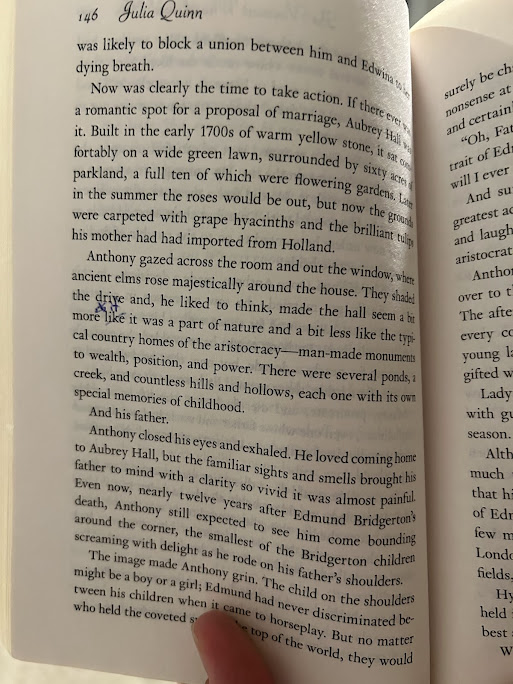
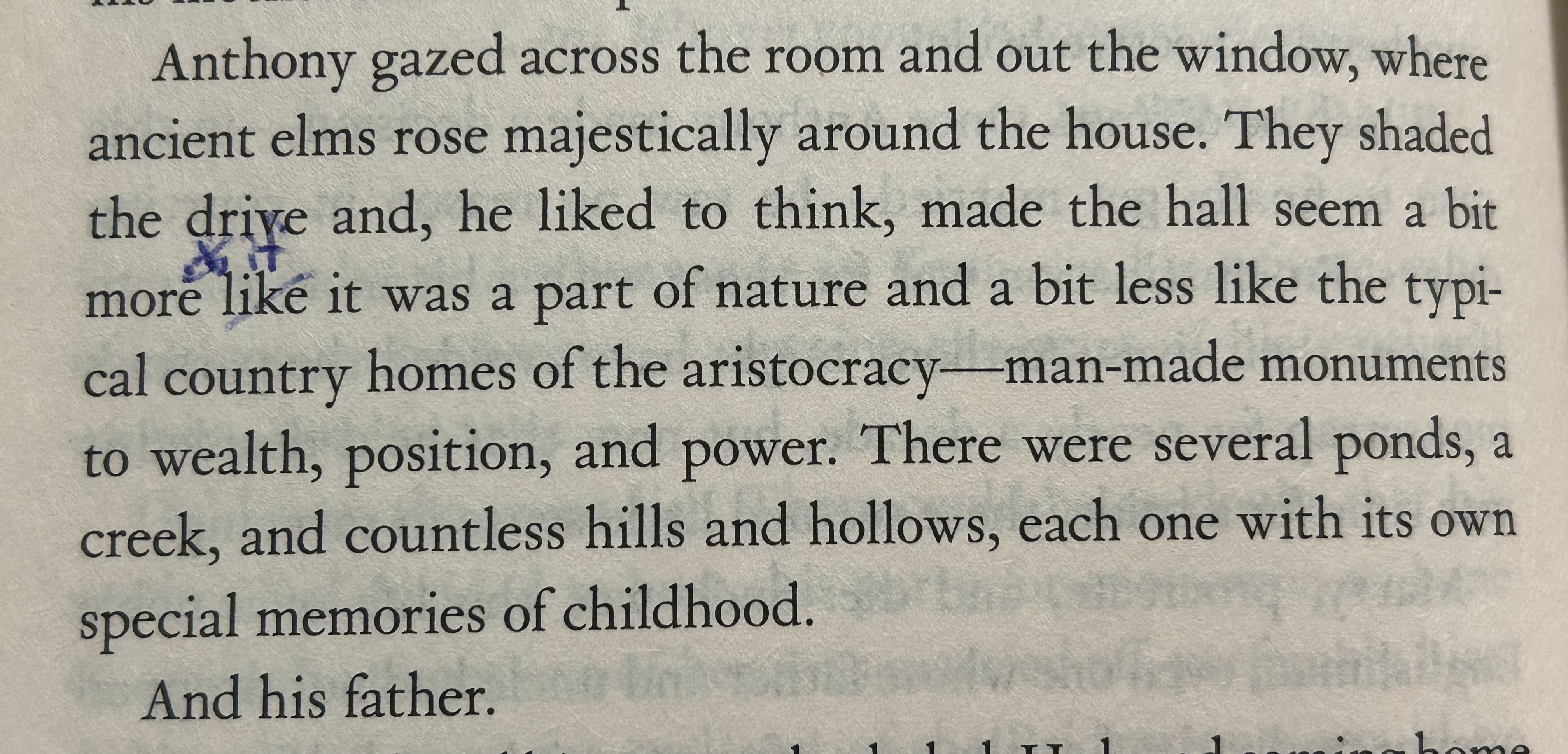
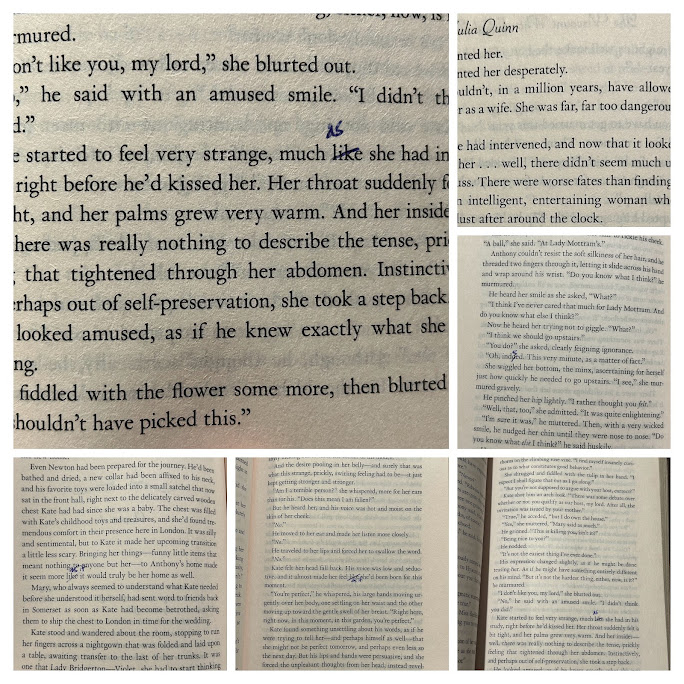
I was a little startled. I mean, this is a trashy romance. The main characters murmur and gaze longingly. I was enjoying the story, but I wasn’t exactly on the lookout for grammar errors; in fact, I’d consciously decided to overlook some of them. And yet…
“As if”? I nearly laughed. This is my fellow reader’s quibble? I mentally shrugged, then moved on. Until it happened again. And again. And again. Someone had taken her blue pen to the novel and fixed “like” – and only “like” – a dozen times throughout the novel.
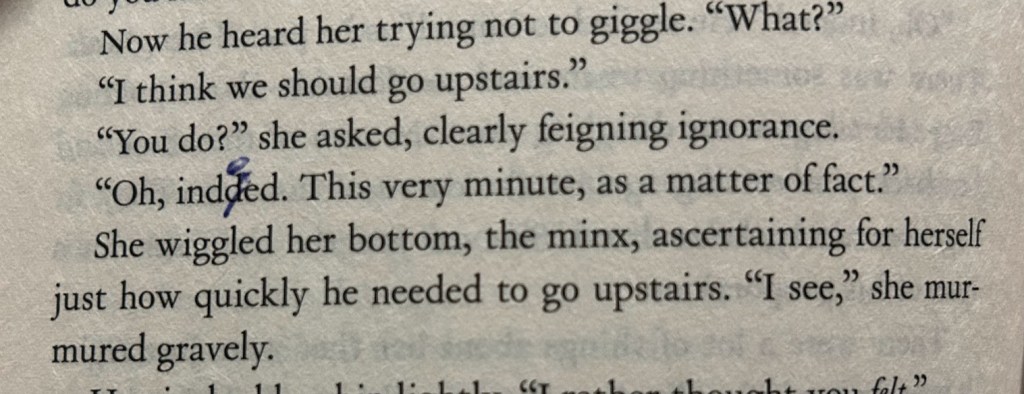
Wait. I lie. Once, she fixed a typo. Indeed.
I imagine her reading along, overlooking the missed subjunctive, ignoring the diction (minx!), letting the anachronisms lie… and then she hits her limit… “like.” She shudders. She thinks of the years she spent in the classroom, teaching students when to use “like” and when to use “as if.” She thinks of endless hours of grading essays, the constant battle against the demise of the English language. Her fingers tingle, and before she knows it, she has a pen – because of course she always has a pen nearby – in her hand, and she has made the correction.
Once she’s started, she cannot stop. The pen is uncapped, the errors egregious – at least in her eyes. Surreptitiously at first, then with greater and greater glee, she fixes the error each time it appears. As the novel climaxes in a crescendo of smouldering looks and husky moans, with one final flourish, she amends the typo in indeed and, triumphant, re-caps her pen. The world is now a little more orderly.
The next day, chastely, she returns the book to the library. Maybe she glances about as she slips the book into the returns slot; maybe she holds her head high, firm in the knowledge that she is right.
One way or another, I got double the pleasure out of book two of Julia Quinn’s Bridgerton series: trashy romance, and proof that English teachers never really leave the classroom.
He’s caught me in the hallway between classes. I hesitate, not quite sure what to say. He bulldozes ahead, “You should come get me from class today, like maybe thirty minutes in.”
Ah-ha! He wants to continue our reading comprehension sessions. Or rather, he wants to get out of his science class for twenty minutes.
“I kind of figured you should stay in class and work on your summative project,” I say.
“Nah,” he scoffs, “I don’t understand any of it. I’m just making stuff up.”
I relent. “Fine. I’ll see what I can do.”
So, about thirty minutes into his Science class, I pull him out.
The project is pretty cool, if you ask me, which he didn’t. They are supposed to be creating their own habitable planet and an alien race that lives there plus some other stuff, but I don’t get a good look at the project because he’s already asking a question.
“Is there a difference between mass and density?”
I tell him to look it up.
“But if you know, why don’t you just tell me?”
I just give him a look. He asks again, gets sidetracked for a minute, and then circles back to ask one more time. Silently, I take his computer and type in “Is there a difference between mass and density”. I turn the screen back to him so he can see the bazillions of responses.
“There is! I thought so! Why didn’t you just tell me?”
I ask him what the difference is. He tells me it doesn’t matter. I refrain from making a joke about matter.
Now he wants to know why the mass of the planets is listed as x1024 and how do you type up high like that? And also what’s a good temperature? Like, you know, a neutral temperature. And why does he have to use Celsius when he’s sort of used to Fahrenheit and actually he’s not really very good with either so is 16 cold?
I ask him if he’s talking Fahrenheit or Celsius. “Either,” he says, “I just want to know if it’s cold.”
Every time he asks a question, I help him look it up. Every time a webpage comes up, he groans and says he doesn’t want to read “all that.”
“Miss, I just want to put down easy stuff and be done,” he tells me. “Can’t you just tell me the answers?”
I tell him that if he just wanted the answers, he wouldn’t have asked me for help. He disagrees. So I don’t tell him about distance from the sun, and I make him look up if a planet can have long days and short nights and whether or not it can always be Fall. He argues with me every step of the way, right up until he tells me class is almost over and he needs to go get his stuff.
“Fine,” I say, trying to keep the frustration out of my voice. “Do you want more help tomorrow?”
Not like you helped him today, says a little voice inside my head. I mean, we fought for many minutes about whether or not he needed to know what axial tilt is. (He does, but he refused to read the information.) Classes end in one week. We are all exhausted and ready to be done.
“Yeah,” he says, “if you have time you can come back. I like it when you help me.”
So tomorrow I will once again sit with him and refuse to either answer his questions or allow him to barge forward without thinking. I will bite my tongue, and he will be frustrated with me, but apparently we’re both good with that.
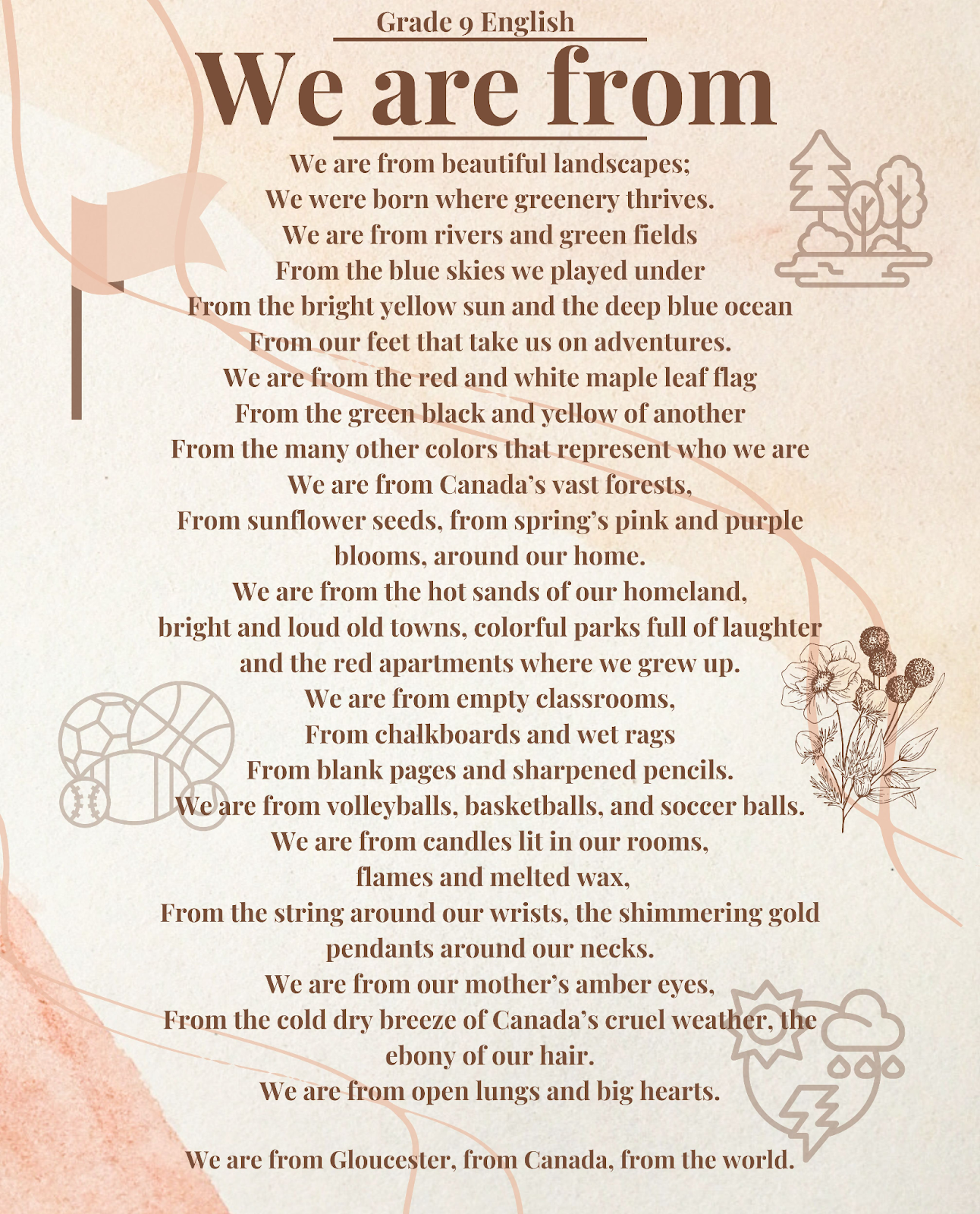
In grade 9, we’ve moved from our first unit – Stories of Us – into our second – Stories of Others. We’ve written Where I’m From using not only George Ella Lyon’s wonderful poem but also interpretations by Melanie Poonai, a young writer from England, and Danika Smith, an Indigenous author from British Columbia, as models. We’ve worked as a class and in small groups to create Where We’re From poems that help us understand our class as a whole. Students turned these into posters or short videos – and the school board’s print shop has delivered gorgeous prints that now decorate our room. We’ve written our own 100-word memoirs, too. Now, it’s time to look outside our classroom walls.
It’s also March, which means that I am in the middle of writing and publishing stories every day. I tell the students about this, and they are interested, impressed, curious, bored, and not listening. Some of them want to know where I get the stories from. I laugh and say, “from you.”
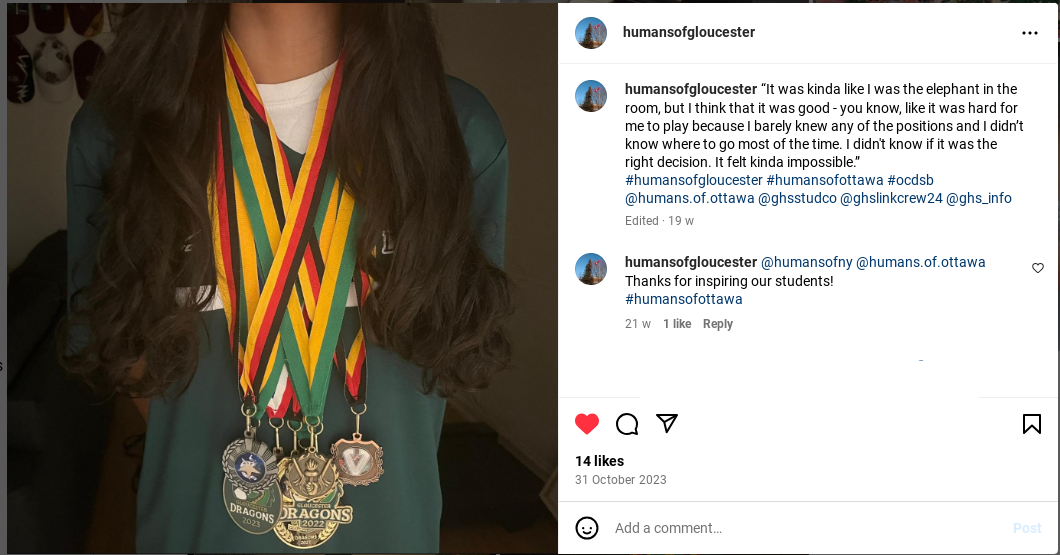
For a few days, we listen to StoryCorps interviews and look at Instagram posts from Humans of New York. We practice active listening and asking follow-up questions. Then, I put this quote up in the right-hand corner of the blackboard as one of our daily quotes:
The truth about stories is that that’s all we are. -Thomas King
After reading time, I draw their attention to King’s words. I ask what they think he means. It takes a minute, but when they arrive at an understanding, a few of them marvel. “It’s really true, isn’t it? Our stories are really important,” says one. “It’s like what we think about what happens is as important as what happens,” says another. I just nod.
I think about the quote all the time. I think about how I am made of the stories I’ve heard, the stories I tell myself. I think of how the way I tell the story affects who I am and how the stories themselves change over time. I think about the value of regularly capturing tiny moments, recognizing the story I’m telling myself as I live it. These stories are everything. As Jess writes, “There is gold in every piece of your story.”
Now, the students are out in the world (mostly in the hallways, to be honest), interviewing other people: family or friends, students or staff. They have to choose a tiny powerful moment from their interview – a story – and pair it with a photo. I post these on our Instagram account, and we marvel at the moments that shape our community. The students must think about what part of their interviewee’s story they chose to tell and what parts they left out. How will that change people’s perceptions? What story are they telling? These students learn to lean in to other people’s stories and consider them deeply.
This year, this part of the unit is closing as March comes to an end. Today marks the end of seven years of this challenge for me. I know that, tired as I am, I will miss this – the writing, the reading, the commenting – tomorrow and in the days to come. And I know it’s because of the stories people share, and the stories I choose to share, too. What a privilege it is to be part of so many stories! What a boon to be allowed so many views of the world!
If Thomas King is right, and I think he is, then I am so much better, so much more because of the stories others have shared this month and in all the months and years past. I am better, too, because of the time you’ve taken to read my stories. Thank you.
He rarely comes to class, but when he does, we do what we can to make sure he has at least a little success. He’s in grade 9 and is currently illiterate in three languages. Research says that students with strong reading skills in their home languages often also have strong reading skills in their second language (see Short & Fitzsimmons, 2007 or this shorter article by Fred Genesee), but he doesn’t have strong reading skills anywhere. We can’t turn back time, but we’re doing what we can to move forward.
He’s lucky because this class has a push-in support teacher. She’s technically there for other students, but no rule says that she can only help them, so we’re using what wiggle room we have to create as much space for him as possible. When we were writing 100-word memoirs, she just happened to be sitting near him and just happened to be able to scribe for him. As I circulated, their heads were close together in front of the computer, counting words. When he realized he had written a story of exactly 100 words, he was so proud that he asked her to read it to him again. He beamed. Then he skipped for three days.
Then next time he made it to class during reading time, I sat with him and quietly talked through The Invention of Hugo Cabret, which he likes because it’s thick and he says it makes him look smart, while Ms H kept an eye on the other readers. Even the pictures were hard for him to understand, but he liked talking about them. Then he refused to do anything else.
Sometimes, he comes to class (late) and then asks to get water or go to the bathroom. I put him off as long as I can, but I am not the arbiter of his bodily functions; when he says, “Miss, I really have to go,” I let him. Sometimes he comes right back, but sometimes he runs. Two days ago, he swore he would only be gone for two minutes, then he took the hall pass and disappeared. I found him in the lobby later that day, skipping a different class. While we walked to where he was supposed to be, he told me that he had thrown up that morning, so he couldn’t return to my class. Given that he was practically bouncing up and down with energy as we edged towards his class, I reminded him that usually someone who throws up goes home, but he said he called home and his mother said no. Ahem. I found him in the hallways again that period and once the next period. He told me he just can’t stay in class.
Yesterday, Ms H had a breakthrough. She saw him (in the hallway, of course) and made some sort of deal/ bet with him – and then he actually showed up to English class a mere 10 minutes late (thus missing most of reading time). Meanwhile, she had hatched a plan. She took him to a quiet room – but not the resource room; he refuses to go there – and she started a phonics assessment with him. She praised him for what he could do and talked about ways we could help. She told him she could start with what he can do instead of expecting him to be able to do impossible things. He was eager.
Ms H was excited that we’d found a way to start giving him some real support. That afternoon we talked through her plan. But this morning, he saw her in the hall during first period, turned around and went the other way. Then, he saw her at the beginning of our class. This time he ran away. Ran.
We stayed after class together, Ms H and I, trying to figure out how to help him accept our offers of support. We reminded ourselves that years of failing in school, years of hiding his weaknesses, mean that he probably thinks he’s beyond redemption. He may be afraid that he’ll just fail again and disappoint us in the process. We walked into the hallway partway through lunch, and there he was, right by our English classroom. Gotcha! Gently, we reminded him of his (broken) promise. I told him that it hurt Ms H’s feelings when he didn’t come. She told him that she had been really excited to see him today. He shifted his weight back and forth, back and forth. When we finished – maybe a 30 second “chat” – he said, “OK” and then… he ran.
Sweet runaway boy, how I hope you’ll let us try to help you read. Reading will make a bigger difference than you can imagine. It’s worth sticking around for.
Today, I got an *AMAZING* message from a former student. She is graduating from university and is “almost an RN now.” I am aglow with happiness for her – and for us: she’s going to be a wonderful nurse. I am proud to say that a tiny part of her story relates to my post from yesterday.
You see… back when Mr. 13 was Mr. 6, he was driving his teacher up a wall. They butted heads regularly (in a first-grade sort of way – the kind where it turns out that six-year-olds need to follow rules sometimes), most often in reading group. There, Mr. 6 would some days read fluently, then other days act silly, “reading” words that were not on the page. We were baffled. The story goes that one night, angry with my insistence that he try to sound out words, he “read” his entire book without looking at the pages *even once*. But he couldn’t read individual words.
Because his teacher was both kind and deeply experienced, she had already flagged his reading as potentially problematic. Because I knew that dyslexia ran in my family, I already knew to pay attention to my children’s reading. Because my colleague’s wife was a child psychologist who did lots of educational testing, she advised testing Mr. 6 asap, rather than following the school system’s recommendation to“wait and see.” Because we have good health insurance, we could pay for private educational testing. And because of all that, we discovered that Mr. 6 had dyslexia when he was, well, 6.
The chips continued to fall in our favour. First, even though I am a high school English teacher, I was already learning about how people learn to read, so I knew that people with dyslexia benefit from early intervention. Then, when the principal said it was “too bad” that Mr. 6 was going into Grade 2 because the school’s reading intervention program started in Grade 3, we were wealthy enough to pay for tutoring. Then, I began researching dyslexia and found Dr. Sally Shaywitz’s book, Overcoming Dyslexia which recommended specific research-based tutoring programs. In a final bit of good fortune, a local tutoring company specialized in exactly this.
Y’all, that is a lot of good luck. Learning to read should NOT be a matter of luck.
Now, let me tell you about my student. She had struggled to learn to read when she was little, but she was an incredibly hard worker, so she managed to stay on top of things. She was seriously smart, so she was able to figure things out, even though reading remained, well, not easy. By the time I met her, she was in 10th grade, and she was working her butt off. She was also doing extremely well in school.
Still, as we got to know each other over a few years, she confided in me that she wasn’t “as smart” as her friends because she took “three times as long” to do her homework and made “stupid mistakes” if she wasn’t focused. I believed her, but I didn’t know what to make of this… until about ¾ of the way through Shaywitz’s book. There, I read a description of a high school student with dyslexia. Right away, I thought of her. Pages later, Shaywitz listed some common signs of dyslexia – and suddenly I had concrete questions I could ask someone.
I explained to this young person that I had an idea about her learning. Then I read her the description in Shaywitz’s book. Recognition dawned: “That’s exactly me!” I am not an educational psychologist, so I can’t diagnose anything, but at least we had an idea of what might be happening. All we needed was some testing – which our school system couldn’t provide because, first, our limited resources go to students who “are not able to access the curriculum” and this student was on the Honour Roll and, second, those same resources are meant for students in our system, and she was nearing graduation. We fought on. One thing led to another, and things stayed plenty dang complicated, but in the end she was able to get accommodations when she went to university. Things weren’t easy, but they were, at least, easier.
Looking back, it all feels awfully precarious. What if my child’s teacher hadn’t noticed his uneven reading? What if we hadn’t known to get him tested? What if I hadn’t been reading about dyslexia? What if?
I think about all the people who will benefit from having this brilliant, determined, caring young person as their nurse. I know this is supposed to be a slice of life – and I really want you to know how much I admire the student I’m writing about – but I have to end with what I already said: learning to read well should not be a matter of luck. As a profession, we are trying to make changes so that more students learn to read well. I hope our systems don’t give up when our first attempts aren’t perfect. I hope our system doesn’t write off students who are already in high school. I hope we have success story after success story to tell in years to come. And I really hope you’re lucky enough to have this person as your nurse. That would, indeed, be lucky.
I’ve just finished taking attendance and am closing my computer so that I can read along with my class when I hear a muffled gasp from the middle of the room.
“Oh!”
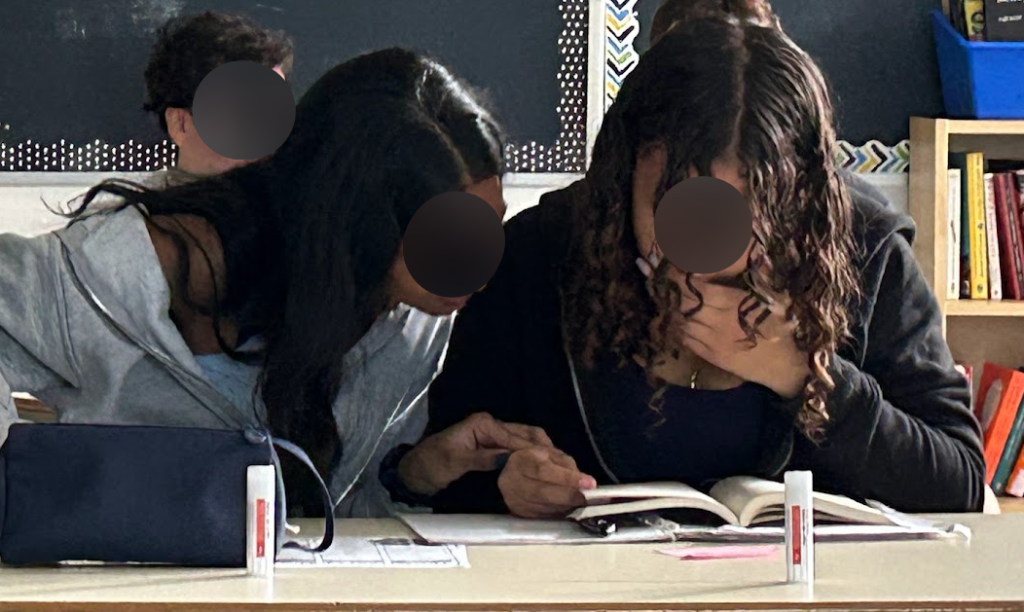
My eyes snap up. Is something wrong? A student has her hand over her mouth, eyes wide as she stares at her book. Her friend shoves her own book – newly started – to one side and leans in to see what’s on the page. The reader’s eyes are wide. She starts to dog-ear the corner but then, just before she creases the fold, she flips the page. Both girls’ eyes dart back and forth as they read quickly down the page. Another intake of breath then, heads together, they hold a whispered conference.
One of them looks up and catches my eye. I nod. I know this book. I know where they are. It is, in fact, gasp-worthy. The student takes a deep breath, then dives back into the story. Just last week she told me that she usually abandons books long before she gets this far, but not this one.
Page finished, her friend reluctantly returns to her own novel. If I had to bet, I’d say that Dear Martin will soon be flying off my shelves. For now, though, there’s at least one reader in the classroom who needs to finish this book.
Sometimes during reading conferences I ask students “How do you choose your next book? How do you decide what to read?” My goal is to determine – and help them determine for themselves – if they are independent readers, people likely to read outside of the classroom. In my experience, people who identify themselves as readers may not know exactly where they get book ideas from, but they can usually answer “what will you read next?” with some ease. If they can’t, they can pretty much always tell me where they’ll get ideas.
While I occasionally go through dry spells, I rarely lack for ideas for my next book – this month’s Slice of Life Challenge alone has already yielded more titles than I could possibly read – though this impossibility won’t stop me from trying. As to how I decide what to read next, the truth is that my next book is often determined by what has come in at the library where my on hold list and my checked out list are in a constant battle for supremacy; I watch, bemused, from a distance as each list grows and shrinks, occasionally cheering on one book or another. Sometimes I let one go in disgust or despair. One way or another, what comes in is often what I read.
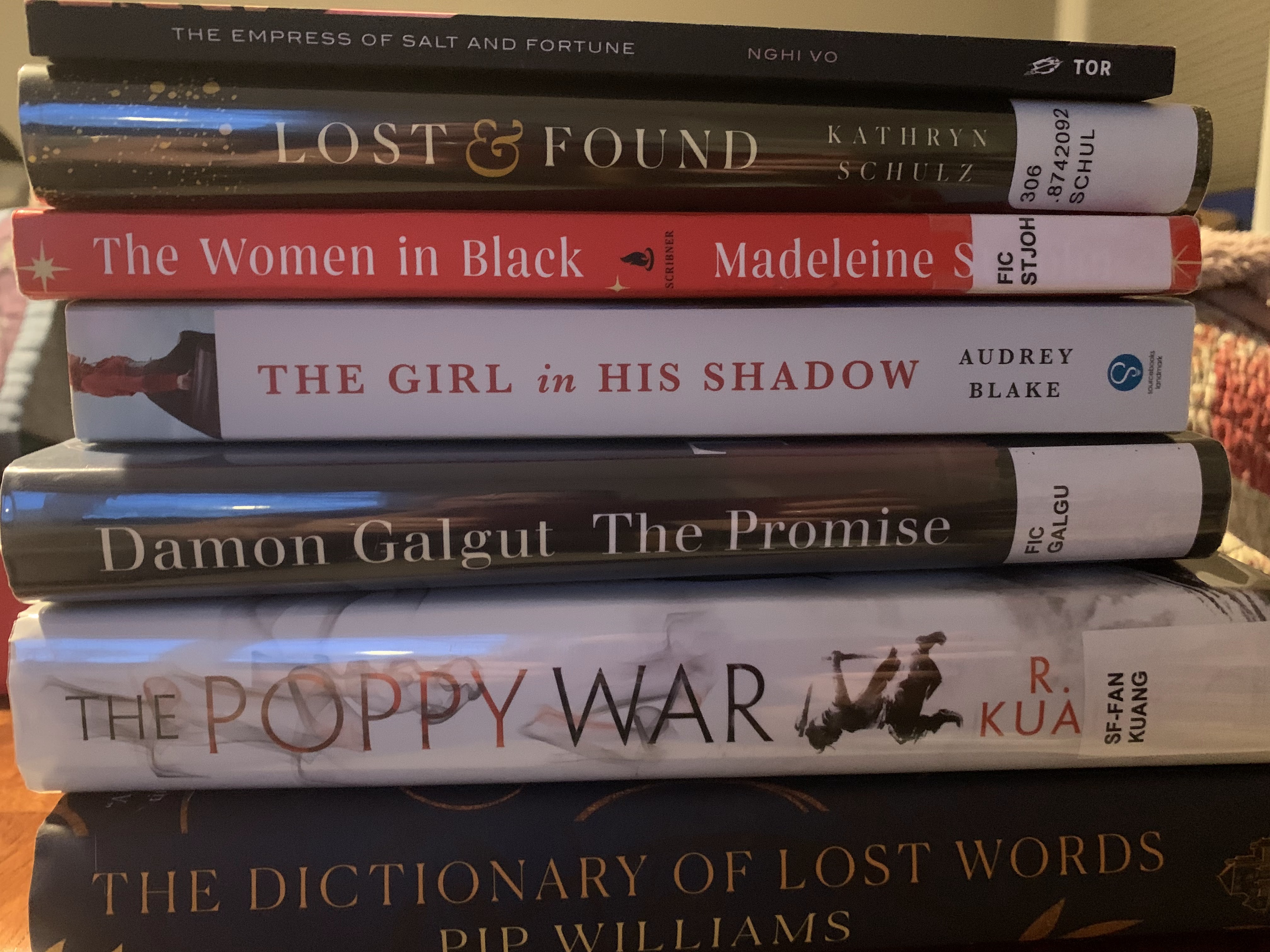
Letting the library decide on my next book has its downsides. For example, before March Break, two books came in from my holds list AND a friend loaned me two books. During March Break, I chose my reading poorly: the first book began so slowly that I took all week to finish it. Then, today, the first day after break, three more books came in. And now, I’m staring down this stack of books:
So many books, so little time
Which to choose? One came in remarkably early despite a *long* wait list – and I wasn’t near the top, so this is clearly luck. I won’t be able to renew it, so maybe start there? Or maybe start with the one that I checked out first since it’s due first? Or maybe buck the stifling due date system and read the one that is calling my name for no particular reason?
I have a feeling I know where I’ll go – but just in case I change my mind, I’ll probably need to keep these next to my bed. And then, if someone asks what I’m going to read next, I can pretend that I’m just working my way through the stack.
It was only the beginning of second period, but all of us were already over this day. Before classes had even started, a few teachers had received an email threatening a school shooting. The actual threat level seemed low, but just in case, the police had been called, the doors locked, a “shelter in place” instituted. Then, the internet went out. And it was Friday. We wondered if the universe was laughing at us: “Good luck at school today,” it snickered.
The grade 12 students were unimpressed. Someone had flicked off the lights as they entered the room – “Hope that’s ok, Miss” – and most people were slumped, exhausted, onto the tables. So much for any lessons I had planned. On the other hand, thanks to the power of routine, almost everyone had a book out.
“I have an idea. You read, I’ll plan something that makes some sort of sense.”
“I can set my watch for 15 minutes,” one student volunteered.
“Miss, can it be 20? Please? I mean, the internet is down and…”
I looked around the room. Heads were nodding. “20 it is,” I declared.
They read; I planned. Then I read, too. 20 minutes passed. C’s watch beeped. An impassioned “NO!” slipped out of a student as she turned a page. “I’m so close to the end of the chapter!”
“Me, too!” “Yes!” “Please, just a few more minutes…”
Of course I said yes. And we all read just a little bit more. And our Friday was just a little bit better. Not perfect, but better.
He’s stayed up too late, reading, for several nights, even though we’ve turned off his light and told him to go to sleep (he reads by the nightlight if the book is “so good I can’t help it”), so this was entirely his fault.
And yet… something was different this morning. When we sat on the couch to talk, he burrowed into my lap and cried. Today the world was too much for him. Tears rolled down his cheeks until he drifted off to sleep; I held him for as long as I could.
I woke him gently. I had to go to work. We struck a deal: go outside; play the math game; call at least one grandma. Grandmas understand.
And I let him stay home. Because even though we are trying to make things feel normal, we are still in the middle of a global pandemic and we are all tired. Some days it’s ok to crawl back into bed, stay home from school and call your grandma.
On Friday, we unboxed the books. Brand new, hardcover books.
“These are for us?” asked one boy, incredulous.
“Yes!” I laughed, “but you have to give them back.” He made a funny face and shook his head a little, dismissive of my excitement. Why would he keep a book?
“Can I use the stamp?”
“Can I choose the number for mine?”
“Yes!” I said yes over and over. Yes, these are for you. Yes, they are new. Yes, you can stamp them. Yes, you take them home.
“This book sure has won a lot of awards,” marveled a boy near the front.
“How’d you even get these, Miss?” asked another student, turning his brand new book over in his hands.
I laughed again, “I begged, borrowed and stole!”
His face got serious. “You didn’t steal, Miss. Don’t say that.”
I took it back. I should know better than to joke about stealing.
On Friday, we started reading Jason Reynolds’ novel in verse, Long Way Down. I had offered the class several options for reading – book clubs, individual choice, whole class – and they told me flat out that they would never read a book on their own. “No point in that,” muttered M.
We’ve been reading all semester, but always short pieces. In general, my students are a little wary of my ways, but they were willing to try poetry with me last month, so I knew we were making progress. Still, they were nervous about reading a book, like maybe I’d gone a bridge too far – a whole book. Some of them are enthusiastic readers, but many of them haven’t read a book for years. When I told them that I would NOT read the entire book out loud, one boy looked down at his desk, shook his head and made a loud “tsk” sound. “That is NOT gonna work.”
And then came Jason Reynolds. Actually, first came the discussion about a shooting death in the neighbourhood. I was shocked to learn that gun violence is a part of so many of my students’ lives, then I was surprised by my own shock. (That’s a reflection for another post altogether.) Then I got upset because I realized how little support these students were receiving for their reality (also a reflection for another time). I had a long talk with the (amazing) EA who works in my classroom who insisted, “That book you’ve been telling me about is the right book for this class.” And she issued a challenge: “If anyone can get them that book, it’s you.”
So I begged. I told the principal I would buy half with my own money. I talked about the awards, the subject matter, the poetry. I told him about our progress, the growth, the learning. I found other pots of money. Finally, I said, “I have to teach these kids this book right now. I just have to.” Hats off to my principal and our Student Success teacher: they bought the books.
That’s their handwriting – and page numbers!
On Thursday I gave the students photocopies of the first few pages. “AW! It’s more poetry,” groaned one kid. But they tried it. We used the same technique we used with Nikki Giovanni’s kidnap poem a few weeks ago: students wrote back to the text right on the paper. They asked questions, made comments and generally had their say. When we shared, they had made lots of inferences and had plenty of evidence to back them up.
Friday was the new books. After everyone had one, I explained that they could take a few minutes just to read. No set goal, no required number of pages, no plan – just read to see what’s there. My goal was 15 minutes. Boy did I underestimate them.
They would not stop reading. T looked up after ten minutes and said, “Can we read as far as we want?” I nodded, he gulped some air and dove back into the book. S turned around and said, “Did you get to the part where he took the gun yet?” H nodded and kept reading. Silence. No phones. No sleeping. Eventually, one student lost focus, and I decided to stop them before the magic spell broke: “Hey, let’s take a break and see what we’ve discovered so far.”
They took a break, talked about the book, started to do the activity… and then I noticed that one, two, three kids had snuck back to their books. Then another. I asked if they wanted to just go back to their seats and read. “YES!” So we did.
As class came to an end, I found two kids surreptitiously trying to slide the book into their backpack. “You’re allowed to take it home if you want,” I said.
“For real?!”
One book went right into the backpack, but T hesitated. Finally, he put it back, “I want to make it last a little longer, Miss.”
I have a feeling that, for some of them, this will last for a long time.