Here is where we grow

School doesn’t start for at least half an hour, but I’m already letting two students into my classroom because one of them thinks she left her vest here yesterday, and ninth graders often move in pairs. As I jiggle the key in the lock, a large figure lumbers up behind us.

 “Oh!” I smile, “I heard a rumour that you passed your Civics class!”

He lurches to a halt in the near-empty hallway and glares at me. My key finally turns, opening the door just as he leans forward and breathes, “I cheated on all my tests” – only he says “testes” and, their eyes wide, the girls practically tumble into the classroom. He shuffles away.

In the room, the lost vest is retrieved and then, in a significantly more graceful echo of what just happened, one child leans towards me and murmurs, “Why would he say that?”

My mind clicks backwards through the moment, and I realize what they think just happened. “He was embarrassed,” I reassure them, “because I gave him a compliment. Some people have a hard time being praised. He did not cheat on his tests.” I emphasize the word tests.

They nod, unconvinced, and head into the hallway just as he returns. They flee. He stops again and looks me up and down. “Do you still have that box?”

I know exactly what he’s talking about. “Oh, yes!” I feign distraction as I move to the front corner of the room. The box he wants is hidden under a desk. “I was just wondering if maybe I should get rid of it,”  I pause, “but if you really did pass Civics, I suppose you could get a prize.”

He squints his eyes. “Two.”

“Hmm…” I pretend to consider this. “Well, first I need to know if you cheated on any tests.”

He glances around, wary. No one is nearby. “No,” he admits, and I swear I see a bit of a blush on his cheeks, but I could be making that up.

For the next fifteen minutes, he rummages through my “Box of Terrible Prizes.” He holds up various items, considering. He tells me which things are still there from last year (hint: it’s most of them), and I remind him that they really are terrible prizes. Undeterred, he checks out tchotchkes and useless plastic toys. He asks more than once if I have anything that makes noise. I do not. He points out prizes that he brought in for trades. Eventually, I remind him that class will start soon, so he makes his choice. Two prizes. No noisemakers. Delighted, toys in hand, he shuffles out of the room, leaving me aglow.

******

Last year, when he was in grade 9, I taught him. Well, “taught” might be a bit of an exaggeration. Last year, we were in the same classroom and sometimes he kind of did English-y things. Often, he was rude to me and others. Sometimes he was very rude. By the end of the school year, even after he’d left my class, every time he saw me in the hallways, he sneered things like, “Oh. It’s you. I hate seeing you,” or “Seeing you makes my day awful.” I am embarrassed to admit that, eventually, I let this make me angry. 

Sure, I had read his school records and communicated with his middle school teachers, so I knew he needed a lot of time and stability to settle into a place. I knew his IEP and had read all his old report cards, but he drove me up a wall. I wasn’t alone; few teachers connected with him. I couldn’t imagine how his middle school teachers had been able to find what they confidently called his “sense of humour.” All I saw was an angry young man.

One thing about a school, though, is that it’s full of kids – and kids grow. And, whether we like it or not, we’re all sort of stuck there together for a few years while they do this. He is lucky to have a Resource room full of people who have kept an open mind about his growth. I will argue that I am luckier that he kept an open mind about me – or maybe he never quite realized that I was actually angry. And I’m lucky that those same colleagues have helped me see him more clearly, too. 

*****

This morning, I realize that I get his humour now: I laugh as he moans and groans about the quality of my terrible prizes; I snicker when he tells me that I need more, and that I’m clearly not giving out enough prizes – maybe this year’s grade nines aren’t as good as he was. I fake exasperation when he lingers as my 12th graders come in, and he scowls when I make him leave, but he’s here. He’s still here. And here is where we grow.

Just 15 minutes

Once again, I forgot it was Tuesday. This is odd because yesterday I knew that today was Tuesday, and, frankly, today I knew it, too. I had planned to write something last night, but then I didn’t because… I can’t remember, but there was a very good reason. This morning I even set aside some writing time, but then the supplies we ordered came in, so I had to check what we received against what we ordered (vaguely similar) and distribute them to various teachers, then I had to set up a new booking system so that we can get the 95ish Chromebooks distributed fairly to the 30ish teachers who want them for various classes (no, the math doesn’t math there). Anyway, one thing led to another and then it was after work and now it’s 8:45 and I haven’t written my Slice of Life.

Recently, when I’ve found myself in this position, I’ve thrown up my hands and decided to put things off until “next week,” but this week my students have essays due, and I have this nagging sense that if they have to write and publish then I should probably write and publish. So here I am.

Part of the reason I lost track of time (and the day of the week – I even missed my knitting group!) is because I’ve been trying to figure out what to do with about 15 minutes of class time tomorrow. The original plan was for the grade 12 students to share their This I Believe essays in a sort of “desk exhibit” – they were going to walk around and read each other’s essays & leave positive comments on post-it notes. BUT… today’s lesson involved a peer feedback protocol that worked so well that quite a few students have some serious edits to make. Given our lack of Chromebooks combined with student jobs and after-school commitments, tomorrow needs to involve a little time to tidy up their writing in class, so the gallery walk will happen on Thursday. They do not, however, need 75 minutes (the length of our classes) to edit, or even 60 minutes (after 15 minutes of daily reading), or even 45 minutes. I figure we need a maximum of 30 minutes of editing time. This means that I need to create a tiny lesson – just 15 minutes – to bridge us from reading and writing narrative arguments to learning about rhetorical analysis and using that with popular culture.

Here is where being a teacher gets weird: I know what we’ve done, and I know where I want us to go; I also know the information I need to share, and I know the students. This lesson should be simple – just, you know, teach. Instead, I’ve spent at least an hour looking at videos and slide shows, thinking about the right way to present the topic so that students are interested and engaged. I need something that intrigues students and is memorable. This will be the first peek at something that we won’t really start until Monday (because essays, PD day, the weekend…) I want this to hook some specific students. I want them to have something to think about. Come Monday, I want them curious.

So do I read them a picture book by Jacqueline Woodson? Do I show them a video about a soccer team in Thailand – one that turns out to be an ad? Or maybe I show a brief interview with Simon Sinek about the power of stories? What stories matter? Why do we care? Who is telling these stories? To whom? For what purpose? Thomas King says, “The truth about stories is that that’s all we are” – I need a fifteen-minute something to start them down the path to believing that. 

I bet I can find it if I think about it for just a few more minutes…

Why read?

It’s the second week of classes, and we’re all slowly settling in to the familiar rhythms of school. In grade 12 English, we’re already reading our second short mentor text for our narrative argument unit. (This is a new unit for me; I wanted something a little different from the personal essay, and here we are.) Today we read a This I Believe essay called “The Power of Hello” by Howard White. I didn’t know who White was (former basketball player, VP at Nike) until I read this, but I loved his message “that every single person deserves to be acknowledged, however small or simple the greeting” so his was an easy essay to choose as a mentor text for the class.

Before we got to the text, however, I paused to ask the students why they think we are still teaching reading and writing in an age of AI. Reading was the easier sell. If you google “Why is reading important?” – which I do every semester – there are pages and pages of hits. I like to summarize them by saying, “Reading makes us smarter, kinder, richer and a better date.” (The better date is because reading can improve conversational skills – who knew? Well, I mean, besides me and the internet.) Lots of students nodded their heads and sort of looked like they agreed, and for today that was enough. We’ll come back to this when they need to remember why I’m pushing for a high volume of reading.

Writing, on the other hand, seemed less important to many students. While one student straight out said, “writing is thinking” plenty of students looked less than convinced. And I get it – though I disagree. Words work for me; for others, this is less true. When I try to sketch something, I am often significantly less successful at communicating. If I needed to show my thinking through movement, I would, I suspect, often fail. Too often, students have only ever written for a grade. I can’t fix that, but I can try to help them understand that words have power that they can harness with practice. I’ve got a whole semester to make my case.

Because of this brief class discussion, reading and writing were on my mind when I saw a woman with a stroller stopped on the sidewalk ahead of me. I wasn’t actively thinking about Howard White’s essay and the power of saying hello, but his words must have been somewhere in the back of my mind because I very consciously registered the scene: a young woman with a baby strapped to her front and a toddler between her legs, hanging off the stroller. She was stopped awkwardly in the middle of the sidewalk, and the toddler was twisting and turning just enough that I knew she wasn’t watching him. I said hello.

“Hi. Um, there’s something in my eye,” she said. “A bug flew in there. I can’t really see.”

In fact, her eye was watering. The baby wasn’t just in a carrier, they were nursing, and the toddler was close to tipping the stroller over. The mother looked just a tiny bit frantic.

“I could look at your eye…?” My voice trailed off into a question. It’s an oddly intimate offer – here, stranger, let me look at your eyeball – but she took me up on it immediately.

I didn’t see a bug, and now her eye was watering with tears? irritation from the bug? “I can really feel it. Can you look again?”

And there it was! A tiny black spot. I reached toward her face and swiped the critter to the edge of her eyelid; she did the rest. “Oh, thank God. Thank you. Thank you so much for stopping.”

I told her, of course, that it was nothing – because it was. Just one mom helping another on the sidewalk at the end of the day. Just a tiny interaction between two people who happened to cross paths. She won’t remember it by tomorrow morning; she may be so tired that she has already forgotten.

But I wonder… would I have noticed her if we hadn’t read that essay in class? Maybe White’s belief that everyone deserves to be acknowledged primed me to actually see her. Maybe the fact that he wrote his small story and shared it helped one human reach out to help another. Maybe now that I’m writing this, I will remember to do this again. Maybe you will read this and you, too, will help someone. Maybe this will happen even if you forget that you read this. 

This, I believe, is why we write and why we read. I think I’ll share it with my students.

It’s kind of a funny story

Commenting on student work, 2024 edition
Me, to a student who obviously used AI: please use your own words.
Student: what says this isn’t in my own words??
Me: I expect students to write in the doc I provide. I am automatically worried when I see a large chunk of work pasted in.
Student: I wrote it on paper before I pasted it onto the computer. If I find the paper will that help??

Um… that’s not how paper works.

That’s how I shared the story with friends. It’s all true, and dear Heaven, but this generation of kids…

But it’s also not the end.

Today, the last day of school, the student came to class. They finished up some work and, at the end of class, hung back at my request. We both wanted to see if all their missing work had been submitted, and I wanted to talk about that pasted-from-paper document. The student had resubmitted it, this time with a photograph of a handwritten document – the paper they supposedly wrote before they (magically) pasted it into the doc.

It was already hot – today’s high was 32C/ 90F and felt like 43C/ 109F – and the end of school was on everyone’s mind. I know I had to muster up all the calm I could find; I assume the student had to do the same. I opened the assignment. I showed the student how I could see the copy/ paste. I showed them the AI detector and the 100% AI result. I acknowledged that I could see the handwritten document, but shared my concern that the assignment didn’t fit the instructions. Then, as patiently as I could, I said, “I can see that you’re upset. Tell me what happened. I’m listening.”

Then I listened.

And it turned out that I was wrong. They walked me through their work and showed me their thinking. They hadn’t used AI to generate the text, but they had typed it up in Grammarly (because when you’re learning English a good grammar program goes a long way) so some of the words were not quite theirs. And they had followed the instructions, sort of, they just hadn’t organized properly to separate parts. And they were shocked that I could see the copy/ paste and a little hurt that I thought they might have “cheated.”

So we talked about cheating and about getting behind in our work and the shortcuts we sometimes take. We talked about the pressure of finishing all that late work and about talking to teachers rather than hiding. Then I thanked him for talking to me and shooed him off to catch up with his friends. The whole thing probably took three minutes, maybe two.

It’s not as good a story as the one where a student says “I wrote it on paper before I pasted it onto the computer” and the teacher thinks, “Um… that’s not how paper works”  but the real part of teaching, I think, is the part after the funny part – the part where we listen – and I wanted to write that, too.

Sort of tutoring

“Miss, are we done with that thing?”

He’s caught me in the hallway between classes. I hesitate, not quite sure what to say. He bulldozes ahead, “You should come get me from class today, like maybe thirty minutes in.”

Ah-ha! He wants to continue our reading comprehension sessions. Or rather, he wants to get out of his science class for twenty minutes.

“I kind of figured you should stay in class and work on your summative project,” I say. 

“Nah,” he scoffs, “I don’t understand any of it. I’m just making stuff up.”

I relent. “Fine. I’ll see what I can do.” 

So, about thirty minutes into his Science class, I pull him out.

The project is pretty cool, if you ask me, which he didn’t. They are supposed to be creating their own habitable planet and an alien race that lives there plus some other stuff, but I don’t get a good look at the project because he’s already asking a question.

“Is there a difference between mass and density?”

I tell him to look it up.

“But if you know, why don’t you just tell me?”

I just give him a look. He asks again, gets sidetracked for a minute, and then circles back to ask one more time. Silently, I take his computer and type in “Is there a difference between mass and density”. I turn the screen back to him so he can see the bazillions of responses.

“There is! I thought so! Why didn’t you just tell me?”

I ask him what the difference is. He tells me it doesn’t matter. I refrain from making a joke about matter.

Now he wants to know why the mass of the planets is listed as x1024 and how do you type up high like that? And also what’s a good temperature? Like, you know, a neutral temperature. And why does he have to use Celsius when he’s sort of used to Fahrenheit and actually he’s not really very good with either so is 16 cold? 

I ask him if he’s talking Fahrenheit or Celsius. “Either,” he says, “I just want to know if it’s cold.”

Every time he asks a question, I help him look it up. Every time a webpage comes up, he groans and says he doesn’t want to read “all that.”

“Miss, I just want to put down easy stuff and be done,” he tells me. “Can’t you just tell me the answers?”

I tell him that if he just wanted the answers, he wouldn’t have asked me for help. He disagrees. So I don’t tell him about distance from the sun, and I make him look up if a planet can have long days and short nights and whether or not it can always be Fall. He argues with me every step of the way, right up until he tells me class is almost over and he needs to go get his stuff. 

“Fine,” I say, trying to keep the frustration out of my voice. “Do you want more help tomorrow?”

Not like you helped him today, says a little voice inside my head. I mean, we fought for many minutes about whether or not he needed to know what axial tilt is. (He does, but he refused to read the information.) Classes end in one week. We are all exhausted and ready to be done.

“Yeah,” he says, “if you have time you can come back. I like it when you help me.”

So tomorrow I will once again sit with him and refuse to either answer his questions or allow him to barge forward without thinking. I will bite my tongue, and he will be frustrated with me, but apparently we’re both good with that. 

One more week.

Writing beside him

I’m helping a former student write a personal essay for his Grade 11 English class. We’ve talked it through, and planned a little; his next step is to write it. Reading and writing aren’t his forte – he’d much rather be on a playing field than in any classroom – but this story is important to him, and he wants to get it down on paper. So here we are, sitting in the upstairs lobby – currently one of the coolest places in our very hot school – and he’s writing.

This kid has my heart, as many of them do. Last year, he didn’t do particularly well in our first semester English class, so he agreed to change his timetable in order to be part of a reading class with me during the second. That alone took some courage: not everyone who needed the support was willing to accept it. Once there, he mostly tried, even when the work was repetitive or “not that interesting,” even when he took extra long body breaks or got frustrated by the “simple” books he was reading.

Knowing that history, I’m intrigued by his choice to sit with me in such a public place this afternoon. With only two weeks left in the school year, students are out of classes nearly as much as they are in, and many of them wander aimlessly through the halls. Several have stopped to greet us; pretty much all of them give us at least a passing look as we sit here at a student table and work. There’s no hiding that we’re writing together, no hiding that I’m helping.

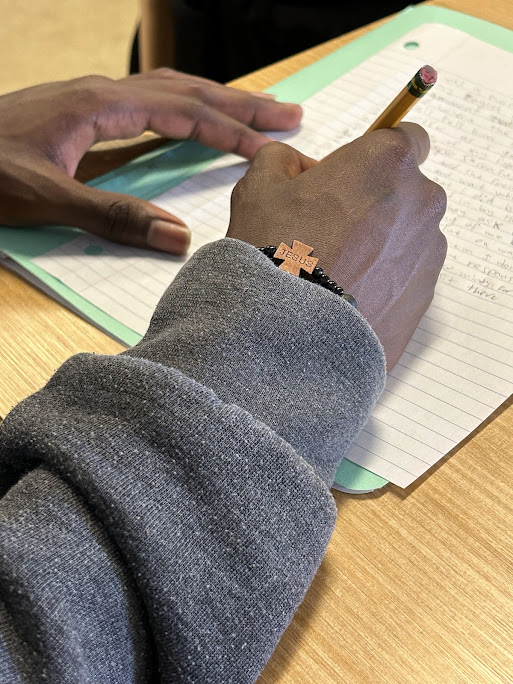
Nevertheless, he’s nearly filled a page with his small, neat handwriting – a feat which would have been unfathomable last year – and his focus hasn’t wavered, though he has had to stop a few times to flex his tired hand. Meanwhile, I sit here typing my own story, this story, marveling at this moment of quiet togetherness amidst myriad other students. We are here, the two of us, writing; we are here, the two of us, writers. 

This sense of camaraderie has me thinking about what we mean when we say that teachers need to “get to know their students.” How well do I know him? I didn’t spend a lot of time last year asking him about his family, though I did call home when I needed to. I have no idea if he has pets, and am not clear about how many siblings he has. In fact, I don’t know many things about him, but I know enough that I can tell him, honestly, that I believe in him. I never told him he was a strong reader or writer; I did tell him that I thought he could be. I never told him this path would be easy – heck, I was clear that parts would be hard – but I did tell him that I thought it was worth it. Other teachers and coaches told him the same thing, complimenting him when he improved, noticing when he was reading, harrying him back to class when he was in the hallways. When he faltered, he had a team of people to remind him of his long-term goals.

Today, he has a story to tell, and he has found me. He says he needs help, but I think he just needs someone who believes in him to write beside him. What a privilege! I can do that any time.

Again

The assignment was due March 5. Today is April 2. So far, only six students have received grades. Why? Because only six have fulfilled *all* the requirements, and I’m refusing to mark assignments that aren’t complete.

Before you get worried, I don’t think I’m overly demanding. The basic assignment is to write a 100-word memoir. A complete assignment has a title and a story that is exactly 100 words. Students must use a spelling/grammar-check (I’ve recommended LanguageTool, but some use Grammarly)  so that no underlined problems remain, and they must label three “craft moves” – or good things in their writing. For the last part, a poster in the classroom lists things we’ve studied and they’ve seen multiple examples.

Some students have only been through one round, but most are on their third or fourth attempt. In years past, I’ve marked what came in, no matter how incomplete. But this semester, something changed. I decided that every single student was capable of following all four steps:

  1. Title
  2. 100 words
  3. Spell check
  4. Label

What is different? I wish I knew. The closest I can come to explaining is that I am taking my role as a “warm demander” increasingly seriously. To the very tips of my toes, I believe that every student in my class is capable of completing the assignment. Even more, I believe that they are capable of completing it well. So I keep returning the assignments with plenty of feedback (“I really appreciate how you’ve opened this fun memoir. Next you need to give it a title and run it through LanguageTool.”) and insisting they do it again. This weekend, one student turned in the identical assignment three times. Last night I caved and wrote in all caps, “USE THE FEEDBACK.” Today, they finally asked for the explanation they required to finish their work. 

I’m not sure that I’m making the right choice, and I need to be clear that I am consistently upbeat and encouraging as I hand back the assignments (again and again with no mark), but I figure if they learn nothing else this semester besides “follow all the steps” that’s probably a reasonable life skill. 

Now, off to write, again, “True compliment about the writing. Next, you need to give your good work a title and run it through LanguageTool.” I’m betting I can get 24 completed assignments by the end of next week because I’m pretty sure I’m more stubborn than they are – at least about getting this right.

This afternoon, a partial transcript #SOL24 27/31

PA system: “We are in a secure school. Please clear the hallways and lock your doors. I repeat, we are in a secure school.”

Email: “If you see [student name] please contact me in the main office right away.”

Email: “Photo”

25 minutes pass

PA system: “We are still in a secure school. Please remain in your classrooms when the bell sounds.”

50 minutes pass

PA system: “The secure school has ended.”

Email: “We will be having a stand up meeting at 3:35 in the auditorium.”

Person: “First, I want to say that under a difficult circumstance, we got to the best possible outcome because so many people came together to do the right things. Even the students in question cooperated with the police.”

Person: “Police entered the classroom and made an arrest. Afterward, social workers were available for students in the classroom.”

Person: “The police recovered a replica gun and a knife from the student.”

Person: “The police also recovered a knife and a replica gun from a second student.”

Person: “The students involved will not be returning to school.”

Person: “Ever?”

Person: “Well, I don’t want to tell you something that might not be true, but they will not return any time soon.”

Person: “An email will be sent home to parents.”

Person: “Social workers will be available at the school tomorrow.”

Email: “Thanks again for all that you did today in support of students and colleagues.”

High school in March, by the numbers #SOL24 22/31

(After Harper’s Index)

Number of pencils borrowed by grade 9 students during period 2 today: 4

Number of pencils returned: 1

Number of pencils lost while students moved between desks, ≈6 feet apart: 2

Number of days in school so far: 11 

Number of fire alarms pulled: 1

Temperature on the day of the pulled alarm: 2C (35F)

Highest temperature in March: 17C (63F)

Date of highest temperature: March 5

Lowest temperature in March: -14C (7F)

Date of lowest temperature: March 22 (yeah, that’s today)

Number of hours set aside for parent-teacher interviews last night: 4

Timing of these interviews: 3:30pm –7:30pm

Number of minutes planned for each interview: 10

Number of parents who requested an interview with me: 3

Number of their students I am concerned about: 0

Number of people at Iftar dinner after parent-teacher interviews last night: ≈150

Number of those who were teachers: ≈20

Number of hours I slept last night: 6.5

Number of hours of sleep I really need: 8

Reason for the missing hours: finished Tom Lake; a cat sat on me until I woke

Number of five-day weeks left in March: 0

Chances we will cram five days of drama into four days of school next week: 98%

Number of days left in the March Slice of Life Challenge: 9

Chances that I will manage to write every day until the end: 100%

Runaway #SOL24 20/31

He rarely comes to class, but when he does, we do what we can to make sure he has at least a little success. He’s in grade 9 and is currently illiterate in three languages. Research says that students with strong reading skills in their home languages often also have strong reading skills in their second language (see Short & Fitzsimmons, 2007 or this shorter article by Fred Genesee), but he doesn’t have strong reading skills anywhere. We can’t turn back time, but we’re doing what we can to move forward.

He’s lucky because this class has a push-in support teacher. She’s technically there for other students, but no rule says that she can only help them, so we’re using what wiggle room we have to create as much space for him as possible. When we were writing 100-word memoirs, she just happened to be sitting near him and just happened to be able to scribe for him. As I circulated, their heads were close together in front of the computer, counting words. When he realized he had written a story of exactly 100 words, he was so proud that he asked her to read it to him again. He beamed. Then he skipped for three days.

Then next time he made it to class during reading time, I sat with him and quietly talked through The Invention of Hugo Cabret, which he likes because it’s thick and he says it makes him look smart, while Ms H kept an eye on the other readers. Even the pictures were hard for him to understand, but he liked talking about them. Then he refused to do anything else.

Sometimes, he comes to class (late) and then asks to get water or go to the bathroom. I put him off as long as I can, but I am not the arbiter of his bodily functions; when he says, “Miss, I really have to go,” I let him. Sometimes he comes right back, but sometimes he runs. Two days ago, he swore he would only be gone for two minutes, then he took the hall pass and disappeared. I found him in the lobby later that day, skipping a different class. While we walked to where he was supposed to be, he told me that he had thrown up that morning, so he couldn’t return to my class. Given that he was practically bouncing up and down with energy as we edged towards his class, I reminded him that usually someone who throws up goes home, but he said he called home and his mother said no. Ahem. I found him in the hallways again that period and once the next period. He told me he just can’t stay in class.

Yesterday, Ms H had a breakthrough. She saw him (in the hallway, of course) and made some sort of deal/ bet with him – and then he actually showed up to English class a mere 10 minutes late (thus missing most of reading time). Meanwhile, she had hatched a plan. She took him to a quiet room – but not the resource room; he refuses to go there – and she started a phonics assessment with him. She praised him for what he could do and talked about ways we could help. She told him she could start with what he can do instead of expecting him to be able to do impossible things. He was eager.

Ms H was excited that we’d found a way to start giving him some real support. That afternoon we talked through her plan. But this morning, he saw her in the hall during first period, turned around and went the other way. Then, he saw her at the beginning of our class. This time he ran away. Ran.

We stayed after class together, Ms H and I, trying to figure out how to help him accept our offers of support. We reminded ourselves that years of failing in school, years of hiding his weaknesses, mean that he probably thinks he’s beyond redemption. He may be afraid that he’ll just fail again and disappoint us in the process. We walked into the hallway partway through lunch, and there he was, right by our English classroom. Gotcha! Gently, we reminded him of his (broken) promise. I told him that it hurt Ms H’s feelings when he didn’t come. She told him that she had been really excited to see him today. He shifted his weight back and forth, back and forth. When we finished – maybe a 30 second “chat” – he said, “OK” and then… he ran.

Sweet runaway boy, how I hope you’ll let us try to help you read. Reading will make a bigger difference than you can imagine. It’s worth sticking around for.