Hey, Siri #SOL22 18/31

(This memory came to me after reading Stacey’s slice about her son and Siri.)

He is maybe three when he discovers that the phone will converse with him. “Hey, Siri!” he says, and she always responds. Within minutes, they are best friends. She will answer any question, entertain any flight of fancy. “Would you like me to call you Alien?” she asks, and I swear her electronic voice sounds dubious. “Yes!” he agrees enthusiastically, so she does. (For years, my phone will continue to call my husband “Alien” because I can’t bring myself to change it.)

Phone in hand, Eric wanders away, chatting enthusiastically with the only one who is paying him any attention at all. We adults are in the other room, reminiscing about old times. The older kids are running about, screeching. The house is full: at least one dog, a cat, siblings, aunts, uncles, friends, grandparents. And it’s noisy – so noisy that no one really hears a three-year-old having a chat with his new electronic best friend. In fact, none of us really even know where he is until we decide to go out on the pontoon boat. “Have you seen Eric?” we ask. No. No. No. No one knows where he is.

Andre heads towards the back of the house, searching. As he passes through the living room, he hears an argument behind the couch. It sounds as though Siri is telling Eric he is being unreasonable. Just as Andre starts to chuckle, Siri stops playing around: “Ok,” she says, still with that dubious tone, “Dialing Emergency in three… two… one…” Andre lunges for the phone, but Siri is already dialing, and Andre manages to hang up just as the call goes through.

Disaster averted, Andre begins to talk to Eric when the phone rings. It’s the emergency operator who informs this flustered father holding an unhappy toddler that she is supposed to send help to the address of the phone call if the call is terminated. Andre explains. He explains about Siri, about the crowd, the noise, the child. It’s early days with Siri, but the operator understands. She does not send an emergency vehicle. We scoop Eric up, change him into a swim diaper and whisk him away to the boat. He barely notices that his friend is gone.

To this day, Siri is disabled on my phone.

Magic Elixir #SOL22 17/31

I sneak quietly down the carpeted stairs into the basement and open the door to the bathroom. Creak. I freeze for a breath, then carefully close the door. Creak. I wince. I’m trying not to wake my eleven year old who is sleeping in the room next door. It doesn’t work: his tired face peers at me mere moments later.

“Hi, Mom,” he mumbles. “What time is it?”
Late. “Go back to sleep,” I murmur. “It’s just me.”
“I know.” He pauses. “But that door is so creepy.”
“Creaky?”
“No, creepy. It sounds like a haunted house. We need WD-40.”
“Remind me tomorrow,” I say as I take him back to his bedroom, tuck him back under his sheets and kiss his forehead.

In the morning, I find the tool chest in the corner of the pantry, then sift through hammers and pliers, twine and tape until the distinctive blue bottle appears.

Downstairs, I spray the door hinges and carefully wipe away the excess. When I test the door, it closes noiselessly. I feel the brief shimmer of domestic victory and catch the edge of a thought: armed with her magic elixir, Mom slays nightmares.

If only I could so easily vanquish other problems.

Oh, my love, my sleepless child, I’m not yet ready to tell you how much of our world is held together with duct tape and dental floss, WD-40 and willpower. You’ll know; you’ll know. For tonight, at least, let’s pretend that WD-40 will always keep the monsters away.

Delete #SOL22 16/22


A musical response to several hours of inbox tidying.
(to the tune of “The Twelve Days of Christmas”)

🎶🎶🎶🎶🎶🎶🎶🎶🎶
One the third day of March Break, my inbox called to me, “It’s time to delete some emails.’
12 million subscriptions
All kinds of updates
Old invitations
Attempts to sell things
Lots of premade lessons
Daily news roundups
Offers of translation

🎶 Messages I’ll never return 🎶

Articles about teaching
Missed webinars
Well-intentioned sharing
And hundreds of unread emails.

🎶🎶🎶🎶🎶🎶🎶🎶🎶

I’ve spent several hours on this project (hours which I could have spent more productively elsewhere, but whatever), and I feel a wonderful sense of lightness. I’ve read a few good articles and gotten past the melancholy of blog posts I’ve missed. I’ve cleaned up three – THREE – email accounts. One will be at zero when I finish commenting on today’s blogs; one is at two; and one we won’t discuss. Just perfect for a rainy day in the middle of March Break.

Alone #SOL22 15/31

“Now I am alone.”
Hamlet 2.2.1

I did not sleep well last night. My brain got all wound up and decided that it was a great time to plan a new unit or two, and my body decided that it was foolish to try to relax when we were just going to wake up sometime anyway. So this morning when everyone else was heading off on another adventure, I begged off.

I come from an all-for-one one-for-all kind of family, so staying behind was really hard. I felt terribly guilty – I kept saying, “I really want to go. It sounds like fun” – and my father, who has organized more outings that we can possibly squeeze into a week, dreamed up multiple ways to include me: “You could nap in the car” and “We can try to come back early.” Luckily, as I brushed my teeth, nearly resigned to joining in, my darling partner reminded me that I am allowed to want quiet. So here I am, alone.

When Hamlet declares “Now I am alone” the players have just left, the stage is empty, and he’s about to give his “O what a rogue” soliloquy in which, among other things, he spends a lot of time wondering what he should do. No one has murdered my father and married my mother (thank goodness!), so my “what next?” is considerably less pressing; I have spent the last hour or so letting go of my lingering guilt about staying home and wondering what on earth I should do.

I am a parent and a teacher during the time of Covid: I am rarely alone for any length of time. In fact, I cannot remember the last time that I was so thoroughly alone – it’s just me, the cat and the dog, and no one is going to interrupt for hours and hours. I’m not in my own house, so no one will call and my internal list of things that I “should” do is shockingly short. Despite that, I’ve needed about an hour of simply sitting to let go.

Now, I am alone. I’ve made a second pot of tea. I am listening to the clock tick and the birds call. Here in this quiet, in this moment of inaction, in a moment I chose for myself, my body is beginning to relax, my mind is starting to unspool. Now I am alone, to fill my time as I wish. Tonight, the players will return and I will be an enthusiastic, even participatory, audience when the stage is full and action inevitable. But for now, I am alone.

Vacation? #SOL22 14/22

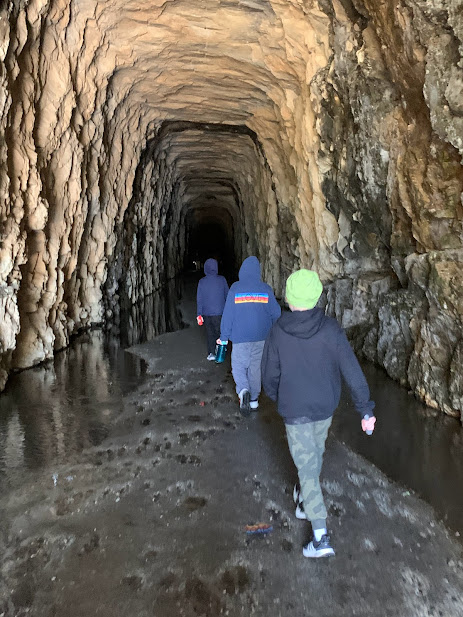
Describe your ideal vacation. Does it involve going into a dark, wet, hand-carved, dead-end tunnel with a group of energetic pre-teen boys? If so, today would have been your day.

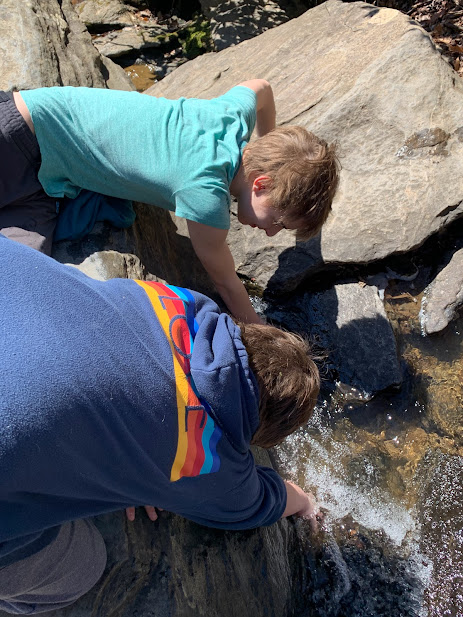
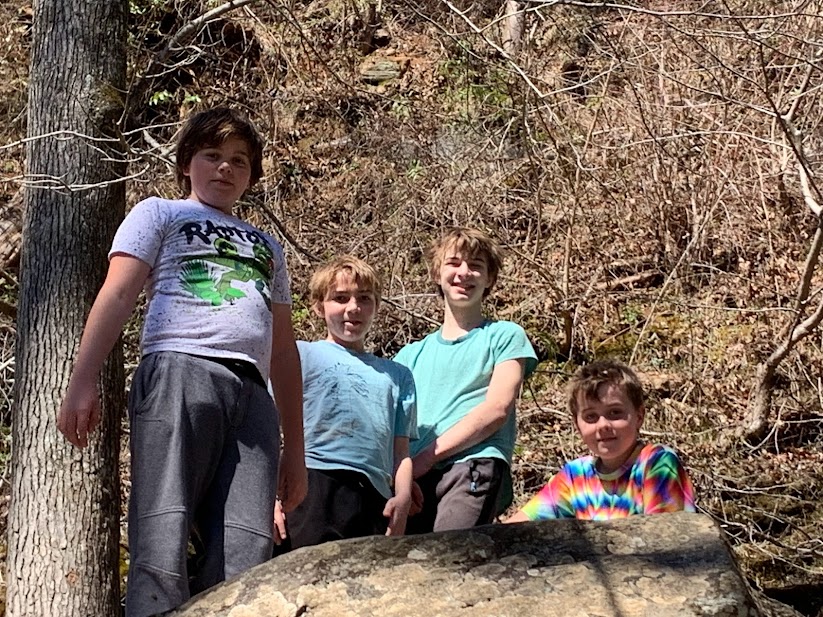
The last time my children and my nephews were together was July 2019, pre-pandemic. Their reunion during this week of March Break has been, well, loud. In two short days (and today isn’t even nearly over), they have done a “Polar Bear” dip in the lake (54F/12C) – then done it again because their aunt offered them $25 if they do it five times for five minutes and they love money, met their (adorable) baby cousin, convinced their grandfather to take them tubing even if the water is ridiculously cold, gone to (distanced) church, played Dungeons and Dragons (with my partner as their patient Dungeon Master), talked about D&D until we forced them to stop, exhausted their grandparents’ dog (who did not know this much non-stop action was possible), watched 40 gazillion episodes of The Simpsons, and gone on an adventure to Stumphouse Tunnel.

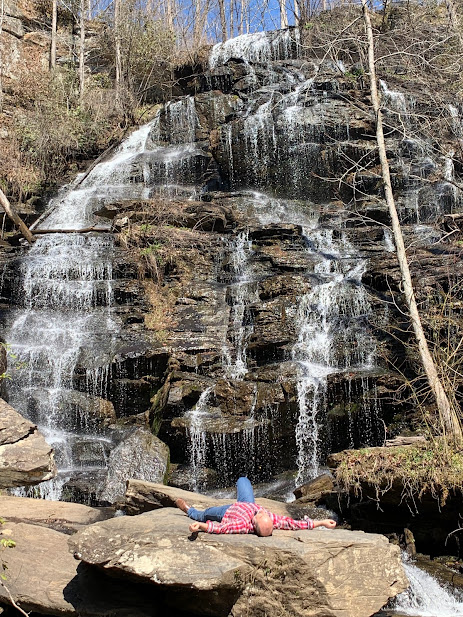
The Stumphouse Tunnel was carved into a mountain in the middle of nowhere South Carolina before the Civil War – apparently as a potential train tunnel. I would be able to tell you more about it, but we didn’t have time to stop and read the signs. We *did* have time to go to the end of the tunnel, climb over top of the tunnel to the peak of the “mountain,” have a picnic, and then go off-trail and clamber down the nearby Issaqueena Falls. The day was gloriously sunny and warm (at least for those of us from Ottawa).

After a few hours of climbing outdoors the kids were almost worn out – but not quite. They contemplated Laser Tag but opted to come home. We’ve played the family version of Cards Against Humanity and some of the adults (ahem – me) took a nap, but there’s still spaghetti pie to make (it’s pi day) and apple pie to eat and at least one movie to watch.

I’m exhausted and as happy as I’ve been for a while: writing on a couch with a cat curled up next to me, listening to boys laughing in the next room, to one boy and his grandfather cooking, to my partner and my stepmother deep in conversation.

Happiness sneaks up on us, doesn’t it? Even when your vacation day involves hiking in a cold, wet tunnel.

Make Writing #SOL22 13/31

I suspect that I found Angela Stockman through my knitting and reading (and all around awesome) friend Lisa Noble, though I honestly can no longer remember. I’ve lurked around Angela for a while – reading her emails, checking out her free units. Not only is she incredibly generous and thoughtful, her specific thinking and doing around writing intrigues me to no end.

Lately, I’ve been reading her work on using “loose parts” to teach writing. I find it fascinating, but each time I think about using it in the classroom I balk: I’m just not very spatial, I tell myself; I haven’t tried this myself, I worry, how will I explain it?

Angela writes, “Offer writers a variety of loose parts to build their ideas, responses, and drafts with.” In this phrase alone, I see all the reasons that loose parts fit with my writing pedagogy: play, multimedia thinking, draft, response… still, I couldn’t do it. Once I almost brought in a tray of thingamambobs, but then I didn’t.

On Friday, a student asked to conference with me about her personal narrative. She knew what she wanted to say, but she couldn’t figure out how to tell the story. She could articulate that the beginning was too long, “too much exposition”, but how could she tell the story without the background? She was stumped.

As we brainstormed, I found myself wanting to take scissors to her work – to physically move pieces around and see what might work where, but of course the writing was on the computer and somehow we couldn’t quite *play* with it. Play – PLAY! Of course!

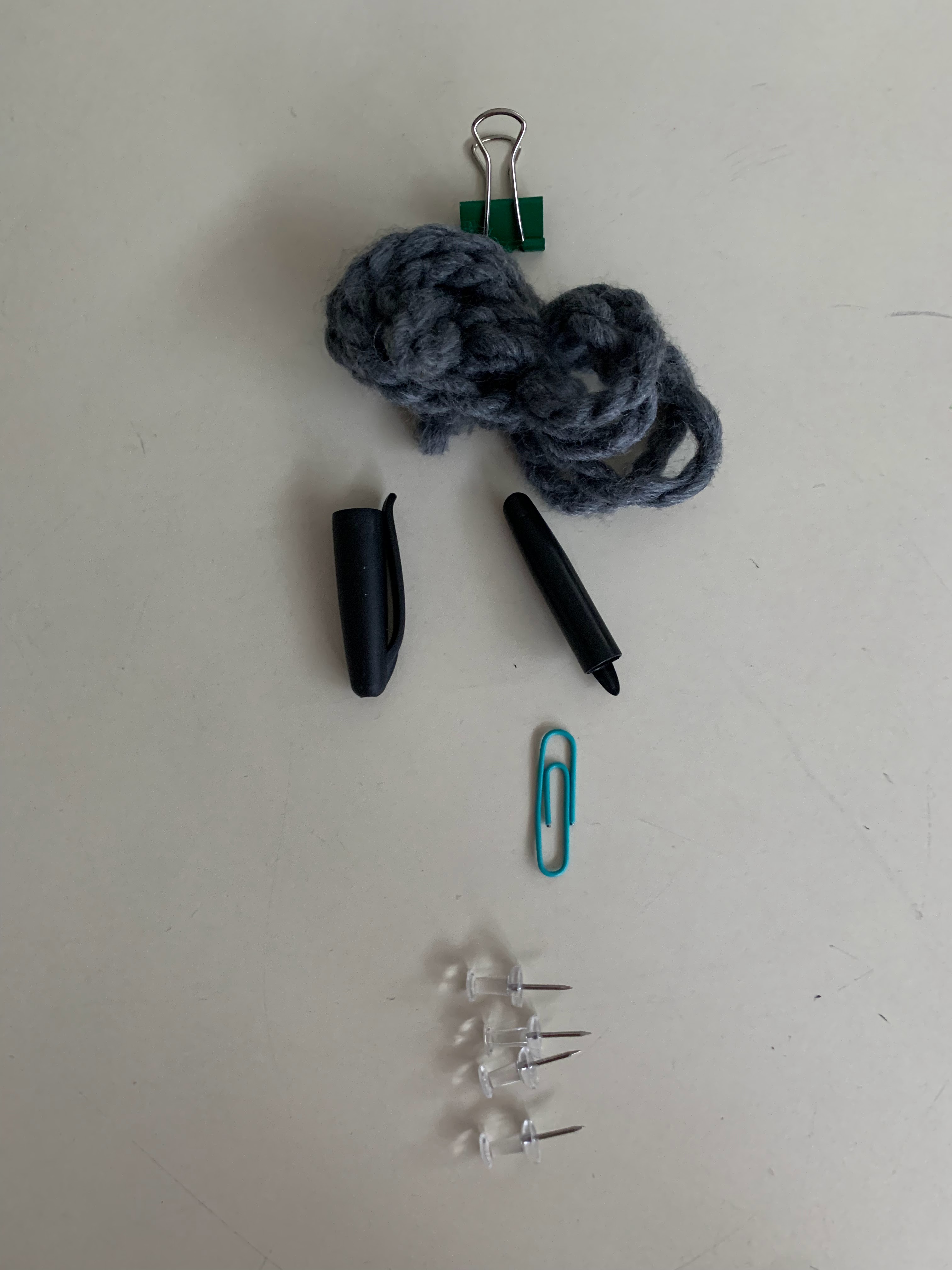
I reached over to my desk and found some loose parts – a few pen caps, some paper clips; some random yarn (I have no idea – don’t ask) and a box of tacks. I plunked them down on the table where we were working. “Ok,” I said, “bear with me. What if these three pen caps were the aunties…”

We named parts, moved them, played around, and she ended up with this structure:

The final essay structure, minus a pen cap.

“This is great!” she said. “I can see exactly how to do it!”

I could, too, so I snapped a photo as the bell rang and thought, loose parts play. Got it.

Next step: figure out how to incorporate this on purpose. I have a feeling I won’t have much trouble with this now.

Many thanks to Angela Stockman, who doesn’t even know me, but who nevertheless just made my teaching better than it was before. Amazing. (And thanks to Lisa, too, for her neverending encouragement.)

Restaurants, masks & sausage biscuits #SOL22 12/31

Mr. 11 peered uncertainly through the windows, “I think about half of them are wearing masks, maybe a third. I’m taking mine just in case.” He stuffed his mask into his pocket as we got out of the car. The rest of us followed suit, but I doubted we would have a chance to put them on, and I was pretty sure no one was wearing a mask.

As we neared the front doors, another family was leaving. One child had a mask under her chin. “See?” he whispered. “She has one.”

I nodded grimly.

Then I opened the door and took the kids into a restaurant for the first time since the pandemic began. In the US. With no masks. Both boys stiffened a little, then settled as we were shown to a table in the half-full dining area.

I had to admit that it felt weird to me, too, so much so that Andre and I had considered skipping restaurants altogether, but this is our first road trip in two and a half years, and we have to eat.

We looked at our menus. “This feels weird,” the boys glanced around, “but also normal.” We ordered, the boys played the peg game on the table, and the food was out in no time. It was delicious.

Still, we didn’t order dessert and we didn’t linger. In the car afterwards, Mr 11 asked, “Does anyone in the US wear masks?”

His brother scoffed, “No.”

It’s been almost three years since our boys have been in the US. Despite the fact that they are half American, and despite my increasingly desperate desire to have them to know the US beyond the headlines, this place doesn’t feel like theirs right now, and sometimes I wonder if it ever will.

As we settled in for a little more driving, I did what I could: “Americans may not wear masks as much as Canadians, but I bet we’ll be able to get sausage biscuits with gravy for breakfast.”

They weighed these two truths. After a brief pause, one of them piped up, “Yeah, sausage biscuits are amazing.”

And for one night, the balance was restored.

Hot tub #SOL22 11/31

“Write about the hot tub,” they say. I’ve done a quick write in front of them, randomly listing childhood memories. Trampoline and Hide-n-Go Seek haven’t piqued their interest in quite the same way as hot tub.

I laugh. “Sadly, there’s not much to say. We had a hot tub in our backyard when I was in high school… nothing really happened there.” I trail off and end up writing about the trampoline after all, shaping the story, modeling various openings, playing with structure.

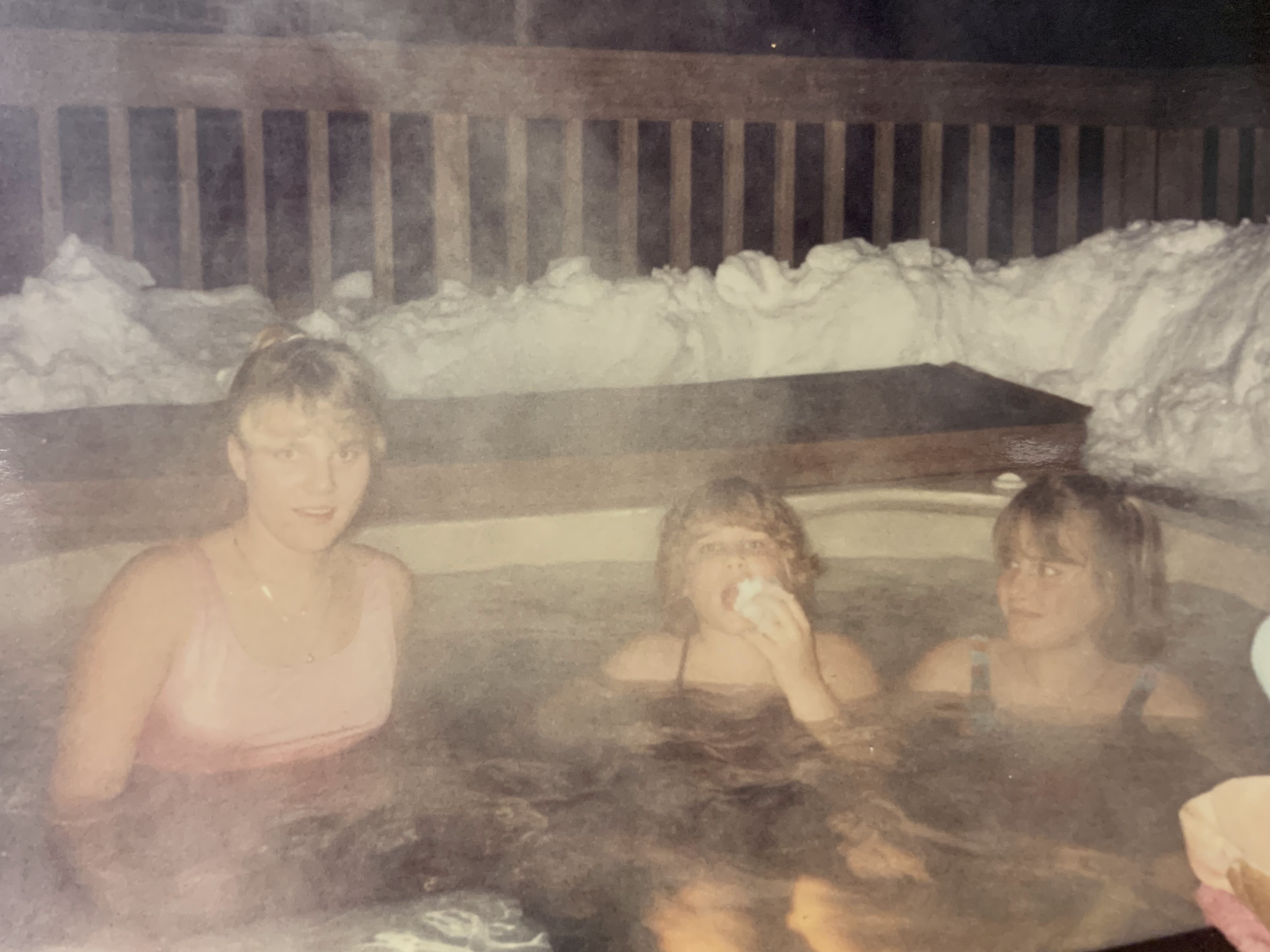
I don’t tell them that images of the hot tub bubble in the back of my mind. Look: my sisters and I are playing in the warm water, snow on the deck. There: I am 13 and awkward, wearing my bubble gum pink bathing suit, my hair pulled back – the photograph reveals a liminal beauty that I can only now appreciate. Over here: My birthday party, fifteen-year-old girls full of high spirits and loud laughter, though in every photo of the evening our heads are hidden in our arms, as shy away from the very lens we crave. “We’re in our bathing suits!” someone had squealed and the camera was put away.

Was that the night the boys crashed the party? Possibly, but even that phrase implies a wildness we didn’t embody. Maybe I should rewrite it and say, “was that the night that Michael and some friends came over while we were outside and we sort of pretended to scream but mostly chatted?” Or maybe both ways of telling the story are true.

With my sisters in the snow

How disappointed they would be with the truth: “The hot tub story” isn’t really a story, and it isn’t salacious. The hot tub is evenings with family, breath-holding contests with my sisters, a science fair project done with my dad (about the chemicals – the only science fair I ever won. Figures that it was about that hot tub.) I know what my students expected to hear when “hot tub” appeared in my list. Instead it’s moments of connection with my family and friends, moments from a time so distant it seems almost unimaginable now.

On the other hand, the trampoline – now, *that’s* a story.

Fatigue #SOL22 10/31

When she first came to visit, I wasn’t surprised; March Break was coming, and she often arrives around this time. Most days, she showed up in the late afternoon, hung around until bedtime and then left, sated. I reminded myself that there was no point in pretending she wasn’t coming, no point in ignoring her – better to accept her visits and maybe go to bed a little earlier than usual to help send her on her way.

But since the beginning of this week, five days before break, she’s been here every day. Some days, I swear she shows up first thing in the morning and lingers until lights out. I can’t shake her. I’ve tried warm baths and early bedtimes. Still, she’s there the minute I open my eyes, laughing. “You thought I’d leave?” Her shoulders shake as she chuckles, “You know better.”

At work, she’s been messing with my calendar: every day this week I’ve found myself accidentally double-booked for at least one meeting. I’m usually very good with time management, so I’m sure it’s her fault. And she’s making me very grumpy. I’m trying to ignore her, but she’s *always* there, and I have to admit my temper is short. She’s even infiltrated my writing – I’ve been posting later and later even though I’m often a morning writer.

The good news is that March Break starts at the end of the day tomorrow. She may try to accompany me on vacation, but I have a feeling that some serious family time, a lack of commitments and, yes, some morning sleep-ins will let her know that it’s time to leave. After all, I much prefer her more pleasant sister, Energy.

Observation #SOL22 9/31

“They were all on-task the whole time; they were literally all sharing their stories.”
I try not to blush – can one intentionally not blush? – and say, “Well, we’ve been practicing.”

Today, a colleague from my previous school came to observe and collaborate. (Pause for a moment and cheer for her principal – and mine – for deciding this was important.) I like to think of my classroom as open, and I regularly say that anyone is welcome at any time, but the truth is that most teachers spend most of their career playing to an audience comprised entirely of students, and I am no exception. I wasn’t nervous, exactly, but having a colleague in my room definitely heightens my senses.

Right away, I noticed that my instructions for one activity weren’t as clear as I had hoped. I noticed that I move around the room an awful lot, and that I am very comfortable with students moving, too. I noticed that I am (ridiculously) enthusiastic about student writing, and I recognized that this probably makes it easier for students to share. Mostly, however, I noticed that my students were willing participants in even unfamiliar activities, like stations that asked them to tell their narrative aloud, read examples of narrative essays or write first drafts. The last time they did “stations” was probably elementary school, but they humour me.

As a teacher I am so obviously my own worst critic that even my students (I see you, Leah & Nadiya) have commented that I should be easier on myself, but I knew that today’s class went well. After lunch, my colleague and I debriefed, which is when she pointed out that even at the “talk” table, everyone was on task. I explained that we had practiced this: we have shared stories in pairs and small groups; in class today, I referred to research we’ve already discussed, research which suggests that talk supports writing; we have also practiced providing effective feedback for other people’s stories. Because of my self-criticism, I am teaching some of these skills more effectively than I did last semester.

If I keep writing, I will find the flaws in the lesson – I misjudged the length of the final activity and there were those imperfect directions at the beginning – but I know that no lesson will ever be perfect. Today was pretty darn good, something I can recognize mostly because I saw someone seeing me teach. And I’ve realized that I’m pretty proud of me – which is not something I let myself say very often – so I thought maybe I should share that.

Talking with my colleague today was not only a pleasure but also a moment of reflection and growth for both of us. Think of how much teachers could grow if more schools prioritized time for observations and collaboration. Wouldn’t that be something?