Good and Bad

Today was supposed to be our first day of Inquiry Based Learning. It was going to be new for both me (I’ve never gone all-in on this) and the students in my Grade 9 sheltered English course. The idea came up last week: I suggested that since there were five students, maybe we should do things differently. After all, waiting for five people with five very different learning profiles to do the same thing at the same time sounded silly.

Everyone agreed. And then…

Two of the five students weren’t in class today, *and* a new student joined our class. I’ve only been teaching this particular group for two weeks, but I can already tell that many of the students come to the class with a giant “NO”. No, they are not planning to read. No, they are not going to move closer to the front. No, they are not interested in putting their phone away. No, they will not write anything. NO. Just NO.

Today was no different. The three students who have been in the class for a while warily watched the newbie, letting his presence shape their participation. I knew better than to plow ahead, but I nevertheless gamely tried to lead a discussion about what we might be interested in learning. One student didn’t speak; another stuck to one-word high-school-approved topics: cars, games, computers. The new student refused. We weren’t making much progress.

Somehow (don’t ask me – I just teach here) our conversation morphed into what these young people like and don’t like about school. Sensing potential, I grabbed a whiteboard marker and starting recording their ideas. Soon, even Mr. No was contributing. I think I won him over when another student started to say something, then backed away from it, saying, “Nah, I’ll just get in trouble.”

“I doubt it,” I replied. “Unless you were planning to curse directly at me, in which case, yeah, I’d be mad.”

Once he had shared his (honestly, not very controversial) opinion that teachers were a lot of the bad about school – and didn’t get in trouble – we were on our way. Soon, the board was full of their observations, and they were sharing stories that went with them. Almost every student had, at some point in their schooling, been *very* disruptive – overturned tables, broken windows, one caused their whole school to be “secured”- and it was almost always because they felt unheard, unseen, or not respected. They were pushed beyond their own limits and they didn’t have another way to respond. Some are still unhappy about things that happened years ago. All of them wish things had been different.

As the end of class approached, I shared that I found their ideas powerful. I said that I thought that other teachers, too, might benefit from knowing about these things. After all, I said, not every teacher knows that sometimes they need to help *less*. We all looked at the board for a quiet moment. Then, carefully, I wondered if perhaps our first project – maybe just for a few days – could be to create a sheet of things teachers could do to be less annoying (not likely to be our final title) and share it with the teachers in our school.

I wish I could say they said “YES” but the truth is that they are reserving judgment. We’d used up their quota of focus for the day, so we have to wait until tomorrow for any decision – and who knows who might be in class tomorrow. Still, I’m beginning to believe that with this class, anything could happen.

Here’s what they have to say:

GoodBad
Learning new thingsHomework
Gym – get my energy out & play gamesThe Office (includes being sent to the office
AND “office people” who don’t listen)
Having fun (includes making teachers mad)People who won’t listen
Making my own decisionsAnnoying teachers:
talking to me for no reason,
telling me what to do,
making me focus when I really can’t focus anymore,
trying to help me when I want to do it on my own.
Using phones

Hot hot hot

“Hot! Hot! Hot! Is it hot enough for you?” The Great Gatsby, Chapter 7

This year, school opened during a heat wave. Teachers were instructed via memo to “drink plenty of fluids” and “wear lightweight and loose clothing.” We got helpful recommendations like, “Where possible, open the windows first ting in the morning and close them mid-morning as it starts to get hot outside” and “Keep the blinds/curtains closed during the day.” Reader, these things did not help.

On Wednesday, I greeted my grade 9 class in the sweltering semi-dark of my sauna-classroom. Outside, the air was already sticky with humidity, so I decided not to open the two small windows, instead making sure the blinds were closed. (In one case, this meant unclipping the binder clips that hold the broken blinds up when necessary.) I didn’t turn on the fluorescent overhead lights; we couldn’t afford any extra heat.

Students swam through the air into the classroom, and slid into their seats. I tried for an opening “seating challenge” (it’s a game, I swear) but by second period, when I met my first class, we were already struggling to think. My carefully planned opening activities quickly fell by the wayside in favour of melting slowly into our desks. Students asked each other not how to get to the nearest washroom but which water fountain offered the coldest water. “None of them,” sighed one student. “All the cold’s already used up.”

I stood in front of the students, sweating. During my first class, I sweat through my underclothes and then through the top of my (lightweight, loose) dress. I gathered what I could of my short hair and pulled it into a ridiculously tiny ponytail, just to get it off my neck. Sweat trickled down my back.

While the actual temperature (32C or 90F) was not completely shocking for Ottawa, the “feels like” temperature (up to 42C or 107F) was. Just across the river, in Quebec, the beginning of the school year was delayed. In Ontario, school started as planned.

Now, if you live in South Carolina – where I grew up – you may be unimpressed by these temperatures, so let me add that we have no air conditioning in our building. If you live in California – where I attended 3rd and 4th grade – you may *still* be unimpressed, so let me also add that we do not have fans in our classrooms.

I mean, we can bring in our own. Here’s what that (not very helpful) memo we get every year tells us: “Portable fans may be employed to help manage the heat. Any portable fans brought from home by staff must be CSA-approved and must be guarded properly and reviewed by the principal/ vice principal/ manager prior to use in classrooms or offices. It is the responsibility of the owner/ staff to clean, and maintain the portable fan.”

We have very, very few fans in our school. At lunchtime, teachers gathered in our office, taking turns near the lone fan. We didn’t talk much. My – blessedly cold – salad and cold water provided short-lived relief. The memo told us that we should find the cool areas in the school, but our air-conditioned conference room had been in use for a meeting all morning, and the library (lightly air-conditioned) could only really accommodate one class at a time. There was no respite.

Then it was time to teach again. The classroom was even hotter than it had been in the morning. My dress was visibly wet before the class was half over. I wiped sweat off of my forehead before it dripped into my eyes. The students draped languidly over their desks. One student briefly considered misbehaving, but when I plopped down next to him to offer help, he reconsidered, too hot to protest.

I dripped my way through inventorying Chromebooks in a closet with another teacher, trying to prepare them for students to use. We drained our water bottles more than once, sweating out every drop we took in. Finally, the final bell rang and students seeped out of the school, exhausted.

Teachers, too, left for the day. Then, we did it again on Thursday. That afternoon I tried to take the dog for a walk after school. Partway around the block, I realized I was actually overheated. Andre came to walk us home, and I – like many other teachers, it turns out – immersed myself in a cool bath. Heat exhaustion. I went to bed early and slept hard.

On Friday, the rain came and the weather finally broke. Week one was done.

First-day jitters

We’ve added a third person to our little carpool, and we pick her up today for the first time. Because it’s the first day of school, she is waiting for us in front of the elementary school where she has just dropped off her children. The day promises to be extremely hot, and she’s already pulling her dress away from her chest as she slips into the car.

“How’d it go?” I ask, and she reports that the kids are happily on their way into school with their new teachers. I think back to when I dropped my own children off at this same school, their sweaty hands clinging to mine when they were little and, later, those same hands raised in a quick goodbye as the child they were attached to dashed off to meet up with friends. Today, teenagers, neither child ‘fessed up to any nerves, but I know they were there – the first day of school is always a bit jittery.

Now, the car is full of chatter. One teacher is starting her third year of teaching and her second semester at GHS. Our new companion has been teaching longer, but she’s new to the school. Me? I’m the veteran – I’m pretty sure this is my 26th first day as a teacher, and it’s my third year at this school. We’re all a little sweaty – and I doubt it’s just the heat. As the A/C finally kicks in, we settle back and admit to our own nerves. Who slept last night? Who feels prepared? Does any teacher ever sleep well the night before the first day? Fully prepared for the moment the students walk in? We don’t think so.

The school building is already jumpy with students when we arrive, nearly an hour before the first bell. In the lobby, nervous teens check printed lists taped to the display case, trying to find their first period teacher. I overhear the same conversations I remember from my own first days as a student: “Who do you have?” “Do you know where room 2045 is?” “Wait? Are we in the same class?” I remember that edgy excitement.

As I walk away from the buzz of the main area towards the classrooms, a few of the students I taught last year tumble to a halt and say hello. One eyes the books I’m carrying. “Are those new?” she asks hopefully. I tell her yes, and show her that I’ve also got a new set of her favourite series from last year. “Oh!” she is excited, then suddenly she bites her lip. “Would it be ok if I borrow one of the ones I’ve already read?” By the time I say yes, the first in the series is in her hands, a shield against this nebulous new year.

Finally, I arrive at my classroom and open my door. I’m straightening up when a head pops in: “Miss, you have my brother!” True, but not this period. I walk them – the brother now stealing shy glances at me- to where they need to be. Back in the lobby, I find anxious parents, trying to understand the chaos in front of them. One family speaks French, and their relief is almost tangible when I respond. Yes, yes, their child is in the right place. Yes, I can help. I’m surrounded by languages I don’t know, too, as students greet each other in delight.

By now, I’ve forgotten my nerves, but the school is still fizzing with energy. A young woman I know from a club I sponsor rushes up to me. “Are you teaching Grade 12 English?” I am not. “But… I need you for Shakespeare.” I have no idea what she’s talking about. “I can’t do it, I just can’t,” she continues,”and I know you can help.” I assure her that her teacher can, in fact, teach Shakespeare well and that if she is still struggling she can come to me. Then I realize she has English second semester. I manage to hold back a laugh as I send her off to her first semester classes.

I smile at students I recognize, notice how they’ve grown and new hairstyles. I ask about summers and check timetables. Soon enough, most people have found their way to where they need to be, and I am again in the classroom. I don’t have students right now – it’s orientation for grade 9 students – but I can feel the energy pulsing through the walls.

That energy simmers and pops throughout the day. Students and staff move about the school, trying to find our places, trying to discover who we are this year, in this space, with these people. We won’t figure it all out today – heck, we might not all figure it out this year – but most of us will sleep better tonight than we did last night. For now, though, the truth is that many of us here are just a little jittery.

Summer looms

The countdown to the end of the year is on. In my office, it’s quite literally on the white board, which displays the dwindling number of teaching days that remain. Today we hit 10. Every morning for the past few weeks, I have walked into the office and panicked just a little bit. It’s not enough time, I think. We have so much more to do. I feel like I’ve only just gotten to know some of these students. I only now understand what will work best. We’ve really only just started. How can we possibly learn enough in just ten more days?

We can’t, of course, and though my tendency is to try to cram in more and more lessons, I know that I need to do the opposite. Slow down, I tell myself. Savour the moments. A few days ago, fellow educator Michelle Haseltine posted, “This school year is quickly coming to an end for so many of us. This post serves as a quick reminder that emotions run high for everyone…high highs and low lows… Saying it out loud to remind myself that feeling all of my feelings is ok. It’s ok to feel more than one thing at a time.” I wrote it down (obviously) because I knew I needed to remember her wisdom.

I tried to use those thoughts this morning, when I realized that today’s goal was going to be “Try not to lose my temper.” What do you mean, you’ve deleted all of the work you did over the past five days because you “changed your mind” about your topic? Yes, that is a comma splice. Yes, I’m sure it is. Yes, we are still going to read for 15 minutes at the start of class. No, you cannot leave class early. You will never randomly be allowed to leave class early. The bell rings; the next class enters; the questions start again. No, you cannot use AI for your essays. Yes, Quillbot counts as AI because it is, in fact, AI – it has “bot” in its name, for pity’s sake. Yes, I have already told you when your summative project is. Yes, it is next week. No, you cannot use AI for it. Yes, I really do think you can do it. Yes, you will have to read every day until the end of the year. No, you cannot leave class early…

At lunchtime, I want to fall into a heap, but there’s a meeting – the final one of the year for this club – and then a parent conference. And another class, another round of ridiculousness brought on, I know, by summer’s imminent arrival. Yes, I really do think you can do this. Yes, you will have to read every day until the end of the year. No, you cannot leave class early…

And yet, as end-of-year excitement swirls through the school, causing chaos, I catch other moments, too: the young woman who sighs deeply when I announce the final essay, then whispers under her breath, “But I really am a better writer now”; the student who is writing her longest piece ever about the day her father learned they would immigrate to Canada; the young man who has started so many classes angry, and who I now know how to cajole into a better mood; the student who tells me they are almost surely going to finish their 15th book before the semester ends. We have grown this year, all of us. We really have. I can feel more than one thing at a time, I remind myself. In fact, I think I have to. Summer looms.

The Sound of Silence

Today we studied Act 2, scene 2 of Hamlet. I like to refer to this scene as “spying and lying”: the messengers return from Norway, Polonius tells the king that Hamlet is acting crazy because he is “mad” for the love of Ophelia, who has been avoiding him at her father’s order. Rosencrantz & Guildenstern show up and lie to Hamlet, and Hamlet is kind of a jerk to everyone. Then the “players” arrive and there’s a long speech with lots of allusions to Greek myths that none of my students know, and THEN Hamlet has a soliloquy. Whew. It’s a busy scene, and long.

In part because it is jam-packed with groundwork for the rest of the play, this scene is hard and, even after all these years, I haven’t yet figured out an exciting way to teach it. Mostly, we read the lines, and I point out the double entendres and puns. Dry. Even when I show them all the dirty jokes, this is never our most exciting day.

Today was even harder for the students because I recently banned cellphones. Some time last week, I completely broke. After years of futile efforts to “encourage” students to put their phones away, hours of explanations about why phones are not helpful, dozens of shared articles, a few experiments (see how many messages we receive and the like), three strikes policies, phone containers and more – all of which followed years of trying to “incorporate” phones into lessons, I finally couldn’t take it any more. I banned them. I’ve put a sign on the door that says “No Phone Zone,” and I am politely but firmly insisting that any phone that comes out during class time come “visit” my phone on my desk. The other option is for the phone – and the student – to leave the classroom. No warnings. So far, everyone has handed over their phone.

The phone ban made a big difference today because Act 2, scene 2 is so hard. The words matter and the double meanings matter and to get it you have to concentrate. Phones are an easy way out when our brains want a break. I still said no – for all 75 minutes. I know – I’m an ogre.

Then, 7 minutes before the end of class, there was an Amber Alert. All through the school, phones sounded, interrupting class; in our room, not a single phone sounded. Not one! Look, some kids were nearly asleep and one or two were studying for Chemistry and at least one was sneakily reading another book, but ALL THE PHONES WERE OFF. I found out about the alert from notifications after class.

Even better, with all the phones away, we managed to (almost) finish in one class period. Tomorrow, the nunnery scene. I am – quietly – ecstatic.

23 minutes later

The class ends at 2:05 and, let me tell you, the students are out the door before the bell even finishes ringing. It’s a big school, and if you don’t skedaddle, you could easily be late for your next class – especially if you need to stop and chat with a friend on the way. 

I use the time after they leave to tidy the classroom: putting away the last of the material we used, checking that everything is ready for tomorrow, erasing the white board, closing the windows, gathering my own things. I turn off the lights as I walk out, heading towards my office just as the next class period begins. 

As I close the door, I spy my colleague, Christina, standing in the hallway. Fantastic! She works in the Special Education program, and I want to talk to her about a few students in my classes. Midterm marks are due tomorrow, so I’ve been particularly focused on the larger picture of how students are learning in class, and I’ve seen some gaps for some of the students we share. Taking advantage of those few minutes after late students have made it to class and before students start asking to go to the bathroom, we chat about what is and isn’t working and how we might be able to work together. “He needs tasks broken into really small steps to get started,” I observe. “Yes,” she agrees, “why don’t I work with him on that assignment when he’s here next?” Just as our conversation veers away from students and towards more general topics, a young woman comes to the door, asking for help. I excuse myself so that Christina can focus, and I continue to make my way toward my office. It’s been about ten minutes since class ended.

Today, I turn into the hallway with the bathrooms. Rookie move, but it’s physically the most direct route to my destination. Sure enough, a group of boys is exiting the bathroom – together. They are boisterous and don’t appear to have been using the bathroom for its intended purpose…although what do I know? Maybe all teenage boys now use the bathroom in packs. I pause, several meters away from the group, hoping my quiet presence and raised eyebrows will encourage them to move towards their classrooms. This does not work; instead they pause in the hallway, talking loudly. I move closer and, intentionally pleasant, say, “Time to head to class.” One or two of the students recognize me, smile, and nod their heads, saying, “Yes, Miss” or “Gotcha, Miss.” Everyone starts to disperse. Everyone, that is, except one student, who moves to duck back into the bathroom. Hmm… that’s unusual. Wasn’t he *just* in there? I recognize the young man; I know that he does best when he is in a classroom and in the presence of adults. I invite him to make a different choice. He declines. More young men arrive and try to head into the bathroom with him. I suggest that this is unwise. 

More often than we might want to admit, adolescents perceive behaviour that adults consider “polite but firm” to be, well, not polite. I know that I need to be especially careful that these students don’t feel that I’m targeting them. I’ve asked them several times to make a better decision, but they’re not responding. Time for me to get help. I let them know what I’m doing and turn around to head to the Main Office. Before I get far, a young woman stops me, asking to be let into an empty classroom where she forgot something. Though I haven’t taught her, I know her and I know that she often wants her needs to be met immediately; I’m also certain that allowing her into an empty classroom with no supervision and the young men down the hallway watching is a bad idea. I pause. “I have to run to the Office, but wait right here. I’ll be back in no time and will definitely let you in.” She eyes me warily, then nods.

There’s no running in the hallways, and this isn’t an emergency, so I move into a quick walk and make it to the Office without further interruption. There, the amazing Office Administrator, Laurie, is out of her seat and on her way to help almost before I finish explaining. “It’s X?” she queries over her shoulder, “I’m on it. You go tell the VP.” She leaves with a walkie-talkie and I move deeper into the rabbits’ warren that is home to our administrators. I briefly explain the situation, then head back to keep my promise to the young person who wanted to enter the room. By the time I get back to that door, another teacher has let her in. 

I confirm that Laurie and a VP are with the students I originally spoke to (shaking my head that they didn’t bother to leave when I literally told them I was going to get an VP) and start back towards my office. I turn into the next hallway and see a colleague. We exchange hellos, but do the thing where you say hi but keep moving so that you can’t stop to talk. Another turn. Up the stairs, and I turn into my office. As I settle into my chair to start my work, I check my watch. 2:28 My class ended 23 minutes ago. I open my laptop and pull up my planning doc. This is why it’s hard to get much work done at school. 

Holidays

“Miss, can you explain Easter in Canada?”

I start to nod, then I realize that have no idea what this student is *really* asking. Perhaps, I think, she is not Christian? I check. Nope, she’s Christian, so that’s not it.

I’m thinking about how to answer the question when, “Oh,” says another, “and I thought Ramadan was over? Didn’t you have that dinner on Thursday? Why are people still fasting?”

Y’all. Class has not even started. Correction: English class has not even started.

I begin eloquently, “Um…”

Ramadan seems easiest. I explain that Ramadan is a period of fasting that lasts… how many days? Dang it. My brain can’t find the number. I hesitate and look to the student teacher. He quickly supplies the number of days left. 

“But you had the dinner,” says one astute student.

Yes, I explain, but Muslims break their fast each night after sundown. Now some students are confused. If people are eating, how are they fasting? I explain that people cannot safely fast for 30 entire days, that they fast between sun up and sun down. Some students look askance, but most seem satisfied, and none of the Muslim students disagrees.

This settled – ish – we move on. Next, I share that this week is also Passover. I say something about Abrahamic religions which, upon reflection, is perhaps not my wisest move. I try to explain what Abrahamic religions are, but simplify to “Judaism, Christianity and Islam” and move on. 

Back to Passover. Israelites. Egypt. Blood on the doors. “Wait – what? They put blood on their doors?” Yes, to save their oldest sons. And now I’m trying to remember the whole story, but it’s been a while, and, again, the student teacher (thank goodness!) adds some details – lamb’s blood, Angel of Death – and most students nod along, though a few are clearly still wondering about the blood, and a few are not paying attention at all.

Whew. On to Easter. This one should be the easiest because I grew up in this tradition, but I stumble as I explain that Jesus is the Son of God because I’m trying to explain, not preach, so in my mind I’m wondering should I say that he is the Son of God or just that we believe he is? And somehow I say that Jesus is a prophet. I’m immediately corrected by a student who says Christians do NOT believe Jesus is a prophet, but by now the back of my brain is at work, and I’m wondering if we can think of the Messiah as a prophet – but then what is he prophesying? So probably not ok to say he’s a prophet – and I really need to keep explaining Easter to this class full of students with really good questions which I thought I could answer, so I go with “Messiah.” Of course, most people in the class don’t know that word so I revert to Son of God, and explain Good Friday in about one sentence because, again, this is English class and finally we get to Easter. And on Easter, the third day, He rose again.

“Like, he came back to life?” And, at last, this is a question I can answer without hesitation, “Yes, in the Christian tradition, Jesus died and then he came back to life on the third day.” No one objects. There’s a brief pause, and I feel relieved that I got something right in this impromptu rundown of this week’s holidays.

Just then, the student who originally asked about Easter, the question that started this all, says, “But I still don’t understand. Why are there so many bunnies?”

Because of you #SOL23 31/31

When I woke up this morning, my left eye was swollen shut. A stye, I think, though no amount of hot compresses have brought it to a point, so who knows, really. At least it’s settled down enough that I can see. I had already taken today off sick; I wasn’t quite sick yesterday, but I was far from my best, and I knew my run-down body needed a break. Turns out, I have slept much of the day because I am, in fact, sick.

When I haven’t been napping, I’ve mostly been deep in a giant bean bag accompanied by a book, the puzzle section of The New York Times, and cats. We haven’t done much, and I’m ok with that.

While I’ve rested, I’ve wondered what I should write for the final day of this Slice of Life Challenge. I’ve wondered this every year that I’ve participated. After a month, I’m used to the practice of noticing and holding on to moments, of seeing how what is happening today brings up memories of what happened years ago. I love the way that writing daily makes me pay attention to the world around me (special thank you to Stacey for dreaming this up years ago to help get through March and to the Two Writing Teachers team for supporting this). I’ll miss this, even though doing it every day is hard.

I teach narrative writing at some point every semester, and I often tell my students that the universal lives in the specific. We connect best with friends and strangers when we share our very specific feelings or experiences – everyone has lived moments of joy or fatigue, grief or giddiness. This challenge is about sharing those moments, creating a community through that connection, through those stories.

I started this month with some trepidation: school systems are in a state of flux right now, and teaching is harder than I’ve ever known it to be. We need to have some hard conversations about things that don’t really fit into the “Slice of Life” model. I wasn’t sure I could write honestly for a month without talking about those hard things, but I did it. Mostly.

When I look back over my posts, I can see some of my concerns lurking behind and beneath my words, but that’s ok, I think, because reading and writing for a month with teachers from around the world means that I can also see the ways in which we hold each other up and, more importantly, how we share the dreams we have for schools and the world we’re striving to create. I can see how many teachers (and coaches and retired teachers and people in the world of education) are dedicated to our children and how, even though many of us are really, really tired, we don’t just cling to hope, we create it.

And so I leave March better than I entered it, better able to find the kernels of joy, better able to rest when I need to and fight for what is precious, better able to teach and, truly, to be taught. If you’re reading this, that’s probably because of you.

See you on Tuesdays.

Breaking the fast #SOL23 30/31

I just got home from school. It’s 9:31pm. Why so late? Tonight, for the first time, our school celebrated Iftar together. 

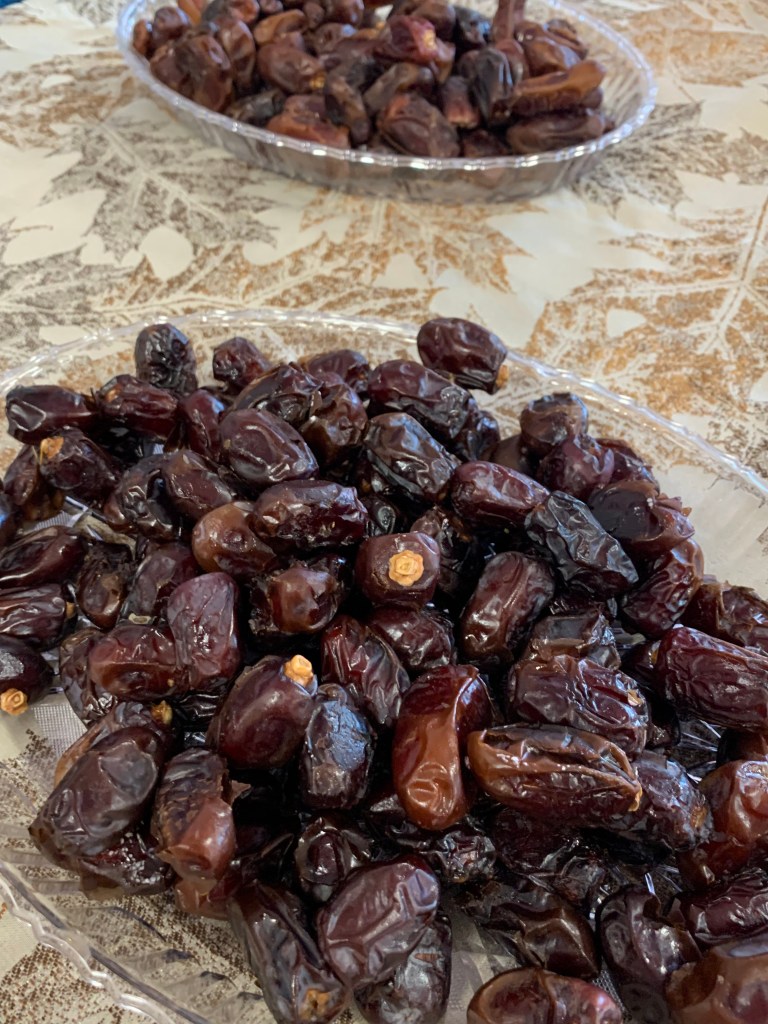
For those of you who don’t know, as I did not until recently, Iftar is the fast-breaking meal that Muslims eat immediately after sundown during Ramadan. People break their fast with dates and water – after neither eating nor drinking (even water) from sunup to sundown – then they pray, then eat their meal.

This year, students asked if we could organize a communal Iftar because Muslims often break their fast in community. I was raised Christian –  in the middle of the Bible Belt in the southern part of the US, no less – so I knew very little about Muslim traditions, but the students at the school where I currently teach are generous with their knowledge. We talked through what Iftar would look like, checked with the Principal, and off we went.

One student really drove things, and another teacher did the work of clearing the path for her. Soon they had chosen a date, organized catering, and started selling tickets. To make sure that all families – even very large families or newcomers who might not yet have a strong financial footing – felt welcome, the school found funds to cover some of the cost of the meal. 

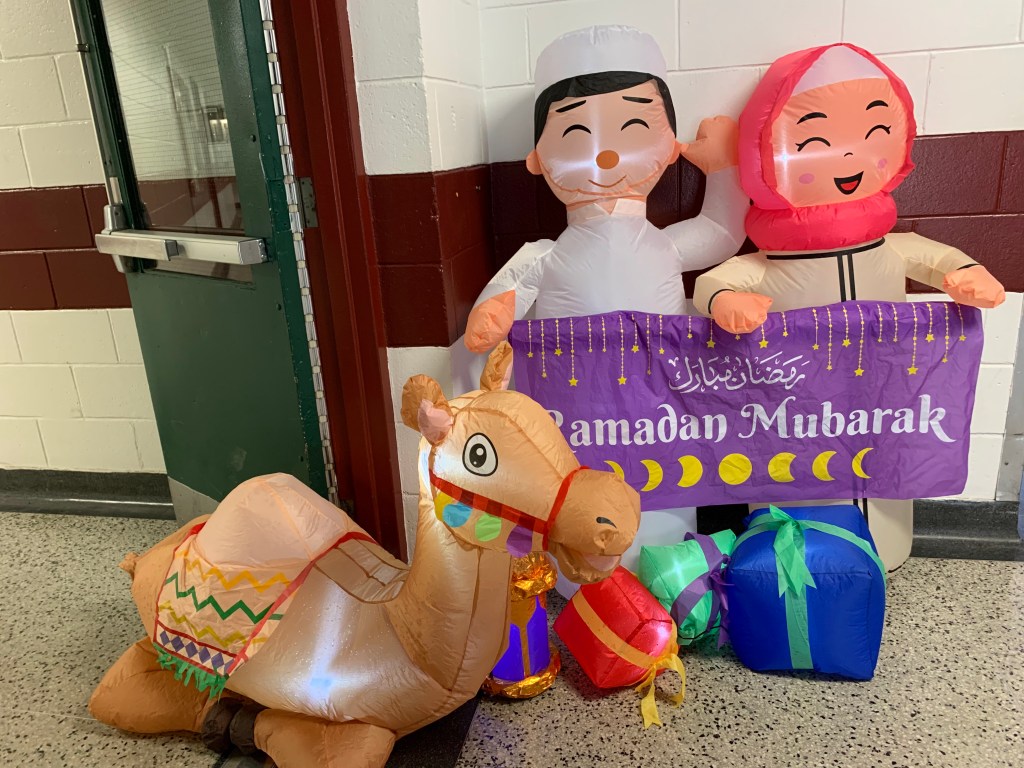
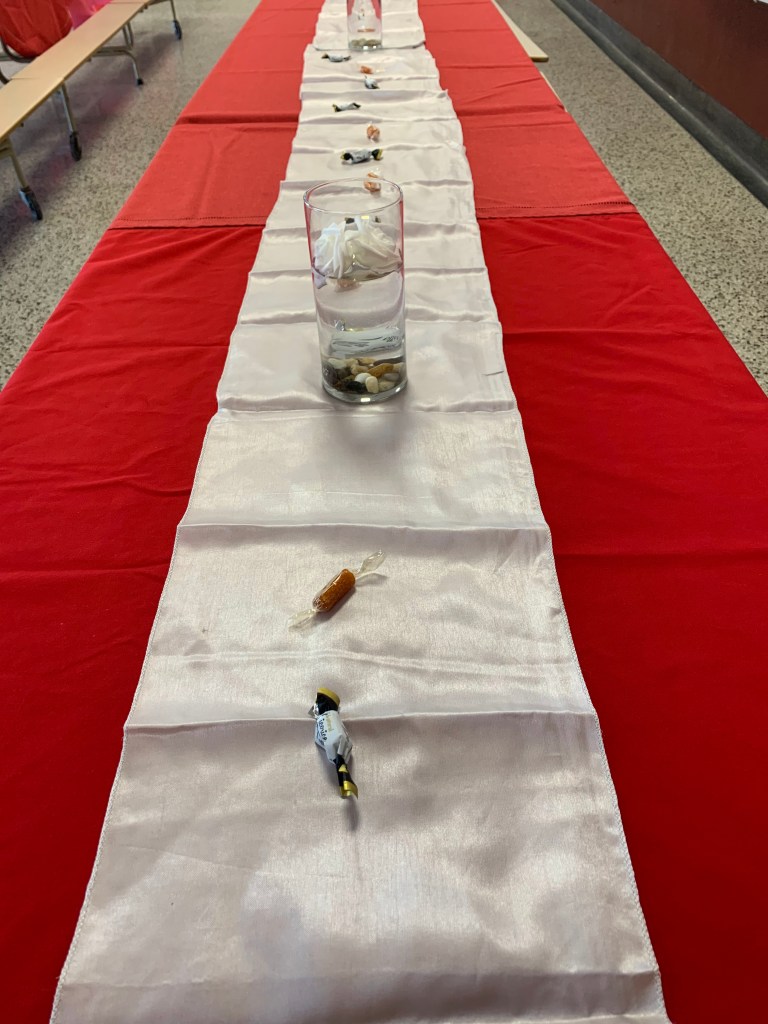
This evening, the cafeteria buzzed as teenagers covered the tables with red tablecloths and white runners. One student’s mother helped out. They strewed traditional candies along the runners and filled “vases” from the science department (“They’re not beakers, Miss, really!”) with water and white flowers. They decorated the hallway and laid out the dates. Soon, a father showed up, and students started shuttling in the meals – rice and skewers and salad. The imam arrived, along with his wife and young children. Before we knew it, the cafeteria contained a community – from babies to grandparents, Muslim and non-Muslim, students and teachers and their families – well over 100 people in all.

Those who were fasting broke their fast and prayed; those of us who were not fasting or praying finished setting out the food. Everyone came together to eat and the room filled with talk and laughter. 

As we cleaned up afterward, I could feel the joy: our first annual Iftar – and another way to celebrate the community our students create. 

It was supposed to be funny #SOL23 28/31

“It was supposed to be funny.”

That’s what I told my grade 12 students on Monday when I shared one of my recent blog posts – the one with the squirrel pictures. I pointed out the title and the photographs. “I started with funny, but I ended with sappy.” This was my writer’s dilemma: “So what I’m looking for are ideas for how to revise this to make it funnier – or even just a little funny.”

Cue uncomfortable shifting in their seats. Critique the teacher’s work? Not likely.

Undaunted, I continued. “OK, R has volunteered to be the leader,” R nodded, “so he’s going to tell us our first step.” 

“Um, ok, um…” he shuffled the papers in front of him, trying to figure out the next step. “Oh! You need to read it out loud.”

I did. I had planned two class periods (minus our daily reading and writing time) for the students to share their work and offer suggestions. I was following the Feedback Protocol developed by Peggy Silva and shared with me by Xan Woods and, not surprisingly, when I told students that they would read their work out loud to their peers panic had ensued. Telling them that someone else could read the piece out loud for them was not the balm they had anticipated. So I’d pulled out my next trick and asked them help me with my writing. 

You can imagine the wary looks I got. I explained about the Slice of Life challenge and how I had been writing every day for almost a month. EVERY DAY? They were half impressed, half worried about my state of mind. Those latter concerns were heightened because now I was offering – no, asking – to have them help me. As I read aloud, I found a mistake in my *published* piece. “Oops, I need to fix that,” I said – and I didn’t die or anything. I just fixed it.

“Ok, R. What’s next?” I asked.

“We have to read it again, then offer you ‘warm’ feedback.”

Because I know this is hard, every time we use the Feedback Protocol, I give students a script (also developed by Xan & easily modified to fit our needs) in addition to the general how-to. Now, we continued through the script. The students had plenty of nice things to say about my piece, and they were able to be pretty specific with their compliments. Then came time for cool feedback. 

“Oh, I feel bad about saying this.”
“Miss, are you sure you want to hear this?”
“I just feel kind of mean.”

I reassured the students that I had asked for this feedback, that I wanted to do better. “Look,” I said, “I really wanted this to be funny. I know you can help. You are 100% funnier than I am.”

As they spoke, I took notes in front of them. The more I wrote down their comments, the more confidence they gained. After a few minutes, time for cool feedback was over. I thanked them and reflected on what I had heard and what changes I thought I would make.

Just like that. Like it was no big deal.

Then it was their turn. Tentatively, they moved into their groups. On the first day, only one student from each group was able to receive feedback. As the class left, the mood was less tense, maybe curious.

Today, after reading time, the groups re-formed quickly. Essays appeared out of notebooks and folders. No one had lost their papers. Around the room, students huddled together around papers, their pencils scratching down notes or writing in margins. Laughter, questions, talking… was this the same group that couldn’t quite remember everyone’s names just a week ago? Were these the same students who looked stunned yesterday when I told them they would read their work out loud? 

Yes, yes these are the same students, I promise. As class came to an end, I asked how they felt about the protocol. “So good,” said someone. “Really useful,” said another.

“Excellent,” I said, then added, “Revisions are due Friday.” Good natured groans sounded around the room. As they kids left for their next class, I overheard someone say, “that was really good, wasn’t it? Like, really good.”

Ah yes, pedagogy for the win.