When the phone rang I was in the middle of giving the “ten-minutes-till-bedtime” warning. But since it was her, I picked up. Because you can tell a real friend hello and goodbye in mere seconds if you need to. Because she doesn’t usually call at almost bedtime. Because I always like to hear what she has to say.
Well, I *usually* like to hear what she has to say. But maybe not when she says, “Hi, um, can you check your texts? I sent you some pictures.” Because, though none of my students appear to believe this, nothing good ever comes from an urgent request to look at pictures on your phone.
Sure enough, I checked my phone and yelped, “That’s a tick! Why are you sending me pictures of ticks?”
As it turns out, the tick had decided to take up residence near her daughter’s armpit.
“Um, that tick is already embedded,” I observed helpfully. Unsurprisingly, they knew that. They had actually called to see if I knew how to get it out. In theory, the answer was yes; in practice the answer was not yet.
Since nobody wants to pull a tick out of their child on their own – at least not the first time – and since apparently not yet is better than not ever, they hopped in the car and headed over to my place. Meanwhile, I cleverly googled “how to remove a tick” (pro-tip: pretty much everything except “pull it out with tweezers” is an old wives’ tale) and then called my father.
Now, before you judge me for making an international phone call to a 73-year-old man to talk about a relatively common and seriously tiny creature, I should mention that my dad is an infectious disease doctor. Ok, and I should also mention that I was really just calling for moral support because he and my stepmother basically live in the woods, and I am decidedly a city girl. They have tick experience. Dad told me to pull the tick out with tweezers, but he added some extra things like “watch for fever for the next ten days” to make me feel like the call was worthwhile.
When my friend arrived, we left my boys downstairs, supposedly making their lunches but really listening carefully at the bottom of the stairs to hear if there was any screaming. My friend, her daughter and I headed up to the bathroom with the good lighting to look at the tick.
It was a tick, alright. It was also very contentedly settled in under the 10-year-old’s arm. With more bravado than bravery, I held the tweezers, her mom held her hand, and I pulled the tick out. That was it.
This result seemed all-too-easy for such a dramatic situation, so we fretted for a while about whether or not we’d gotten the whole tick. Our concerns mostly led us to poke the poor child’s tick bite repeatedly with the (sanitized) tip of a safety pin. She was surprisingly patient with our ministrations, possibly because she was convinced that if we left any of the tick behind undefined but horrible things would happen, possibly because she guessed that her friends were downstairs listening for screams.
Finally, we declared her tick-free, swabbed just about everything we could reach with rubbing alcohol (because that’s what the website said to do), and headed back downstairs. The boys pretended that they had spent the whole time packing their lunches, the girl grabbed the dinner she had brought along (we had rudely interrupted with our concerns about her potentially imminent death-by-tick), and her mom put the bottle with the tiny tick corpse into her pocket – “just in case it has Lyme disease,” she said, though I’m not sure how having the tick body will help. We hugged, they left, and just like that the drama was over.
New definition of friendship: will remove a tick from your child’s body, during dinner and/or at bedtime.
“The word ‘believe’ is rooted in an old English word meaning to hold dear, esteem, trust; it has the same origins as the word ‘love.’ To ‘believe’ is not to agree with particular ideas or concepts, but it is make a commitment of the heart.” – Rev. Bryant Oskvig
Last year, I overheard a colleague complain that “everyone” has autism these days. My first reaction was disgust – how could they!? – but my second was compassion. After all, haven’t we all had times when we didn’t believe?
I was teaching 7th grade math. Math! Of all things. And middle school. I had wanted to teach either 3rd grade or high school English – middle school was on my “never will I ever” list. But here I was, in an oddly-shaped room with creaky wooden floors in an old house in downtown Washington, D.C. The school had as much personality as its location and the students, well, they matched their surroundings.
To be fair, the teachers were equally unconventional. I was one of the few teachers with any formal education credentials, and all of us were impossibly young and unmistakably dedicated to teaching well. We used to joke that we should just put beds in our offices and move in: it would save us the charade of having a life. I was trying to learn the craft of teaching, but 7th grade math in a quirky little school was a far cry from anything I had studied or practiced in grad school. So I was reading a lot about teaching and doing a whole lot of thinking on my feet.
My classroom was full of squirrelly 12-year-olds, and I was full of unusual ideas. We kept math journals, created math skits, and learned statistics with M&Ms. My fellow teachers and I shared successes and failures daily. We dissected education trends and talked about various ideas for hands-on learning. And we complained. Not a lot, but plenty. Often we complained about how “all the kids” had “some diagnosis” that prevented us from using our fancy, researched techniques.
One of our favorite targets was ADHD (though it was ADD at the time). We were virtually all single 20-somethings, but that didn’t stop us from harrumphing about “kids these days” and speaking knowledgeably about parenting trends and over-medication. I can’t speak for my colleagues, but I firmly believed that ADHD was a fad and that most medication was just to settle down normally active children.
In my classroom, students sat in a semicircle. That is, when they sat. Memory tells me that “a bunch” of them were boys, but I can’t vouch for that. I can say that they lacked a certain focus every day after lunch. They were sweaty, talking, moving, tapping, chaotic creatures who occasionally learned some math almost as if by accident. And then there was Alex.
Alex was in constant motion. He talked a mile a minute and had incredible eyelashes that framed big hazel eyes. He could make me laugh in about half a second, and I was pretty sure that he actually wanted to learn math. That said, he had physically fallen out of his desk more than once… Oh, and he “supposedly” had ADHD. He was pretty much always in some sort of trouble.
For a while, I had tried putting students who misbehaved into the center of the semicircle. Only belatedly did I realize that a) I was shaming them, and b) many of the boys took complete advantage of having all eyes on them. I needed a new plan. One of my books suggested a “three-strikes and you’re out” policy. I went with it.
I’ve forgotten the lesson that day, but I know it was a fun one. I know this for sure because Alex really wanted to take part. He was leaning forward in his desk, straining and stretching, tilting the whole thing at alarming angles. He had mentioned that he hadn’t taken his meds that morning, but since I didn’t really believe he had ADHD, I didn’t take much notice. I gave him his first warning about 5 minutes into class.
He looked chagrined. “Sorry. I just can’t focus.”
I gave my best stern look, “Well, give it a little more effort.”
He did. I could see he was trying to watch only me. But he just couldn’t. He was trying to watch everyone in the whole class at exactly the same time. Sure enough, minutes later I gave him his second warning and sent him to cool down in the hallway.
He came back in quickly. He was so excited to be in the room. He sat on his hands. He held his beautiful eyes wide open. He squirmed and he wiggled. And he fell out of his desk. Somehow, this time, I knew it had been an accident. But the whole class was laughing, and I had this three strikes policy.
“Alex,” I said, “you have to go to the office.”
“I know,” he replied, and his little head hung low. His whole skinny little body was the picture of despair. “But I was trying to be good.”
My heart broke as I asked the question: “But were you good?”
“No,” he said, so softly I could barely hear him. He looked up through his long lashes as tears started to fall. And he went to the office.
Because, you see, he had ADHD. And he hadn’t taken his medication. So he couldn’t focus, and the whole exciting classroom was one giant distraction for him. I knew it in that moment as surely as I knew anything.
I wanted to shout after him, “Wait! No! I was wrong! I believe!” But I didn’t. And since I wasn’t the only non-believing teacher, that wasn’t his only trip to the office. Happily, we had an incredibly kind principal and a deeply connected community. I taught Alex again, and I was privileged to watch him grow up. Today, I see him on Facebook and I marvel at the compassion he has for his own students. He was an outdoor education instructor and now he teaches science. He seems to be a fantastic teacher, but I could be a little biased.
And I believe. I believe in ADHD and autism and so much more. I worry sometimes about labels, and I know that these things are complicated. But mostly, I look at the children who come into my room and I think, “I believe you. I believe in you.” And I wish for my non-believing colleagues a moment that helps them believe, too.
The first student to arrive had her earbuds in, but the volume was low enough for her to hear my question: “What happened to you during the tornado?” Without hesitating, she took her earbuds out and started talking.
She was still talking when the next student came in. I was listening while writing advance organizers on the board. Soon, the second student started sharing her stories from the chaotic weekend. “It was really scary!” As I watched the energy between the two girls, I went back to the top of the plan for the day and put a question mark next to the first planned activity, “Read.”
The next students arrived as a group, found seats around the circle and joined right in. “My mother saw it from her window!” “We didn’t have power for TWO DAYS!” “Everyone saw that video!”
By the time the last student arrived, wheeling his chair up to the spot we save for him, we were deep in conversation. My students, sometimes reluctant to discuss anything, were sharing story after story. After a few minutes of free-for-all, someone suggested we should make sure to hear from everyone. Around the circle we went. Next I asked them to share something hard or not-so-good that happened. Finally, I asked about things that were unexpectedly good as a result of the tornado.
Our class was lucky: neither of the two tornadoes that touched down in Ottawa on Friday caused serious harm to them or their families. Nevertheless, one of electrical substations that provides power to Ottawa sustained a direct hit, so the whole city has been affected in one way or another. We were even off of school yesterday, the first time school has been cancelled in the 11 years I’ve taught here. We were close enough to danger to heighten the students’ attention but no one had experienced trauma, and I took total advantage of it.
Our class has been reading news stories daily as a way to increase the context we have for reading in general. We talk about the stories and study how they are written. We gather vocabulary words and learn how to ask questions. Slowly, we’re learning to write news articles. We’ve got a list of what makes something a news article, and that has become our success criteria. This unit takes a few weeks, but it’s worth it. My students will need this exact skill for standardized testing this year, and writing the news helps them understand perspective taking, narrative voice and sticking to one story. Some will even begin to take audience into account as they write, which is always fun.
Today, we talked about how the story of the tornadoes unfolded in the news, from the first emergency alert to the discussion of the aftermath (new vocab word!) in today’s paper. We looked at some pictures and thought about why the papers might have chosen to publish these images and whether or not they reflected our experience. Finally, everyone chose an image and wrote a news story about the tornadoes.
The students were completely engaged – success criteria in front of them (oh, how I love those lists!), pencils moving, keys tapping. Some bit their lips as they thought, two asked each other to check something, and most wrote until I stopped them… with just enough time left in class to reveal the shocking follow-up on a story we’ve been following. (The police arrested a second woman!) When the bell rang, we were all pretty energized.
I left the classroom musing about what made this day work so well. We never did get to our 20 minutes of reading – and I’m usually pretty insistent on that – but giving the students time and space to talk, think, and write about the thing that was actually on their mind made today’s class stand out.
These kids have things to say. Today is a reminder that my job is to help them say it.
“Place your hands firmly against the wall, middle fingers pointing up, fingers well spread. Place your feet under your hips. Find your distance. Using the pressure of your hands on the wall, turn the inside of your forearms downward while at the same time spinning your triceps in. Open your elbows.
“Now, maintaining that action, stretch back through your hips. Elongate your spine and make your back straight.”
Suddenly the teacher’s voice changes. The zen is gone; it’s time to get serious: “Ok. Hold that. I’m coming around with a stick to let you feel how straight your back is – or isn’t.”
I hold and breathe. In and out. In and out. Spin here, stretch there, stay straight, hold…
I have been practicing yoga for 15 years or so. There have been times that I couldn’t get myself to classes regularly but still practiced at home (hello, year in France) , and others where I couldn’t even practice at home regularly (I’m looking at you, baby #2), but I still count about 15 years.
I love yoga. I find both peace and challenge in my classes, some space that I can’t create when I’m not stretching my body and concentrating on my breath. Yoga is one of my mainstays.
And yet, second semester last year, I just couldn’t do it anymore. I was tired and stressed out and my body ached. These are all the reasons a person SHOULD go to yoga, but I ended up not going, and I was the worse for it. this year I decided to recommit. I hired a girl down the street to pick the kids up after school on Wednesdays and enlisted my husband to get home a little earlier.
Excited, I went online to sign up for my class. The scheduled loaded and I was suddenly paralyzed: My class is level 2/3 at 7:30, but at 5:45 there was a level 1 class.
Yoga teachers often talk about going back to the basics, about how there really is no level 2 or 3. There are just the poses, our body and our breath. Teachers remind us that even an experienced practitioner can learn from a level 1 class. After all, despite appearances, the challenge in yoga is mostly internal. Still, level 1 after 15 years? What would I learn? Was I just looking for the easy way out? I stared at the schedule for a long moment, and I signed up for level 1.
The first two classes have been both freeing and challenging. Even the simplest of instructions have nuances, and now I hear the teacher’s instructions anew. Concentrating on the foundation of poses I’ve been doing for years is helping me make changes that I never dared to in my other classes. I don’t cut corners to get into complex poses because I’m busy working on all the tiny complexities of the basic poses. Plus, in level 1, cheating shows. My teacher might not comment on a lifted heel when every other bit of me is twisted into a new space, but there’s nowhere to hide when I’m working on Uttihita Trikonasa (Triangle Pose) or Virabhadrasana 2 (Warrior 2).
Level 1 means I’m letting go of expectations about what I should or shouldn’t be able to do and accepting what my body can actually do. It means admitting that there are things I’ve been faking for years. It means practicing concentrating on myself and not others. (I stink at this, in case you’re wondering). As it turns out, level 1 is hard.
So I breathe in, I breathe out, and I grow. And I’m ready for the next class.
He’s reading! He’s really reading. Just look at this picture – reading at the breakfast table this morning, ignoring his pancake.
I actually had to tell him to put the book away. And I’ve had to add “make sure he’s turned the light out” to our bedtime routine. I can’t quite believe it.
Eric has dyslexia. We knew something was not quite right by the end of Grade 1, but we couldn’t put our finger on it. He was in the highest reading group in class, but he regularly “read” without looking at the pages. He learned many things quickly and easily, but he didn’t like school and he just couldn’t seem to get along with his teacher. This made no sense: she was experienced and beloved by many; he was funny and eager. They hit an impasse and, bless her, she just kept saying “I don’t know what it is, but something isn’t right.” Finally, despite my misgivings about testing young children, we took Eric for an assessment. And it turned out he was reading at the 3rd percentile for his age. THE THIRD. He was fake reading all over the place.
We are incredibly lucky that we figured this out early. I learned about dyslexia and found a tutor who uses a researched method with proven outcomes (The Barton method – Orton Gillingham based). She’s amazing and Eric, the trooper, has rarely complained about two hours of tutoring a week. Still, frankly, the progress has been slow. I know that the tutoring is not simply supposed to teach him to read but rather to actually rewire his brain so that reading becomes easier, and I know that takes time, but knowing something and believing it are two different things. In grade 2, he read dutifully with me every evening but nothing else. This summer he basically avoided reading altogether. I was beginning to despair.
And then, three weeks ago, he picked up a book and read it. The whole thing. He stayed up until 10pm. I was on my way to bed when I noticed his light on – talk about a shock! He was three pages from the end and so excited when he finished that he couldn’t go to sleep. The next day he read the second book in the series.
Soon, confidence growing daily, he enlisted others. He read out loud on the couch to his brother. (Thomas was really encouraging: “Wow! That was a big word! Good job, Eric!”) He told a friend about his reading, and the friend showed up at our house with the rest
of the Dog Man series and a new series to start. Unbeknownst to me, Eric devised a reading plan. Dog Man => Bird and Squirrel => Bad Guys => something? => Wings of Fire. Wings of Fire is his ultimate reading goal. He watched his brother read it two years ago and, apparently, has been desperate to get to it *by himself*. He has every book in the series lined up on his bookshelf, ready to go. And until he gets there, he’s planning to read all the time. Which explains the reading at breakfast. And after school.
And here he is in the car in the driveway, reading in the backseat, refusing to get out.
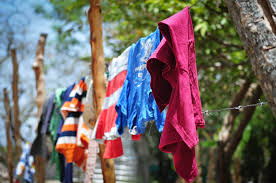
Once the weather gets really nice – late spring around here, or even early summer if it’s a rainy year – I love hanging our laundry out to dry. We have two (TWO!) laundry lines off our back porch, and I find pleasure in the quiet rhythm of shaking open a wet item, reaching for the clothespins, pinning the clothing up, sending the line squeakily towards the yard, and beginning the cycle again. Hours later, as I take the laundry down, I revel in the slight stiffness of some of the dried clothes and the fresh almost non-smell as I fold them.
Laundry lines, which generations past saw as either a necessity or a drudgery, are a luxury for me. Hanging laundry means slowing time and honoring place. We live in a busy downtown where not everyone has a backyard, much less a porch or space and time for laundry. In fact, our house is bounded on one side by housing units, about 10 of which look into our backyard in some way, and on the other side by a larger house that has been divided into three apartments. Our back-door neighbors have a well-used laundry line, and next to them two other houses rise above our yards and look down into our little space. Basically, a lot of people can see our laundry dry.
This potential public combined with my children’s enthusiastic ability to grind dirt into pretty much any item of clothing they wear means that every time I hang the laundry, I end up thinking about the phrase “airing your dirty laundry.” I mean, our laundry is clean-ish, but it’s out there for everyone to see. My neighbors know what my underwear look like, just how big a hole has to be before I declare a shirt unwearable, and exactly how clean is acceptable for socks in our house (hint: not very). I’m not airing our dirty laundry, exactly, but I am surely sacrificing some of our privacy when I head out with a basket full of clothes to dry.
I keep thinking about this. Once upon a time, everyone had to hang their laundry dry. People hung clothes out tenement windows in New York, and Ma hung clothes on the Prairie with Laura and Mary and little Carrie. There was a time when it was scandalous to let your underclothes peek out, but everyone around you knew about your underclothes anyway. Privacy was different then, I imagine. Your neighbors saw your laundry and they knew your business. It must have been an oddly intimate sort of knowing in a time before the tell-all era we currently inhabit.
Today, bras show frankly under t-shirts, boxer shorts parade above saggy jeans, and panties flash below short shorts. Online, I am wildly public about some things, but oddly reticent about others. For example, I cannot for the life of me to bring myself to describe my underwear to you. I’ll hang them up for everyone in the neighborhood to look at, but no way will I write about them here, even though people who read this blog for sure know more about me than some of my neighbors.
Why my hesitation? There are companies on the internet that know more about me than any one person ever will. They know what I browse and where I pause and when I buy. They know all my numbers and statistics and Heaven only knows what else. Yet I curate my social media and consciously choose how to present myself to the world as if my life is private. It’s disconcerting. I don’t particularly like either side of this modern privacy – the curated face or the grasping attempt to monetize everything behind that face. It makes me uncomfortable, like looking at your neighbor in church and knowing that under the fancy Sunday dress are worn-out knickers.
I persist in hanging my laundry. And as I clip another dingy sock to the line, I recognize one more laundry-line luxury: no internet entity, human or otherwise, knows exactly how dirty those socks have to be before I throw them back in the washer for another round. If you want that kind of intimacy, you have to live next door.
The bread was burning. The smell was unmistakable, so I grabbed the turner and flipped the sandwich over to see if it was salvageable. It was not. Nor was its compatriot, blackening merrily next to it in the pan. I flipped them anyway and, as I ruefully considered whether I could scrape off enough burn to make them kid-edible, I burned the other side. Thoroughly.
Two grilled cheese sandwiches, straight into the compost.
I took a deep breath, closed my eyes briefly, realized this is as close as I get to meditation most days, and started over. Butter the first slice of bread; slice the cheese; arrange the orange strips on the bread; place the second slice of bread on top; butter again; into the pan. Repeat.
These two didn’t burn.
How many hundreds of times have I made grilled cheese sandwiches? How many times have I made *these* grilled cheese sandwiches? Same bread, same cheese, same pan, same stove. How on earth did I manage to made such a mess of something so simple? I watched the second batch like a newly-minted chef. They did not burn. My house was brimming with 7- and 8-year-olds making the most of another glorious summer day, so I started another batch. Nothing burned.
As the boys charged in and scarfed down the sandwiches, I tried to get rid of the lingering acrid smell. I opened the door and turned on the range fan. Still the question remained, like an accusation, “How many times have I done this? How could I burn them?” And then, suddenly, I started to chuckle. Yup, how many times? How many hundreds of times have I made these? How many more will I make? Most will turn out, and some will undoubtedly burn.
Ah, but the universe communicates in funny ways, and here – thanks to some sandwiches – was my end-of-summer lesson. Sometimes, the sandwiches burn for no reason at all. Sometimes, I can do everything right and it still won’t work. Sometimes, I just need to throw it away and start over without judgment or blame or worry.
This is exactly what I needed to remember as I head into the new school year: Sometimes, the sandwiches burn; I can always make more.
Not the mock shyness as she stands in my doorway, eyeing me.
She asked to see me.
Not the slender length of her limbs.
She’s four; she might have grown.
Not the wild flare of her colorful skirt as she twirls around.
She is still all energy.
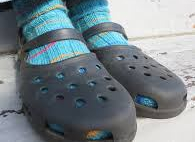
Not the hand-knitted heavy socks defying August heat in blue plastic shoes.
She has her own style.
Not the shameless request for food as her mother sighs, “I just tried to feed her.”
She knows where I hide the treats.
Not even the soft scratchiness of her newly-shaved hair.
I have seen the pictures.
What surprises me is the heat of her head as she tucks her whole body into my embrace;
What surprises me is the sheer hot truth of her.
Today, after nearly 6 weeks away, I got to see my friend’s child for the first time since she started chemo. She is doing well & the chemo is doing its job. There is a long journey ahead, to be sure, but right now it is marked by optimism. Much of our visit was the same as always; much of it was not. When they left, I couldn’t stop thinking of her and chose to write this.
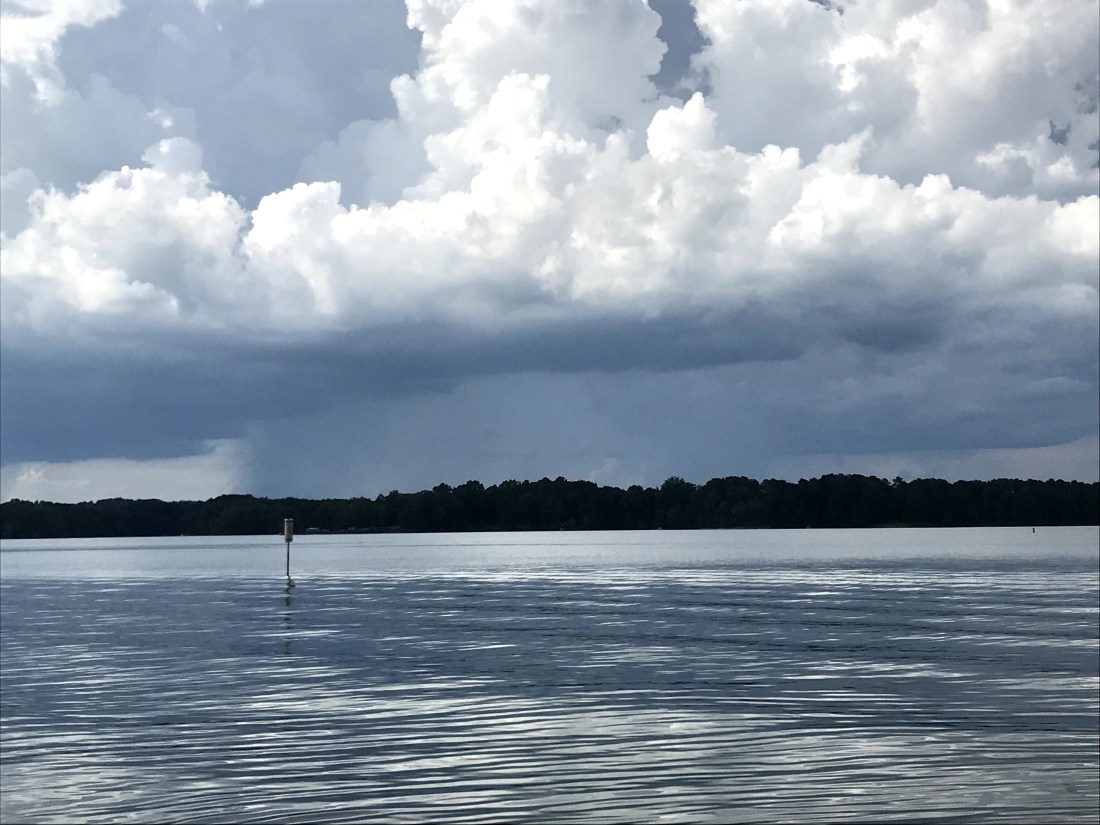
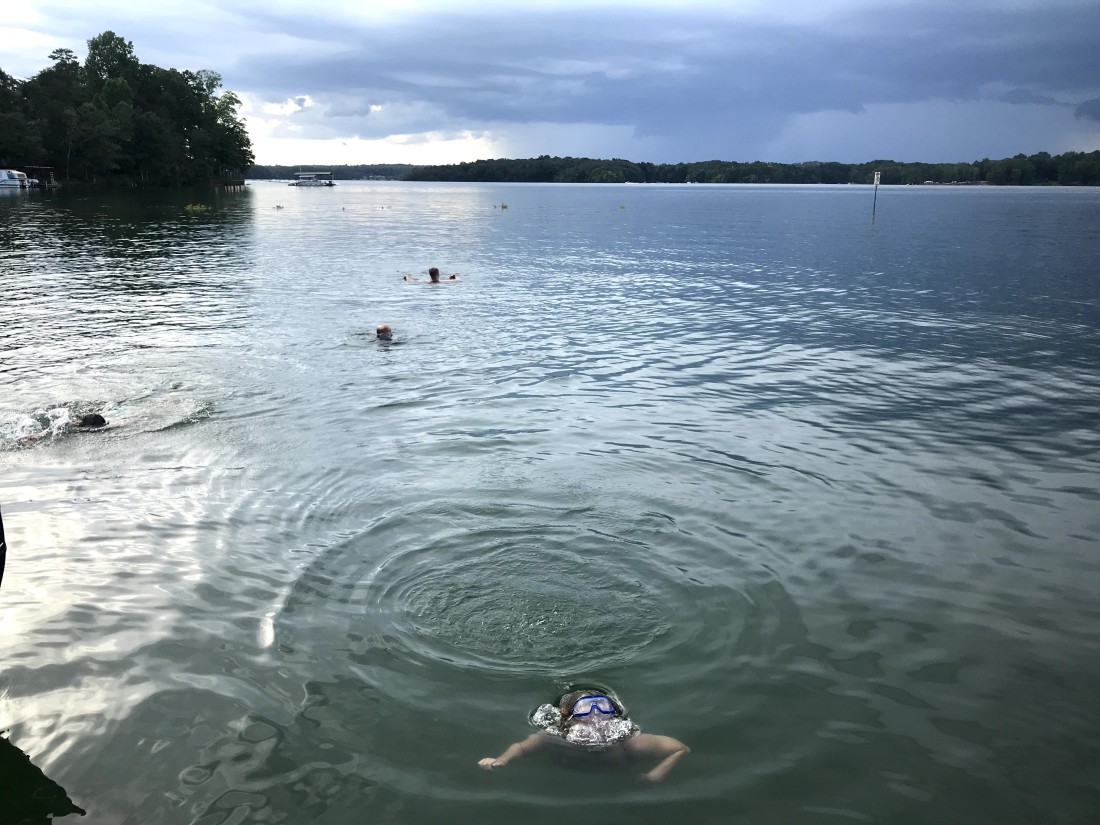
I’m sitting on the dock at the lake watching my children swim and listening for thunder in the clouds I can see rolling our direction. It’s surprisingly hard to tell the difference between the low rumble of distant thunder and the thud of the dog running across the dock, the grind and clang of metal ladder as it thumps against the wood while the kids clamber up, or even the occasional dive-muffled yell as they tumble back in. Listening requires attention, an immersion in the moment.
Evenings here, storms roll in from the northeast. We can see them coming from miles away and they don’t always reach us, so we linger in the lake for as long as possible. Sometimes a gray haze of rain connects the distant clouds to the green forest roof. Sometimes there’s thunder. Every now and then there’s lightning, which means everyone out of the lake, even if the storm is visibly far away. Tonight, we are hoping for no lightning, no thunder. We’re hoping to wallow in the warm water, play on the sandbar, maybe even get in one more boat ride.
Ah, the neighbor is out for her evening swim with her three dogs. She strokes out to the sandbar buoy and back. Her dogs swim over to play with the kids as my parents’ dog – not a water dog – whines, paces and barks from near my feet. In the near distance a speed boat slowly pulls a new wake-boarder who struggles for balance; the humid air carries the sound of their motor and music trails in their wake. Is that thunder? No, I don’t think so.
We leave here the day after tomorrow after nearly 6 weeks of vacation. I am ready to go home, but I’m not quite tired of this yet. My school year doesn’t start for another 3 1/2 weeks, but I feel as though summer is coming to an end. Online, I’m surrounded by talk of back to school – teachers are setting up classrooms, attending PD, planning lessons. Here in South Carolina, back to school sales abound. I tell myself that I have plenty of time – so much of summer remains! – and still, I feel the tug of September, I sense the ending.
The great blue heron flies by and this evening she does not stop to perch on the sandbar buoy; she skims the surface of the water on her way to wherever it is she rests. The boat passes again, no wakeboarder now, heading home. And…I think I hear thunder.
Early August brings a barely perceptible increase in pressure, an almost gentle sense of melancholy: I have things I want to do, things I wanted to get done. Time is running short, or at least shorter. September is there, looming. It’s like I’m sitting on the dock at the lake, watching my children swim and listening for thunder in the clouds I can see rolling my direction.
A few months ago I became a regular reader of Margaret Simon’s blog, Reflections on the Teche, and I almost immediately fell in love. Sometime in March, she posted yet another of her beautiful pictures of the Bayou Teche and I pretty well just asked to come visit her. She was gracious in her reply (for example, she did not say, “I don’t even know you!”), and I hope she understood what I was trying to say: her descriptions of the place around her came alive in a way that made me want to be there. I haven’t visited yet, but Margaret’s awareness of the Bayou that surrounds her infuses much of her writing, so I was delighted to learn about her new book, Bayou Song: Creative Explorations of the South Louisiana Landscape(University of Louisiana at Lafayette Press, 2018).
The book is a wonderful mix of elements: Margaret provides poetry and short, informative descriptions of various flora and fauna found on the Bayou Teche, Anna Amelia Cantrell offers whimsical illustrations and Henry Cancienne adds gorgeous photographs. These work together to create mini-sections: a photograph or two, some information, a poem and an illustration. But wait, there’s more! After all that, in each section readers are offered two entry points to add their own ideas to the book: a writing prompt and a sketch/drawing prompt.
I loved it – and I had a feeling my students would love it, too, but… it’s summer. No students at hand. So I turned to my favourite stand-in students: my children. I told myself that I just wanted to know if they would find the format as compelling as I did, that I was not actually forcing them to do school work during the summer… and then, I got a clever idea. You see, we’ve been on the road for a while now. First, we drove from Ontario to South Carolina to visit my family. After a ten day visit, we hopped back in the car for a series of adventures – an overnight in a cave in Tennessee, a trip to a waterpark, a drive through multiple states and, finally, a visit to my sister’s family in Kansas.
In terms of landscape, it’s safe to say that Kansas is not much like Ontario. As we drove along, I couldn’t take my eyes off the tallgrass prairie of the Flint Hills and the sky and the farms and, well, all of it. My darling children were more engrossed in their tablets than the landscape and, even though they humored me by tearing their eyes from the screens when I called out “Look at the ________!”, their lack of interest was driving me crazy – until I realized I might have a solution at my fingertips: Bayou Song. I knew Margaret had written this book with kids in mind. In fact, I asked her about the audience she envisioned as she wrote.
“I absolutely envisioned my audience as my students. I’ve taught them poetry every year and have come to be known as the poetry teacher. I love this. My heroes are teachers like Amy VanDerwater, Laura Shovan, Irene Latham, and Laura Purdie Salas. I turn to their work over and over for teaching and writing inspiration. I also wrote it for teachers! I want teachers to find a way to enter into poetry with kids that is not intimidating but inspiring and fun.”
I had a feeling my kids and their cousins (all boys, ages 7, 9, 9, and 10) might, indeed, be inspired and have fun if I could get them to read even a bit of Bayou Song. So one morning, as we drove to the Milford Nature Center, I challenged them to observe the plants and animals around them. They were suspicious but I played up the fun and the challenge and they became champion lookers. My nephews are from Kansas while my boys are first time visitors, so their observations built on each other as we explored.
We walked through the nature center and watched the rescued bobcats, turkey vulture, kestrel, bald eagle, prairie dogs, snakes, and owls… we peered into the stream and saw the water bugs, minnows, frogs, herons… we chased down butterflies, grasshoppers, and beetles as we wandered down the trail… we heard the cicadas, the bees, the birds, the water…. we found the tracks of deer, raccoon, herons, humans… In short, we immersed ourselves in the landscape for several hours.
When we got home, we turned to Bayou Song to see how our observations helped us. Margaret is a great believer in poetry for kids and asked her own students about parts of this book. Here’s what she says:
“I write poetry with my students all year long. When I was editing these poems, I asked for their advice a few times and stole some of their ideas. The one that comes to mind is ‘Things to Do if You’re a Snapping Turtle.’ My student Lynzee came up with the last line. She said, ‘Don’t leave home.’ I re-envisioned the line as ‘Don’t leave your room’ thinking about how a room is a special, safe place for a child.”
So, I followed Margaret’s lead. I asked for the kids advice: is this a good book to use in a classroom? We opened the book and the boys were immediately drawn to the Legend of Bayou Teche.
Legend of Bayou Teche
Long ago, in the days when Native American tribes lived
in harmony with the land, there lived a huge venomous
snake. The snake’s body stretched for miles and miles.
The Chitimacha tribe warriors gathered together to
conquer this enemy snake. To kill a hundred-mile-long
snake was no easy task, so it took days for the snake
to die. As the snake fought to survive, it twisted and
turned and created a great gorge in the soil, eventually
dying and decomposing, leaving behind Bayou Teche.
“Creepy,” said one. “Cool,” said another. “Turn the page!” said the third. I did, and we saw this:
“LOOK! It’s a snake and a tree!” “And it’s a river!” “There are birds.” We read the poem. The boys nodded a lot and got into a debate about creepy vs cool. Then we read the prompts:
Write it: Choose a place in nature (an ocean, a tree, a flower, an animal)
to write about. If you use personification (as in “I am a Beckoning Brown
Bayou”), you become the thing you are writing about. How would an ocean,
tree, flower, or animal feel, act, hear, smell, or see?
Sketch it: What is a waterway near you? Does it have a shape? Does the shape
match its name? Draw the waterway so that it matches its name.
We repeated this process for the first few sections – one boy lingered over the “non-fiction,” another liked the drawings, two had me read poems out loud repeatedly – until one of the kids looked at me and said, “When do we get to write?” Um, in mid-July a bunch of kids just asked me if they could write and respond to poetry. “How about now?” I suggested. I already had the paper, pens and colored pencils. The kids dove into drawing, writing, and sharing their ideas with each other. They talked about what we had seen. They thought about things in new ways – like leaves as hair or trees as rivers. All four boys were intensely focused as they worked. Here’s a peek into their creations:
Thomas was inspired by both prompts for “Legend of Bayou Teche”.
Eric liked the photographs and drew a prairie dog playing a guitar in response to “What is your favorite musical instrument? Draw a picture of the instrument being played by an animal.”
Philip lives near a military base. He loved the prompt “Think of something in nature that reminds you of something else. How is a tree like a soldier, for example? Write a three-lined poem.”
(The fourth boy was also inspired, but creating his grand vision – the Kansas River and several complicated elements of animals and trees – required more stillness than he could muster in one July sitting, and he asked me not to share his unfinished product.)
Clearly, Bayou Song is an open invitation to children and adults (because, I can’t lie, I wrote a little something, too) to experience their environment and respond to it in ways that are simultaneously thoughtful and playful. When we went canoeing yesterday, the boy in my canoe was still imagining himself as various animals and noticing things as we floated by. As a parent, I couldn’t ask for more. As a teacher, I can’t wait to use it as a mentor text and as an inspiration in my classroom next year.
Would you like to know more about Bayou Song? Continue your tour at these blogs, where you’ll find more poems and illustrations from the book, interviews with Margaret Gibson Simon, and other surprises.



 “The word ‘believe’ is rooted in an old English word meaning to hold dear, esteem, trust; it has the same origins as the word ‘love.’ To ‘believe’ is not to agree with particular ideas or concepts, but it is make a commitment of the heart.” –





 © Anna Cantrell, 2018
 Thomas was inspired by both prompts for “Legend of Bayou Teche”.
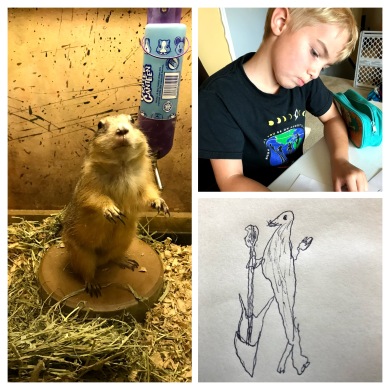 Eric liked the photographs and drew a prairie dog playing a guitar in response to “What is your favorite musical instrument? Draw a picture of the instrument being played by an animal.”
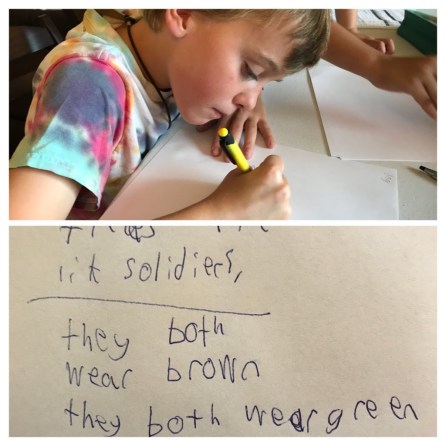 Philip lives near a military base. He loved the prompt “Think of something in nature that reminds you of something else. How is a tree like a soldier, for example? Write a three-lined poem.”
 Persistence and Pedagogy