Say my name #SOL23 21/31

“Ok, it’s 9:25. Who wants to do the Land Acknowledgement?”

Around the classroom, grade 12 students shift in their seats. No one meets my eye. A few more kids slip in and find spots while I wait. Eventually, someone raises their hand. They choose to read the printed acknowledgement out loud rather than offer their own. We review the meaning of “stewardship” and then it’s time for a quick book talk – Their Eyes Were Watching God – but before we shift into independent reading, A says, “Wait! We have to do names.”

Students begin to chuckle. “Right!” I smack my forehead dramatically, “Names. Surely we can do better than yesterday?” Yesterday was a disaster – it took three tries before anyone could name everyone and apparently no one – including me – was pronouncing one student’s name correctly. (And this after I had practiced!) Eventually she gave up on us, even though we really were trying. Today goes a little better. We get through everyone twice before we move to reading.

Y’all. It is mid-March. And yes, we are a semestered school, and yes the beginning of this term was riddled with weather days, but we’ve still been together as a class for six weeks. I try to say students’ names all the time (mostly because I think it’s polite and friendly, but also because it’s a research-supported way to give people a sense of belonging and increase engagement), but lately (ok, yes, post-pandemic) it seems like quite a few students don’t bother to learn the names of their peers unless they were already friends before the class started. I’m not ok with that.

I have checked in with the teenager in my home; he admits to only knowing some of the names of his classmates. In fact, he is perplexed by my question. “They don’t usually make us work with other people,” he says. When I ask, “But how do you meet people?” because he is in grade 9 and therefore at a new school and therefore has made new friends, he says, “I already have a group of friends I’m happy with” then gives me a look and goes back to his phone. I push and ask how he met his new friends this year, but he only grunts at me. Minutes later he looks up and says, “that’s actually a good question,” but he doesn’t have an answer.

Unfortunately for my students, I’ve come back from March Break with a fire in my belly: I’m determined to help them connect – and if they can’t or won’t or don’t want to connect, I’m determined to at least give them practice in the skills they will need to do this later on. Yesterday, I told them about this article that argues that we should not allow cellphones in school *and* that we need to “rewire classrooms for connectedness.” So I’ve asked students to keep their phones away and I’m insisting we learn each other’s names. I get the sense that some of them think that this is cute but ultimately useless, but so far no one has said no. 

Today, once it seems like many people know most names, I tell the students about the next step in my scheme: I want them to learn something about the other people in the class. In the front row, the same student who had reminded me that we needed to practice names, shakes his head as he opens his book. “Good luck, Miss,” he sighs. I’m pretty sure I’m going to need it.

Starting again #SOL23 20/31

I got to school early enough to print and photocopy a few documents before heading down to the classroom. There, I rearranged the desks while I cleaned abandoned paper and almost-lost books out of the shallow spaces under the table tops. I erased the bits of colour that lingered at the edges of the chalkboard, marks I had missed as we left a week ago, then replaced them with today’s date and quote, carefully leaving out the punctuation so that the students would have a puzzle waiting when they arrived.

T was first. He often is. Then E, who came in then left then came back again. Then N, who sat, self-composed, and waited for class to start. And S slid into place next to T. As I asked them about their March Break, I moved around the room, gathering up the books leaning on the ledge of the front chalkboard – casually labelled “New Books”-  and taking them back to the bookshelves to settle into their long-term home. I replaced them with books I had scavenged during March Break and rewrote “New Books” above them, in a different colour of chalk, hoping that someone might be intrigued.

By now, the classroom was about half full. Sunlight filtered in through the half-pulled shades; the lights were still off. Some students were already reading; others had their heads down; still others chatted softly. A few more students arrived. The classroom breathed quiet anticipation. Then the hands of the clock moved, and Break was over. We were ready to start again.

Throwing in the towel #SOL23 18/31

March Break is almost over and I’m still so tired my eyes ache. I’m not ready to go back. The EduKnitNight chat is full of “you can do it” messages as we gear up for the certain chaos of the return to school on Monday. 

“Gently suggesting that we all take space for ourselves – even if just for 20 minutes – today or tomorrow. To help us through the week with a little reserve.”
“Breathe, know that you are enough, be kind to yourself.”
“Messy and underprepared is not a sin.”

There’s a post in there somewhere, but I can’t quite find it. I text my sisters for ideas & they immediately list hilarious moments from our past – the time B put ketchup on her ice cream, the time we hid our exchange student’s speedo before we went to the beach, the time my sister broke her arm (which is funny because we were wearing towels around our necks and jumping off blue armchairs, spinning around and yelling, “Wonder Woman” when it happened). Soon we are talking about my nephews’ upcoming birthday, and…

I still don’t know what to write. I want to write about the concert Andre and I heard on Thursday or the play we saw last night. I want to write something funny about… something… but instead here I am, writing about not writing and laughing at myself because I have been participating in this challenge for six years and I think I have written some version of this post every year and every year I’ve felt badly about it. 

I think about Elisabeth saying once, probably my first year, that this isn’t so much a writing challenge as a publishing challenge, that part of this month is about knowing that some days I’m going to write things that aren’t great and I still have to hit publish because it’s ok for some things to be mediocre. 

And, once again, I have written something – which is better than nothing – and now it’s time for dinner and conversation with my friend. “Messy and underprepared is not a sin” I whisper under my breath. In a moment I’ll post this, heave myself out of this beanbag nest and tomorrow, I’ll write again.

Parking #SOL23 17/31

I used to drive a school bus. Yup, you read that right. When I taught in Washington DC the school was so small that PE requirements were fulfilled through after school teams and young teachers got our commercial drivers license so we could drive the teams we coached.

Most of the school’s bright blue fleet was short buses, but Amy and I coached the (giant) middle school soccer team, so we drove the full-sized bus all over the DC area. We regularly garnered startled second looks from drivers as they passed us on the highway, but that didn’t bother us: we knew we were more than competent. Mel, Head custodian and general fixer of everything (who was also in charge of the buses) knew it, too, which is why he trusted Amy and me to park the size bus after all the kids had been picked up.

Because the school was in the middle of one of DC’s downtown neighborhoods, there was only one nearby space that could accommodate the big bus. The operation required two people and a lot of nerve. We negotiated narrow one-way streets until we arrived perpendicular to a long alleyway. Here, we maneuvered our  blue behemoth in a fifteenish-point turn, then threaded our way between two buildings, the sides of the bus mere inches from the brick walls on either side. About a third of the way up the alley, a pipe snaked up the side of the building on the right; a few feet further on, a meter jutted out of the building on the left. There was no room for error.

Once we made it through the alley, we emerged into the relative freedom of a very small parking lot, where we slid the bus into a spot right against a wall. Finishing was always exhilarating.

Which explains why I blushed with pleasure tonight as a group of us left the restaurant and the woman at the next table touched my arm and said, “I watched you park your minivan. It was amazing.” I looked out the window, suddenly realizing that everyone inside had been able to see me parallel park in a very tight spot, then I grinned, “well, I used to drive a school bus.”

Civilization VI #SOL23 16/31

I have spent all day – and I mean the entire day – playing a game. I started last night, went to bed much later than I intended, woke up & was vaguely friendly to my family (who then went out for the day – skiing 😆) and, after they left, started again.

It has been glorious. My mind has been completely engaged in planning a civilization, sending out settlers, city planning, diplomacy and more. I haven’t thought about school at all – heck, I even forgot to write a post this morning and I certainly haven’t started commenting. Instead, I’ve been Eleanor of Aquitaine, carefully building up my cultural and religious influence as I slowly gain power. I’ve fished and farmed and fought (as little as possible of that last; I maintain a big enough army that people don’t really want to attack me). I settled near Halong Bay and constructed Chichen Itza and the Colossus and the Hagia Sofia and more. Cervantes grew up in my empire, as did Rumi, and their writings have made us all very happy.

I’ve played for so long that my brain is seeing hexagons (the tile shape in the game) everywhere. Now, my family has returned and I’ve baked another batch of blondies (thanks to fellow blogger Arjeha who shared the recipe two days ago – because my children ate *the entire pan* yesterday) and I’m going to go for a walk even though the weather remains stubbornly cold and gray. Soon after that I’ll have to put on something other than sweatpants because we’re going out. Sigh.

Nevermind. In Eleanor’s world, I’m building a theater and an aqueduct. The closest volcano has gone extinct and I’ve circumnavigated the globe. I’m fairly certain that another Vietnamese city will soon ask to join my empire because of my amazing culture.

I’m a reader, and I get easily lost in a good book, but if you ever have a need to forget the real world for a few (ok, a lot of) hours, do I ever have a good game for you. (It’s Civ VI – if you didn’t notice that in the title😉.)

The day after Pi Day #SOL23 15/31

These days, it feels like everyone knows about March 14, Pi Day. I know we didn’t do this when I was younger, but now it’s a thing, so I thought about making some sort of pie yesterday, but skipped it because it’s March Break and I didn’t feel like it.

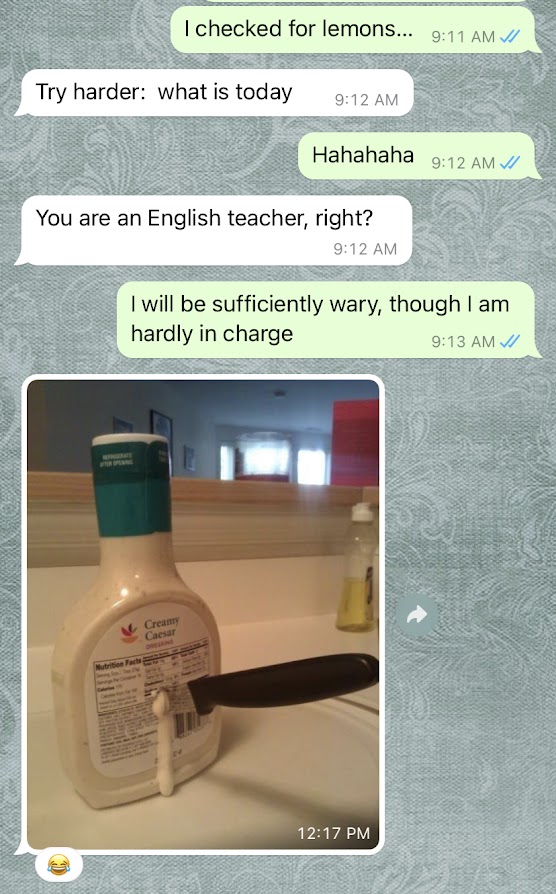
This morning, I came downstairs to find this (it was on my phone, but I needed my phone for the picture):

I’ll admit, it took me a minute. At first, I thought my husband might be referring to one of our new favourite things which a younger colleague recently shared when I was all steamed up: Cave Johnson Lemons

(Really, you should listen. It’s hilarious.)

But… no, I wasn’t quick enough. Here’s our conversation.

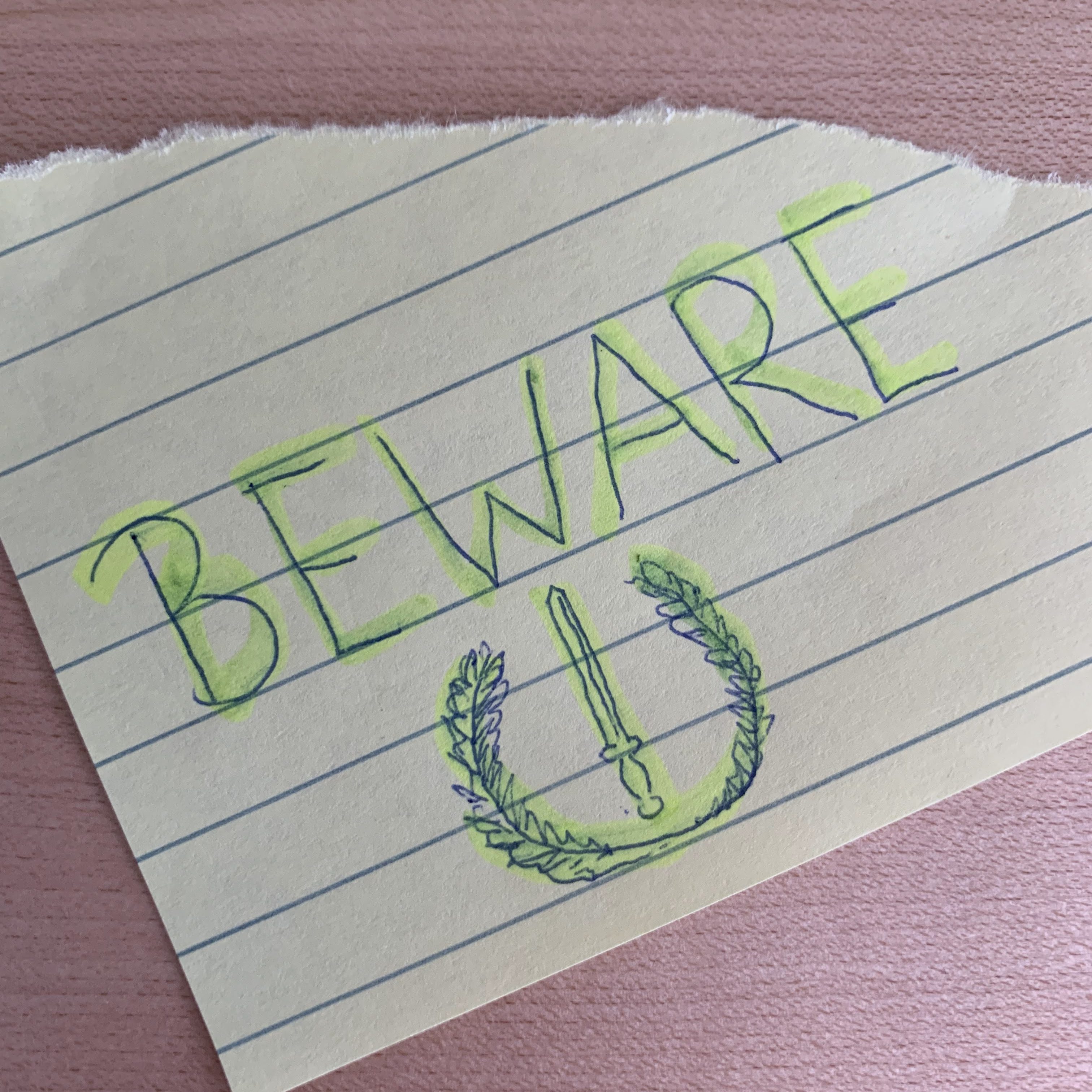
I’m pretty sure (but not 100% sure) that the final picture is from the internet and not from his office, but one can never tell: apparently, in our house, we skip Pi Day and go straight for the Ides of March.

What if? #SOL23 14/31

The first time I remember saying that I wanted to be a teacher was when we were living in California and had friends over for dinner. We were in the dining room because there were too many of us for the kitchen table, and I think a few of us kids were seated in a row on one side. One after another, we responded to some adult who had asked us what we wanted to be when we grew up. The boy from next door said he was going to be a pilot, like his dad. My youngest sister, who must have been four, declared her intent to be a garbageman. I said I was going to be a teacher. Both of us were met with scoffing laughter, in my case because, “you’re too smart to be a teacher.” 

For years, I assumed that everyone wanted to be a teacher, kind of like lots of little kids want to be construction workers or, like my sister, garbagemen, and then they got over it at some point. I just couldn’t seem to get over it. I nurtured my secret desire while telling well-meaning adults that I planned to be a lawyer or, later, a diplomat. Meanwhile, teaching leaked through my every crack: I taught swim lessons and coached swim teams; I volunteered as a tutor; I nannied. Even though I attended a college that had no education major, I took a course that involved an internship, and convinced the prof to let me work in a third grade classroom; then I took a language acquisition course, then a children’s literature course. None of these were in my major. 

When I finally accepted an overseas teaching position, I packed a stack of graduate school applications, already printed. I started filling them in after my first day in the classroom; I’d sent them all by the end of my second week.

Teaching is who I am; I am as likely to tell a stranger that I am a teacher as that I am a mother. In fact, I can’t imagine someone knowing me and not knowing that I teach, but lately I’ve been wondering… what if I weren’t a teacher? What might I be?

The serious options:

  • A lawyer – I deeply admire my friends who work for justice and equity through the law.
  • An editor – I have been blessed (?) with a brain that sees spelling and grammatical errors quickly and easily, and I’m pretty good at straightening out complicated sentences.
  • A librarian – I had no idea about all the cool things librarians could do. My librarian friends curate art, help with tech, do research for Parliamentarians, and much, much, more. 
  • A nonprofit worker of some sort – which is what I did between college and teaching. I worked for the Red Cross and for a small nonprofit that worked with some UN agencies. It was kind of cool.
  • A psychologist – which, in some ways, isn’t that different from being a teacher.

The wilder options:

  • An actress – obviously (she pirouettes and takes a bow)
  • A former swim champion turned coach – ideally a champion with some medals or something
  • An organizer (one of those people you call to come help you get your house sorted out) – because I am *much* better at organizing other people than myself.
  • A midwife or a doula – in fact, ever since having my first child with a doula alongside me, I’ve imagined doing this, maybe after I retire. What a thrill to help someone bring life into the world!
  • And, in the realm of the completely impossible, a dancer or acrobat – I have precisely zero ability to do this, but every time I attend the ballet or watch Cirque de Soleil, I dream of being able to move my body like that. So impressive.

I’m sure there’s more I’ll remember after I publish this; it’s kind of fun to think about who else I could be. What about you? If you weren’t you, what would you do?

It’s all downhill from here #SOL23 13/31

The car, warm and humid, smells of dirty wet socks and preteen sweat with subtle notes of Dorito and popcorn. In the passenger seat, the oldest boy dozes, lost in headphones and dreams. Behind me, the youngest cheers, “I know where we are! Now that we’ve slowed down, I can open a window!” and the three middle kids guffaw over a phone. We are on our way home from a day at the ski hill.

I am not much of a skier, but I often wish I were. When I watch people swoosh down a slope and skid into a  splashy stop right at the end of the line for the chairlift, I think that it looks like fun. When I ski, however, there is no swishing and no suavely swooping stops. Mostly, I pizza my way down the beginners’ slope, praying that I don’t look as stupid as I feel.

This is the first year my kids have skied since Covid began three years ago. Today was the first day I have skied in a decade. I wish I could tell you that it went well. Instead, I worried my way around the house as we left, all too aware that I didn’t know exactly what we needed for the day. Once at the ski hill, I sausaged my thighs into snow pants and had so much trouble putting on my boots (bought maybe eight years ago when I became convinced that to be a good Canadian mother I needed to own skis & take the kids skiing regularly, but never actually worn because I’m not actually a skier) that a young woman in the rental place took pity on me and helped me out after she had finished with the kids. 

Immediately, my feet began to hurt, but I’ve forced my feet into uncomfortable ice skates year after year, and I know that ski boots aren’t meant to feel *good* exactly, so I pushed forward. Outside, the boys stepped into their skis and took off. I tentatively stuck my toe into the front bit and pushed my heel into the back, feeling proud that I managed not to slide down the (almost nonexistent) slope as I did so. Then I moved towards the bunny hill, pizza wedge already firmly established.

By the time I got there, my feet were screaming. I focused on figuring out how to get up the tiny incline to the magic carpet that takes tots to the top of the hill. I watched several little ones in front of me get on, and gathered my courage to step onto the mat. All the way up, I rocked from side to side, trying to give my poor feet a little relief from the pain. Just as I began to realize that the pain was coming from compression, not weight, I reached the top and had to return my focus to remaining upright. 

Sliding down the bunny hill without falling took most of my concentration and, at the bottom, I felt a sudden burst of confidence. A much longer “green” slope was just off to my left. I could take the chair lift up and have a lovely easy ski, I thought. I couldn’t see the actual – it was just behind the trees – but I was certain I was ready. 

I remembered how to sit into the chair lift & up I went. I rested my aching feet on the support bar and was grateful for what relief that provided. About halfway to the top, I began to worry about getting off of the lift. I tried to recall the tips and tricks for something I had never been expert at: lift your ski tips, let the chair push you out… I did it! Then I promptly fell over. 

Once I righted myself, I spied the arrow to the green slope and skied over. Then, I stood at the top and panicked. I almost turned around to check that I had chosen the right run, but I knew I had. I took a deep breath, formed a wedge with my skis, and started down. I fell on the third turn. Once you’re on the hill, there’s nothing to do but keep going, so I stood up, took a deep breath and started talking myself down. Soon, I was talking out loud, encouraging myself down the hill like I might a small child, “You can do this, you’ve got this, okay here comes the turn, don’t worry, just put your weight on one leg and… don’t panic, don’t panic… Good job! You did it! See how well you’re doing! Here’s another turn…” I kept the positive patter up all the way down. As I turned for the last time and straightened my skis towards the bottom of the hill, I heard myself say, “Good girl! Now you never have to do that again.” I almost laughed out loud; my subconscious knew what was what.

As I skied towards the chalet, I realized that my feet were numb. When I finally sat down and took off those boots, sweet relief washed over me. Even my winter boots felt welcomingly roomy in comparison. “Well,” I told myself, “I guess that’s it: I’m done skiing forever.” I settled in with my book and became home base as kids came in and out, looking for food and warmth. I felt a little sad about being such a terrible skier, but my feet were really happy to be done.

Hours later, I pile exhausted, smelly kids into the car and drive them home. Over dinner, I describe our day to my partner, and a look of concern comes over his face. “Honey,” he says, “ski boots aren’t supposed to feel like that.” I explain how skates are uncomfortable and my feet are old and my arches need support and… “No. That’s not it,” he insists, “We need to get you some better boots.”

I nod my head bravely. I imagine those swooshing skiers. I thought I was done forever, but I might not be – but right now I’m too tired to think about it.

The Day Two Blues #SOL23 12/31

March Break officially started Friday at 3:25. Not that I was counting. (I was counting.) Today is officially day two of nine, and I am in the middle of the day-two blues. 

Friday night we ordered takeout and didn’t tell the children to get off the internet and stayed up too late reading our books. Yesterday I was all, “yay for March Break” and “I slept in” and “let’s just sit around and do puzzles all morning” and “sure, I’d love to take a long walk” and “everyone can forage for dinner.” We watched a movie on Netflix; then we watched several episodes of a show we enjoy because why not? 

Today is day two. I woke early and was thrown off by the time change, even though I knew it was coming. All day, I’ve been less certain of my sloth. I’m not sure if I like the book I started yesterday, I couldn’t quite decide if I should take a nap for so long that it got too late for a nap. I’ve been hemming and hawing about whether today should be a “get it done” day (so things aren’t hanging over me for the rest of break) or a “just kick back” day (because it’s day two). It’s 5:45 now, so it’s actually been a “talk about doing things but don’t do them” sort of day. Not my favourite.

Today, social media is full of photos of friends who’ve arrived at their beach vacations and friends who’ve already hit the ski slopes. Around here, Andre managed to shovel a path to the back shed and I went wild and crazy by taking *two* walks and folding the laundry. No, we did not post pictures.

Today I’ve been staring down the list of things I thought I’d get done during this break and realizing, as I often do, that I may have been a little overly ambitious. Today I’m feeling the full fatigue of the last few weeks. I’m fizzling out. Today, I’ve got the day-two blues. 

So I’ve set out a puzzle and pulled out my knitting. I’ve snuggled into the couch and stayed in my sweats.  I’m choosing some movies and chatting with friends. I’m letting go of (some of the) lists and allowing myself to feel at loose ends. Tomorrow is day three, and there’s no such thing as the day-three blues because it doesn’t rhyme. I can live with that.

Compliments #SOL23 11/31

Years ago, my colleague, Aaron Bachmann, walked into our office one day and told us that he had learned that people don’t get enough compliments and that, when they did, something like 90% of them focused on appearance. He was determined to change that. 

Aaron set about giving us all compliments – real ones. It was hilarious and cheesy, but it also felt good. And he kept it up. He gave compliments all the time, to the point where even now, years later, whenever I think of him I smile. Sure, I remember him fondly (we haven’t worked together in almost two decades, more’s the pity), but it’s more than that: when I think about Aaron, I feel better about myself.

There’s tons of research about the power of  compliments (here, for example) and, naturally, about how to do it “right” (here), but you already know the truth: voicing your sincere appreciation of someone else does all sorts of wonderful things.

Now, I have *no* research on this next part, but I think most teachers don’t get a lot of compliments – or at least not the kind we can fully believe. I mean, I love when a student gives me a compliment, but most of the time a part of me is also a tiny bit wary because students have a clear interest (grades) in telling me that they like what we’re doing. (This is why students who stay in touch and say nice things later on are really meaningful to me, even though I’m pretty terrible at writing back in a timely manner.) But the truth of our job is that  we spend most of our days alone in a room with students. We spend our days trying to meet the needs of many humans, and we are often all too aware of the ways in which we don’t live up to our high standards. Parents are rightly concerned about their child’s development and happiness, so they don’t often give compliments either: when things are going well, they leave us alone; when things aren’t going well, we hear about it. As for administrators, well, that is highly dependent on the administrator, but my experience is that most high school principals are not big on compliments.

This week, our Literacy Coach, Xan Woods, came to our school. When she wasn’t assessing students or compiling data or supporting other people, she had time to watch me teach. This is one of her go-to supports: whenever she can, she observes, then provides feedback. Xan knows that these past few weeks have been extraordinarily difficult for me, and she knows how I’ve struggled with my own concerns about my competency in the Reading class I’m teaching. I was excited to have her sit in because I knew she would have good feedback and new strategies to help me improve.

But here’s what actually happened: at the end of the day, she complimented me. She noticed that the students in the class are starting to respond to the instruction. She told me about the various ways she saw them support one another. She pointed out that they were willing to write on the board (a huge step forward), and that every student read aloud – not just in choral and echo reading, but at least one sentence on their own (a miracle) – for the first time. She was genuinely excited for me and said, “You’re amazing! You’re really doing it!” then talked about strategies that were working. Later, she posted a short video clip of me, teaching, on Twitter and outlined things that were going well. I almost blushed. She does this for many of the teachers she observes, so that we can learn from each other as we teach in our separate classrooms. It’s incredible.

I can’t even begin to express how much this meant. She didn’t say I was perfect. She didn’t say that there were no improvements we could make. She simply noticed where I was doing a good job, and for a while, the difficulties that have been dogging me felt less heavy. When I taught the next day, I was a bit more relaxed, a bit more confident in my choices. Xan made a difference.

This writing challenge, too, lifts me up. Yesterday, a high school friend, Katie, told me she loves the time of year when I publish every day. I glowed. Maybe Stacey and Melanie and the others at Two Writing Teachers knew this would happen. Maybe they knew teachers needed this space. Every March so many teachers use their precious time to write something and publish it every day. We make ourselves vulnerable in ways I don’t think we always share: Who will read (and maybe judge) our public writing? What if, as a teacher, I publish something that is not very well-written?(Um, I do this every March. 31 days in a row is a lot of published writing; some of it is necessarily not great.) Whose story can I share? What may I reveal about myself? Others? The school? It’s a lot. Yet every day, people reply to our posts and say wonderful things. We write to each other, sharing connections, observations, thoughts and, always, compliments. For one month, we lift each other high and say what Xan said to me: “You’re amazing! You’re really doing it!”

Aaron knew it all those years ago: compliments change everything. So, to Aaron and Xan, to the people behind Two Writing Teachers, and to everyone who is writing and everyone who is commenting, thank you. Your words change the world for the better.