September Looms

I gave myself the summer off, mostly. From blogging, from prepping for classes, from worrying about who can or cannot read and what needs to change or stay the same. I tried to actually relax – or at least not to be actively stressed. I attend zero conferences. I abandoned books I didn’t like. I didn’t plan a big family trip. I hung out with friends and family and quit Twitter. Overall, I think I did ok. 

I still have a week left before school starts, so this morning I rolled out of bed and plopped almost directly into our oversized beanbag to read a little of Jhumpa Lahiri’s Whereabouts. Instead of immersing myself in the story, however, I found myself wondering if I could finish it and return it to the library today, another item checked off the before-school to-do list that’s already filling up. My mind gleefully got into the go-getter groove, and soon I was listing as much as I was reading. Gah! Not what I had wanted.

I tried to shake off the looming lists and plans. I tried to read one more short chapter, but Hera – our cat – was having none of it. She scaled the back of the bean bag and dragged her tongue across my cheek. Skritch. Then she did it again. She clambered onto my chest, batted down the book, and looked me in the eyes. I knew she was right: time for tea and then into school to set up the classroom.

So I got up, neither fully relaxed nor fully tense, and lumbered down the stairs towards September.

Runaway #SOL24 20/31

He rarely comes to class, but when he does, we do what we can to make sure he has at least a little success. He’s in grade 9 and is currently illiterate in three languages. Research says that students with strong reading skills in their home languages often also have strong reading skills in their second language (see Short & Fitzsimmons, 2007 or this shorter article by Fred Genesee), but he doesn’t have strong reading skills anywhere. We can’t turn back time, but we’re doing what we can to move forward.

He’s lucky because this class has a push-in support teacher. She’s technically there for other students, but no rule says that she can only help them, so we’re using what wiggle room we have to create as much space for him as possible. When we were writing 100-word memoirs, she just happened to be sitting near him and just happened to be able to scribe for him. As I circulated, their heads were close together in front of the computer, counting words. When he realized he had written a story of exactly 100 words, he was so proud that he asked her to read it to him again. He beamed. Then he skipped for three days.

Then next time he made it to class during reading time, I sat with him and quietly talked through The Invention of Hugo Cabret, which he likes because it’s thick and he says it makes him look smart, while Ms H kept an eye on the other readers. Even the pictures were hard for him to understand, but he liked talking about them. Then he refused to do anything else.

Sometimes, he comes to class (late) and then asks to get water or go to the bathroom. I put him off as long as I can, but I am not the arbiter of his bodily functions; when he says, “Miss, I really have to go,” I let him. Sometimes he comes right back, but sometimes he runs. Two days ago, he swore he would only be gone for two minutes, then he took the hall pass and disappeared. I found him in the lobby later that day, skipping a different class. While we walked to where he was supposed to be, he told me that he had thrown up that morning, so he couldn’t return to my class. Given that he was practically bouncing up and down with energy as we edged towards his class, I reminded him that usually someone who throws up goes home, but he said he called home and his mother said no. Ahem. I found him in the hallways again that period and once the next period. He told me he just can’t stay in class.

Yesterday, Ms H had a breakthrough. She saw him (in the hallway, of course) and made some sort of deal/ bet with him – and then he actually showed up to English class a mere 10 minutes late (thus missing most of reading time). Meanwhile, she had hatched a plan. She took him to a quiet room – but not the resource room; he refuses to go there – and she started a phonics assessment with him. She praised him for what he could do and talked about ways we could help. She told him she could start with what he can do instead of expecting him to be able to do impossible things. He was eager.

Ms H was excited that we’d found a way to start giving him some real support. That afternoon we talked through her plan. But this morning, he saw her in the hall during first period, turned around and went the other way. Then, he saw her at the beginning of our class. This time he ran away. Ran.

We stayed after class together, Ms H and I, trying to figure out how to help him accept our offers of support. We reminded ourselves that years of failing in school, years of hiding his weaknesses, mean that he probably thinks he’s beyond redemption. He may be afraid that he’ll just fail again and disappoint us in the process. We walked into the hallway partway through lunch, and there he was, right by our English classroom. Gotcha! Gently, we reminded him of his (broken) promise. I told him that it hurt Ms H’s feelings when he didn’t come. She told him that she had been really excited to see him today. He shifted his weight back and forth, back and forth. When we finished – maybe a 30 second “chat” – he said, “OK” and then… he ran.

Sweet runaway boy, how I hope you’ll let us try to help you read. Reading will make a bigger difference than you can imagine. It’s worth sticking around for.

Knock-on Effects #SOL24 7/31

Today, I got an *AMAZING* message from a former student. She is graduating from university and is “almost an RN now.” I am aglow with happiness for her – and for us: she’s going to be a wonderful nurse. I am proud to say that a tiny part of her story relates to my post from yesterday. 

You see… back when Mr. 13 was Mr. 6, he was driving his teacher up a wall. They butted heads regularly (in a first-grade sort of way – the kind where it turns out that six-year-olds need to follow rules sometimes), most often in reading group. There, Mr. 6 would some days read fluently, then other days act silly, “reading” words that were not on the page. We were baffled. The story goes that one night, angry with my insistence that he try to sound out words, he “read” his entire book without looking at the pages *even once*. But he couldn’t read individual words.

Because his teacher was both kind and deeply experienced, she had already flagged his reading as potentially problematic. Because I knew that dyslexia ran in my family, I already knew to pay attention to my children’s reading. Because my colleague’s wife was a child psychologist who did lots of educational testing, she advised testing Mr. 6 asap, rather than following the school system’s recommendation to“wait and see.” Because we have good health insurance, we could pay for private educational testing. And because of all that, we discovered that Mr. 6 had dyslexia when he was, well, 6.

The chips continued to fall in our favour. First, even though I am a high school English teacher, I was already learning about how people learn to read, so I knew that people with dyslexia benefit from early intervention. Then, when the principal said it was “too bad” that Mr. 6 was going into Grade 2 because the school’s reading intervention program started in Grade 3, we were wealthy enough to pay for tutoring. Then, I began researching dyslexia and found Dr. Sally Shaywitz’s book, Overcoming Dyslexia which recommended specific research-based tutoring programs. In a final bit of good fortune, a local tutoring company specialized in exactly this. 

Y’all, that is a lot of good luck. Learning to read should NOT be a matter of luck.

Now, let me tell you about my student. She had struggled to learn to read when she was little, but she was an incredibly hard worker, so she managed to stay on top of things. She was seriously smart, so she was able to figure things out, even though reading remained, well, not easy. By the time I met her, she was in 10th grade, and she was working her butt off. She was also doing extremely well in school. 

Still, as we got to know each other over a few years, she confided in me that she wasn’t “as smart” as her friends because she took “three times as long” to do her homework and made “stupid mistakes” if she wasn’t focused. I believed her, but I didn’t know what to make of this… until about ¾ of the way through Shaywitz’s book. There, I read a description of a high school student with dyslexia. Right away, I thought of her. Pages later, Shaywitz listed some common signs of dyslexia – and suddenly I had concrete questions I could ask someone. 

I explained to this young person that I had an idea about her learning. Then I read her the description in Shaywitz’s book. Recognition dawned: “That’s exactly me!” I am not an educational psychologist, so I can’t diagnose anything, but at least we had an idea of what might be happening. All we needed was some testing – which our school system couldn’t provide because, first, our limited resources go to students who “are not able to access the curriculum” and this student was on the Honour Roll and, second, those same resources are meant for students in our system, and she was nearing graduation. We fought on. One thing led to another, and things stayed plenty dang complicated, but in the end she was able to get accommodations when she went to university. Things weren’t easy, but they were, at least, easier.

Looking back, it all feels awfully precarious. What if my child’s teacher hadn’t noticed his uneven reading? What if we hadn’t known to get him tested? What if I hadn’t been reading about dyslexia? What if?

I think about all the people who will benefit from having this brilliant, determined, caring young person as their nurse. I know this is supposed to be a slice of life – and I really want you to know how much I admire the student I’m writing about – but I have to end with what I already said: learning to read well should not be a matter of luck. As a profession, we are trying to make changes so that more students learn to read well. I hope our systems don’t give up when our first attempts aren’t perfect. I hope our system doesn’t write off students who are already in high school. I hope we have success story after success story to tell in years to come. And I really hope you’re lucky enough to have this person as your nurse. That would, indeed, be lucky.

“Oh!”

I’ve just finished taking attendance and am closing my computer so that I can read along with my class when I hear a muffled gasp from the middle of the room.

“Oh!”

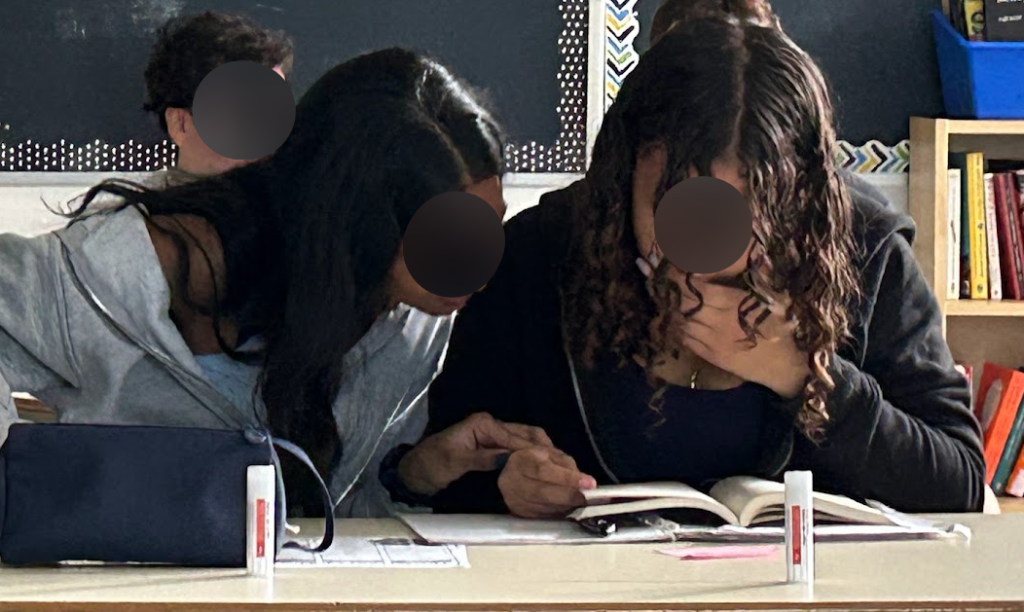
My eyes snap up. Is something wrong? A student has her hand over her mouth, eyes wide as she stares at her book. Her friend shoves her own book – newly started – to one side and leans in to see what’s on the page. The reader’s eyes are wide. She starts to dog-ear the corner but then, just before she creases the fold, she flips the page. Both girls’ eyes dart back and forth as they read quickly down the page. Another intake of breath then, heads together, they hold a whispered conference.

One of them looks up and catches my eye. I nod. I know this book. I know where they are. It is, in fact, gasp-worthy. The student takes a deep breath, then dives back into the story. Just last week she told me that she usually abandons books long before she gets this far, but not this one.

Page finished, her friend reluctantly returns to her own novel. If I had to bet, I’d say that Dear Martin will soon be flying off my shelves. For now, though, there’s at least one reader in the classroom who needs to finish this book.

Heartstopper

I’m at the back of the classroom, trying to choose which title to use for today’s book talk. My hand is hovering over Heartstopper. I want to tell the students about this fun and accessible graphic novel about a cute high school romance – and hey! There’s a Netflix adaptation! I love the series, and am sure that some of the students will love it, too. 

Still, I hesitate. I know that some of the students will not love Heartstopper. In fact, some of them may be offended that it’s on the shelves at all. If I share this book in today’s book talk, they will, at best, giggle and blush; maybe they’ll look away; some will be quite upset. All of this because the cute romance is between two boys.

As a teacher, I want the classroom to be a space where all students feel welcome. I imagine a space where they feel confident that they will be able to learn, where they feel safe and respected.  But already, even as I type this, I can feel the tension in my stomach because this vision – the room where everyone can bring their full self and thrive – is largely a dream. Reality rests on some seriously rocky ground.

Two weeks ago, across Canada, a group of people protested to “protect our children from indoctrination and sexualization.” Many students “walked out” of (well, most simply did not attend) school. I was shocked, though I shouldn’t have been. Conservatives – from the leader of the national Conservative Party to Ontario’s Education Minister – have been ramping up their attacks on LGBTQ+ people for several years. In early September, the Premier of Ontario told a group of supporters that schools are “indoctrinating” students on issues of gender. 

But queer people exist. Our schools welcome people – students, staff, parents – who live and love in all sorts of ways. [I have stared at this paragraph for many long minutes now. Long minutes plus almost two weeks. I want to write this, but how will I say what I mean? I don’t know. I have to remind myself that this is a very small blog, that I am writing mostly for myself, that I am trying to be a teacher who writes which means being a teacher who experiences what my students experience: a blank page, a blank mind and, sometimes, a fear of writing or a lack of words. I *will* write this tonight. I *will* hit publish.] I guess what I want to say is, LGBTQ+ people are people. They love and are deserving of love. They live and deserve to be allowed to live full, rich lives. 

The walkout and the subsequent acts in our school – the defacing of pride flags, the hate(ful) speech in classes – profoundly unsettles many of us. There are tears in the staff room; tempers are short. The Rainbow Youth Club is nervous about meeting. Everyone’s edgy.

Days later, at our staff meeting, two powerful voices help staff refocus. “Be careful,” they tell us, “not to jump to conclusions.” “Lead with curiosity,” they remind us. “Remember that some of our students have recently arrived from places where merely discussing these issues could have serious repercussions. As best as you can, when faced with statements that you might categorize as hate, ask genuine questions.” I am humbled that people whose very existence is being attacked are reminding us to be kind, curious, teachers. 

The speakers help us find balance between the human rights of all people and the right to freedom of religion. We can practice our religion here, read our religious texts, attend any house of worship. We do not, however, have the right NOT to learn about other practices and peoples in our public schools. We may not discriminate against others who do not share our beliefs. They remind us that all children deserve to see themselves reflected in the curriculum, and that statistically, whether we know it or not, someone in our class is probably LGBTQ+. They deserve to be seen.

That night, on social media, I share a post: a person holds a sign that says, “Classrooms that erase QUEER identities are erasing truth and beauty and joy.” The next morning, I wake to a message from an old friend: “I was erased.” 

And now I’m at the back of the classroom, trying to choose which title to use for today’s book talk. My hand is hovering over Heartstopper. I think about my friend and about the presenters. I think about students past and present, about friends, family and other loved ones, all of whom identify as queer. I think about students who will feel uncomfortable and (hopefully not, but maybe) unwelcome if I choose this book. I think about how much we change – how incredibly much we all change – over the course of a lifetime. I cannot know now what someone will believe in a week, a month, a year. I cannot know who anyone will love. 

I’m an English teacher. What I know is stories. Some stories you’ll like; some you won’t. They may make you cry or laugh or rage. You may read a story that you’ll want to throw across the room in anger, or one that you’ll always keep within arm’s reach because you feel so seen. If you’re lucky, you’ll read them all. So I pull out Heartstopper and lean it against the blackboard. Because everyone’s welcome here.

Reading Instruction Rabbit Hole #SOL23 8/31

Consider listening to this song as you start reading this post. With apologies to Joni Mitchell…

🎜Help me, I think I’m falling
Down the reading instruction rabbit hole again
When I get that crazy feelin’, I know I’m in trouble again…🎜

I may or may not have quite a few (ahem, a very large number of) tabs open on (more than one window on) my computer. They may or may not be largely (ok, almost entirely) about teaching reading to adolescents. I may or may not be trying to teach myself how to teach reading by consuming as much information as possible in the (already full) hours after work and before (ok, often well after) bedtime while the course is already in session. It may or may not be true that this is part of the reason that I’m writing this at 8:30pm rather than, well, any earlier hour.

I know the title of this blog is “Persistence and Pedagogy” but I’m usually at least a little more balanced. These days, I feel like I’m all persistence in search of pedagogy. So far, all the podcasts and books and articles have taught me one thing for sure: teaching reading is something that someone should take an actual class in, ideally before they are given a class which requires them to teach reading. But here I am.

On February 5, I turned to Twitter. I tweeted: 
Have successfully lobbied for a hs #reading class for rdrs who need extra support.  Now not sure where to start. 10 kids every day. Have done screeners for phonics & vocab. Everyone’s needs are different. Ideas/best practices for this class? Help? 

I got lots of good ideas. Y’all – there are LOTS of good ideas. So. Many. Ideas. The good news is that there are a lot of other teachers out there (I see you Anne-Marie!) doing all sorts of good work with this, and plenty of them are willing to share. My Knit Night crew has lots of ideas to offer, too. There is a lot to read about reading, let me tell you.

Today, I realized that our class may have found our rhythm: we open with a bit of phonics, practice with prefixes and suffixes, create words and brainstorm word families, echo read, choral read, read aloud independently, then take a break. Whew. Next comes vocabulary, then some work with sentence structure, maybe a word game & then the bell rings and, exhausted, we leave. Mostly, the cell phones stay away. Mostly, the students will at least whisper-read the words out loud.

I’m keeping documentation of student learning, and I really really hope this course has some positive outcomes for these students because reading well feels so desperately important. If you’re a reading teacher & you have ideas, feel free to send them my way.

🎜Help me, I think I’m fallin’ in the science of reading abyss 
It’s got me hopin’ for the future and worryin’ about the past
‘Cause I’ve seen some hot, hot theories come down to smoke and ash…🎜

Book Love

Out of the corner of my eye, I could see the student teacher looking around the classroom in astonishment. 9:30 on a Tuesday morning in mid-November and every one of the students in Grade 9 English was reading a book. Every single one. L had finally caved last week when I plunked a shiny copy of Neil Gaiman’s The Sandman: Preludes & Nocturnes in front of him and walked away as though I didn’t care even the tiniest bit if he opened it. (Reader, I did care. I cared a lot. And I walked away anyway.) Now, for fifteen minutes, the regular rhythm of ocean waves filled the room (thank you YouTube) and we all read.

He commented on it later; I knew he would. A room full of 14-year-olds reading books is, after all, truly an unusual sight, and it was this young teacher’s first day with us. “How did you do that?” he wondered. I almost laughed. Those fifteen minutes are the result of a career’s worth of practice, a lifetime of reading and a lot of support from other people.

My classroom is full of books. A wonky combination of scavenged bookshelves line the back wall, full of novels and nonfiction, poetry and graphic novels, all shelved according to the eclectic organization that more or less mirrors students’ reading tastes. Books have been tossed into class bins, waiting to be picked up the next day. Books lean against the blackboard, begging to be chosen next. They teeter in uneven stacks on flat surfaces around the room, waiting to be reshelved. They linger in desks where they were stashed just in case the reader could sneak in a few extra words before class ended. 

Some students enter this room and feel at home; others are less excited. By 9th grade, some people have already abandoned reading. Every year I ask, “When was the last time you read a book cover to cover?” Every year, I hear stories of reading lives gone dormant, reading lives that have never had a chance to grow.

“It’s ok,” I say, “it’s ok. There’s something here for everyone” and I offer books from childhood, books they used to love, books someone once read aloud or books they’ve seen as movies or books full of pictures. I tell them about stories that have made me cry or laugh out loud. I ‘fess up to my serious crush on Jason Reynolds and admit that I have read past my bedtime and that I still can’t read horror novels – then I show them the collection of horror novels that I won’t ever read.

I tell students that I am a scavenger. I frequent little free libraries and I know which public libraries sell books cheap. At garage sales I explain why I need to buy all the books for much less than they are asking. I convince friends to pass along the books their teens are done with. Once, a former student cleaned out her room and brought me all the books she thought other students might like. I even ask on Facebook (because I’m old).

And this year? This year I won a grant from The Book Love Foundation. I applied last Spring, knowing that it was a long shot – so many teachers apply; so few can be funded. When I found out that I had won the grant, I cried, and then I got to work making my list. The books arrived last week – boxes and boxes of them. Books by Indigenous authors and Black authors and Muslim authors and LGBTQ authors; books with characters who wear hijabs or who face monsters or who had a child while they were in school or who found success beyond their dreams. Books about sports and books about travel and books about memories and books about the future. Books you’ve definitely heard of and books I haven’t read yet. (That might have been the students’ favourite part. “Wait. You haven’t read this one? Are you kidding? I’m going to read it before you!”) So. Many. Books. Good books.

We unboxed the books together, and already the Rupi Kaur is tucked next to someone’s bed; two of the Maze Runner series are out; Alice Oseman is circulating; Girl in Pieces has a waiting list; Kwame Alexander went to basketball practice, and Tupac’s poetry may have lured in the one last reading holdout – the lone student who hasn’t really read anything yet. These books honour the students in the classroom. Thanks (at least in part) to the Book Love Foundation, the students know that they are valued and valuable.

As for that student teacher, I don’t think I’ll have to convince him that choice reading is magic. Oh, I’ll I need to let him know that in September we could barely read as a class for five minutes, but he’s seen what happens when people know that they can read what they want, for real. And once I shelve these new books, maybe I can help him start his own classroom library, too.

(FYI – these grants are made possible by donors. If you want to help support classroom libraries, please consider donating here.)

Picture this: Slice of Life 12/31 #SOL20

I’m working my way around the room doing reading conferences. Several students have chosen more challenging novels in the last week or so, and I’m curious to see how things are going. As I sit down next to O, I see that he is on page 177 of Harry Potter. He’s been reading it for less than a week.

“Wow!” I say, genuinely impressed. “You’re making really good progress!”

He glances up, murmurs “Mmhmm” and keeps reading. I hate to interrupt, but I also want to check in on him. This is the first book without pictures that he has ever read (which I talked about a few days ago). I want to make sure he’s getting it.

“What do you like about the story?”

He places his finger on the line he was reading and looks at me, eyes wide with wonder. “It’s like I can see the pictures in my mind while I’m reading the words. That never happened before.”

My heart nearly bursts. Elementary teachers often get see students learn how to read; in high school these moments are few and far between. Often if students arrive in high school reading poorly, they leave the same way. For so long, I have worked to help kids learn, I have tried to believe they are “at promise” as much as “at risk,” but it is only now, more than twenty years into my career, that I think I might have hit upon a method that works. I am almost embarrassed to say what it is: meet them where they’re at; let them choose their book; give them lots of time and encouragement; believe in them; wait.

But, oh! He can picture what he’s reading. I could write about this every day forever and ever.

3d17d-screen2bshot2b2014-12-152bat2b7-37-262bpm

When English goes to Math: Slice of Life 7/31 #SOL20

“Amanda! Just the person I wanted to see! I have a story you’re going to love.” Mr. W pops into the English office on his prep. We are both pedagogy nerds, and we love the Applied classes we regularly teach. Mr. W teaches math and I teach English, so we often have many of the same students. We like to swap stories and have even managed to create a couple of lessons that overlapped, much to the shock/horror/delight of our students. I’m grinning before he even starts talking.

“So, you have O, right?”

I nod. I have O and four other students for the second semester in a row.

“So, this week has been nothing but trying to get him to pay attention.” Oh, yes, how well I know this. “It’s been his ipod, phone whatever. All week long.”

I am still nodding when Mr. W delivers the twist. “But yesterday, I look up, and what is he doing? He’s reading. I couldn’t believe it. There he is with Harry Potter under his desk. I couldn’t get him to stop. He read for most of the class.”

I wince. “Sorry?” Then I pause, “Actually, sorry not sorry…”

Mr. W gets it. He grins and his eyes twinkle. “But wait! Then, at the end of class, he comes up to me and says, ‘Sorry I wasn’t paying attention, sir, but I’m reading Harry Potter and it’s the first book I’ve ever read without pictures and it’s really good.’ And what could I say? So I agreed. Whatever you’re doing, it’s working.”

I am speechless.

Mr W pauses, letting me take this all in, then says, “But to get you back, next week I’m sending him to English with math worksheets…”

I have to laugh, “You can’t fool me. I know you don’t do worksheets.”

He chuckles, “Drat! You know me too well!” Then he leaves the office, and I sit, quietly stunned.

How lucky I am. How lucky to have a colleague who also loves these students, who knows the value of reading, who takes the time to tell me this story, even though he could have seen this as a disruption

How lucky I am that I get to teach so many of these students for a second semester. Having them all year is a real treat for me. I love how we can move past the routines of the classroom and start to reach for deeper learning. They trust me more: they’re more willing to try a new form of writing, knowing that I’m there to support not judge; they’re more willing to let themselves try a new book. I am so lucky to watch this unfold.

I know that reading is really tough for some of my students; the words on the page just don’t quite come together in their minds for various reasons. Daily independent reading is a hard sell. It takes us weeks (months, for some of them) to fall into the rhythm of regular reading. I have to be extremely consistent and firm. I have to really believe that they need to start where they are and that, for some of my students – grade 10 students – that means spending a semester reading Diary of a Wimpy Kid, Amulet and Bone. These are all good books, and I’ve read the research about reading & graphic novels & developing readers, but I will admit to moments where I wonder if they will*ever* move forward.

And here we are. O is reading Harry Potter in math class. His mother told me that she went out and bought him the whole series. And J has finished his first chapter book and started The Ranger’s Apprentice series; his mom bought him the series, too. And V is on book 5 of Percy Jackson. M has a favourite author (Jason Reynolds!!).

And me? I’m just going to spend this Saturday morning basking in the feeling that I work in a school where we – students and teachers alike – celebrate our work and our success. What could be better than that?

3d17d-screen2bshot2b2014-12-152bat2b7-37-262bpm

Book magic

Elisabeth recommended it, and Catherine had a copy. I committed to exploring graphic novels this year, so I read it. I liked Hey, Kiddo a lot – well enough to recommend it – but it didn’t knock my socks off. Still, I decided to book talk it in my class because many of my readers are either artists or are reading lots of graphic novels right now: It seemed like a good fit.

Hey, Kiddo

Some books get immediate love in my class – two or three sets of hands reach for them as I finish talking, and the kids have to work out who gets to read first; others languish – I set them near their intended target, but the book stays firmly closed; this book snuck away from me – a student picked it up when I wasn’t looking, and I had to glance around the room to see where it was.

I wish I could say that I was thinking of this student specifically when I gave the book talk, but truthfully, I had a few kids in mind. Only after I saw J caress the cover as he slipped the book into his backpack did it occur to me that this book might be the right book.

He savoured it over the next few days, lingering over some of the images, writing about it during a free write, rereading certain sections. The book was clearly speaking to him. At the end of the week, I swapped out my friend’s copy for a copy I’d picked up from the public library. After all, I needed to return the book to my friend. J was fine with this so long as he could keep reading.

This weekend, as I was returning the book, I told my friend Catherine – who is also a teacher – how much J loved the book. I told her about the journal and the careful attention. Her response was immediate: “Give it to him.” I was startled – graphic novels aren’t cheap – but Catherine insisted, “If it’s changing his life, he should have it. It’s too mature for my students anyway.”

I gave J the book today. Busses had been cancelled because of freezing rain so only three students made it to class. J was astonished when I told him it was his, “Really? For me?” He held the book tightly for a moment before slipping it carefully into his backpack. And then, he told us his story. Just us, in a small circle in our little room in the library, drinking tea and sharing truths because of a book that made someone feel a little less alone in the world. One magic book.

3d17d-screen2bshot2b2014-12-152bat2b7-37-262bpm