Man vs Max

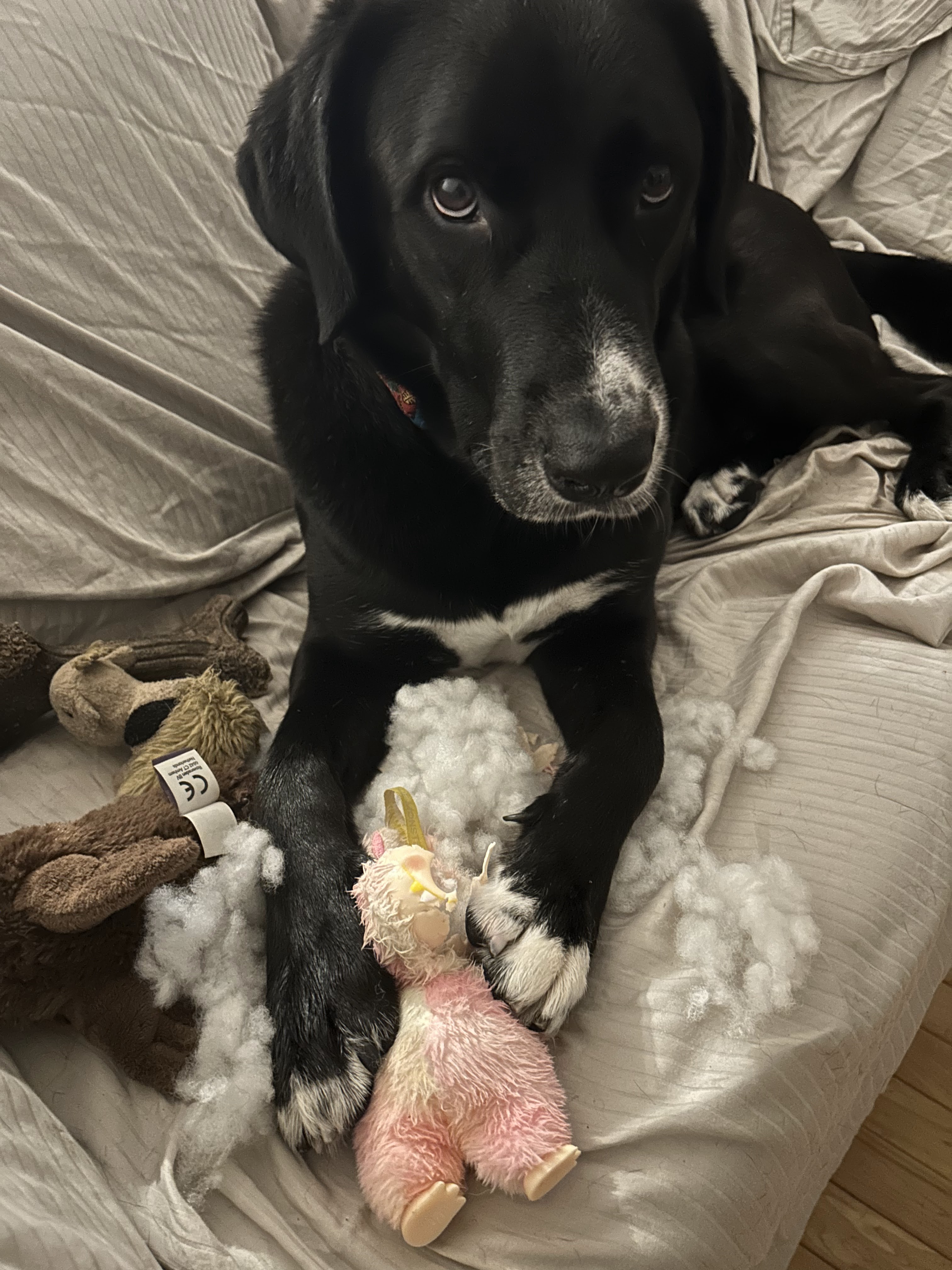
Max found a Labubu – and ate it

Our dog Max is a rescue. What he was rescued from, we don’t exactly know, but we do know that he came to Canada from Lebanon, we assume in a large dog crate. This explains many things. First, Max is an anxious dog. Second, he does not love crates. According to our dog trainer, his anxiety presents as aggression – so, she assures us, he’s not really an #$@hole; he just acts out because he’s nervous and doesn’t know what’s expected of him. As a teacher who often works with students who need a little extra attention, I feel like this is something I should have picked up, but the dogs I grew up with were decidedly not anxious, so I had no idea.

One thing that helps nervous dogs, apparently, is having a space in the house that is their safe space. Before we knew what he was doing, Max had chosen under our kitchen table as his space, which is not ideal because, well, that’s where our feet go. He’s generally ok with feet being there, but “generally” is not really enough when it comes to where your feet go while you eat. So… we are trying to help Max find another safe place in the house.
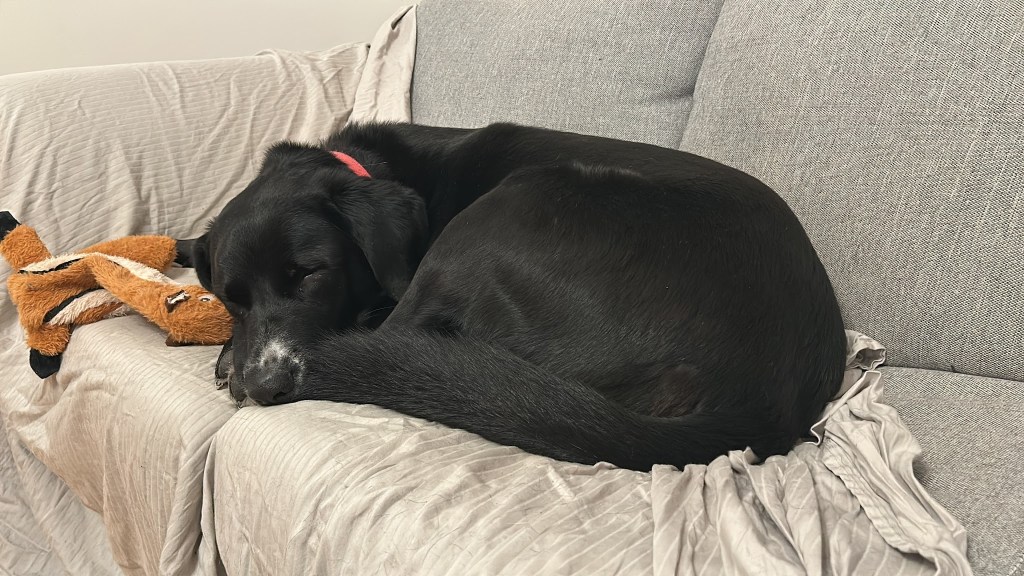
Max’s absolute favourite place to sleep is on our couch – with a stuffie

We started with a large hard-sided crate, which we put in the TV room by the sofa where we often hang out. Max was not impressed. He absolutely, 100% refused to go in the crate. Heck, he would hardly go near it. He growled at it and, when we put his favourite toys inside, whimpered a little, but he did not go get them. He spent weeks steadfastly refusing to go near the crate, giving it a wide berth while giving us the side-eye. Finally, we realized that he had probably flown from Lebanon in a crate, so we retired it to the basement (a place too scary for him to even contemplate; he will barely look down the stairs).

Months later, we put a dog bed in the kitchen near his table-lair. We have been trying to teach him the “place” command, and he will kind of do it, especially if treats are involved, but it’s out in the open, and he’s made it clear that he might go there to humour us, but this is not where he intends to sleep. So two weeks ago, we got *another* crate – this one with metal sides that he can see through. (Thank goodness for friends and family who are supporting us and our anxious dog by providing us with various types of crates and beds in our quest for calm.) 

We set up crate number two in a different corner of the TV room, and this time he didn’t growl or whimper. Then we got smart: we put Max’s food dish in the far corner of the new crate. To eat, he would have to go in. He’s half Lab, so he loves food, but he’s still Max, so he was tentative: he tested things out with one paw… then two… then he s-t-r-e-t-c-h-e-d in to eat his food. Such a brave boy!
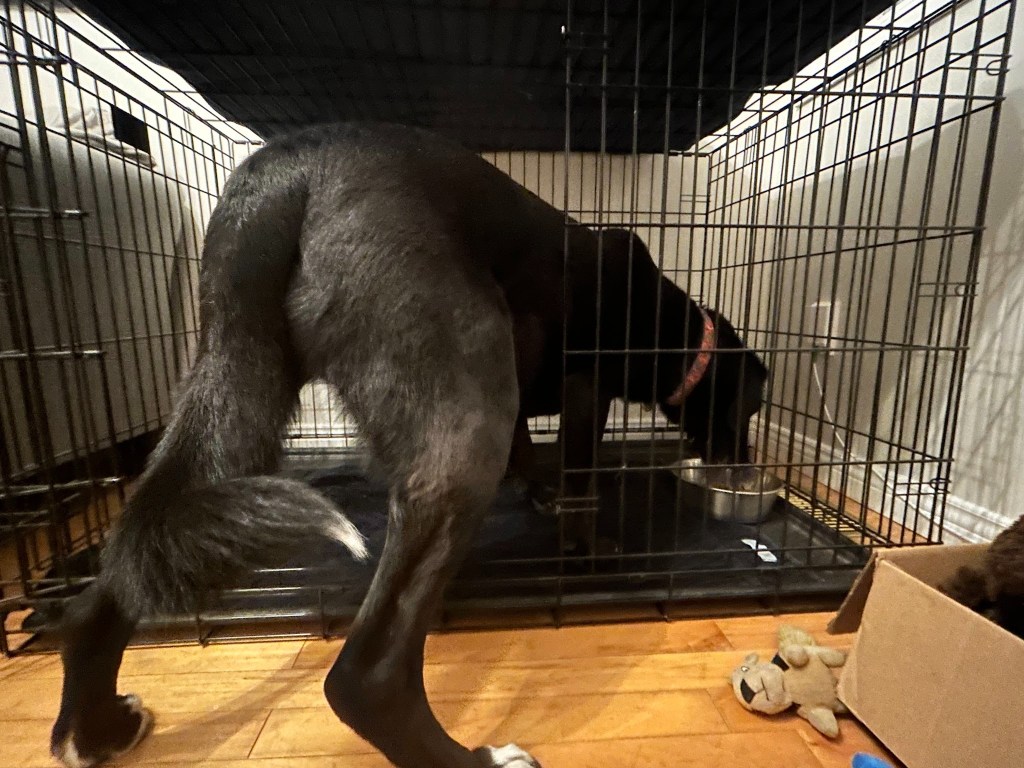
Max with two feet in

We added a towel to make the bottom of the crate more comfortable, and two days later, Max managed to put three paws in the crate. Then, yesterday, he discovered a better solution. When Andre put a treat in the far corner, Max pawed at the towel and pulled the whole thing towards the door. Once he’d pulled the bowl close enough, he grabbed the treat and triumphantly trotted back to his safe space under the table to eat in peace. 

Anxious, but not dumb, this dog. Sigh. In the question of Man vs Max, I think Max is winning.

Update: tonight he put all four paws in the crate! 
PD Day Agenda

9:30 sharp (as per the email to staff)- PD Day begins
Teachers wander into the library and mill about, slowly noticing that we have assigned seats. Some people try to switch groups. One entire table switches locations because they have been placed so far to the front and side that they cannot see the screen. 

9:33:30 – Principal address
“Today’s PD will be extremely useful.”

9:35:12 – First speaker.
Topic: substance abuse
Y’all, it is happening: kids are still abusing substances. You know it, I know it, they know it. Sure, the overall stats are pretty good and, yeah, we *could* invest in vape detectors for the bathrooms, but that costs money, so instead someone will tell you about marijuana and cannabis as though it is still the 80s. We will not talk about things like phones, social media, opioids or fentanyl. Stay focused. 

Some time later – Break – supposedly 10 minutes but now 5 because we are already behind

10:47:08 – Teacher-led presentation about [Literacy/ Numeracy]
Note that this session will begin just late enough that the staff who worked like crazy on this presentation will have to cut something important, and every minute extra will shorten our lunch.

10:48:00 – ICEBREAKER
Today we will either be annoying the Humanities teachers and boring the Science/ Math teachers or annoying the Science/ Math teachers and boring the Humanities teachers. Roll the dice. 

10:59:21 – Chipper staff members (confession: I am usually one of them) begin desperately attempting to convince other staff that they should stop saying that they “hate [math/English]” and that they really should not tell their students that [any subject but mine] won’t be useful after high school. 

10:59:42 – If the school is providing lunch, (unlikely but possible) it arrives. It is set it up in the back of the room as staff continues to learn about [math/English] and why we should integrate it into our classroom. The smell of lunch now fills the room as the staff presentation continues.

Special note: today’s lunch is scheduled to begin 30 minutes later than on a normal school day. The smell of food should permeate the room long before teachers can eat.

11:12:37 – The buzz of teacher talk suggests that everyone is on task and excited to use [math/English] in our classes next week. Or maybe it suggests that Mr. X has pulled out pictures of his twins – now 6 months old! – and everyone is cooing over them. Well, everyone except the AP Physics teacher, who is still marking tests, and two basketball coaches who are hunched over a playbook. “Look!” says a harried teacher-presenter, “That playbook is a perfect example of [math/English]!”

11:28:16 – Everyone applauds the teacher-presenters. One of them is visibly sweating; another has just wiped away tears; a third is still looking at pictures of the twins. The principal announces that all 17 afternoon sessions are now “self-directed learning” to honour us as professionals. To prove we have “engaged with the content” teachers are required to complete a “proof of engagement” after each session. This may include Google forms, e-signing a document, taking an online test, a spit shake, swearing on a religious text of your choice, taking a blood oath, offering up your firstborn unless you guess the name of a short bearded visitor, hopping on one foot for exactly 2 minutes and 16 seconds, and other activities to show that we have completed each session.

11:30 Teachers leave for lunch

12:30ish – Some teachers return

Afternoon – 43 voluntary meetings are available for teachers to attend this afternoon. None of them are about any of the 17 required afternoon topics. They are voluntary so we do not have to be there because this is the time scheduled to complete our required self-directed work. If we choose to attend the voluntary meetings, we will have to complete the required work at home. Oh, and the Principal will be at all voluntary meetings and will take attendance. Just in case. 

Partial list of the 17 Mandatory Self-Directed Training Sessions

From the Ministry of Education: The total video time of this training is 7.25 hours, not including the time required to prove you did the work. We have allotted 3 hours for you to complete it. We have disabled your playback speed options on some – but not all – of the videos. If you figure out which videos allow you to change the speed, AND if you skip slides on the boring slideshows and just go straight to the tests, you can probably finish by the end of the school day.

Note: all training will be identical for all staff K-12 at all sites. There will be no differentiation.
7 minutes, 8 seconds: Equitable and Inclusive Schools
14 minutes, 12 seconds: Child Abuse Prevention and Reporting
8 minutes, 47 seconds: Appropriate sign-offs for professional emails
4 minutes, 3 seconds: Cybersecurity, Part 3
21 minutes, 32 seconds: Ladder skills
3 minutes, 54 seconds: Concussion Symptoms
3 minutes, 2 seconds: Only You Can Prevent Forest Fires
18 minutes, 7 seconds: Stop, Drop and Roll
5 minutes, 4 seconds: Shoe Tying – Reverse Chain or Bunny Ears?
1 minute, 44 seconds: Self-care to Prevent Burnout – You Are Responsible for Your Mental Health

Conveniently, no one knows when the teachers go home.

Storytelling

“We all have stories to tell,” I say to my Creative Writing class. “We tell stories all the time. We swim in them.” I draw their attention to the Thomas King quote I’ve put in our Google Classroom: “The truth about stories is that that’s all we are.”

Students bob their heads up and down. They are nodding, but they are also wary. After all, we’re starting our “Narrative” unit, and they know they will soon be writing “a story” that they will have to share with others. This is terrifying.

I have been where they are, I tell them, so I am confident that they are brimming with stories – both real and imagined. To prove this, we do an inside/outside activity (also known as concentric circles) – two circles of students, facing each other – and tell each other stories for nearly half the class. A time I was embarrassed, a time I felt proud, a wonderful gift I received or gave... The classroom is alive with voices and laughter. Stories fill the air; we are joyous.

“The stories we tell define who we are,” I say afterward, and I believe it. Then we try to capture some of what we’ve just said, to put our voices on paper. The mood in the room changes. I write, too. It’s hard.

Some days, I write quotations on the board:

“The most powerful person in the world is the storyteller.” – Steve Jobs

Even as I scrawl the words on the chalkboard – in yellow or white or pink – I am telling myself secret stories about my own writing, about my own power. At first, I don’t notice these subconscious stories. I write all the time, I think. I am, after all, writing nearly every day. I jot down ideas in random places and tell my students that I am collecting story kernels and poem fragments. I write in front of my students: I start poems and essays; I leave them half-finished to “show my process.” The students have (mostly) turned in their poetry assignments. My best poem sits, unfinished, covered with notes and nudges. I tuck it away.

Meanwhile, Monday evenings come and go. I tell myself that I’m too tired to write anything up, that I will write tomorrow. By Tuesday evening, I tell myself that it’s too late to publish a “Slice of Life” on the Two Writing Teachers blog (my writing haven). I tell myself I’ve missed the window this week, that no one will want to read this late. I will write next week.

Weeks pass. I think that I am not writing in public because I am busy or bored or boring. I think that I have already written about this or talked too much about that. I whisper to myself that a particular story is “not mine to tell” or “will get me in trouble” though I don’t know what for or by whom. One day, I manage to catch hold of a thought as it darts through my mind; almost immediately, its brethren make themselves known: not good enough, not funny enough, not interesting enough, everyone knows this, too many people are reading this, not enough people are reading this…

Ah! Well. I give myself a little lecture about writer’s block and allow myself a little laugh about having been here before. Then I set myself a writing deadline – which I happily ignore. But my self-imposed deadline doesn’t disappear. Instead, it lingers in odd places, growing bolder: “Your students have turned something in,” it says, “why do *you* get to skip writing?” “Writing is reflecting,” it cajoles, “and reflecting makes for good teaching.” “This won’t get easier,” it scolds. 

Finally, today – Tuesday, not Monday – in class, not at home, I cave. I ink the word WRITE in my calendar. I come home, play games on my phone, do a little training with the dog, chat with the children, tidy… and then I make myself say the thing out loud, even if it’s under my breath.

“I am a writer.”

And I write.

After all, “We become the stories we tell ourselves.” – Michael Cunningham

Next week, I will write again.