Let’s keep talking #SOL23 7/31

During Black History Month, I shared a nugget of information about Black History every day at the beginning of class. This month is Irish Heritage Month (Canada) and Bangladeshi History Month (Ontario), so I asked the students if they wanted more information nuggets. The 9th graders said no, but the 12th graders said “yes, some days” and I was happy to comply.

Yesterday, I shared the Minister’s statement about Irish Heritage. The students listened politely,  then one young person raised her hand and said, “Honestly, after Black History month, just… why? Why do we need to celebrate Irish heritage when they are a dominant culture?” (Ok, that’s a paraphrase. She was both more eloquent & more delicate.)

I looked around the room. Heads were nodding. Irish culture hardly seems under-represented to this group. I stood in front of them, Irish, and didn’t have an answer. “Well,” I started, “I guess I’ll think out loud. Are you all comfortable interrupting if you disagree or if you have questions? Because I don’t have a researched answer for you. This is just me.” They agreed.

And down the rabbit hole we went. Why and when did Irish people emigrate to Canada? Sure,  Irish people had been desperately poor and had experienced terrible discrimination, but how bad was it? Did they know that the Irish had not been considered white?

Wait. Hold up. The class was instantly interested. From there we found ourselves talking about race as a sociological construction and considering how we know who is and isn’t part of which race. “Are we still good?” I asked at one point, and a student replied immediately, “Oh yeah. Let’s keep talking.” So we did.

We looked at images of a biracial author and his biracial children, some of whom look more like one race or another. Who gets to decide who is which race? We talked about another author whom I had long perceived to be Black but who does not, in fact, identify as a person of color. Some students talked about their own race. We talked about a former student of mine who inherited genes from distant ancestors on both sides of her family and did not appear to be the same race as her parents. Our conclusion – or at least the one that I took away – was, “If you want to talk about how we define race, things get messy fast.”

Eventually we circled back to why we celebrate Irish Heritage Month. Maybe – maybe – we thought, if we can start to look at different parts of being white, if we can acknowledge different aspects of whiteness and stop pretending that white culture is a monolith, maybe we can make space for other races and cultures, too. Or maybe not, but it was the best we could come up with. There was a moment of quiet in the classroom, then we opened our books and read.

*Addendum – which comes from not having finished this slice last night. Today, I shared two different articles about the Irish and whiteness. One bluntly asserts that the idea that the Irish were ever considered not white is pure nonsense. The other disagrees. Officially, we looked at the use of quotation marks and how they affected the tone of each article, but our discussion ranged widely. So… we’re behind, but also kind of ahead. This is what comes of having interesting students.

Not a soccer mom #SOL23 6/31

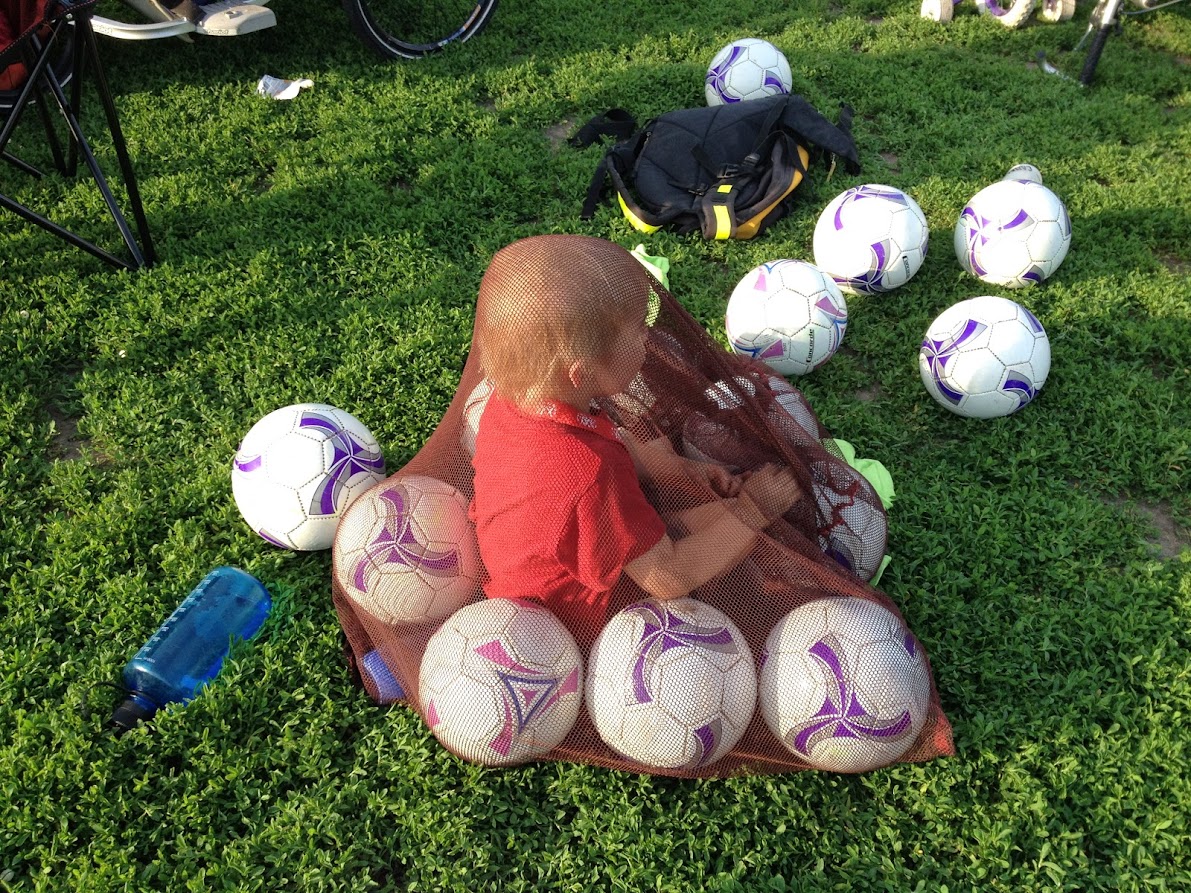
Confession: I am a terrible soccer mom. I was a little shocked to discover this about myself, but it’s true nonetheless. I didn’t start out this way. I played soccer growing up. My dad coached; my mom watched; my sisters played – it was a family thing. So, when the kids were little, I dutifully signed them up for soccer and volunteered to help coach their teams, but eventually, I realized that I was more interested in the game than they were. Evidence:

Yes, that is my (younger) child. Yes, he is *inside* the ball bag. No, he did not want to play.

So, the kids stopped playing on teams and I stopped coaching. Life went on.

Both kids are pretty athletic (as I am not), and my older child never stopped playing the game with buddies, but he didn’t join a team again until this year. Then, he made the high school team, too. Suddenly, I have an app on my phone and there are uniforms and practices and games and tournaments and so so many emails. I know that this is part and parcel of youth sports, but it turns out, I’m a terrible soccer mom. Evidence:

I ignore a lot of the emails.

The app made me crazy, too, so I made my partner download it.

Which means I really should read the emails.

We are often late to practice. Sometimes it is my fault.

I do not know the names of all the boys on the team. (In fairness to me, my child does not like it when I ask him things like the names of the boys on the team, so I stopped.)

I definitely do not know the parents of the boys on the team.

I often take walks during the outdoor games. 

I often do crosswords during the indoor games.

I accidentally missed today’s semi-final because I was walking (In my defense, my son is injured and was not playing AND I had been told the game was starting later AND I didn’t know that the playoff games were shorter. Which I probably should have known. But whatever.)

The truth is that I’m a little surprised that I don’t want to be more involved, but I don’t. Maybe it’s because he didn’t play for so long or because when he started again this year, he asked me not to watch while he got used to playing again. Mostly, though, it’s because it’s his thing, not mine. One way or another, I’m not really a soccer mom, and I’m making my peace with that.

A metaphor #SOL23 5/31

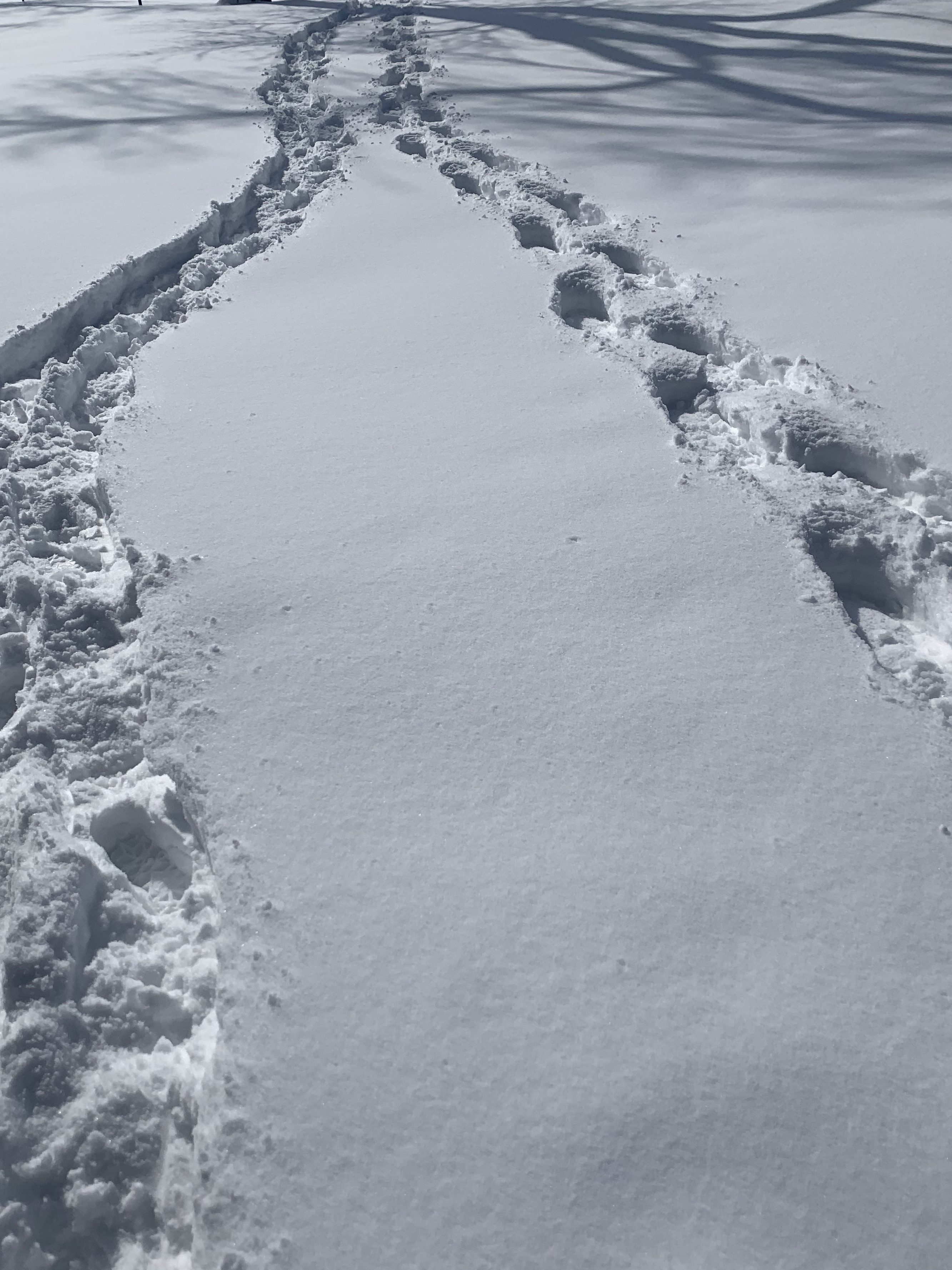
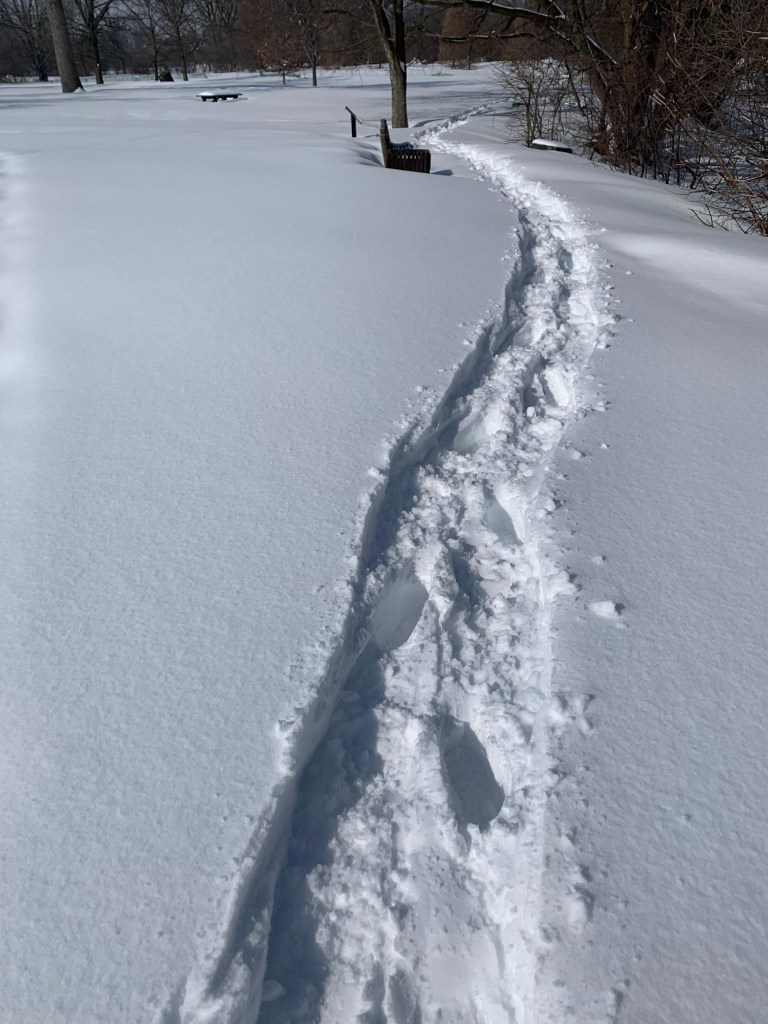
I was about halfway through the snow to the river when I realized that the path would not be plowed. I would have known this if I’d paused to think, but I’d been anxious to take advantage of the time between two soccer games, so I’d dashed out for a walk without really thinking everything through. “Typical,” I mutter as I take another step forward and sink again, ankle-deep in snow.

If I had paused before I left, I might have thought about this part of my walk – the part *after* the easy part. Maybe I would have decided to try it anyway, but since we got 20ish cm of snow yesterday, I probably would have stuck to the sidewalks. “Nah,” I realize, I wouldn’t have thought of it anyway. Apparently 15 years in Ottawa has not significantly improved my winter planning. And if I had thought of it, I would have stayed at the game – the sidewalk runs along a parkway with a fair amount of traffic. Yuck.

Anyway, now I have to decide: keep going – I can see that the trail is really snowy – or turn back. My own tracks will be firmer footing, but then I’ll be going backwards. And someone has already broken this trail, it’s just that they had better gear (snowshoes). What the heck, I decide, it’s only snow.

This is where I realized that nothing was going to be plowed.

So I keep going towards the river. The trail does not get easier. Sometimes I sink up to mid-calf for step after step; other times the snowshoe path is firmer and I can move several feet on firm ground. This is a metaphor, I think. I am forever throwing myself into things first and only afterwards realizing what I’ve gotten myself into. 

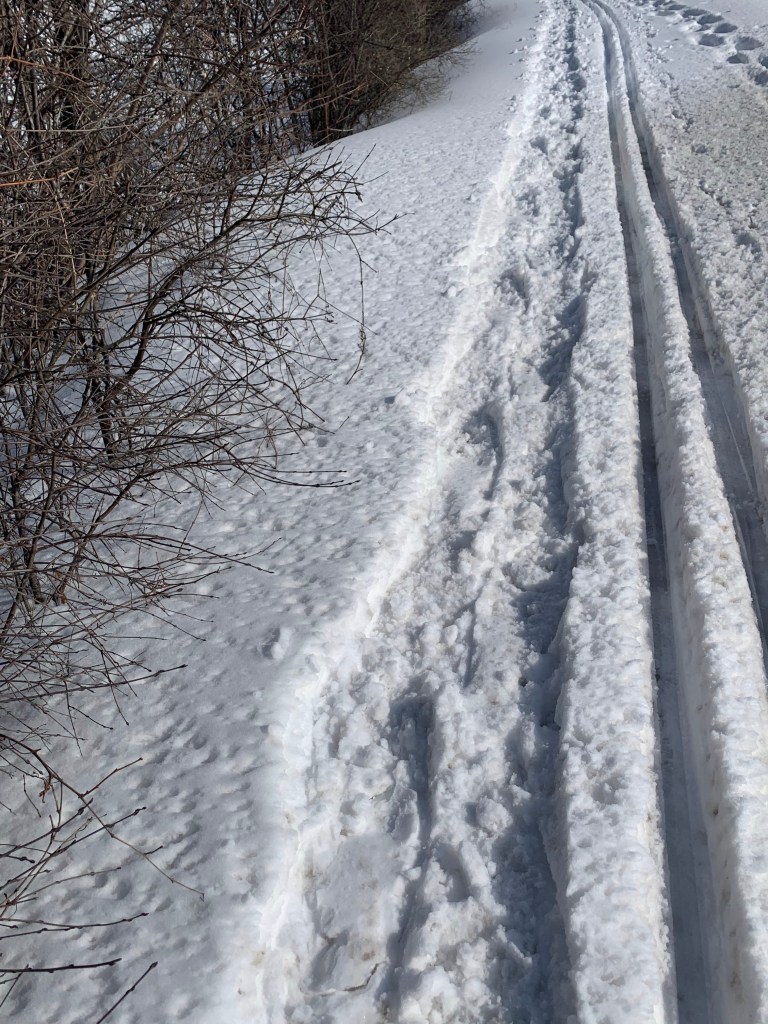
Nevertheless, I keep going. The trail along the river is divided into two paths, one for snowshoes and one for cross country skis. The ski path looks well-worn and firm. I bet if I walked there, I wouldn’t sink so much, I think. But I don’t, because that would make the trail much harder for the skiers. It’s not their fault I came unequipped. I continue my slow, uneven plodding, stopping regularly to look at the river. The view, the quiet – they’re worth the work. And sure, it would have been easier if I’d done this another way, but I didn’t, and I’m still here. This is a metaphor, I think, This is what it’s like to learn new things. I walk, stop, walk, stop; the snow slides into my boots; the bottoms of my leggings get soggy. 

By the time I reach my turnoff, I’m hot and a little tired. My jacket is tied around my waist and I’ve even had to take off my hat. Just as I find firm footing on the pavement, two skiers pass me and nod. They glide smoothly forward, easily covering ground that had been so hard for me. I check my watch – I have taken a long time to go a short distance. Now, on the sidewalk, I pass more people. Our only obstacles are puddles, but we’re also surrounded by cars and the dirt of their exhaust is gray against the snow. I remind myself this is a extended metaphor and walk the rest of the way back to the soccer games.

Video Game Poetry #SOL23 4/31

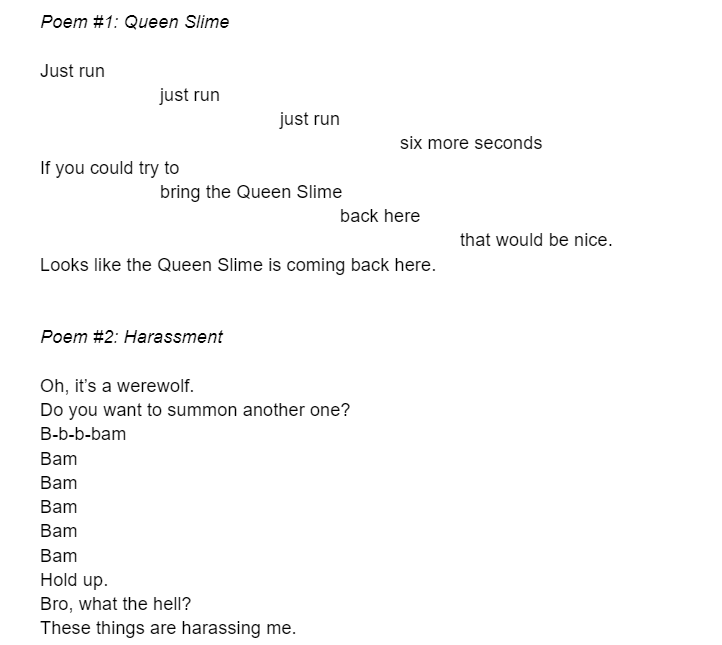
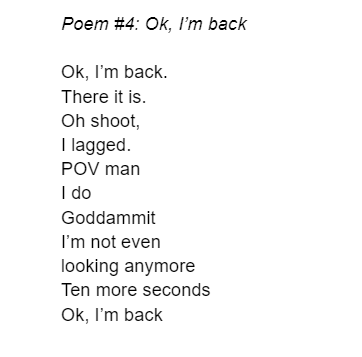
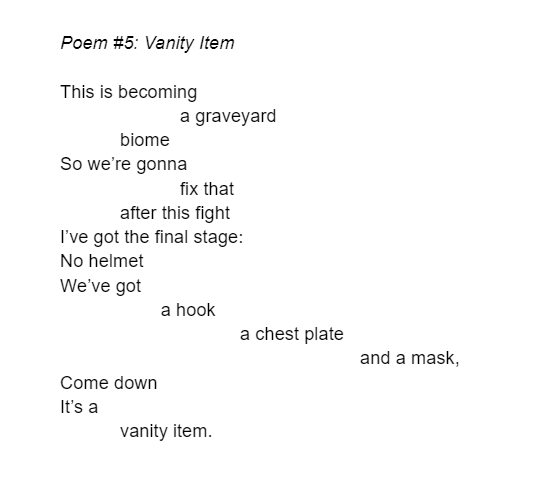
I have spent much of the morning in the same room as Mr 12, who is deep in a video game with a bunch of his friends. At first I was annoyed – it’s hard to write with someone talking loudly right by me – then inspiration struck: somewhere on Twitter, people are turning their bedmate’s sleep talking into Insta-style poetry. Here, very lightly edited, is the poetry of 12-year-old gamers. (Apologies for the curse-words. I promise he mostly curses in video-game play.)

When all else fails #SOL23 3/31

When life swirls around me and what I thought I knew doesn’t make sense any longer, when my plans get tossed into the air or my tears drip down, when there’s nothing left to grasp on to, I often turn to sudoku.

Sudoku makes sense. 9 times 9 squares. 9 numbers, 9 times. If I pay attention, the pattern will unfold and everything will settle into its proper place.

For an easy sudoku, I like to complete the patterns in my head as best I can, pushing myself to solve the puzzle in numerical order – so I enter all the 9s last – or square by square, holding a corner back until the end. I like to see how much I can solve before I need to start filling things in. Some days it’s more than others.

An easy sudoku has it’s place, but my real sanctuary is the hard ones. I might glance through one of these grids quickly at first, but inevitably I settle down to the rhythm of the pattern – if this can only go here then that can’t go there. If these numbers appear three times in this row then that square must be… yes! Got one. My brain settles in as I fill tiny squares with tiny indicators of possible solutions. Entering one thing means carefully tidying up all the possibilities that no longer exist. If I’m careful I will discover every number’s inevitable space.

In sudoku, attention to detail means that everything will end up where it belongs because everything has a place. 20 minutes after I start, I’ll place the last number – hopefully a nine – in the 81st square and no matter what else is happening, I am able to breathe a little more easily.

When all else fails, sudoku solves everything.

When all else fails #SOL23 3/31

When life swirls around me and what I thought I knew doesn’t make sense any longer, when my plans get tossed into the air or my tears drip down, when there’s nothing left to grasp on to, I often turn to sudoku.

Sudoku makes sense. 9 times 9 squares. 9 numbers, 9 times. Sudoku promises that everything has a place, that if I pay attention, the pattern will unfold.

For an easy sudoku, I push myself to solve the puzzle in numerical order – so I enter all the 9s last – or 9 patch square by 9 patch square, holding one corner back until the end. I like to see how much I can solve before I need to start filling things in. Some days it’s more than others.

While an easy sudoku has it’s place, my real sanctuary is the hard ones. I might glance through one of these grids quickly at first, but inevitably I settle into the rhythm of the pattern – if this can only go here then that can’t go there. If these numbers appear three times in this row then that square must be… yes! Got one. My brain calms as I fill tiny squares with tiny indicators of possible solutions. Entering one thing means carefully tidying up all the possibilities that no longer exist. Every number has an inevitable space.

In sudoku, attention to detail means that everything ends up where it belongs because each number has its own inarguably right place. 20ish minutes after I start, I place the last number – hopefully a nine – in the 81st square and no matter what else is happening, I am able to breathe a little more easily.

When all else fails, sudoku can be solved.

The First Time #SOL23 2/31

One of the prompts I offer during our memoir unit is “The first time I…” (NB: when working with high school students it is best to *immediately* complete the sentence with a few mundane firsts, otherwise minds tend to wander in directions that are, ahem, not compatible with the classroom.) It’s a funny little prompt because first times are, I have learned, simultaneously memorable and hard to remember. This is one of those prompts that sees students’ pens hover above their notebooks before they drop, scribbling furiously; their writing stops and starts then stops again; sometimes the ideas don’t come until the next day or even many days later. 

Around the time I use this prompt, I often share a short memoir by Willy Conley which opens with a question about when he first realized he was deaf. This ‘first’ can perplex students. “How did he not know he was deaf?” they ask, and I have no ready answer. “How did you realize things about yourself?” I offer as a response, and we often physically look at ourselves. As I ask probing questions, students respond, “But I’ve *always* known I was a boy. I never realized it” or “I just *knew* I was Canadian; I didn’t have to think about it” and on we go, the discussion touching on aspects of their identity that they take for granted. Sometimes we are able to dig in; other times, I gently move the discussion back to riding bikes or ice skating. Physical firsts, it turns out, often stick in the memory.

Each semester, after the discussion, my mind inevitably turns to Zora Neale Hurston and the line in Their Eyes Were Watching God when, as a child, Janie sees a picture of herself and realizes she is Black: “Aw, aw! Ah’m colored!” she exclaims. The first time I read that line, I had to pause just like my students do now when confronted with Conley’s realization of deafness: How did she not know? And, of course, when I asked that question about Janie, I had to turn it on myself and ask “When did I first realize I was white?” 

The first time I realized I was white was in high school Spanish class. Even though my southern school was intentionally integrated (by bussing), almost no Black students were in any of the “Honors” classes I took. I had finished up all the French classes the school offered and switched to Spanish my junior year. There I met Kiki, who was Black. Spanish was easy for me as it was not for her, and our teacher asked if I would help with her. Ever a teacher, I was delighted. We got along famously, but things were the way they were and there was no moment when getting along well would have had a chance to veer into true friendship. One time, as we worked, she said something about me being a “white girl.” I was surprised. I had heard people talk about “the Black kids”, but never “the white kids”. I had never really thought of myself that way, but clearly she did. My mind lingered on that thought for a minute, then Kiki and I went back to the Spanish work in front of us, a white girl and a Black girl, trying to figure out new words in a world that saw our skin color before it saw us.

Biting my tongue; watching my words #SOL23 1/31

Here I sit on Day 1 of the March Slice of Life Challenge: once again, I have committed to try to write & publish every day for the next 31 days. I’ve done this for a few years now, so I know some of the ups & downs, but this year brings a new challenge beyond writing: I need to bite my tongue. 

Biting my tongue does not sound like fun. I pause to consider this. Literally biting your tongue hurts a lot – there’s a moment of disbelief, followed by the warm taste of blood, and then the pain that lingers while your tongue heals. Worse, once you’ve bitten your tongue, you often bite it again, its unexpectedly swollen shape catching in your teeth over and over. No wonder I do not want to write for a month if I need to bite my tongue. That sounds awful.

**Some minutes pass in which I fruitlessly attempt to remember times when I have or haven’t bitten my tongue, literally or figuratively. I remember nothing despite knowing that I have done these things.

In an attempt to re-frame, I have decided that I will not, in fact, bite my tongue this month. Instead, I will watch my words. This catches my imagination. Here I sit, writing about this moment in my life, and I can literally watch my words come into being. Look, there’s another one. And another! In class, I tell students to keep their pencil moving or to keep their fingers typing. Watch those words multiply! Look at how much you’ve written! 

Now I imagine my words multiplying, then beginning to peel off the page. They grow bigger and bigger, each word breaking free and flying around the room until the room can no longer contain them and they slip through cracks and imagined spaces and – there! – off they go, out into the world until I am no longer able to watch them, no longer able to see who they meet or how they meet them. I feel lighter already. Yes, watching words is doable.

Friends, I may not make it through all 31 days, but I might, and I won’t if I don’t start. I will not be able to write the whole truth all of the time, but I will be able to write a slice of the truth. I will be able to capture a moment – maybe a moment like this one that exists only because I have embraced the uncertainty that comes from watching my words grow. This month, I will share those words with you, acknowledging from the beginning that each slice of life is only one part of a sometimes nearly invisible whole.

I will not bite my tongue, but I will watch my words. That seems realistic. Watch with me?

Join us at twowritingteachers.org After all, you never know what you might write until you write it.

Need a hug?

Two days before Winter Break, I asked a student to switch seats to mitigate disruptive behaviour. Instead, angry, they ran out of the room and left the school. The next day ice and snow closed schools, so we didn’t see each other again until January.

This gave me plenty of time to reflect. In my twenty-some-odd years of teaching, I’ve only rarely experienced something like this. I know enough to know that it’s not usually about the teacher, but I also know enough to know that there are always things I could have done differently and better. Without beating myself up, I thought long and hard about what had happened.

The first day back, the student was in class. I let everyone go a minute early, knowing that this student rarely left quickly. As they packed, I sat next to them and quietly apologized for my role in their distress. They ducked their head and looked away, “No. it was me. I’m really sorry.” We talked briefly, me explaining that I could have noticed their distress, them explaining that there was a lot going on. 

After that moment, they came to class a little more often and showed up during exam days for extra help so they could pass English. Every interaction felt a tiny bit more relaxed.

Then the semester ended, and the student was no longer in my class. Last week, I popped over to the public library (right next door to the school – so convenient), and saw this student, this child, standing, clearly forlorn, a large bag dangling from one hand. When I greeted them, I noticed their red eyes. I asked about the bag – they didn’t say much. I asked if they were ok.

“People are mean,” they whispered, and tears welled in their eyes. I said yes, sometimes they really are. I asked if I could help. No. I asked if teachers or students were being mean. Students. Silence. The tears spilled over. 

I leaned in and touched their shoulder gently. “I wish I could give you a hug,” I said.

“You can,” they replied, and looked up.

I’ll stop there. 

These days, teachers cannot hug students. Just this week, the Ontario College of Teachers’ newsletter included “hugging” as one of the several reasons a teacher’s license was suspended. Even touching the child’s arm was possibly a bridge too far. We do not hug students.

On the other hand, the child was crying. They had been bullied and spent much of the class in the office as a result. They did not see school as a safe space, but they were starting see me as safe. 

So, what do you think? Should I have given them a hug? What would you have done? What would you want for your child? Does your answer change if I am NOT a middle-aged white woman? Does it change based on the child’s gender? Or are teachers – acting in loco parentis – allowed to treat all children in our care with, well, care? Can we comfort them when they ask for comfort? 

I know my answer. What’s yours?

Thanks to twowritingteachers.org for hosting this space for teacher-writers.

And then, a miracle occurred

Only years after we started did anyone outside of schools begin to wonder. After all, teachers had been doing so much with so little for so long that people had forgotten that we, too, were subject to the basic laws of physics. Let’s be honest: most people had forgotten the basic laws of physics, so it was easy to forget the rest.

No one questioned how our classrooms were set up, the computers charged, the rooms tidied. No one wondered how teachers were able to give exams, grade all the final projects, communicate with parents, write report cards and start an entirely new semester with an entirely new set of classes and students all in the same week.

When politicians or parents or the public added another thing to teachers’ plates, they never wondered how it would get done. “This isn’t much,” they thought – if they thought about it at all. Soon we were able to give epipens, handle both epileptic and non-epileptic seizures, monitor blood sugar, stop bleeding, re-start hearts and more. We could identify and support students with any and every learning need because we seemed to have endless time to read the latest research and put it into place in the classroom.

Every English teacher read hundreds of books per year so they could always recommend the latest ones. Science teachers set up perfect labs, day after day, week after week, month after month. History teachers never lacked for primary sources. Art rooms were constantly clean. Teachers called home for every absence, every missed test, every concern. We all returned student work the day after it was submitted.

No one really noticed. “After all,” they thought, “that’s what teachers *should* do.” The less generous grumbled, “It’s about time they did their jobs” while the more charitable thought, “teachers seem much more relaxed than when I was in school.”

When the first scientist suggested that maybe something unusual was happening, teachers basically ignored it. “Oh,” we laughed, “don’t be silly. Teaching is easy. We have plenty of time.” When the second voice joined the first, a few of us started to worry. Luckily, it was a long time before our secret stash of time turners were revealed and we had to confess just how many hours all of this actually took…

*****

Sorry. Just kidding. Today we had about three hours to tie up loose ends from last semester, tidy our rooms – or change rooms or even schools – and prepare for all new classes. But fear not, we have three whole days of teaching full time before our report cards are due. Totally normal.

Many thanks to Two Writing Teachers for hosting the Slice of Life every Tuesday.