Read aloud

I’ve already handed out the papers – forty words neatly divided into two columns with checkboxes next to each word; forty words we read aloud earlier this week as a group; forty words that should be easily accessible to high school students, although I am well aware that they will not be easy for the students in this room – and the students are calmly looking them over. Calmly, that is, until I say, “So, today’s challenge is to read these words out loud in your small groups.” As the words “out loud” leave my mouth, a hand shoots up.

“Um, I can’t read out loud because I’m dyslexic.”

I pause. In retrospect, I will be able to articulate some of the myriad thoughts that run through my mind before I speak, even though in the moment I respond immediately. Later, I will feel my hesitation, the laughter that wants to bubble up behind my shock, even the bit of the sadness that eventually seeps into my consciousness. Right then, however, I say casually, “Everyone in here is dyslexic. That’s why we’re here.”

Suddenly all eyes are on me. I stumble. “I mean, I guess you’re not all technically dyslexic, but every person in the room – including me, actually – has a reading disability. Literally. All of us. You’re here to get better at reading. If you were already good at it, you wouldn’t be here.”

As I finish speaking, I am briefly worried: am I being mean? But I know I’m not. I’m being honest. And I’m surprised. We’ve been together for almost a month. The class is called “Reading”. We’ve spent weeks working on basic phonics, practicing short vowel sounds, encoding phonemic word chains, and decoding three- and four-letter words. I can’t imagine even a casual observer who wouldn’t understand what we’re doing: Everyone is here to get better at reading.

In the classroom, students look around. I can’t catch all the various emotions, but I start to realize that they were not, in fact, all aware of the truth of the class. I remind them (again, I swear!) that we are here to support each other, that mistakes are normal and part of learning, that this is practice, that this is how we get better. I reassure them that they will not die from reading aloud. I promise that, as far as I know, there is no recorded history of students dying purely from reading – even reading aloud. They start to laugh. Soon enough, everyone is reading out loud, round-robin style, in their circle, and they are, as predicted, helping each other. Mistakes are made. Everyone survives. There are smiles and laughter and we are learning rather than worrying. By the end of class, people are willingly writing on the white board to practice encoding. When someone says, “I can’t really spell” someone else replies, “neither can most of us” and there are plenty of giggles. 

But after the students leave, I can’t shake the feeling that this moment needs my attention. What was happening when the student announced that they could not read out loud? Why were they still self-conscious in a room full of striving readers? At first, I think of how my co-teacher and I have worked to make this class respectful of the learners: students who are still striving to learn to read in high school are typically students who have not been well served by our system; they are not dumb, they simply haven’t received the instruction they need. The reasons behind that are as unique as our students, but it’s still true. We designed this class to honour them and treat them as the intelligent beings they are, so maybe we should take some comfort in the fact that they did not realize that they were all here for reading instruction. Still, as much as I like a good pat on the back, the moment continues to gnaw at me.

Long after school ends, I’m walking the dog when I suddenly realize what I witnessed: despite having a learning community of support and care, our students have been working so hard for so long to hide their reading struggles that they haven’t had time to notice that others are struggling, too. They spend much of their social and cognitive energy protecting their identity and sense of self, and as a result they cannot easily focus on others. I imagine spending my work day trying to cover up something that I see as a major deficit – as if all I did all day long was try to hide a giant stain on my clothing. I imagine being so busy covering that stain in creative ways that I don’t have time to see that others have stains, too. No, worse: I am so concentrated on hiding the stain that I don’t really look at others; I just assume they are wearing much better clothes than I am. I keep one hand on that spot and sometimes miss things going on around me because I’m worried. If I relax and my hand creeps away from the stain, I have to quickly put it back down, maybe glance around and make sure no one else saw it. By the end of the day, I am exhausted and not able to remember everything that happened.

All of this explains why, at the end of September, the students in our Reading class haven’t fully understood that they are in a class where everyone is learning to read better, a class where, ideally, they can relax a little. It may be a while before they believe that everybody else in the room is making mistakes, too. It may be even longer before they trust each other enough to get things wildly wrong, to make outrageous guesses, and to allow themselves to do the hard work of learning to read. I realize, too, that I have more work to do to make this a space of hope and freedom, to let reading class help students be more fully themselves.

I reflect for a while and consider ways to tweak the class for increased student agency and more time for relationship-building. Clearly, I decide, we need more laughter. Clearly, we need more talk. And yes, clearly we need more read alouds. I’m on it.

I bought you a book

She had grade 9 English with me and, though it’s hard for me to believe, she’s in grade 12 now which means we’ve been smiling at each other and saying hello in the hallways for three years. In seven weeks, she’ll graduate, yet it was only a few days ago that I realized I’d never told her the story.

Oddly, I’ve told a lot of other people the story: how we were both new to the school; how she was quiet but eager; how she finished reading a book then asked me shyly if I had any books about Asia. She didn’t even ask for something set in Bangladesh – her home country – just anywhere in Southeast Asia. Oh, how I wanted to say yes! I scoured my bookshelves – my classroom library suddenly seemed so paltry – but I could only come up with one, and it didn’t really fit: it was really about a girl living in the US who was dealing with issues of sexuality. The 14-year-old in front of me wasn’t ready for that book; she wanted something that reminded her of home.

I was sad to have to tell her that I didn’t have anything, really. We found another good book, and she continued to read, but I couldn’t shake my disappointment. I looked online to find books about Bangladesh. I checked out Samira Surfs from the public library – too young, too refugee-focused. I found books set in Pakistan, books by white authors, books for adults… 

As the school year continued, I had to confront a sad truth: my classroom library was designed for a different student population. At my new school, the books I had didn’t reflect the students in the room. I knew I needed to address the problem, but I also knew I needed money to do it. 

At this point, I applied for a classroom library grant from the Book Love Foundation (founded by Penny Kittle). I asked two senior students to write me a recommendation; they also helped me with my video. And then… I won a grant! Oh, the books I bought – books set in places around the world. Sports books and fantasy books and realistic fiction. Graphic novels and novels in verse and memoirs with main characters from places my students knew and I did not. And yes, a book set in Bangladesh.

By the time the books came in, she was in grade 10 and our paths rarely crossed, so I didn’t think to tell her what she had inspired. Last year, I barely saw her at all. This year, though, our schedules overlap, and I see her often. And this year, I finally realized that I’d never told her about the books. So, last week I told her. She was startled. She didn’t remember asking for a book and she was surprised that I remembered where she was from. She blushed a little and we went on our way.

Then, a few days later, there was a knock at the classroom door. Could she come in? Could she see the books? I showed her what I could find on the shelves, but I had to laugh: so many of the books that I would have offered her if only I’d had them then – Amina’s Voice, Amina’s Song, Amira and Hamza, The Last Mapmaker – weren’t there because they’re being read by current grade 9 students. Still, I showed her Saints and Misfits, and Love from A to Z, and The Patron Saints of Nothing – and listen, it’s not perfect, but oh how she smiled.

Three years later, her request and the Book Love grant have changed everything. 

(If you are interested in information about applying for the grant, feel free to reach out to me – though honestly the link has all the information; if you are interested in donating to the foundation, please don’t hesitate. All kids deserve to see themselves in good books!)

Classic literature #SOLC25 30/31

The text from the young teacher comes in on Saturday. They want to start reading Lord of the Flies or maybe Hatchet with their intermediate ESL class. They’ve looked into purchasing copies, but it’s expensive. Maybe they could just print the pdf of the book, chapter by chapter? How do I buy books for kids?

I am quietly stunned. I sit with this for a few minutes, trying to decide where to begin my response. Finally, I point out that printing the entire book for 20 students is still expensive – we just transfer the expense to the school. Then, I suggest that the school has books – in both the ESL and the English departments. Then I pause.

In my next series of messages, I say that I find LOTF and Hatchet to be at very different levels. I casually note that neither of them has any female characters. (To be fair, in Hatchet Brian at least has a mother; no women exist in LOTF – just British schoolboys as far as the mind can fathom.) I wait again before adding that LOTF makes some “weird” arguments about the importance of British schooling for a civilized society.

I do not say that LOTF has a peculiarly western view of humans as inherently selfish and vaguely awful. I do not say that when a group of school boys were actually marooned on an island, they did not descend into chaos or madness. Instead, they worked together, supporting one another through hardships. I do not say that perhaps students from around the world will not be intrigued by stories in which western boys fight to dominate nature. Instead, I offer to brainstorm some other options and take the teacher on a tour of our tiny book room. They say yes.

Later that day, I read an article in the New York Times about The Great Gatsby turning 100. I love Gatsby and I love teaching it, though I haven’t taught it in a while. I have my reasons – its casual racism, its core critique of the American Dream in an era when that is all too easy – though I would probably teach it again if I could shoehorn it in somewhere. Still, I’m struck when the article reminds me that, upon the novel’s publication, “Reviewers shrugged. Sales were sluggish. The novel and its author slid toward obscurity.” I disagree with the early reviewers, but I find it interesting that the novel was not immediately seen as “classic” or even very good.

LOTF was similarly poorly received at first, and I can reel off a list of other books English teachers love that had rough starts – from Frankenstein and Wuthering Heights to Animal Farm and The Handmaid’s Tale with plenty of others in between. I’d love to point this out to those who wander through English offices saying things like, “there’s a reason they’re classics.” 

In fact, someone said exactly that in our English office not too long ago. My most effective approach to these platitudes is a lot of listening seasoned with a well-timed word or two, so I let the teacher talk. Eventually, they pointed out that part of the reason that it’s hard to find new “classics” is because books need to be “just right” to work in a classroom – not too long, not too spicy, not too hard, not too dull. They need approachable literary devices and characters that are relatable. 

By this metric, Gatsby, LOTF and even To Kill a Mockingbird are classics in no small part because of their length and lack of curse words. They have a plot and characters we can remember, so, assuming we ignore the racism and sexism and similarity in their world views, we can’t really go wrong.

I point out that “not too hard and not too long” means that our list has to keep changing. When I started teaching, The Scarlet Letter was on every high school bookshelf; now, the language makes it extremely challenging, so it is taught much less frequently. When I was in high school, everyone read Dickens. Now, his work is just too long and wordy. What has replaced these “classics”? I toy with the idea that The Outsiders is on the list; in the 70s and early 80s, it was just a good book to read. What about The Handmaid’s Tale? Atwood is Canadian, but we don’t teach her novel too often – too political or too long? I don’t know. Why has Their Eyes Were Watching God not made it into rotation in Canada? I have no idea.

I love to say that when we read everything, we can read anything, but many of our students are not reading everything or even very much at all. As a result, the books schools choose to offer take on outsized importance; each book is expected to do the work of ten: catch student interest, teach something worthwhile, be a paragon of “good” writing, reflect what our society can/ should be and more. Sadly – or maybe happily – no one book can be everything we want because good stories are, by design, problematic. To really use literature as a teaching tool, we need lots of it. 

I don’t know how to make that happen, but I’m pretty sure it doesn’t start by teaching students who are learning English in Canada in 2025 about shipwrecked British schoolboys in the 1940s. I’m going to suggest we start somewhere else.

4-4-4 #SOLC25 23/31

This evening, after several false starts (possibly because I’m still a little tired from whatever illness got me down yesterday), I decided to do a 4-4-4: write about four things within four feet of you for four minutes. I set the timer & wrote, then went to have dinner with the family. Now I’ve spent another minute editing/ tidying. (And probably another minute writing this.) It’s a pretty good way to get writing when I’m feeling stuck. Special thanks to Elisabeth Ellington who used this form earlier this month and to whomever mentioned Saffy’s Angel (maybe as a book her mother liked? Can’t remember.)

***

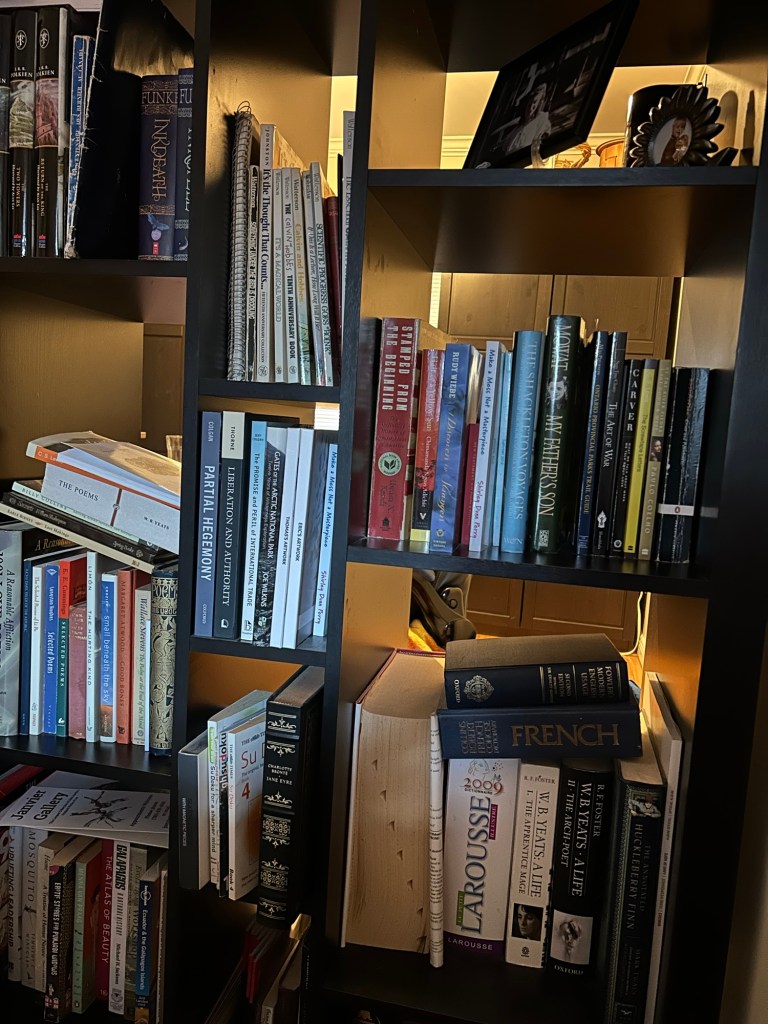
On the other side of the bookshelf, Mr. 14 is on the computer. What is he doing? I don’t know. I do know that earlier today he let me add him to my Google Classroom to check out a quiz I made. Then he commented on my quiz (“interesting, but hard”). He’s awfully fun to have nearby; one of the many reasons I appreciate having his computer in our main living area.

He’s just behind this bookshelf

My feet are up on the arm of the love seat in front of me. Just beyond them, our black lab mix, Max, is snoring lightly. He prefers being near me whenever possible; even better if he can be near me and in a soft space. If I stir, he’ll wake up, but for now, he sleeps peacefully.

Max takes up the entire love seat

Beside me on the couch are two blue yoga balls in a small mesh bag. They are calling me, reminding me that some mobility work will be good for my body, even if I’m not quite done being sick, even if I would rather just sit and read my new book, James by Percival Everett. It’s open and just next to the yoga balls. So far, it is amazing. I finished The Heaven and Earth Grocery Store just in time for book club on Friday night; that one was a slow read for me. Then, yesterday, I read Saffy’s Angel – a middle grade novel recommended by Elisabeth Ellington – because I spent most of the day in bed. It was a great half-sick lie-in-bed read. Last night I started James, and I’m tearing through it – making much faster progress than I did on The Heaven and Earth Grocery Store

Time’s up. 

When an English teacher is ailing #SOLC25 22/31

This is not the post I had planned for today. The plan was to write early, comment liberally (catching up on the blogs I’ve missed this week – so many) and take a nice long walk. Then, I was going to grade papers, maybe craft a little and generally be productive. Instead, I’ve spent most of the day in bed, sleeping off and on and generally feeling miserable. Super frustrating.

Since I’ve taken to my bed and am feeling sorry for myself, I’ve been thinking of Jane Austen – as one does. Have I caught a violent cold? I have not been coughing, so I don’t think so. Do I have a putrid tendency? I’m not 100% sure what that is, but I doubt that’s my primary ailment Rather, I find I have feverish symptoms and my head aches acutely. Oh! And I’m definitely languishing a bit, but my sleep brings me rest, not delirium, so no need to send for the apothecary… yet. Finally, while I am discontented at the moment, I do not fancy myself nervous, which is good because darling Jane has little patience with people’s nerves. Luckily, I am no fanciful, troublesome creature!

I will acknowledge that I am nowhere near as sick as Marianne Dashwood after the horrid Willoughby uses her so poorly, but I may be nearly as sick as Jane Bennet after she walked to Netherfield in the rain. Either way, I am missing a devoted sister to nurse me back to health. I shall have to send my sisters a letter to let them know that they have failed in their duty to attend to me in my time of need. Luckily for them, Andre has returned from his afternoon outing, and he is coddling me (a little), though no possets as of yet. Perhaps he is courting me. As a result, I suspect I will recover – though perhaps I will consult a physician to see if he might prescribe a trip to Bath. No doubt that would restore my good health.

Until then, I’ll settle for reading a good book in my own bath.

A good day #SOLC25 19/31

Today was a good teaching day, the kind that makes me keep grinning off and on right through the evening. At first, I was going to write something else, but then I wanted to capture this.

First period:
In grade 12, we’ve just started Hamlet. I am always torn about teaching Shakespeare, but I really love teaching this play. And today was amazing. We finished up yesterday’s rhetorical analysis of Claudius’s first speech and students cited lines from the play without being prompted. In my head, I was jumping for joy, but on the outside I played it cool, like, “yeah, my classes always just naturally use lines from Shakespeare to back up their points. Nothing to see here.” My super-cool teacher persona just took notes on the board and nodded her head.

Then we moved on to Hamlet’s first soliloquy. I’d planned a soliloquy buster (which I clearly got from somewhere at some time, but I no longer remember where or when), and even though we’ve only been together for six weeks, and even though it wasn’t quite 10am, and even though it’s Shakespearean language, the students happily moved their desks and sat in a circle and read aloud. Then, the real miracle occurred: no one protested (I mean, I heard a groan or two, but that’s just normal) when I dragged the class into the school lobby to “walk” the soliloquy. I stood on the risers and read the lines loudly while students held their copy of it and walked, turning 180 degrees every time there was a punctuation mark. By the end, we were breathless. When I asked how they thought Hamlet was feeling as he gave this soliloquy, students knew immediately: agitated, frantic, upset.

The energy in the room was high when the bell rang; I could almost *feel* the learning. They were jazzed. 

Second period: Planning. And I actually got things done. I even sent a suggestion to the principal: what if we invite the public library to set up a table during parent-teacher conferences and help people get library cards? (He said yes!)

Third period:
Literacy support. Another teacher actually invited me into their classroom to support students. I used AI to almost instantly convert the assignment (which is a *great* assignment but which has a LOT of words) into a checklist. I photocopied that and handed it out within minutes AND managed to sneakily support two students who really needed support. HOORAY!

Fourth period:
My, ahem, energetic grade 9 class started Long Way Down today. Their reactions to seeing the books piled on desks were decidedly mixed: “Are we going to read that?” can be said in many ways. But Jason Reynold’s novel has a magic that has never failed me – not since the first moment students unboxed brand-new copies of the book a few years ago d, and started to read. Today, Reynolds’ voice filled the room, our hearts beat as we heard that Will’s brother Shawn was shot, and we waited the horrible millisecond while we turned the page and read the words “and killed”. Someone gasped.

The kids let me pause to ask a few questions here and there, but mostly they begged to keep reading, so we read right to the bell. As they piled the books back on the desk (we have to share books with other classes), several of them said, “That’s a really good book, Miss.” I just nodded and said, “I know. I know.”

Then one darling child stayed after and whispered the story of the book she finished over March Break, the one she really wanted to tell me about, even if it might spoil it if I decide to read it. (Reader, I will not; it is “romantasy” – virtually all she reads – and sounds extremely silly, though just right for her.) I nodded and oohed and aahed until she realized her bus was coming and ran out the door.

For just a minute, I sat in the quiet classroom, completely satisfied with a day when learning felt almost tangible, when almost everyone was engaged almost all the time. I don’t always write about these days, but they happen – they really do – and I wanted to capture today. It was wonderful.

Literacy on vacation #SOLC25 10/31

Last night, after a long day of travel that culminated in beach and pool time, I crawled into bed, exhausted, and read a few pages of my new book (The Heaven and Earth Grocery Store). This morning, I woke to a long meandering chat with my aunt over tea and coffee. At some point, as I caught her up on my life, I talked about literacy. If you talk to me long enough, I pretty much always do.

She has recently gone through her books and had set aside some for me to look through, in case I want any. Would I contemplate taking books from an island back to Ottawa? Yes, yes I would. I am constantly looking for ways to get books into my students’ hands, and books cost a lot, so I am well-known for my – ahem – willingness to accept books. As a matter of fact, I brought books as gifts for my cousin-nephews, so I’ll have space to take more back if any of these look enticing. Now, out on the veranda, as I sit down to write, books and reading are on my mind, as they often are. 

I know the 2024 NAEP Reading Scores have just been released, and I know they’re not great. I teach in Canada, but I have little evidence to suggest we’re doing a lot better. Oh, I know our PISA scores are better than most, but only if you consider having 50% of Canadian students reading at level 2 or below “fine”. I do not.

I’ve just spent a frankly silly amount of time looking at the statistics I linked to in the previous paragraph. I was reading because I wanted to be sure that what I wrote was true, and now I’m stuck for what to say. Thinking about literacy is a huge part of my life, but is this little blog, mostly anecdotes, really the place to write about this? Is today, sitting by the ocean, really the day? And what will I say that others haven’t said? My family is waiting for me (only half true: the teens are still asleep), and hey, I’m on vacation: I should be relaxing. But I am almost never not thinking about literacy.

Even here, on vacation, reading and writing are firmly part of my life, and I find myself wondering if what I want for students is realistic. Do I want everyone to travel with books? Do I think we all need to be “readers” (whatever that means)? I don’t think that’s what I’m after. I do want all students to have reading as a back pocket possibility. I want them to develop the empathy and the knowledge and the critical thinking that come from reading. Literacy is a pathway to many kinds of success, and I know that very few people who have achieved only functional literacy are able to follow that pathway with any ease.

Now I’ve gotten lost in the weeds of this post: I’ve been typing and erasing for too long and I feel silly for starting my vacation thinking about this, but I can’t stop. Do I write about what I’m doing in my classroom? Do I link to more information? Do I share my hopes and dreams for my students? Maybe not today. For now, I’ll go back inside and go through that bag of books to find ones that students might read, then I’ll snuggle in with my cousin-nephew and see if I can tempt him into the world of Dragon Masters, one of my own children’s favourite book series when they were his age. I’ll have to pull him away from the iPad, but it’ll be worth it in the long run.

And I’ll write more about literacy later – because heaven knows I’ll be thinking about it.

It’s the books

Of our eight bags – four carry-ons and four “personal items” – mine was the only one flagged for further inspection. The security guy smiled ruefully at me as he swung my bag onto the metal table. After asking permission, he unzipped the main compartment and said, “it’s the books.” I must have looked perplexed because he followed up, “The screener showed a large block of biological material. It’s the books.” He rifled haphazardly through the rest of my bag, but he already knew he wouldn’t find anything else: it was the books.

I could almost feel my teens – who, for the record, did NOT have any books in their bags – roll their eyes. My partner shook his head disbelievingly, “You got flagged for books?” Me? I quickly calculated how many books I had packed: only two… in that bag.

All told, I took three books, one journal and one agenda on vacation. Three books is a reasonable amount for a week, if you ask me: one I was finishing, one I planned to read while I was there, and one I’ve been nibbling on, in case the other one didn’t work out. The journal is self-explanatory, right? And the agenda, to be fair, was an oversight: I’m used to having it with me, and forgot to take it out. 

For the record, I finished both the first and the second books and was back to nibbling at the third by the time we were on our way home. Of course, I had also received two more books and a blank journal as gifts. If you’re keeping count, that means I was headed home with five books, two journals an agenda… and a teeny sudoku puzzle book that I forgot to count on the way out because really, it barely qualifies. Wary, I tried to split my “large block of biological material” between my two bags.

My efforts were for naught: I got flagged by security. This time, I started the conversation.

“It’s the books.”

The TSA agent eyed me up and down. I can only imagine what he saw. He turned to my backpack and peered into its depths. “Yup, it’s the books.” 

“I read a lot,” I tried to sound apologetic, but I suspect I failed.

“What I want to know,” he mused, “is will you really read all of these on this trip?”

I started to explain about the one to finish and the one to read and the one just in case and the gifts, but I suddenly knew how that would sound to him. I almost explained that I am an English teacher and that I love to read. I wanted to tell him about the one I’d just finished and…instead, I said lamely, “Well, you never know.”

I reclaimed my bag, checked the zipper, and headed over to my family.

“Same thing?” asked my partner.

“Yup,” I smiled, “It’s the books.”

And I read happily all the way home.

Once an English teacher…

The first hint was on page 194. Blue ink.

I was a little startled. I mean, this is a trashy romance. The main characters murmur and gaze longingly. I was enjoying the story, but I wasn’t exactly on the lookout for grammar errors; in fact, I’d consciously decided to overlook some of them. And yet…

“As if”? I nearly laughed. This is my fellow reader’s quibble? I mentally shrugged, then moved on. Until it happened again. And again. And again. Someone had taken her blue pen to the novel and fixed “like” – and only “like” – a dozen times throughout the novel.

Wait. I lie. Once, she fixed a typo. Indeed.

I imagine her reading along, overlooking the missed subjunctive, ignoring the diction (minx!), letting the anachronisms lie… and then she hits her limit… “like.” She shudders. She thinks of the years she spent in the classroom, teaching students when to use “like” and when to use “as if.” She thinks of endless hours of grading essays, the constant battle against the demise of the English language. Her fingers tingle, and before she knows it, she has a pen – because of course she always has a pen nearby – in her hand, and she has made the correction.

Once she’s started, she cannot stop. The pen is uncapped, the errors egregious – at least in her eyes. Surreptitiously at first, then with greater and greater glee, she fixes the error each time it appears. As the novel climaxes in a crescendo of smouldering looks and husky moans, with one final flourish, she amends the typo in indeed and, triumphant, re-caps her pen. The world is now a little more orderly.

The next day, chastely, she returns the book to the library. Maybe she glances about as she slips the book into the returns slot; maybe she holds her head high, firm in the knowledge that she is right.

One way or another, I got double the pleasure out of book two of Julia Quinn’s Bridgerton series: trashy romance, and proof that English teachers never really leave the classroom.