What does it mean to be American?

It’s been twenty years since I taught American Lit to 11th graders in a high school in Washington, DC. After I’d taught the course a few times, I used to start the class with the question students would answer on the final exam: What does it mean to be American? In September, students answered glibly: duh, you have to be born here. But even as they said that, they could feel that it wasn’t right, so they would hack away at the edges of the answer: you have to have an American parent, or maybe an American passport. But a cursory look showed that didn’t work, either. First, not all Americans have passports and second, does the passport make a person American? The rest of the school year just made things more complicated.

Were the Pilgrims (born in Europe) and other early settlers American? We read some of William Bradford’s Of Plymouth Plantation. Ok, the students said, the Pilgrims count as American (even though “America” didn’t exist at the time and obviously the original settlers weren’t born here); if you came to America for a better life, that counts. I complicated things: So, if people who fled their homeland in search of freedom count as American, what about people who do the same in modern times? We read short stories by Edwidge Danticat (American, born in Haiti) and Jhumpa Lahiri (American, born in England to Indian parents). Are their characters American? 

What about the people who already lived on the continent when the colonists arrived? What of the Native Americans? (Honestly, I’m a little relieved to realize that even 20+ years ago we read at least one speech by a Native American, though we should have done much more.) And what if you didn’t choose to come? What of people who were enslaved? Surely Jim in Huckleberry Finn was American. 

Maybe being American is about a set of values? We looked at Puritan leader (born in England) John Winthrop’s “City upon a Hill” (from his essay “A Model of Christian Charity”) and considered what he calls on fellow Puritans to try to create: a community of virtue, effort, and compassion. We read the beginning of the Declaration of Independence (written by Thomas Jefferson, born in the colony of Virginia) and excerpts of (French author) de Tocqueville’s “Democracy in America.” Does he see in the mid-1800s what Winthrop dreams of two centuries earlier? Is that what Huck Finn seeks when he decides to “light out for the Territory”? Is it what Jay Gatsby is striving for as he reaches for the green light? What Janie longs for in Their Eyes Were Watching God?

Gatsby is definitely American – no question about it – but there is the pesky concern of the “foul dust [that] floated in the wake of his dreams.” Perhaps, students thought, Americans had strayed from important original values, as Jonathan Edwards (born in America) thundered in his famous 1741 sermon “Sinners in the Hands of an Angry God.” Again, this gets complicated. In The Scarlet Letter, Hester Prynne’s (born in Europe) sin is the impetus for the whole novel, but in the end, (like Gatsby? unlike Gatsby?) she is the best of them all, except for maybe her daughter Pearl (born in America) – but Pearl takes her riches and moves to Europe. Hester stays in the New World. So who is American?

But, those are just characters, the students protested. True enough. But many real live Americans, good Americans, I insisted – Americans who shaped our nation – were sinners and criminals. Some students were doubtful – 20+ years ago was, I think, a more innocent time. Still, I said, Roger Williams (born in England) was banished from Massachusetts for advocating religious tolerance and the separation of church and state. We read Thoreau’s “On Civil Disobedience” and Martin Luther King, Jr’s “Letter from a Birmingham Jail.” We read Walt Whitman, Zora Neale Hurston, Emily Dickinson, Langston Hughes, and more. One year we read My Antonia and made popcorn balls. Always we came back to our central question.

(How did I get them to read so much? I have no idea.)

By the end of the course, no matter what we read, we had a massive tangle. Americans, it seemed, could be born anywhere and live anywhere. They could be Americans by birth, by choice or by force. They could be saints and sinners, criminals and leaders. And then it was time for the exam. We ended where we started: “What does it mean to be an American?” The answers were always complicated.

****

Last week, on the 13-hour drive from South Carolina to Buffalo, my two sisters and I had plenty of time to talk. We usually see each other only once a year, and we never run out of conversation. This year, after a gas stop in West Virginia and a possible sighting of ICE agents, our talk turned to politics and family. 

I guess you could call our family “blended,” but mostly I think of it as chaos held together by love. Even if I just tell you about the children (my six various siblings) who go with my dad and stepmom, things get complicated. My step grandmother was born Dutch and became an American; my stepmom is Alabaman through and through. I was born in the US but am now a dual citizen. My children, born and raised in Canada, are dual citizens. My partner is pure Canadian, but his mother, my mother-in-law, is a dual citizen; my father-in-law is 100% American. One of my sisters was born in Panama on an Air Force Base, but she doesn’t remember it at all and does not speak Spanish. Her daughter, my niece, born in the US, does speak Spanish and is dating a young man whose family is Mexican (his dad was born there; I can’t remember about his mom); he is American. My sister-in-law is a naturalized American who was born and raised in Cuba. Her mother is living with them (very legally) but is not yet a citizen. My brother, her husband, is pretty much a good ol’ boy (in the best of ways), but his kids have olive skin and dark hair and speak both Spanish and English. Except for my sister-in-law’s mother, I would say all these people are American. Even she may be a future American.

Adding in my mom’s side – she has four siblings – doesn’t make things any more clear. My uncle married a Filipina woman who is now American. One of their two sons, my cousins, just got out of the Marines, so definitely American, right? But when he was on tour, children in Saudi Arabia made the “slant eye” face at him, annoying him to no end. My mother’s sister married a Brit, and they live in the Cayman Islands; their child, my cousin, is American-British-Caymanian. He went to college in the US and worked in NYC before meeting an American woman and moving back to Cayman. Their children were born in Cayman. All except my uncle have American passports. 

As a family, we are Lutheran, Catholic, Presbyterian, Jewish, atheist. We are white, Asian and Latino. We speak English, Spanish, Tagalog, and French. We are gay, straight and bi. We are addicts and we abstain.  We have committed crimes and been arrested for them or gotten away with it. We have done good things and been recognized for them or overlooked. We have high school diplomas, bachelor’s degrees, master’s degrees, MDs or PhDs. We are business owners, doctors, teachers, CPAs, hourly employees, unemployed, researchers and more. We were born in six countries, and we currently live in three countries; we have lived in many, many more. We voted for Harris or for Trump or not at all. We are all American.

In the car, my sister worried about a friend who is married to a US permanent resident who was born in El Salvador. His parents brought him here when he was a toddler. As a young teen, he got involved with a gang and committed “a bad crime” (yes, it is bad). He was arrested and went to jail. He served his time, got out, got a job and got married. Now in his mid-40s, he has never committed another crime. As we drove north, he was on his way south to his annual check-in with immigration, and they were terrified. The family has money and a lawyer, and a no-deportation order. But they had no idea if, after he followed the law and went to the courthouse, he would come back out or be disappeared. “We talk about ICE deporting ‘criminals,’” my sister said, “and everyone seems to think that is ok; but he’s a good person who did an awful thing. He’s here legally. Should we deport him because of something he did when he was 15? Why can’t we talk about the human cost? When did we stop thinking of immigrants as fully human?”

As we drove through the mountains of West Virginia, I mused, “What does it mean, then, to be an American?” I still don’t know, exactly, but I am sure the definition should be rooted more in love than in hatred. If there’s one virtue that my loving, chaotic family and all those texts I used to teach have in common, it is compassion. 

Well, maybe not “Sinners in the Hands of an Angry God,” but really, that one is kind of over the top.

Immigrant

Last week, my child had to interview an immigrant for a grade 9 Geography assignment. Everyone in his class had to do the same. Pause for a moment and take that in: we live in a place where a teacher can safely assume that every child in a class of 25ish can, with relative ease, find a person in their life who has immigrated to the country. Oh, and we live in a place where that is a good thing.

I no longer take this for granted.

My child chose to interview me because I am an immigrant. Some days I am highly aware of myself as an immigrant; others, it seems like a word that pertains to other people. As an American immigrant to Canada, right now I feel horribly connected to my birth country: people who, like me, have immigrated, only to the US instead of to Canada, are being targeted and deported – sent to rot in foreign jails from which they may never return – for no reason other than being immigrants. Yes, yes, I realize that there are trumped-up reasons for their deportation, but even the Cato Institute (not exactly a bastion of liberal thinking) has determined that many of the men recently deported to an El Salvadorean prison had no criminal record and had never violated immigration law. The immoral actions of the current US government must surely give many immigrants pause.

So, when my child started asking me questions, I was a little tense. He was conducting the interview in Frenglish because I refused to answer exclusively in English for a class that he’s taking in French. Soon, he learned that I had lived in five places (and two countries!) before I was ten; that I have taught in four countries; that people in the US don’t take their shoes off when they enter a home. (“Wait? Really? That’s weird. Why don’t I know about that?” he asked. I said that his American relatives probably just laugh at him behind his back. Hee hee hee.)

He learned about the visa process and what it was like to move to a country where I could not yet hold a job and didn’t really have any friends.

“What did you do?” he asked.
“Learned to knit,” I replied, which is sort of true.
“I never really thought of you not knitting,” he said.
Oh, my sweet child. One is not born knowing how to knit.

After the interview, he drafted his “article”. It was still in Frenglish, though the French was coming along. Tonight, he’s polishing it, so we’ve spent quite a long time making sure the French grammar is right and double-checking accents. “I trust you more than Google Translate and BonPatron,” he tells me.

I point out that I am American. He is literally writing about me being American. I am not a native French speaker and still have a bit of a Southern accent when I speak. He says my French is still “really good,” and I decide to accept the compliment.

He decides he wants pictures to accompany his article. He’s particular – he wants me at specific ages and doing certain things.
“Do you have any in the snow?” he asks.
“Not if I can avoid it,” I tell him, but I live in Ottawa now, so of course I do. I send him what I can.

After a few minutes he says, “Do you have any of you looking normal?” which makes me laugh – I love making silly faces for the camera. Still, for him, and to make immigrants look good, I find some “normal” pictures. 

For you, however, I will share some of the funny ones.

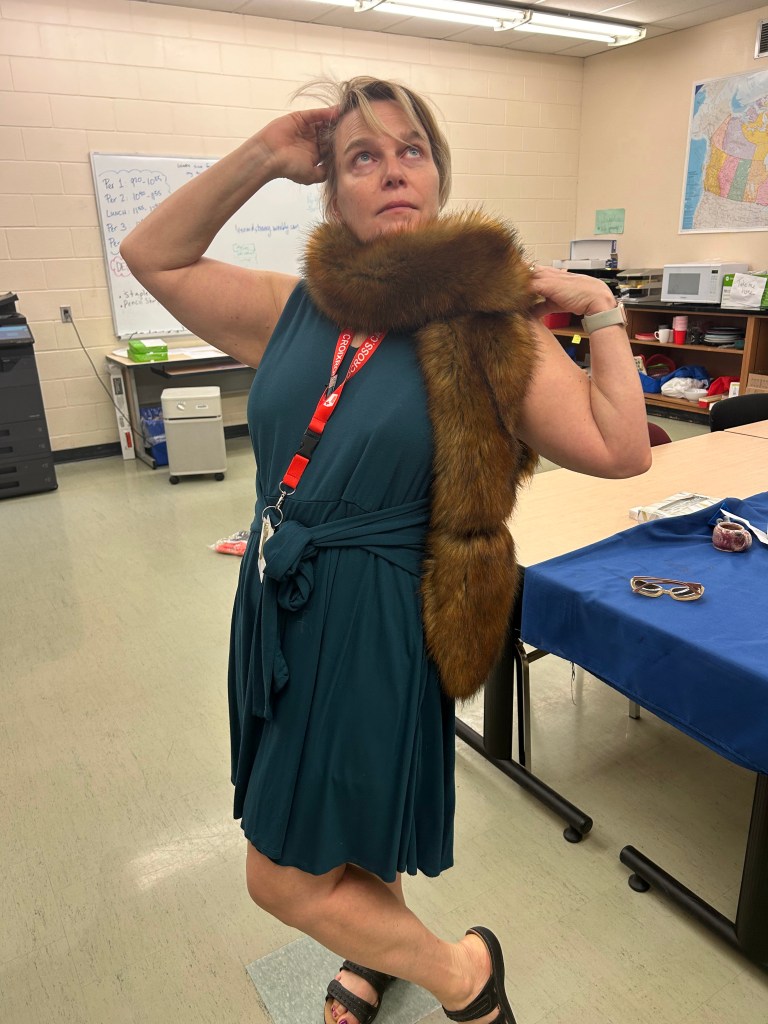
There: faces of an immigrant. Remember this the next time another person gets deported. They might be a lot like me.

Dinner Party Conversation #SOLC25 29/31

We may have been talking a little too much about politics in our house over the last few weeks. Just now, when I told Mr. 14 that I was writing about tonight’s dinner table discussion with friends – the US, Trump, tariffs, deportations, Signal – he rolled his eyes. “Everyone knows what you’re going to say.”

“What should I say instead?” I asked.

“Tell them that someone thought tariffs were a great idea,” he suggested. “Tell them that we had a big fight and we threw the person who thought tariffs are good into the backyard with the dogs.

“At least that will be different,” he added. “I mean, what Canadian thinks tariffs are good?”

So, um, yeah: that’s my 14-year-old’s take on Trump’s tariffs.

Back up two hours to the dinner discussion my son found so predictable. There, the 16-year-old daughter of a friend tried to fathom the Signal war planning fiasco. “Wait – what?” She squinted her eyes a little and looked at her mother and me like we were trying to pull a fast one. “They talked about bombing people in a group chat?” She paused and let that sink in. “Like, seriously? Grown men? Real bombs? In a *group chat*?” When we mentioned that they had accidentally invited a journalist and that some of them were outside the US, she was incredulous. “Do they even know how group chats work?”

Around the table, people talked about not buying fruit that came from the US, avoiding products they used to rely on, cancelling streaming services. The teen whose parent is cancelling streaming services was unimpressed, but consoled herself that “at least TikTok is Chinese.”

With that, we are treated to a TikTok video of NDP leader Jagmeet Singh demonstrating how he ties his turban while he talks about his Conservative opponent. (For the non-Canadians, the NDP is the furthest left of the three major Canadian political parties; we are having an election on April 28.) She calls this “hair porn” and we all watch, fascinated.

Not long after this, we piled into the living room to watch our movie. As we settled in, three families, four children, two dogs, I kept thinking of one of JD Vance’s lines from the leaked Signal chat, one which has been on repeat in my head, though not in the way he meant it. “I think we are making a mistake,” he wrote.

For once, I think the VP got it right. Maybe we should throw him in the backyard with the dogs.

Dinner conversation, outlined #SOLC25 27/31

We went out for burgers with our kids tonight to celebrate a birthday. The Works isn’t fast, but their burgers are delicious. While we waited for our food, we talked; when the burgers came, we kept talking. Once we were home, I was stunned to look back on our meandering conversation and to realize how interesting I find my teenage children. When did they get this curious about the world?

I can’t possibly write it all up, so I’m taking (more) inspiration from Sherri and trying an alternative format. Here’s an outline of we discussed:

  1. Andre’s run today
    1. his longest since pre-children
    2. how far the rest of us have run
      1. I have run the farthest (yes, I’m bragging)
  2. What the Bank of Canada does
    1. The state of the internet when Andre worked for the Bank
    2. It was rudimentary
  3. Why the drama teacher was late to class
    1. This is unclear
    2. Maybe she was creating a seating plan?
    3. She still does not know the names of everyone in the class
      1. It is six weeks into the semester
    4. She now has pictures of the students with their names
      1. It’s not obvious that this is helping
  4. When the next set of article summaries is due
    1. Monday
    2. This will require good time management
  5. Camus
    1. He is an existentialist
    2. This was not required reading
  6. Jesse Thistle
    1. He spent a lot of time in his memoir recounting his experiences with addiction
    2. He met his wife after he got clean
      1. Because falling in love with an addict would be hard
      2. She was from the same town he was
      3. They now have children
  7. Being cancelled
    1. Is it being cancelled if, like Joseph Boyden, you misrepresent yourself?
      1. Did Joseph Boyden actively misrepresent himself or did he not understand the gravity of what he was doing?
  8. Race – biological or cultural?
    1. The idea of race as a cultural construct is very difficult to fathom
      1. It’s hard to see culture when you’re in it
    2. Andre and I provided (frankly) thoughtful examples
      1. The children were unconvinced
      2. But they listened
  9. Why Google’s AI summaries are untrustworthy
    1. Which teachers have discussed this in school – mostly English and Social Science teachers
    2. hilarious examples from our children 
  10. Tariffs
    1. Why targeting the auto industry might be effective or ineffective
    2. Why countries are or are not banding together to oppose the US
  11. Illegal actions by the current US President
    1. Including interfering in private industry, like specific law firms
    2. Also telling a university that its students cannot wear masks during protests
      1. Which seems a bit much
  12. Group chats
    1. Signal vs WhatsApp
    2. Why would you add a journalist to a government group chat?
    3. Why would the US bomb Yemen?
      1. Who are the Houthis?
  13. The efficacy of protests
    1. Some of these seem deeply ineffective to the children
      1. One protest was declared “annoying”
    2. The children are not convinced that protesting Israel/ Gaza is effective – on either side
      1. Institutions outside the affected area have financial interests in what is going on
        • Including weapons
  14. Civil disobedience
    1. Examples from Gandhi & India
    2. The US Civil Rights Movement
      1. Rosa Parks was effective
      2. Perhaps we need to watch some movies about this because it sounds really interesting to the kids

Dinner ended.
WHEW!

Scam Artist #SOLC25 26/31

As I pulled into the driveway, Andre was coming out of the house with the dog. They paused to greet me (aka Max dragged Andre to the car door), and Andre said, “I thought I’d go ahead and take him for his walk since you were running a little late.”

I gave Andre a funny look. “Mr. 16 didn’t walk him? He said he would.”

Andre, in turn, gave Max a funny look. “Max? Did you already have a walk?”

Max looked off into the distance, the picture of doggy innocence. If dogs could whistle, he would have whistled an innocent little tune. “Who me?”

And Andre decided that since Max was already on the leash, he might was well take him for a second walk.

Who could resist this face?

Being the Parent #SOLC25 25/31

I parked in the tiny parking lot and sat in my car for a few minutes, hoping that the rain would let up. While I waited, I texted a friend to let her know I had arrived; we made plans to meet in a bit. That taken care of, I darted out of the car and towards the well-lit building. A young man – one of Mr. 16’s friends – said hello to me as I made my way up the stairs. There, a couple I’ve known for years were standing near an open door, so I paused to chat for a few minutes – kids, work, life. Luckily, no one was in no rush. 

Eventually, a door down the hallway opened, and an old colleague gestured to me. I made my excuses to my friends and headed over to him. We embraced briefly and then caught up. He shared photos of his son – already two and a half! – and we laughed a bit about my youngest, now 14, and some of his antics in English class. Time flew; soon it was time to go.

This is how parent-teacher interviews go for me now that both of my children are in high school. 

The next interview was across the courtyard, and I ran into several people I knew as I made my way to the classroom. There, a semi-familiar young teacher greeted me and reminded me that we had worked together a few years ago. “I’ve gained weight,” he said ruefully, “Imagine me, thinner.” Again, we used some of our ten minutes to catch up and some to talk about Mr. 14. When time was up, the next parent was a friend, so we all talked for a minute before I left them to their discussion.

Being the parent in these meetings is odd. I’ve taught in this school district for seventeen years now, and I’ve worked in four different high schools. Since I take pleasure in both collaboration and mentoring, and since new teachers often move around a bit before they get a contract, I’ve gotten to know a lot of teachers at a lot of schools. More than that, a few of my former students are now teachers (!!).  These days, much to my children’s dismay, parent-teacher conferences are a semisocial event for me.

The third teacher on my appointment sheet was not able to make interviews – too bad, really, because she was the only person I didn’t already know. After I figured out that she was absent, I made my way back to the front hall of the school to wait for Mr. 16. He was serving as a guide for the evening, and it was still cold and rainy, so I had offered him a ride home. This meant I was free to stand in the lobby and chat with an old friend/colleague and talk about books, the upcoming PD Day, and changes in the school board. Soon, one of Mr. 16’s teachers joined us, and we began an animated discussion of AI and how it’s affecting learning. By the time Mr. 16 was released from his duties, we were gesturing with enough enthusiasm to be completely mortifying.

Eventually, parent-teacher conferences wound down. Before we left, I found the friend/ neighbour/ colleague who I had texted when I arrived, and we all walked out to the car together – of course we were also giving her a ride home. After we dropped off my friend, my child said, “It’s kind of cool that you know so many of my teachers.”

I’m glad he’s ok with it because apparently this is what it means for me to be a parent who teaches.

4-4-4 #SOLC25 23/31

This evening, after several false starts (possibly because I’m still a little tired from whatever illness got me down yesterday), I decided to do a 4-4-4: write about four things within four feet of you for four minutes. I set the timer & wrote, then went to have dinner with the family. Now I’ve spent another minute editing/ tidying. (And probably another minute writing this.) It’s a pretty good way to get writing when I’m feeling stuck. Special thanks to Elisabeth Ellington who used this form earlier this month and to whomever mentioned Saffy’s Angel (maybe as a book her mother liked? Can’t remember.)

***

On the other side of the bookshelf, Mr. 14 is on the computer. What is he doing? I don’t know. I do know that earlier today he let me add him to my Google Classroom to check out a quiz I made. Then he commented on my quiz (“interesting, but hard”). He’s awfully fun to have nearby; one of the many reasons I appreciate having his computer in our main living area.

He’s just behind this bookshelf

My feet are up on the arm of the love seat in front of me. Just beyond them, our black lab mix, Max, is snoring lightly. He prefers being near me whenever possible; even better if he can be near me and in a soft space. If I stir, he’ll wake up, but for now, he sleeps peacefully.

Max takes up the entire love seat

Beside me on the couch are two blue yoga balls in a small mesh bag. They are calling me, reminding me that some mobility work will be good for my body, even if I’m not quite done being sick, even if I would rather just sit and read my new book, James by Percival Everett. It’s open and just next to the yoga balls. So far, it is amazing. I finished The Heaven and Earth Grocery Store just in time for book club on Friday night; that one was a slow read for me. Then, yesterday, I read Saffy’s Angel – a middle grade novel recommended by Elisabeth Ellington – because I spent most of the day in bed. It was a great half-sick lie-in-bed read. Last night I started James, and I’m tearing through it – making much faster progress than I did on The Heaven and Earth Grocery Store

Time’s up. 

When an English teacher is ailing #SOLC25 22/31

This is not the post I had planned for today. The plan was to write early, comment liberally (catching up on the blogs I’ve missed this week – so many) and take a nice long walk. Then, I was going to grade papers, maybe craft a little and generally be productive. Instead, I’ve spent most of the day in bed, sleeping off and on and generally feeling miserable. Super frustrating.

Since I’ve taken to my bed and am feeling sorry for myself, I’ve been thinking of Jane Austen – as one does. Have I caught a violent cold? I have not been coughing, so I don’t think so. Do I have a putrid tendency? I’m not 100% sure what that is, but I doubt that’s my primary ailment Rather, I find I have feverish symptoms and my head aches acutely. Oh! And I’m definitely languishing a bit, but my sleep brings me rest, not delirium, so no need to send for the apothecary… yet. Finally, while I am discontented at the moment, I do not fancy myself nervous, which is good because darling Jane has little patience with people’s nerves. Luckily, I am no fanciful, troublesome creature!

I will acknowledge that I am nowhere near as sick as Marianne Dashwood after the horrid Willoughby uses her so poorly, but I may be nearly as sick as Jane Bennet after she walked to Netherfield in the rain. Either way, I am missing a devoted sister to nurse me back to health. I shall have to send my sisters a letter to let them know that they have failed in their duty to attend to me in my time of need. Luckily for them, Andre has returned from his afternoon outing, and he is coddling me (a little), though no possets as of yet. Perhaps he is courting me. As a result, I suspect I will recover – though perhaps I will consult a physician to see if he might prescribe a trip to Bath. No doubt that would restore my good health.

Until then, I’ll settle for reading a good book in my own bath.

Say it again #SOLC25 21/31

Inspired by Sherri’s post with the same title. Things I say on repeat…
(And if you were here yesterday: I FINISHED THE BOOK!)

Good morning! You awake? Time to wake up! Hey, kiddo, if you don’t get up your brother’s going to get the first shower.

I’m leaving! Have a good day!

No, I don’t know who has the Chromebooks. Have you checked Richard’s room?

Books and notebooks out and open! Make sure you have a pen or pencil available. 

You know where the pencils are. The pencils are where they have been all year. I’m sure you can find a pencil. Yes, that is where the pencils are. 

Please make sure your phones are away. Headphones and air buds, too, please. Away means in your backpack. Your pocket is not a backpack. I see a few phones out. Make sure your phone hasn’t accidentally snuck into your hands. Phones are sneaky like that.

If the teacher writes it on the board… you should write it in your notebook.

Is anyone else hot or is it just me? 

You can’t read and talk at the same time; that’s not how brains work.

Listen first, then move.

Ok, you know the drill: SLANT! Sit up, lean forward… look, even if you don’t ask questions you can nod your head and track me when I’m speaking.

Ok, but you need to be back in five minutes or less. Five minutes is reasonable.

No one else is hot?

Bye! Bye! Nice work today! Bye! See you tomorrow! Bye! 

Hi! How was school? Has anyone walked the dog? Ok, I’m going to walk the dog. Did anyone feed the dog? Have the cats been fed?

No, dinner’s not for a little while. Try a healthy snack. It won’t be long.

Please make sure your dishes end up in the dishwasher. Do you have any homework? I’m just going to mark a few things. Please make sure that plate ends up in the dishwasher.

Goodnight, my love. See you in the morning.