
Some of the grade 12s have already found their seat before the students from period 1 have entirely cleared out, but somehow the bell still sneaks up on us. As the announcements play, I observe that a lot of students are wearing green and comment out loud before remembering that today is “fake” St. Patrick’s Day since the real one falls during March Break this year. One thing leads to another and soon we are looking up St. Patrick and why people celebrate St. Patrick’s day. Didn’t he drive something out of Ireland? Rats? Cats? (Snakes. It was snakes – though that part’s a legend.) Why do Canadians care if someone drove snakes out of another country? Umm… they don’t.
Our conversation meanders and morphs and I point out that the Irish were considered highly undesirable when they first came over, and talked about how many nationalities and ethnicities struggle, even today, to find a foothold in a new place. Yes, even in Canada. Somehow the idea that Irish people were considered “nonwhite” comes up, and students are shocked. I disabuse them of this – the idea that Irish people were ever viewed as entirely non-white is pretty clearly false – but they are puzzled by the idea that race could be so malleable. I take a deep breath.
Soon, we are talking about the idea that race is not, in fact, a purely biological construct, that what societies notice and separate and categorize as different races changes over time. No matter how many times I have explained this, the idea is always hard for students to take in. Today, I am able to use the wide array of skin tones in the classroom to show that “white” makes no sense. We all agree that I am “white” but my skin is clearly not the palest in the room. From there, I move to my family – are my niece and nephew white or Latino? The answer is obviously both, but when they move through the world, they will likely be viewed as one or the other. From there, I move to the author Lawrence Hill, who has generously shared his family background with his readers. We talk about the “one drop” rule and the labeling of humans as “quadroons” or “octaroons.” The students have questions.
At one point, someone asks if I see gaps between how Canadians understand race or racism and how Americans do. Now that is an interesting question. I give it some thought. One thing about Americans – at least when I lived there – was that we couldn’t pretend that slavery hadn’t existed. Canadians too often like to think that we did not benefit from the enslavement of human beings. We did. I tell my students today that I gave up teaching Lawrence Hill’s The Book of Negroes a few years back when I tired of my annual attempt to convince that one recalcitrant white kid that slavery really was that bad. Like… sir, allowing an enslaved human being to learn to read and write does not negate the fact that you consider them property. My current students are horrified. We talk about how much has changed in the last 15 years, the last 40 years. I tell them about how I was raised “not to see color” and how I had to learn that whiteness too often obliterates other perspectives. Eventually, I tell them that I need us to move on, that we’ve got plenty to think about for a while, and we settle in for some quiet reading.
I use reading time to check in with various students. Did they feel heard? Did I miss something? One student calls me over and thanks me – no one ever talks about this, she says. I thank her and ask her to bring up anything that needs to be discussed in the future. Another student asks what books I have that address these issues. I pull Stamped from the Beginning, Homegoing, Beloved… she and her friend start thumbing through these, eventually choosing different books and sliding them into their backpacks to read over break. The class calms and breathes. We’ve gotten off topic – how did wearing green lead us to slavery? I muse – but I believe this digression was well worth it.
After reading, we begin our first Socratic Circles of the semester. “Does walking away constitute meaningful action or is it merely an escape?” In groups of 8, fishbowl style, the students engage in thoughtful discussion about justice, utilitarianism, cowardice and whether or not anyone has the right t make decisions for others. Every student speaks. Everyone is engaged. It is a minor miracle.
Just before the end of the class period, I show students the “graphs” of each discussion. We talk about how good discussions allow everyone to participate in their own way while making sure that everyone feels welcome. It’s ok to talk more or less, to indicate agreement by leaning in or nodding. This class has done exactly that. When I point this out, one student counters with, “Yeah, but like six people were absent.” True, but I’ll take the wins where I can get them. When the bell rings, I tell them honestly how incredibly impressed I am with them.
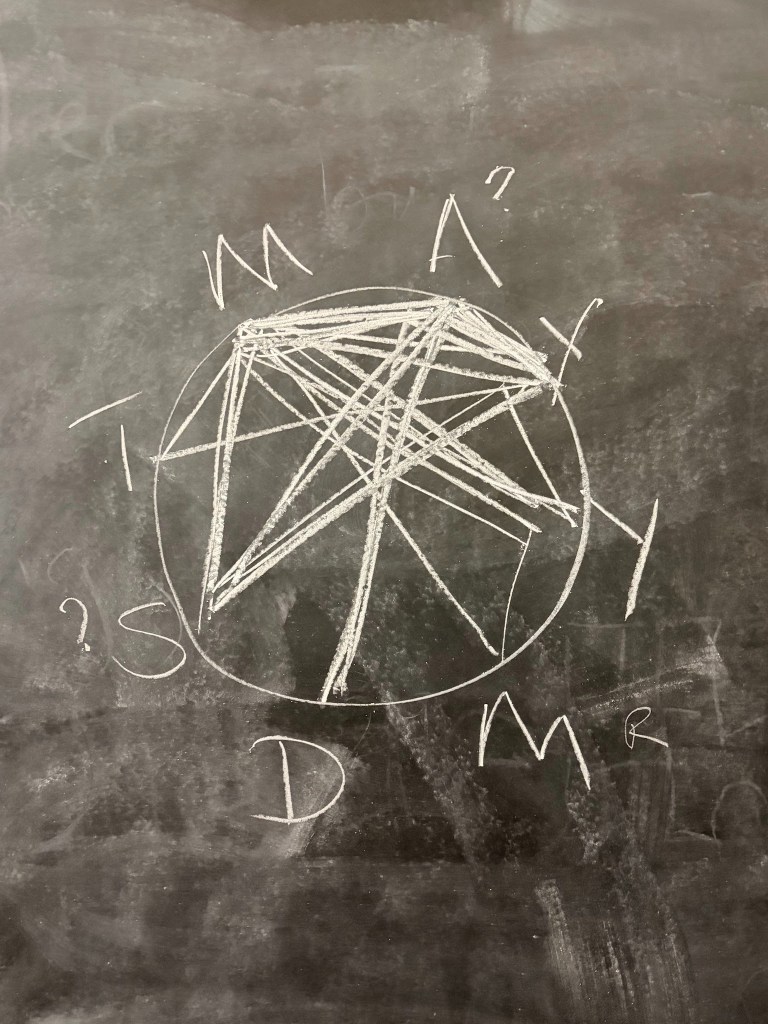
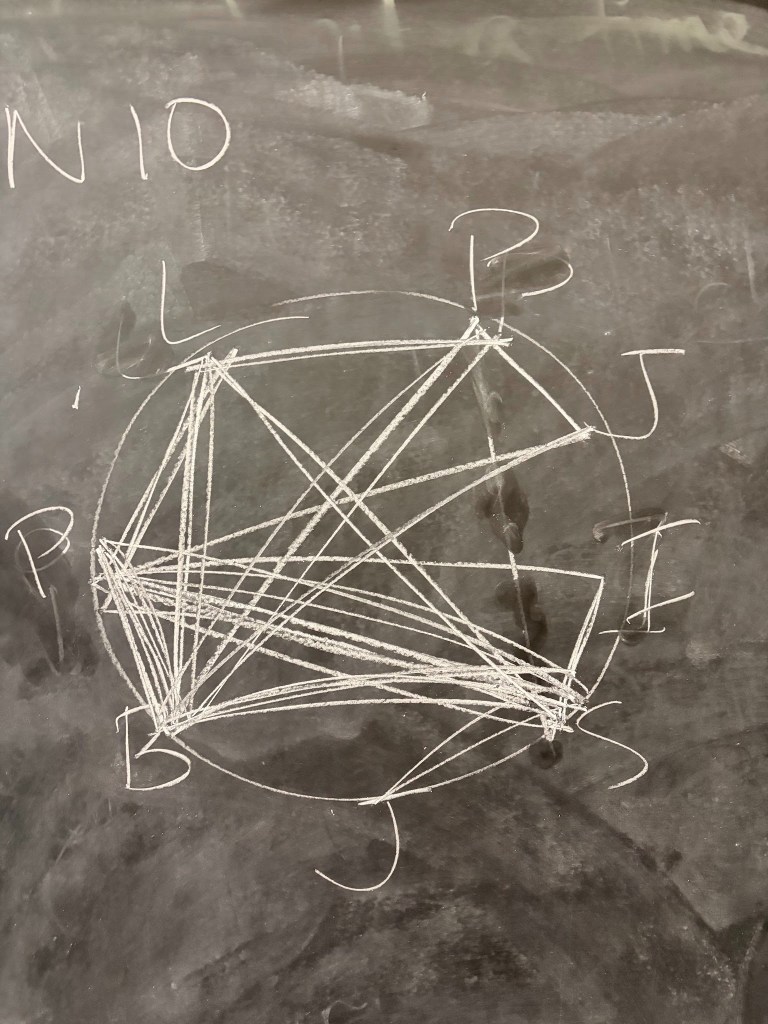
A few linger to discuss books (“Hear me out, Miss. What would you say to teaching Catcher in the Rye after Hamlet?”), but most head off to lunch. I am tired but elated. What an amazing pre-break class.


 Persistence and Pedagogy