What does it mean to be American?

It’s been twenty years since I taught American Lit to 11th graders in a high school in Washington, DC. After I’d taught the course a few times, I used to start the class with the question students would answer on the final exam: What does it mean to be American? In September, students answered glibly: duh, you have to be born here. But even as they said that, they could feel that it wasn’t right, so they would hack away at the edges of the answer: you have to have an American parent, or maybe an American passport. But a cursory look showed that didn’t work, either. First, not all Americans have passports and second, does the passport make a person American? The rest of the school year just made things more complicated.

Were the Pilgrims (born in Europe) and other early settlers American? We read some of William Bradford’s Of Plymouth Plantation. Ok, the students said, the Pilgrims count as American (even though “America” didn’t exist at the time and obviously the original settlers weren’t born here); if you came to America for a better life, that counts. I complicated things: So, if people who fled their homeland in search of freedom count as American, what about people who do the same in modern times? We read short stories by Edwidge Danticat (American, born in Haiti) and Jhumpa Lahiri (American, born in England to Indian parents). Are their characters American? 

What about the people who already lived on the continent when the colonists arrived? What of the Native Americans? (Honestly, I’m a little relieved to realize that even 20+ years ago we read at least one speech by a Native American, though we should have done much more.) And what if you didn’t choose to come? What of people who were enslaved? Surely Jim in Huckleberry Finn was American. 

Maybe being American is about a set of values? We looked at Puritan leader (born in England) John Winthrop’s “City upon a Hill” (from his essay “A Model of Christian Charity”) and considered what he calls on fellow Puritans to try to create: a community of virtue, effort, and compassion. We read the beginning of the Declaration of Independence (written by Thomas Jefferson, born in the colony of Virginia) and excerpts of (French author) de Tocqueville’s “Democracy in America.” Does he see in the mid-1800s what Winthrop dreams of two centuries earlier? Is that what Huck Finn seeks when he decides to “light out for the Territory”? Is it what Jay Gatsby is striving for as he reaches for the green light? What Janie longs for in Their Eyes Were Watching God?

Gatsby is definitely American – no question about it – but there is the pesky concern of the “foul dust [that] floated in the wake of his dreams.” Perhaps, students thought, Americans had strayed from important original values, as Jonathan Edwards (born in America) thundered in his famous 1741 sermon “Sinners in the Hands of an Angry God.” Again, this gets complicated. In The Scarlet Letter, Hester Prynne’s (born in Europe) sin is the impetus for the whole novel, but in the end, (like Gatsby? unlike Gatsby?) she is the best of them all, except for maybe her daughter Pearl (born in America) – but Pearl takes her riches and moves to Europe. Hester stays in the New World. So who is American?

But, those are just characters, the students protested. True enough. But many real live Americans, good Americans, I insisted – Americans who shaped our nation – were sinners and criminals. Some students were doubtful – 20+ years ago was, I think, a more innocent time. Still, I said, Roger Williams (born in England) was banished from Massachusetts for advocating religious tolerance and the separation of church and state. We read Thoreau’s “On Civil Disobedience” and Martin Luther King, Jr’s “Letter from a Birmingham Jail.” We read Walt Whitman, Zora Neale Hurston, Emily Dickinson, Langston Hughes, and more. One year we read My Antonia and made popcorn balls. Always we came back to our central question.

(How did I get them to read so much? I have no idea.)

By the end of the course, no matter what we read, we had a massive tangle. Americans, it seemed, could be born anywhere and live anywhere. They could be Americans by birth, by choice or by force. They could be saints and sinners, criminals and leaders. And then it was time for the exam. We ended where we started: “What does it mean to be an American?” The answers were always complicated.

****

Last week, on the 13-hour drive from South Carolina to Buffalo, my two sisters and I had plenty of time to talk. We usually see each other only once a year, and we never run out of conversation. This year, after a gas stop in West Virginia and a possible sighting of ICE agents, our talk turned to politics and family. 

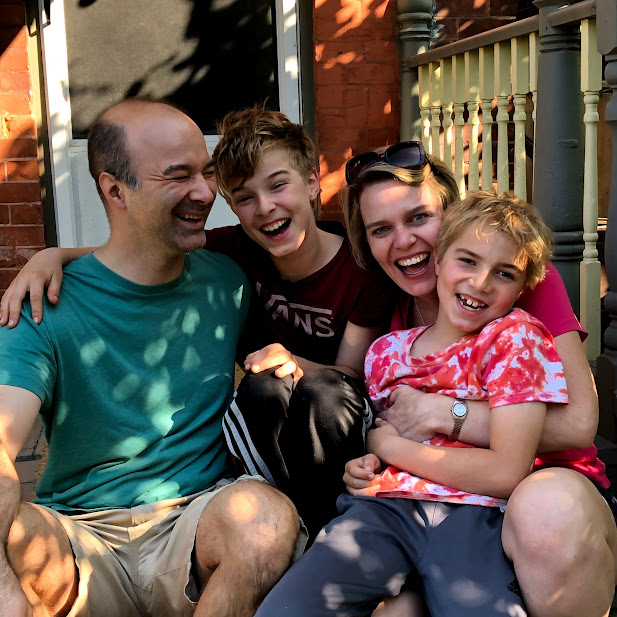
I guess you could call our family “blended,” but mostly I think of it as chaos held together by love. Even if I just tell you about the children (my six various siblings) who go with my dad and stepmom, things get complicated. My step grandmother was born Dutch and became an American; my stepmom is Alabaman through and through. I was born in the US but am now a dual citizen. My children, born and raised in Canada, are dual citizens. My partner is pure Canadian, but his mother, my mother-in-law, is a dual citizen; my father-in-law is 100% American. One of my sisters was born in Panama on an Air Force Base, but she doesn’t remember it at all and does not speak Spanish. Her daughter, my niece, born in the US, does speak Spanish and is dating a young man whose family is Mexican (his dad was born there; I can’t remember about his mom); he is American. My sister-in-law is a naturalized American who was born and raised in Cuba. Her mother is living with them (very legally) but is not yet a citizen. My brother, her husband, is pretty much a good ol’ boy (in the best of ways), but his kids have olive skin and dark hair and speak both Spanish and English. Except for my sister-in-law’s mother, I would say all these people are American. Even she may be a future American.

Adding in my mom’s side – she has four siblings – doesn’t make things any more clear. My uncle married a Filipina woman who is now American. One of their two sons, my cousins, just got out of the Marines, so definitely American, right? But when he was on tour, children in Saudi Arabia made the “slant eye” face at him, annoying him to no end. My mother’s sister married a Brit, and they live in the Cayman Islands; their child, my cousin, is American-British-Caymanian. He went to college in the US and worked in NYC before meeting an American woman and moving back to Cayman. Their children were born in Cayman. All except my uncle have American passports. 

As a family, we are Lutheran, Catholic, Presbyterian, Jewish, atheist. We are white, Asian and Latino. We speak English, Spanish, Tagalog, and French. We are gay, straight and bi. We are addicts and we abstain.  We have committed crimes and been arrested for them or gotten away with it. We have done good things and been recognized for them or overlooked. We have high school diplomas, bachelor’s degrees, master’s degrees, MDs or PhDs. We are business owners, doctors, teachers, CPAs, hourly employees, unemployed, researchers and more. We were born in six countries, and we currently live in three countries; we have lived in many, many more. We voted for Harris or for Trump or not at all. We are all American.

In the car, my sister worried about a friend who is married to a US permanent resident who was born in El Salvador. His parents brought him here when he was a toddler. As a young teen, he got involved with a gang and committed “a bad crime” (yes, it is bad). He was arrested and went to jail. He served his time, got out, got a job and got married. Now in his mid-40s, he has never committed another crime. As we drove north, he was on his way south to his annual check-in with immigration, and they were terrified. The family has money and a lawyer, and a no-deportation order. But they had no idea if, after he followed the law and went to the courthouse, he would come back out or be disappeared. “We talk about ICE deporting ‘criminals,’” my sister said, “and everyone seems to think that is ok; but he’s a good person who did an awful thing. He’s here legally. Should we deport him because of something he did when he was 15? Why can’t we talk about the human cost? When did we stop thinking of immigrants as fully human?”

As we drove through the mountains of West Virginia, I mused, “What does it mean, then, to be an American?” I still don’t know, exactly, but I am sure the definition should be rooted more in love than in hatred. If there’s one virtue that my loving, chaotic family and all those texts I used to teach have in common, it is compassion. 

Well, maybe not “Sinners in the Hands of an Angry God,” but really, that one is kind of over the top.
4-4-4 #SOLC25 23/31

This evening, after several false starts (possibly because I’m still a little tired from whatever illness got me down yesterday), I decided to do a 4-4-4: write about four things within four feet of you for four minutes. I set the timer & wrote, then went to have dinner with the family. Now I’ve spent another minute editing/ tidying. (And probably another minute writing this.) It’s a pretty good way to get writing when I’m feeling stuck. Special thanks to Elisabeth Ellington who used this form earlier this month and to whomever mentioned Saffy’s Angel (maybe as a book her mother liked? Can’t remember.)

***

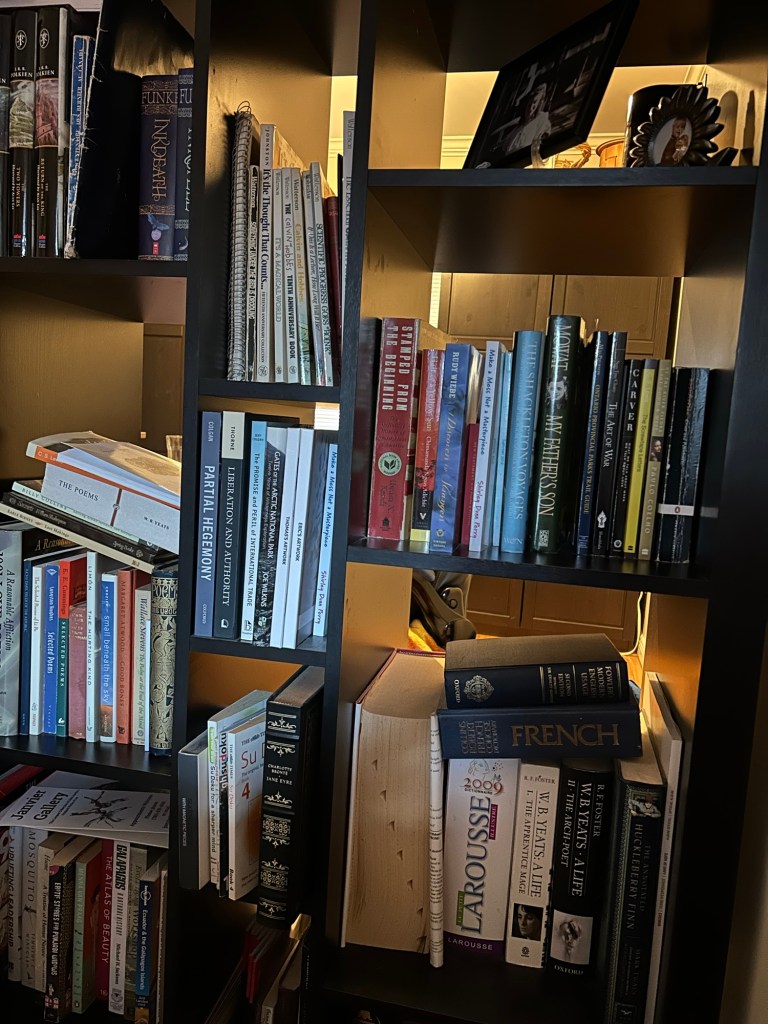
On the other side of the bookshelf, Mr. 14 is on the computer. What is he doing? I don’t know. I do know that earlier today he let me add him to my Google Classroom to check out a quiz I made. Then he commented on my quiz (“interesting, but hard”). He’s awfully fun to have nearby; one of the many reasons I appreciate having his computer in our main living area.

He’s just behind this bookshelf

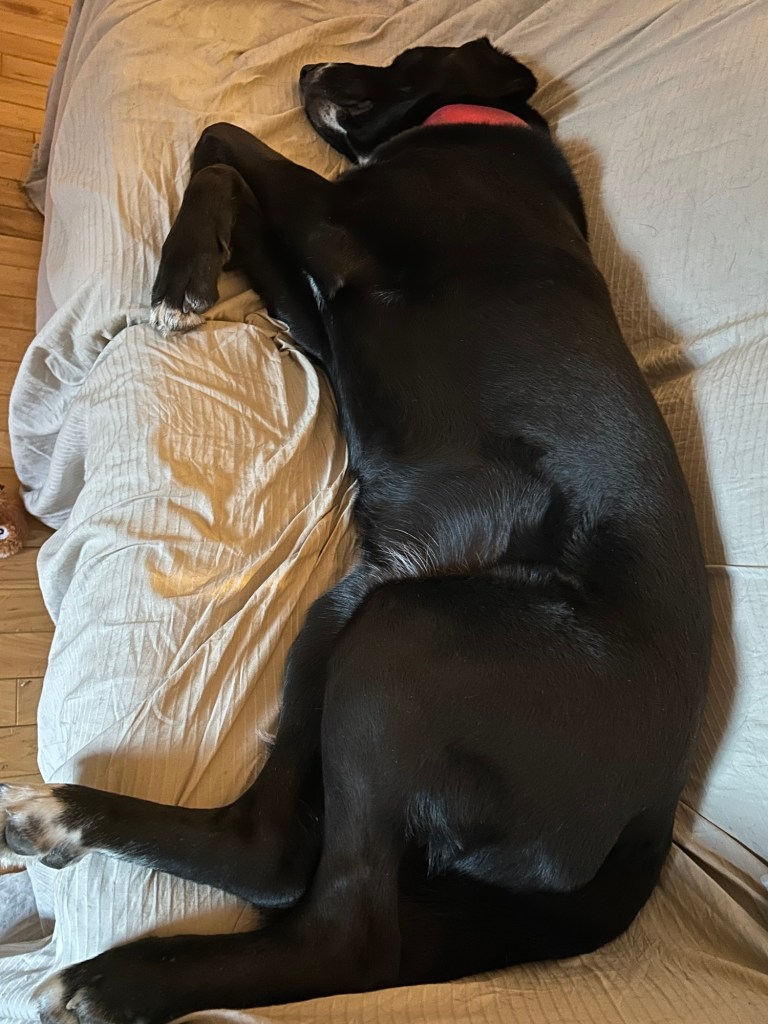
My feet are up on the arm of the love seat in front of me. Just beyond them, our black lab mix, Max, is snoring lightly. He prefers being near me whenever possible; even better if he can be near me and in a soft space. If I stir, he’ll wake up, but for now, he sleeps peacefully.

Max takes up the entire love seat

Beside me on the couch are two blue yoga balls in a small mesh bag. They are calling me, reminding me that some mobility work will be good for my body, even if I’m not quite done being sick, even if I would rather just sit and read my new book, James by Percival Everett. It’s open and just next to the yoga balls. So far, it is amazing. I finished The Heaven and Earth Grocery Store just in time for book club on Friday night; that one was a slow read for me. Then, yesterday, I read Saffy’s Angel – a middle grade novel recommended by Elisabeth Ellington – because I spent most of the day in bed. It was a great half-sick lie-in-bed read. Last night I started James, and I’m tearing through it – making much faster progress than I did on The Heaven and Earth Grocery Store

Time’s up. 

Locked out #SOLC25 9/31

We are locked out of my aunt’s house. She and my spouse left about an hour ago to go see my nephew (really my cousin’s son, but big families get confusing) in a swim meet. My boys and I stayed behind, too happy in the ocean to go with them. Eventually, I traded the Caribbean for the heated pool, and soon my kids followed.

While they roughhoused in the pool, I made my way back to my aunt’s place to write today’s post – only to discover that the key she left behind didn’t turn in the lock. So here I sit, poolside, writing on my phone and watching my teens. They’ve had me film them in slo-mo as they do various wild tricks; now they’re playing something akin to baseball with a pool noodle and a beach ball. My writing keeps getting interrupted by gales of laughter and giggles.

The sun is starting to set, so I have finally texted to admit that we can’t get in – but we’re in no rush. When we left this morning it was snowing and gray; we can stay here, locked out together, and be happy for a long time.

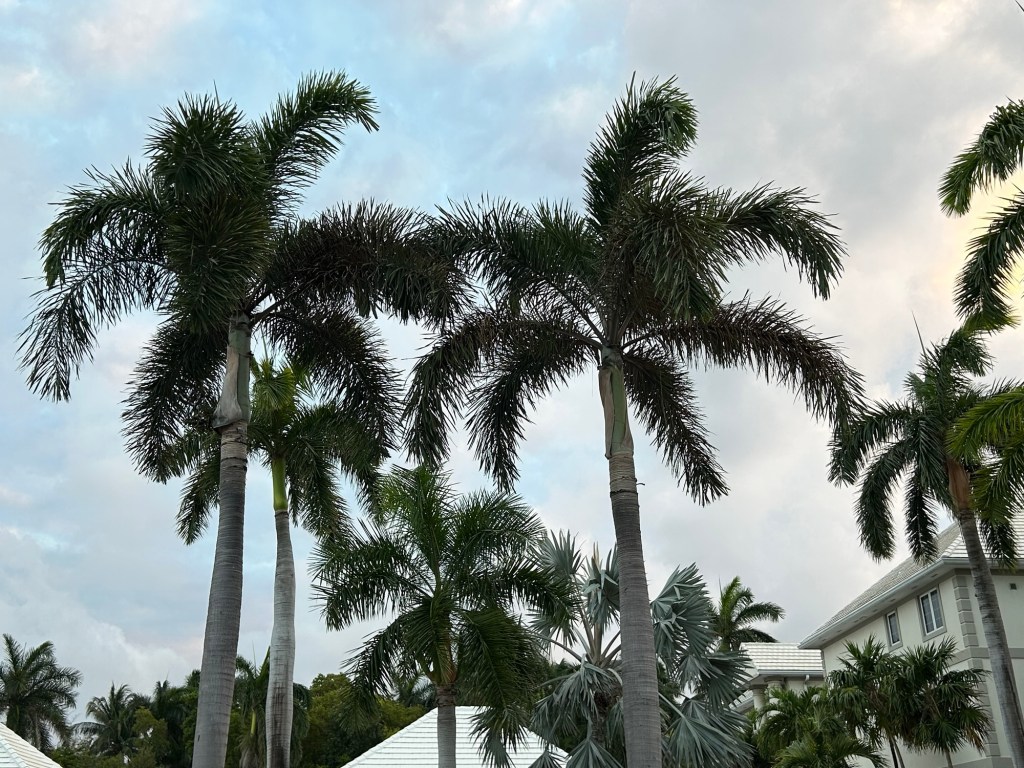
My view as I write

Nearby #SOL24 3/31

Years ago, a photographer friend of mine, Maggie Knaus, had an exhibition that she entitled “Nearby.” In it, she featured pictures she had taken when her brother-in-law had been nearby. He had passed away, but the images remained, beautiful and poignant. 

I think about that exhibition a lot: the beauty; the sadness; the sense that noticing who is nearby, who is not quite in the picture, is powerful and important. Because of it, I find myself thinking about who is nearby as I go about my day.

Right now, for example, my spouse and his buddies are playing a board game in the next room. The game will last most of the afternoon, their laughter and chatter an accompaniment to my writing and planning. Dice rattle; pieces plunk onto the board. I love the easy camaraderie of these men, the way they gather often, using games to deepen their friendships. They laugh again, and here, mere metres away, I smile.

Mr. 15 is in his third-floor hideaway. The “chill room” was meant to be a shared space, but his bedroom is tiny, so he has spilled into this space, too: computer, books, beanbag – and all the detritus that trails behind teenage boys. When he is home, he is up there. Moments ago, we crossed paths in the kitchen as he cut two thick slabs of fresh bread, slathered them with butter and popped them into the toaster “to melt the butter just enough.” I silently marvelled at his tall and slender form, at his long torso stretching up from pajama bottoms knotted low around his hips. What a miracle, to watch my child become a man. I hug him when I can and keep my comments to a minimum. Now, he is hidden again: only his voice trails down the stairs, a murmured reminder that he is nearby.

Mr. 13 is in the room with me, but a bookcase and a bamboo screen separate us. He is nearly silent now. Only the click of the keyboard and the occasional slide of the chair across the floor let me know he is nearby. Soon enough, he will finish this task and join his friends online. At some point, his excited voice will rise up to fill this room, and I will say, “Seriously! Can you please tone it down?” and he will – for 30 seconds or a minute – until the game and the friends fill his brain again and his voice surges again.

In the kitchen, one cat sleeps in her perch near the sliding glass door. In the basement, the other cat sleeps in the box of giveaway coats that she has adopted as her own. And here on the couch, the dog has curled up next to me as I write. 

In this mundane moment, I pause to recognize just how much love is near me, just how lucky I am.

A call from the teacher

The phone rang after dinner. I warily checked the caller ID, then perked up when I saw my sister’s name. Ah, exactly what I needed! But just as we settled in to a nice chat, I heard a beep.

Call waiting. I didn’t even know we still had call waiting. We’re already the odd family out because we still have a landline, but I can’t even remember the last time two people tried to call our house at the same time. Odd. (For what it’s worth, our reasoning for the landline is complicated, but the crux of it is that one of the kids still doesn’t have a cell phone AND we want them to be able to answer the phone in a general sort of way – you know, like if their grandparents call.)

Even odder, the tiny screen displayed the school district’s phone number. Someone was calling us from a school at 8:15pm. I asked my sister to hold on, and clicked over. My younger child’s teacher chirped a cheery hello. Quickly, I hung up on my sister (sorry, sis) and devoted my attention to this unusual caller.

I was a little concerned. I mean, when was the last time we had a not-automated call from the school? We got his report card last week and nothing looked terribly amiss. And he was already at home, playing video games & chatting with his friends, safely in one piece. More than that, when I’d asked, “How was your day?” he had pleasantly replied, “boring” as he does virtually every day. Everything seemed fine.

But his teacher was talking. I calmed my racing mind and paid attention. She was just calling to say hello and see how things were going. She was impressed with his math work. She knows about his dyslexia and complimented his writing. We talked about this and that. Finally, I asked if she was calling everyone. Yes, she was. She had decided to call all of her students’ families just to check in after report cards. After all, she said, it’s really too bad that the students who are doing well don’t get this sort of attention. We had a very pleasant conversation, and I hung up in a good mood. Judging from her voice, I bet she felt pretty good, too.

Before I called my sister back, I realized: I have done this. I have called home to say something nice. I have called home to check in. I have been the chipper voice on the other end of the line, the teacher saying that things are going well. But, I have never been the parent who got this call. And you know what? It felt nice. It felt like the sort of thing I might want to do for the families of this semester’s students. In fact, maybe I’ll start again this week.

Family Reunion

What I want to say is that it is a terrible idea to start a 17-hour drive the day after the school year ends. And that this is the reason we somehow forgot my suitcase. And that I had packed all the toothpaste, among other things. And that I had to replace everything which is part of the reason I was fussy until about four hours ago.

What I want to say is that 18 people in one house is, more or less, 12 too many, even if one of them is my adorable 13 month old niece who, for reasons none of us can quite fathom, is basically happy all of the time.

What I want to say is that South Carolina is hot, even at the beach, and that most of us are ridiculously sunburned even though we’ve only been here three days. And we were too far away to really appreciate yesterday’s fireworks, and what were we celebrating, really, since each day the beach appears to be full of straight white couples and Roe has been overturned and there were 21 mass shootings in the US between July 1st and 4th and as we drove down here we passed within spitting distance of at least two of them.

But then I meet my sister’s partner, a woman who makes her very happy and who, as it turns out, makes a delicious daiquiri. And my Cuban sister-in-law is tucked away in the shade, reading and cooing at the baby. And my brothers are on the beach, kicking a soccer ball with my son while my partner plays in the ocean with my nephews. And I marvel that my family has dealt with addiction and divorce and depression and suicide attempts and miscarriage and abortion and money troubles and the list goes on and on. Some of us own guns; some of us abhor guns. Some of us are vegan; some of us are enthusiastic meat-eaters. Some of us have MDs; some of us never finished college.

By all rights, we should not get along at all, and sometimes we don’t, but for the week of the family reunion, day after day we laugh and love and find the things we have in common. The grill sets off the fire alarm – again – and the kids try to fill the pool with water balloons and then, after dinner, we have a birthday cake to celebrate birthdays we’ve missed. Tonight, we are all in the main room with the baseball game on mute while Jamie and Donna serenade us with old time bluegrass music and about half the family sings the chorus.

This family reunion – so many of us joined in such unexpected ways – doesn’t fix everything, of course, but it’s not nothing. Some nights, once I’ve recovered from the long drive and the end of the school year and all its attendant fatigue, I think it might be (almost) everything.

Many thanks to Two Writing Teachers, whose weekly Slice of Life keeps me writing and thinking.

Vacation? #SOL22 14/22

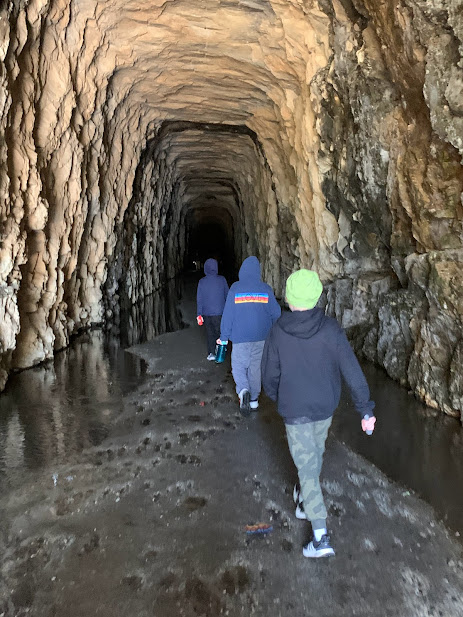
Describe your ideal vacation. Does it involve going into a dark, wet, hand-carved, dead-end tunnel with a group of energetic pre-teen boys? If so, today would have been your day.

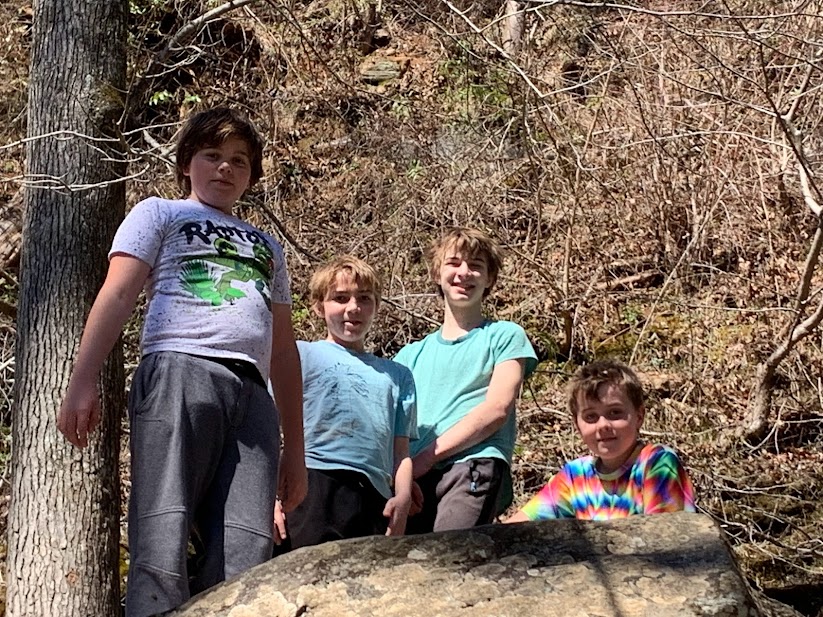
The last time my children and my nephews were together was July 2019, pre-pandemic. Their reunion during this week of March Break has been, well, loud. In two short days (and today isn’t even nearly over), they have done a “Polar Bear” dip in the lake (54F/12C) – then done it again because their aunt offered them $25 if they do it five times for five minutes and they love money, met their (adorable) baby cousin, convinced their grandfather to take them tubing even if the water is ridiculously cold, gone to (distanced) church, played Dungeons and Dragons (with my partner as their patient Dungeon Master), talked about D&D until we forced them to stop, exhausted their grandparents’ dog (who did not know this much non-stop action was possible), watched 40 gazillion episodes of The Simpsons, and gone on an adventure to Stumphouse Tunnel.

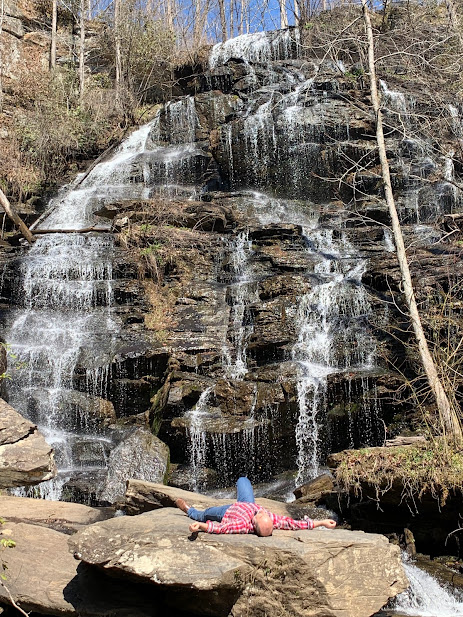
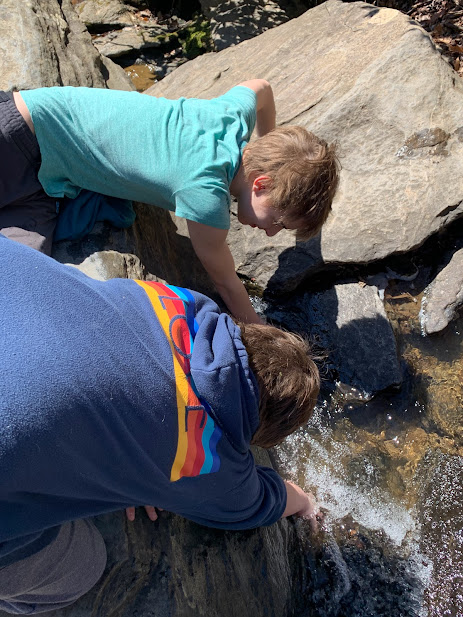
The Stumphouse Tunnel was carved into a mountain in the middle of nowhere South Carolina before the Civil War – apparently as a potential train tunnel. I would be able to tell you more about it, but we didn’t have time to stop and read the signs. We *did* have time to go to the end of the tunnel, climb over top of the tunnel to the peak of the “mountain,” have a picnic, and then go off-trail and clamber down the nearby Issaqueena Falls. The day was gloriously sunny and warm (at least for those of us from Ottawa).

After a few hours of climbing outdoors the kids were almost worn out – but not quite. They contemplated Laser Tag but opted to come home. We’ve played the family version of Cards Against Humanity and some of the adults (ahem – me) took a nap, but there’s still spaghetti pie to make (it’s pi day) and apple pie to eat and at least one movie to watch.

I’m exhausted and as happy as I’ve been for a while: writing on a couch with a cat curled up next to me, listening to boys laughing in the next room, to one boy and his grandfather cooking, to my partner and my stepmother deep in conversation.

Happiness sneaks up on us, doesn’t it? Even when your vacation day involves hiking in a cold, wet tunnel.