Knock-on Effects #SOL24 7/31

Today, I got an *AMAZING* message from a former student. She is graduating from university and is “almost an RN now.” I am aglow with happiness for her – and for us: she’s going to be a wonderful nurse. I am proud to say that a tiny part of her story relates to my post from yesterday. 

You see… back when Mr. 13 was Mr. 6, he was driving his teacher up a wall. They butted heads regularly (in a first-grade sort of way – the kind where it turns out that six-year-olds need to follow rules sometimes), most often in reading group. There, Mr. 6 would some days read fluently, then other days act silly, “reading” words that were not on the page. We were baffled. The story goes that one night, angry with my insistence that he try to sound out words, he “read” his entire book without looking at the pages *even once*. But he couldn’t read individual words.

Because his teacher was both kind and deeply experienced, she had already flagged his reading as potentially problematic. Because I knew that dyslexia ran in my family, I already knew to pay attention to my children’s reading. Because my colleague’s wife was a child psychologist who did lots of educational testing, she advised testing Mr. 6 asap, rather than following the school system’s recommendation to“wait and see.” Because we have good health insurance, we could pay for private educational testing. And because of all that, we discovered that Mr. 6 had dyslexia when he was, well, 6.

The chips continued to fall in our favour. First, even though I am a high school English teacher, I was already learning about how people learn to read, so I knew that people with dyslexia benefit from early intervention. Then, when the principal said it was “too bad” that Mr. 6 was going into Grade 2 because the school’s reading intervention program started in Grade 3, we were wealthy enough to pay for tutoring. Then, I began researching dyslexia and found Dr. Sally Shaywitz’s book, Overcoming Dyslexia which recommended specific research-based tutoring programs. In a final bit of good fortune, a local tutoring company specialized in exactly this. 

Y’all, that is a lot of good luck. Learning to read should NOT be a matter of luck.

Now, let me tell you about my student. She had struggled to learn to read when she was little, but she was an incredibly hard worker, so she managed to stay on top of things. She was seriously smart, so she was able to figure things out, even though reading remained, well, not easy. By the time I met her, she was in 10th grade, and she was working her butt off. She was also doing extremely well in school. 

Still, as we got to know each other over a few years, she confided in me that she wasn’t “as smart” as her friends because she took “three times as long” to do her homework and made “stupid mistakes” if she wasn’t focused. I believed her, but I didn’t know what to make of this… until about ¾ of the way through Shaywitz’s book. There, I read a description of a high school student with dyslexia. Right away, I thought of her. Pages later, Shaywitz listed some common signs of dyslexia – and suddenly I had concrete questions I could ask someone. 

I explained to this young person that I had an idea about her learning. Then I read her the description in Shaywitz’s book. Recognition dawned: “That’s exactly me!” I am not an educational psychologist, so I can’t diagnose anything, but at least we had an idea of what might be happening. All we needed was some testing – which our school system couldn’t provide because, first, our limited resources go to students who “are not able to access the curriculum” and this student was on the Honour Roll and, second, those same resources are meant for students in our system, and she was nearing graduation. We fought on. One thing led to another, and things stayed plenty dang complicated, but in the end she was able to get accommodations when she went to university. Things weren’t easy, but they were, at least, easier.

Looking back, it all feels awfully precarious. What if my child’s teacher hadn’t noticed his uneven reading? What if we hadn’t known to get him tested? What if I hadn’t been reading about dyslexia? What if?

I think about all the people who will benefit from having this brilliant, determined, caring young person as their nurse. I know this is supposed to be a slice of life – and I really want you to know how much I admire the student I’m writing about – but I have to end with what I already said: learning to read well should not be a matter of luck. As a profession, we are trying to make changes so that more students learn to read well. I hope our systems don’t give up when our first attempts aren’t perfect. I hope our system doesn’t write off students who are already in high school. I hope we have success story after success story to tell in years to come. And I really hope you’re lucky enough to have this person as your nurse. That would, indeed, be lucky.
Par, pars, parsh, parch #SOL24 6/31

“Hey Mom! Can you come help with my English writing?”

I’m supposed to be doing my own writing – this writing, to be precise – and I’m still knee-deep in grade 9 projects, but he knows I won’t say no. Mr. 13 is an excellent writer – effective vocabulary, interesting sentence structures, good grasp of punctuation – and he is dyslexic. Years of Orton-Gillingham-based tutoring means that he reads well and knows how to make good use of extensions like Grammarly or Language Tool, but when push comes to shove, he still benefits from a once over by someone who’s not dyslexic. Also, he knows I like to read what he writes.

He’s reading his sentences aloud under his breath as I plunk down next to him. “Um… I need a word for like ‘kind of was related to the point but not 100%.'” My eyes widen as I try to figure out what on Earth he’s talking about. “Oh!” he snaps his fingers, “got it: partially!”

He types parsley.

He keeps going, then circles back to fix it. Parshly. Spellcheck suggests harshly as a replacement, so he changes it to parchly – and the new suggestion is archly. “Um, Mom?”

Partially means ‘in part’ so it starts with the root part,” I say.

Part isn’t really a root,” he interrupts. Then, “sorry.” He would know. He knows Latin and Greek origins of words; he understands spelling rules in ways I have never had to.

I laugh, “Just start with part.” He does. I break the word down orally so he can hear all the syllables, then I spell. “Now i a l…” I pause because he is looking at me like I have two heads. Finally, I reach over and type the word.

He stares for a long second, then shakes his head in wonder. “There is no way that word looks like /parshully/. I would never have guessed that.”

And he wouldn’t have. Which is why I was so angry last night when I found one of his old math tests where the teacher has circled his attempt at the word “isosceles” and written “Really???” with multiple question marks. He brushed it off – “I mean, she did tell us we had to be able to spell all the terms” – but she doesn’t see how hard he works to spell these words.

But now he’s moved on and is enthusiastically excoriating someone’s weak debate argument. He doesn’t need me again until the end, when I do a check for capital letters and other words that spellcheck didn’t get. This time, he’s mostly good. I ruffle his hair and head back to finish my own work.

I wish all teachers could understand his truth – the kind that looks good on the surface but is working awfully hard to stay afloat. “Isosceles,” I mutter, and his exasperated voice trails behind me, reminding me to let it go. “Mom!”

Cross words

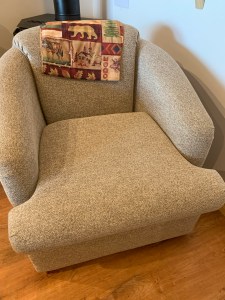
My 9 year old and I are snuggled tightly together in a small armchair designed for one. His bare back warms me as he unconsciously presses his body into mine. Toes, knees, legs, back, shoulders tangle around me. Only his hands are his own, and they are holding my phone. His stormy face bends towards it, and his dark eyebrows draw together in concentration: he is helping me with the New York Times crossword puzzle.

Armchair decidedly for one

We should be outside. We’ve rented a cottage for a week with friends, and everyone else is taking advantage of a beautiful day at a quiet lake. But my boy got angry earlier, and his anger is a monster that swallows his words and hardens his body. When he is angry, he often will not speak and sometimes will not even move. He curls up, hides under a soft dark blanket and refuses to engage with the world or any of the people in it. Today, this meant that he could neither explain his anger nor participate and tidying the cottage after lunch. Tidying is not negotiable, so today he got in trouble, then he screamed, and then he cried.

He stomped off to settle himself down a little bit outside, and then he returned for the sure fix: a snuggle. “Crossword?” He pleaded, oral language still almost too much for him. We have declared this week device free, but three days ago, after another frustration, he sat with me while I worked the crossword. To everyone’s shock, he loved it. Today the only crossword in this cottage is on my phone, and I relent. We snuggle together, reading the clues and guessing. “Christmas ____” is easy, and he loves the clue “suds maker.” Slowly the grid fills.

I would never have guessed that these horizontal and vertical lines, these interlinked squares with so many possibilities and so few right answers, would calm him. His breathing slows; his face lights up when he gets an answer; his body relaxes. With each completed box he puts words in their place. Slowly his world becomes more orderly. We finish the whole puzzle in less than 30 minutes.

Now he can tell me what made him upset. It was nothing, really – a typical sibling spat, easily solved. But cross words and compromises are tough for my boy. I know this, though I can’t fix it. We agree on a non-verbal cue he can use next time to ask for extra time before we try to talk to be honest, I don’t think it will work, but it’s worth a try. And I think I’ll invest in a book of crosswords.

Swimming in words

I’m not sure the formatting will work everywhere, so at the bottom I’m trying (for the first time!) to embed the document as I wrote it. Read the version that works for you – but no need to read both because they are the same.IMG_4345.jpg

Swimming in words

Alewives

Decorated warbonnet

Mosshead warbonnet

Penpoint gunnel

My son is dyslexic. Longfin sculpin Sailfin sculpin

Letters and words swim around my child

Crescent gunnel

Pacific spiny lumpsucker

Strawberry anemone

Northern ronquil Northern clingfish and he can’t always make the letters

Scalyhead sculpin

Match the sounds.

Like today at the aquarium when Cabezon Kelp Greenling Banggai Cardinalfish

Swim before me, and everywhere are the Estuarnine stonefish Frogfish Polkadot batfish and

I search for the Stocky anthias Square spot fairy basslet Sea goldie French grunt but

My head swims and I cannot make the names match the Saucereye Porgy

Sergeant Major

Blue tang

Lookdown

Ocean Surgeon

Blue striped grunt

Koran angelfish

When Smallmouth Grunt and “Look, a Red Lionfish!” and my boy reads those words.

The sounds are starting to match the letters.

I begin to be able to name the beauty swimming around us.

So we are patient for the Red Irish Lord Jewel damsel Fire goby

And together we see the 

High-hat

Moon jelly

C-O sole.

It’s an early draft, for sure, but here I am, publishing it anyway.

slice-of-life_individual

Slice of Life, Day 17, March 2018

Thanks to Two Writing Teachers for this wonderful month of inspiration.