Anything you can do to a cloud #SOLC25 2/31

Sheri set a timer and did a free write for six minutes because someone else did the same, so here I am, jumping on the bandwagon on day two. And I should know how to do this: I freewrite all the time in my teaching practice because I am forever trying to convince my students that it is OK – even good – to just write. My goal for them by the end of the semester is seven minutes. I have no idea why, but there it is. And truthfully, for grade 9, at this point we’re aiming for five solid minutes of writing.

I need to admit that I have deleted a few times already – but I swear this is mostly free writing and if I were handwriting this, I would have just crossed things out, so that counts.

Why do I free write with them? I honestly think that seeing someone else write, watching their process and their struggles, noticing how they pause and keep going, seeing what they throw away and what they keep, can help students understand that writing isn’t about presenting perfected ideas – in fact, it’s about the opposite of that: writing is about honing ideas, checking them out, looking at them from different angles, dressing them up in words and seeing what they look like, finding the places where the ideas aren’t entirely complete…

That’s a lot of mixed metaphors, but hey, it’s a free write.

So I write in front of my students, near my students, among my students. In class, I tell students that a preposition is anything you can do to a cloud – you can go in front of a cloud, near a cloud, through a cloud, over a cloud – and then we write sentences with prepositions, playing with making very long, very silly sentences.

I started this blog in part to experience for myself some of the things my students experience: writing on a deadline, writing when I don’t feel like it, writing when I don’t have much to say, writing knowing that someone else will read it.

Time is up. Now I’ve done my one-minute post-writing clean-up (another trick I use – so they re-read and make a few changes) so I can post this. Then, tomorrow, when we’re writing, I’ll have proof that freewriting is “real” and even shareable. Maybe this will even help them write more.
Writing beside him

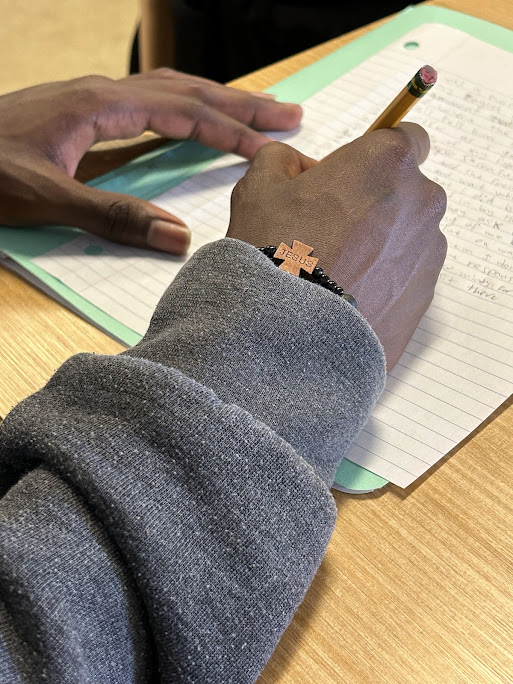
I’m helping a former student write a personal essay for his Grade 11 English class. We’ve talked it through, and planned a little; his next step is to write it. Reading and writing aren’t his forte – he’d much rather be on a playing field than in any classroom – but this story is important to him, and he wants to get it down on paper. So here we are, sitting in the upstairs lobby – currently one of the coolest places in our very hot school – and he’s writing.

This kid has my heart, as many of them do. Last year, he didn’t do particularly well in our first semester English class, so he agreed to change his timetable in order to be part of a reading class with me during the second. That alone took some courage: not everyone who needed the support was willing to accept it. Once there, he mostly tried, even when the work was repetitive or “not that interesting,” even when he took extra long body breaks or got frustrated by the “simple” books he was reading.

Knowing that history, I’m intrigued by his choice to sit with me in such a public place this afternoon. With only two weeks left in the school year, students are out of classes nearly as much as they are in, and many of them wander aimlessly through the halls. Several have stopped to greet us; pretty much all of them give us at least a passing look as we sit here at a student table and work. There’s no hiding that we’re writing together, no hiding that I’m helping.

Nevertheless, he’s nearly filled a page with his small, neat handwriting – a feat which would have been unfathomable last year – and his focus hasn’t wavered, though he has had to stop a few times to flex his tired hand. Meanwhile, I sit here typing my own story, this story, marveling at this moment of quiet togetherness amidst myriad other students. We are here, the two of us, writing; we are here, the two of us, writers. 

This sense of camaraderie has me thinking about what we mean when we say that teachers need to “get to know their students.” How well do I know him? I didn’t spend a lot of time last year asking him about his family, though I did call home when I needed to. I have no idea if he has pets, and am not clear about how many siblings he has. In fact, I don’t know many things about him, but I know enough that I can tell him, honestly, that I believe in him. I never told him he was a strong reader or writer; I did tell him that I thought he could be. I never told him this path would be easy – heck, I was clear that parts would be hard – but I did tell him that I thought it was worth it. Other teachers and coaches told him the same thing, complimenting him when he improved, noticing when he was reading, harrying him back to class when he was in the hallways. When he faltered, he had a team of people to remind him of his long-term goals.

Today, he has a story to tell, and he has found me. He says he needs help, but I think he just needs someone who believes in him to write beside him. What a privilege! I can do that any time.

Second day jitters #SOL24 2/31

At first, this post may look like a poem – and it is! A pantoum, no less! – but it actually a tribute to mentors & the writing process.

On Day Two
How have I forgotten these early days
When doubt – or lack of sleep – drowns
any conviction that I have made
the right choice,

When doubt – or lack of sleep – drowns
the constant rhythm of the deep heart’s core,
which knows the right choice must be
the leap I have already taken?

The constant rhythm of my deep heart’s core
fears nothing:
The leap I have already taken,
the worry that I will share my imperfection,

fears, – nothing
you, too, have not felt before.
The desire to share imperfection,
and be seen –

you, too, have felt it before,
that conviction that we are made
to be seen.
But, oh, I had forgotten these early days.

How I started
(Mentor #1: Alice Nine, who blogged here when I first started, used to write something and then share her process. I found it endlessly fascinating. Today, I’ll share mine.)

I went to bed last night with my head full of ideas for blogging – and I woke up this morning with nothing. Nothing. “Why,” I asked myself, “did I even sign up this year?” (Note: I literally never considered NOT signing up, so this question is ridiculous.) I proceeded to spend a fairly impressive amount of time beating myself up: I overcommit, I take on new things but don’t let anything go, I compare myself to others, I should have chosen a theme for the month (Mentors #2 & #3: Sherri Spelic and E Griffin, both of whom have lovely themes for the month). You get the picture.

Of course, I quickly realized that I have been in this space before – the space where I doubt basically everything. It happens every March during this challenge (and usually right at the beginning, go figure). My mind leaped quickly to the truth that this is also how I felt when I had newborns: some combination of overwhelming excitement, fear and doubt. This leap, I am certain, came from reading a new-to-me blog yesterday, Ana Paton’s lovely post about overwhelm and holding her newborn daughter & poetry.

In my head I heard, “How have I forgotten these early days?” I scribbled that down & then free-wrote for a few minutes. It was poem-ish, probably because of that single line. Plus, mentor #4, my friend Earl Brogan once told me that if I was having trouble saying something, I should try poetry. (I think I harumphed, but he has been proven right.)

Getting unstuck
When I ran out of steam, I paused and wrote about what I was trying to write. I make my students do this meta-writing all the time, and I love it. I wrote, “Revision: This is a poem of fears and questions. Is the final answer yes? Or I am enough? Or one step at a time? Hmm… Or is the final answer a question?” The idea of questions and answers led me to try the duplex form that poet Jericho Brown invented because the theme seemed ideal for a conversation. I played with that for a while until I suddenly wrote, “Nope – not a duplex – because the second voice is insipid.”

Well.

One of the sites I’d used to remind myself of the duplex form had also discussed pantoum. I love pantoums but find them complicated to write. Still, my early draft had a lot of repetition, so I copied out the form.

Stealing a line
From there, I spent a fair amount of time tinkering with lines. A pantoum is not a weekday poem – at least not for me. At one point, I nearly threw in the towel, but then I remembered a line from (Mentor #5) WB Yeats’ poem “The Lake Isle of Innisfree” – the deep heart’s core. Once I would have eschewed that line as not mine, but I another trick I share with my students is to “steal a line.” So I did.

Having some courage
And here I am! I have a pantoum! And I’m publishing it! And for that, I need to thank other mentors like (mentors #6 – a bazillion) Margaret Simon, Glenda Funk and Fran Haley who regularly & generously share their poetry – plus the Monthy Open Write that Sarah Donovan hosts over at Ethical ELA.

As it turns out, I write in a community who does, I think, “see” me. And for that, I thank Stacy Shubitz, Melanie Meehan and everyone at TwoWritingTeachers.
Now, with day 2 under my belt, I move forward into day 3.