I bought you a book

She had grade 9 English with me and, though it’s hard for me to believe, she’s in grade 12 now which means we’ve been smiling at each other and saying hello in the hallways for three years. In seven weeks, she’ll graduate, yet it was only a few days ago that I realized I’d never told her the story.

Oddly, I’ve told a lot of other people the story: how we were both new to the school; how she was quiet but eager; how she finished reading a book then asked me shyly if I had any books about Asia. She didn’t even ask for something set in Bangladesh – her home country – just anywhere in Southeast Asia. Oh, how I wanted to say yes! I scoured my bookshelves – my classroom library suddenly seemed so paltry – but I could only come up with one, and it didn’t really fit: it was really about a girl living in the US who was dealing with issues of sexuality. The 14-year-old in front of me wasn’t ready for that book; she wanted something that reminded her of home.

I was sad to have to tell her that I didn’t have anything, really. We found another good book, and she continued to read, but I couldn’t shake my disappointment. I looked online to find books about Bangladesh. I checked out Samira Surfs from the public library – too young, too refugee-focused. I found books set in Pakistan, books by white authors, books for adults… 

As the school year continued, I had to confront a sad truth: my classroom library was designed for a different student population. At my new school, the books I had didn’t reflect the students in the room. I knew I needed to address the problem, but I also knew I needed money to do it. 

At this point, I applied for a classroom library grant from the Book Love Foundation (founded by Penny Kittle). I asked two senior students to write me a recommendation; they also helped me with my video. And then… I won a grant! Oh, the books I bought – books set in places around the world. Sports books and fantasy books and realistic fiction. Graphic novels and novels in verse and memoirs with main characters from places my students knew and I did not. And yes, a book set in Bangladesh.

By the time the books came in, she was in grade 10 and our paths rarely crossed, so I didn’t think to tell her what she had inspired. Last year, I barely saw her at all. This year, though, our schedules overlap, and I see her often. And this year, I finally realized that I’d never told her about the books. So, last week I told her. She was startled. She didn’t remember asking for a book and she was surprised that I remembered where she was from. She blushed a little and we went on our way.

Then, a few days later, there was a knock at the classroom door. Could she come in? Could she see the books? I showed her what I could find on the shelves, but I had to laugh: so many of the books that I would have offered her if only I’d had them then – Amina’s Voice, Amina’s Song, Amira and Hamza, The Last Mapmaker – weren’t there because they’re being read by current grade 9 students. Still, I showed her Saints and Misfits, and Love from A to Z, and The Patron Saints of Nothing – and listen, it’s not perfect, but oh how she smiled.

Three years later, her request and the Book Love grant have changed everything. 

(If you are interested in information about applying for the grant, feel free to reach out to me – though honestly the link has all the information; if you are interested in donating to the foundation, please don’t hesitate. All kids deserve to see themselves in good books!)
I Can Do Hard Things #SOLC25 31/31

Not for the first time this month, I nearly forgot to write. Tonight seems egregious, since it’s the last post of the March Challenge, but there it is. I’m the mom who would forget to leave the house with a spare diaper, even with the second baby – even when the second baby was over a year old. Apparently I have trouble forming new habits.

Of course, part of the reason I almost forgot to write is that I’ve been thinking about this post for a while. Wrapping up a month’s worth of daily writing and publishing is definitely part of the challenge, and this year is no different. I’ve been trying to put into words what I’ve learned this time around, or at least what I experienced. In my head, I’m close to knowing; in writing, I’m a little farther away from conclusions.

This March, I’ve sort of shoehorned writing in around other things. Some years I feel like it’s been more central to the month; this year it’s been more part of the fabric of my days. Predictably, some days have been tough, but mostly I had something to say when I sat down to write. As usual, I feel that I haven’t commented on nearly enough blogs, and I’m missing reading some of my “regulars.” I’ve come to recognize that this is ok.

Mostly, this March has been a reminder that I can do hard things – and I’m allowed to do them in a way that works for me. Write in the evening instead of in the morning? I can do that. Some days comment on only three or four other blogs? I can do that, too. Write a two-sentence post? Sure. Or use almost all pictures? Ok. Heck, accidentally post about extremely similar dinner conversations in the space of three days? Go for it. This month I have forgiven myself over and over for things that, as it turns out, others don’t even notice. Who knew that writing every day would help me continue to shed the shoulds that have governed my life for so long.

Tonight, I went to a class at my gym that I have never tried before. It “includes a little more intensity and choreography than our usual.” Since I can barely keep up with the “usual,” I wasn’t sure that I was making a good choice, but I did it anyway. I had to stop a few times, and for one entire “choreo” track, I gave up and just did my own basic steps. No one cared and I got a great workout. Once I got home, I had to wait a while to stop sweating – which is part of why I nearly forgot to write. The whole thing was more than my usual, but I can still feel the buzz of energy from having finished.

March is like that: it’s more than my usual, but the buzz – from the writing, from the community, from the challenge – lingers long afterwards, and it’s totally worth it. 

See you on Tuesdays! (Um, yes, that’s tomorrow.)

4-4-4 #SOLC25 23/31

This evening, after several false starts (possibly because I’m still a little tired from whatever illness got me down yesterday), I decided to do a 4-4-4: write about four things within four feet of you for four minutes. I set the timer & wrote, then went to have dinner with the family. Now I’ve spent another minute editing/ tidying. (And probably another minute writing this.) It’s a pretty good way to get writing when I’m feeling stuck. Special thanks to Elisabeth Ellington who used this form earlier this month and to whomever mentioned Saffy’s Angel (maybe as a book her mother liked? Can’t remember.)

***

On the other side of the bookshelf, Mr. 14 is on the computer. What is he doing? I don’t know. I do know that earlier today he let me add him to my Google Classroom to check out a quiz I made. Then he commented on my quiz (“interesting, but hard”). He’s awfully fun to have nearby; one of the many reasons I appreciate having his computer in our main living area.

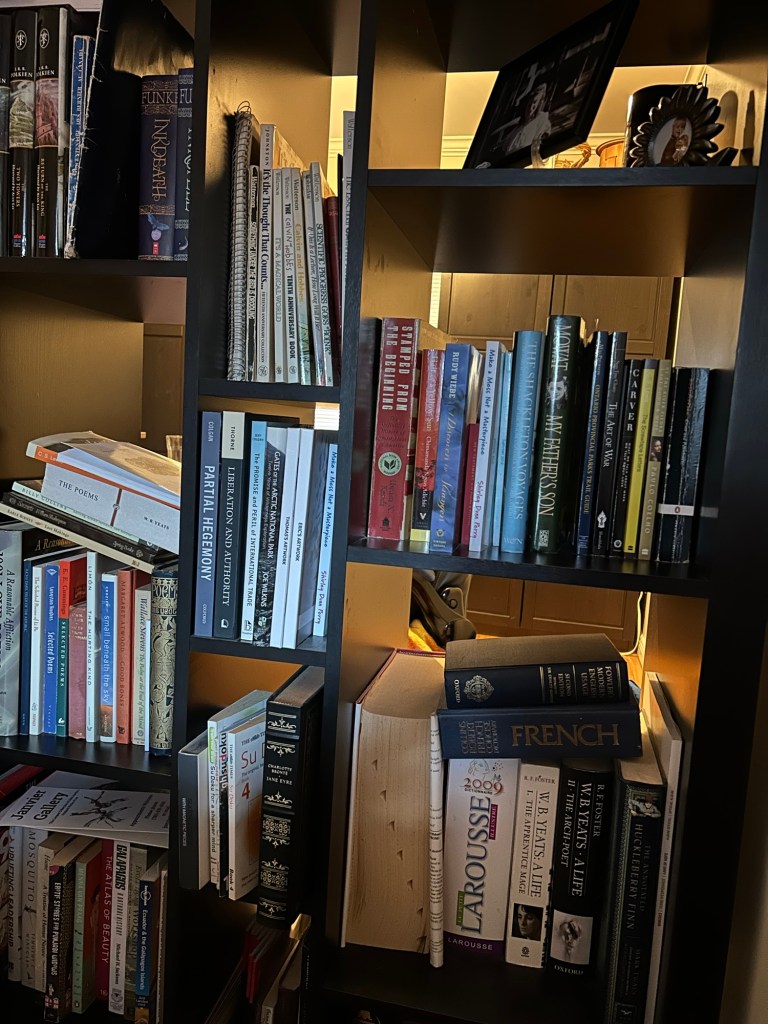
He’s just behind this bookshelf

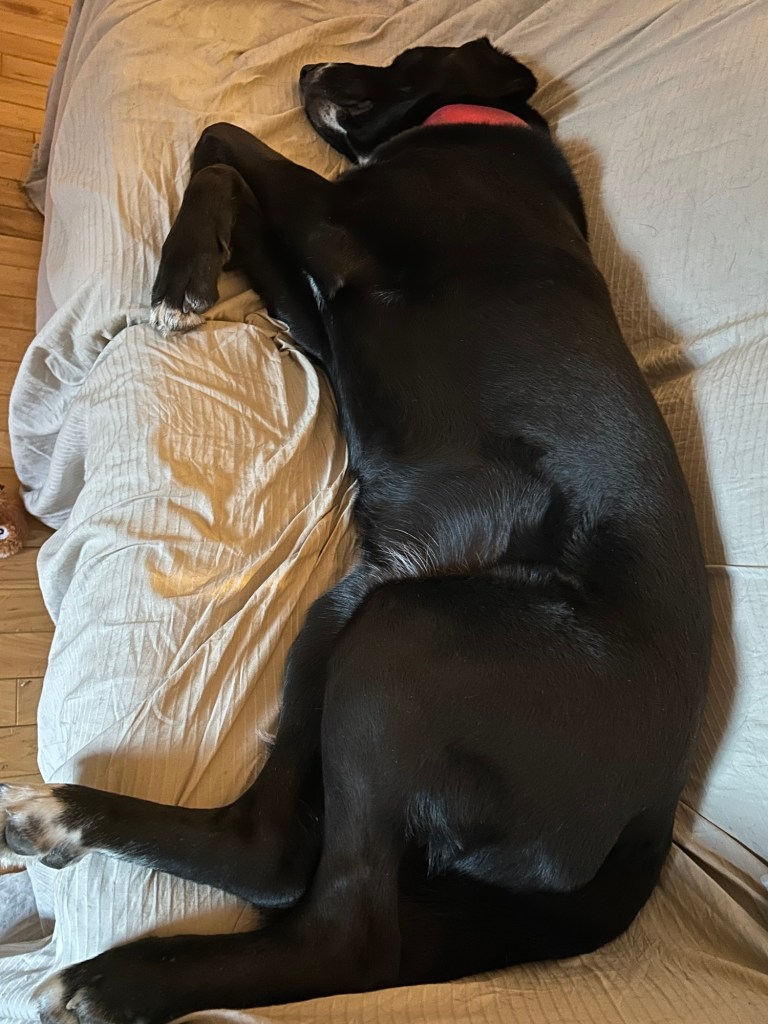
My feet are up on the arm of the love seat in front of me. Just beyond them, our black lab mix, Max, is snoring lightly. He prefers being near me whenever possible; even better if he can be near me and in a soft space. If I stir, he’ll wake up, but for now, he sleeps peacefully.

Max takes up the entire love seat

Beside me on the couch are two blue yoga balls in a small mesh bag. They are calling me, reminding me that some mobility work will be good for my body, even if I’m not quite done being sick, even if I would rather just sit and read my new book, James by Percival Everett. It’s open and just next to the yoga balls. So far, it is amazing. I finished The Heaven and Earth Grocery Store just in time for book club on Friday night; that one was a slow read for me. Then, yesterday, I read Saffy’s Angel – a middle grade novel recommended by Elisabeth Ellington – because I spent most of the day in bed. It was a great half-sick lie-in-bed read. Last night I started James, and I’m tearing through it – making much faster progress than I did on The Heaven and Earth Grocery Store

Time’s up. 

Say it again #SOLC25 21/31

Inspired by Sherri’s post with the same title. Things I say on repeat…
(And if you were here yesterday: I FINISHED THE BOOK!)

Good morning! You awake? Time to wake up! Hey, kiddo, if you don’t get up your brother’s going to get the first shower.

I’m leaving! Have a good day!

No, I don’t know who has the Chromebooks. Have you checked Richard’s room?

Books and notebooks out and open! Make sure you have a pen or pencil available. 

You know where the pencils are. The pencils are where they have been all year. I’m sure you can find a pencil. Yes, that is where the pencils are. 

Please make sure your phones are away. Headphones and air buds, too, please. Away means in your backpack. Your pocket is not a backpack. I see a few phones out. Make sure your phone hasn’t accidentally snuck into your hands. Phones are sneaky like that.

If the teacher writes it on the board… you should write it in your notebook.

Is anyone else hot or is it just me? 

You can’t read and talk at the same time; that’s not how brains work.

Listen first, then move.

Ok, you know the drill: SLANT! Sit up, lean forward… look, even if you don’t ask questions you can nod your head and track me when I’m speaking.

Ok, but you need to be back in five minutes or less. Five minutes is reasonable.

No one else is hot?

Bye! Bye! Nice work today! Bye! See you tomorrow! Bye! 

Hi! How was school? Has anyone walked the dog? Ok, I’m going to walk the dog. Did anyone feed the dog? Have the cats been fed?

No, dinner’s not for a little while. Try a healthy snack. It won’t be long.

Please make sure your dishes end up in the dishwasher. Do you have any homework? I’m just going to mark a few things. Please make sure that plate ends up in the dishwasher.

Goodnight, my love. See you in the morning.

A good day #SOLC25 19/31

Today was a good teaching day, the kind that makes me keep grinning off and on right through the evening. At first, I was going to write something else, but then I wanted to capture this.

First period:
In grade 12, we’ve just started Hamlet. I am always torn about teaching Shakespeare, but I really love teaching this play. And today was amazing. We finished up yesterday’s rhetorical analysis of Claudius’s first speech and students cited lines from the play without being prompted. In my head, I was jumping for joy, but on the outside I played it cool, like, “yeah, my classes always just naturally use lines from Shakespeare to back up their points. Nothing to see here.” My super-cool teacher persona just took notes on the board and nodded her head.

Then we moved on to Hamlet’s first soliloquy. I’d planned a soliloquy buster (which I clearly got from somewhere at some time, but I no longer remember where or when), and even though we’ve only been together for six weeks, and even though it wasn’t quite 10am, and even though it’s Shakespearean language, the students happily moved their desks and sat in a circle and read aloud. Then, the real miracle occurred: no one protested (I mean, I heard a groan or two, but that’s just normal) when I dragged the class into the school lobby to “walk” the soliloquy. I stood on the risers and read the lines loudly while students held their copy of it and walked, turning 180 degrees every time there was a punctuation mark. By the end, we were breathless. When I asked how they thought Hamlet was feeling as he gave this soliloquy, students knew immediately: agitated, frantic, upset.

The energy in the room was high when the bell rang; I could almost *feel* the learning. They were jazzed. 

Second period: Planning. And I actually got things done. I even sent a suggestion to the principal: what if we invite the public library to set up a table during parent-teacher conferences and help people get library cards? (He said yes!)

Third period:
Literacy support. Another teacher actually invited me into their classroom to support students. I used AI to almost instantly convert the assignment (which is a *great* assignment but which has a LOT of words) into a checklist. I photocopied that and handed it out within minutes AND managed to sneakily support two students who really needed support. HOORAY!

Fourth period:
My, ahem, energetic grade 9 class started Long Way Down today. Their reactions to seeing the books piled on desks were decidedly mixed: “Are we going to read that?” can be said in many ways. But Jason Reynold’s novel has a magic that has never failed me – not since the first moment students unboxed brand-new copies of the book a few years ago d, and started to read. Today, Reynolds’ voice filled the room, our hearts beat as we heard that Will’s brother Shawn was shot, and we waited the horrible millisecond while we turned the page and read the words “and killed”. Someone gasped.

The kids let me pause to ask a few questions here and there, but mostly they begged to keep reading, so we read right to the bell. As they piled the books back on the desk (we have to share books with other classes), several of them said, “That’s a really good book, Miss.” I just nodded and said, “I know. I know.”

Then one darling child stayed after and whispered the story of the book she finished over March Break, the one she really wanted to tell me about, even if it might spoil it if I decide to read it. (Reader, I will not; it is “romantasy” – virtually all she reads – and sounds extremely silly, though just right for her.) I nodded and oohed and aahed until she realized her bus was coming and ran out the door.

For just a minute, I sat in the quiet classroom, completely satisfied with a day when learning felt almost tangible, when almost everyone was engaged almost all the time. I don’t always write about these days, but they happen – they really do – and I wanted to capture today. It was wonderful.

Literacy on vacation #SOLC25 10/31

Last night, after a long day of travel that culminated in beach and pool time, I crawled into bed, exhausted, and read a few pages of my new book (The Heaven and Earth Grocery Store). This morning, I woke to a long meandering chat with my aunt over tea and coffee. At some point, as I caught her up on my life, I talked about literacy. If you talk to me long enough, I pretty much always do.

She has recently gone through her books and had set aside some for me to look through, in case I want any. Would I contemplate taking books from an island back to Ottawa? Yes, yes I would. I am constantly looking for ways to get books into my students’ hands, and books cost a lot, so I am well-known for my – ahem – willingness to accept books. As a matter of fact, I brought books as gifts for my cousin-nephews, so I’ll have space to take more back if any of these look enticing. Now, out on the veranda, as I sit down to write, books and reading are on my mind, as they often are. 

I know the 2024 NAEP Reading Scores have just been released, and I know they’re not great. I teach in Canada, but I have little evidence to suggest we’re doing a lot better. Oh, I know our PISA scores are better than most, but only if you consider having 50% of Canadian students reading at level 2 or below “fine”. I do not.

I’ve just spent a frankly silly amount of time looking at the statistics I linked to in the previous paragraph. I was reading because I wanted to be sure that what I wrote was true, and now I’m stuck for what to say. Thinking about literacy is a huge part of my life, but is this little blog, mostly anecdotes, really the place to write about this? Is today, sitting by the ocean, really the day? And what will I say that others haven’t said? My family is waiting for me (only half true: the teens are still asleep), and hey, I’m on vacation: I should be relaxing. But I am almost never not thinking about literacy.

Even here, on vacation, reading and writing are firmly part of my life, and I find myself wondering if what I want for students is realistic. Do I want everyone to travel with books? Do I think we all need to be “readers” (whatever that means)? I don’t think that’s what I’m after. I do want all students to have reading as a back pocket possibility. I want them to develop the empathy and the knowledge and the critical thinking that come from reading. Literacy is a pathway to many kinds of success, and I know that very few people who have achieved only functional literacy are able to follow that pathway with any ease.

Now I’ve gotten lost in the weeds of this post: I’ve been typing and erasing for too long and I feel silly for starting my vacation thinking about this, but I can’t stop. Do I write about what I’m doing in my classroom? Do I link to more information? Do I share my hopes and dreams for my students? Maybe not today. For now, I’ll go back inside and go through that bag of books to find ones that students might read, then I’ll snuggle in with my cousin-nephew and see if I can tempt him into the world of Dragon Masters, one of my own children’s favourite book series when they were his age. I’ll have to pull him away from the iPad, but it’ll be worth it in the long run.

And I’ll write more about literacy later – because heaven knows I’ll be thinking about it.

Yes or No? #SOLC25 6/31

We’ve been reading short stories in Grade 9 in preparation for reading Jason Reynolds’ novel Long Way Down. We’ve reviewed/ learned vocabulary like “plot” and “climax”; we’ve talked about summary vs retelling vs opinion; we’ve read a story with an ambiguous ending (because I know what we’re getting into); we’ve even practice discussing big ideas, like equality and utopia. Some days are good – like Tuesday, when the Socratic-ish discussion of equality led one group into a discussion about whether police need to be more powerful than everyone else; suddenly they were thinking deeply about the story and our world and things that seem awfully important – and some days are, well, less good.

Today, Thursday, I asked students to choose one of three prompts and write a one or two paragraph response. I firmly believe that this is a reasonable expectation, but 24 students means 24 different interpretations of reasonable, and some students were not happy with the request. Still, I was surprised when a usually strong student called me over about five minutes into our writing time, clearly distressed.

They had chosen the prompt “In your opinion, is the society in “Harrison Bergeron” a utopia?” even though they missed the day we discussed that. On their screen they had written, “No.”

They looked at me, a bit wide-eyed, and said, “I don’t know what else to write.”

“Mmmm… “ I said, “I can see the problem. I’ve made a mistake.”

“Yes,” they nodded emphatically.

“May I?” I asked, as I reached toward their keyboard. With permission, I typed, “Explain your reasoning using examples from the story.”

The student breathed an audible sigh of relief and said, “Oh, ok” and immediately began writing more as they muttered, “It was a yes or no question.”

Yes, sweet child, it was a yes or no question. Thank goodness I was able to fix it.

It’s the books

Of our eight bags – four carry-ons and four “personal items” – mine was the only one flagged for further inspection. The security guy smiled ruefully at me as he swung my bag onto the metal table. After asking permission, he unzipped the main compartment and said, “it’s the books.” I must have looked perplexed because he followed up, “The screener showed a large block of biological material. It’s the books.” He rifled haphazardly through the rest of my bag, but he already knew he wouldn’t find anything else: it was the books.

I could almost feel my teens – who, for the record, did NOT have any books in their bags – roll their eyes. My partner shook his head disbelievingly, “You got flagged for books?” Me? I quickly calculated how many books I had packed: only two… in that bag.

All told, I took three books, one journal and one agenda on vacation. Three books is a reasonable amount for a week, if you ask me: one I was finishing, one I planned to read while I was there, and one I’ve been nibbling on, in case the other one didn’t work out. The journal is self-explanatory, right? And the agenda, to be fair, was an oversight: I’m used to having it with me, and forgot to take it out. 

For the record, I finished both the first and the second books and was back to nibbling at the third by the time we were on our way home. Of course, I had also received two more books and a blank journal as gifts. If you’re keeping count, that means I was headed home with five books, two journals an agenda… and a teeny sudoku puzzle book that I forgot to count on the way out because really, it barely qualifies. Wary, I tried to split my “large block of biological material” between my two bags.

My efforts were for naught: I got flagged by security. This time, I started the conversation.

“It’s the books.”

The TSA agent eyed me up and down. I can only imagine what he saw. He turned to my backpack and peered into its depths. “Yup, it’s the books.” 

“I read a lot,” I tried to sound apologetic, but I suspect I failed.

“What I want to know,” he mused, “is will you really read all of these on this trip?”

I started to explain about the one to finish and the one to read and the one just in case and the gifts, but I suddenly knew how that would sound to him. I almost explained that I am an English teacher and that I love to read. I wanted to tell him about the one I’d just finished and…instead, I said lamely, “Well, you never know.”

I reclaimed my bag, checked the zipper, and headed over to my family.

“Same thing?” asked my partner.

“Yup,” I smiled, “It’s the books.”

And I read happily all the way home.

Writing beside him

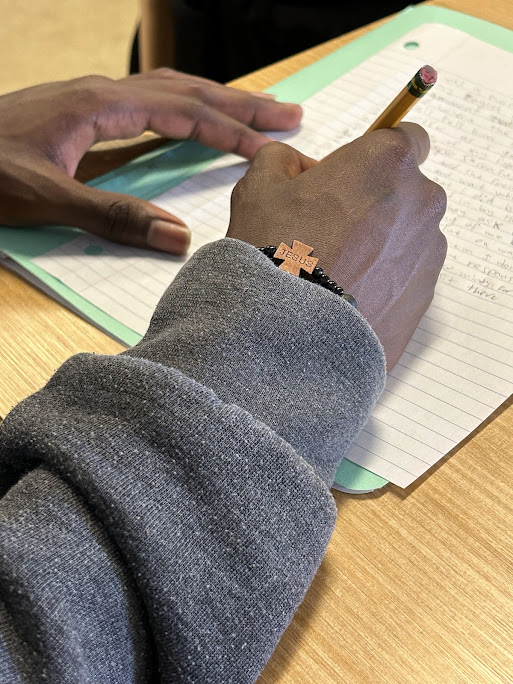
I’m helping a former student write a personal essay for his Grade 11 English class. We’ve talked it through, and planned a little; his next step is to write it. Reading and writing aren’t his forte – he’d much rather be on a playing field than in any classroom – but this story is important to him, and he wants to get it down on paper. So here we are, sitting in the upstairs lobby – currently one of the coolest places in our very hot school – and he’s writing.

This kid has my heart, as many of them do. Last year, he didn’t do particularly well in our first semester English class, so he agreed to change his timetable in order to be part of a reading class with me during the second. That alone took some courage: not everyone who needed the support was willing to accept it. Once there, he mostly tried, even when the work was repetitive or “not that interesting,” even when he took extra long body breaks or got frustrated by the “simple” books he was reading.

Knowing that history, I’m intrigued by his choice to sit with me in such a public place this afternoon. With only two weeks left in the school year, students are out of classes nearly as much as they are in, and many of them wander aimlessly through the halls. Several have stopped to greet us; pretty much all of them give us at least a passing look as we sit here at a student table and work. There’s no hiding that we’re writing together, no hiding that I’m helping.

Nevertheless, he’s nearly filled a page with his small, neat handwriting – a feat which would have been unfathomable last year – and his focus hasn’t wavered, though he has had to stop a few times to flex his tired hand. Meanwhile, I sit here typing my own story, this story, marveling at this moment of quiet togetherness amidst myriad other students. We are here, the two of us, writing; we are here, the two of us, writers. 

This sense of camaraderie has me thinking about what we mean when we say that teachers need to “get to know their students.” How well do I know him? I didn’t spend a lot of time last year asking him about his family, though I did call home when I needed to. I have no idea if he has pets, and am not clear about how many siblings he has. In fact, I don’t know many things about him, but I know enough that I can tell him, honestly, that I believe in him. I never told him he was a strong reader or writer; I did tell him that I thought he could be. I never told him this path would be easy – heck, I was clear that parts would be hard – but I did tell him that I thought it was worth it. Other teachers and coaches told him the same thing, complimenting him when he improved, noticing when he was reading, harrying him back to class when he was in the hallways. When he faltered, he had a team of people to remind him of his long-term goals.

Today, he has a story to tell, and he has found me. He says he needs help, but I think he just needs someone who believes in him to write beside him. What a privilege! I can do that any time.

Civilly Disobedient

Way back near the beginning of my teaching career, one of my regular classes was grade 11 American Lit. I think I taught it for seven or eight years, and by the end I had developed some pretty good activities. This is one of my favourites – though I could never get away with it now, both because I doubt my students could access the texts and because, well, you’ll see…

First, the background. We read some of Emerson’s “Self-Reliance” and both the Introduction and Chapter One of “Nature”. Students loved lines like “Whoso would be a man must be a nonconformist” and “Trust thyself: every heart vibrates to that iron string” even while they struggled with metaphors  like “Society is a joint-stock company.” One afternoon, their homework was to try to understand Emerson’s insistence that “To go into solitude, a man needs to retire as much from his chamber as from society” by going outside and not reading, writing, or listening to anything. They had cell phones, but at the time they could still go without for a while.

Next, we read Thoreau. We started with a few excerpts from Walden which is an easy follow-on from “Nature.” We read about Thoreau’s cabin in the woods and his beans. Then, the piece de resistance: “Civil Disobedience”. We considered the questions he raises, like, “a government in which the majority rule in all cases cannot be based on justice, even as far as men understand it. Can there not be a government in which majorities do not virtually decide right and wrong, but conscience?” and “Unjust laws exist: shall we be content to obey them, or shall we endeavor to amend them, and obey them until we have succeeded, or shall we transgress them at once?” Class discussions were sometimes (ok, often) raucous.

Then came the day of days. Students arrived in class and were given these instructions:

I believe that you have a reasonably in-depth understanding of Thoreau.  In particular, I feel that you understand how he relates to Emerson and to nature, why he chose to protest against the government, why he feels protest is necessary, and what he believes the consequences of peaceable revolution are for the protester and the government.

If you feel that you have a good understanding of Thoreau, then you may begin today’s assignment now.  Please do something of which Thoreau would approve.  Class will resume at 2:25.

That is all I will tell you.

Stunned, they milled about the room, trying to figure out what to do. Eventually, year after year, they left the class and went in search of a protest. One group took the athletic trophies from the school display case and paraded them around. “WE won these. They belong to US, not the school” they crowed. One group took control of the PA system and read passages urging self-reliance and rebellion to the entire school. Many students headed outside to find a green space and hang out. Some left campus and found food, claiming they were old enough to go off-campus alone. Many many of them did not make it back five minutes before the end of class. Instead, giddy with their tiny taste of rebellion, they tore in as the bell rang, gathered their things and ran to their next class.

As they rushed off, I yelled after them, “Your homework is to write about what you did!” 

“OKAY!” they called back. And that was that.

The next day opened with exhilarated students sharing their escapades and referring to lines in the text that supported their actions. Never had textual analysis been so worthwhile. After everyone had spoken and the energy had dwindled a little, I drew their attention to a passage we had studied before: 

I know this well, that if… one HONEST man, in this State of Massachusetts, ceasing to hold slaves, were actually to withdraw from this copartnership, and be locked up in the county jail therefor, it would be the abolition of slavery in America.

Basically, he says that we end unjust laws by standing against them and being punished for our stance. The end of the injustice comes because others are inspired by our unjust punishment. (Honestly, this seems a little naive to me, but we went with the flow.)

Hmm. So, were the students trying to stand up against injustice? And if so, were they willing to be punished for it? I pointed out that I had not even given them permission to leave the room, much less to traipse about taking things and making statements. So, everyone was going to have lunch detention for the next one to three days depending on the severity of their misconduct.

Horror! Outrage! The students were unwilling to accept this! “Ok,” I shrugged. “I’ll make you a deal.” And then I broke their hearts. “The punishment will only make a difference in the world if you think you are an honest person standing up for what is right. If that’s not you, just stand up and say, ‘I don’t believe in what I did’ and your detention will disappear. After all, there’s no point in the punishment then.”

Some students stood immediately. They’d had fun, but they weren’t really protesting. Slowly, slowly, more would follow. The class joined in the debate with those who hesitated. What was injustice? Was this action protesting a law or a government of some sort? Did they think their punishment would actually bring about change? Almost always, everyone eventually stood and acknowledged that they weren’t willing to accept punishment for their actions for one reason or another. 

Of course, sometimes, someone held out. The most memorable of these was Danny. He had, indeed, left the classroom, but he’d sat outside and taken in the beautiful day. He had a book with him, but he argued that Thoreau had nothing against books, and he wasn’t convinced Emerson was saying *never* to read. He said he absolutely believed that students should have more time to pursue their own interests and if lunch detention was the consequence and it made people consider his stance, so be it.

In the end, I always canceled lunch detention – after all, it was mostly a ruse to get them to think deeply – but Danny was having none of my wishy-washy ways. The next day at lunch, Danny sat in the main office, clearly visible through the glass walls, and read a book. He jailed himself for three days and talked to anyone who asked about why students should be allowed more freedom of choice. 

I’ve been thinking about this lesson a lot recently, what with all the news of protests. From where I sit now, I can see its flaws, but it was effective at the time. If nothing else, we all took a minute to think about what civil disobedience really entails and what we were willing to sacrifice for our beliefs. It was a good lesson.