N-less #SOL24 11/31

For a few days last week, my keyboard’s n stuck as I tried to reply to others’ posts. I was frustrated. My discomfort made me ask myself if I could write a whole post without it because I like to test myself. I will admit, it is very difficult. Years ago, I worked at a small DC school where, at a PD day, the facilitator asked us to write for a short time without “e”. For me, that was easy. I immediately chose to write about a topic without “e”: swim stuff, e.g. swim practices, with their laps, or swim meets with their races. I wrote quite a lot, which frustrated the speaker because she had hoped to illustrate how hard it is to write without a simple letter. If I had appreciated her motive, I would have stayed quiet. Such is youth, I suppose. Hmm… maybe I will ask my pupils to try this exercise.

As I write today, I realize how much has shifted. At that PD, we all wrote with paper. Today, however, I write with a computer; I have a tab with access to a thesaurus; my spellcheck tries to correct misspelled words to add the letter I avoid. As I cease this exercise, I will use Ctrl-f to check if I used what I promised to dodge. Truly, spellcheck is how I was able to reply to posts last week. It took a lot of time, so I replied to very few posts, which made me sad. If I missed you, I am sorry! I swear that I read, but to reply was quite difficult.

As I write, I also realize that without this letter I avoid, I must be upbeat. Without it, I have become aware that the adverse is hard to write. The words for bad possibilities or outcomes all use the letter. Hmm… this is a fresh thought for me. I pause to marvel at this simple idea. Whoa. Lots of ideas/objects use this letter, too, because of suffixes. Lastly, I have realized that I must write exclusively for this time or the past. The future requires this letter. So… I am forced to write about the positive, past or immediate with few words for big ideas. It’s complicated. As I wrap up, I try to visualize this n-less world. Impossible. I am over this self-imposed exercise: I would like all the letters back, please! 

Dear boys’ bathroom

Recently, in the Writer’s Craft class I am teaching, we read Kobe Bryant’s “Dear Basketball” letter, and I prompted students to write a letter to an object. Of course I wrote in front of them and chose a hard/funny topic. Here it is, slightly revised and a little more scandalous than what I shared in class.

Dear first floor boys’ bathroom,

I don’t understand your allure. You are, apparently, one of the most attractive things in the school – boys flock to you, hang out with you, lie to be with you – and yet, I’ve seen you, and, frankly, you are nothing special. In fact, sometimes you are downright nasty.

What sanctuary do you offer? Sometimes I imagine you are a hiding space, a place for boys to be away from the prying eyes of teachers. Other times, I think you are an invitation to transgression: when boys spend time with you, they know they walk the line between what is and is not allowed. They’re kind of safe – after all, everyone needs the bathroom sometimes, and they have time to hide anything really bad when they hear an adult walking in. You offer just the kind of trouble that gets them sent back to class, out of your secret spaces and into the hallways where they must walk in the light.

I cannot imagine the pull of a stinky space where people go to take care of bodily functions as a place to hang out. But what do I know? I mean, Yeats wrote, “But Love has pitched his mansion in/ The place of excrement” lines that shocked me when I was in high school, so I’m probably not the best judge. Not that you know about Yeats; I suspect you’re more a reader of graffiti. Even as I write to you, my mind goes to brothels and back alleys, places that offer physical satisfaction and frissons of delight to those willing to go just to the edge of what society accepts. 

Perhaps you are the opium den of our school, or the whorehouse – and if I’m going to share this, perhaps you are enticing me, too, to the edge of what is allowable. Still, downstairs boys’ bathroom, your siren call is undeniable, and I’m not yet willing to tie myself to the mast to keep students from being lured to your shores – or toilets. For now, I will gently suggest that boys ignore your temptations, knowing full well that they will not be able to resist.

Yours,
The teacher down the hall

Second day jitters #SOL24 2/31

At first, this post may look like a poem – and it is! A pantoum, no less! – but it actually a tribute to mentors & the writing process.

On Day Two
How have I forgotten these early days
When doubt – or lack of sleep – drowns
any conviction that I have made
the right choice,

When doubt – or lack of sleep – drowns
the constant rhythm of the deep heart’s core,
which knows the right choice must be
the leap I have already taken?

The constant rhythm of my deep heart’s core
fears nothing:
The leap I have already taken,
the worry that I will share my imperfection,

fears, – nothing
you, too, have not felt before.
The desire to share imperfection,
and be seen –

you, too, have felt it before,
that conviction that we are made
to be seen.
But, oh, I had forgotten these early days.

How I started
(Mentor #1: Alice Nine, who blogged here when I first started, used to write something and then share her process. I found it endlessly fascinating. Today, I’ll share mine.)

I went to bed last night with my head full of ideas for blogging – and I woke up this morning with nothing. Nothing. “Why,” I asked myself, “did I even sign up this year?” (Note: I literally never considered NOT signing up, so this question is ridiculous.) I proceeded to spend a fairly impressive amount of time beating myself up: I overcommit, I take on new things but don’t let anything go, I compare myself to others, I should have chosen a theme for the month (Mentors #2 & #3: Sherri Spelic and E Griffin, both of whom have lovely themes for the month). You get the picture.

Of course, I quickly realized that I have been in this space before – the space where I doubt basically everything. It happens every March during this challenge (and usually right at the beginning, go figure). My mind leaped quickly to the truth that this is also how I felt when I had newborns: some combination of overwhelming excitement, fear and doubt. This leap, I am certain, came from reading a new-to-me blog yesterday, Ana Paton’s lovely post about overwhelm and holding her newborn daughter & poetry.

In my head I heard, “How have I forgotten these early days?” I scribbled that down & then free-wrote for a few minutes. It was poem-ish, probably because of that single line. Plus, mentor #4, my friend Earl Brogan once told me that if I was having trouble saying something, I should try poetry. (I think I harumphed, but he has been proven right.)

Getting unstuck
When I ran out of steam, I paused and wrote about what I was trying to write. I make my students do this meta-writing all the time, and I love it. I wrote, “Revision: This is a poem of fears and questions. Is the final answer yes? Or I am enough? Or one step at a time? Hmm… Or is the final answer a question?” The idea of questions and answers led me to try the duplex form that poet Jericho Brown invented because the theme seemed ideal for a conversation. I played with that for a while until I suddenly wrote, “Nope – not a duplex – because the second voice is insipid.”

Well.

One of the sites I’d used to remind myself of the duplex form had also discussed pantoum. I love pantoums but find them complicated to write. Still, my early draft had a lot of repetition, so I copied out the form.

Stealing a line
From there, I spent a fair amount of time tinkering with lines. A pantoum is not a weekday poem – at least not for me. At one point, I nearly threw in the towel, but then I remembered a line from (Mentor #5) WB Yeats’ poem “The Lake Isle of Innisfree” – the deep heart’s core. Once I would have eschewed that line as not mine, but I another trick I share with my students is to “steal a line.” So I did.

Having some courage
And here I am! I have a pantoum! And I’m publishing it! And for that, I need to thank other mentors like (mentors #6 – a bazillion) Margaret Simon, Glenda Funk and Fran Haley who regularly & generously share their poetry – plus the Monthy Open Write that Sarah Donovan hosts over at Ethical ELA.

As it turns out, I write in a community who does, I think, “see” me. And for that, I thank Stacy Shubitz, Melanie Meehan and everyone at TwoWritingTeachers.
Now, with day 2 under my belt, I move forward into day 3.

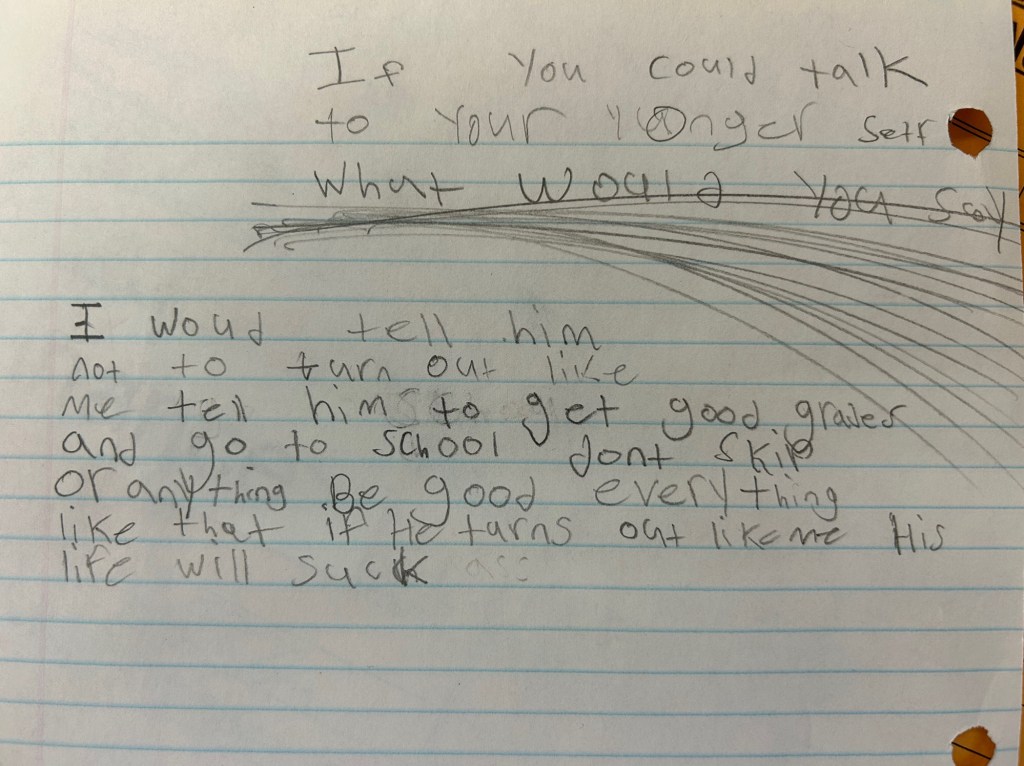
If you could talk to your younger self

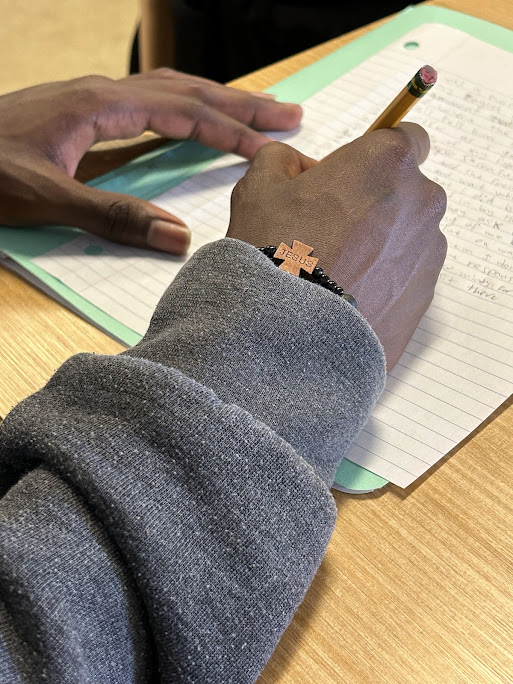
I was tidying the copying area in our office when a sheet of lined paper, adrift amidst the abandoned photocopies, caught my eye. A quick glance told me this was not my writing prompt, not my student. Still, I couldn’t help but read the words – and my heart broke open. Oh, how I wish I could tell this anonymous student about the poetry he has created, tell him that he is so much better than he knows.

If you could talk to your younger self what would you say

I would tell him
not to turn out like
me tell him to get good grades
and go to school dont skip
or anything Be good everything
like that if He turns out like me His
life will suck

My response (quickwrite)
If I could talk to the student whose paper was left behind

I would tell him
not to give up on
himself, tell him to hold on
and keep doing what he can. Be kind, everything
that I wish he could hear. If he knew the power of his
words, he would be stunned.

Wordless

Sometimes my youngest has trouble with words. Whatever mysterious worlds hold him together – his own internal sun, moon and Earth – line up, and emotion rises in him like a spring tide, flooding him and robbing his ability to speak. If I catch him early enough, he can still tell me what’s happening, though it’s hard. If we don’t notice the rising waters until it’s too late, his voice is gone. While he sits, nearly mute, fist pounding the space beside him, tears in his eyes, I struggle to guess at the words that elude him. Sometimes, I can find the words for him, and he collapses in relief; others, though, we’re not so lucky and all that that’s left is the language of the body. When I can, I hold him until the waters recede.

This is what happened on New Year’s Eve. I was the only adult left awake with the kids, who were waiting up for whatever magic they think happens at midnight – or at least for fireworks. I knew he had planned to walk out to the dock with the rest of us, but as the hour approached, he no longer wanted to come. When I asked him what was going on, his words were drowned out and his eyes filled with tears. I was reluctant to leave my youngest crying alone on the couch as the new year rolled in, but the others were waiting and time was short. Luckily, my partner was still awake, reading. He knows these moments, and came down to snuggle with our child while I went with the others into the dark. By the time we returned, my son was fast asleep.

These moments are frustrating, heartbreaking and, most of all, perplexing for me. I live in a world of words, trusting them to be my messengers to others, certain that I can coax them into shapes that will communicate meaning to those around me. I rely on words to tame the very emotions that, I think, overwhelm my child.

And yet. And yet.

These past months, words have often eluded me. I haven’t written here regularly. In fact, I haven’t written anywhere regularly. I’ve spent far too long staring at other people’s stories in an attempt to avoid my own. I’ve had no desire – much less ability – to put words to what I’m feeling. Instead, I’ve allowed myself to float on my own wordless tides. It’s unsettling.

Now, as 2024 begins, many people I love and admire – writers, readers and lovers of words – have chosen “one little word” for the year. I’ve tried to choose one, too, but the words have been as hard to hold as water. No word stays. As if to prove a point, I have spent some time now writing, erasing, then staring at the screen. The words slip through my fingers. What should I say? What should I not say? How do I feel? I don’t know. I want to commit to writing weekly this year. I want to say that I am grateful to know in advance some of the challenges that this year will bring. But those things aren’t true. 2024 may be the year I wrestle (again) with what a friend told me long ago: “Words put space between thought and meaning.”

I think about my sometimes wordless child, approaching the new year exhausted and curled up with his father. Perhaps this year it will be enough to hold on to those I love and ride the tides as we can, with or without the words to describe the experience. Surely, that is enough. 

Heartstopper

I’m at the back of the classroom, trying to choose which title to use for today’s book talk. My hand is hovering over Heartstopper. I want to tell the students about this fun and accessible graphic novel about a cute high school romance – and hey! There’s a Netflix adaptation! I love the series, and am sure that some of the students will love it, too. 

Still, I hesitate. I know that some of the students will not love Heartstopper. In fact, some of them may be offended that it’s on the shelves at all. If I share this book in today’s book talk, they will, at best, giggle and blush; maybe they’ll look away; some will be quite upset. All of this because the cute romance is between two boys.

As a teacher, I want the classroom to be a space where all students feel welcome. I imagine a space where they feel confident that they will be able to learn, where they feel safe and respected.  But already, even as I type this, I can feel the tension in my stomach because this vision – the room where everyone can bring their full self and thrive – is largely a dream. Reality rests on some seriously rocky ground.

Two weeks ago, across Canada, a group of people protested to “protect our children from indoctrination and sexualization.” Many students “walked out” of (well, most simply did not attend) school. I was shocked, though I shouldn’t have been. Conservatives – from the leader of the national Conservative Party to Ontario’s Education Minister – have been ramping up their attacks on LGBTQ+ people for several years. In early September, the Premier of Ontario told a group of supporters that schools are “indoctrinating” students on issues of gender. 

But queer people exist. Our schools welcome people – students, staff, parents – who live and love in all sorts of ways. [I have stared at this paragraph for many long minutes now. Long minutes plus almost two weeks. I want to write this, but how will I say what I mean? I don’t know. I have to remind myself that this is a very small blog, that I am writing mostly for myself, that I am trying to be a teacher who writes which means being a teacher who experiences what my students experience: a blank page, a blank mind and, sometimes, a fear of writing or a lack of words. I *will* write this tonight. I *will* hit publish.] I guess what I want to say is, LGBTQ+ people are people. They love and are deserving of love. They live and deserve to be allowed to live full, rich lives. 

The walkout and the subsequent acts in our school – the defacing of pride flags, the hate(ful) speech in classes – profoundly unsettles many of us. There are tears in the staff room; tempers are short. The Rainbow Youth Club is nervous about meeting. Everyone’s edgy.

Days later, at our staff meeting, two powerful voices help staff refocus. “Be careful,” they tell us, “not to jump to conclusions.” “Lead with curiosity,” they remind us. “Remember that some of our students have recently arrived from places where merely discussing these issues could have serious repercussions. As best as you can, when faced with statements that you might categorize as hate, ask genuine questions.” I am humbled that people whose very existence is being attacked are reminding us to be kind, curious, teachers. 

The speakers help us find balance between the human rights of all people and the right to freedom of religion. We can practice our religion here, read our religious texts, attend any house of worship. We do not, however, have the right NOT to learn about other practices and peoples in our public schools. We may not discriminate against others who do not share our beliefs. They remind us that all children deserve to see themselves reflected in the curriculum, and that statistically, whether we know it or not, someone in our class is probably LGBTQ+. They deserve to be seen.

That night, on social media, I share a post: a person holds a sign that says, “Classrooms that erase QUEER identities are erasing truth and beauty and joy.” The next morning, I wake to a message from an old friend: “I was erased.” 

And now I’m at the back of the classroom, trying to choose which title to use for today’s book talk. My hand is hovering over Heartstopper. I think about my friend and about the presenters. I think about students past and present, about friends, family and other loved ones, all of whom identify as queer. I think about students who will feel uncomfortable and (hopefully not, but maybe) unwelcome if I choose this book. I think about how much we change – how incredibly much we all change – over the course of a lifetime. I cannot know now what someone will believe in a week, a month, a year. I cannot know who anyone will love. 

I’m an English teacher. What I know is stories. Some stories you’ll like; some you won’t. They may make you cry or laugh or rage. You may read a story that you’ll want to throw across the room in anger, or one that you’ll always keep within arm’s reach because you feel so seen. If you’re lucky, you’ll read them all. So I pull out Heartstopper and lean it against the blackboard. Because everyone’s welcome here.

Because of you #SOL23 31/31

When I woke up this morning, my left eye was swollen shut. A stye, I think, though no amount of hot compresses have brought it to a point, so who knows, really. At least it’s settled down enough that I can see. I had already taken today off sick; I wasn’t quite sick yesterday, but I was far from my best, and I knew my run-down body needed a break. Turns out, I have slept much of the day because I am, in fact, sick.

When I haven’t been napping, I’ve mostly been deep in a giant bean bag accompanied by a book, the puzzle section of The New York Times, and cats. We haven’t done much, and I’m ok with that.

While I’ve rested, I’ve wondered what I should write for the final day of this Slice of Life Challenge. I’ve wondered this every year that I’ve participated. After a month, I’m used to the practice of noticing and holding on to moments, of seeing how what is happening today brings up memories of what happened years ago. I love the way that writing daily makes me pay attention to the world around me (special thank you to Stacey for dreaming this up years ago to help get through March and to the Two Writing Teachers team for supporting this). I’ll miss this, even though doing it every day is hard.

I teach narrative writing at some point every semester, and I often tell my students that the universal lives in the specific. We connect best with friends and strangers when we share our very specific feelings or experiences – everyone has lived moments of joy or fatigue, grief or giddiness. This challenge is about sharing those moments, creating a community through that connection, through those stories.

I started this month with some trepidation: school systems are in a state of flux right now, and teaching is harder than I’ve ever known it to be. We need to have some hard conversations about things that don’t really fit into the “Slice of Life” model. I wasn’t sure I could write honestly for a month without talking about those hard things, but I did it. Mostly.

When I look back over my posts, I can see some of my concerns lurking behind and beneath my words, but that’s ok, I think, because reading and writing for a month with teachers from around the world means that I can also see the ways in which we hold each other up and, more importantly, how we share the dreams we have for schools and the world we’re striving to create. I can see how many teachers (and coaches and retired teachers and people in the world of education) are dedicated to our children and how, even though many of us are really, really tired, we don’t just cling to hope, we create it.

And so I leave March better than I entered it, better able to find the kernels of joy, better able to rest when I need to and fight for what is precious, better able to teach and, truly, to be taught. If you’re reading this, that’s probably because of you.

See you on Tuesdays.

It was supposed to be funny #SOL23 28/31

“It was supposed to be funny.”

That’s what I told my grade 12 students on Monday when I shared one of my recent blog posts – the one with the squirrel pictures. I pointed out the title and the photographs. “I started with funny, but I ended with sappy.” This was my writer’s dilemma: “So what I’m looking for are ideas for how to revise this to make it funnier – or even just a little funny.”

Cue uncomfortable shifting in their seats. Critique the teacher’s work? Not likely.

Undaunted, I continued. “OK, R has volunteered to be the leader,” R nodded, “so he’s going to tell us our first step.” 

“Um, ok, um…” he shuffled the papers in front of him, trying to figure out the next step. “Oh! You need to read it out loud.”

I did. I had planned two class periods (minus our daily reading and writing time) for the students to share their work and offer suggestions. I was following the Feedback Protocol developed by Peggy Silva and shared with me by Xan Woods and, not surprisingly, when I told students that they would read their work out loud to their peers panic had ensued. Telling them that someone else could read the piece out loud for them was not the balm they had anticipated. So I’d pulled out my next trick and asked them help me with my writing. 

You can imagine the wary looks I got. I explained about the Slice of Life challenge and how I had been writing every day for almost a month. EVERY DAY? They were half impressed, half worried about my state of mind. Those latter concerns were heightened because now I was offering – no, asking – to have them help me. As I read aloud, I found a mistake in my *published* piece. “Oops, I need to fix that,” I said – and I didn’t die or anything. I just fixed it.

“Ok, R. What’s next?” I asked.

“We have to read it again, then offer you ‘warm’ feedback.”

Because I know this is hard, every time we use the Feedback Protocol, I give students a script (also developed by Xan & easily modified to fit our needs) in addition to the general how-to. Now, we continued through the script. The students had plenty of nice things to say about my piece, and they were able to be pretty specific with their compliments. Then came time for cool feedback. 

“Oh, I feel bad about saying this.”
“Miss, are you sure you want to hear this?”
“I just feel kind of mean.”

I reassured the students that I had asked for this feedback, that I wanted to do better. “Look,” I said, “I really wanted this to be funny. I know you can help. You are 100% funnier than I am.”

As they spoke, I took notes in front of them. The more I wrote down their comments, the more confidence they gained. After a few minutes, time for cool feedback was over. I thanked them and reflected on what I had heard and what changes I thought I would make.

Just like that. Like it was no big deal.

Then it was their turn. Tentatively, they moved into their groups. On the first day, only one student from each group was able to receive feedback. As the class left, the mood was less tense, maybe curious.

Today, after reading time, the groups re-formed quickly. Essays appeared out of notebooks and folders. No one had lost their papers. Around the room, students huddled together around papers, their pencils scratching down notes or writing in margins. Laughter, questions, talking… was this the same group that couldn’t quite remember everyone’s names just a week ago? Were these the same students who looked stunned yesterday when I told them they would read their work out loud? 

Yes, yes these are the same students, I promise. As class came to an end, I asked how they felt about the protocol. “So good,” said someone. “Really useful,” said another.

“Excellent,” I said, then added, “Revisions are due Friday.” Good natured groans sounded around the room. As they kids left for their next class, I overheard someone say, “that was really good, wasn’t it? Like, really good.”

Ah yes, pedagogy for the win.

Compliments #SOL23 11/31

Years ago, my colleague, Aaron Bachmann, walked into our office one day and told us that he had learned that people don’t get enough compliments and that, when they did, something like 90% of them focused on appearance. He was determined to change that. 

Aaron set about giving us all compliments – real ones. It was hilarious and cheesy, but it also felt good. And he kept it up. He gave compliments all the time, to the point where even now, years later, whenever I think of him I smile. Sure, I remember him fondly (we haven’t worked together in almost two decades, more’s the pity), but it’s more than that: when I think about Aaron, I feel better about myself.

There’s tons of research about the power of  compliments (here, for example) and, naturally, about how to do it “right” (here), but you already know the truth: voicing your sincere appreciation of someone else does all sorts of wonderful things.

Now, I have *no* research on this next part, but I think most teachers don’t get a lot of compliments – or at least not the kind we can fully believe. I mean, I love when a student gives me a compliment, but most of the time a part of me is also a tiny bit wary because students have a clear interest (grades) in telling me that they like what we’re doing. (This is why students who stay in touch and say nice things later on are really meaningful to me, even though I’m pretty terrible at writing back in a timely manner.) But the truth of our job is that  we spend most of our days alone in a room with students. We spend our days trying to meet the needs of many humans, and we are often all too aware of the ways in which we don’t live up to our high standards. Parents are rightly concerned about their child’s development and happiness, so they don’t often give compliments either: when things are going well, they leave us alone; when things aren’t going well, we hear about it. As for administrators, well, that is highly dependent on the administrator, but my experience is that most high school principals are not big on compliments.

This week, our Literacy Coach, Xan Woods, came to our school. When she wasn’t assessing students or compiling data or supporting other people, she had time to watch me teach. This is one of her go-to supports: whenever she can, she observes, then provides feedback. Xan knows that these past few weeks have been extraordinarily difficult for me, and she knows how I’ve struggled with my own concerns about my competency in the Reading class I’m teaching. I was excited to have her sit in because I knew she would have good feedback and new strategies to help me improve.

But here’s what actually happened: at the end of the day, she complimented me. She noticed that the students in the class are starting to respond to the instruction. She told me about the various ways she saw them support one another. She pointed out that they were willing to write on the board (a huge step forward), and that every student read aloud – not just in choral and echo reading, but at least one sentence on their own (a miracle) – for the first time. She was genuinely excited for me and said, “You’re amazing! You’re really doing it!” then talked about strategies that were working. Later, she posted a short video clip of me, teaching, on Twitter and outlined things that were going well. I almost blushed. She does this for many of the teachers she observes, so that we can learn from each other as we teach in our separate classrooms. It’s incredible.

I can’t even begin to express how much this meant. She didn’t say I was perfect. She didn’t say that there were no improvements we could make. She simply noticed where I was doing a good job, and for a while, the difficulties that have been dogging me felt less heavy. When I taught the next day, I was a bit more relaxed, a bit more confident in my choices. Xan made a difference.

This writing challenge, too, lifts me up. Yesterday, a high school friend, Katie, told me she loves the time of year when I publish every day. I glowed. Maybe Stacey and Melanie and the others at Two Writing Teachers knew this would happen. Maybe they knew teachers needed this space. Every March so many teachers use their precious time to write something and publish it every day. We make ourselves vulnerable in ways I don’t think we always share: Who will read (and maybe judge) our public writing? What if, as a teacher, I publish something that is not very well-written?(Um, I do this every March. 31 days in a row is a lot of published writing; some of it is necessarily not great.) Whose story can I share? What may I reveal about myself? Others? The school? It’s a lot. Yet every day, people reply to our posts and say wonderful things. We write to each other, sharing connections, observations, thoughts and, always, compliments. For one month, we lift each other high and say what Xan said to me: “You’re amazing! You’re really doing it!”

Aaron knew it all those years ago: compliments change everything. So, to Aaron and Xan, to the people behind Two Writing Teachers, and to everyone who is writing and everyone who is commenting, thank you. Your words change the world for the better.

Biting my tongue; watching my words #SOL23 1/31

Here I sit on Day 1 of the March Slice of Life Challenge: once again, I have committed to try to write & publish every day for the next 31 days. I’ve done this for a few years now, so I know some of the ups & downs, but this year brings a new challenge beyond writing: I need to bite my tongue. 

Biting my tongue does not sound like fun. I pause to consider this. Literally biting your tongue hurts a lot – there’s a moment of disbelief, followed by the warm taste of blood, and then the pain that lingers while your tongue heals. Worse, once you’ve bitten your tongue, you often bite it again, its unexpectedly swollen shape catching in your teeth over and over. No wonder I do not want to write for a month if I need to bite my tongue. That sounds awful.

**Some minutes pass in which I fruitlessly attempt to remember times when I have or haven’t bitten my tongue, literally or figuratively. I remember nothing despite knowing that I have done these things.

In an attempt to re-frame, I have decided that I will not, in fact, bite my tongue this month. Instead, I will watch my words. This catches my imagination. Here I sit, writing about this moment in my life, and I can literally watch my words come into being. Look, there’s another one. And another! In class, I tell students to keep their pencil moving or to keep their fingers typing. Watch those words multiply! Look at how much you’ve written! 

Now I imagine my words multiplying, then beginning to peel off the page. They grow bigger and bigger, each word breaking free and flying around the room until the room can no longer contain them and they slip through cracks and imagined spaces and – there! – off they go, out into the world until I am no longer able to watch them, no longer able to see who they meet or how they meet them. I feel lighter already. Yes, watching words is doable.

Friends, I may not make it through all 31 days, but I might, and I won’t if I don’t start. I will not be able to write the whole truth all of the time, but I will be able to write a slice of the truth. I will be able to capture a moment – maybe a moment like this one that exists only because I have embraced the uncertainty that comes from watching my words grow. This month, I will share those words with you, acknowledging from the beginning that each slice of life is only one part of a sometimes nearly invisible whole.

I will not bite my tongue, but I will watch my words. That seems realistic. Watch with me?

Join us at twowritingteachers.org After all, you never know what you might write until you write it.