My favourite place #SOLC25 12/31

I have woken first. I sit at the table on the porch of my aunt’s cottage and sip milky spiced chai. I am relaxed.

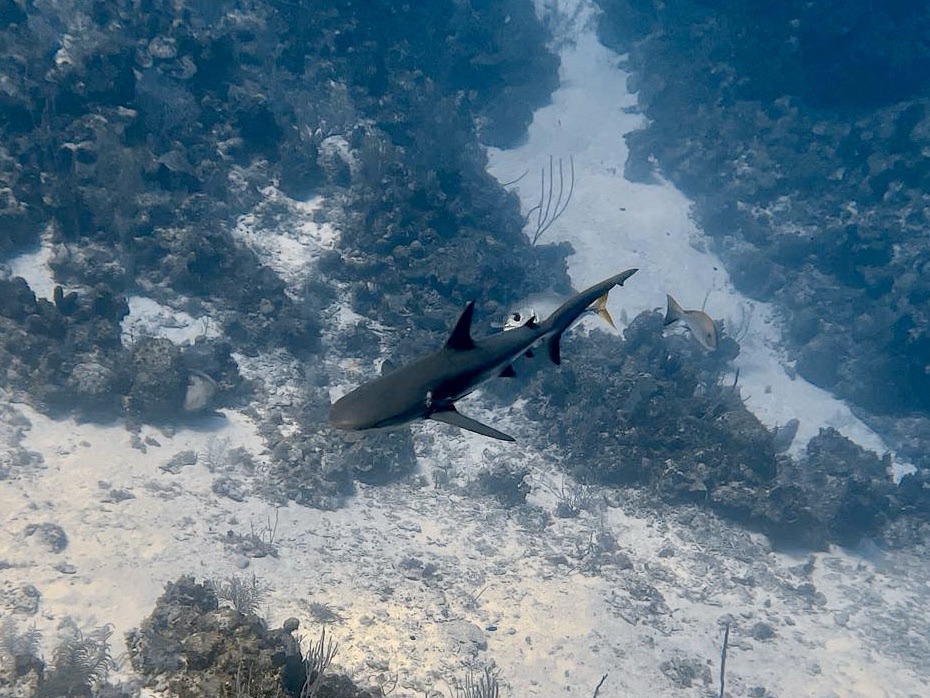
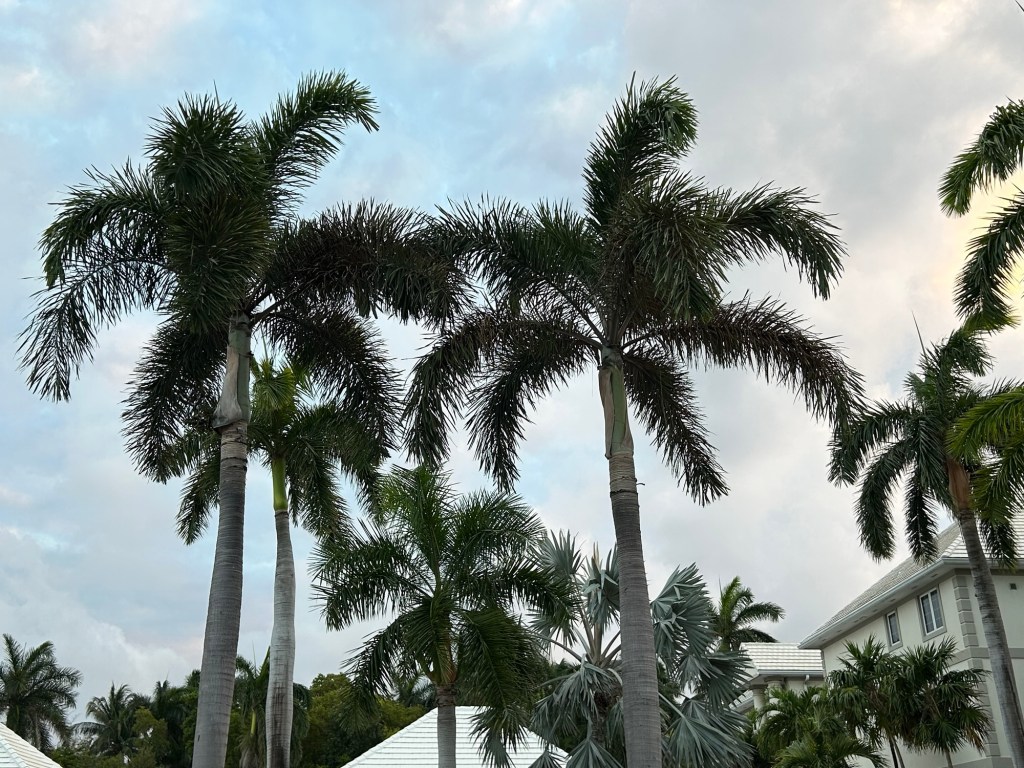
The white-winged doves call almost continuously over the soft susurration of water and the cool rustle of the morning breeze through the palm leaves. I know that beyond the porch screen, the world is awake, although from here everything looks still. The deep green water in the little bay calmly offers a mirrored view of everything it sees. If I wander out across the white sand, I will be able to see hermit crabs exploring the shallow edges of the water, jelly fish – beautiful pulsing flowers – a little further out, and fish of various sorts swimming through the reeds, but for this moment, I am quiet on the land.

A grackle flies into the jungle geranium (ixora coccinea) bushes which surround the house, and she poses. She tilts her sleek head at me as if she knows how beautifully her iridescent black feathers contrast against the green leaves and red flowers. Really, she’s just hoping for food. “I don’t have anything for you,” I say and, as if she understands, she flies away. She’ll be back throughout the day, but for now, I imagine her reporting to friends, “No, she’s the only one awake, and she’s still drinking her tea.”

Soon, my spouse appears and joins the lively quiet of this space. We speak occasionally, easily, but mostly we allow ourselves to exist independent of whatever expectations weigh on us elsewhere. The birds continue to call.

Now the human world begins to wake. Now engines growl from the road, from the water. A couple walks by, conversing in hushed tones, moving towards different water – the pool or the ocean. Two paddleboarders slip almost silently into sight. Next door, a little one runs to the edge of the bay, a pail in hand, ready to shape her tiny part of the world. I stand to make a second pot of tea and the curious grackle comes back. 

View from the porch

This place – my aunt & uncle’s cottage – is my favourite place in the world.

Locked out #SOLC25 9/31

We are locked out of my aunt’s house. She and my spouse left about an hour ago to go see my nephew (really my cousin’s son, but big families get confusing) in a swim meet. My boys and I stayed behind, too happy in the ocean to go with them. Eventually, I traded the Caribbean for the heated pool, and soon my kids followed.

While they roughhoused in the pool, I made my way back to my aunt’s place to write today’s post – only to discover that the key she left behind didn’t turn in the lock. So here I sit, poolside, writing on my phone and watching my teens. They’ve had me film them in slo-mo as they do various wild tricks; now they’re playing something akin to baseball with a pool noodle and a beach ball. My writing keeps getting interrupted by gales of laughter and giggles.

The sun is starting to set, so I have finally texted to admit that we can’t get in – but we’re in no rush. When we left this morning it was snowing and gray; we can stay here, locked out together, and be happy for a long time.

My view as I write

Yes or No? #SOLC25 6/31

We’ve been reading short stories in Grade 9 in preparation for reading Jason Reynolds’ novel Long Way Down. We’ve reviewed/ learned vocabulary like “plot” and “climax”; we’ve talked about summary vs retelling vs opinion; we’ve read a story with an ambiguous ending (because I know what we’re getting into); we’ve even practice discussing big ideas, like equality and utopia. Some days are good – like Tuesday, when the Socratic-ish discussion of equality led one group into a discussion about whether police need to be more powerful than everyone else; suddenly they were thinking deeply about the story and our world and things that seem awfully important – and some days are, well, less good.

Today, Thursday, I asked students to choose one of three prompts and write a one or two paragraph response. I firmly believe that this is a reasonable expectation, but 24 students means 24 different interpretations of reasonable, and some students were not happy with the request. Still, I was surprised when a usually strong student called me over about five minutes into our writing time, clearly distressed.

They had chosen the prompt “In your opinion, is the society in “Harrison Bergeron” a utopia?” even though they missed the day we discussed that. On their screen they had written, “No.”

They looked at me, a bit wide-eyed, and said, “I don’t know what else to write.”

“Mmmm… “ I said, “I can see the problem. I’ve made a mistake.”

“Yes,” they nodded emphatically.

“May I?” I asked, as I reached toward their keyboard. With permission, I typed, “Explain your reasoning using examples from the story.”

The student breathed an audible sigh of relief and said, “Oh, ok” and immediately began writing more as they muttered, “It was a yes or no question.”

Yes, sweet child, it was a yes or no question. Thank goodness I was able to fix it.

Anything you can do to a cloud #SOLC25 2/31

Sheri set a timer and did a free write for six minutes because someone else did the same, so here I am, jumping on the bandwagon on day two. And I should know how to do this: I freewrite all the time in my teaching practice because I am forever trying to convince my students that it is OK – even good – to just write. My goal for them by the end of the semester is seven minutes. I have no idea why, but there it is. And truthfully, for grade 9, at this point we’re aiming for five solid minutes of writing.

I need to admit that I have deleted a few times already – but I swear this is mostly free writing and if I were handwriting this, I would have just crossed things out, so that counts.

Why do I free write with them? I honestly think that seeing someone else write, watching their process and their struggles, noticing how they pause and keep going, seeing what they throw away and what they keep, can help students understand that writing isn’t about presenting perfected ideas – in fact, it’s about the opposite of that: writing is about honing ideas, checking them out, looking at them from different angles, dressing them up in words and seeing what they look like, finding the places where the ideas aren’t entirely complete…

That’s a lot of mixed metaphors, but hey, it’s a free write.

So I write in front of my students, near my students, among my students. In class, I tell students that a preposition is anything you can do to a cloud – you can go in front of a cloud, near a cloud, through a cloud, over a cloud – and then we write sentences with prepositions, playing with making very long, very silly sentences.

I started this blog in part to experience for myself some of the things my students experience: writing on a deadline, writing when I don’t feel like it, writing when I don’t have much to say, writing knowing that someone else will read it.

Time is up. Now I’ve done my one-minute post-writing clean-up (another trick I use – so they re-read and make a few changes) so I can post this. Then, tomorrow, when we’re writing, I’ll have proof that freewriting is “real” and even shareable. Maybe this will even help them write more.

Community #SOLC25 1/31

It’s snowing again. What purports to be our front yard is currently a pile of snow so tall that shovelling more snow on top of it causes mini-avalanches either back onto the shoveller or over the top and down the other side. Across from our driveway, a snow pile significantly bigger than our minivan looms ominously. To leave home in the car, I have to do a sort of backwards three-point turn, using the snow mountain as a semi-soft reminder of how far I can go – though our recent thaw-freeze cycle means that the snow is a little more compacted and a whole lot harder than it was a week ago. Our street was due for snow clearing *before* the last big dump, but each major snow storm sees the city scrambling to remove snow from the bigger roads while our little residential street slowly subsides under the white stuff.

As I leave my house to walk to a massage appointment, neighbours are already out clearing their driveways. Glenn pauses to greet me, teasing, “Here I thought you were coming out to shovel, but I suppose you’ve got teenagers for that.”

“Ha! They’re only any good if you can wait until mid-afternoon for the driveway to be cleared.” I laugh. Then I realize that Glenn is shovelling Mario’s driveway – and Mario is maybe snow blowing Glenn’s driveway? Unclear. And a guy from the halfway house – someone I haven’t met yet – is obviously helping Glenn.

“Did you all get confused about who lives where?” Everyone laughs, and we banter for a moment before I head on my way, grinning at the way our neighbourhood functions.

***

The massage therapist has a 7-month old and updates me on all the recent developments – he’s rolling both ways now, and he’ll be crawling any day now. I tell him (the father, not the baby) about my own children, and we marvel at the changes in our lives since I started seeing him a few years ago.

After the appointment, we’re still chatting while I put on my coat and boots, and his next client arrives. “I thought I recognized that voice!” she laughs, and I turn around to see a former colleague. Since I last saw her, she moved away and back, had a baby, turned 40. Social media has let us keep up a little, but here in the little office, we greet each other again.

***

And now I’m home, starting my 8th year of participating in the March Slice of Life Challenge. I have already read a few blog posts from friends (though I’ve never met them in person). I write knowing that some of my friends from as far back as elementary school will read my posts, and we’ll reach out and catch up a little. I’m anticipating a month full of moments where we’re all shovelling each other’s virtual driveways and running into each other in the comments section. Once again, I’m looking forward to this community we create with words.

With many thanks to the team at Two Writing Teachers for growing and preserving this community.

Writing beside him

I’m helping a former student write a personal essay for his Grade 11 English class. We’ve talked it through, and planned a little; his next step is to write it. Reading and writing aren’t his forte – he’d much rather be on a playing field than in any classroom – but this story is important to him, and he wants to get it down on paper. So here we are, sitting in the upstairs lobby – currently one of the coolest places in our very hot school – and he’s writing.

This kid has my heart, as many of them do. Last year, he didn’t do particularly well in our first semester English class, so he agreed to change his timetable in order to be part of a reading class with me during the second. That alone took some courage: not everyone who needed the support was willing to accept it. Once there, he mostly tried, even when the work was repetitive or “not that interesting,” even when he took extra long body breaks or got frustrated by the “simple” books he was reading.

Knowing that history, I’m intrigued by his choice to sit with me in such a public place this afternoon. With only two weeks left in the school year, students are out of classes nearly as much as they are in, and many of them wander aimlessly through the halls. Several have stopped to greet us; pretty much all of them give us at least a passing look as we sit here at a student table and work. There’s no hiding that we’re writing together, no hiding that I’m helping.

Nevertheless, he’s nearly filled a page with his small, neat handwriting – a feat which would have been unfathomable last year – and his focus hasn’t wavered, though he has had to stop a few times to flex his tired hand. Meanwhile, I sit here typing my own story, this story, marveling at this moment of quiet togetherness amidst myriad other students. We are here, the two of us, writing; we are here, the two of us, writers. 

This sense of camaraderie has me thinking about what we mean when we say that teachers need to “get to know their students.” How well do I know him? I didn’t spend a lot of time last year asking him about his family, though I did call home when I needed to. I have no idea if he has pets, and am not clear about how many siblings he has. In fact, I don’t know many things about him, but I know enough that I can tell him, honestly, that I believe in him. I never told him he was a strong reader or writer; I did tell him that I thought he could be. I never told him this path would be easy – heck, I was clear that parts would be hard – but I did tell him that I thought it was worth it. Other teachers and coaches told him the same thing, complimenting him when he improved, noticing when he was reading, harrying him back to class when he was in the hallways. When he faltered, he had a team of people to remind him of his long-term goals.

Today, he has a story to tell, and he has found me. He says he needs help, but I think he just needs someone who believes in him to write beside him. What a privilege! I can do that any time.

Again

The assignment was due March 5. Today is April 2. So far, only six students have received grades. Why? Because only six have fulfilled *all* the requirements, and I’m refusing to mark assignments that aren’t complete.

Before you get worried, I don’t think I’m overly demanding. The basic assignment is to write a 100-word memoir. A complete assignment has a title and a story that is exactly 100 words. Students must use a spelling/grammar-check (I’ve recommended LanguageTool, but some use Grammarly)  so that no underlined problems remain, and they must label three “craft moves” – or good things in their writing. For the last part, a poster in the classroom lists things we’ve studied and they’ve seen multiple examples.

Some students have only been through one round, but most are on their third or fourth attempt. In years past, I’ve marked what came in, no matter how incomplete. But this semester, something changed. I decided that every single student was capable of following all four steps:

  1. Title
  2. 100 words
  3. Spell check
  4. Label

What is different? I wish I knew. The closest I can come to explaining is that I am taking my role as a “warm demander” increasingly seriously. To the very tips of my toes, I believe that every student in my class is capable of completing the assignment. Even more, I believe that they are capable of completing it well. So I keep returning the assignments with plenty of feedback (“I really appreciate how you’ve opened this fun memoir. Next you need to give it a title and run it through LanguageTool.”) and insisting they do it again. This weekend, one student turned in the identical assignment three times. Last night I caved and wrote in all caps, “USE THE FEEDBACK.” Today, they finally asked for the explanation they required to finish their work. 

I’m not sure that I’m making the right choice, and I need to be clear that I am consistently upbeat and encouraging as I hand back the assignments (again and again with no mark), but I figure if they learn nothing else this semester besides “follow all the steps” that’s probably a reasonable life skill. 

Now, off to write, again, “True compliment about the writing. Next, you need to give your good work a title and run it through LanguageTool.” I’m betting I can get 24 completed assignments by the end of next week because I’m pretty sure I’m more stubborn than they are – at least about getting this right.

The Truth About Stories #SOL24 31/31

In grade 9, we’ve moved from our first unit – Stories of Us – into our second – Stories of Others. We’ve written Where I’m From using not only George Ella Lyon’s wonderful poem but also interpretations by Melanie Poonai, a young writer from England, and Danika Smith, an Indigenous author from British Columbia, as models. We’ve worked as a class and in small groups to create Where We’re From poems that help us understand our class as a whole. Students turned these into posters or short videos – and the school board’s print shop has delivered gorgeous prints that now decorate our room. We’ve written our own 100-word memoirs, too. Now, it’s time to look outside our classroom walls.

It’s also March, which means that I am in the middle of writing and publishing stories every day. I tell the students about this, and they are interested, impressed, curious, bored, and not listening. Some of them want to know where I get the stories from. I laugh and say, “from you.”

For a few days, we listen to StoryCorps interviews and look at Instagram posts from Humans of New York. We practice active listening and asking follow-up questions. Then, I put this quote up in the right-hand corner of the blackboard as one of our daily quotes:

The truth about stories is that that’s all we are. 
-Thomas King

After reading time, I draw their attention to King’s words. I ask what they think he means. It takes a minute, but when they arrive at an understanding, a few of them marvel. “It’s really true, isn’t it? Our stories are really important,” says one. “It’s like what we think about what happens is as important as what happens,” says another. I just nod.

I think about the quote all the time. I think about how I am made of the stories I’ve heard, the stories I tell myself. I think of how the way I tell the story affects who I am and how the stories themselves change over time. I think about the value of regularly capturing tiny moments, recognizing the story I’m telling myself as I live it. These stories are everything. As Jess writes, “There is gold in every piece of your story.”

Now, the students are out in the world (mostly in the hallways, to be honest), interviewing other people: family or friends, students or staff. They have to choose a tiny powerful moment from their interview – a story – and pair it with a photo. I post these on our Instagram account, and we marvel at the moments that shape our community. The students must think about what part of their interviewee’s story they chose to tell and what parts they left out. How will that change people’s perceptions? What story are they telling? These students learn to lean in to other people’s stories and consider them deeply.

This year, this part of the unit is closing as March comes to an end. Today marks the end of seven years of this challenge for me. I know that, tired as I am, I will miss this – the writing, the reading, the commenting – tomorrow and in the days to come. And I know it’s because of the stories people share, and the stories I choose to share, too. What a privilege it is to be part of so many stories! What a boon to be allowed so many views of the world!

If Thomas King is right, and I think he is, then I am so much better, so much more because of the stories others have shared this month and in all the months and years past. I am better, too, because of the time you’ve taken to read my stories. Thank you. 

Throwing in the towel #SOL24 16/31

I give up. It’s not that I haven’t written anything today. Oh no, it’s much worse than that: it’s that I haven’t *finished* anything today. When I realized I was struggling to write, I looked through my photos, thinking that a photo essay might be just right. I even got as far as creating a March collage. Then I decided I didn’t like it. Harrumph.

I considered writing about my pets because I love posts with pets, but this morning Hera stood on my chest and purred until I woke up, and the dog was kind of a jerk at the dog park this afternoon, so no posts for them.

I looked back at ideas I’ve collected from other bloggers this month and got deeply involved in a prompt from Steph at Steph Scrap Quilts, but it’s definitely not done enough to share. Or, more true, I like it too much to share it too early.

I tried to shake off my writing blahs by doing non-writing things that sometimes help me write: I took a walk, baked (banana bread – delicious), talked to my sisters for a long time, worked out, read other blog posts… Still, nothing.

And here I am. It’s almost 8pm, and this is what I’ve got. I’m giving myself credit for writing something when nothing would have been easier, and I will publish my imperfect writing.

Now that I think about it, I’m going to dedicate this to my students. After all, I started blogging as practice so that I could be a better writing teacher. I think it’s worked. If nothing else, I know what it means to stare down a blank document, knowing I have a deadline, knowing that others will read my work, knowing that another day, another hour might make it better. And then, I publish anyway. This is what I wish for you all: the strength to do your work, even when you aren’t inspired, and the courage to turn it in, even when it’s imperfect. This is me, practicing what I teach.

Grief at 6 weeks #SOL24 14/31

“You can’t write your way out of this,” says my therapist, and I know she’s right, but that doesn’t mean I have to like it. Anyway, the words won’t come out properly, so it’s not like I have a choice.

She says she’s not crying as much as she expected. Apparently her therapist told her, “You’re going to have to actually feel your feelings.”

We repeat the phrase to each other and laugh at ourselves because we aren’t crying until we are crying – and then we start laughing again because we’re crying about not crying and does this count as feeling your feelings?

At the gym, the coach shows us the workout: lifting again, the weights carrying some of our grief. But today all of her muscles hurt and she didn’t sleep well and she’s just so angry that she finally has time to take care of herself only her body won’t cooperate. I know what she means, but it’s not my child who died, not my body that aches so deeply. We do what we can and cry again. 

“I’m so tired of crying,” she says, and I agree, “yeah, six weeks is way too long to mourn a child” and “what are you thinking anyway?” because apparently right now all we can do is cry, then laugh, then cry again.

With that, the coach erases the whiteboard, grabs her phone and orders us all something from Starbucks. We change our shoes and head out for a walk, which doesn’t fix everything – or anything – but at least we are outside, together, sipping hot drinks in the sun.