A good day #SOLC25 19/31

Today was a good teaching day, the kind that makes me keep grinning off and on right through the evening. At first, I was going to write something else, but then I wanted to capture this.

First period:
In grade 12, we’ve just started Hamlet. I am always torn about teaching Shakespeare, but I really love teaching this play. And today was amazing. We finished up yesterday’s rhetorical analysis of Claudius’s first speech and students cited lines from the play without being prompted. In my head, I was jumping for joy, but on the outside I played it cool, like, “yeah, my classes always just naturally use lines from Shakespeare to back up their points. Nothing to see here.” My super-cool teacher persona just took notes on the board and nodded her head.

Then we moved on to Hamlet’s first soliloquy. I’d planned a soliloquy buster (which I clearly got from somewhere at some time, but I no longer remember where or when), and even though we’ve only been together for six weeks, and even though it wasn’t quite 10am, and even though it’s Shakespearean language, the students happily moved their desks and sat in a circle and read aloud. Then, the real miracle occurred: no one protested (I mean, I heard a groan or two, but that’s just normal) when I dragged the class into the school lobby to “walk” the soliloquy. I stood on the risers and read the lines loudly while students held their copy of it and walked, turning 180 degrees every time there was a punctuation mark. By the end, we were breathless. When I asked how they thought Hamlet was feeling as he gave this soliloquy, students knew immediately: agitated, frantic, upset.

The energy in the room was high when the bell rang; I could almost *feel* the learning. They were jazzed. 

Second period: Planning. And I actually got things done. I even sent a suggestion to the principal: what if we invite the public library to set up a table during parent-teacher conferences and help people get library cards? (He said yes!)

Third period:
Literacy support. Another teacher actually invited me into their classroom to support students. I used AI to almost instantly convert the assignment (which is a *great* assignment but which has a LOT of words) into a checklist. I photocopied that and handed it out within minutes AND managed to sneakily support two students who really needed support. HOORAY!

Fourth period:
My, ahem, energetic grade 9 class started Long Way Down today. Their reactions to seeing the books piled on desks were decidedly mixed: “Are we going to read that?” can be said in many ways. But Jason Reynold’s novel has a magic that has never failed me – not since the first moment students unboxed brand-new copies of the book a few years ago d, and started to read. Today, Reynolds’ voice filled the room, our hearts beat as we heard that Will’s brother Shawn was shot, and we waited the horrible millisecond while we turned the page and read the words “and killed”. Someone gasped.

The kids let me pause to ask a few questions here and there, but mostly they begged to keep reading, so we read right to the bell. As they piled the books back on the desk (we have to share books with other classes), several of them said, “That’s a really good book, Miss.” I just nodded and said, “I know. I know.”

Then one darling child stayed after and whispered the story of the book she finished over March Break, the one she really wanted to tell me about, even if it might spoil it if I decide to read it. (Reader, I will not; it is “romantasy” – virtually all she reads – and sounds extremely silly, though just right for her.) I nodded and oohed and aahed until she realized her bus was coming and ran out the door.

For just a minute, I sat in the quiet classroom, completely satisfied with a day when learning felt almost tangible, when almost everyone was engaged almost all the time. I don’t always write about these days, but they happen – they really do – and I wanted to capture today. It was wonderful.
Cheating Cheater #SOLC25 18/31

He was shamelessly cheating. While the “big boys” (my teens) and my spouse splashed around the small pool, calling loudly to each other, my cousin’s 7-year-old ducked underwater every time he heard the dreaded cry, “Marco!” Others might give away their position by replying, “Polo!” but he was no fool. You’re a lot harder to find if Marco can’t hear you.

Of course we called him on it, tickling him and dunking him. “You’re a cheating cheater!” my sons teased, and he didn’t deny it. Seven is the perfect age to check out what happens when you break the rules. Turns out, if you cheat long enough, we’ll change the game – and we’ll love you anyway. 

***

After school, my child tells me that one of his teachers has accused him of cheating. “The worst part,” he says, “is that I did it: we wrote that section together – but only because we thought we were allowed to.” He takes a deep breath. “I tried to explain. I tried to tell him that we obviously thought it was ok because we used the exact same words. If I was trying to cheat I wouldn’t be so dumb about it, but he wouldn’t even listen.”

My son is upset, and rightly so. The idea that someone thinks you have intentionally been dishonest can be devastating. Worse, he likes this teacher and this subject; he’s worried about the ramifications of this incident. 

“Will you write to him and tell him I’m not a cheater?” he asks. I counsel him to send an apology email, even though he’s still upset about the accusation itself. He pulls out his phone and shows me the email he’s already composed. “Is it good enough?” he asks. “Can I send it?” It is and he does.

***

We all knew that the 9th grade Mythology test was nearly impossible. Senior students recounted horror stories. “No one passes,” they assured us. “It’s killer.” I studied and studied, and worried so much that I made myself physically ill before the test. I vomited and got sent home at lunch.

My teacher announced to the class that what I had done was a form of cheating. She gave them the “easy” version of the test and “saved” the hard one for my return. Then, she told me that she assumed I had lied about being sick. I cried while I took the make-up test – which I aced, even though it was very, very hard. I’m still not sure if she ever thought of me as completely honest after that. I know that I never quite trusted her again.

***

I don’t know what to write to my son’s teacher, but I know what I want to say. I want to say, even if he did it, even if he intentionally did the wrong thing – and I don’t think he did – please remember that he’s a child, not a cheater. Please don’t do to him what my teacher did to me all those years ago. 

I’ll find the words for the email, but before I do, I’m going upstairs to give my child an extra hug. I can’t change this particular game, but I’ll love him anyway.

yr move #SOLC25 17/31

hey

im returning thisessay 2U cuz u haven’t done any of th things i asked like for example u didnt capitalize i & u forgot that u half to use spellcheck and um punctuation cuz this is something u wrote for school also i specifically asked u to, you know, spell words out instead of using txt shorthand again cuz this is for school

yah & how fast can u get it back 2 me cuz i need it for report cards? Sry! I know its late but if u cd be fast that wd be grt. Also ur parents will freak on me if ur marks r low so id rlly appreciate it if u wd do this solid

I no writing formally might seem whack, but trust, its the move – or at least, it’s ur move if u want to level up

yr tchr

The Language of Flowers (Cayman Version) #SOLC25 14/31

For multilingual Friday, I’m trying a photo “essay.” As I’ve worked on this, I’ve realized how little I know about this as a form. I have struggled for a theme, tried to figure out organization, made choices about what to keep and what to cut. I thought I was just going to play and share pretty pictures – and in the end, I think that’s what it looks like – but it turns out, given a new language, I had to work to understand form and learn how to manipulate things. Also, it looks different on a laptop than on a phone. Gah! If I had been at home rather than on vacation, I would have given up because this took so long. Makes me think of what I’m asking for when I ask my students to “just” write an essay or some such. Interesting.

Learning to be Underwater #SOLC25 11/31

The instructor gives the ok sign to each of us, one after the next, and waits for our mimed response. Next, he points two fingers at us and then at his eyes. Once he has everyone’s attention, he removes the second stage from his mouth and slowly blows out bubbles as he searches for his “missing” air supply. He finds it, puts it back in his mouth, and starts breathing normally again. Then, he points directly at my youngest child and signals for him to repeat the same actions. Nearby, I watch patiently, waiting for my turn, confident that, far from putting us in danger, this activity will make us all safer in the long run.

This week, my family is taking a scuba diving course. We’re learning a lot and I, of course, am busily observing both how we are instructed and how we are learning. I am always curious about how skills are taught outside of classrooms. Scuba is particularly fascinating because the consequences of not being able to perform the skills effectively can be deadly, but plenty of regular people scuba dive, so, while there can be no compromise, skills acquisition has to be manageable for all sorts of people.

Before we arrived on the island, all of us completed a five-section, multi-part online course with a final exam that we had to pass with a minimum of 75%. Each section built on previous sections for at least some of the learning (i.e., “How to be a Diver, part 3). As a family, we took four very different paths to success: one of us started early and learned methodically, using the “You will learn” introduction to each section to guide their reading, taking notes to learn “how not to die underwater”; one of us read the information in chunks, making sure they were able to pass the short required quiz at the end of each section before moving on; one of us skipped most of the reading but watched the videos for each section before “acing” the quizzes (not my word); and one of us went straight to the quizzes and tried them, then, once they knew what they didn’t know, went back to review only that section before completing the quizzes correctly and moving on. These choices were not obviously age-based, and no, I was not the one who took notes. We all passed the final exam, though one of us had to take it twice (72% then 80%). The last person finished the day we left on vacation. (Ok, that was a kid.)

If you’re keeping track… PADI (the group that administers the course) 

  • used a focus checklist (“by the end of this section, you will be able to…”)
  • presented the information in both written and video format
  • offered low-stakes immediate retrieval assessment questions (we could redo them as often as necessary) 
  • encouraged spaced practice by expecting us to review things we had learned in previous sections
  • at the end of each of the five sections, offered more retrieval with a section quiz which we had to pass but could retake and THEN
  • provided an evaluation which mimicked the section quizzes and which we had to pass with a 75%. If we needed to, we could review material and take it again.

That is decent pedagogy.

Today, we started the “practical” portion of the course with… wait for it… a written quiz based on the material we learned online. It was not for points. We simply took the quiz and then the instructor reviewed the answers and chatted with us about mistakes that anyone had made. For much of the information, this was at least the FOURTH time we had been asked to retrieve it. I don’t want to shock anyone, but we all passed this low-stakes review.

I’ll probably write more about the practical part of the course later, but I want to pause here and notice what I can take into the classroom from the written portion. For me, the lesson focus wasn’t particularly useful – I tended to skip that part – but one of my children loved using it to guide his attention. Interesting. We all spent different amounts of time with the information and took it in differently (I didn’t watch a single video; everyone else watched some or all of them). The low-stakes retrieval questions worked for all of us, as did the “do it until you pass” mastery quizzes at the end of each section and of the written course. The spaced practice was effective, too: if you’d forgotten something from a previous unit, you got a quick review in order to pass the current one.

I was most impressed, however, with the “extra” retrieval we did today. Let me tell you, everyone who took the course is very clear on the biggest ideas – and PADI has used both spaced practice and retrieval practice to ensure that we actually remember it.

Of course, a classroom is a different place. Most obviously, students’ motivation for learning in a classroom is not quite as compelling: rarely does anyone die because they forgot where to put a comma or mispronounced “epitome.” But I’m also thinking about how our family moved at different paces and took information in differently. That could happen in a classroom, to some extent. I think a lot about the Modern Classrooms Project, for example, which seems to account for some of that. My particular school is desperately low on technology, so I’m not quite ready to adopt the approach, but it seems right. I wonder what I could do to make learning in the classroom just a little more like getting ready to scuba dive? 

Maybe I could just bring some really cool fish.

This tarpon – and her friends! – were at least three feet long & swimming casually next to our lunch spot.

Yes or No? #SOLC25 6/31

We’ve been reading short stories in Grade 9 in preparation for reading Jason Reynolds’ novel Long Way Down. We’ve reviewed/ learned vocabulary like “plot” and “climax”; we’ve talked about summary vs retelling vs opinion; we’ve read a story with an ambiguous ending (because I know what we’re getting into); we’ve even practice discussing big ideas, like equality and utopia. Some days are good – like Tuesday, when the Socratic-ish discussion of equality led one group into a discussion about whether police need to be more powerful than everyone else; suddenly they were thinking deeply about the story and our world and things that seem awfully important – and some days are, well, less good.

Today, Thursday, I asked students to choose one of three prompts and write a one or two paragraph response. I firmly believe that this is a reasonable expectation, but 24 students means 24 different interpretations of reasonable, and some students were not happy with the request. Still, I was surprised when a usually strong student called me over about five minutes into our writing time, clearly distressed.

They had chosen the prompt “In your opinion, is the society in “Harrison Bergeron” a utopia?” even though they missed the day we discussed that. On their screen they had written, “No.”

They looked at me, a bit wide-eyed, and said, “I don’t know what else to write.”

“Mmmm… “ I said, “I can see the problem. I’ve made a mistake.”

“Yes,” they nodded emphatically.

“May I?” I asked, as I reached toward their keyboard. With permission, I typed, “Explain your reasoning using examples from the story.”

The student breathed an audible sigh of relief and said, “Oh, ok” and immediately began writing more as they muttered, “It was a yes or no question.”

Yes, sweet child, it was a yes or no question. Thank goodness I was able to fix it.

Attendance concerns #SOLC25 5/31

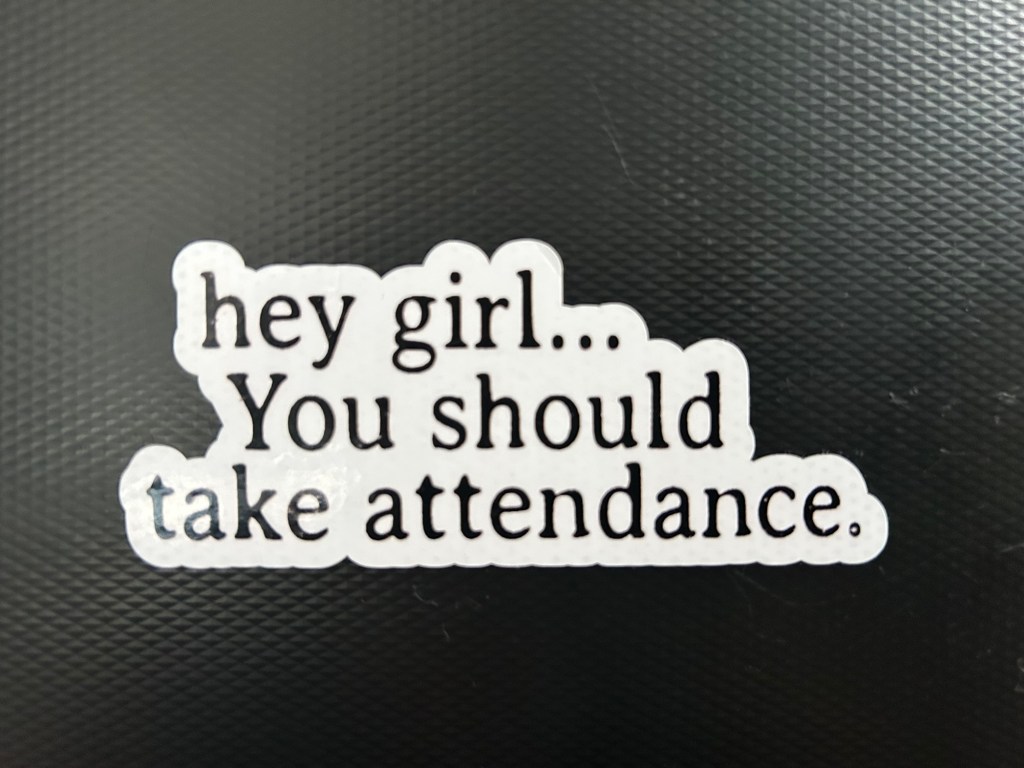
Thanks to one of my colleagues, many of us have this sticker on our laptops: 

img_3045

You would think that this would help us remember to turn in our attendance for every class every day, but if our Vice Principal is to be believed (and he seems reliable enough), it does not.

As a result of my inability to submit attendance for all of my classes before 4pm, I have written myself an attendance letter. 

(NB: Our lovely administrators would never actually write a letter like this!)

Dear [Employee Name],

We are writing to express our concern regarding your recent attendance pattern: specifically, [insert problem here: you keep forgetting to turn it in].

Our records indicate that you sometimes take attendance as soon as class begins. We commend you for your optimism! We know that on those days, invariably, at least 12 students arrive late – generally walking in one by one over a 45-minute period – and thanks to our fancy tracking system, you have to keep a record of the time at which each student enters the class. We understand that this might be difficult for you, but noting their arrival time is imperative for our systems.

We are here to support you. May we suggest noting arrivals on a piece of paper and hoping you don’t misplace it before you enter the data later in the day? Do you even have paper near you? If not, why not? If so, where do you keep it? And do you manage to keep a pen, too? That would be impressive organization for a teacher who is also moving about the room to respond to her students. Alternately, perhaps you could pause your instruction, freeze the projected computer screen each time another student enters, then navigate to our school attendance site and immediately enter their arrival. Would that disrupt your teaching? If so, what is your plan to manage that problem?

Consistent attendance taking is crucial to the smooth operation of our school. Your attendance-taking pattern has impacted [explain specific impacts, e.g., our records]. According to our computerized records, your period Z class has nearly perfect attendance, despite the fact that one student no longer attends school at all. We note, too, that you insist that this class is “nearly unmanageable” with “students entering and leaving at will.” This implies that perhaps you are forgetting to submit your attendance for this class.

We are here to support you. Have you tried using a hall pass system? Perhaps students in this class would be willing to write their arrival and departure times on a piece of paper strategically placed near the door. Attention: do not write student names where others can see them; this might be shaming. We realize that all the other students have seen the late arrivals; nevertheless, we invite you to manage attendance privately. Maybe you can place the paper a little out of the way? And put a cover on it? And you will probably want to attach a pencil. We are certain your students will use this paper appropriately. Also, please note that even if a student spends 70 minutes of the 75-minute class period “in the bathroom”, you should still mark that student present and note the time they arrived.

We encourage you to discuss any underlying issues that may be affecting your ability to maintain regular attendance, and we highly doubt that your attendance records reflect anything close to reality. Please reach out to [supervisor’s name] to discuss potential solutions and support options available to address these concerns. Please note that [supervisor’s name] is unwilling to text you every. single. day to remind you to do your attendance. That’s what your laptop sticker is for.

We value your contributions to the team and want to work with you to ensure your attendance meets school expectations.

Sincerely,

[Name]

[Title]

Teacher Math #SOLC25 3/31

Word problem:
Having been made aware – repeatedly – that photocopying is consistently the largest line item in the school’s budget, a teacher has nevertheless decided to make photocopies for a grade 9 English class. The activity will require only one day, so students who are absent today will not need a copy. 24 students are enrolled in the class. How many photocopies should the teacher make in order to have enough for all the students without “wasting” money?

Break down using the GRASS method.

GIVEN: Read the question carefully. Figure out what values are given.
24 students are enrolled in the class.

REQUIRED: Figure out what is required.
Enough – but not too many – photocopies for the students who attend class today.

ANALYSIS: Analyze the question and use appropriate math operations.
It’s one week before March Break and one (1) student has already left on vacation. Their parent notified you. Experience tells you that up to two (2) more students may have already left without letting anyone know. 

24-1-1 = 22 OR 
24-1-2 = 21

It’s the first week of Ramadan and class is at the end of the day. There are at least seven (7) Muslim students in the class. Some of them will be fasting, and some of them may be fasting for the first time in their lives. This is difficult, so some of them may go home before the end of the school day. Still, it’s only Monday, so probably most of them will try to stick it out. Estimate: one (1)

22–0= 22 OR
22–1= 21 OR
21–1= 20

The flu has been going around. Loads of students and teachers were out last week, some for up to five (5) days. Today’s list of absent teachers is long, and during period one, about a third (⅓) of the class was absent. This class was pretty healthy last week. Are they more likely to be sick this week as a result? Check the online attendance to see if anyone has already been called in sick by their parents. One student is marked absent. Estimate: at least one (1) and up to three (3) sick students.

22–1= 21 OR
22–2= 20 OR
22–3= 19 OR
21–1= 20 OR
21–2= 19 OR
21–3 = 18 OR
20–1= 19 OR
20–2= 18 OR
20–3= 17

Last week you sent emails home to several families addressing student behaviours. Of the four (4) families you contacted, two (2) replied. How many of these students will attend class today? Educated guess based on experience: three (3) will attend and one (1) will skip in frustration.

21–1= 20 OR
20–1= 19 OR
19–1= 18 OR
18–1= 17 OR
17–1= 16

Finally, students may not be able to attend due to “Acts of God”: “I missed my bus after lunch” or “I got suspended for fighting in the bathroom” or “My best friend’s boyfriend just posted on IG and another girl was in the picture so I had to stay with her because she was so upset” or “Sorry, Miss, I forgot it was a Day 1 and I went to my Day 2 class and I only realized it wasn’t my class after 25 minutes.” Estimate for today: an optimistic zero (0)

WAIT: don’t forget to add in the extra copy for the student who loses their sheet between the time you hand it out and the time they need to use it. (approximate elapsed time: 8.3 seconds)

20+1= 21 OR
19+1= 20 OR
18+1=19 OR
17+1= 18 OR
16+1= 17

SOLUTION: Solve the question.
Maximum photocopies required: 23
Minimum photocopies required: 17

Repeat these calculations for each of today’s classes.

STATEMENT: State your answer in simple words.
For today’s classes, in order not to waste money, the teacher requires somewhere between 17 and 70 kajillion photocopies.

Realize after all of this that at least three students will be gone for some or all of the class because of a volleyball game. Their coaches posted about this on the email conference three (3) minutes after you finished photocopying.

Good luck!

Anything you can do to a cloud #SOLC25 2/31

Sheri set a timer and did a free write for six minutes because someone else did the same, so here I am, jumping on the bandwagon on day two. And I should know how to do this: I freewrite all the time in my teaching practice because I am forever trying to convince my students that it is OK – even good – to just write. My goal for them by the end of the semester is seven minutes. I have no idea why, but there it is. And truthfully, for grade 9, at this point we’re aiming for five solid minutes of writing.

I need to admit that I have deleted a few times already – but I swear this is mostly free writing and if I were handwriting this, I would have just crossed things out, so that counts.

Why do I free write with them? I honestly think that seeing someone else write, watching their process and their struggles, noticing how they pause and keep going, seeing what they throw away and what they keep, can help students understand that writing isn’t about presenting perfected ideas – in fact, it’s about the opposite of that: writing is about honing ideas, checking them out, looking at them from different angles, dressing them up in words and seeing what they look like, finding the places where the ideas aren’t entirely complete…

That’s a lot of mixed metaphors, but hey, it’s a free write.

So I write in front of my students, near my students, among my students. In class, I tell students that a preposition is anything you can do to a cloud – you can go in front of a cloud, near a cloud, through a cloud, over a cloud – and then we write sentences with prepositions, playing with making very long, very silly sentences.

I started this blog in part to experience for myself some of the things my students experience: writing on a deadline, writing when I don’t feel like it, writing when I don’t have much to say, writing knowing that someone else will read it.

Time is up. Now I’ve done my one-minute post-writing clean-up (another trick I use – so they re-read and make a few changes) so I can post this. Then, tomorrow, when we’re writing, I’ll have proof that freewriting is “real” and even shareable. Maybe this will even help them write more.

Lost plot

A poem written upon learning that many of my grade 9 students are not 100% sure what “plot” means and most have never seen a plot graph or heard many basic narrative terms. They did have some great guesses for the meanings of various words; it’s just that they were mostly, well, off.

Lost Plot

They’ve lost the plot.
They’re not sure what they’re planning
or where they are landing
or planning to land.

They’re certain that plot 
is a place or a person
who’s pretty important and 
they’ve got this in hand.

They say not to worry –
they’ll figure out the story.
They’re already exposing
and plotting, they think.

Then rising and falling
with a giggle in the offing because
– gasp  –
there’s a climax and they know what that means.

They’ve got resolution –
it’s like revolution and quite near the middle –
or that’s what they thought.
It’s when things come together 
for the person (or whatever)
and no one’s left out, so the story’s complete.

Never mind definitions,
they’re now on a mission
to finish this worksheet and get out the door.

So here I am plotting
to break down the story, incite some new learning,
maybe teach some new words.
Not antagonistic, I’m being realistic,
But honest to goodness they all should know plot.