The Colles Fracture

In the late 1770s or, more likely, the early 1780s, young Abraham Colles is said to have found an anatomic textbook floating in the river Nore in Kilkenny, Ireland. Apparently the river had flooded, and the local physician’s textbook had been carried away only to arrive, fortuitously, in Abraham’s hands. Abraham tried to return the book, but Dr. Butler gifted it to him, and thus was born a great physician.

In 1790 Abraham and his brother William enrolled in Trinity College in Dublin.  At the same time Abraham became an apprentice at  Dr Steevens’ Hospital. When he wasn’t working or studying Abraham could be found sleeping in dark corners of the hospital, perhaps not unlike medical students today who snooze where they can. Once he had finished his degree in Dublin, Abraham moved to Edinburgh where he trained as a graduate student at what was perhaps the best medical school of the time. He graduated from Edinburgh in 1797. From there, stories tell us that he walked to London, a journey of 10 to 14 days.

***

While I have never walked from one place to another for 14 entire days, I have walked every day but one for 2029 days in a row. I started walking daily during the pandemic.  A friend suggested a challenge to walk every day from Victoria Day to Labour Day, in part to combat the malaise of those pandemic days. From Labour Day we pushed to Thanksgiving then Christmas and soon our goal became a year of daily walking. After a year, seeing no reason to stop, we continued. And so it went. I walked after work and sometimes in the neighbourhoods around work if I had to stay late. I walked while travelling and while on vacation. I walked through good weather, but also through rain and, in the middle of Canadian winters, through snow and even ice. Walking, in many ways, became part of who I am.

***

After his walk to London, Abraham Colles worked on dissections with the well-known doctor, Astley Cooper. From there, he returned to Dublin and was elected as a member of the Royal College of Surgeons. He was a practicing doctor and beloved professor who published three books and over a dozen surgical papers. 

As a physician, Dr. Colles was particularly devoted to the importance of dissection. He wanted to show his students “the connection between anatomical structures of each part and the surgical diseases and operations to which it is subject.” To this end, he was known to dissect for up to two hours a day and he kept careful records of what he found. 

There’s a lot more to his career, of course, but what’s interesting to me is that all of this careful observation led to Dr Colles’ name being given to a particular fascia, a ligament, and a fracture. In 1814, decades before x-rays came into use, Dr. Colles published a paper about the characteristic “dinner fork” formation of the fracture and showed ways to treat it. Colles fractures usually occur after a person falls onto an outstretched hand*. We often call a Colles fracture a broken wrist, but it is truly a break at the end of the radius bone near the wrist. They are among the most common fractures seen in emergency rooms.

A “fall onto an outstretched hand” is so common that it’s known in Emergency Rooms by the acronym FOOSH. I find this acronym particularly apt as it imitates the sound that happens when you fall. In a way this is an onomatopoeic acronym that causes a fracture which is, itself, an eponym. This is oddly satisfying.

***

I missed one day of walking during those 2029 days because I was truly sick. While my streak had ended, I felt better the next day, so I went out and started walking again. I’d gotten used to it. My daily walks had given me new awareness of the things around me. I now noticed changing flowers and leaves, the way the ice froze in different patterns in the winter, and how the world changed day by day. Somehow observing made me feel more connected to the world and to myself.

But on Sunday morning, my observations of ice and my connection to the world didn’t prevent me from slipping and falling on a patch of ice hidden under the snow. FOOSH! I went down hard, and even though I’m fully an adult, I cried when I landed. After a few minutes, a woman who had been standing across the street wandered over, cigarette in hand, and asked, “you okay?” I very clearly was not.

She seemed vaguely sympathetic but disinclined to help, so I pulled myself up using my left hand on the stop sign next to me. I limped back to my house, tears still in my eyes, holding my right hand against my chest. There, I realized that for the first time in some years, I was home alone: My spouse and older child were visiting universities; my youngest was out with friends. I tried to convince myself that I wasn’t badly injured, but I didn’t need to have years of dissection work under my belt to know that my hand did not look normal. I called an ambulance.

The paramedics were as gentle as possible. Given the prevalence of this sort of break, they must have seen it a hundred times before, so I think they knew. When I finally talked to a doctor, he told me that not only did I break my wrist, I “super broke” my wrist: the X-ray at the hospital revealed that I had sustained the fracture that Abraham Colles identified well over 100 years ago.

The good news is that, while I will need surgery and then have a cast for six weeks, I should heal well. The bad news is that it hurts. And, while I have taken advantage of this injury to show my creative writing students how to write an essay in the style of John Green’s Anthropocene Reviewed I have had to dictate the whole thing and have learned that I do not like dictating essays. 

I am impressed with Abraham Colles work and grateful to the medical professionals who are treating me. Nevertheless, I give the Colles fracture one star. 

PD Day Agenda

9:30 sharp (as per the email to staff)- PD Day begins
Teachers wander into the library and mill about, slowly noticing that we have assigned seats. Some people try to switch groups. One entire table switches locations because they have been placed so far to the front and side that they cannot see the screen. 

9:33:30 – Principal address
“Today’s PD will be extremely useful.”

9:35:12 – First speaker.
Topic: substance abuse
Y’all, it is happening: kids are still abusing substances. You know it, I know it, they know it. Sure, the overall stats are pretty good and, yeah, we *could* invest in vape detectors for the bathrooms, but that costs money, so instead someone will tell you about marijuana and cannabis as though it is still the 80s. We will not talk about things like phones, social media, opioids or fentanyl. Stay focused. 

Some time later – Break – supposedly 10 minutes but now 5 because we are already behind

10:47:08 – Teacher-led presentation about [Literacy/ Numeracy]
Note that this session will begin just late enough that the staff who worked like crazy on this presentation will have to cut something important, and every minute extra will shorten our lunch.

10:48:00 – ICEBREAKER
Today we will either be annoying the Humanities teachers and boring the Science/ Math teachers or annoying the Science/ Math teachers and boring the Humanities teachers. Roll the dice. 

10:59:21 – Chipper staff members (confession: I am usually one of them) begin desperately attempting to convince other staff that they should stop saying that they “hate [math/English]” and that they really should not tell their students that [any subject but mine] won’t be useful after high school. 

10:59:42 – If the school is providing lunch, (unlikely but possible) it arrives. It is set it up in the back of the room as staff continues to learn about [math/English] and why we should integrate it into our classroom. The smell of lunch now fills the room as the staff presentation continues.

Special note: today’s lunch is scheduled to begin 30 minutes later than on a normal school day. The smell of food should permeate the room long before teachers can eat.

11:12:37 – The buzz of teacher talk suggests that everyone is on task and excited to use [math/English] in our classes next week. Or maybe it suggests that Mr. X has pulled out pictures of his twins – now 6 months old! – and everyone is cooing over them. Well, everyone except the AP Physics teacher, who is still marking tests, and two basketball coaches who are hunched over a playbook. “Look!” says a harried teacher-presenter, “That playbook is a perfect example of [math/English]!”

11:28:16 – Everyone applauds the teacher-presenters. One of them is visibly sweating; another has just wiped away tears; a third is still looking at pictures of the twins. The principal announces that all 17 afternoon sessions are now “self-directed learning” to honour us as professionals. To prove we have “engaged with the content” teachers are required to complete a “proof of engagement” after each session. This may include Google forms, e-signing a document, taking an online test, a spit shake, swearing on a religious text of your choice, taking a blood oath, offering up your firstborn unless you guess the name of a short bearded visitor, hopping on one foot for exactly 2 minutes and 16 seconds, and other activities to show that we have completed each session.

11:30 Teachers leave for lunch

12:30ish – Some teachers return

Afternoon – 43 voluntary meetings are available for teachers to attend this afternoon. None of them are about any of the 17 required afternoon topics. They are voluntary so we do not have to be there because this is the time scheduled to complete our required self-directed work. If we choose to attend the voluntary meetings, we will have to complete the required work at home. Oh, and the Principal will be at all voluntary meetings and will take attendance. Just in case. 

Partial list of the 17 Mandatory Self-Directed Training Sessions

From the Ministry of Education: The total video time of this training is 7.25 hours, not including the time required to prove you did the work. We have allotted 3 hours for you to complete it. We have disabled your playback speed options on some – but not all – of the videos. If you figure out which videos allow you to change the speed, AND if you skip slides on the boring slideshows and just go straight to the tests, you can probably finish by the end of the school day.

Note: all training will be identical for all staff K-12 at all sites. There will be no differentiation.
7 minutes, 8 seconds: Equitable and Inclusive Schools
14 minutes, 12 seconds: Child Abuse Prevention and Reporting
8 minutes, 47 seconds: Appropriate sign-offs for professional emails
4 minutes, 3 seconds: Cybersecurity, Part 3
21 minutes, 32 seconds: Ladder skills
3 minutes, 54 seconds: Concussion Symptoms
3 minutes, 2 seconds: Only You Can Prevent Forest Fires
18 minutes, 7 seconds: Stop, Drop and Roll
5 minutes, 4 seconds: Shoe Tying – Reverse Chain or Bunny Ears?
1 minute, 44 seconds: Self-care to Prevent Burnout – You Are Responsible for Your Mental Health

Conveniently, no one knows when the teachers go home.

Storytelling

“We all have stories to tell,” I say to my Creative Writing class. “We tell stories all the time. We swim in them.” I draw their attention to the Thomas King quote I’ve put in our Google Classroom: “The truth about stories is that that’s all we are.”

Students bob their heads up and down. They are nodding, but they are also wary. After all, we’re starting our “Narrative” unit, and they know they will soon be writing “a story” that they will have to share with others. This is terrifying.

I have been where they are, I tell them, so I am confident that they are brimming with stories – both real and imagined. To prove this, we do an inside/outside activity (also known as concentric circles) – two circles of students, facing each other – and tell each other stories for nearly half the class. A time I was embarrassed, a time I felt proud, a wonderful gift I received or gave... The classroom is alive with voices and laughter. Stories fill the air; we are joyous.

“The stories we tell define who we are,” I say afterward, and I believe it. Then we try to capture some of what we’ve just said, to put our voices on paper. The mood in the room changes. I write, too. It’s hard.

Some days, I write quotations on the board:

“The most powerful person in the world is the storyteller.” – Steve Jobs

Even as I scrawl the words on the chalkboard – in yellow or white or pink – I am telling myself secret stories about my own writing, about my own power. At first, I don’t notice these subconscious stories. I write all the time, I think. I am, after all, writing nearly every day. I jot down ideas in random places and tell my students that I am collecting story kernels and poem fragments. I write in front of my students: I start poems and essays; I leave them half-finished to “show my process.” The students have (mostly) turned in their poetry assignments. My best poem sits, unfinished, covered with notes and nudges. I tuck it away.

Meanwhile, Monday evenings come and go. I tell myself that I’m too tired to write anything up, that I will write tomorrow. By Tuesday evening, I tell myself that it’s too late to publish a “Slice of Life” on the Two Writing Teachers blog (my writing haven). I tell myself I’ve missed the window this week, that no one will want to read this late. I will write next week.

Weeks pass. I think that I am not writing in public because I am busy or bored or boring. I think that I have already written about this or talked too much about that. I whisper to myself that a particular story is “not mine to tell” or “will get me in trouble” though I don’t know what for or by whom. One day, I manage to catch hold of a thought as it darts through my mind; almost immediately, its brethren make themselves known: not good enough, not funny enough, not interesting enough, everyone knows this, too many people are reading this, not enough people are reading this…

Ah! Well. I give myself a little lecture about writer’s block and allow myself a little laugh about having been here before. Then I set myself a writing deadline – which I happily ignore. But my self-imposed deadline doesn’t disappear. Instead, it lingers in odd places, growing bolder: “Your students have turned something in,” it says, “why do *you* get to skip writing?” “Writing is reflecting,” it cajoles, “and reflecting makes for good teaching.” “This won’t get easier,” it scolds. 

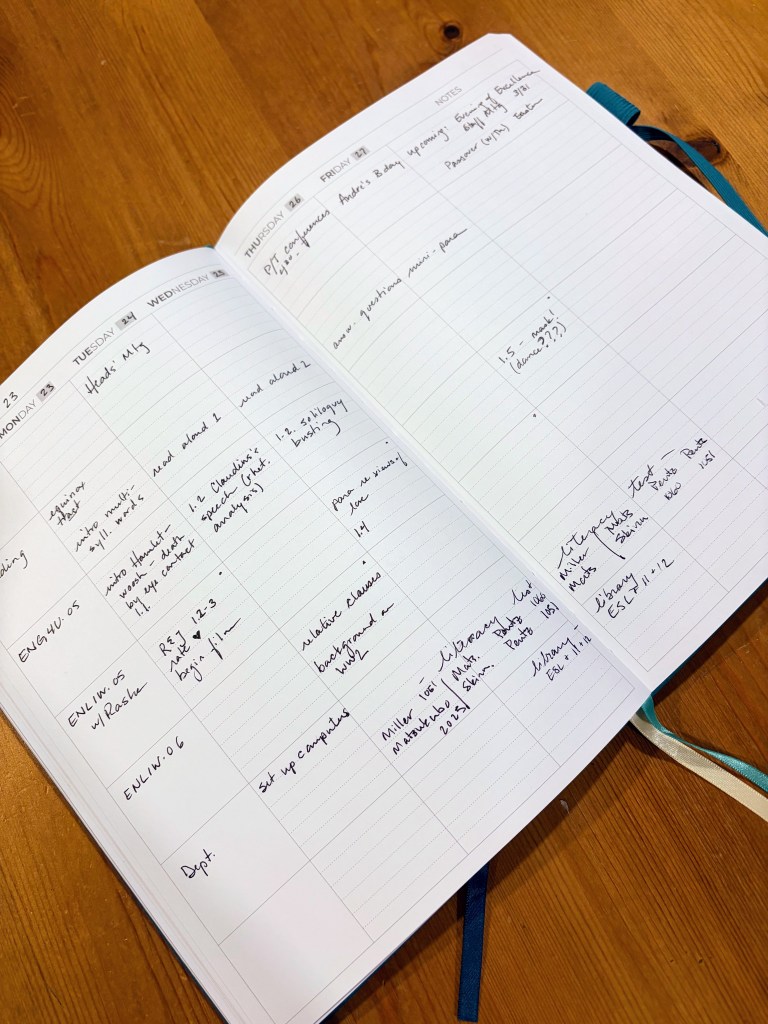
Finally, today – Tuesday, not Monday – in class, not at home, I cave. I ink the word WRITE in my calendar. I come home, play games on my phone, do a little training with the dog, chat with the children, tidy… and then I make myself say the thing out loud, even if it’s under my breath.

“I am a writer.”

And I write.

After all, “We become the stories we tell ourselves.” – Michael Cunningham

Next week, I will write again.

Read aloud

I’ve already handed out the papers – forty words neatly divided into two columns with checkboxes next to each word; forty words we read aloud earlier this week as a group; forty words that should be easily accessible to high school students, although I am well aware that they will not be easy for the students in this room – and the students are calmly looking them over. Calmly, that is, until I say, “So, today’s challenge is to read these words out loud in your small groups.” As the words “out loud” leave my mouth, a hand shoots up.

“Um, I can’t read out loud because I’m dyslexic.”

I pause. In retrospect, I will be able to articulate some of the myriad thoughts that run through my mind before I speak, even though in the moment I respond immediately. Later, I will feel my hesitation, the laughter that wants to bubble up behind my shock, even the bit of the sadness that eventually seeps into my consciousness. Right then, however, I say casually, “Everyone in here is dyslexic. That’s why we’re here.”

Suddenly all eyes are on me. I stumble. “I mean, I guess you’re not all technically dyslexic, but every person in the room – including me, actually – has a reading disability. Literally. All of us. You’re here to get better at reading. If you were already good at it, you wouldn’t be here.”

As I finish speaking, I am briefly worried: am I being mean? But I know I’m not. I’m being honest. And I’m surprised. We’ve been together for almost a month. The class is called “Reading”. We’ve spent weeks working on basic phonics, practicing short vowel sounds, encoding phonemic word chains, and decoding three- and four-letter words. I can’t imagine even a casual observer who wouldn’t understand what we’re doing: Everyone is here to get better at reading.

In the classroom, students look around. I can’t catch all the various emotions, but I start to realize that they were not, in fact, all aware of the truth of the class. I remind them (again, I swear!) that we are here to support each other, that mistakes are normal and part of learning, that this is practice, that this is how we get better. I reassure them that they will not die from reading aloud. I promise that, as far as I know, there is no recorded history of students dying purely from reading – even reading aloud. They start to laugh. Soon enough, everyone is reading out loud, round-robin style, in their circle, and they are, as predicted, helping each other. Mistakes are made. Everyone survives. There are smiles and laughter and we are learning rather than worrying. By the end of class, people are willingly writing on the white board to practice encoding. When someone says, “I can’t really spell” someone else replies, “neither can most of us” and there are plenty of giggles. 

But after the students leave, I can’t shake the feeling that this moment needs my attention. What was happening when the student announced that they could not read out loud? Why were they still self-conscious in a room full of striving readers? At first, I think of how my co-teacher and I have worked to make this class respectful of the learners: students who are still striving to learn to read in high school are typically students who have not been well served by our system; they are not dumb, they simply haven’t received the instruction they need. The reasons behind that are as unique as our students, but it’s still true. We designed this class to honour them and treat them as the intelligent beings they are, so maybe we should take some comfort in the fact that they did not realize that they were all here for reading instruction. Still, as much as I like a good pat on the back, the moment continues to gnaw at me.

Long after school ends, I’m walking the dog when I suddenly realize what I witnessed: despite having a learning community of support and care, our students have been working so hard for so long to hide their reading struggles that they haven’t had time to notice that others are struggling, too. They spend much of their social and cognitive energy protecting their identity and sense of self, and as a result they cannot easily focus on others. I imagine spending my work day trying to cover up something that I see as a major deficit – as if all I did all day long was try to hide a giant stain on my clothing. I imagine being so busy covering that stain in creative ways that I don’t have time to see that others have stains, too. No, worse: I am so concentrated on hiding the stain that I don’t really look at others; I just assume they are wearing much better clothes than I am. I keep one hand on that spot and sometimes miss things going on around me because I’m worried. If I relax and my hand creeps away from the stain, I have to quickly put it back down, maybe glance around and make sure no one else saw it. By the end of the day, I am exhausted and not able to remember everything that happened.

All of this explains why, at the end of September, the students in our Reading class haven’t fully understood that they are in a class where everyone is learning to read better, a class where, ideally, they can relax a little. It may be a while before they believe that everybody else in the room is making mistakes, too. It may be even longer before they trust each other enough to get things wildly wrong, to make outrageous guesses, and to allow themselves to do the hard work of learning to read. I realize, too, that I have more work to do to make this a space of hope and freedom, to let reading class help students be more fully themselves.

I reflect for a while and consider ways to tweak the class for increased student agency and more time for relationship-building. Clearly, I decide, we need more laughter. Clearly, we need more talk. And yes, clearly we need more read alouds. I’m on it.

The Lights are On, but…

As I approach my classroom, I glance down at the crack between the door and the floor. “Wait – is it dark?” It’s Monday of the third week of school. I shouldn’t get my hopes up, and yet I can’t help it. I call out to my colleague, who trails behind me, somewhat less obsessed. “I think it’s dark!”

As I get closer, reality sets in, “Nope. It’s still light.” My shoulders slump and my pace slows. The lights are still on – exactly as they have been 24 hours a day since some time during the week before school started. I sigh, “Guess it’s another day without the projector.” Her laugh is somewhere between commiseration and desperation. We turn into the stairwell – where the lights automatically flicker on – and make our way to our permanently lit office.

Over the summer, most of the lights in our school were replaced. This was a much-needed renovation: most of the old fluorescent fixtures – the kind with the long bulbs and the plastic covers – had long since lost their coverings. Last year, students in one of my classes managed to accidentally shatter one of the bulbs, and the fixtures were, in general, well past the end of their useful life. We welcomed the idea of new lights.

We should have known better. 

We found out on the last day of the school year that we needed to empty our classrooms before the electrical work started. If we didn’t, we were warned, the construction crews would “try” their best to get things back in the right places, but they made no guarantee. Since it was the very last day we were allowed in the building, and since both time and boxes were in extremely short supply, most of us threw our hands up and left. I figured I could come in the week before school started and get things sorted. This did not happen.

In our school board this year, both teachers and students started on the Tuesday after Labour Day. There were no PD days, no time to meet or plan or – crucially – set up our rooms after the summer’s chaos. And chaos it was. Teachers weren’t allowed into our building until the Friday before the long weekend. (Well, that’s not quite fair: on Wednesday we learned that if we had classrooms on the first floor, we could get in on Thursday afternoon.) I went in all day on Friday, but I had to help new teachers (who were not officially employed until Tuesday) find their way around the school – all while trying to figure out why I had a heat lamp of sorts while I was missing most of the student chairs from the classroom. And then there was the question of what had happened to the teacher desks from the English office; they had migrated into the Business office, where they huddled into a corner, hiding. I worked all day, and didn’t come close to being ready. I noticed that we didn’t have light switches – heck, I even laughed about it – but I was so busy that I didn’t quite register what it would mean to have super-bright LED lights on all day every day.

On Labour Day, while others enjoyed a day off, I cajoled Mr. 17 and his friends into the school building to help haul things around. Desks were moved; chairs were located; books were carted from one room to another and, after several hours of sweaty work, the office, the classroom and the book room were functional, if not organized. The teens commented on the brightness of the lights and asked how I would manage without being able to turn them off, but I was mostly focused on making sure that students would have a place to sit on Tuesday.

School started. The lights were on. By the end of the first day, my eyes were tired, but then I was generally tired because it was the first day, so I ignored it. By the end of the second day, my eyes were dry. By the end of the week, I was a little headachy. Imagine: every room has lights on at full brightness ALL THE TIME. There is no respite. I have tried to use the projector to, you know, teach, but the lights are so bright that students can really only see text. No images. No video clips. No nothing. Mostly, I try not to use it because it’s not worth the hassle – or the extra light from the bulb.

The rest of North American schools are trying to figure out how to deal with AI in the classroom. Me? I just want to turn off the lights.

Last week, a few upstairs classrooms got light switches. Today, as we left school, electricians were in our office. They had removed some of the ceiling tiles and were fiddling with wires. I didn’t dare ask – because I didn’t want to jinx it – but I’d swear they might have been installing a light switch. It’s not as good as having a light switch in my actual classroom, but I’ll take dimmed lights in the office if it’s all I can get. Maybe I can go in before school and sit, blissfully, in the dark for a few minutes. Rumour has it that the whole school will have light switches installed “in the next few weeks.” Until then, the lights are on.

What does it mean to be American?

It’s been twenty years since I taught American Lit to 11th graders in a high school in Washington, DC. After I’d taught the course a few times, I used to start the class with the question students would answer on the final exam: What does it mean to be American? In September, students answered glibly: duh, you have to be born here. But even as they said that, they could feel that it wasn’t right, so they would hack away at the edges of the answer: you have to have an American parent, or maybe an American passport. But a cursory look showed that didn’t work, either. First, not all Americans have passports and second, does the passport make a person American? The rest of the school year just made things more complicated.

Were the Pilgrims (born in Europe) and other early settlers American? We read some of William Bradford’s Of Plymouth Plantation. Ok, the students said, the Pilgrims count as American (even though “America” didn’t exist at the time and obviously the original settlers weren’t born here); if you came to America for a better life, that counts. I complicated things: So, if people who fled their homeland in search of freedom count as American, what about people who do the same in modern times? We read short stories by Edwidge Danticat (American, born in Haiti) and Jhumpa Lahiri (American, born in England to Indian parents). Are their characters American? 

What about the people who already lived on the continent when the colonists arrived? What of the Native Americans? (Honestly, I’m a little relieved to realize that even 20+ years ago we read at least one speech by a Native American, though we should have done much more.) And what if you didn’t choose to come? What of people who were enslaved? Surely Jim in Huckleberry Finn was American. 

Maybe being American is about a set of values? We looked at Puritan leader (born in England) John Winthrop’s “City upon a Hill” (from his essay “A Model of Christian Charity”) and considered what he calls on fellow Puritans to try to create: a community of virtue, effort, and compassion. We read the beginning of the Declaration of Independence (written by Thomas Jefferson, born in the colony of Virginia) and excerpts of (French author) de Tocqueville’s “Democracy in America.” Does he see in the mid-1800s what Winthrop dreams of two centuries earlier? Is that what Huck Finn seeks when he decides to “light out for the Territory”? Is it what Jay Gatsby is striving for as he reaches for the green light? What Janie longs for in Their Eyes Were Watching God?

Gatsby is definitely American – no question about it – but there is the pesky concern of the “foul dust [that] floated in the wake of his dreams.” Perhaps, students thought, Americans had strayed from important original values, as Jonathan Edwards (born in America) thundered in his famous 1741 sermon “Sinners in the Hands of an Angry God.” Again, this gets complicated. In The Scarlet Letter, Hester Prynne’s (born in Europe) sin is the impetus for the whole novel, but in the end, (like Gatsby? unlike Gatsby?) she is the best of them all, except for maybe her daughter Pearl (born in America) – but Pearl takes her riches and moves to Europe. Hester stays in the New World. So who is American?

But, those are just characters, the students protested. True enough. But many real live Americans, good Americans, I insisted – Americans who shaped our nation – were sinners and criminals. Some students were doubtful – 20+ years ago was, I think, a more innocent time. Still, I said, Roger Williams (born in England) was banished from Massachusetts for advocating religious tolerance and the separation of church and state. We read Thoreau’s “On Civil Disobedience” and Martin Luther King, Jr’s “Letter from a Birmingham Jail.” We read Walt Whitman, Zora Neale Hurston, Emily Dickinson, Langston Hughes, and more. One year we read My Antonia and made popcorn balls. Always we came back to our central question.

(How did I get them to read so much? I have no idea.)

By the end of the course, no matter what we read, we had a massive tangle. Americans, it seemed, could be born anywhere and live anywhere. They could be Americans by birth, by choice or by force. They could be saints and sinners, criminals and leaders. And then it was time for the exam. We ended where we started: “What does it mean to be an American?” The answers were always complicated.

****

Last week, on the 13-hour drive from South Carolina to Buffalo, my two sisters and I had plenty of time to talk. We usually see each other only once a year, and we never run out of conversation. This year, after a gas stop in West Virginia and a possible sighting of ICE agents, our talk turned to politics and family. 

I guess you could call our family “blended,” but mostly I think of it as chaos held together by love. Even if I just tell you about the children (my six various siblings) who go with my dad and stepmom, things get complicated. My step grandmother was born Dutch and became an American; my stepmom is Alabaman through and through. I was born in the US but am now a dual citizen. My children, born and raised in Canada, are dual citizens. My partner is pure Canadian, but his mother, my mother-in-law, is a dual citizen; my father-in-law is 100% American. One of my sisters was born in Panama on an Air Force Base, but she doesn’t remember it at all and does not speak Spanish. Her daughter, my niece, born in the US, does speak Spanish and is dating a young man whose family is Mexican (his dad was born there; I can’t remember about his mom); he is American. My sister-in-law is a naturalized American who was born and raised in Cuba. Her mother is living with them (very legally) but is not yet a citizen. My brother, her husband, is pretty much a good ol’ boy (in the best of ways), but his kids have olive skin and dark hair and speak both Spanish and English. Except for my sister-in-law’s mother, I would say all these people are American. Even she may be a future American.

Adding in my mom’s side – she has four siblings – doesn’t make things any more clear. My uncle married a Filipina woman who is now American. One of their two sons, my cousins, just got out of the Marines, so definitely American, right? But when he was on tour, children in Saudi Arabia made the “slant eye” face at him, annoying him to no end. My mother’s sister married a Brit, and they live in the Cayman Islands; their child, my cousin, is American-British-Caymanian. He went to college in the US and worked in NYC before meeting an American woman and moving back to Cayman. Their children were born in Cayman. All except my uncle have American passports. 

As a family, we are Lutheran, Catholic, Presbyterian, Jewish, atheist. We are white, Asian and Latino. We speak English, Spanish, Tagalog, and French. We are gay, straight and bi. We are addicts and we abstain.  We have committed crimes and been arrested for them or gotten away with it. We have done good things and been recognized for them or overlooked. We have high school diplomas, bachelor’s degrees, master’s degrees, MDs or PhDs. We are business owners, doctors, teachers, CPAs, hourly employees, unemployed, researchers and more. We were born in six countries, and we currently live in three countries; we have lived in many, many more. We voted for Harris or for Trump or not at all. We are all American.

In the car, my sister worried about a friend who is married to a US permanent resident who was born in El Salvador. His parents brought him here when he was a toddler. As a young teen, he got involved with a gang and committed “a bad crime” (yes, it is bad). He was arrested and went to jail. He served his time, got out, got a job and got married. Now in his mid-40s, he has never committed another crime. As we drove north, he was on his way south to his annual check-in with immigration, and they were terrified. The family has money and a lawyer, and a no-deportation order. But they had no idea if, after he followed the law and went to the courthouse, he would come back out or be disappeared. “We talk about ICE deporting ‘criminals,’” my sister said, “and everyone seems to think that is ok; but he’s a good person who did an awful thing. He’s here legally. Should we deport him because of something he did when he was 15? Why can’t we talk about the human cost? When did we stop thinking of immigrants as fully human?”

As we drove through the mountains of West Virginia, I mused, “What does it mean, then, to be an American?” I still don’t know, exactly, but I am sure the definition should be rooted more in love than in hatred. If there’s one virtue that my loving, chaotic family and all those texts I used to teach have in common, it is compassion. 

Well, maybe not “Sinners in the Hands of an Angry God,” but really, that one is kind of over the top.

There, their, they’re

I’m losing them and there’s no time to think this all the way through. The class is smallish today because it’s Eid al-Fitr. Split-second decision: I go for it.

“Let’s play a game!” I clap my hands together. Faces look up. At least one cell phone gets pushed into a desk.

“A good game?” someone asks.

I shake my head. “Always a teacher game.” They’ve heard me say this so many times, I half expect them to chime in, but they don’t. Wow. We are really disengaged. Before they have time to complain, I start counting them off. “Remember your number. Use your fingers.”

Six groups of three. I tell the students to push their tables towards the back of the room. As the metal legs scrape across the linoleum floors, I write there, their, and they’re on whiteboards – one up front and one on either side of the room. 

I turn around and clap again: “Everyone to the centre of the room!”

I wish I could tell you that they are excited, but mostly they sort of drag themselves suspiciously into what is generally the centre. Hmm… I am going to have to be the one to light this fire.

My brain churns. Clarity is key. On a good day, I’ve pre-planned the activity and thought through the steps, so I can give directions efficiently and effectively. Today, however, I’m winging it. Exams loom, the Chromebooks aren’t available, it’s a Monday…and it’s raining. The students are standing in the centre of the room, looking at me warily.

“Ok! Each group has three people. For every round of this game, one of those three people has to move AND it has to be a different person for each round. You can consult with each other, but every team member has to take a turn being it.”

Oh, now they’re paying attention. “It?” Yup.

I explain that I will read a sentence that uses one of the forms of there/ their/ they’re. The team whose runner touches the board with the correct form first will get a point. Then, we’ll do it again with new runners and a new sentence. I indicate the whiteboards with the various forms. I tell them that I plan to move fast, so they should have the next runner ready to go once the first one is done.

Chaos ensues. We whip through the sentences I had originally planned for us to do as a worksheet, then keep going with another handful. Students are laughing and sweaty. Heck, I am laughing and sweaty. I have to settle a few near-arguments about which form is correct. We pause for everyone to catch their breath, and I change the words on the board to its/ it’s. We play another round. Eventually, class is nearly over. We have just enough time to move the desks back. The winning team gets to choose a gift from the “box of terrible prizes.”

“These really are terrible,” one of them mutters, but it doesn’t matter. We’ve reviewed, and the students are ready for the homophones that I know are on the test. Plus, it was fun.

****

(Pull back the curtain)
“But… how did you think of that?” my younger colleague asks when I tell the story after school. It’s a good question. In the classroom, we often have to think on our feet, and I’ve realized that I have a series of questions that help me make choices:

  • What do the students need to know?
    Tricky homophones
  • Why do they need to know it?
    For the test
    • Why is it on the test?
      Silly or not, using these words correctly is an entrée into a certain level of education/ standing in the world; this is clout.
  • What’s standing in their way?
    Boredom, widely varied levels of knowledge, lack of urgency (they don’t care about this)
  • What options do we have to learn this material?
    Worksheets (boring), computers (someone else booked them), independent work (won’t hit the Goldilocks zone in this class – it will be either too easy or too hard), pair work, group work…
  • How does this group of students learn?
    They like talking and moving, but they don’t 100% trust each other.
    They do well with competition and speed but not too much pressure.
  • What would make this memorable for them?
    Movement, working at the board
  • How can I put all that together?

It doesn’t always work, but this is more or less where my brain goes when I’m planning. What? Why? How? What would make this stick?

And, of course, it never hurts to embrace a little chaos.

Twelve Days

In 12 days, he will be done with high school. Today, however, he is sitting in my classroom during his “spare” period, trying to catch up on what he’s missed. He has his earbuds in, his phone out. He’s using one of my Sharpies to write a thesis on a scrap piece of paper.

He will not catch up.

I’ve known him since his first day of grade 9, and I’ve taught him English three times. Usually, when I say that out loud, I put air quotes around “taught”. When he was in grade 9, I hid the Sharpies and push pins from him so that he wouldn’t casually harass his peers.  In grade 10, I insisted that he read aloud to newcomers (which he loved) and tried to cajole an essay out of him (which he hated). Now he’s in grade 12, and during independent reading time he is (still) reading the book he started in grade 9. He claims he’s close to the end. These days, I can only occasionally convince him to come to class – and even then he doesn’t pay much attention.

Today, after a futile hour of explaining that a thesis statement is supposed to be about more than the plot of a story, and insisting that to create an effective thesis statement a person must actually read the story under consideration, I head to my office to grab lunch before my hall duty. In the stairwell, a colleague comments on my obvious exasperation and reminds me that, because of me, this child will (possibly) read one more story than he would have otherwise. He will, at the very least, write a series of (bad) paragraphs that are loosely related to one another. He will know that someone thinks he can do more.

I try to believe this is enough.

I manage a few bites of sandwich before the bell rings, then grab my apple and head into the halls. In the science wing, someone has pulled the handle of the emergency shower, so the floors are flooded. A VP stands amidst the resultant disaster, directing students away from the shimmering water while custodians run the shop vac. Around the corner, a large group of students talks loudly in the new bathroom; I tease that they must be having a bathroom party, and they laugh as they slowly move away. Nearby, a student sits against the lockers, their head tilted back, their eyes closed, creating a moment of peace in the chaos of the school day. A colleague pauses to ask me a question. Behind us, two girls chase each other, screeching, down the hall. 

Outside, the sun beckons. The lawn is dotted with dandelions and dawdling kids. Students fill the basketball courts and the athletic field. The year is so close to an ending that I can almost feel the hallways holding their breath. “Soon,” they whisper, “soon.”

As I walk, I remember the day my mother dropped me off at university. When it was time for her to go, she cried. “I’ll be fine, Mom,” I said, not sure if I was comforting her or reassuring myself.

“I know,” she sniffed, “it’s just that I have so much more to teach you.”

She was right, of course, though so was I. My student will manage something, and it will be both enough and not nearly enough. I will put away the Sharpies. The year will end. He will graduate. I will have more to teach him.

I bought you a book

She had grade 9 English with me and, though it’s hard for me to believe, she’s in grade 12 now which means we’ve been smiling at each other and saying hello in the hallways for three years. In seven weeks, she’ll graduate, yet it was only a few days ago that I realized I’d never told her the story.

Oddly, I’ve told a lot of other people the story: how we were both new to the school; how she was quiet but eager; how she finished reading a book then asked me shyly if I had any books about Asia. She didn’t even ask for something set in Bangladesh – her home country – just anywhere in Southeast Asia. Oh, how I wanted to say yes! I scoured my bookshelves – my classroom library suddenly seemed so paltry – but I could only come up with one, and it didn’t really fit: it was really about a girl living in the US who was dealing with issues of sexuality. The 14-year-old in front of me wasn’t ready for that book; she wanted something that reminded her of home.

I was sad to have to tell her that I didn’t have anything, really. We found another good book, and she continued to read, but I couldn’t shake my disappointment. I looked online to find books about Bangladesh. I checked out Samira Surfs from the public library – too young, too refugee-focused. I found books set in Pakistan, books by white authors, books for adults… 

As the school year continued, I had to confront a sad truth: my classroom library was designed for a different student population. At my new school, the books I had didn’t reflect the students in the room. I knew I needed to address the problem, but I also knew I needed money to do it. 

At this point, I applied for a classroom library grant from the Book Love Foundation (founded by Penny Kittle). I asked two senior students to write me a recommendation; they also helped me with my video. And then… I won a grant! Oh, the books I bought – books set in places around the world. Sports books and fantasy books and realistic fiction. Graphic novels and novels in verse and memoirs with main characters from places my students knew and I did not. And yes, a book set in Bangladesh.

By the time the books came in, she was in grade 10 and our paths rarely crossed, so I didn’t think to tell her what she had inspired. Last year, I barely saw her at all. This year, though, our schedules overlap, and I see her often. And this year, I finally realized that I’d never told her about the books. So, last week I told her. She was startled. She didn’t remember asking for a book and she was surprised that I remembered where she was from. She blushed a little and we went on our way.

Then, a few days later, there was a knock at the classroom door. Could she come in? Could she see the books? I showed her what I could find on the shelves, but I had to laugh: so many of the books that I would have offered her if only I’d had them then – Amina’s Voice, Amina’s Song, Amira and Hamza, The Last Mapmaker – weren’t there because they’re being read by current grade 9 students. Still, I showed her Saints and Misfits, and Love from A to Z, and The Patron Saints of Nothing – and listen, it’s not perfect, but oh how she smiled.

Three years later, her request and the Book Love grant have changed everything. 

(If you are interested in information about applying for the grant, feel free to reach out to me – though honestly the link has all the information; if you are interested in donating to the foundation, please don’t hesitate. All kids deserve to see themselves in good books!)

The Day After

“Have you talked about the election in any of your classes today?”

Most heads shake no. Interesting. 

“Do you know who won last night?”

Now a few heads nod. A few voices venture an actual response: “The Liberals.” 

“Right!” I push on. “Great! So… who knows the name of the Prime Minister?”

Hmm… harder. Murmurs move around the room. Maybe it starts with an “M”? Someone is sure there’s a /k/ sound. One confident student says “Not Trudeau” and everyone laughs. 

“Mark Carney,” I tell them. A few fingers snap, a few heads nod. Yes. Yes, that’s right. They knew that.

And now for the tough question, “What else do you know?”

I know I teach English, not Civics, and I know these students are only 14 and 15 years old – far from voting age, at least as far as they’re concerned. Still, last night was a federal election, and I believe that school must be about more than the assignment of the moment. In fact, in the last few years I’ve come to recognize that a big part of my personal “why” in teaching is to help students become thoughtful citizens. I want to help them learn to think deeply. I want them to believe in their own inherent value and to understand the value of others – and of compromise. In a world that tells them that they are valuable mostly as consumers, I want them to feel agency. So here we are, talking about politics in English class.

A few minutes later, we’ve put together some basic facts: the Conservative Party actually performed very well last night, even if they didn’t win; this means the country is divided; the NDP, which is more liberal than the Liberals (“that’s weird”) lost official party status; the Green Party still exists; people’s votes mattered because the vote in many ridings was close.

Someone asks if the Conservatives are “against human rights.” I assure the students that they are not.

Someone asks who I voted for. That’s private. Why? I explain the idea of secret ballots and the idea that someone like a teacher might have undue influence, even unintentionally, on students. Nevertheless, I acknowledge my bias and encourage them to challenge me if they think differently than I do. 

Someone asks when the next election is. We talk briefly about minority governments and why that makes the date of our next election a little less predictable.

The class, usually extremely energetic, is somewhat subdued. I know they know some of this information already, and I know that sometimes inviting the outside world into the classroom can feel odd. Their focus holds for three minutes, maybe five, and then we’re back to the regular routines – requests for pencils, for water, for the washroom, for someone to move their desk, to pay attention, to “say that again” to “just be quiet already”.

Still “Mark Carney” stays written on the board until halfway through class when we move on to brainstorming evidence from our book. If I’m lucky, some of them will remember his name and how we talked about the election, even in English.