The first I hear of his plan is when he pops in to pick up something he has printed for a class, and I ask how his classes are going. I haven’t seen him in a few days, but that’s not surprising: he’s a new teacher with a full load of courses, and I know that’s tough. Still, he cheerily tells me all is well, then, in passing says, “So, about Hamlet: I think I’m just going to sort of, you know, touch on the main points and cover it in two weeks. You ok with that?”
I am not.
I have many layered reactions to his casual statement, but I also need to help another teacher set up for our provincial Literacy Test and then set up my own classroom, so I defer the conversation, suggesting that we meet soon. For the next few days, I consider what I want to say.
Nothing in our curriculum tells us to teach Hamlet. In fact, we have no required texts at any grade level. Our school board has not endorsed or purchased any French textbook series – or any textbooks at all. Instead, we are given the freedom to choose what to teach as long as we assess students based on the provincial curriculum.
For some teachers, this is a dream. Complete freedom? Entirely up to the teacher? Wow! What respect! What trust! Imagine being able to meet your students where they are, being able to respond to the needs and interests of the students in the classroom. We could address bias head-on! We could re-shape what we teach! It sounds amazing, and I truly agreed with this perspective for a long time, but recently, I’ve been reconsidering this supposed freedom.
A few weeks ago, the Toronto Star ran this article (with a clearly AI generated image that already betrays their bias).
The article – which is behind a paywall, so I can no longer access it or share it here – begins by weighing the pros and cons of paper textbooks (hint: they’re expensive and hard to update), but a) it seems to assume that we are possibly using electronic textbooks (we are not) and b) then quickly shifts to noting that, without textbooks, no one really knows what any one class is learning. There’s no continuity from classroom to classroom much less from year to year. In my experience, this is true – and it’s only the tip of the iceberg.
Let’s start with French instruction as an example. I do not currently teach French, but I did for many years, and it’s a required course through grade 9 in Ontario. In grade 9, most high schools have a mix of students from several different middle schools. What did they learn last year? No one knows. With no textbooks and no clear year-to-year expectations, teachers are left to figure out what their students already know and what to teach them next. If we’re lucky, each school has a scope-and-sequence – but the only requirement to follow that is collegiality. If a middle school has more than one French teacher, the students from one school may arrive with different knowledge. Some years, I taught students who had studied animals, family members, colours and daily routine every year for four or five years. What should I teach next? Whatever I felt like.
Imagine, however, that a miracle occurs and the students all begin with a similar level of knowledge. Now, the teacher needs to a) decide what to teach next and b) create all the practice activities to help that learning occur. Every single one. No textbooks help guide this choice. A new teacher might find a mentor and get some guidance; AI might make worksheet creation a little easier – but really, the teacher is responsible for determining what comes next and how to teach it.
I don’t want to shock anyone, but there’s good research available about effective language teaching. In fact, (some) textbooks even use that research. And there are reasonable resources available for teachers to use to support their students – but when the school boards stop buying these resources, individual teachers are left to create them over and over on their own – or to purchase them from other teachers online. School boards save money; teachers pay. And that’s just French.
Where I teach, the science, math and geography textbooks are old, and there is no money for updated sets. I suppose we could offer students online textbooks, as the article suggested, but our board generally doesn’t approve subscription services (often required for these textbooks), and even if it did, not all of our students have access to Chromebooks or computers.
Luckily, English departments can just, you know, teach books. Right now, what limits our instruction is a) the books in our book rooms and b) what we, as teachers, have read. Unfortunately, because no books are required or recommended by our province or our school board, every bookroom has different books available. A teacher in their first few years of teaching who is still bouncing from school to school (standard in our board), may have to teach different books every semester, even if they are teaching the same grade level. What if they’ve never read that book before? Well, they’d better get reading. This explains why the young teacher I was speaking with just taught grade 12 students three short stories that my own children read in grade 8. There are *millions* of short stories out there, but to teach them you have to know about them. Instead teachers are left adrift, thinking not about how to teach certain texts or themes but rather what to teach. And, of course, the richer the school community, the more comprehensive the book room – which leads to an entirely different set of inequities.
Still, I don’t want to pretend we have no money: many years my school gets some money to purchase books that “reflect the students’ lived experiences.” This sounds great but is actually quite complicated. For example, I’m a department head, age 54 and an avid reader. For as long as I’ve been keeping track (and yes, that predates the internet), I’ve read an average of about a book a week. For the past ten or so years, I’ve read about 100 books a year – age along puts me literally thousands of books over a teacher who is twenty years younger than I am, if they read the same amount. Not to mention that I have my own reading preferences (no horror, thank you very much) and no one buys my books (well, except the public library – hooray for public libraries!) or pays me for my reading time. Every time our school has money, I am left to sift through titles to find books that are the right reading level, age range, length, topic and “lived experience.” Plus, of course, I need to find books that other teachers will actually teach. There’s no list of suggested books or set of criteria to help me with these decisions. I’m on my own, trying to determine what books students at our school should have available to study in their classes. What is students’ “lived experience” in a school where 60% of students speak a language other than English at home? where nearly 30% are new to Canada? How about in a school that both has the highest housing insecurity in the board AND encompasses several wealthy neighbourhoods? Whose lived experiences do I prioritize? What stories should we offer? (Fear not: I’ve developed my own criteria.) And, when I do make the decisions I am asked to make, I am left open to the attacks the article discusses: I can be vilified as a teacher activist who is deciding what students should learn based on my own priorities.
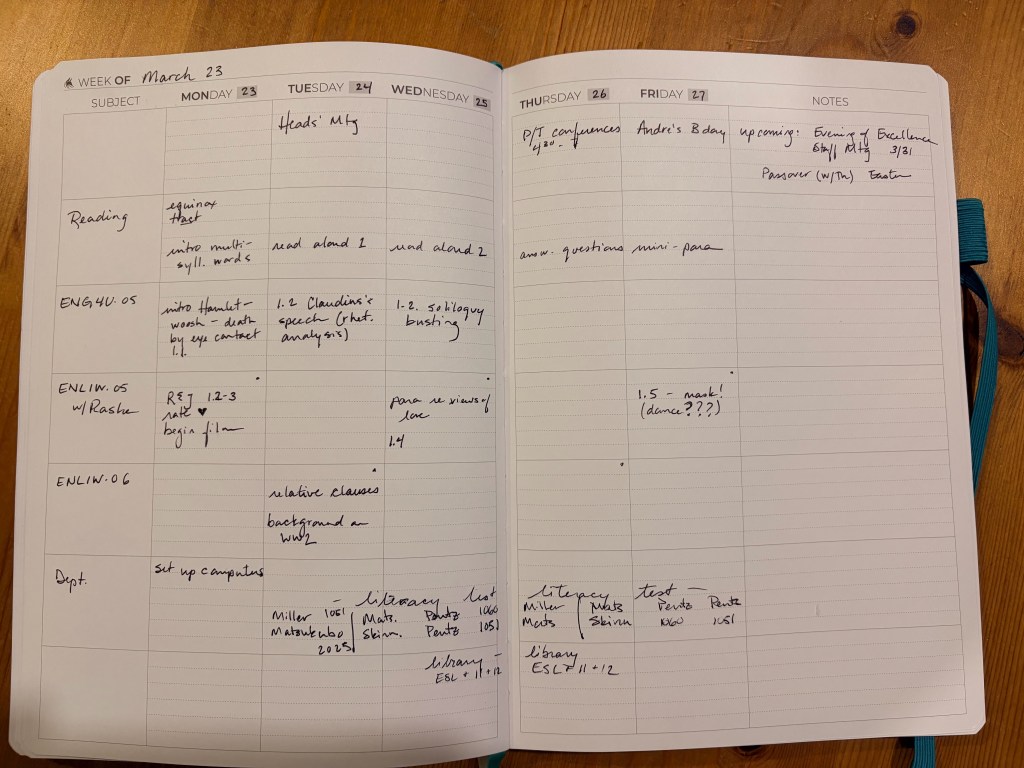
Let’s go back to the young teacher who has just told me that he plans to teach Hamlet in two weeks. He has been teaching for nearly seven months. This semester he has his first grade 12 English class – along with two other new classes to teach. The curriculum doesn’t require Hamlet, but, then again, it doesn’t require anything. We have some beat up old copies of Hamlet (donated to us from the richer school down the street), and he’s read Hamlet so he’s at least a little familiar with it. Has he read the other texts we have available? Probably not. Brother, The Book of Negroes, and Washington Black are all good books, but even though he’s deeply committed to equity, they’re not books he’s prepared to teach. And the school year doesn’t slow down.
Two days after that moment at the copier, we sit down to chat. I ask what his goals are for the two week unit (he sees it as a bridge, a moment when the students encounter hard text and realize they can make sense of it with some effort); I ask why he chose Hamlet (he wants to give them something hard AND something that will provide them with a toehold into a cultural dialogue they might not have encountered yet; he wants them to be proud of their understanding); I ask why two weeks (he has big plans because he is young and enthusiastic – I envy the students in his class who have a teacher with this energy) and who his students are and what he wants them to get out of the class and the text and… we talk for nearly 30 precious minutes. In the end, he realizes that Hamlet probably isn’t a two-week text for 12th graders. We make a different plan. It’s imperfect, and I will have to ask other (richer) schools for copies of the (still *extremely* traditional) book he’s chosen, but it’s more doable.
Meanwhile, every other grade 12 English class in the school will study Hamlet. Some of our students will read three of Shakespeare’s plays before they graduate; others will read none. Some of them will read books that, apparently, reflect their “lived experiences”; some will read all classics. Despite our departments’ best efforts, in French, some students will learn colours and animals again, and in English, some will read the same short story they read in middle school. Throughout the school, teachers will try to piece together what their students know, should know, need to know… then we will stay up late creating worksheets and handouts and slide shows that we used to get from a (deeply imperfect) textbook. Some of us will do the calculations and spend our own money on information other (tired) teachers have created.
Sometime in May, the board will tell the principals then the principals will tell the teachers that our biggest expenditure is on photocopying. We will be chided and told to be more aware and to print only what we need and to offer more things online. But no one will buy any textbooks. Apparently it’s saving the province money.






 Persistence and Pedagogy