Attendance concerns #SOLC25 5/31

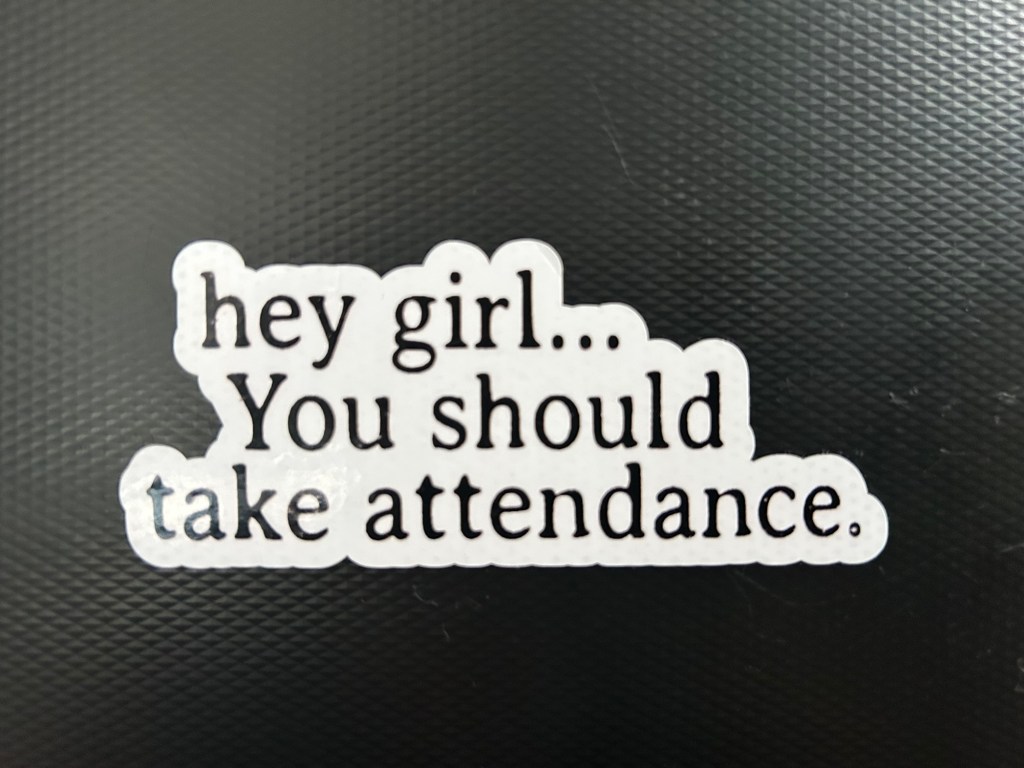
Thanks to one of my colleagues, many of us have this sticker on our laptops: 
img_3045

You would think that this would help us remember to turn in our attendance for every class every day, but if our Vice Principal is to be believed (and he seems reliable enough), it does not.

As a result of my inability to submit attendance for all of my classes before 4pm, I have written myself an attendance letter. 

(NB: Our lovely administrators would never actually write a letter like this!)

Dear [Employee Name],

We are writing to express our concern regarding your recent attendance pattern: specifically, [insert problem here: you keep forgetting to turn it in].

Our records indicate that you sometimes take attendance as soon as class begins. We commend you for your optimism! We know that on those days, invariably, at least 12 students arrive late – generally walking in one by one over a 45-minute period – and thanks to our fancy tracking system, you have to keep a record of the time at which each student enters the class. We understand that this might be difficult for you, but noting their arrival time is imperative for our systems.

We are here to support you. May we suggest noting arrivals on a piece of paper and hoping you don’t misplace it before you enter the data later in the day? Do you even have paper near you? If not, why not? If so, where do you keep it? And do you manage to keep a pen, too? That would be impressive organization for a teacher who is also moving about the room to respond to her students. Alternately, perhaps you could pause your instruction, freeze the projected computer screen each time another student enters, then navigate to our school attendance site and immediately enter their arrival. Would that disrupt your teaching? If so, what is your plan to manage that problem?

Consistent attendance taking is crucial to the smooth operation of our school. Your attendance-taking pattern has impacted [explain specific impacts, e.g., our records]. According to our computerized records, your period Z class has nearly perfect attendance, despite the fact that one student no longer attends school at all. We note, too, that you insist that this class is “nearly unmanageable” with “students entering and leaving at will.” This implies that perhaps you are forgetting to submit your attendance for this class.

We are here to support you. Have you tried using a hall pass system? Perhaps students in this class would be willing to write their arrival and departure times on a piece of paper strategically placed near the door. Attention: do not write student names where others can see them; this might be shaming. We realize that all the other students have seen the late arrivals; nevertheless, we invite you to manage attendance privately. Maybe you can place the paper a little out of the way? And put a cover on it? And you will probably want to attach a pencil. We are certain your students will use this paper appropriately. Also, please note that even if a student spends 70 minutes of the 75-minute class period “in the bathroom”, you should still mark that student present and note the time they arrived.

We encourage you to discuss any underlying issues that may be affecting your ability to maintain regular attendance, and we highly doubt that your attendance records reflect anything close to reality. Please reach out to [supervisor’s name] to discuss potential solutions and support options available to address these concerns. Please note that [supervisor’s name] is unwilling to text you every. single. day to remind you to do your attendance. That’s what your laptop sticker is for.

We value your contributions to the team and want to work with you to ensure your attendance meets school expectations.

Sincerely,

[Name]

[Title]
Make it make sense #SOLC25 4/31

Two poems in honour of the tariffs President Trump is imposing on Canada and Mexico today. Economists expect these to wreak havoc on the economies of all three countries.

“The tariffs, you know, they’re all set. They go into effect tomorrow.”
– Donald Trump

“Make that make sense.”
– Justin Trudeau

T is for tariffs that start up today.
A is for allies he’s driving away.
R is for rationale – no one knows what it is.
I is for ignorance, mostly it’s his. One
F is for fairness, a feature that’s missing, and one 
F is for future, the thing that we’re risking.
S is for senseless, the markets all shriek

It turns out that tariffs are economically weak.

__________
Found poem
from Justin Trudeau’s speech in response to Trump’s tariffs – March 4, 2025

War against Canada
We don’t want this: your government has chosen to do this to you.

Make that make sense.

Your government has chosen to put America at risk.
They have chosen to harm American national security
They have chosen to launch a war that will harm American families.

Make that make sense.

They have chosen to sabotage their own agenda

Make that make sense.

Let’s look at the facts: We
made commitments
appointed
designated
launched.
In sum, we stepped up. 

We did everything we promised,
we stuck to our word, and
we did it because we believe
in working together.

Make that make sense.

Donald, this is a very dumb thing to do.

Make it make sense.

We’re all going to pull
together, because that’s what we do. We will
use every tool, we will
be there to help.

We will defend, we will prevent, we will relentlessly fight. 

We will stand up
every single second of every single day,
because this is worth fighting for.

There is no price we aren’t willing to pay,
and today is no different.

Make it make sense.

Teacher Math #SOLC25 3/31

Word problem:
Having been made aware – repeatedly – that photocopying is consistently the largest line item in the school’s budget, a teacher has nevertheless decided to make photocopies for a grade 9 English class. The activity will require only one day, so students who are absent today will not need a copy. 24 students are enrolled in the class. How many photocopies should the teacher make in order to have enough for all the students without “wasting” money?

Break down using the GRASS method.

GIVEN: Read the question carefully. Figure out what values are given.
24 students are enrolled in the class.

REQUIRED: Figure out what is required.
Enough – but not too many – photocopies for the students who attend class today.

ANALYSIS: Analyze the question and use appropriate math operations.
It’s one week before March Break and one (1) student has already left on vacation. Their parent notified you. Experience tells you that up to two (2) more students may have already left without letting anyone know. 

24-1-1 = 22 OR 
24-1-2 = 21

It’s the first week of Ramadan and class is at the end of the day. There are at least seven (7) Muslim students in the class. Some of them will be fasting, and some of them may be fasting for the first time in their lives. This is difficult, so some of them may go home before the end of the school day. Still, it’s only Monday, so probably most of them will try to stick it out. Estimate: one (1)

22–0= 22 OR
22–1= 21 OR
21–1= 20

The flu has been going around. Loads of students and teachers were out last week, some for up to five (5) days. Today’s list of absent teachers is long, and during period one, about a third (⅓) of the class was absent. This class was pretty healthy last week. Are they more likely to be sick this week as a result? Check the online attendance to see if anyone has already been called in sick by their parents. One student is marked absent. Estimate: at least one (1) and up to three (3) sick students.

22–1= 21 OR
22–2= 20 OR
22–3= 19 OR
21–1= 20 OR
21–2= 19 OR
21–3 = 18 OR
20–1= 19 OR
20–2= 18 OR
20–3= 17

Last week you sent emails home to several families addressing student behaviours. Of the four (4) families you contacted, two (2) replied. How many of these students will attend class today? Educated guess based on experience: three (3) will attend and one (1) will skip in frustration.

21–1= 20 OR
20–1= 19 OR
19–1= 18 OR
18–1= 17 OR
17–1= 16

Finally, students may not be able to attend due to “Acts of God”: “I missed my bus after lunch” or “I got suspended for fighting in the bathroom” or “My best friend’s boyfriend just posted on IG and another girl was in the picture so I had to stay with her because she was so upset” or “Sorry, Miss, I forgot it was a Day 1 and I went to my Day 2 class and I only realized it wasn’t my class after 25 minutes.” Estimate for today: an optimistic zero (0)

WAIT: don’t forget to add in the extra copy for the student who loses their sheet between the time you hand it out and the time they need to use it. (approximate elapsed time: 8.3 seconds)

20+1= 21 OR
19+1= 20 OR
18+1=19 OR
17+1= 18 OR
16+1= 17

SOLUTION: Solve the question.
Maximum photocopies required: 23
Minimum photocopies required: 17

Repeat these calculations for each of today’s classes.

STATEMENT: State your answer in simple words.
For today’s classes, in order not to waste money, the teacher requires somewhere between 17 and 70 kajillion photocopies.

Realize after all of this that at least three students will be gone for some or all of the class because of a volleyball game. Their coaches posted about this on the email conference three (3) minutes after you finished photocopying.

Good luck!

Anything you can do to a cloud #SOLC25 2/31

Sheri set a timer and did a free write for six minutes because someone else did the same, so here I am, jumping on the bandwagon on day two. And I should know how to do this: I freewrite all the time in my teaching practice because I am forever trying to convince my students that it is OK – even good – to just write. My goal for them by the end of the semester is seven minutes. I have no idea why, but there it is. And truthfully, for grade 9, at this point we’re aiming for five solid minutes of writing.

I need to admit that I have deleted a few times already – but I swear this is mostly free writing and if I were handwriting this, I would have just crossed things out, so that counts.

Why do I free write with them? I honestly think that seeing someone else write, watching their process and their struggles, noticing how they pause and keep going, seeing what they throw away and what they keep, can help students understand that writing isn’t about presenting perfected ideas – in fact, it’s about the opposite of that: writing is about honing ideas, checking them out, looking at them from different angles, dressing them up in words and seeing what they look like, finding the places where the ideas aren’t entirely complete…

That’s a lot of mixed metaphors, but hey, it’s a free write.

So I write in front of my students, near my students, among my students. In class, I tell students that a preposition is anything you can do to a cloud – you can go in front of a cloud, near a cloud, through a cloud, over a cloud – and then we write sentences with prepositions, playing with making very long, very silly sentences.

I started this blog in part to experience for myself some of the things my students experience: writing on a deadline, writing when I don’t feel like it, writing when I don’t have much to say, writing knowing that someone else will read it.

Time is up. Now I’ve done my one-minute post-writing clean-up (another trick I use – so they re-read and make a few changes) so I can post this. Then, tomorrow, when we’re writing, I’ll have proof that freewriting is “real” and even shareable. Maybe this will even help them write more.

Community #SOLC25 1/31

It’s snowing again. What purports to be our front yard is currently a pile of snow so tall that shovelling more snow on top of it causes mini-avalanches either back onto the shoveller or over the top and down the other side. Across from our driveway, a snow pile significantly bigger than our minivan looms ominously. To leave home in the car, I have to do a sort of backwards three-point turn, using the snow mountain as a semi-soft reminder of how far I can go – though our recent thaw-freeze cycle means that the snow is a little more compacted and a whole lot harder than it was a week ago. Our street was due for snow clearing *before* the last big dump, but each major snow storm sees the city scrambling to remove snow from the bigger roads while our little residential street slowly subsides under the white stuff.

As I leave my house to walk to a massage appointment, neighbours are already out clearing their driveways. Glenn pauses to greet me, teasing, “Here I thought you were coming out to shovel, but I suppose you’ve got teenagers for that.”

“Ha! They’re only any good if you can wait until mid-afternoon for the driveway to be cleared.” I laugh. Then I realize that Glenn is shovelling Mario’s driveway – and Mario is maybe snow blowing Glenn’s driveway? Unclear. And a guy from the halfway house – someone I haven’t met yet – is obviously helping Glenn.

“Did you all get confused about who lives where?” Everyone laughs, and we banter for a moment before I head on my way, grinning at the way our neighbourhood functions.

***

The massage therapist has a 7-month old and updates me on all the recent developments – he’s rolling both ways now, and he’ll be crawling any day now. I tell him (the father, not the baby) about my own children, and we marvel at the changes in our lives since I started seeing him a few years ago.

After the appointment, we’re still chatting while I put on my coat and boots, and his next client arrives. “I thought I recognized that voice!” she laughs, and I turn around to see a former colleague. Since I last saw her, she moved away and back, had a baby, turned 40. Social media has let us keep up a little, but here in the little office, we greet each other again.

***

And now I’m home, starting my 8th year of participating in the March Slice of Life Challenge. I have already read a few blog posts from friends (though I’ve never met them in person). I write knowing that some of my friends from as far back as elementary school will read my posts, and we’ll reach out and catch up a little. I’m anticipating a month full of moments where we’re all shovelling each other’s virtual driveways and running into each other in the comments section. Once again, I’m looking forward to this community we create with words.

With many thanks to the team at Two Writing Teachers for growing and preserving this community.

Lost plot

A poem written upon learning that many of my grade 9 students are not 100% sure what “plot” means and most have never seen a plot graph or heard many basic narrative terms. They did have some great guesses for the meanings of various words; it’s just that they were mostly, well, off.

Lost Plot

They’ve lost the plot.
They’re not sure what they’re planning
or where they are landing
or planning to land.

They’re certain that plot 
is a place or a person
who’s pretty important and 
they’ve got this in hand.

They say not to worry –
they’ll figure out the story.
They’re already exposing
and plotting, they think.

Then rising and falling
with a giggle in the offing because
– gasp  –
there’s a climax and they know what that means.

They’ve got resolution –
it’s like revolution and quite near the middle –
or that’s what they thought.
It’s when things come together 
for the person (or whatever)
and no one’s left out, so the story’s complete.

Never mind definitions,
they’re now on a mission
to finish this worksheet and get out the door.

So here I am plotting
to break down the story, incite some new learning,
maybe teach some new words.
Not antagonistic, I’m being realistic,
But honest to goodness they all should know plot.

About my grade

Friday
On Friday, I give him his “evidence record” – the sheet of paper that shows the grades a student has earned on various assignments throughout the semester. While I’m excited about the recent series of high scores he’s earned, his eyes move directly to the list of “Incomplete” work, assignments he simply didn’t do at the beginning of the school year. 

“So,” he says, and he slumps as if the paper in his hand is almost too heavy to hold, “how many of these do I need to do to catch up?”

Grade 12 did not start well for him. I didn’t know him well enough to ask, but I’ve been teaching long enough to recognize a smart kid in a bad set of circumstances without needing to know the particulars.  

“None.”

He looks up. “What?”

I eye him, “What would you learn by going back and doing these assignments?”

“Not to do it again.” His answer is almost rote, and maybe I imagine it, but I’d swear there is a tinge of despair.

“Really?” I wear my best skeptical look.

“Probably not,” he admits.

“Well, I’d say that our work has gotten harder, not easier,” (This is true: he skipped “This I Believe” in favour of Hamlet and increasingly complex analysis and writing) “so doing previous assignments won’t teach you much and won’t show me much. We’re supposed to look at the ‘most recent, most consistent’ evidence we have. And recently, your consistent evidence shows excellence.”

He needs to confirm what he’s just heard. He needs the actual words. “So I don’t need to do these?”

“Nope.”

He stares at the paper in wonder, then he looks up. “Are you a hugger?” he asks. “Can I hug you?”

I say yes, and I get a wonderful hug from a near-adult who maybe just learned that sometimes mistakes can and should be forgiven – a far better lesson than whatever grade is on the paper that was weighing him down a minute ago.

Monday
On Monday, she stalks into the classroom, wearing a tragic look. She plunks her backpack down and yanks out her book. I can’t say she slams it on her desk, but it’s close. I’ve gotten used to her emotional highs and lows, so I approach her warily.

“Rough weekend?”

“Yes.”

“Want to talk about it?”

“No.”

Oh, so that’s how this is going to be, I think.I back off. She glares. Dark circles ring her eyes – and her eyes follow me as I set up the classroom for the morning. I try again. 

“You ok?”

“I didn’t get in to my university.”

I pause. I’ve known this might be coming. She is not doing well in English, and English is a gatekeeping class: universities tend to require certain levels in English class. She’s been a little mad at me since midterm marks came out – but her disappointment hasn’t increased her work quantity or quality. 

I stop what I’m doing and go to her desk to give her my full attention. “Oh no!” I am truly sad for her even though I am, I think, less surprised than she is.

“It was my English mark.” I would say she snarls, but she’s too sad for a snarl, and now tears appear in her eyes. 

“I’m so sorry,” I say softly – and I am, I really, really am. I wish I could magically make this better; I wish I could go back in time and help her learn the skills she needs to be successful in this class; I wish I could tell her she’s doing better now. Instead, I am stuck trying to support the actual human being in front of me, and I know that simply giving her a good grade that isn’t supported by her work doesn’t help her in the long run. “What do you need?”

She tells me the number grade she needs. It *might* be within reach – though honestly it will be a stretch, and we only have two weeks before the exam. 

“Ok,” I say. “Let’s work with that. Let’s concentrate on preparing for the exam.”

“But I’m terrible at essays,” and now she really is crying.

“Ok, but I can help. We can work together. And you might improve.” 

She might. She will need to use our next classes well. She will need to come into the exam with her notes in order, having considered what she wants to write. She will need to work. I want to promise that it’s within reach. I want to comfort her, but I bite my tongue. Comfort is cold when it’s a lie.

She hears what I’m not saying and glares at me again as she wipes away her tears. “Fine,” she says tersely, and opens her book.

Tuesday
On Tuesday, I wake to an email. Last night I “released” marks from an assignment Grade 9 students did before Winter Break. Honestly, I’d returned them before the break, when the assignment was due, but more assignments have come in, and I’m trying to get my grade book in order before we get to the end of the semester. I’d like to give the grade 9s a chance to catch up or improve, especially if they’ve learned something new. 

The email that I sent out shared their scores as a fraction out of 14.

The email I get from the student says, “Is this bad?”

Technically, I am an English teacher, but truly I am a teacher. I know that a person should be able to guesstimate – at the very least – if they’ve done well based on a fraction. I write back, “To figure out a mark like this, you are looking for the percentage. To find the percentage, you divide the first number (the part) by the second number (the whole). In this case your score is 12 divided by 14. The rest is up to you. Luckily, you’ll be getting back several more marks like this in the next few days, so you’ll get lots of practice!”

I wonder why this student didn’t know that they’d done well. It was a “quiz” (in the sense that there were answers, but it was open) in a Google form. Do they not remember it? Were they uncertain of their responses? Were they guessing on some? When I took quizzes, I usually had a sense of whether I’d done well.

I wonder how the student will react to my email. Will they be frustrated that I didn’t simply answer? Will they calculate their score? Will they calculate the grades they get in the next few days?

Then my brain wanders to grades in general. I wonder about them a lot. I wonder what they mean to students, parents, teachers, administrators, universities… I know they don’t mean the same thing to everyone. I wonder about numbers that make people give hugs and cry and send emails. I wonder about how these numbers fit into learning.

But it’s time to go, so I put my wonderings away and gather my things, glad that I’m not getting a fraction, percentage or number of any sort to try to tell me how I’m doing.