Second day jitters #SOL24 2/31

At first, this post may look like a poem – and it is! A pantoum, no less! – but it actually a tribute to mentors & the writing process.

On Day Two
How have I forgotten these early days
When doubt – or lack of sleep – drowns
any conviction that I have made
the right choice,

When doubt – or lack of sleep – drowns
the constant rhythm of the deep heart’s core,
which knows the right choice must be
the leap I have already taken?

The constant rhythm of my deep heart’s core
fears nothing:
The leap I have already taken,
the worry that I will share my imperfection,

fears, – nothing
you, too, have not felt before.
The desire to share imperfection,
and be seen –

you, too, have felt it before,
that conviction that we are made
to be seen.
But, oh, I had forgotten these early days.

How I started
(Mentor #1: Alice Nine, who blogged here when I first started, used to write something and then share her process. I found it endlessly fascinating. Today, I’ll share mine.)

I went to bed last night with my head full of ideas for blogging – and I woke up this morning with nothing. Nothing. “Why,” I asked myself, “did I even sign up this year?” (Note: I literally never considered NOT signing up, so this question is ridiculous.) I proceeded to spend a fairly impressive amount of time beating myself up: I overcommit, I take on new things but don’t let anything go, I compare myself to others, I should have chosen a theme for the month (Mentors #2 & #3: Sherri Spelic and E Griffin, both of whom have lovely themes for the month). You get the picture.

Of course, I quickly realized that I have been in this space before – the space where I doubt basically everything. It happens every March during this challenge (and usually right at the beginning, go figure). My mind leaped quickly to the truth that this is also how I felt when I had newborns: some combination of overwhelming excitement, fear and doubt. This leap, I am certain, came from reading a new-to-me blog yesterday, Ana Paton’s lovely post about overwhelm and holding her newborn daughter & poetry.

In my head I heard, “How have I forgotten these early days?” I scribbled that down & then free-wrote for a few minutes. It was poem-ish, probably because of that single line. Plus, mentor #4, my friend Earl Brogan once told me that if I was having trouble saying something, I should try poetry. (I think I harumphed, but he has been proven right.)

Getting unstuck
When I ran out of steam, I paused and wrote about what I was trying to write. I make my students do this meta-writing all the time, and I love it. I wrote, “Revision: This is a poem of fears and questions. Is the final answer yes? Or I am enough? Or one step at a time? Hmm… Or is the final answer a question?” The idea of questions and answers led me to try the duplex form that poet Jericho Brown invented because the theme seemed ideal for a conversation. I played with that for a while until I suddenly wrote, “Nope – not a duplex – because the second voice is insipid.”

Well.

One of the sites I’d used to remind myself of the duplex form had also discussed pantoum. I love pantoums but find them complicated to write. Still, my early draft had a lot of repetition, so I copied out the form.

Stealing a line
From there, I spent a fair amount of time tinkering with lines. A pantoum is not a weekday poem – at least not for me. At one point, I nearly threw in the towel, but then I remembered a line from (Mentor #5) WB Yeats’ poem “The Lake Isle of Innisfree” – the deep heart’s core. Once I would have eschewed that line as not mine, but I another trick I share with my students is to “steal a line.” So I did.

Having some courage
And here I am! I have a pantoum! And I’m publishing it! And for that, I need to thank other mentors like (mentors #6 – a bazillion) Margaret Simon, Glenda Funk and Fran Haley who regularly & generously share their poetry – plus the Monthy Open Write that Sarah Donovan hosts over at Ethical ELA.

As it turns out, I write in a community who does, I think, “see” me. And for that, I thank Stacy Shubitz, Melanie Meehan and everyone at TwoWritingTeachers.
Now, with day 2 under my belt, I move forward into day 3.
An unwelcome visitor #SOL24 1/31

I knew for sure that I had an unwelcome visitor on Saturday. I’d heard the quiet knocking every morning for days, but tried to pretend it wasn’t coming: I went to bed early, but soon sleep started to elude me; I woke daily with a tickle in the back of my throat. By Saturday there was no ignoring the visitor: the virus had arrived.

“I think I’m sick,” I croaked at my spouse, as if my voice and the circles under my bleary eyes didn’t make this obvious.

“I think you are,” he replied, and set me on the couch to recuperate.

We’ve had viruses visit before, of course. Mostly we greet them with tea and honey; we entertain them with ridiculous series on Netflix or long cuddles with good books; always, we like to offer them plenty of rest. This satisfies most viruses. After a day or two, they thank us politely and move on, sometimes leaving behind a bit of a mess, but nothing that we can’t handle if we’re cautious.

This virus though, the one that came on Saturday, this one has overstayed its welcome. I tried to coddle it over the weekend, hoping that it would be willing to move on by Monday morning, but no. Instead, the virus – which had initially taken up residence in my throat – decided that it was too confined and expanded into my lungs and my sinuses. There, it stretched out. “Ah… just what I needed: more space.” It took a particular liking to my lungs and hung out there, making it hard for me to breathe.

So, I took the virus to the doctor’s office where we tried to take a picture of it, but it was shy and hid from the x-ray. “Well,” said the doctor, “at least it’s not Pneumonia. She always overstays her welcome – a real hanger-on, that one.” Pneumonia has visited both me and my spouse, so I knew exactly what the doctor meant. She is a terrible guest. “Still,” the doctor continued, “there are some truly ill-mannered viruses going around right now. This one may stay for days.”

I nodded my head, but I didn’t believe her. I know how to deal with a virus, and I don’t get sick very often. I wheezed my way home and curled up on my couch. I played puzzle games with my virus and watched lots of bad TV. We downloaded a mindless game app and played for hours. We drank unending pots of tea with honey. We knit, pet the dog and took naps. Still, the virus stayed. It fiddled with the thermostat, so I tried to help it get comfortable with some ibuprofen. Then, ungrateful, it spent Monday evening painting my throat bright red. “Much better,” it squealed. After that, it yelled at me whenever I swallowed, “You’re ruining the paint job!”

Every afternoon, I checked in with my virus. “Maybe you could leave tomorrow?” I asked. The virus laughed, and watched me write increasingly tearful emails to the vice principal, telling her that I needed to be out yet again. Last night, as I created the fifth day of lesson plans, the virus was not even remotely helpful. In fact, it laughed even harder and said, “I *might* leave tomorrow, but I’m just not sure yet. Maybe you should go in just to see what I do.” I’d gotten wise to it, though. I knew that it just wanted to stay longer, so I called in sick and sent the (now pretty pathetic) lesson plans.

Today is the seventh day of the virus’s visit. I’ve told it that my spouse and I don’t typically welcome guests for more than a week without consulting with one another, so it is reluctantly packing up. The paint job it had so delighted in has largely faded, and it’s moved into a smaller space, mostly in my throat. I’ve offered it more tea and sleep, but I think it’s starting to crave something different, hopefully something it can’t find in this house. By Monday, this unwelcome visitor should be gone, and I should be back to work. Fingers crossed.

Sick Days

Second semester started with days of absent students. Some didn’t understand that the semester began in the middle of the week. Some thought the first few days were “kind of useless” and decided to stay home. Two were out of the country indefinitely. Lots of students were changing their timetables. Of course, most students were there, so I focused on the ones in the classroom, tried to make clear assignments for those who were out, and continued along.

By the end of the first full week, classes were well underway, but students seemed to be coming and going at an unusual rate. I chalked it up to, well, I don’t know what – but weird things happen in small environments, and schools are no exception. So, a lot of students were missing class, such is life, and talk at the teachers’ table at lunchtime suggested that this was true in many classes. Worse, some kids were getting sick and then were gone for days – days! None of the normal “sick for a day and then back” that usually happens. We couldn’t figure it out.

Then, last week, my youngest got sick. He doesn’t love school, so I often look askance at any request to stay home, but on Tuesday, he was visibly unwell, so we let him stay home – and there he stayed for three full days. Three days! He’s 13! 13-year-olds bounce back ridiculously quickly; they don’t stay home for days because of a nondescript cold. (It wasn’t covid.) But here we were. By the time Friday rolled around, he’d missed the annual ice skating outing, pizza day, and more. He was ready to go back.

So I shouldn’t have been surprised when I started feeling sick on Saturday. I was gentle with myself, but I figured it was just a cold. Just a cold… and here I am, four days later, still at home. I am sick. It’s not Covid, but I was sick enough to check with the doctor on Monday. They shook their head and said, “there are some nasty viruses going around.” Indeed. Them they x-rayed my chest to see if I had pneumonia – I don’t. I’m just sick. Last night I slept 13 hours. I’ve spent most of the last three days sitting on the couch. My throat is a hot mess. I’m sick.

When I check class attendance, I see that the students are still sick, too. To date, only 6 of my 26 grade 9 students have perfect attendance; only 4 of the 21 grade 12s. No wonder I’ve been spending so much of my afternoon literacy block trying to simply find the students I need to work with. Whew.

I’m out again tomorrow – and I really hate being away from school. If I’m lucky, I’ll be better by Thursday. At least I’ve solved the mystery of all the missing students – they’re sick!

A call from the teacher

The phone rang after dinner. I warily checked the caller ID, then perked up when I saw my sister’s name. Ah, exactly what I needed! But just as we settled in to a nice chat, I heard a beep.

Call waiting. I didn’t even know we still had call waiting. We’re already the odd family out because we still have a landline, but I can’t even remember the last time two people tried to call our house at the same time. Odd. (For what it’s worth, our reasoning for the landline is complicated, but the crux of it is that one of the kids still doesn’t have a cell phone AND we want them to be able to answer the phone in a general sort of way – you know, like if their grandparents call.)

Even odder, the tiny screen displayed the school district’s phone number. Someone was calling us from a school at 8:15pm. I asked my sister to hold on, and clicked over. My younger child’s teacher chirped a cheery hello. Quickly, I hung up on my sister (sorry, sis) and devoted my attention to this unusual caller.

I was a little concerned. I mean, when was the last time we had a not-automated call from the school? We got his report card last week and nothing looked terribly amiss. And he was already at home, playing video games & chatting with his friends, safely in one piece. More than that, when I’d asked, “How was your day?” he had pleasantly replied, “boring” as he does virtually every day. Everything seemed fine.

But his teacher was talking. I calmed my racing mind and paid attention. She was just calling to say hello and see how things were going. She was impressed with his math work. She knows about his dyslexia and complimented his writing. We talked about this and that. Finally, I asked if she was calling everyone. Yes, she was. She had decided to call all of her students’ families just to check in after report cards. After all, she said, it’s really too bad that the students who are doing well don’t get this sort of attention. We had a very pleasant conversation, and I hung up in a good mood. Judging from her voice, I bet she felt pretty good, too.

Before I called my sister back, I realized: I have done this. I have called home to say something nice. I have called home to check in. I have been the chipper voice on the other end of the line, the teacher saying that things are going well. But, I have never been the parent who got this call. And you know what? It felt nice. It felt like the sort of thing I might want to do for the families of this semester’s students. In fact, maybe I’ll start again this week.

If you could talk to your younger self

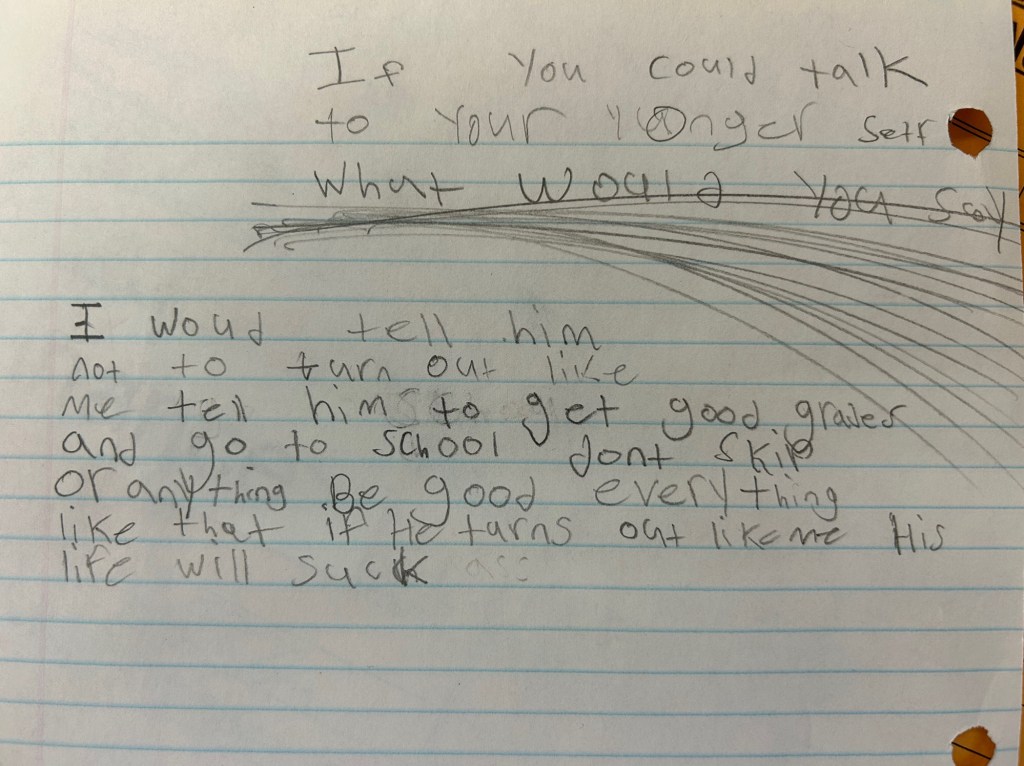
I was tidying the copying area in our office when a sheet of lined paper, adrift amidst the abandoned photocopies, caught my eye. A quick glance told me this was not my writing prompt, not my student. Still, I couldn’t help but read the words – and my heart broke open. Oh, how I wish I could tell this anonymous student about the poetry he has created, tell him that he is so much better than he knows.

If you could talk to your younger self what would you say

I would tell him
not to turn out like
me tell him to get good grades
and go to school dont skip
or anything Be good everything
like that if He turns out like me His
life will suck

My response (quickwrite)
If I could talk to the student whose paper was left behind

I would tell him
not to give up on
himself, tell him to hold on
and keep doing what he can. Be kind, everything
that I wish he could hear. If he knew the power of his
words, he would be stunned.

Wordless

Sometimes my youngest has trouble with words. Whatever mysterious worlds hold him together – his own internal sun, moon and Earth – line up, and emotion rises in him like a spring tide, flooding him and robbing his ability to speak. If I catch him early enough, he can still tell me what’s happening, though it’s hard. If we don’t notice the rising waters until it’s too late, his voice is gone. While he sits, nearly mute, fist pounding the space beside him, tears in his eyes, I struggle to guess at the words that elude him. Sometimes, I can find the words for him, and he collapses in relief; others, though, we’re not so lucky and all that that’s left is the language of the body. When I can, I hold him until the waters recede.

This is what happened on New Year’s Eve. I was the only adult left awake with the kids, who were waiting up for whatever magic they think happens at midnight – or at least for fireworks. I knew he had planned to walk out to the dock with the rest of us, but as the hour approached, he no longer wanted to come. When I asked him what was going on, his words were drowned out and his eyes filled with tears. I was reluctant to leave my youngest crying alone on the couch as the new year rolled in, but the others were waiting and time was short. Luckily, my partner was still awake, reading. He knows these moments, and came down to snuggle with our child while I went with the others into the dark. By the time we returned, my son was fast asleep.

These moments are frustrating, heartbreaking and, most of all, perplexing for me. I live in a world of words, trusting them to be my messengers to others, certain that I can coax them into shapes that will communicate meaning to those around me. I rely on words to tame the very emotions that, I think, overwhelm my child.

And yet. And yet.

These past months, words have often eluded me. I haven’t written here regularly. In fact, I haven’t written anywhere regularly. I’ve spent far too long staring at other people’s stories in an attempt to avoid my own. I’ve had no desire – much less ability – to put words to what I’m feeling. Instead, I’ve allowed myself to float on my own wordless tides. It’s unsettling.

Now, as 2024 begins, many people I love and admire – writers, readers and lovers of words – have chosen “one little word” for the year. I’ve tried to choose one, too, but the words have been as hard to hold as water. No word stays. As if to prove a point, I have spent some time now writing, erasing, then staring at the screen. The words slip through my fingers. What should I say? What should I not say? How do I feel? I don’t know. I want to commit to writing weekly this year. I want to say that I am grateful to know in advance some of the challenges that this year will bring. But those things aren’t true. 2024 may be the year I wrestle (again) with what a friend told me long ago: “Words put space between thought and meaning.”

I think about my sometimes wordless child, approaching the new year exhausted and curled up with his father. Perhaps this year it will be enough to hold on to those I love and ride the tides as we can, with or without the words to describe the experience. Surely, that is enough.