I’m not sure the formatting will work everywhere, so at the bottom I’m trying (for the first time!) to embed the document as I wrote it. Read the version that works for you – but no need to read both because they are the same.
Swimming in words
Alewives
Decorated warbonnet
Mosshead warbonnet
Penpoint gunnel
My son is dyslexic. Longfin sculpin Sailfin sculpin
Letters and words swim around my child
Crescent gunnel
Pacific spiny lumpsucker
Strawberry anemone
Northern ronquil Northern clingfish and he can’t always make the letters
Scalyhead sculpin
Match the sounds.
Like today at the aquarium when Cabezon Kelp Greenling Banggai Cardinalfish
Swim before me, and everywhere are the Estuarnine stonefish Frogfish Polkadot batfish and
I search for the Stocky anthias Square spot fairy basslet Sea goldie French grunt but
My head swims and I cannot make the names match the Saucereye Porgy
Sergeant Major
Blue tang
Lookdown
Ocean Surgeon
Blue striped grunt
Koran angelfish
When Smallmouth Grunt and “Look, a Red Lionfish!” and my boy reads those words.
The sounds are starting to match the letters.
I begin to be able to name the beauty swimming around us.
So we are patient for the Red Irish Lord Jewel damsel Fire goby
And together we see the
High-hat
Moon jelly
C-O sole.
It’s an early draft, for sure, but here I am, publishing it anyway.
the credit card company called and told me that someone is using my credit card (to buy from UberEats, of all things – clearly they do not have any clue about how to disguise their usage) and now I have to get a new one and I won’t have it for 7 days and even though I don’t think I use my credit card a lot I actually do and this is going to be a problem.
I have to fight with both of my children to get them to learn their math facts. This will take at least an hour for approximately 10 minutes of practice. Each
the batteries in the wireless keyboard are running low and I don’t know if any of the other batteries are charged and it’s too much trouble to go check.
I promised myself I wouldn’t write until I was done grading and I’m not going to be done grading until I die, which is going to make it really hard to write.
the cats are asking to be fed. Again.
and speaking of cat food, we are running out and someone needs to go buy new and you just know that’s going to be me.
I’m driving the swim team carpool.
I’m pretty sure that my writing posture is giving me carpal tunnel so I probably need to take the day off.
I’m not supposed to go on the computer before bedtime and bedtime is definitely near.
I’m on vacation and too many things have happened for me to choose just one to write about.
I told my family about my blog and now I can’t write about them so my source of inspiration is gone.
I’m just too tired.
(I’ve been keeping this list since the beginning of this challenge. Not gonna lie – I was hoping to save it for later in the month, but we’re on vacation and I am exhausted – go figure. So, here it is. And hopefully tomorrow I can process intense family time and great fun in a way that makes sense.)
I am a terrible passenger. I am writing this so that I will not look at the road and
Look at all that snow! Too much for March – terrible driving weather.
involuntarily wince as my husband passes trucks. It’s terrible driving weather – snow falling, temperature hovering near freezing, road deceptively black and mostly (hopefully) wet rather than icy. He’s a good driver, but I still can’t comfortably watch.
So far, to keep my eyes off the road and my hands from gripping the armrest, I have played Sudoku while listening to an audiobook, read an entire book aloud to our children, and scrolled through my phone (supposedly to read the newspaper). Now I’m writing. We’ve only been on the road for two hours. We have two and a half to go.
I wish I were a better passenger. I wish I could settle in and allow someone else to be in charge without second guessing, well, everything. When I think about it, I can feel myself sitting back and admiring the scenery. I can almost hear myself chatting breezily with my husband and not holding my breath as we round a curve. I relax because I’m not trying to hide by my ridiculous reactions. I imagine the mundane joy of showing someone how much I trust them by simply remaining calm.
But this is beyond my conscious control, and my subconscious desire to be in the driver’s seat comes with a cost: my reactions can make others less confident (or sometimes even angry); I end up doing the lion’s share of the driving; and I struggle to let go. And then there’s the emotional toll of trying to hide the irrational panic that grips me as we pass another truck.
I am a terrible passenger. It’s something I am working on.
But… after we arrived, I asked my husband to read this because I was feeling like a heel. He agreed with every word (harumph), but he swears that he only barely noticed me holding my breath once on this trip, and he says I need to add that I am a great driver. I’m pretty sure he’s not placating me. In case you’re wondering, he’s a fantastic passenger.
It’s pi day and this year I’ve been trying to explain to my kids what that means. We’re on vacation right now, and I suggested pie for dessert in honour of pi day. I was imagining cutting it and talking about diameter. So we went to the grocery store, where they chose Oreo ice cream and ice cream sandwiches. I said, “What about pi day?” They said, “Mom, we want ice cream.”
We all know about the proverbial “drop that made the bucket overflow.” My husband sees this as a negative – who wants their bucket to overflow? – but I think I confused it with the biblical “my cup runneth over” so I have long seen it as a positive – who doesn’t want a full bucket? For me, when someone’s bucket overflows, they are full and they are ready for the next step. What next step? No idea – I’m the one mixing metaphors here. Maybe they’re ready for a bigger bucket? Hmm… Either way, when I’m working with students, if I’m really lucky, there comes a moment when everything clicks and their bucket finally overflows, everything is suddenly different, even if the difference is small in the grand scheme of things. I’ve been privileged to experience some of those moments in my career, and those memories, those little floods will sustain me for a long time. I know that there are children for whom I have made a difference.
But here’s the thing: it takes a lot of drops to fill a bucket before it can overflow, and sometimes we don’t count all those drops. The work can seem endless and daunting. Most days, teaching isn’t about the wonderful overflow; most days, teaching is about adding drops to the buckets with no guarantee that they will ever be full.
Let me be clear: I do not think my students are vessels into whom I pour learning. As I tell them, “Sorry guys, you have to work a lot harder than that.” Nor do I believe in the teacher as savior who swoops in, fills up the bucket and changes lives. It’s not that easy either. But that doesn’t let me off the hook: I am still responsible for putting drops of love and learning, confidence and questioning, into my students’ buckets. And I need to work especially hard to help fill the leaky ones.
So I fill them as best I can: I say thank you to the students; I comment on their writing; I listen to them; sometimes I bring brownies in just because; I encourage students to sing happy birthday to each other; we talk about things that happen in the world, things that are on their mind; I acknowledge that the work they are doing is hard, and I am overt about telling them that I think they can do it; we use the word “yet” a lot; I try to apologize when I need to and to admit what I don’t know; I call home when things go well; I follow students into the hallways when they leave, and I tell them they are not broken. They are not broken.
Last week, when I finally leaned down next to M, whose head has been on the desk for days, who has stopped taking off his jacket or his hat, who just gave up football to concentrate on school but who hasn’t been concentrating on school at all… last week, when I whispered, “I’m worried about you,” I was not under the impression that I was going to change anything, but I really wanted him to know that I see him and that I care. I am only his teacher and only one of four and only this semester. I don’t understand him (yet) or even always like him (yet). He turned his head away from me and grumbled, “I’m worried about YOU.” I laughed and said, “Fair enough.”
And let me tell you, nothing changed. But M’s bucket is leaking, and I’m going to fill it with as many drops as I can because somebody needs to. In fact, more than one somebody needs to. If we’re lucky, we’ll see a change before he graduates. But we may not. This is the second year I’ve worked with him, and I can’t say that things are looking up for him…yet. But they might. And they surely won’t if we decide he’s too hard to work with, too far behind, too defiant, too tired, too tough for us.
Me? I’m just going to keep adding drops to that leaky bucket of his because someday he’s going to be an adult, and his bucket needs filling. When the time comes, I hope his bucket is so full that he is ready to overflow. I hope his cup runneth over.
Once, when my older son was about 3, not long after his brother was born, he started a list of all the things he loved. He was inspired by the large roll of paper we were drawing on and the urgent need to capture the incredible greatness of everything. He dictated; I wrote. He had a LOT to share, and I had trouble keeping up. At one point he stopped to take a breath, looked over at me and commanded: “Mommy, you do it, too.” Good idea: next to his list, I wrote the heading “Things Mommy loves” and underlined it. I wrote 1. Then I hesitated.
“Love” is such a big word. There are many things I like, but things I love? I wanted his expansive, all-encompassing list, but I could only think “my children, my husband” in the most common and inane way. I wanted to feel his urgency, but instead I was mired in uncertainty, unwilling to commit, unable to generate even one thing. I rejected everything: yoga? I mean, I really enjoy it, but love it? Maybe ice cream? How silly is it to start with ice cream? Teaching? I love teaching, but what does it say that my list of things I love starts with my job? I got tangled in my own head and couldn’t get myself unstuck. My toddler loved THE WHOLE WORLD and I couldn’t write anything. I was exhausted and I was nearly in tears. My child had no interest in my existential crisis.
“Mommy!” His little voice was imperious. “Do you like fudge?”
“Well, yes,” I hesitated.
“Then write that down.”
And my love blew the world open again.
—-
This memory returned to me when I saw Elisabeth Ellington’s 12 things I love slice. I was inspired. (She, in turn, was inspired by Margaret Simon who was inspired by two others.) With a nod to those who came before me, and special gratitude to my son, who continues to teach me to love, here are 12 things I love.
12 Things I Love
I love fudge. (Because even though if I stopped to think about it, I would probably list it under “likes”, it counts. Everything counts.)
I love chai tea, creamy with milk, in the morning
I love the way my 7-year-old hums and sings as he goes about his day.
I love reading a book that’s so good I stay up past my bedtime or sneak paragraphs in the car before picking up the children.
I love breakfast. I love that we eat breakfast together as a family. I love that we make big elaborate breakfasts on weekdays and then laze around and eat dry cereal on the weekends.
I love when the phone rings and the caller ID tells me it’s one of my sisters or one of my best friends. I love that sliver of time before I press “talk” when I’m already smiling.
I love ice cream. I especially love Breyer’s vanilla ice cream with real vanilla beans. Because that is the best.
I love starry nights at the beach.
I love teaching. I love being in the classroom, getting to know the kids, trying to figure them out, trying to show them why I love literature, helping them find their own voice and their own love.
I love yoga. I love feeling my body stretch out and my mind pull in to focus on body and breath, breath and body.
I love baths. Long, hot baths are one definition of luxury.
While searching through my idea files, I found a journal entry from my second week of teaching in France twelve years ago. I’ve tweaked it, but it’s just too funny not to share. So today’s slice is a memory:
Week Two begins and all is well in the world of the Lycée. After the topsy turvy beginning of the French school year, today felt like time to get down to business.
My première class (11th graders) started at 8am (poor things – teenage body clocks just aren’t set for that time!) by writing their (required) summer reading essay. I brought an electric kettle, tea, and coffee to help their brains get moving – and N brought in a few store croissants. I’m not convinced any of them could make heads or tails of One Hundred Years of Solitude by reading it on their own over the summer, and I’m sad that I had to assign this essay before we discussed it. I told them to think of it as practice for when you really don’t know what you’re doing: you come up with something and make damn sure the writing is good because you know the content isn’t. At least I made them laugh before they began. Still, who wants to start the year handing the teacher an essay that doesn’t really represent their ability? Ah well. They wrote for the entire 90 minutes – not one finished early.
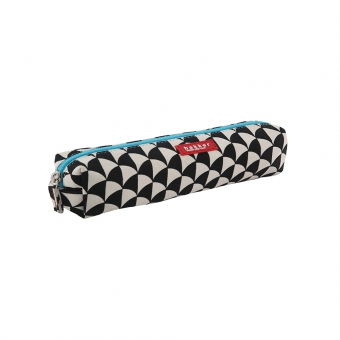
All French students have a “trousse”. The technical translation of this is “pencil case”, but the truth is much more complex. A trousse holds the keys to success in the French school system.
Une trousse
Much like Mary Poppins’ magic carpet bag, the trousse might contain anything: I have seen students reach into their trousse and come up with pencils, ball point pens, ink pens, colored pencils, markers, ink-pen erasers with blue write-over tips, rulers, scissors, small staplers, paperclips, ponytail holders, small dictionaries, cell phones, TVs, entire living room sets, deeds to houses, and occasionally originals of the constitutions of various small countries. Every writing task involves a variety of colors and steps: even note-taking requires straight edges to underline headings, colors to show what point goes with what and careful ordering of the points the teacher makes. Me? I make regular use of mind-maps and often end class with a chalkboard full of arrows and circles. So far I’ve resisted the temptation to see how my very organized students are possibly using straight-edges and magic eraser to make sense of my crazy notes, but I’ve already started dreaming up days of mild torture: using multiple colors of chalk haphazardly, starting phrases and then crossing them out, beginning an organized chart then erasing it – or adding to it – in the middle. Someday I’m going to steal all their straight edges and see what happens. I imagine the entire classroom will devolve into chaos.
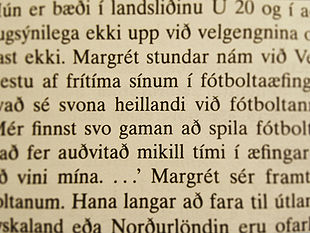
My 5ème class – the 7th graders – has no problem talking, though I suppose some would argue about how much thought goes into it. They continue to amuse me and I suspect will do so all year. We are preparing for Beowulf – the big beginning comes tomorrow when we actually start reading! Today was all about Anglo-Saxon riddles. Last week this group got very involved in writing out their own epic quests (L’s heroic test was being forced go to the planet of the nerds and dress like a nerd for a week; someone else’s superhuman gift was smelling chocolate 2 miles away), so you can imagine that riddle solving and riddle-writing was a big hit. M was so proud of his short riddle that he forgot to pause at the end and told us the answer the minute he finished reading it. J told two riddles in a row about spiders (after using Spiderman as his example of an epic hero on Friday), but then fooled us all by telling a third riddle… about a pencil. Today they also saw Old English for the first time, and I was definitely worn out because it took me a full three minutes to get them to stop discussing whether it looked more like Swedish, German or Icelandic. Icelandic?
Icelandic
When have they ever seen Icelandic? Sheesh. I can’t wait to get these kids dressed as ancient warriors or to have them re-enact the scene where Beowulf tears Grendel’s arm off. I’m convinced we’re going to get in trouble somehow or another; it’s really only a matter of time with these guys. Sometimes they can’t even quite stay in their seats as we talk. It’s going to be a great year.
Thank heavens for my one hour lunch break. I’m not sure I could have managed two more classes without some food! As it was, when I got to the 4ème class, the 8th graders definitely had a little more control of the room than I did. Perhaps it was because I told them that Petrarch wrote hundreds of sonnets to a woman he only ever saw once in church and never really met; or maybe it was because one of the students figured out early on that they had to write a sonnet for homework. Slowly, the class began to revolve around two themes, neither of which were exactly my point for the day: “but I don’t understand why he didn’t just talk to her” and “wait, it has to rhyme AND be in that rhythm thing we wrote last night?” Um , yeah, that iambic pentameter thing.
So I found myself repeating, again and again, variants of “he couldn’t talk to her and, yes, all sonnets are written in iambic pentameter.”
“But I don’t know that many rhyming words.”
“Does it have to make sense?”
“Was she married?”
“If she was married, dummy, she just could’ve gotten a divorce.”
“Not back then.”
“How would you know?”
“What if it doesn’t rhyme? Will that count off?”
“Oh no – Shakespeare wrote a different kind?”
“Which kind do we have to do?”
“But Shakespeare met the women he wrote about.”
“Do they have to be about girls?”
“I would never have written that many poems about somebody I didn’t even talk to.”
And on we went. Needless to say, we did not have time to try to put together cut up sonnets, nor did we get to Romeo and Juliet’s first scene together when they actually speak two sonnets in a row. By the end of the class, I felt a little bit like the Wicked Witch of the West as she melts and cackles, “Oh, my plans, all my beautiful plans!” Heck, when class came to an end, I felt lucky that anyone actually knew the word sonnet; if they figure out that it’s somehow related to Romeo and Juliet, I think I will be ahead of the game.
And thus I have started my second week. In 5ème L is already one of my sweeties and he knows it. I still don’t know the names of half my 4ème or Seconde classes. Somehow I have to get my 5ème through Beowulf, my 4ème through Romeo and Juliet and my Première through Crime and Punishment; and my Secondes will grimly plod through Huckleberry Finn unless I can get them to engage. And in all of this, I’m supposed to settle in to France, get my paperwork completed and keep my sanity. I’m sure that can all happen – I’m just not sure it can all happen to me. But, as Kurt Vonnegut said, and as precisely none of my Secondes understood (perhaps because half of their essays relied heavily on internet sources), “so it goes”.
I have been thinking a lot about Wallace Stevens for the past few days. As one does. His poem “The Disillusionment of Ten O’Clock” has been on my mind. Today, I think I’ll write an imitation. Or a parody. Or, well, a poem like his.
The houses are haunted
By white night-gowns.
None are green,
Or purple with green rings,
Or green with yellow rings,
Or yellow with blue rings.
None of them are strange,
With socks of lace
And beaded ceintures.
People are not going
To dream of baboons and periwinkles.
Only, here and there, an old sailor,
Drunk and asleep in his boots,
Catches Tigers
In red weather.
Now mine:
The Disillusionment of the Day Before Spring Break
The classrooms are haunted
By lecturing teachers.
None are laughing,
Or talking with laughing students,
Or laughing with crying students,
Or crying with writing students.
None of them are strange,
With hats of feathers
And rainbow waistcoats.
Teachers are not going
To speak of Uranus and bubbles.
Only, here and there, an old writer,
Daring and aware that the principal is gone,
Teaches Writers
In red weather.
Taking a page from Alice Nine, I want to think for a minute about what I did here, especially because I sometimes ask my students to play with poem imitation.
I knew I wanted to write about school on Friday right before the break. I had been struck by how empty the hallways were in our normally busy school. Many of our students and teachers are on various March Break trips, and it was snowing, so we had some serious attrition as the day went on. By 3:30, our lively school was a ghost town. Nevertheless, when I thought about how to write this as a slice of life, I came up blank: yup, the school was quiet the day before a long break. Nothing to see here, move along. It was so mundane as to be unremarkable – yet it seemed remarkable to me.
Wallace Stevens really has been on my mind for a few weeks, so the idea that the school was just a ghost of all its possibility easily brought this poem to mind. (Note to self: you can’t be inspired by what you haven’t read.) Also, the teachers have been preparing a silly surprise for our principal (who has a good sense of humour and who went on one of the school trips), so I was thinking about our really goofy sides. (I can’t post the pictures in case someone from my school stumbles across this & somehow the principal sees – suffice it to say that we’ve been having fun.)
Stevens sees what happens when we let the mundane take over all the wild possibilities. What are the wild possibilities in the classroom? At first, I had the teachers “droning” and the list of things the teachers weren’t doing was more realistic, but then I took a second look and noticed that “white nightgowns” are unremarkable and, more importantly, non-judgmental… that is, until you read the rest of the poem. Teachers lecturing probably won’t catch anyone’s attention in an early line – it’s what we assume high school teachers do – but the wilder possibilities in the next three lines should change that.
In the next three lines Stevens has a careful pattern – pulling a colour from one line into the next – and all these colours exist very firmly in the realm of possibility. It took me several tries to find a way to make my phrases do the same thing. In fact, only at the last minute did I realize that I could replace the “rings” in his poem with “students” in mine. That opened things up for me.
I love the lines about the “socks of lace” and the “beaded ceintures” because “socks of lace” pulls my attention when “lace socks” might not. And I imagine that Stevens originally wrote “beaded belts” (nice alliteration, Wallace!) and then revised it to something more unusual and evocative. (“Damn the alliteration, I’ll use ‘ceintures!’ That’ll get ’em!”) I actually started my line writing “Fascinators of feathers” then realized that “socks” are mundane and switched to “hats.” I couldn’t quite find an equivalent for “ceintures” but I decided “waistcoat” was near enough and I like the assonance that came from rainbow.
Uranus and bubbles just came to me. Probably because another blogger I read recently (can’t remember which one – sorry!) wrote about talking with her nephew and Uranus came up.
Finally, who might replace the old drunk sailor? Who in our school was dreaming big dreams on Friday afternoon? Well, a writing teacher, obviously. Someone who has journeyed and knows about possibilities. (Yes, yes, I’m biased.) And a reference to our absent principal, who allows us to play, followed by the red weather line because a) I didn’t know what else to write and b) I like a nod to the original when I write imitations.
I’m not sure I knew how much went into this until I wrote it down. Well, no wonder it’s hard for my students. WHEW!
I was teaching EFL in Bulgaria – my first year of teaching – and most of my students were spellbound by my American-ness. After seven months, I was beginning to think that I had mastered the art of teaching or, better yet, that I was simply a natural teacher.
What was so hard after all? Discipline was a breeze: most of my students wanted to be in my classroom. Motivation was a snap: everything I assigned fascinated them just because it was from me. Of course, a few students refused to believe in my American magic, but I had fallen under my own spell and thought of these few as difficult, recalcitrant, even bad.
In fact, cheating was one of the only problems I had encountered in my short time in the classroom. Today I know that I had no idea how to teach writing. I didn’t model, scaffold or even help with revision. As a result, for their first assignment nearly all of my students had turned in essays copied from some famous work or another.
I really believed that these children of a failed Communist state valued accuracy and impressiveness over creative thought. I had no idea that I had played a role in the outcome, so it was hard to tell who was more befuddled by the Fs I gave back on that first assignment – me at what I perceived as my students’ betrayal, or them at my unrealistic expectations.
A few months’ experience had made me a slightly better teacher. I had learned to articulate my expectations more clearly and my ever-attentive students had worked to meet me well more than halfway. It didn’t hurt that the students generally liked me and, mostly, wanted to please me. I rarely received plagiarized papers anymore. Until Martin’s.
He was unconcerned as he swaggered up to my desk after class. He gave his friends suggestive looks as if I were going to proposition him or ask him on a date. I shooed them out of the room, and he planted himself in front of me with an impressive “I don’t care about anything you do” stance: shoulders slumped, hands jammed in his pockets, chin jutted sideways. He assumed an air of infinite boredom. I realize now that he must have been waiting for praise on his essay.
The essay was about his grandfather and his wartime exploits. It was nearly perfect and absolutely fascinating, so I assumed that it was someone else’s grandfather’s exploits. I hadn’t even bothered to finish reading it. After all, Martin’s work in English had been far from perfect to date – when he did it, that was. Frustratingly, I thought that he and I had recently made a connection, and I was angry that he had copied this essay now that we were on the verge of understanding one another. It didn’t matter: he was one of the “bad” kids who didn’t hang on my every word.
Martin was clearly smart, and he had no natural respect for me. He didn’t care if I was from the US or Mars, and I found his apparent lack of motivation more frustrating than anything else I had encountered. I had no idea how to encourage him. Sometimes I felt that his attitude, his unwillingness to do his work, was calling my bluff: I was just masquerading as a teacher. His lack of respect for me fed my growing fear that maybe this teaching thing wasn’t as easy as I had imagined.
I accused him of cheating. Martin was silent for a long moment before he ripped his essay out of my hands. He raged back to his seat. He grabbed his bag and shouted his way to the door. Through the noise and garbled grammar, I discovered that Martin had spent hours on the essay. His grandfather was, perhaps, the most important person in his life. He had taught Martin everything. Martin had wanted me to know his grandfather and had worked and worked to show him to me.
I cried after he left. Nothing I could say or do made any difference (and in my youthful chagrin I changed his grade to an A, as if that were the important thing). Martin had long known what I had just realized: I didn’t see him as a whole person but rather as just another kid in my English class, just another one of the bad boys, just another, but not unique. My accusation confirmed his opinion. If I had read the whole thing, if I had listened to the note of honesty that rang through the essay, if I had paused for even a moment, I might have seen Martin, the real Martin, who had tentatively entrusted me with a bit of himself in that essay. But I hadn’t.
In my whole career, I may never want to go back and fix something as badly as I want to go back and fix that day. But since that awful confrontation, I have tried, in Martin’s honor, to remember every day that I teach whole people, people with lives outside of my classroom and outside of the school. I teach people with problems at home, secrets to keep, and dreams they desperately need to share. I teach people who have amazing grandfathers. Martin may never know that I know this, but I always will. It has shaped my career. It has changed my life.
And I really really hope that it has not shaped his.
Today, a young woman I have never met before came into the Special Education room and asked, “Is there anyone here who could help me with an essay?” In Spec Ed I pretty much always get to answer those questions with a resounding “YES”. It’s fantastic.
She and I sat side by side looking at the essay she had written and the comments her teacher had made. The essay was already strong, and the teacher had ideas for how to make it stronger: try discussing your theme in more depth in the introduction; try making your topic sentences more specific to what you are proving; try breaking down long quotes and discussing the importance of particular words or images. The suggestions were clear and came with thoughtful direction.
The teacher had not provided a grade on the essay, and the young woman was quite nervous. We spent time deeply focused on the comments, what they implied about the essay in its current form, what they envisioned for a future form. We looked back and forth between the essay and the comments, talking, pointing, questioning. Eventually, I left her to her writing and moved on to work with other students.
At some point while I was talking to another student, she finished up and left. She didn’t say goodbye; she didn’t need to. She was deep into her own learning and confident in her own process. I was delighted, and I kept smiling a secret little smile as I continued through the morning.
This was the story I told about my day when I got home, and then the story I wanted to write about today, which made me curious: What was it about this interaction that was buoying me up? I have edited literally thousands of essays with students. I have helped thousands of students. As great as this interaction was, it has happened before and it will happen again. (Though I freely admit that I love it every time.)
I thought about the moment when she understood how to re-shape her topic sentences. How she suddenly said, “Oh! So stop trying to be general and really dig in to what I’m going to be saying in the paragraph. It’s almost like leaving off my old first sentence.” Was that it? It should be, but no…
What old first sentence did I need to leave off to see what was really going on? How could I re-view my experience of this? I decided to do what I tell my students: just start writing and see where you end up. It’s only a first draft.
And sure enough, as I wrote, I got it. That young woman who stopped into Spec Ed for help: she doesn’t have an IEP. In fact, she doesn’t have an IEP, she’s in a Grade 12 University level English class, and by all accounts (I asked her teacher), she’s an excellent student. But she came to Spec Ed for help. This is fantastic. Our Special Education room is becoming the room we’ve envisioned: everyone who wants to learn is welcome. Spec Ed is a space for learning strategies, for valuing how we learn and that we learn. You don’t need an IEP to look honestly at your strengths and your needs and figure out how to mesh those two things. You don’t need a learning disability to realize that you need help. And if you *do* have a learning disability, you should have a place that values learning for all. That’s why helping another student with another essay made my day. We’ve created a real learning space right in the middle of the school.
And now, I take a leap. This isn’t my first draft (I’ve been revising as I go), but it’s not a polished piece, either. This is my first blog and today I will publish a piece that is definitely still in progress. Since I decided to participate in the month-long Slice Of Life challenge, I’m going to have more of these, and I’m not used to it. Still, if I value learning and I value writing, then I value the process as much as the product. I say this *all the time*; today, thanks to this challenge, I start to live it. Here goes publishing a draft…






 Persistence and Pedagogy