Letting Go #SOL22 7/31

In the front of the room, Mr. P was talking. Technically, this was “my” class – I was the assigned teacher – but I’d stopped teaching and started functioning as a co-teacher/ support a few days earlier. Now, I was moving about the room, answering quiet questions, checking on student work, when one of the Black students touched my sleeve. I leaned down to hear her question. Without taking her eyes off of Mr. P, she whispered, “Thank you.” I knew exactly what she meant.

***

One week ago – on day one of this challenge – I wrote about the moment when Mr. P and I decided to team teach a class. And not just any class: we decided to team teach a new interdisciplinary course called “Anti-Black Racism in the Canadian Context.”

Some background: I am an experienced teacher with a permanent contract in our school board, and I am white; he is an experienced teacher who is not yet a permanent teacher in our school board, and he is Black. I grew up in the US; he grew up in Jamaica. Last June, when courses were being assigned, there was only one – ONE – Black teacher in this school, and he was not able to teach this class, so the principal asked me. I’m not Black, but I have been working towards anti-racism; filled with both trepidation and excitement, I said yes. To be honest, I was kind of proud that he thought I could do it.

Over the summer and the first semester, I read a lot, talked a lot, and thought a lot about how I could teach an Anti-Black Racism course to a group of students from many racial backgrounds. I researched and learned. I was determined to do my absolute best. The course began on a frigid February day, and I started by acknowledging my precarious position. No matter what I said or did, I was still a representative of white authority standing at the front of the classroom. Even though I planned to have an inquiry-based course, the structure of our system means that I was still “in charge”. It was uncomfortable, but we could live with discomfort.

And then came Mr. P. He had been hired to cover a position at our school this semester. We started chatting about literacy instruction almost the moment we met. Each of our discussions was better than the last, our pedagogy in synch, our hopes and expectations for students overlapping. He is wildly knowledgeable and wonderfully expressive. Within days, he was popping into the classroom; days after that, he started co-teaching with me. By Friday of last week, he was leading the course, and I had stepped into the background.

I’m pretty opinionated about what constitutes good teaching, but watching what happened when a person with lived experience of racism taught the course was humbling. I have been taught by Black educators, listened to Black colleagues, sought out Black perspectives. I am aware of the need for diverse voices – especially Black voices – in our schools. I knew all of this. But – oh, how I wish you could have been in the room last week when he talked about Bob Marley or recognized a Jamaican poet I had quoted. I wish you could have seen the moment that he addressed the racist coverage of the war in Ukraine. I wish you could have heard him talk about what it was like for him to come to Canada as a Black man. I can teach all sorts of things, but I can’t teach that.

Friday afternoon, the principal came by to tell me that Mr. P was needed in the room where he was originally assigned – a support position: valuable, but flexible enough that he had been able to spend a week in our class. Still, that couldn’t last forever, and I knew what had to happen: I asked the principal to transfer the course into Mr. P’s name. I didn’t know that the change would happen right away, but it did. This morning, with little warning, I said goodbye to that group of students and to the Anti-Black Racism course.

I’m a little heartbroken – if one can be a little heartbroken. I would love to keep teaching the course for many reasons. I think I’m mourning my preparation. I know I’m mourning my own chance to learn from Mr. P. I’m absolutely mourning the students and the connections we were making. I love the classroom, and I will spend the rest of this semester with only one traditional class.

On the other hand, a highly qualified Black teacher is leading a diverse group of students to a new understanding of race and racism while he shares a powerful lived experience. And that is worth celebrating.

Brat #SOL22 6/31

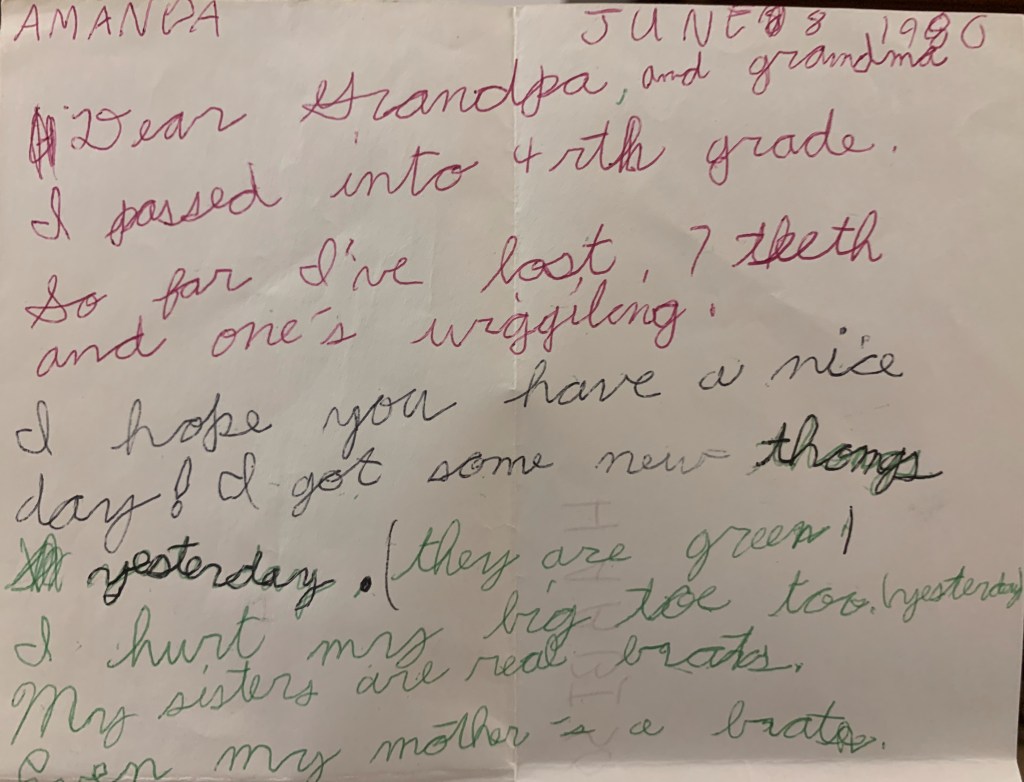
I’ve been putting things off all day, trying to do what I’ve deemed necessary before I allow myself to do what I find fun. This strategy has mostly been making me anxious as time slips through my fingers: it’s almost 5:30 and the chore-like bits aren’t done. Luckily, I just found a slice of life so good that it simply must be shared, so I’m giving up on cleaning and starting on fun. Here, take a peek into my life at the end of third grade.

Just in case you can’t read my almost-fourth-grade handwriting, here goes:

AMANDA JUNE 8, 1980

Dear Grandpa, and grandma
I passed into 4rth grade.
So far I’ve lost 7 teeth and one’s wiggiling.
I hope you have a nice day! I got some new thongs yesterday. (they are green)
I hurt my big toe too. (yesterday)
My sisters are real brats.
Even my mother is a brat.

I didn’t even bother to sign it – though I did draw a giant smiley face. I guess I figured they would know who I was – the one who wasn’t a brat.

Look for the helpers #SOL22 4/31

This week has been the kind of week that sometimes leaves me unable to write: one of those weeks where the truth is so outrageous that teachers would be unable to read the whole thing and non-teachers would be so gobsmacked that their mind would rebel and they would declare that this must be an exaggeration; one of those weeks where if I wrote even half the truth, I’d be out of a job; one of those weeks where it’s a lot easier to focus on the crazy than the good.

Andre and I talked about this wild ride of a week as he accompanied me on my daily walk. The weather was much milder than it had been earlier in the week (see yesterday’s complaint), and we chatted companionably as we walked along the almost-thawing sidewalks of our downtown neighbourhood. We stopped at a store and were on our way home when we saw it: a delivery van stuck in the heavy slushy snow, its wheels spinning. Three young men surrounded the van; another was behind the wheel. They were well and truly stuck. As we watched, the driver hopped out and went around back to join one of his companions. They stared forlornly at the wheel.

As Andre and I got closer, one of the men near the front came around to join the two in the back. They conversed briefly, then everyone went back to their original positions: one driving, two in front pushing, and one in back calling directions. Andre was already putting our shopping bag on a dryish patch of driveway as he looked over at me and said, “Wanna help them?”

Of course I wanted to help. This moment – the car stuck, the people pushing – this is part of winter. This is what we do. The wheels spin; the passengers get out; everyone pushes. If that’s not enough, passerby or neighbours pitch in. As people arrive they call out something banal like, ‘Wanna hand?” but they don’t wait for the answer: they are already pitching in, already pushing. So it was with us.

One of the three outside guys said, “Pushing didn’t help much before, but maybe with more of us…” He trailed off because, of course, we were already there. Someone counted, the driver reversed, we all pushed. The van resisted – “rock it!” – rocked forward and slid a little back and sideways. We paused to regroup. The was a brief conversation, but the result was inevitable: we did it again.

There isn’t really space for five people to push the front of a van, but that didn’t stop another passerby from leaving his well-dressed partner to wait on the sidewalk as he joined us. “One, two, three!” We pushed again. More progress.

The girlfriend watched, bemused. The guys gathered and looked at the new situation. “Ok, come forward a little, straighten the wheels, then reverse. We’ll let it rock forward, then push.” We all returned to our positions. The countdown, the forward motion, a giant heave-ho and… free! The van was on the street!

The driver waved out the window to thank everyone. I waited for the other three men to hop into the van, but they didn’t. Two picked up their own packages – I hadn’t noticed them before – from various dry-ish spaces nearby. One loped off on his own, empty-handed. The man who’d joined after us, went back to his partner. He laughed, “She’s not from here. She’s never seen this.” We laughed, too: “You haven’t really made it through winter if you haven’t rescued a car.” They continued on their way. One man turned down a walkway nearby. Another crossed the street in front of us.

It turned out, none of us knew each other. Six strangers (well, I guess I know Andre, so four strangers and a couple) had all stopped on their way from somewhere to somewhere to push a seventh stranger out of the snow on a Friday evening because, despite the pandemic and war, despite nuclear reactors and shooting threats, no matter how crazy the week or the world is, helping someone out is just something we do.

Surprised by Winter #SOL22 3/31

I have lived in Ottawa for 15 years now, longer than I’ve lived anywhere else in my life, but somehow I’m still coming to terms with winter. I’m regularly annoyed when it snows before the end of November. I make jokes like “March comes in like a lion and goes out like a… lion.” As someone raised largely in the South, I mutter “April is the cruellest month” year after year when Ottawa April shows its capricious nature: freeze thaw freeze thaw; few things bloom and I often wonder if Spring will ever arrive.

I should know better. I should.

Despite all of this, I managed to be shocked this morning when I walked out to my car covered in a light layer of snow, and, underneath, the windshield slick with ice. For once, I was leaving vaguely on time, determined to get to school early enough to write this slice before students arrived. But winter had different ideas.

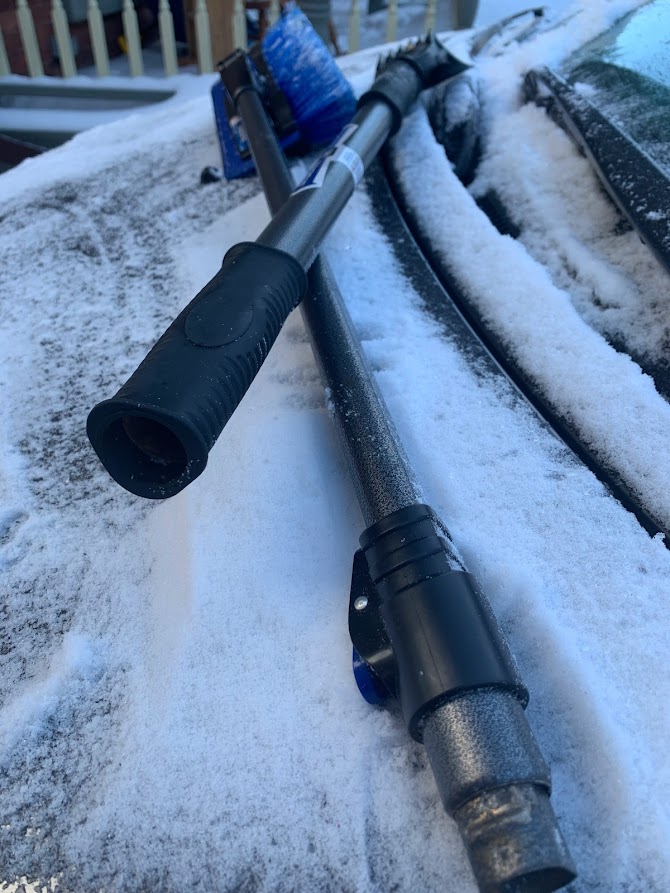
Why replace this scraper? After all, winter’s nearly over, right?

I swept my gloved hand along the seam of the top of the car door before I opened it so that none of the snow would fall on my seat. I half-sat on the front seat and turned the car on, followed by the front windshield heater, the back windshield heater and the seat heater. I groped on the floor for the now-broken scraper that I had decided didn’t need to be replaced this season because “it’s already March.”

Then, I spent the requisite three or four minutes brushing and scraping the car – not quite enough to make me late, really, but just enough to remind me that I should not be surprised by winter. The broken scraper meant that I couldn’t quite reach everything, so I drove to work with the mom minivan mohawk: the narrow strip of snow that not-quite-tall enough moms end up leaving in the middle of the roof of their minivans.

Pretty sure I still won’t buy a new scraper this season. After all, it’s nearly Spring.

Knit Night #SOL22 2/31

I was hopping mad by the end of the school day. I texted with colleagues, then met with them. I talked to a friend while I drove home (thank goodness for dear friends who live far away so they can’t tell anyone what I *really* think). I expressed myself volubly to my partner. And then it was time for Knit Night.

I set myself up in the basement, which occasionally doubles as my office. I opened the laptop, plugged in the good light and the headphones, found my current knitting project (The Nightshift Shawl – swoon) and settled in.

I don’t know how I got lucky enough to join a group of wildly smart educators who knit while solving the problems of the world, but I did. We meet online for a couple of hours on Tuesdays in the best kind of group: Come when you can; share what you want; no worries if you can’t make it.

We talk about everything. Tonight we talked about funerals and how we love even difficult people. We laughed about Sunday School and premarital sex. We wondered about potential racist implications in phrases that don’t have racist origins. (Can I say “call a spade a spade“? Unclear.) We compared notes about whether or not educators with PhDs use the title “Dr” in our school boards or if they did when we were growing up. And somehow, hilariously, we ended up talking about teaching sex ed to 7th graders, explaining spontaneous erections and periods and suddenly we were bemoaning the influence of porn and some *very* dirty lyrics were posted in the chat and NO, it is emphatically not ok for 4th graders to know those and OH MY.

I will freely admit that I had to pull back the last row I knitted before we logged off; I’m pretty sure it was because I was giggling so hard. Some Knit Nights are tough: we don’t get the job we applied for or cancer treatment has worn someone out. Others are angry: racism and misogyny abound and sometimes we feel helpless. Occasionally (ok, often) we are ridiculously nerdy: after all, we’re basically a group of knitting librarians and English teachers; we’ve read *everything*. Always, always, these night are restorative.

I admit it: nothing is fixed. Tomorrow I will still have to go into work and deal with all the things that happened today. Still, I greet most Wednesdays in a slightly better mood because of a few hours of knitting and laughing. Really, who wouldn’t?

Team teaching #SOL22 1/31

I am finishing my third (or thirtieth or three hundredth) meeting of the afternoon when he pops in. He’s been “pushing in” to a class and thinks that maybe he’s stepping on the teacher’s toes just a little bit. I taught that class last semester and was grateful for every extra adult body I could get, but I trust his judgement. Maybe this new, young teacher has things under control; maybe she has a higher tolerance for high jinks; maybe she likes to have some space to teach by herself. Whatever it is, if he thinks he’ll serve the class better by stepping away for awhile, then that’s probably the right move. I, too, am finding that pushing in is complex.

He and I have only talked a handful of times, but we’ve already had several of those discussions that trip along from one topic to the next, our tongues flying and our hands gesturing. I don’t know much about him yet, but I already admire him. Today he senses my fatigue. “How’s that class going?” he asks. I take a deep breath.

I confess that we have finished unit 1 – Foundations – and are moving into a unit on history. I explain that I am drowning in information. I keep thinking of the title of an article I read in grad school: A Little Too Little and a Lot Too Much. I feel wildly uncertain. What is my next step? How can I honour student voice? How can I acknowledge what they know and what I don’t know?

He understands right away, and he points out – gently, politely – that I am too deep in my emotions and too light on academics. I shake my head: No. No. That can’t be it. I am a white woman teaching a course called “Anti-Black Racism in the Canadian Context”; I have to be aware of emotions and student knowledge and… “No,” he is saying, “no.” He can see through me. I am aiming for perfection. He laughs, “It’s just history. I know that teachers can be possessive of their classrooms, but…would you let me come tomorrow? This is my specialty. I am salivating at the thought of teaching this class.”

We talk. More than once each of us prefaces comments with “can I be honest here?” He finds the holes in the anti-racism that I hope permeates my soul but which I sometimes wear like armour. We talk about the dismal truth about the numbers of Black teachers in our board and our province. I tell him that I hope that someday I will not be teaching this class because someone more qualified will teach it. He reminds me that I am good enough even while he reminds me that I will never be enough. I push back, get frustrated and feel seen all at the same time.

We end up planning together – we are both committed to a pedagogy of inquiry – our ideas intertwine and the course takes shape again. When we pause he says, “I am a hugger. Are you a hugger?” and we hug because for now this course – which until today was taught by me, a white woman doing her best – will be team-taught by a white woman and a Black man who have found a way to disrupt the system that put us in separate spaces when we should be together.

Welcome to Day 1 of the annual March Slice of Life Challenge. Come, write with us for 31 days. We would love to meet you!

Disrespectful

I am running late to get to my friend’s 40th birthday celebration because, half a block from my house, I turned around to get a mask. I hadn’t been planning to wear a mask outdoors, but there are small groups of people – maskless and decked out with Canadian flags – gathered in clusters on the downtown streets. Lots of them. I did NOT want to mistaken for part of that group, so I ran back in and found my Ruth Bader Ginsberg mask, the one that says “NOT FRAGILE LIKE A FLOWER: FRAGILE LIKE A BOMB.” Now, properly attired and clearly indicating my position in this stand-off, I hurry towards my friend’s house.

The day is cold and sunny with a beautiful high blue sky. The crisp air would redden my cheeks had I not put on my mask. I thrust my gloved hands deep into my pockets and walk. I haven’t walked more than one block to the west of my house in almost three weeks, not since the “protests” began. The people I’m passing do not look like my neighbors. They are, to a person, white, though our neighborhood is home to people of many races. Along with the Canadian flags, they have black flags that say F*** Trudeau – only without the asterix. My neighbors tend to politely step to the side as others pass, making sure to offer each other space so that we can safely walk outdoors without masks. Not these people. On the streets, pickup trucks drive by and honk. The visitors shout and wave back.

Today feels almost like Canada Day, but there’s a nasty undertone. I don’t know if I’m making that up, but my nerves are frayed after three weeks of living blocks away from the “Freedom Convoy.” (I do not actually call them that – what they call freedom is pure selfishness – but aside from “occupiers,” the other words I use are not ones I care to admit to in this blog.) My family and I count ourselves lucky: we could only hear their incessant honking as a background drone, not an earsplitting nightmare; we don’t have their diesel fumes leaking into our living space; we are white, so we are not automatic targets when we go outside; we don’t have a Pride flag displayed, so no one has used our front yard as their toilet. All we have is inconvenience, in the grand scheme of things, plus an ever-present fear that things are going to become violent. Even the cold air feels like tension. Make no mistake: these trucks are weapons, and these people are here for hate, no matter how much they believe they are here for freedom.

Right now I just want to get to my friend’s party. Six of us are planning to sit outside in the freezing cold in camping chairs set up on their backyard skating rink. We will wrap ourselves in blankets, huddle around a tiny outdoor fire, drink hot cider with a splash bourbon and eat chocolate cake. We will last about an hour in this most Canadian of pandemic birthday celebrations. We have not been indoors together in nearly three years because too many germs from too many places make Covid too real of a possibility and we have young kids and grandparents to think about.

These people I am passing think differently. They believe conspiracy theories and that they should get everything they want, regardless of others. They don’t want the vaccine AND they want to participate freely in everything – swim lessons, restaurants, hockey teams, workplaces, all of it. I used to try to be open-minded, or at least curious, about their thinking, but three weeks into this illegal occupation, three weeks into harming businesses and workers and everyday people, three weeks of honking when the politicians they are mad at aren’t even in the city… well, my curiosity has waned.

These people are here for fun. I find myself thinking unkind thoughts about them. Ok, angry thoughts. Ok, rageful thoughts. I call my sister and curse into the phone while she laughs at my surprisingly curse-ridden vitriol. Better to tell her than to tell the people around me. My heart beats faster as I pass some groups. My anger rises as I see white people, maskless, flag-covered, sprawling across benches in the park we use, gathered on corners, insisting to store employees I recognize that they will come in without masks (later today both downtown grocery stores will close because they decide their employees are no longer safe; many restaurants have had to close; people have thrown bricks through the window of an Asian restaurant and set a small fire in an apartment building then tied the doors shut). I walk faster.

I remember Lisa telling her daughter to shoot them the bird and I wonder briefly what she would do if she could see this mess. I tell my sister, who is still patiently listening to me as I try to cross town, about what I am seeing and feeling. And then I spot them: a couple, sitting on a bench on a corner in the middle of the local shopping street. They are taking up a lot of space. On his belly, he’s balanced a box of poutine – classic Canadian street fare. She has a Canadian flag draped around her shoulders. He’s casually letting a pole with a “F#*& Trudeau” flag dangle into the sidewalk in front of me. 

“Disrespectful,” I hiss. “Get out of my city. Get out of my home.”

He starts to yell something back at me, but I am already past him and my sister is talking directly into my ears, “Mandy, this is a bad idea. Keep walking. Don’t engage.” Moments later, she is laughing and so am I. This? This is it? I’m in the middle of a slow-motion insurrection, surrounded by white supremacists using trucks as weapons and my go-to insult is “disrespectful”?

I pull my knitted cap lower over my expertly highlighted blonde hair, wrap myself more tightly in my hand-knitted scarf, and wonder at who I am: a middle class white teacher lady who curses on the phone in secret but can only engage the occupiers like a schoolmarm.

****

Days later, I am still wondering what more I can do, how much I will risk. Days later, I know that the failure of the “authorities” to protect (white) citizens, to keep us (white people) safe (from white people), to even begin to address this occupation (by white supremacists), has changed me completely. I cannot yet articulate how this will manifest, but I know that my tendency towards moderation has disappeared in the face of this. I am ashamed that only now do I truly understand what others have been saying for years: the police, the authorities are not trustworthy. I believed them, but until now I had not experienced this. Though I already thought that I was past this, I now know that I can no longer be the white moderate who Martin Luther King, Jr decries in Letter from Birmingham Jail: “I have been gravely disappointed with the white moderate. I have almost reached the regrettable conclusion that the Negro’s great stumbling block in his stride toward freedom is…the white moderate, who is more devoted to “order” than to justice; who prefers a negative peace which is the absence of tension to a positive peace which is the presence of justice; who constantly says: ‘I agree with you in the goal you seek, but I cannot agree with your methods of direct action.'”

If I’m going to live up to my RBG mask, I’m going to need some better insults.

Ice

Sometimes, when my heart or my head have raced so far ahead of my body that I can no longer tell if I am getting enough oxygen, I take a cube of ice from the freezer and clutch it until the sharp edges dig into the soft centre of my palm, until my fingers go cold, then numb. I close my eyes and feel every bit of the ice in my hand. I cling to it as my body’s warmth softens its sharp edges, as my animal heat grows and pushes against the coldness, until every bit of me – my cells, my blood, my breath – responds to this challenge and water, cold and clear, seeps through the cracks between my fingers. When I can breathe again, I let it go.

****

I am looking for the story equivalent of that ice cube, a cold hard undeniable centre that grounds me, but I’m having trouble finding it.

Protesters currently occupy Ottawa. I’ve lived in the capital cities of three different countries, so I’m familiar with protests. This one, though, this one is wearing me down. You can read about the protests on your favourite news site – but the long and the short of it is that there are trucks blocking our streets and honking honking honking. This despite the fact that there are few (no?) politicians currently in Ottawa. These protesters are mostly affecting residents, causing small businesses – already struggling from Covid restrictions – to close, along with public libraries, an elementary school (for one day), the local mall, city service centres, a vaccination clinic, a Sikh temple and more. People can’t think for the noise; the blocked streets prevent elderly people from getting their food delivered. Some of the people involved in the protest have behaved badly and their demands are unclear.

Monday morning, I tweeted about sending my child to school through the protesters. Monday evening, I spent hours hiding truly hateful responses – some threatening – and blocking accounts. The work was deeply unsettling and exhausting. 

I foolishly tried to lead a “discussion” with my classes – because this protest is affecting students, too, and because it’s a great example of how different news sources report different things and shape our thinking via diction, selection and omission –  but I was in no way able to model critical thinking. I was too tired and too angry. I even shared a piece of “news” that turned out to be false. I should have done better, but I did what I could.

****

Meanwhile, sexual harassment lurks in the hallways and corners of our school. Children who have learned largely online or in interrupted spurts are behaving badly. Some profess astonishment when teachers talk about truths: that sending unwanted pictures of body parts is harassment; that even “compliments” are often unwelcome when they are comments on people’s appearance. Others are angry that their requests for help are going unheard. Some of our students have told us about assault. Their stories are unsettling.

In the school, lines of communication feel broken. There is no time to talk. We’ve moved from a shooting threat to winter break to online school, then through a snowstorm and straight into the end of the semester. Tomorrow – a “catch up” day for students – is overflowing with meetings as staff members scramble to connect with one another, to find ways to cram months of desperately needed conversation into the hours that we desperately need to mark student work and begin writing report cards. Thursday, we will return to our pre-Covid school schedule (four classes per day) and call it “normal” even though half of our students have never experienced it. We have no time to plan for this. We will pretend this is ok.

In one of my circles of teacher friends, we no longer ask each other if we cried today; we ask if we cried in public or in private. Our sleep is restless or hard to find. We are exhausted.

****

Meanwhile, the pandemic rages on. In Canada, Wednesday saw the highest number of deaths from Covid so far. Wednesday.

In school, I endlessly repeat, “put your mask over your nose,” heed the recent notice that we should not open our classroom windows, pretend that it’s normal to have five, six, seven students away from each class.

I remind myself that endemic is not synonymous with mild and nevertheless hope for endemic.

****

What is my cold hard truth? What can I feel so deeply that it transforms? Today, it is Mary Oliver’s poem “Wild Geese.” Here, feel the pressure of its hard edges, then let her words melt between your fingers until you can breathe again.

You do not have to be good.
You do not have to walk on your knees
for a hundred miles through the desert repenting.
You only have to let the soft animal of your body
Love what it loves.
Tell me about despair, yours, and I will tell you mine.
Meanwhile the world goes on.
Meanwhile the sun and the clear pebbles of the rain
are moving across the landscapes,
over the prairies and the deep trees,
the mountains and the rivers.
Meanwhile the wild geese, high in the clean blue air,
are heading home again.
Whoever you are, no matter how lonely,
the world offers itself to your imagination,
calls to you like the wild geese, harsh and exciting –
over and over announcing your place
in the family of things.

Grief #SOL21 6/21

The first time I understood someone else’s grief was the second time I fell in love with a poem. The day after our beloved Calculus teacher, Doc, died of cancer, the principal announced her passing over the PA.

Doc loved teaching and, I think now, loved us. After her diagnosis, she had taken a summer trip and then decided to keep teaching for as long as she could. We would be her last class – not something we understood at all.

Sometimes, when we were struggling with a concept or deep into a problem, she’d order pizza to be delivered to the school’s back door & sneak it up to the classroom. We’d stay in and do math through lunch. No one ever complained.

Once, when my home life was falling apart, she asked me to come to her house and babysit her granddaughter. I still remember the long quiet afternoon away from home, swaying with the baby as Norah Jones sang “Don’t Know Why.”

After the principal’s dry announcement, Mrs Jackson – 9th grade Algebra – came on. In a voice that quavered at first, she began: “Do not go gentle into that good night”

With each line, each verse her voice grew stronger, until the end: “Do not go gentle into that good night./ Rage, rage against the dying of the light.”

Was there silence then? It was high school; experience tells me that most of the students went right back to talking. But that’s not what I remember: I remember silence. I remember Dylan Thomas’s words reverberating through homeroom, through the hallways, through the school. I remember knowing that I would cry when I got home.

I had no idea that a poem could stop the world like that. I had no idea that grief could echo in empty spaces. I know now.

Now I know.

Thanks to https://twowritingteachers.org for hosting this annual challenge

Pivot

Educators in Ontario are starting 2021 by pivoting. Again. 2020 saw us pivot from what we quaintly referred to as “school” to “emergency remote learning” from April to the end of June. Then, in my school board, high school teachers started September in “quadmesters” organized into what is possibly the weirdest teaching I can imagine (and one which I still cannot describe succinctly): we teach one course for approximately four hours a day every other week. During that week, half of the class is in person one day and the other half is at home; the next day, they switch. Teaching is hybrid because the at-home cohort requires “some” synchronous connection with the in-class cohort during the day. Once both cohorts are home and have had a lunch break, they are supposed to do asynchronous learning for another hour. I’m pretty sure we used to call that homework, but whatever. The next week, we switch to a different course. Apparently, this is a mere pivot from our previous practice.

Now, as 2021 starts, we are “pivoting” again because Ontario is back in lockdown – or at least partial lockdown. First, we’re teaching fully online for three weeks. Because that doesn’t feel quite challenging enough, we are going to teach two classes a day for 112 minutes each (the two classes which we previously taught on alternating weeks for 225 minutes). The instruction must be synchronous for some amount of time that I can no longer remember, and there will still be an asynchronous component at the end of the day for those whose heads aren’t already spinning.

Also, while no one knows exactly what will happen, we’ll probably pivot back (re-pivot? un-pivot?) for the last week of January when we may or may not return to the original 2020 quadmester plan, except that this would give one course a full week of instruction and the other course none – so I may or may not be seeing the students who may or may not need something to learn. I mean, it’s not a problem because when we get there, we’ll just pivot.

But the current pivot means that all I need to do during winter break is cut my pre-planned two weeks of hybrid daily instruction plans in half, spread them over three weeks and – maybe? – two days, download and practice using a few apps (hello, colleagues who have time to practice with me) so that fully virtual learning can go smoothly, convert any planned in-person instruction to a different delivery mode, and get ready to handle any residual upset the students might be experiencing from the last time this happened – when we told them we were extending March Break & then separated them from all their friends & didn’t allow them back in the school for 5 months.

You know, pivot.

As 2020 ends and people suggest various phrases that define the year – “You’re on mute” is a fave – I vote for “pivot.” Oh, how I have come to loathe that word. To me, it implies an easy twist to a new position. Just turn a little and keep doing what you were doing. No biggie. No need to reconsider your pedagogy to take into consideration the trauma adolescents might be experiencing as the world around them goes haywire. No need to think about how that affects their ability to learn. No need to recognize that in-person, hybrid, and online education are, in many ways, entirely different beasts. No need to examine which educational practices are foundational and which are, perhaps, merely habitual. Just pivot.

So I looked it up. Because I’m a word nerd like that. And, while I regularly tell my students NOT to start essays with definitions (Dear Heaven, but they don’t need another way to avoid saying actual things), I’m going to share two of the definitions I found at dictionary.com.

Pivot
– to modify (a policy, opinion, product, etc.) while retaining some continuity with its previous version
– Basketball. to keep one foot in place while holding the ball and moving the other foot one step in any direction.

Suddenly I am back in high school, playing basketball with my athletic younger sister at the top of our driveway. She is on the Varsity basketball team. I am terrible at basketball, and my inexpert play is not helping her improve her game. Frustrated by my inability to block effectively, she sighs, “Just… set a pick,” and she places me between her and the basket. “Spread your feet, bend your knees a little, and stand still.”

I do, and she dribbles around me again and again, her brown hair flying as she finds different ways to create space for her shots. Sometimes – often – she pivots, confusing the imaginary defense before she spins around me and shoots.

Pivot, huh? Keep one foot in place and move the other foot in any direction. Retain some continuity. It sounds easy when the government or our school board assures people that we will simply pivot to online teaching, but I know better. Pivoting isn’t an effortless turn, a round peg gliding smoothly in a round hole. I think of my sister, relentlessly seeking improvement, earning her starting position one afternoon at a time, bouncing and bouncing, turning and turning, intentionally putting obstacles between herself and the basket. She was working.

Thanks to twowritingteachers.org for hosting this weekly space where teachers can hone their writing skills – and have fun doing it!

Still, even if we had to work at it, we had fun on those afternoons, and we got better – or she did, anyway. I didn’t, but I was mostly just standing still. It wasn’t easy, but, well… I think I need to go try out a couple of new apps. I’ll try to remember to keep one foot in place, but I’m constantly stepping with the other because on Monday, we pivot.