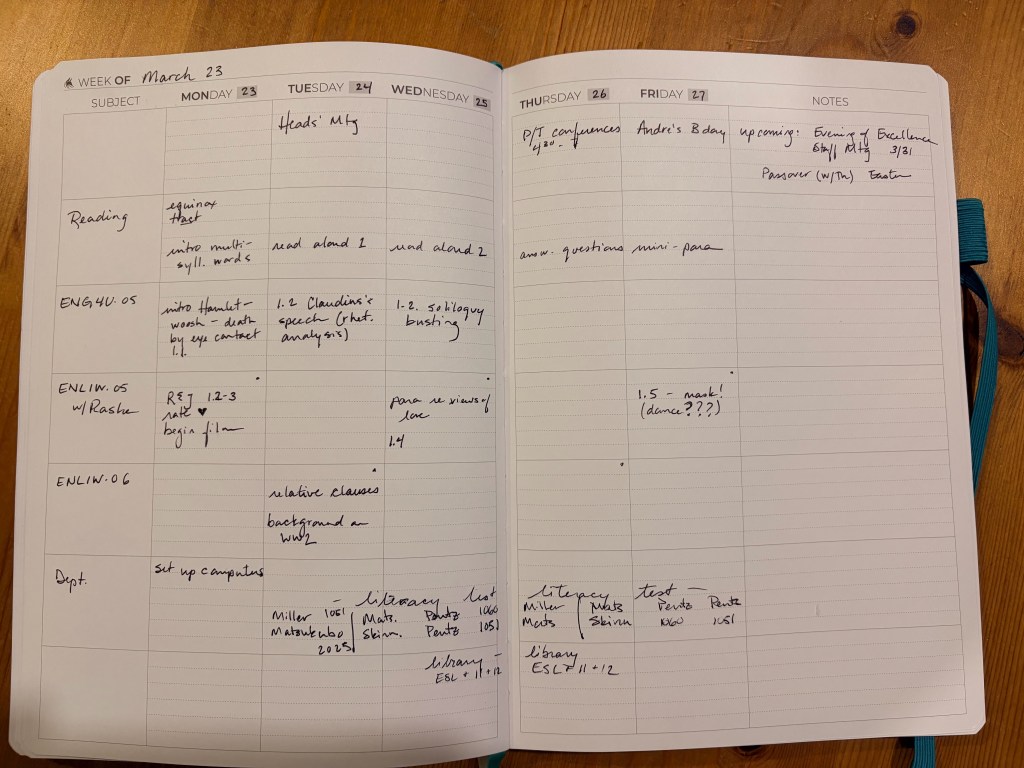
Earth Date, March 2026 Context: Ramadan, Lent, war in Iran, the week before March Break
Monday, Break -5: Finally succumbing to whatever bug has been decimating attendance, I stay home sick; some students do some of the work I’ve left for them.
Tuesday, B -4: Student walk out (to protest provincial changes to education) starts at lunch and continues into the afternoon; workers in the neighbourhood accidentally cut the power lines; things goes dark; school is dismissed early.
Wednesday, B -3: Major ice storm predicted; buses cancelled; teachers must attend school but students do not; I have a total of two students attend class; in the end, the freezing rain mostly misses us.
Thursday, B -2: Intruder in the school; “secure the school” called during morning classes; person is “given support”; afternoon classes continue as normal; student attendance is dwindling; everyone is exhausted; one day to go.
Friday, B -1: Do we even want to imagine what might happen tomorrow? We had a fire alarm pull last week, so that’s done. We haven’t had a flood, but I feel like ice sort of covers water issues. Earthquake? Tornado? Unexpected solar eclipse? Time out of joint? Cross your fingers that we make it to our break.
By the time you read this, I will already know my fate.
I might be at home, curled up in a blanket, marking essays or reading a book.
I might be driving on an icy road, heading to a school likely to be all but empty – buses cancelled; schools open.
And, though this is very unlikely, I might be preparing to teach a full class of students.
Weather forecast: up to 20mm of ice accumulation (25 mm = 1 in) from freezing rain. Warning level: orange
(No one really seems to know what an orange warning is – but it’s more dire than yellow and less dire than red, so that’s something.)
When I was a student, I didn’t fully appreciate how much teachers sometimes long for snow days. Here in Ottawa, a true snow day is a rare thing indeed – we almost always stay open – which makes it even more wish-inducing. For tomorrow, I have my money on option 2: buses will be canceled, but teachers will still be required to go in. A few intrepid students will show up, but we won’t be allowed to teach anything new, so the day will be lost. Sigh.
Still, I’m up a little later than I should be, writing.
Still, I haven’t told my children they must go to sleep.
Apparently that childhood longing for an unexpected day off never fully goes away.
Once, when I was a young teacher working with many other young teachers in Washington, DC, several inches of snow were predicted to start on a Thursday night. DC had no ability to handle snow, so if it snowed, we would have the day off. In anticipation, after work we all went to a local basement pool hall – one of our favourite hangouts. As the evening progressed, we played pool and drank beer, laughed and sent various teachers up the stairs to open the door onto the street and check for snow.
The evening crept onward, but no snow fell. We worked at a very small school; fully half of the faculty – probably more – was playing pool in that basement bar, drinking beer and waiting for the snow. By 10pm, with no snow falling, the more clever amongst us went home, hoping to sleep off whatever damage they had already done in time for school the next morning. But most of us stayed.
11pm. More beer. No snow. A few more people left. But not many.
Then, around midnight, just when we were beginning to recognize the reality of what we had done, someone went up the stairs – ostensibly to go home – whooped loudly, turned around and raced back down to rejoin the crowd. “It’s snowing!” The bar erupted with cheers. The bartender gamely turned up the tv and we rejoiced to hear that DC schools were closed the next day.
I don’t remember what time we went home that night, but it was late, and – oh – how I remember our joy.
A snow day. An unexpected day off. What a gift.
It could happen. And listen, I’m far too old to be out playing pool until all hours of the night, but, just in case, I might wear my pajamas inside out. And I think I’ll let my kids stay up late.
The lights went out. The image projected on the board went black.
Then I heard screams.
Chaos ensued. Up and down the hallway, teachers threw open classroom doors to see what was happening. Student faces peeked out behind them. Soon, we learned that the power crew working down the street had accidentally cut the power lines in the neighbourhood. Luckily, my classroom has windows and, even better, I had just handed out new worksheets, so we were golden.
Golden, that is, if you ignored the intermittent screaming from across the hall, often followed by hilarious laughter. The interior classrooms were really very dark, so there was quite a lot of random scream-laughing… after a few minutes, I invited my across-the-hall neighbour and his ELD (English Language Development – for students who did not have the chance to attend much school before they came to Canada) Science class into my Grade 9 English class. More chaos.
If I know anything about school chaos, I know this: students with nothing to do will find something to do pretty quickly. It’s better for everyone if teachers direct that energy before the students do.
Unfortunately, my class had been starting to work with correlative conjunctions and inversion (after a moment last week revealed how deeply they did not understand this – really, the excitement never ends in our classroom). I’d shared “the flip” right before the lights went out.
The story not only hides the truth but also creates fear becomes Not only does the story hide the truth, but it also creates fear.
Now we’d added half again as many students to the room and their English levels were undetermined. This was, perhaps, not the ideal lesson for the moment. But what are you going to do? The classroom was full of kids and something had to happen. No problem. I caught my colleague’s eye, then quickly grouped the students, pairing two or three English students with one or two Science students.
“Great,” I clapped my hands. “Now, if you’re in my class, you’re going to teach this pattern to your new partners.” Nothing like adding a little academic chaos to the chaos of a power outage. The students stared.
Soon the Science teacher and I were circulating, encouraging students to introduce themselves, to share worksheets, to try something new. Slowly, the magic of students working together across languages and levels started to spread through the classroom. People were laughing and talking and trying to understand each other.
I had just stepped back to take in the somewhat-darkened slightly goofy chaos of learning when a VP came in and told us that school was dismissed early for the day. Everyone understood that, and cheers erupted. Students streamed out of the classroom, and my colleague and I smiled at each other. It had only been 10 minutes, but it had been good.
is even more ridiculous than walking home from daycare with a toddler or scouring the pavement for that one glove, lost in the last week of winter partly because he has to smell every inch of newly-exposed mud partly because of my desire to breathe in the rain-washed air, partly because of his desire to breathe in everything partly because of his enthusiasm for the disgusting remnants the melting snow has revealed on the edge of the sidewalks partly because I have to pull him away from all the people and dogs that are also out enjoying the sunshine it is hard to believe when I’m with him that there can be anything as still as unforgiving as an icy walkway possibly studded with salt in the warm Ottawa 2 o’clock light we are wandering through the neighbourhood like neurons connecting through sunlight
*I stayed home sick today, but I still had to walk Max. We had a lovely midday meander.
UNDERSTANDINGS Students will understand that…the teacher read their work
ESSENTIAL QUESTIONS Why? Why why why?
Stage 2 – Evidence
Evaluative Criteria
Assessment Evidence
The essays have a final mark
OTHER EVIDENCE: Ideally with thoughtful comments
All of them
Stage 3 – Learning Plan
Summary of Key Learning Events and Instruction End goal* – Finish the marking *those who finish early will be allowed to comment on other blog posts as a reward Start marking Look for things on the computer again Organize the paper versions of essays Spend an ungodly amount of time fiddling with formatting Finally write your blog post Make more tea Decide you need more tea Talk to your sister Water the plants Play NYTimes word games Check phone for messages again – just in case Read headlines – spiral about the state of the world Clean the toaster Toast a bun for breakfast Make a pot of tea Collect clothing for laundry Add very important items to the grocery list Check phone for messages Decide you will blog before you start marking Sleep in a little
For teacher-writers truly dedicated to procrastination: on Friday night, do NOT write your blog post; decide that you will, instead, write before beginning to mark on Saturday morning.
After I broke my wrist in December, I took a few weeks off from walking the dog. In fact, I took a few weeks off from walking at all; I had no desire to find out what might happen if I slipped on another patch of ice. Can one break a currently-broken wrist? What if I slipped and broke my left wrist? What does one do with two broken wrists? I decided that I didn’t want to know the answers to these questions so, since Ottawa is definitely icy in the winter, I stayed home and “let” my partner and the kids walk the dog.
The children were compliant but not thrilled with their new duty. Mr. 15 wondered pretty regularly exactly how not icy it would have to be before I would take up my former duties. “Winter lasts a long time, Mom,” he stated bleakly. Mr. 17 tried to talk me into “just” using my left hand – but walking Max, our large energetic black lab mix, is a two-handed endeavour. Still, I missed my daily walks, so in mid-February I tentatively rejoined the dog-walking rotation: anytime the sidewalks were mostly clear, I took the dog.
Things were different now. Where before walking Max was just something I did, now it required my full focus. I scanned the sidewalks for icy patches; I looked ahead to spot other dogs that might cause Max to pull on the leash; I checked the streets for any vans he might need to try to attack (he really hates vans and buses). To protect my right hand, I needed my wits about me, so I did not put in earbuds and listen to podcasts as I used to do. I didn’t even look for things to photograph – something I love to do. I just walked the dog.
Suddenly I could hear those much-detested vans earlier and help settle Max before they arrived. When the weather broke for a February thaw, I heard the birds. And I noticed anew that people who passed me spoke several different languages – one of the many things I love about our neighbourhood. When I felt steady on my feet, my mind was able to wander. I hummed songs and just sort of thought.
This morning, as my mind meandered, I remembered the first time I realized that headphones (or MP3 players, I guess, though I didn’t know it at the time) were going to change the world. I was walking down the Champs Elysees, trailing the students I had accompanied overseas. The iPod was relatively new, and several kids had brought theirs on the trip. As some of the boys exited yet another patisserie (I’d be willing to swear that all they did on that trip was eat), I realized that Ben was bopping down the wide sidewalk of the great boulevard with his ears full of his own music. He wasn’t hearing the language swelling and swooping around him or the street noises that rose and fell as we passed various stores or even the thrum of the traffic. He was taking in the sites with his own soundtrack. I’m not 100% sure, but I think I told the kids to take out their headphones and be in Paris. I know that at some point I gave up the fight.
My objection seems almost quaint today. Now, students sit in class, an earbud in one ear, strategically hidden behind a shock of hair or under a hat. They are vaguely offended when I ask them, again, to take out their personal life soundtrack. During silent reading time, they insist that they “read better” with music on. When I ask, many can’t think of a time that they aren’t listening to something unless they are forced to take their earbuds out. They hate the “silence” and tell me it’s uncomfortable. In my office, most of my colleagues have something in their ears all the time so that they can “concentrate.” I, too, often go through the world with someone else’s voice in my ears.
My broken wrist may have broken that spell for me. Sure, I miss my podcasts, but I am enjoying the space that I’ve found. I can’t call it silence because the world is full of sounds, I’d just forgotten that they could be enough. Maybe I’ll get sick of it soon. Maybe I’ll slip back into the sense that every minute needs to count as two – or that every minute is mine to control in some way – but I’m starting to think that maybe I won’t. I think that maybe it’s time for me to remember that the world provides its own soundtrack and that my mind is happy there. It turns out, I like the space that comes from being a little tuned out.
When I was in high school, friends of mine kept track of how many times our Chemistry teacher said a particular phrase. I think it was “um,” but surely that is too banal. Surely we had better things to do in Chemistry than tally the number of times our poor teacher hesitated every class period, day after day, right? Of course, we also kept track of at least one teacher’s outfits: ah, there’s Tuesday’s skirt! Right on cue, Thursday’s dress! And my sister’s class once united to torture a student teacher by tearing out their notes, day after day, then pretending she had not given the previous day’s lecture.
Clearly, this was before cell phones.
I am now in my 50s, and some days I feel lucky if the students even notice if I’m in the room, but these memories explain this morning’s dilemma: what to wear to school? I have plenty of options, but it’s March and I am sick of every item of winter-adjacent clothing I own. Plus, of course, I couldn’t wear the green palazzo pants today because I want to wear them tomorrow when we have a guest speaker. Why do I need to wear those pants for a guest speaker who I’ve never met before and may never see again? I do not know, but this morning that was my only fully-formed idea about clothing. As a result, I stared longingly at the green pants for several minutes.
Eventually, I reached for a black dress with white stripes, but I suddenly feared it might be my “Wednesday” outfit. I put it back, deciding that my safest bet was something navy – because when was the last time I wore navy? Minutes later, I realized that I probably hadn’t been wearing anything navy because I couldn’t find my navy shoes or any cardigan that coordinated even vaguely with navy.
At this point, getting dressed – something that normally takes me no time at all – had taken me quite a bit of time indeed. I texted my carpool buddy that I was running late and, ignoring the nagging voice in my head – the one with a distinct Southern accent – that whispered “No white before Memorial Day,” I grabbed a white cardigan. I finally located my navy shoes, then ran downstairs to grab breakfast. I threw together a lunch, and took my breakfast to go. My carpool buddy arrived, and we headed off to school: me, confident that I was not wearing a Wednesday outfit and knowing that, at the very least, my shoes were appropriate. No tally sheets for this teacher!
No tally sheets, that is, unless my students are keeping track of days when I have completely forgotten to put on any make up. Sigh.
At least tomorrow’s outfit is ready to go, and – who knows? – maybe the guest speaker will be really impressed by my green palazzo pants. Maybe he’ll add them to a secret tally sheet of “really well-dressed teachers for a Thursday in March.” I bet I top the list for that one.
During my prep period I head to the front office to ask a question. In the lobby, the Principal is talking to two of our regular “hall walkers” – students who spend most of their time in the halls rather than in class. I maintain my pace but watch, intrigued, as he moves them inexorably towards the office even as they argue with him. At one point he says, “1,150 students are in class. Why aren’t you?” I’m impressed by this statement, but the students remain defiant as I pass.
Just before I enter the office, I see a few more regular loiterers hanging out nearby. Though I have no real authority other than that of being an adult in the building, I believe that teachers and administrators should work together to help students meet our expectations, so I spur them along a bit with a joking phrase and “You should be in class.” They acknowledge my words with a clearly false response and stay where they are. I ignore their obvious lie and go into the office. Actually getting them to class would take more fight than I’ve got in me right now.
A few minutes later, I’ve finished up in the office, and I walk out, chatting, with a colleague. We continue to talk as we wend our way back to our classrooms. More students linger in the lobby. Again, I pause to say, “You should be in class.” Again, they offer anodyne excuses that have little to do with reality. I know they’re lying; they know they’re lying. We all continue on our way.
Once we reach my classroom, my colleague comes in and shuts the door behind him. “Hear me out,” he says, “before you say anything.” I figure this is because of my terrible habit of interrupting, but this time it’s more than that. He looks directly at me. “You need to stop telling kids to go to class.”
He explains his logic: every little interaction like the ones I’ve just described is a tiny annoyance, a mini increase in my blood pressure or my stress. And for what? Every time, the students lie or ignore what we say, and every time they get a little “win.” They only go to class if we follow them there, and that is a much much bigger annoyance for everyone and a bigger stressor for the teacher. He believes that ignoring their behaviour is better for us and, at the very least, no worse for them.
I have to think about this. I consider the “animal training” philosophy that suggests we should ignore behaviour we don’t like and reward behaviour we do. I consider the amount of effort it takes even the Principal to get kids to respond appropriately. I consider what I lose when I ask students to go to class but don’t follow through.
Then I think about what it might mean if no one asked students to go to class. What happens if most or all teachers just turn their heads instead of intervening? But are we really intervening now or are we just playing at intervention? I don’t know.
I’ve been thinking about this since my prep today. I can honestly say that asking students to go to class has only ever been effective when I have accompanied them all the way to the door of the classroom. Even then, I overheard one of our VPs say that she had walked a student to class today and the student left the room again within minutes. Maybe I’ll give my colleague’s idea a try, even if it feels weird. What do you think?