On futons, spiders & memories: Slice of Life 20/31 #SOL20

Today we managed to get the futon frame out of the basement and into the guest room. Our “guest” is our exchange student from the Netherlands. His dad was an exchange student with my family when I was in high school. Given the current state of the world, this exchange is a *little* different than anyone was anticipating. The current state of our house isn’t making things any easier. Luckily, Pieter is very good natured and has not complained about sleeping on a futon mattress on the floor for a few nights. Unluckily, the futon frame – once we found it and got it upstairs – was very dusty and home to more than a few spiders. Pieter and Andre cleaned it up and put it together and then, over dinner, I regaled them with a spider story from possibly the craziest overseas trip I ever led – the time another teacher and I took ten students to Cameroon. 

After dinner and bedtime, I dug up the email I sent from that day, about twenty years ago. Here is a slightly edited letter from my past self to the parents who trusted me (age 20-something – aka *not old enough*) to take their children to Africa for a few weeks. Just re-reading it makes me gasp and smile. (The editing is that I removed the kids’ names, though I doubt any of them would care. We were two chaperones, ten kids from our school in the US, plus five from the local Cameroonian high school.)

Why hello there.  Did you miss us? Have you been sitting at home wondering what in the world your children have been doing?  Well, they are all alive and well and they are not bored.  Let me tell you about it…

As I recall, I left you at the end of the day Saturday – we’d been to the village and the lava flow.  Sunday morning we woke up bright and early and continued our exciting experiences of Cameroonian roads as we headed up to Bimbie, a town not far from Limbe. Our first order of business was hiking the Bimbie Nature Trail which runs through an old growth lowland rainforest – the only one left between Limbe and Douala. We split into two groups and made our way into the dark, humid interior. We walked by fig trees that have adapted to place their fruit on the ground so animals can get it more easily; we saw ebony trees and smelled their wonderfully aromatic flowers – and learned that you can eat the berries inside the flowers, though I found them bitter; we slopped through a mangrove and thanked the heavens once again for hiking boots that the mud couldn’t suck off our feet (though it tried); we saw a tree whose heartwood rots out leaving space for all sorts of creatures, including hundreds of bats; we even saw a four or five hundred year old tree. The hike was lovely and quite a success.

Upon our return to the road, we realized that the car that had been left for us was not big enough for everyone to get back to Camp Saker, the camp where we were staying in the rainforest.  So a LOT of people crowded into the first car, and the other half of us walked. Eventually, the car came back for the rest of us and we all got to the camp, sweaty but happy.

After lunch, we headed back into the forest with researchers from the Botanic Gardens and we learned how to do a wildlife transect to study a forest.  One student got to use the Global Positioning System (super-technology in the middle of the forest) and the rest of us served as recorders, measurers, tapers and spotters. We spotted lizards, caterpillars and birds’ nests as well as lots of crab holes, but we didn’t see much large wildlife because, in addition to the fact that we were crashing through the forest with about 20 people, these forests have been hunted to the point that almost no large wildlife is left.  Sad, but true. A few sweaty hours after we started our transect, we made our way back to the road and then back to camp.

We spent the early evening at the little beach near our camp. The Cameroonian boys all played soccer on the beach and some of our students joined in. Stella, our cook, was supposed to be making us dinner but, unbeknownst to us, our driver accepted a private deal and was, as a result, several hours late. So Stella was stuck in town, and couldn’t get to us. We realized something was wrong as we got hungrier and hungrier, but we really weren’t sure how to cook for 17 in a camp in the middle of the forest with only rudimentary cooking supplies. When I explained to the kids that we didn’t know what was going on, one of the Cameroonian girls stepped up and promptly took over, cooking a delicious bean stew over an open fire in an outdoor kitchen while I made rice (over a gas stove in an indoor kitchen). Let me just say how seriously impressed I was with her ability to take over and cook. Just as we began to serve, Stella arrived with soda (the height of luxury), and even she was impressed that we’d managed a delicious dinner on our own.

After dinner, some of the students organized a coconut feast (the guides had shown them how to get coconut milk on the morning hike). A few kids gathered the coconuts; everyone worked on opening them; one boy even used his baseball skills to throw coconuts at rocks until they burst.  We all loved the fresh coconut meat, which the kids observed tastes nothing like what you get in the grocery store.

Just before bed, I had to get help from my co-chaperone because a GIANT spider had taken up residence on the ceiling over my bed – not quite as big as my hand, but nearly…  I just couldn’t bring myself to sleep underneath it. He chased the enormous thing about until it gave up and dropped directly into my hiking boot – not my ideal outcome. As you can imagine, this made it very difficult for me to put my boots on the next morning. We decided to keep the spider incident quiet because we didn’t want to tell the kids and “creep them out” (many things “creep people out” around here), but then we learned of the lizard in the boys’ toilet and the various critters in the girls’ room, so we shouldn’t have worried. The night was also stiflingly hot, and Camp Saker doesn’t have air-conditioning – or even fans – so we all had a restless night and people looked a little worse for the wear Monday morning.

Today we are having a symposium (which I am late for as I type, so I’m about to sign off) and this afternoon will be spent at the beach with a beach barbecue for dinner. Tomorrow we have an optional hike to Bomona waterfall. It’s optional because it involves starting at 5 am and a 2 hour uphill hike – but the falls are supposed to be beautiful. As soon as the hike is over, we head to Yaounde. Thursday morning we will meet with the American Ambassador and show him our work painting the education center (which the embassy helped fund) at the Zoo and then we go to Douala. All of this is to say that I will probably email tonight, but after that I can make no guarantees. In addition, please limit your emails to your children to a line or two tonight as I won’t be able to get them the actual text, and this is probably the last time you should e-mail.

Hope all is well in DC and that you are out from under the snow.  More information as I can write.

Amanda

3d17d-screen2bshot2b2014-12-152bat2b7-37-262bpm

Ice, Ice, Baby: Slice of life 16/31 #SOL20

I grew up in southern climes. My father was in the Air Force and we lived in Panama, Texas and California before we settled in South Carolina. Even my “far away” university was below the Mason-Dixon line. As a result, until I moved to Ottawa, I had little experience with seriously cold weather. I refused to agree to move here until I had visited in the winter. My then-boyfriend now-husband was so anxious about this that, when I arrived in mid-February, he met me at the airport, bundled me into a taxi, looked at me and asked, with absolute sincerity, “So, do you think you can handle the cold?” I said yes. This is what love will do to you – even if you’re a Southern Girl.

img_2518
Ice ripples

I didn’t see snow fall until I was in the 5th grade. That summer, we had moved from California to South Carolina, not exactly a bastion of cold weather, but colder than what I knew. One day in February, someone yelled, “SNOW!” and we all ran to the window to see it until Mrs. Rish called us back in her quavering voice: “Sit down! Sit down, children! It’s not like you’ve never seen snow before.” I turned to her, eyes wide with wonder and said, “I haven’t.” Bless her for saying, “Well then, Mandy, you can stay there.” I pressed my face to the cold glass and watched in amazement for long minutes before I returned to my seat.

img_2473
Ice near yoga class

You can imagine my first few winters in Ottawa. I had to learn everything anew, not least of which was how to dress myself – and then babies – for cold weather. None of the coats I owned were even close to warm enough. I did not have winter boots. I was pretty sure that no gloves in the world could keep my fingers warm in February. Sometimes I tried to stay inside for days, despite Andre’s gentle insistence that going outside at least once a day was healthy.

img_2511
parking lot ice


Eventually, time and the kids got me outside. After all, I didn’t want to miss the fun of building snowmen or turning the back porch into an epic sledding ramp. When the boys started parent-child skating lessons, I went to the rink and tried to pretend that, like the other parents, I was mostly there to hold the kids up when, in fact, I was learning, too. Now I can lace skates – theirs and mine – stand up from a fall, and even race my kids down the frozen canal in February. I’ve come to love snowshoeing and have taken a ski lesson to get over my fear of downhill skiing. I still don’t love it, but I can get down a hill.

img_2475
This icy dragon is breathing fire

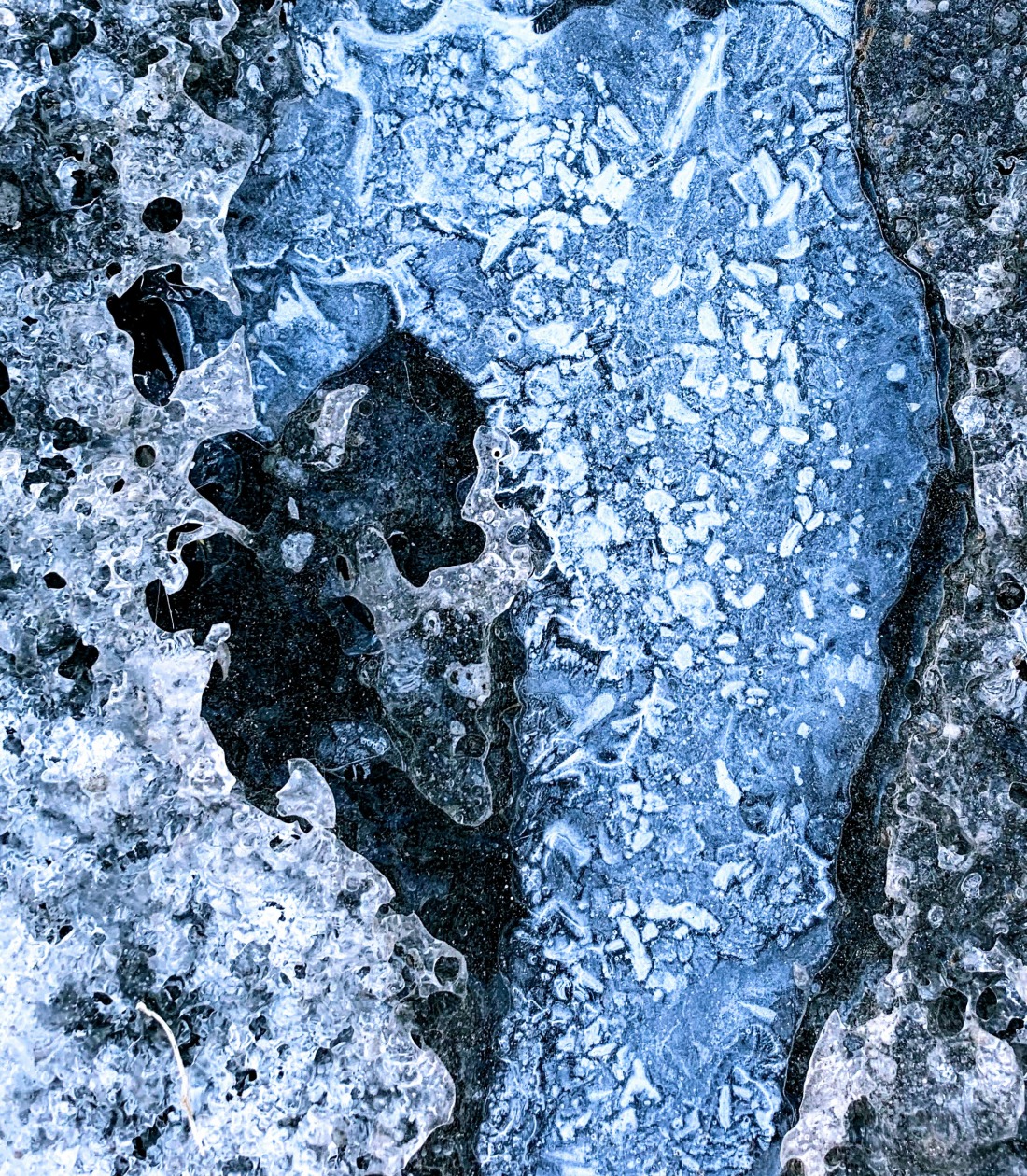
The more I played outside in the winter, the more I got used to the cold. Sure, I wear hats and gloves starting in October and straight through to April, making “real” Canadians laugh, but in last year or two I’ve caught myself “just running to the car” in slippers & a bathrobe even when the temperature is well below zero (Celsius – think maybe in the 20s Fahrenheit). Yet none of this prepared me for my recent fascination with ice.

ice from below
Ice stalactites from a roof

Canadian kids have some built-in knowledge about ice. They know which patches are likely to be slippery and which ones they can careen across without a second thought. My children tear down the sidewalk, sure-footed, running ahead while I slide my feet tentatively across every potentially slick patch, always unsure of what is safe. I am not ice-savvy; I’m not sure I ever will be. Perhaps this is why I started examining the ice all around me as I walked. It was as if my brain concluded “If I can’t intuit things about ice, maybe I can observe my way into this important knowledge.”

Much to my children’s disgust, instead of becoming a savvy winter walker, I’ve slowed down even further. The more I look at the ice, the more I fall in love. These days, I stop on the sidewalk, pause in parking lots and wander through parks, looking at the ice the way I once looked at the falling snow, in absolute wonder at the unexpected beauty of winter.

img_2517

Bouncing Back – writing in front of them, take 2: Slice of Life 3/31 #SOL20

Last Tuesday, I posted about trying to write in front of my class and failing. On Wednesday, our class used a New York Times mentor text to think about how we can use details to show rather than tell. The text is from an essay called “The Iguana in the Bathtub” by Anne Doten. Here’s how it opens:

When the temperature dipped below 40, iguanas started falling from the trees. Small, sleek green iguanas; big iguanas as long as four feet from snout to tail, scales cresting gloriously from their heads; orange-and-green iguanas, their muscled, goose-pimpled arms resolving into sharp claws. Iguanas were everywhere: in the bushy areas surrounding canals, on sidewalks, in backyards, lying helpless among the fallen, rotting fruit of mango and orange trees.

I encouraged the students to try their hand at opening a scene in this way – exuberant, over the top description. We played around with this for a while, and then everyone got back to work on their own scenes. I didn’t write in front of them on Wednesday, but that evening, as I prepared for the next day’s class, I dove back into my own failed attempt and used the model I’d given the students. Imitating Doten’s opening freed something in me, and the words came more easily. Suddenly, I was able to write the story I’d failed at the day before. On Thursday, I showed my students my progress, and they were suitably impressed – whether with my story or my persistence, I am not sure.

We’ve also looked at dialogue in class, and I don’t have any in here yet, so I’m going to ask for suggestions today. My students are of good ideas. Until then, here’s my revised piece:

When Mrs. Barkman announced the mythology test, all of our eyes widened. We had heard about this test from the upperclassmen: impossible, beyond the feats of human memory, designed exclusively to weed out those of us who didn’t really belong in Honors English, created merely to squash all of our dreams. To hear my best friend’s older brother tell it, every year students ran weeping from the classroom, tearing their hair, blood seeping from their eyes, fingers permanently disfigured from the cramping caused by all the writing. We were scared.

After class, my friends and I huddled in the hallway and murmured worriedly. What would happen if we failed? None of us had ever failed. It was unthinkable.

Somehow, someone appointed me to talk to Mrs. Barkman about the test. I say “somehow” but, looking back, I’m not shocked it was me. I have long been too willing to stand up to authority, especially in the role of defender. I was, simultaneously, intensely studious and intensely willing to speak up. I didn’t yet know if I was a rule-follower or a rebel. I didn’t yet know that I could be both. I was 13. One day I wore blue eyeshadow, “midnight” mascara, and blush applied so heavily that I looked permanently sunburned. The next day I came to school fresh-faced wearing turquoise pants and a Disney t-shirt.

In my mind, I approach Mrs. Barkman as a 13-year-old with pigtails. I tell her that we are not ready for the test tomorrow and that we need more time. In my mind, she looms over me, nose like a hatchet, eyes like a hawk. In my mind, her sharp voice cuts through my tremulous one as she denies me – us – any leeway.

But I might have been wearing mascara so thick that it flaked onto my cheekbones and a shirt designed to show my nearly nonexistent cleavage. It’s possible that I was shrill and demanding. There’s a chance I was more cocky than courageous.

Both scenarios are equally possible. Either way, she refused to move the test.

I worried so much about the test and my encounter with my terrifying teacher that I made myself sick. My mother kept me home from school the next day. Mrs. Barkman gave my peers a ridiculously easy matching test and, when I returned, I took the hard test – alone. 

I aced it, but it was months before Mrs. Barkman stopped thinking I had skipped on purpose. I aced it, but I still didn’t know if I was a nerd or a rebel or a social justice warrior. I think I might have just been 13.


3d17d-screen2bshot2b2014-12-152bat2b7-37-262bpm

Wood, with a gift for burning

Monday night and again I am sleepless. I have sung the songs, done the dishes, folded the laundry. I have chatted and texted and messaged. I have prepped and stretched and even – just for tonight – taken the pill, so that I can get the sleep I need.

Instead, my brain is awash with Adrienne Rich. She has come out of nowhere, her words interrupting my reading, her lines repeating ceaselessly in my head. She will not be ignored.

You’re wondering if I’m lonely:
O.K., then, yes I’m lonely

I am not lonely, I think back to her – or at least to her poem. What are you doing here?

Another stanza arises, unbidden. This is what comes of memorising verse, I grumble in my head.

If I’m lonely
it’s with the rowboat ice-fast on the shore
in the last red light of the year
that knows what it is, that knows it’s neither
ice nor mud nor winter light
but wood, with a gift for burning

My God, how I love this image. If I remember the words it is because the image is burned into my brain. If I could paint, I would paint this. I would take a photograph that would be this stanza. I would write it again as a book, as a hymn, as a prayer. 

No, I would leave it exactly as it is.

When she died, The New York Times called Adrienne Rich “one of the great poets of rage.” I was astonished. Rage? Really? Then again, I only know a few of her poems, and only one stanza of one poem has burned its way into my brain. So really, I know nothing. Tonight, with her words haunting me, I check the article again – I’ve only just remembered this characterization, and I feel a sudden intense need to understand because this poem, this is not anger. I see this: 

Ms. Rich is one of the great poets of rage, which in her hands becomes a complex, fluctuating power that encompasses the roots of the word “anger” in the Old Norse term for “anguish.”

Anguish. Of course. Not anger – so hard for me to understand, to express, to feel – but anguish… I can understand anguish. I imagine what it means to be the poet of anguish, the goddess of anguish, the writer of anguish.

I don’t feel anguish or anger tonight; instead I am starting to feel sleepy. Rich’s image persists as my eyes close. Am I ice-fast this cold December night? Perhaps the words arose because of the last red light of the year? No, I know the truth. Oh, Adrienne. Tonight your rowboat rocks me to sleep; tonight I will dream knowing that I, too, am wood, with a gift for burning

(Read the whole poem – Song by Adrienne Rich – here.)

3d17d-screen2bshot2b2014-12-152bat2b7-37-262bpm

Words to describe the love

This summer, my father-in-law had a heart attack as he walked home from picking up a newspaper at a corner store. He and my mother-in-law were visiting family in Massachusetts, thousands of miles from their home in Arizona. By rights, Jim should have died. He literally collapsed on a neighborhood street.

But he didn’t die. Angels intervened. Neighbours sitting on a porch, enjoying the morning, saw him fall. An off-duty EMT was home and began effective CPR almost immediately. The ambulance that came for him was from a major trauma center.

For a few days, things were chaotic and unclear. Family drove in, flew in, called in and stayed close in every way that they could. And then, miraculously, Jim was ok. There were some cuts from the fall, some broken bones from the CPR and a defibrillator implanted for his heart, but in large part, he’s just fine. By the end of the summer, he was walking around, wondering when he’d be able to get back to his long hikes in the desert canyons of Arizona.

There are no words for this sort of miracle. I couldn’t write about this when it happened in July, and I can barely gather all the threads now: the wrenching loss; the nearly unbelievable salvation; the incredible rebirth; the emotions and experiences of so many people.

Today I received a beautiful letter from my mother-in-law, thanking her family for our support. My father-in-law wrote about his experience almost right afterwards,and I found his account equally moving. Each letter is haunting, so I’ve turned them into found poems. It’s the only way I can capture those few weeks in July.

My Strange Disappearance
I didn’t return in a reasonable time.
I have no memories
so I’m
reconstructing
from what people have told me.
I presumably stopped breathing,
my heart presumably stopped pumping.

Some force was certainly at work
to bring two strangers to my side
to bring me back from sudden death.

Unless I imagined this
family mysteriously appeared.

Do I believe in angels?
I sure believe in something.
I like the word angels.

-found in a letter from Jim Perry

Words to describe the love
I’ve been looking for words
But each time I thought or spoke
I felt raw and open.

I wake in the middle
of the night or
on my early morning walks.
I am swept away.
The heart-distance is non-existence.

How tender and fragile life is.

Please know that
if you need me,
I will come.

-found in a letter by Shirley Dunn Perry

3d17d-screen2bshot2b2014-12-152bat2b7-37-262bpm

Summary of Debate

I am close to finishing my summer writing courses. So, so close, and yet… so far. One long piece of creative non-fiction, one 1500-word research essay (with a proposal – how is that long enough for any real research? Whatever. I’ll take it.) and one 500-word close reading. I can get this done. 

In the meantime, I am amusing myself and, hopefully, the poor “tutors” who have to read these assignments day in and day out. It was with them in mind that I wrote the following slice of life. The assignment calls for a one-paragraph summary of both sides of “a specific, local debate” in under 250 words. I had to present the two sides in an objective, neutral manner. I decided to go extremely specific and local…

Debate: What Is That in the Sky?

The debate in our car is heated: is the giant glowing white orb that we see in the sky above us the moon or is it something else? The person taking the affirmative position states that it is the moon and develops her argument relying almost exclusively on logos. She begins with a concession, acknowledging that the glowing orb does, in fact, look larger than usual, which is part of what attracted the attention of the passengers in the car. She continues to support the affirmative position by pointing out that, despite its size, the orb is in the place where the moon is usually seen, looks like the moon, and appears to be moving along the moon’s expected trajectory. Finally, the person in the affirmative attempts to use ethos, pointing out that years of experience in observing the moon makes her a credible source for determining if the orb is, in fact, the moon. For these reasons, the affirmative asserts that this is the moon. The person defending the negative position contends that what they are seeing is not the moon. This argument, too, relies largely on logos. For one, he argues, what they see in the sky right now is clearly much larger than the moon. The person assuming the negative position points out that he has never seen a moon this large. He then refers to authority, maintaining that “someone” recently read him a book about planets and that planets are, in fact, very large. He concludes his point by reminding his opponent that he, too, has seen the moon many times, which gives him vast experiential knowledge, if not quite as much as the other side. He closes with a clear statement of position: “I know a lot about moons, and that is not the moon.” In summary, the affirmative position is that the large, white, glowing orb in the sky is the moon; the negative position is that it is not the moon but, more likely, a planet.

In case you are wondering, it was the moon.

3d17d-screen2bshot2b2014-12-152bat2b7-37-262bpm
Join us at https://twowritingteachers.org every Tuesday.

On scars and being a woman

I was on a new-to-me big kids’ bike with skinny wheels, a slender blue frame and even gears. I wobbled a little every time I started, but no matter: the bike was mine.

That day, riding home from Saundra’s, a hot breeze blew my unkempt hair across my sun-browned face. I knew I should have combed it that morning, and could almost hear my mother scolding, “Mandy, if you’re going to have long hair you need to brush it and tie it back.” But who had time for combs when Saundra swore there was a real live black widow spider right in her bathroom and I needed to come over now before it got away?

The bike veered sideways as my dirty hand pawed my hair from my eyes. My legs splayed out and I nearly crashed, but – miracle! – caught myself just in time. As I  stuttered to a stop, I felt a stinging pain and looked down to see a furrow carved into my left shin. I watched the blood well up and drip down my leg, eventually pooling at the edge of my bobby sock. Then I started to cry.

It was only another few minutes to my house, and I biked the whole way: teary, bloody, determined. By the time I got there, my shin was splattered dark red and my face was shiny wet. In the kitchen, my father cleaned my leg with a damp paper towel while I dried my eyes on his shirt. Now that we could see it, the cut wasn’t much, really: a narrow inch and a half of pain. Daddy got the Band-aids and some Neosporin and set about doctoring me up.

When he finished, he patted my hair and said, “Well, that’ll leave a scar. There goes your shot at Miss America.” He grinned conspiratorially and walked away. But I was eight, and I didn’t get the joke. Was I supposed to be Miss America? Was I supposed to want to be? My father had already returned to his gardening, but I sat in the kitchen staring at the dark stain I could just make out through the pink of the bandage and thought of the beautiful women on TV. Where were their scars? Did they ride bikes? Maybe they were better at biking.

I don’t know when I realized that my father had never wanted me to be Miss America. I don’t know when I understood the jest he had offered to his scruffy, sturdy eight-year-old daughter. But that was the summer I recognized that, someday, I was going to have to deal with hair and dirt and scars and beauty. By the time 4th grade started, I played mostly with girls, combed my hair more regularly, and faked disgust at spiders.

It’s almost invisible now, the scar that introduced me to womanhood, but if I look hard, I can still see it.


3d17d-screen2bshot2b2014-12-152bat2b7-37-262bpm

This post is part of the Slice of Life challenge, hosted by Two Writing Teachers, a weekly invitation to share a snapshot of life through writing. To read more or participate, click here.

When friendship lasts

As we pulled into a parking spot, we saw a blond boy waiting on his porch, looking longingly up and down the street. For a fraction of a second, before he recognized us, I saw how tall he was and, maybe, how lonely. Then his eyes widened and a smile filled his face. While he was visibly excited, he descended the steps and came towards us slowly.

In the van, Eric said, “What’s he doing waiting on the porch?”
“I think he’s waiting for you,” I explained.
“Oh,” Eric was hesitant, “ok.”

He opened the van door and walked towards his old friend. Looking at the ground, their feet in constant motion, the boys exchanged diffident “hi”s. Then, without warning or explanation, they started talking and, just like that, resumed their friendship from three years ago when they were six. Hours later, after the park, the corner store, the house; after basketball and jungle gyms and ice cream; after talking and laughing and wrestling, they parted reluctantly, already asking when they could see each other again.

Oscar’s family just finished a three-year assignment overseas. Our boys were inseparable before they left, but they’ve only seen each other in person once since then, so they barely know each other now. After all, they’ve spent one-third of their lives on different continents. No matter, they seemed to say, friends are friends.

182309_10153144212400333_1857240488_n
Learning to bike together at age 3

I believe this. Every summer we travel to South Carolina to see family and one of our stops is at my friend Malia’s house. She and I become friends as new moms in Ottawa, long before her husband’s job landed her an hour and a half from my father’s house in SC. As much as I love seeing her, our children’s friendship is a real driver of our annual visits. You see, our oldest kids were constantly together for their first year and a half. Sometimes I think they got encoded in each other’s DNA. Despite being separated when they were 18 months old and not meeting again until they were, I think, eight, despite visits of only a few days once a year, the boys magnet together every summer and still count each other among their closest friends.

1936713_261603415332_4873452_n
Left out of their mother’s conversation – escape attempt in progress
IMG_9836
These days, their enthusiasm is overwhelming.

And really, I should understand. After all, my husband still spends at least one weekend a year with friends he’s known since daycare. As for me, last month my childhood best friend and I had a slumber party (ok, ok, a “visit” because we are adults now, but really, it was a sleepover) for two glorious days. We met at her parents’ house for dinner. They made salmon, grilled on the backyard barbecue, creamed corn leftover from a reception, and homemade broccoli salad. After dinner, her father made us peach ice cream by blending real peaches into vanilla ice cream. He added a dollop of whipped cream and we settled onto the new patio until the mosquitos chased us indoors. This dinner, served in a place I know so well by people I love so deeply, nearly overwhelmed me.

After almost 40 years of friendship, the fact that we hadn’t seen each other for at least two years didn’t change a thing. We started chattering the moment I walked in, talking as though we had just picked up the thread of the conversation we started sometime in 5th grade. Sometimes I think that, if you counted only the times when we were physically together, Jamie and I haven’t stopped talking since we were ten. Nevermind that we are now very different people who likely wouldn’t have much in common if we were to meet today. That’s not how friendship works.

67155062_2602703636441018_773560778656579584_o
The picture’s a little blurry, but we’re still laughing after all these years.

Even as I write, my toes are still painted from the pedicure we got the next morning. Just seeing them makes me smile. There’s something about these friendships, the unlikely pairings that last well beyond the convenience of time and place, something that nourishes us through their mysterious inexplicability.

Parker and Thomas have been talking online. Jamie and I just tag each other in social media posts. Oscar and Eric already have plans to play together again. It makes me grin. I’m glad they’re back from their posting – may the friendships continue.

3d17d-screen2bshot2b2014-12-152bat2b7-37-262bpm


Hey, Turkey! #SOL19 23/31

After yesterday’s post, which included turkey vultures, the children would like me to explain how turkeys have come to figure prominently in our family jokes.

Our camping trip had been largely a bust. We’d had a good first day, but now everything everywhere was wet. The rain came sporadically – just enough to keep us from doing anything but not quite enough to send us home. Mercifully, our tent wasn’t leaking, but keeping an almost-4-year-old and a 6-year-old occupied in a tent was taking a toll on everyone. Finally, after an aborted attempt to tell yet another story, Andre declared that it was “just water” and loaded us all into the car to go find a trailhead and take a hike.

Camping in the rain1

The children were shocked.

“But it’s raining!” protested one.

“And muddy!” objected the other, looking at me because I, too, was grumpy and this sudden decision to hike in the rain struck me as, um, unwise. I kept my mouth shut and tried to be impressed by Andre’s enthusiasm, but I was mostly annoyed as I imagined more mud in more places.

We shoved everyone into rain gear and drove the five minutes to the trailhead in silence.

As we got out of the car, the drizzle began again and a breeze shook water from the trees onto our heads. Commence loud complaining. Andre, whose ability to be creative and funny in the face of daunting circumstances never ceases to amaze me, stepped onto the trail then stopped short and said, “Ssh… you don’t want to scare the turkeys!”

Wait. What?

He crouched down a little and looked towards the forest as though turkeys might appear at any moment. “Ok,” he whispered, “these are special giant turkeys unique to this region. The biggest ones can get as big as a small car. Actually, one was nearly as big as our car.”

The boys looked doubtful. I was trying very hard not to laugh. Andre continued, “If we want to see them, we need to proceed carefully. And we need to call them. Do you know how to call a turkey?”

We all shook our heads no. Andre, still crouched and tiptoeing, started to gobble while the three of us, convinced he had lost his mind, just stared at him. Then I thought, what the heck, and I started to gobble, too. Thomas watched us briefly and joined in. We proceeded cautiously towards the trees, gobbling like maniacs. Only 3-year-old Eric hung back.

Andre turned around and said quietly, “C’mon, Eric, don’t you want to help call the turkeys?” Eric just stared at him. He shook his head.

Thomas and I chimed it, cajoling, “Come on, it’s easy, you just say ‘gobble, gobble’.”

Eric shook his head again. He was not going to gobble. The rest of us might have gone insane, but he was maintaining a firm grip on reality.

Andre tried one more time, “Ok, Eric. If you don’t want to gobble, how do you call a turkey?”

Eric fixed us all with narrowed eyes, put his hands around his mouth, leaned back and bellowed, “HEY! TURKEY!”

The rest of the hike was lots of fun.

3d17d-screen2bshot2b2014-12-152bat2b7-37-262bpm


The fish & chips that changed my life #SOL19 17/31

If I’d known that the moment was going to change my life, I might have paid more attention to the details. I was in Galway with 11 other high school teachers for a 5-week fellowship on W.B. Yeats and two of us had gone out for fish and chips. I don’t remember which chip shop we went to. The fish was firm, the fry glistened and the newspapers it came wrapped in were soon heavy with oil. You know, a standard Irish chip shop.

I’d left my boyfriend for the summer, off to learn everything I could about the poetry I loved. I had cried at the airport, but now, a few weeks in, I if I were honest with myself, well, I missed him very little. He had many strengths, but none of them were sitting around a table sharing food and passionately discussing poetry. Or, really, passionately discussing any of the things I loved. Still, he was a good man, solid and secure, and I knew he loved me. I knew he would be there when I returned and, since we were approaching 30 and our relationship was stable, I knew he would likely propose soon.

Earl and I must have been talking about this over fish and chips. I didn’t miss my boyfriend, exactly, but he was on my mind, especially since the only other single woman in my close circle of college friends had just announced her engagement. I was the only one left; I was next.

Earl, who loved music, poetry, literature and all things Irish, had white hair that rarely looked combed and a big personality that he rarely reigned in. I remember meandering talks with him as we walked from our dorms into Galway proper, sat in a pub or picked through the poetry that had moved us all across the ocean for the summer. Earl’s laughter drew everyone into the joke and his quick wit often had me choking back giggles. While those are my dominant memories of him, they are not the whole of Earl because by that point in our trip, we all knew that he had lost his daughter in an accident not many years before. His oversized love of Irish music, good beer and all things Yeats couldn’t completely mask this truth. Single, childless, not far from his daughter’s age, I had only the notion of the kind of scar that loss might leave. I knew part of him was hurting, but I also knew that being with Earl was enlivening.

That evening, over dinner, Earl put down his Guinness and paused. And this part of my memory isn’t fuzzy at all. “He has to make you laugh, Amanda. There’s no way you’ll make it if he doesn’t make you laugh.”

Our conversation continued. After we ate, we walked back to the dorm – or, more likely, we met up with others for a pint and maybe some dancing. I laughed a lot. I don’t need the concrete memories to know that I did. I laughed and talked and and read and thought for the whole five weeks. 

Though many of the details from that fellowship are fuzzy now, it changed me deeply. There are more stories I could tell from that trip, for sure, and someday I will. But this one is important because I broke up with my boyfriend – how could I not? – and have since married a man who fills my life with laughter and love. 

Thanks, Earl.

3d17d-screen2bshot2b2014-12-152bat2b7-37-262bpm