Compliments #SOL23 11/31

Years ago, my colleague, Aaron Bachmann, walked into our office one day and told us that he had learned that people don’t get enough compliments and that, when they did, something like 90% of them focused on appearance. He was determined to change that. 

Aaron set about giving us all compliments – real ones. It was hilarious and cheesy, but it also felt good. And he kept it up. He gave compliments all the time, to the point where even now, years later, whenever I think of him I smile. Sure, I remember him fondly (we haven’t worked together in almost two decades, more’s the pity), but it’s more than that: when I think about Aaron, I feel better about myself.

There’s tons of research about the power of  compliments (here, for example) and, naturally, about how to do it “right” (here), but you already know the truth: voicing your sincere appreciation of someone else does all sorts of wonderful things.

Now, I have *no* research on this next part, but I think most teachers don’t get a lot of compliments – or at least not the kind we can fully believe. I mean, I love when a student gives me a compliment, but most of the time a part of me is also a tiny bit wary because students have a clear interest (grades) in telling me that they like what we’re doing. (This is why students who stay in touch and say nice things later on are really meaningful to me, even though I’m pretty terrible at writing back in a timely manner.) But the truth of our job is that  we spend most of our days alone in a room with students. We spend our days trying to meet the needs of many humans, and we are often all too aware of the ways in which we don’t live up to our high standards. Parents are rightly concerned about their child’s development and happiness, so they don’t often give compliments either: when things are going well, they leave us alone; when things aren’t going well, we hear about it. As for administrators, well, that is highly dependent on the administrator, but my experience is that most high school principals are not big on compliments.

This week, our Literacy Coach, Xan Woods, came to our school. When she wasn’t assessing students or compiling data or supporting other people, she had time to watch me teach. This is one of her go-to supports: whenever she can, she observes, then provides feedback. Xan knows that these past few weeks have been extraordinarily difficult for me, and she knows how I’ve struggled with my own concerns about my competency in the Reading class I’m teaching. I was excited to have her sit in because I knew she would have good feedback and new strategies to help me improve.

But here’s what actually happened: at the end of the day, she complimented me. She noticed that the students in the class are starting to respond to the instruction. She told me about the various ways she saw them support one another. She pointed out that they were willing to write on the board (a huge step forward), and that every student read aloud – not just in choral and echo reading, but at least one sentence on their own (a miracle) – for the first time. She was genuinely excited for me and said, “You’re amazing! You’re really doing it!” then talked about strategies that were working. Later, she posted a short video clip of me, teaching, on Twitter and outlined things that were going well. I almost blushed. She does this for many of the teachers she observes, so that we can learn from each other as we teach in our separate classrooms. It’s incredible.

I can’t even begin to express how much this meant. She didn’t say I was perfect. She didn’t say that there were no improvements we could make. She simply noticed where I was doing a good job, and for a while, the difficulties that have been dogging me felt less heavy. When I taught the next day, I was a bit more relaxed, a bit more confident in my choices. Xan made a difference.

This writing challenge, too, lifts me up. Yesterday, a high school friend, Katie, told me she loves the time of year when I publish every day. I glowed. Maybe Stacey and Melanie and the others at Two Writing Teachers knew this would happen. Maybe they knew teachers needed this space. Every March so many teachers use their precious time to write something and publish it every day. We make ourselves vulnerable in ways I don’t think we always share: Who will read (and maybe judge) our public writing? What if, as a teacher, I publish something that is not very well-written?(Um, I do this every March. 31 days in a row is a lot of published writing; some of it is necessarily not great.) Whose story can I share? What may I reveal about myself? Others? The school? It’s a lot. Yet every day, people reply to our posts and say wonderful things. We write to each other, sharing connections, observations, thoughts and, always, compliments. For one month, we lift each other high and say what Xan said to me: “You’re amazing! You’re really doing it!”

Aaron knew it all those years ago: compliments change everything. So, to Aaron and Xan, to the people behind Two Writing Teachers, and to everyone who is writing and everyone who is commenting, thank you. Your words change the world for the better.

Try to remember

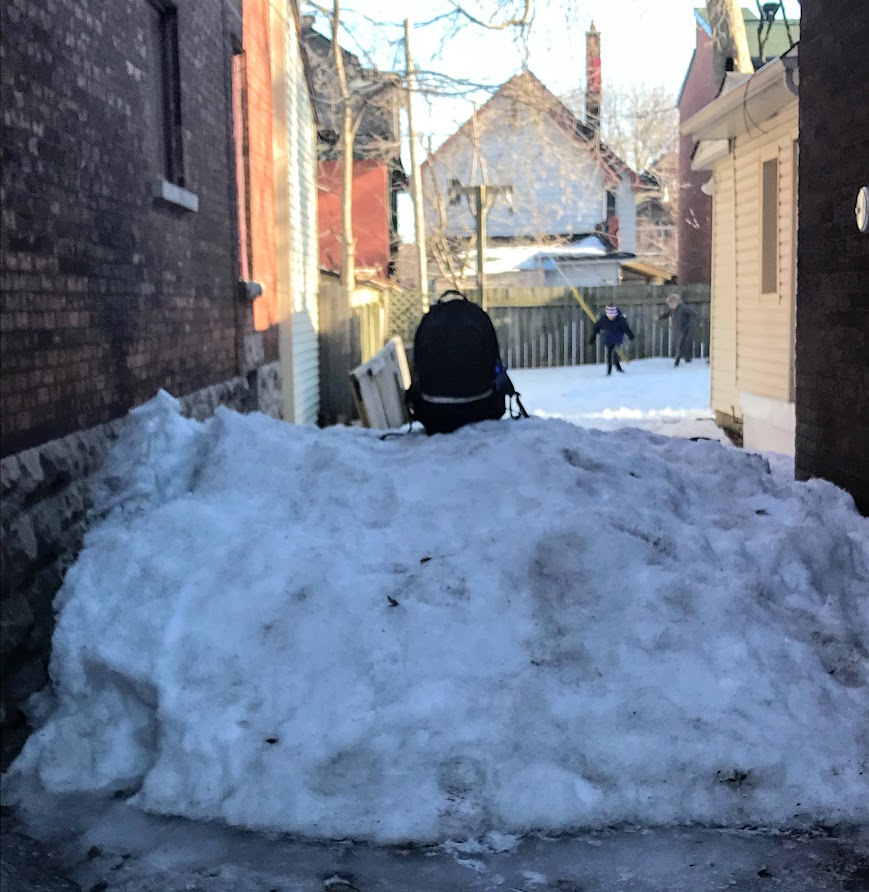
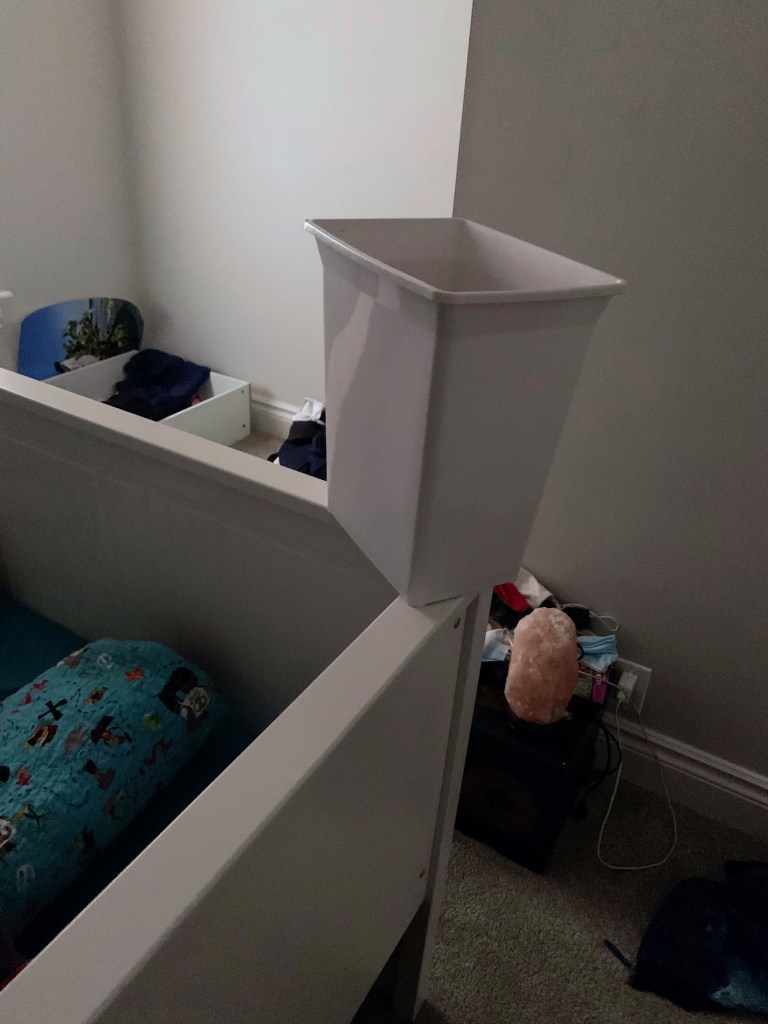
Last night, I went into Mr. 12’s bedroom to give him a kiss goodnight and found this

That is a trash can balanced on the edge of his bed. Naturally, I asked him if he wanted me to put it on the floor. “No!” he sat up. “It’s for my memory.”

Pardon? I must have looked at him funny because he answered my unspoken question.

“You know, like Dad does.”

I was still confused. As far as I know, my partner has never placed a plastic garbage can precariously close to the edge of our bed in honour of his memory.

“Like the clothespin.”

That little tidbit was no help at all. I wondered if perhaps he was sleep-talking.

He sighed, “You know how Dad does weird things so he doesn’t forget something else? This is to remind me that I owe D money and I have to bring it tomorrow.”

Ah-ha! Andre has recently been using a memory technique where he does one thing to help him remember to do another. So we have a blue clothespin on our dishwasher detergent to remind him to… something. He’s also trying to create new habits by placing something we want to remember near something we already use. So, this is happening in our kitchen

And, while parents hear the platitude that “your children are watching you” so often that it is banal, I realized that somehow I had begun to think that my preteen and teen were, in fact, no longer watching us at all. Turns out, I was wrong in the best of ways.

But I still don’t know what the clothespin helps us remember.

Grief #SOL21 6/21

The first time I understood someone else’s grief was the second time I fell in love with a poem. The day after our beloved Calculus teacher, Doc, died of cancer, the principal announced her passing over the PA.

Doc loved teaching and, I think now, loved us. After her diagnosis, she had taken a summer trip and then decided to keep teaching for as long as she could. We would be her last class – not something we understood at all.

Sometimes, when we were struggling with a concept or deep into a problem, she’d order pizza to be delivered to the school’s back door & sneak it up to the classroom. We’d stay in and do math through lunch. No one ever complained.

Once, when my home life was falling apart, she asked me to come to her house and babysit her granddaughter. I still remember the long quiet afternoon away from home, swaying with the baby as Norah Jones sang “Don’t Know Why.”

After the principal’s dry announcement, Mrs Jackson – 9th grade Algebra – came on. In a voice that quavered at first, she began: “Do not go gentle into that good night”

With each line, each verse her voice grew stronger, until the end: “Do not go gentle into that good night./ Rage, rage against the dying of the light.”

Was there silence then? It was high school; experience tells me that most of the students went right back to talking. But that’s not what I remember: I remember silence. I remember Dylan Thomas’s words reverberating through homeroom, through the hallways, through the school. I remember knowing that I would cry when I got home.

I had no idea that a poem could stop the world like that. I had no idea that grief could echo in empty spaces. I know now.

Now I know.

Thanks to https://twowritingteachers.org for hosting this annual challenge

A nighttime visitor

I was reading Neil Gaiman’s The Ocean at the End of the Lane. It isn’t a properly scary book – not like scary movies, anyway – though I suppose I wouldn’t know since I don’t watch scary movies – but it is vaguely terrifying. It’s about being a child and, well, let’s call it “menacing”: no jump scares; lots of tense terror. Whatever it was, I could not put it down because I was too afraid to stop reading.

Sometime after midnight, I gave myself a stern talking to – I was a grown woman with children for heaven’s sake. I gave myself a little leeway since my husband was away on a trip, leaving me alone in our bed, but my visiting in-laws were asleep in the guest room right next to my room. They would expect me to wake up tomorrow at a normal hour, and I needed to get some sleep.

I turned another page. And another. I could not look away from the darkness that wormed its way out of the book and into my mind. Eventually, my eyes drooped closed. I had just enough consciousness left to reach up and turn off the reading light.

As my mind slipped fretfully towards slumber, the pocket door that led into our bedroom scraped open. My eyes flew open and the rest of my body shut down: I could no more move than scream. A tall, pale figure came slowly into view, almost stumbled – just there! – hovered for a moment, then turned and glided away, scraping the door closed as it left.

My lips had gone numb; so had my fingertips. I remained paralyzed in the bed, listening for some indication that what I had just seen was real, afraid that what I’d just seen was real. After seconds, minutes, hours had passed, I raised a trembling hand to the chain above my head and pulled. The light came on, though it now seemed nearly powerless against the dark. My hand groped towards the bedside table. I found the book and opened it again.

I read all the way to the end. I cannot remember when I was finally able to sleep, when the characters were as safe as they were going to be, when pure exhaustion overtook my fear.

I stumbled down to the kitchen the next morning. Everyone was chipper, everything was bright: Grandpa Jim’s beard practically glowed white; Grandma Shirley hummed and sang while she made breakfast. Hollow-eyed, I watched, wondering if I should say anything about last night’s visitation. Would they believe me? Had I imagined it?

As we settled in to eat, Grandpa Jim started to talk, “A funny thing happened to me last night.” My head snapped up; my sense were wildly alert. Had he seen it, too? “I got up to go to the bathroom, got turned around and walked right into your bedroom before I realized it. I’m just glad I didn’t wake you up.” He returned to his granola and I stared at him for a full minute before I burst into hysterical laughter.

Not a ghost; just a grandpa.

I’ve never forgotten the book. You could do worse than to read The Ocean at the End of Lane as Halloween approaches – or anytime, really.

Many thanks to TwoWritingTeachers.org for hosting this weekly gathering of writers.

In the closet

When I had my second child, I was teaching at a relatively rural high school. Sure, some of the kids lived in the town, and more lived on large properties, but a fair number lived on farms, too. There were stories of kids coming to school on snowmobiles in the winter or sneaking off to go fishing or hunting when the season opened. I am pretty firmly a city girl, so a lot of this was new to me.

This was also the school where I started working in a program euphemistically called “Student Success.” The students in my room had not, in fact, met with success. The class was small, but every student was there to catch up on at least one and usually two or more subjects which they previously had failed.

I loved every minute of it. The room was full of all kinds of kids who were there for all kinds of reasons. The small number of students meant that I could get to know them and that they could get to know one another. The fact that they had already failed a course meant that any movement forward was a success. We shared a lot, laughed a lot, and celebrated a lot.

For those same reasons, I used myriad strategies to help students stay focused, persist through difficult moments, and generally learn how to learn. One of those strategies involved using the small office/closet/storage space next to our classroom so that a student could have some quiet. This was *never* a punishment, the door was always open, and we didn’t use it often, but sometimes it was just what we needed when someone was looking for focus.

I was particularly grateful for that little space when I returned from parental leave. I was still nursing, so having a private place to pump was fantastic – no more hiding in the corner of the classroom away from the door or hoping no one looked over at me in the staff room. Ah, the luxury of my own small room. It was heaven.

Of course, I still used it with students sometimes, so I carefully packed away the various plastic bits and bobs and zipped everything back into place every time. Or almost every time. Except, apparently, for the time when K went in there to finish up a test in peace. He was a particularly exuberant kid, not known for his ability to sit still or focus for any length of time. He worked on his family farm and regularly regaled us with tales from his daily life. He loved to talk. So I wasn’t at all surprised to see K’s face at the door mere moments after he had left for the quiet room. But I was surprised that he was, momentarily, speechless. His face was red and he was hopping from foot to foot, sputtering.

Alarmed, I jumped up. “K! What is it?”

He stared at me, eyes wide with horror, “You put me in the MILKING ROOM? THE MILKING ROOM! Miss, I CAN’T WORK IN THERE!!”

I nearly fell off of my chair laughing – so did everyone else. K took a while to settle down again. Needless to say, no tests were written for the rest of that class period and that particular room was no longer in use for the rest of the school year.

The milking room. Still makes me laugh.

Many thanks to twowritingteachers.org for hosting the Slice of Life every week. And special thanks this week to my teachers knitting group whose storytelling led me to remember this one.

Teeter Totter

Last night I was rubbing one child’s back while I read The Mysterious Benedict Society aloud to both kids. His muscles were tighter than I expected in a 9-year-old, and my thumb jittered off one particularly knotty spot and settled with a shudder into a softer space. “Sorry,” I interrupted my reading, “that must have felt weird.”

He considered. “I kind of liked it. Can you do it again?”

I could not recreate the exact sensation for him, so I went back to reading and continued to rub his back.

After that moment, though, I wasn’t concentrating on the read-aloud as much as I should have been. Instead, I found myself reliving summer moments on the teeter totter in my neighbor’s backyard. We were far too old for teeter totters: I didn’t even move to South Carolina until the summer before 5th grade, and I’m fairly certain the teeter totter didn’t arrive until sometime after that summer. What sort of self-respecting 6th grader plays on a teeter totter? And why on earth did the neighbors have one in their backyard when the oldest of their three children was also at least 11? I can no longer answer these questions, but I know for sure that for at least part of one sticky hot Southern summer, the neighborhood kids ate watermelon and rode on a teeter totter in the Pinckney’s back yard.

I really was far too old for this and, as the oldest in the group, too big, too heavy, too cool. And yet, I couldn’t resist. Rion was big enough to balance against me – or we could put together some combination of the littler kids with the bigger ones to balance things out. Up and down we rode, day after day, laughing, dripping watermelon juice and gleefully spitting out the seeds.

If I close my eyes, I can still remember being the one down on the ground, looking at Rion on the other end of the board, trapped in the air… waiting… waiting… and then – now! – I push off hard and whoosh up to the top where I stop with a hard bounce against the board. Now I am suspended, looking down at Rion, knowing she will push soon…but when? waiting… waiting… and then, whoosh back to the ground where the seat hits with a hard juddering thump. Sometimes we hold each other suspended for breathless seconds between each motion; sometimes we find a rhythm and go up and down up and down with unthinking regularity. One way or another, the fun of it is in the motion, the unpredictability, the sense that where we are is not where we will be, and that we will have to cooperate to keep it going.

Sometimes, in a tiff, one child would hold another high high high in the sky and then, all anger and meanness, hop off the bottom altogether so that the other person would come down fast with a jolting, horrible whomp. Fights ensued. Teeter totter might be soothing in its regularity or wonderfully unpredictable, but abandoning someone to fall on their own was the unforgivable end of the game.

“That HURT!” we raged, eyes nearly streaming with tears because it did, in fact hurt, or it could have hurt or it might hurt next time, or maybe just because the game was over for at least a few minutes and everyone had to content themselves with the dullness of predictable gravity.

My memories were interrupted when the chapter I was reading ended; it was time for bed. Up and down, up and down. We had had a good day, I knew, though some parts were noticeably less good. This whole time has been like that, really.  Up and down: now I can make a list of the good bits – waking later in the mornings, snuggling longer with my children, working out most days – and the bad ones – missing my friends, not seeing my students regularly, feeling like a failure for some part of most days. I give my son’s back one more rub, wondering if I can rediscover the teeter totter, remember the joy in  the waiting, the whoosh and the whomp that are all part of the ride. Use my memories to make my present more bearable. Maybe. Maybe. But not tonight. Tonight it’s time for sleep. I shoo the boys off the bed and head towards their rooms to tuck them in and sing some songs.

3d17d-screen2bshot2b2014-12-152bat2b7-37-262bpm

Relax

Kindergarten naptime followed a routine so clear that I can remember it more than 40 years later. First, all of the children went to the box and got out one of the colorful sleeping mats. Then, we put them in a circle on the taped lines. Something calming and comforting came next – did Mrs. Kay read to us? sing? I can’t quite remember, probably because I was getting sleepy. What I remember very clearly, however, is the final step: relaxation check.

We lay very still on our mats and relaxed. Mrs. Kay, whom I adored, walked quietly around the circle, gently picking up the hand of one kindergartner after another. If we were relaxed, our arm would fall easily back to the ground. By the time she was finished, most of us were asleep.

Except for me. Oh, I was plenty tired – I’d started kindergarten “early” and was the youngest in the class, so I needed my rest – but the relaxation check drove me to distraction. I simply could not remember if I was supposed to keep my arm up or let it fall down when Mrs. Kay lifted it. I would settle onto the mat, and my senses would go on high alert. I listened for my beloved teacher’s soft step and strained to hear if the other children were letting their arms drop or keeping them up. As Mrs. Kay approached, my body tensed. I held my breath. Would I get it right? Up or down? Up or down?

I must have figured this out over time. I know I napped because I remember waking up. It’s possible, even likely, that these anxious moments only occurred for a week or two near the beginning of the year, but emotion makes memory and I remember the desperation of wanting to relax in the right way more than I remember relaxing.

This memory surfaced as I read aloud to the kids tonight and my older son postured and played and then stuck his arm straight up in the air. “Settle your body,” I said and he giggled, then relaxed into the story.

After the kids were in bed, I immediately started thinking about just a few more things that I needed to get done. “Settle,” I told myself sternly, “relax.” But somehow I’m forever back in kindergarten, wanting to please, wanting to sleep, trying to remember whether my arm should be up or down. Up or down? Up or down?

If only Mrs. Kay were here to shake my arm gently, lean down to me and whisper in my ear, “It’s ok, Mandy. Let go. You can sleep now. ”


3d17d-screen2bshot2b2014-12-152bat2b7-37-262bpm

Dutch Baby

My younger son trudges sleepily into the kitchen, still snuggled in a brown minky blanket. “‘Morning, Mama,” he says, as he shuffles over to give me a hug. Up close, he contemplates me for a moment, then apparently decides to go for it, “Can you make us a Dutch baby this morning?”

It’s Tuesday, but COVID19 and closed schools mean there’s no particular rush to get out the door, so it’s easy for me to say yes, even though I made this yesterday. I stretch away from the kitchen island where I was trying to sneak in a little work before the kids woke. Then, I begin a series of actions so familiar that I do them without thinking.

I wash my hands and turn to the oven: preheat to 425. Open the drawer by the stove and pull out the middle-sized bowl. Scoop half a cup of flour – no need to be too precise – and use the same measure for half a cup of milk. Find a fork. Mix – or not. Crack in four eggs and mix again.

Shoot! I forgot – again – to put the pan in the oven. Ah well, there’s still time. My son picks his head up from the counter as he sees me rummaging for a pan. “Can you use the small one?” I produce our smaller cast iron skillet, “Sure.” Lately, he’s liked a denser pancake; for a while we used the bigger skillet to get really airy ones.

Now, butter in the skillet – 1 Tbsp? 2? I don’t know or care: I just eyeball it – and skillet in the oven to preheat while the butter melts.

A few minutes later, I pull the pan out, swirl the melted butter to coat the bottom and sides, and scrape in the eggy mixture. Everything goes into the oven, and I head back to my seat to finish a few final minutes of my own work before the parenting work takes over for the day.

My mind wanders briefly to my high school friend, Julia, whose blog post nearly a decade ago brought this recipe into our house. I regularly think of her while I cook this. It’s funny, I muse, the people who change our lives. So often, I think about the big picture: “Who was your biggest influence? Who is your hero? Which person changed your life?” When I answer, I rarely think of my daily routine, the small things that make up the bulk of my life. But how many times have I made Dutch babies in the last decade? Easily a hundred; probably many more. I bet my boys will grow up to make these for their families. Our lives are better because of Julia. I doubt she even knows. Later today I will make tagine and think of my friend Erin, remember a moment in her mother’s kitchen when she showed me how accessible couscous recipes really are; then, as I add salt, I will think of an ex-boyfriend’s mother who told me once that when she’s cooking soups or stews she usually adds as much salt as she thinks she’ll need and then just a little more. Works like a charm.

My older son straggles into the kitchen, bed-headed and groggy. “Dutch baby? Sweet!” he  plunks himself down in a seat at the table.

The 9-year-old has set up vigil in front of the oven. He loves to watch this simple pancake puff to enormous proportions. Somehow, the flour, milk & egg transform themselves into a glorious airy breakfast concoction in a mere 12 minutes. Soon enough, perfection:


Perfection in the form of a puff pancake. What a gift! And who knows? Maybe you will read this post, make a Dutch baby for breakfast someday soon, and find that your life has changed just a little bit, too.

3d17d-screen2bshot2b2014-12-152bat2b7-37-262bpm


Mango

Every time I eat a mango, I’m transported back to an afternoon in Strasbourg, France. My friends and I had spent our junior year abroad perfecting not only our French but also the art of the picnic lunch. We would pool our money and visit an epicerie for some cheese, saucisson, fruit and, naturellement, chocolate. Then we would stop at a boulangerie for a baguette and wander towards a park somewhere, maybe along the river Ill, maybe in the Orangerie. For this particular picnic someone- not me – had chosen a mango as one of our fruits.

I knew what a mango was, or at least I felt like I did. I had the sense that I liked it, but I couldn’t remember eating one. This seems odd now, not having had mango, but at the time, mango was an exotic fruit and could not be easily procured at the grocery store. This was a time before we expected so much to be available so often, when the one Vietnamese restaurant in my small town billed itself as “Chinese” but made Vietnamese if you asked. Coconut came only in plastic bags, shredded and sugary, and no one had even imagined pomegranate juice.  I knew what a mango was, but only in a distant way.

We settled onto the grass – had we brought a blanket? did we sit on our lightweight sweaters? I can’t remember – and laughed as we tore chunks from the baguette and wrapped the crusty goodness around soft Brie. Someone cut some slices from the mango and passed them around.

The smooth orange flesh of the fruit slid across my tongue and my eyes widened. Sunshine. Laughter. Something like distilled happiness. I swallowed and glanced around. What magic was this? I took another bite of the sweet, tangy fruit. Again, I was gone. Where was I? I closed my eyes. Happiness, happiness and so warm. I felt tears well up. What on earth was happening to me?

I retreated into my own sphere, still with my friends but far from them, too; far from France, far from the moment. I savoured the sweet smoothness and heard the echoes of bird calls. I breathed deeply, overwhelmed, and then… just like that, I knew: Panama. I had eaten mango when we lived in Panama, the country we left when I was only three years old. The country I couldn’t remember at all. It was the only explanation – those sounds, those senses, that feeling of freedom.

Another deep breath and I was back with my friends. I didn’t say a thing about what I’d experienced. What would I say? Who would believe that a single taste could have such power? I didn’t even know how to describe it. Instead, I laughed and chatted and walked back to classes when we finished our lunch. That night, I called my mom. I asked my mother: did we eat mango? did we eat mango in Panama? “Oh yes,” she was matter-of-fact, “you loved them, but Daddy is allergic to their skins, so I never looked for them when we came home.”

Mango. Now I can have them almost any time I want. In fact, I just had one with lunch. And for a moment, I was 19 and in France, I was 3 and in Panama. And then I was in my kitchen again.

3d17d-screen2bshot2b2014-12-152bat2b7-37-262bpm

The early train: Slice of Life 23/31 #SOL20

This morning, I woke knowing what day it was. My mother-in-law had posted this message to remember her son, my brother-in-law, D’Arcy:

12 years ago today, my son boarded what I have come to think of as “the early train”.  You know the train – the one we all inevitably, eventually board.  To those of you who have recently, or are about to, undergo a loss that stuns and overwhelms you:  I can’t tell you how, or why, or when, but for me the time came when thoughts of my son turned from searing hand-on-the-stove kind of pain to a flooding of tenderness with the embrace of the deepest love I have ever known.  I suspect that time will come for most of you. It won’t come quickly, though you might feel it in brief waves, early on. Hang in, hang on, reach out. 

Year after year, I am touched by how she expresses herself on this day. She shares freely what is often hidden and, though I know she will scoff, I feel that her sharing has become wisdom. She will say it is simply what it is – we don’t get much choice in situations like this. He is not here; we are. We must continue to live.

Today, I am sharing a poem. It makes me quake in my boots because I am *always* nervous about poetry – and obviously this is one I just wrote this morning, so now I’m sharing a draft! That said, I am inspired by the way fellow bloggers Not The Whole Story or Reflections on the Teche or Nix the Comfort Zone express themselves in poetry (not every day, but often). And an old friend suggested that poetry is a good way to deal with uncertainty.

I can’t quite explain why all of this came together for me in this way, but there it is. And, I want to be clear: the death in the middle is not my child but my brother-in-law. We miss him every day.

Untitled for now

My first son came slowly.
He hesitated, reluctant to be rushed.
“Push,” the midwife urged me, “you’re going to have to push.”
Wait wait wait
I was focused, determined
Pushing, pushing, pushing
Against the waves, with the waves of urgent pain
My world for as long as I could remember
My world forever
My world for mere moments
Receded then returned as
A flooding of tenderness, as the deepest love I will ever know.

Today, the snow falls lightly
White white white
A thin covering over the gray, dirty snow we wish away.
For a few minutes, a few hours, forever
The world is purified.
We remember the beauty of Winter
While we long for a Spring we imagine, beautiful.
And Spring will come
Messy, muddy, melting until the rotted remnants of life
Revealed as death under the dirty snow.
Spring will wake
Wet, insistent, unrelenting with its green promises.
Spring will force us to accept the hope
Concealed by this thin white cover .

Twelve years ago today we woke to a changed world
Because twelve years ago today he did not wake.
No fresh snow covered the gray.
Spring’s muddy mess pushed forward, pushed forward
And he did not.
That year we fought hope forever, for mere moments.
Yet Spring came, unrelenting.

My second son came quickly
His will to be in the world overwhelming.
“I’m pushing,” I cried, though I had just sent the midwife for medicine.
Now now now
Animal, insistent
Pushing, pushing, pushing
Against the waves, with the waves of urgent pain.
My world for as long as I could remember
My world forever
My world for mere moments
Receded then returned as
A flooding of tenderness, the deepest love I will ever know.

Today, the snow falls lightly
A reminder that last week, last month, last year
We played in this cold, wet miracle.
Tomorrow, the rain will come.
We will revel in the messiness of Spring,
The searing pain of the memories transformed
To a flooding of tenderness,
The deepest love we will ever know.

The pain is really the briefest sense of undertow as we play in the waves of his presence.


And here is the poem my mother-in-law wrote this poem a few days after D’Arcy’s death:

The Early Train

some are travelling northbound
their cheeks flushing pink with the cold
some are travelling sideways
moving west or moving east
some lose tickets, miss the gate
either way, theirs is to wait
and some    are bound for the early train
one      has taken the early train

copyright © mls March 29 2008

3d17d-screen2bshot2b2014-12-152bat2b7-37-262bpm