
Last week, my child had to interview an immigrant for a grade 9 Geography assignment. Everyone in his class had to do the same. Pause for a moment and take that in: we live in a place where a teacher can safely assume that every child in a class of 25ish can, with relative ease, find a person in their life who has immigrated to the country. Oh, and we live in a place where that is a good thing.
I no longer take this for granted.
My child chose to interview me because I am an immigrant. Some days I am highly aware of myself as an immigrant; others, it seems like a word that pertains to other people. As an American immigrant to Canada, right now I feel horribly connected to my birth country: people who, like me, have immigrated, only to the US instead of to Canada, are being targeted and deported – sent to rot in foreign jails from which they may never return – for no reason other than being immigrants. Yes, yes, I realize that there are trumped-up reasons for their deportation, but even the Cato Institute (not exactly a bastion of liberal thinking) has determined that many of the men recently deported to an El Salvadorean prison had no criminal record and had never violated immigration law. The immoral actions of the current US government must surely give many immigrants pause.
So, when my child started asking me questions, I was a little tense. He was conducting the interview in Frenglish because I refused to answer exclusively in English for a class that he’s taking in French. Soon, he learned that I had lived in five places (and two countries!) before I was ten; that I have taught in four countries; that people in the US don’t take their shoes off when they enter a home. (“Wait? Really? That’s weird. Why don’t I know about that?” he asked. I said that his American relatives probably just laugh at him behind his back. Hee hee hee.)
He learned about the visa process and what it was like to move to a country where I could not yet hold a job and didn’t really have any friends.
“What did you do?” he asked.
“Learned to knit,” I replied, which is sort of true.
“I never really thought of you not knitting,” he said.
Oh, my sweet child. One is not born knowing how to knit.
After the interview, he drafted his “article”. It was still in Frenglish, though the French was coming along. Tonight, he’s polishing it, so we’ve spent quite a long time making sure the French grammar is right and double-checking accents. “I trust you more than Google Translate and BonPatron,” he tells me.
I point out that I am American. He is literally writing about me being American. I am not a native French speaker and still have a bit of a Southern accent when I speak. He says my French is still “really good,” and I decide to accept the compliment.
He decides he wants pictures to accompany his article. He’s particular – he wants me at specific ages and doing certain things.
“Do you have any in the snow?” he asks.
“Not if I can avoid it,” I tell him, but I live in Ottawa now, so of course I do. I send him what I can.
After a few minutes he says, “Do you have any of you looking normal?” which makes me laugh – I love making silly faces for the camera. Still, for him, and to make immigrants look good, I find some “normal” pictures.
For you, however, I will share some of the funny ones.

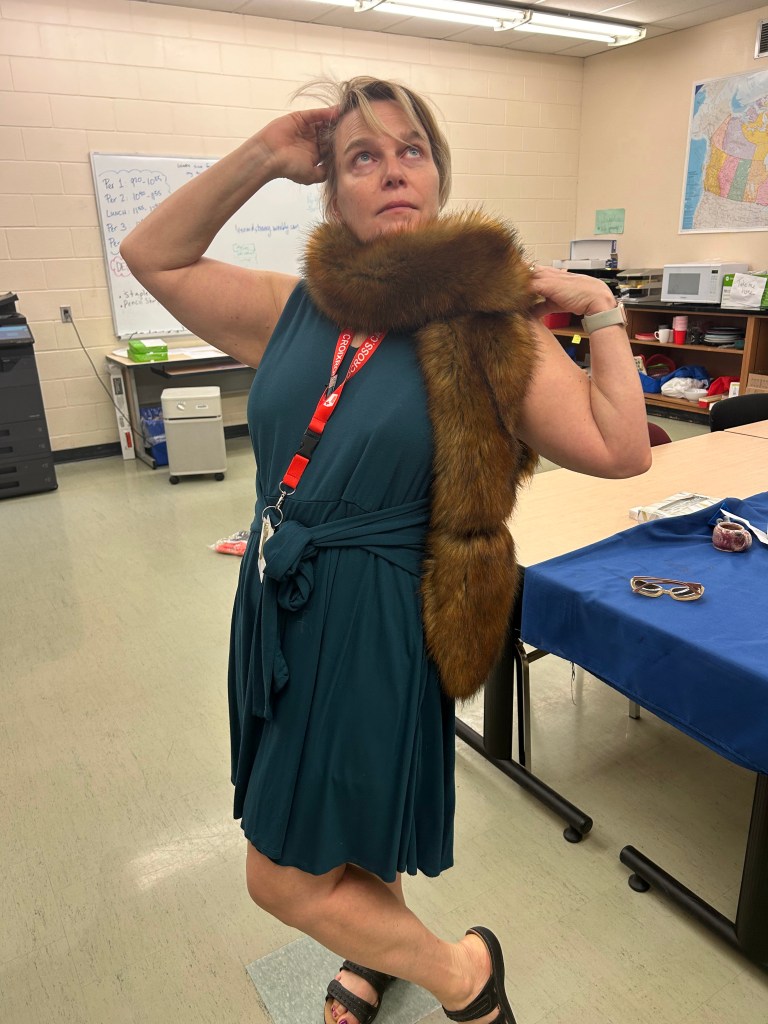




There: faces of an immigrant. Remember this the next time another person gets deported. They might be a lot like me.

 Persistence and Pedagogy
There are so many faces of us all, immigrant or not — it is just one aspect of someone’s identity. It reminds me of something that Alan Gratz writes in Refugee in Mahmoud’s chapter about others only seeing the refugees when they make trouble, not seeing the other sides of them. Talk about deportation of “immigrants” dehumanizes and strips these people of their identities — and of course, that makes it easier for many to accept what’s happening, which is exactly what they want. It’s enraging.
I am grateful for your slice, for reading this heartful and funny exchange between you and your son. The photos are excellent too!
LikeLike
Amanda! These are spectacular photos, and ever so you. Wait, there needs to be one of you in the basement looking for yarn!
thank you for this piece. These are important interviews to do. I remember years ago I had a display outside my classroom door about Alan Gratz’ Refugee. To my surprise (and happiness) our remarkable board tech troubleshooter popped his head in the door and said “I came to Canada as a refugee. Tell me about this book.” That was the first of many great conversations (the most recent one took place in the Costco parking lot 2 weeks ago) about life, the universe and everything. We learn so much from each other’s stories.
LikeLike
What a great story about the tech troubleshooter. These stories really are wildly important; I think we forget how varied the faces of immigration really are. Also, I thought you might like the photos 🙂
LikeLike
Wow– what a political statement woven into a slice of life. And the pictures… And the reminder that follows them. And the interactions between you and your son– that you’re not born learning to knit, that people really do wear their shoes in the house, that you’re better than google translate. A powerful capture of a moment.
LikeLike
Thanks Melanie – this is not the piece I intended to write when I sat down, but that’s one of the joys of writing regularly: sometimes what needs to be said gets said.
LikeLike
Amanda,
It has taken me almost a week to circle back to this post, but I did not want to miss it when I saw the title. I wish the U.S. celebrated immigrants more. I’m appalled at the cruelty inherent in the deportations, and I’m embarrassed. I don’t recognize us anymore. Anyway, someday I hope you’ll include a recording of your boi r in both French and English. I love your silly pictures and everything about this post. I also think of immigrants I meet as being a lot like me, a part of the human race doing the best we can.
LikeLike